

ASTM E2256-19
(Guide)Standard Guide for Hydraulic Integrity of New, Repaired, or Reconstructed Aboveground Storage Tank Bottoms for Petroleum Service
General Information
- Abstract
SIGNIFICANCE AND USE
5.1 Inspection, repair, and construction of ASTs in petroleum service should follow at a minimum the requirements of API 650 and API 653. These standards describe methods for testing the weld quality and structural and hydraulic integrity of new or repaired ASTs. With increasing emphasis on protecting the environment and with environmental issues related to the storing of petroleum materials in ASTs, owners and operators of such tanks may want or need a guide devoted to existing and enhanced methods for evaluating the hydraulic integrity of new or repaired tank bottoms.
5.2 The consequences of a tank bottom failure include the economic loss of product, cost of repair or replacing the tank bottom, and exposure to the cost of environmental remediation and potential damage or harm to adjacent lands that may give rise to adverse public relations or regulatory action. In addition, releases of petroleum products introduce potential fire or explosive conditions.
5.3 Owners and operators of ASTs or their agents can use this guide to help choose methods of evaluating the hydraulic integrity of their repaired or new tank bottoms. Selection of the methods should be based on regulatory and economic criteria that include operational and cost/benefit considerations.
5.4 This guide is intended for use by an individual experienced in repair and construction of ASTs in petroleum service.
5.5 This guide is intended for use when repairing or building ASTs. This guide does not address suitability for use or imply useful life of an AST bottom.
5.6 This guide is intended to be used in conjunction with and as a supplement to standards provided for hydraulic integrity in API 650 and API 653.
5.7 Procedures or methods included here may be supported by a previously completed and documented performance evaluation(s) that may lend itself as valuable results validation.
SCOPE
1.1 This guide is intended to provide the reader with a knowledge of construction examination procedures and current technologies that can be used to give an owner or operator of an aboveground storage tank (AST) in petroleum service, relevant information on the hydraulic integrity of a new, repaired, or reconstructed tank bottom prior to return to service. This guide does not pertain to horizontal ASTs, manufacture of tanks using UL 142, or to tanks constructed of concrete or other non-ferrous materials.
1.2 The adoption of the methods and technologies presented in this guide are not mandatory, rather they represent options that may be selected to identify the likelihood of product leaking through a new, repaired, or reconstructed tank bottom.
1.3 This guide is not intended to suggest or treat any technology in a preferential manner.
1.4 The person responsible for applying this guide should be a knowledgeable individual with experience in the design, inspection, construction, or combination thereof, of aboveground storage tanks for use in petroleum service, and should also be certified under the requirements of API 653 when use is related to tank bottom repair.
1.5 Refer to API RP 575 for useful information and recommended practices for maintenance and inspection of atmospheric and low pressure stirage tanks.
1.6 This guide is written in metric measure units (SI Units) in accordance with requirements of Practice E621. English measure equivalents are in parentheses.
1.7 The applicability of this guide to the proposed tank configuration and service conditions should be established prior to use.
1.8 This guide complies with ASTM policy for development and subsequent use of a standard.
1.9 This guide is subject to revision at any time by the responsible technical committee and must be reviewed every five years and if not revised, either reapproved or withdrawn. Your comments are invited either for revision of this guide or for additional standards and should be addressed to ASTM International, 100 Barr Harbor ...
- Status
- Published
- Publication Date
- 31-Dec-2018
- Technical Committee
- E50 - Environmental Assessment, Risk Management and Corrective Action
- Drafting Committee
- E50.01 - Storage Tanks
Buy Documents
ASTM E2256-19 - Standard Guide for Hydraulic Integrity of New, Repaired, or Reconstructed Aboveground Storage Tank Bottoms for Petroleum Service
REDLINE ASTM E2256-19 - Standard Guide for Hydraulic Integrity of New, Repaired, or Reconstructed Aboveground Storage Tank Bottoms for Petroleum Service
Overview
ASTM E2256-19 - Standard Guide for Hydraulic Integrity of New, Repaired, or Reconstructed Aboveground Storage Tank Bottoms for Petroleum Service - provides essential guidance on assessing the hydraulic integrity of aboveground storage tank (AST) bottoms used in petroleum service. With increasing regulatory demands and environmental concerns regarding product releases from ASTs, this standard supports owners and operators in adopting effective inspection, testing, and evaluation practices before tanks are returned to service. ASTM E2256-19 serves as a supplemental guide to API 650 and API 653, which set the baseline for storage tank construction and inspection.
Key Topics
- Hydraulic Integrity: The foundation of this guide is verifying the ability of tank bottoms to prevent leaks and protect the environment.
- Inspection and Testing Methods: Provides a range of established and developing methods, including visual examination, radiography, liquid penetrant testing, magnetic particle testing, vacuum box, and bubble tests.
- Regulatory and Economic Considerations: Selects evaluation methods based on both regulatory compliance and cost-benefit analysis for efficient operations.
- Qualified Personnel: Stresses that evaluation and testing should be carried out by experienced individuals, often with certification under API 653 for repairs and inspections.
- Supplementary to API Standards: Designed to be used in conjunction with API 650 (construction) and API 653 (inspection/repair) for comprehensive tank bottom evaluation.
- Environmental Protection: Addresses the implications of tank bottom failure, including product loss, repair costs, environmental remediation, and safety risks.
Applications
ASTM E2256-19 is applied throughout the lifecycle of an aboveground storage tank in petroleum service, specifically during:
- Construction of New Tank Bottoms: Ensuring hydraulic integrity from the outset to minimize future risk.
- Repair and Reconstruction Activities: Evaluating the reliability of welds, plates, and associated piping after remedial work or modifications.
- Pre-commissioning and Return to Service: Conducting thorough examinations before tanks are put back in operation to prevent potential leaks.
- Environmental Compliance: Meeting increasing environmental standards and safeguarding against accidental releases, fire, or explosion hazards.
- Risk Management: Reducing the potential for costly product loss, environmental impact, and incident-related regulatory action.
Popular evaluation methods outlined include:
- Visual examination of welds and plates for surface defects
- Radiographic inspection for internal weld flaws
- Liquid penetrant and magnetic particle testing for crack detection
- Bubble and vacuum box testing for leak location
- Advanced techniques like tracer gas and automated monitoring
Related Standards
ASTM E2256-19 relies on the integration and supplementary use of numerous industry standards, including:
- API 650 - Welded Tanks for Oil Storage: Primary standard for tank construction.
- API 653 - Tank Inspection, Repair, Alteration, and Reconstruction: Governs tank inspection and maintenance.
- API 575 - Inspection of Atmospheric and Low-Pressure Storage Tanks: Guidance for tank inspection frequency and techniques.
- ASME Boiler and Pressure Vessel Code, Section V: Contains requirements for non-destructive examination procedures.
- AWS QC1-96 and AWS B1.10: Certification and qualification for welding inspection.
- ASNT SNT-TC-1A: Recommended practice for personnel qualification in non-destructive testing (NDT).
- ASTM E165, E709, E1209, E1219, E1220: Industry-accepted non-destructive examination methods referenced for materials and weld evaluation.
Practical Value
Implementing ASTM E2256-19 delivers several tangible benefits for tank owners and operators in the petroleum industry:
- Reduces risk of product leaks and associated environmental penalties
- Strengthens confidence in tank bottom performance and longevity
- Supports compliance with regulatory and industry best practices
- Guides informed decision-making regarding tank repair options and inspection schedules
- Aligns maintenance approaches with evolving technologies and environmental standards
Adhering to ASTM E2256-19 helps organizations ensure safe, reliable, and environmentally responsible operation of aboveground petroleum storage tanks.
Relations
- Effective Date
- 01-Jan-2019
- Effective Date
- 01-Apr-2024
- Effective Date
- 01-Mar-2024
- Effective Date
- 01-Mar-2024
- Effective Date
- 01-Nov-2023
- Effective Date
- 01-Nov-2019
- Effective Date
- 01-Mar-2018
- Effective Date
- 15-Nov-2017
- Effective Date
- 01-Nov-2017
- Effective Date
- 15-Nov-2016
- Effective Date
- 01-May-2016
- Effective Date
- 01-Nov-2015
- Effective Date
- 01-Nov-2015
- Effective Date
- 01-Oct-2014
- Effective Date
- 01-Jun-2014
Buy Documents
ASTM E2256-19 - Standard Guide for Hydraulic Integrity of New, Repaired, or Reconstructed Aboveground Storage Tank Bottoms for Petroleum Service
REDLINE ASTM E2256-19 - Standard Guide for Hydraulic Integrity of New, Repaired, or Reconstructed Aboveground Storage Tank Bottoms for Petroleum Service
Get Certified
Connect with accredited certification bodies for this standard

Element Materials Technology
Materials testing and product certification.

ABS Group Brazil
ABS Group certification services in Brazil.

ABS Quality Evaluations Inc.
American Bureau of Shipping quality certification.
Sponsored listings
Frequently Asked Questions
ASTM E2256-19 is a guide published by ASTM International. Its full title is "Standard Guide for Hydraulic Integrity of New, Repaired, or Reconstructed Aboveground Storage Tank Bottoms for Petroleum Service". This standard covers: SIGNIFICANCE AND USE 5.1 Inspection, repair, and construction of ASTs in petroleum service should follow at a minimum the requirements of API 650 and API 653. These standards describe methods for testing the weld quality and structural and hydraulic integrity of new or repaired ASTs. With increasing emphasis on protecting the environment and with environmental issues related to the storing of petroleum materials in ASTs, owners and operators of such tanks may want or need a guide devoted to existing and enhanced methods for evaluating the hydraulic integrity of new or repaired tank bottoms. 5.2 The consequences of a tank bottom failure include the economic loss of product, cost of repair or replacing the tank bottom, and exposure to the cost of environmental remediation and potential damage or harm to adjacent lands that may give rise to adverse public relations or regulatory action. In addition, releases of petroleum products introduce potential fire or explosive conditions. 5.3 Owners and operators of ASTs or their agents can use this guide to help choose methods of evaluating the hydraulic integrity of their repaired or new tank bottoms. Selection of the methods should be based on regulatory and economic criteria that include operational and cost/benefit considerations. 5.4 This guide is intended for use by an individual experienced in repair and construction of ASTs in petroleum service. 5.5 This guide is intended for use when repairing or building ASTs. This guide does not address suitability for use or imply useful life of an AST bottom. 5.6 This guide is intended to be used in conjunction with and as a supplement to standards provided for hydraulic integrity in API 650 and API 653. 5.7 Procedures or methods included here may be supported by a previously completed and documented performance evaluation(s) that may lend itself as valuable results validation. SCOPE 1.1 This guide is intended to provide the reader with a knowledge of construction examination procedures and current technologies that can be used to give an owner or operator of an aboveground storage tank (AST) in petroleum service, relevant information on the hydraulic integrity of a new, repaired, or reconstructed tank bottom prior to return to service. This guide does not pertain to horizontal ASTs, manufacture of tanks using UL 142, or to tanks constructed of concrete or other non-ferrous materials. 1.2 The adoption of the methods and technologies presented in this guide are not mandatory, rather they represent options that may be selected to identify the likelihood of product leaking through a new, repaired, or reconstructed tank bottom. 1.3 This guide is not intended to suggest or treat any technology in a preferential manner. 1.4 The person responsible for applying this guide should be a knowledgeable individual with experience in the design, inspection, construction, or combination thereof, of aboveground storage tanks for use in petroleum service, and should also be certified under the requirements of API 653 when use is related to tank bottom repair. 1.5 Refer to API RP 575 for useful information and recommended practices for maintenance and inspection of atmospheric and low pressure stirage tanks. 1.6 This guide is written in metric measure units (SI Units) in accordance with requirements of Practice E621. English measure equivalents are in parentheses. 1.7 The applicability of this guide to the proposed tank configuration and service conditions should be established prior to use. 1.8 This guide complies with ASTM policy for development and subsequent use of a standard. 1.9 This guide is subject to revision at any time by the responsible technical committee and must be reviewed every five years and if not revised, either reapproved or withdrawn. Your comments are invited either for revision of this guide or for additional standards and should be addressed to ASTM International, 100 Barr Harbor ...
SIGNIFICANCE AND USE 5.1 Inspection, repair, and construction of ASTs in petroleum service should follow at a minimum the requirements of API 650 and API 653. These standards describe methods for testing the weld quality and structural and hydraulic integrity of new or repaired ASTs. With increasing emphasis on protecting the environment and with environmental issues related to the storing of petroleum materials in ASTs, owners and operators of such tanks may want or need a guide devoted to existing and enhanced methods for evaluating the hydraulic integrity of new or repaired tank bottoms. 5.2 The consequences of a tank bottom failure include the economic loss of product, cost of repair or replacing the tank bottom, and exposure to the cost of environmental remediation and potential damage or harm to adjacent lands that may give rise to adverse public relations or regulatory action. In addition, releases of petroleum products introduce potential fire or explosive conditions. 5.3 Owners and operators of ASTs or their agents can use this guide to help choose methods of evaluating the hydraulic integrity of their repaired or new tank bottoms. Selection of the methods should be based on regulatory and economic criteria that include operational and cost/benefit considerations. 5.4 This guide is intended for use by an individual experienced in repair and construction of ASTs in petroleum service. 5.5 This guide is intended for use when repairing or building ASTs. This guide does not address suitability for use or imply useful life of an AST bottom. 5.6 This guide is intended to be used in conjunction with and as a supplement to standards provided for hydraulic integrity in API 650 and API 653. 5.7 Procedures or methods included here may be supported by a previously completed and documented performance evaluation(s) that may lend itself as valuable results validation. SCOPE 1.1 This guide is intended to provide the reader with a knowledge of construction examination procedures and current technologies that can be used to give an owner or operator of an aboveground storage tank (AST) in petroleum service, relevant information on the hydraulic integrity of a new, repaired, or reconstructed tank bottom prior to return to service. This guide does not pertain to horizontal ASTs, manufacture of tanks using UL 142, or to tanks constructed of concrete or other non-ferrous materials. 1.2 The adoption of the methods and technologies presented in this guide are not mandatory, rather they represent options that may be selected to identify the likelihood of product leaking through a new, repaired, or reconstructed tank bottom. 1.3 This guide is not intended to suggest or treat any technology in a preferential manner. 1.4 The person responsible for applying this guide should be a knowledgeable individual with experience in the design, inspection, construction, or combination thereof, of aboveground storage tanks for use in petroleum service, and should also be certified under the requirements of API 653 when use is related to tank bottom repair. 1.5 Refer to API RP 575 for useful information and recommended practices for maintenance and inspection of atmospheric and low pressure stirage tanks. 1.6 This guide is written in metric measure units (SI Units) in accordance with requirements of Practice E621. English measure equivalents are in parentheses. 1.7 The applicability of this guide to the proposed tank configuration and service conditions should be established prior to use. 1.8 This guide complies with ASTM policy for development and subsequent use of a standard. 1.9 This guide is subject to revision at any time by the responsible technical committee and must be reviewed every five years and if not revised, either reapproved or withdrawn. Your comments are invited either for revision of this guide or for additional standards and should be addressed to ASTM International, 100 Barr Harbor ...
ASTM E2256-19 is classified under the following ICS (International Classification for Standards) categories: 75.200 - Petroleum products and natural gas handling equipment. The ICS classification helps identify the subject area and facilitates finding related standards.
ASTM E2256-19 has the following relationships with other standards: It is inter standard links to ASTM E2256-13, ASTM A333/A333M-24, ASTM A6/A6M-24, ASTM A53/A53M-24, ASTM A6/A6M-23, ASTM A106/A106M-19a, ASTM A20/A20M-18, ASTM A20/A20M-17, ASTM A6/A6M-17a, ASTM A6/A6M-16a, ASTM A6/A6M-16, ASTM A20/A20M-15, ASTM D3282-15, ASTM A20/A20M-14, ASTM A106/A106M-14. Understanding these relationships helps ensure you are using the most current and applicable version of the standard.
ASTM E2256-19 is available in PDF format for immediate download after purchase. The document can be added to your cart and obtained through the secure checkout process. Digital delivery ensures instant access to the complete standard document.
Standards Content (Sample)
This international standard was developed in accordance with internationally recognized principles on standardization established in the Decision on Principles for the
Development of International Standards, Guides and Recommendations issued by the World Trade Organization Technical Barriers to Trade (TBT) Committee.
Designation: E2256 − 19
Standard Guide for
Hydraulic Integrity of New, Repaired, or Reconstructed
Aboveground Storage Tank Bottoms for Petroleum Service
This standard is issued under the fixed designation E2256; the number immediately following the designation indicates the year of
original adoption or, in the case of revision, the year of last revision.Anumber in parentheses indicates the year of last reapproval.A
superscript epsilon (´) indicates an editorial change since the last revision or reapproval.
1. Scope 1.9 This guide is subject to revision at any time by the
responsible technical committee and must be reviewed every
1.1 This guide is intended to provide the reader with a
five years and if not revised, either reapproved or withdrawn.
knowledgeofconstructionexaminationproceduresandcurrent
Your comments are invited either for revision of this guide or
technologies that can be used to give an owner or operator of
for additional standards and should be addressed to ASTM
an aboveground storage tank (AST) in petroleum service,
International, 100 Barr Harbor Drive, W. Conshohocken, PA
relevant information on the hydraulic integrity of a new,
19428.
repaired, or reconstructed tank bottom prior to return to
service. This guide does not pertain to horizontal ASTs, 1.10 This guide is not intended for use as a model code,
manufacture of tanks using UL142, or to tanks constructed of ordinance or regulation.
concrete or other non-ferrous materials.
1.11 Thisguidedoesnotcovereverytankbottominspection
1.2 Theadoptionofthemethodsandtechnologiespresented procedure that may be properly applied.
in this guide are not mandatory, rather they represent options
1.12 This standard does not purport to address all of the
that may be selected to identify the likelihood of product
safety concerns, if any, associated with its use. It is the
leaking through a new, repaired, or reconstructed tank bottom.
responsibility of the user of this standard to establish appro-
priate safety, health, and environmental practices and deter-
1.3 This guide is not intended to suggest or treat any
mine the applicability of regulatory limitations prior to use.
technology in a preferential manner.
1.13 This international standard was developed in accor-
1.4 Thepersonresponsibleforapplyingthisguideshouldbe
dance with internationally recognized principles on standard-
a knowledgeable individual with experience in the design,
ization established in the Decision on Principles for the
inspection, construction, or combination thereof, of aboveg-
Development of International Standards, Guides and Recom-
round storage tanks for use in petroleum service, and should
mendations issued by the World Trade Organization Technical
also be certified under the requirements of API 653 when use
Barriers to Trade (TBT) Committee.
is related to tank bottom repair.
1.5 Refer toAPI RP575 for useful information and recom- 2. Referenced Documents
All documents refer to the latest edition.
mended practices for maintenance and inspection of atmo-
spheric and low pressure stirage tanks. 2
2.1 ASTM Standards:
A6/A6MSpecification for General Requirements for Rolled
1.6 This guide is written in metric measure units (SI Units)
in accordance with requirements of Practice E621. English Structural Steel Bars, Plates, Shapes, and Sheet Piling
A20/A20MSpecificationforGeneralRequirementsforSteel
measure equivalents are in parentheses.
Plates for Pressure Vessels
1.7 The applicability of this guide to the proposed tank
A36/A36MSpecification for Carbon Structural Steel
configuration and service conditions should be established
A53/A53MSpecification for Pipe, Steel, Black and Hot-
prior to use.
Dipped, Zinc-Coated, Welded and Seamless
1.8 ThisguidecomplieswithASTMpolicyfordevelopment
A106/A106MSpecification for Seamless Carbon Steel Pipe
and subsequent use of a standard.
for High-Temperature Service
A333/A333MSpecification for Seamless and Welded Steel
PipeforLow-TemperatureServiceandOtherApplications
ThisguideisunderthejurisdictionofASTMCommitteeE50onEnvironmental
Assessment, Risk Management and CorrectiveAction and is the direct responsibil-
ity of Subcommittee E50.01 on Storage Tanks. For referenced ASTM standards, visit the ASTM website, www.astm.org, or
Current edition approved Jan. 1, 2019. Published February 2019. Originally contact ASTM Customer Service at service@astm.org. For Annual Book of ASTM
approved in 2003. Last previous edition approved in 2013 as E2256–13. DOI: Standards volume information, refer to the standard’s Document Summary page on
10.1520/E2256-19. the ASTM website.
Copyright © ASTM International, 100 Barr Harbor Drive, PO Box C700, West Conshohocken, PA 19428-2959. United States
E2256 − 19
with Required Notch Toughness tank bottom and the supporting foundation. See Fig. 1for an
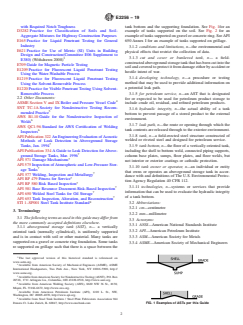
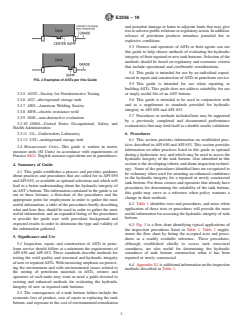
D3282 Practice for Classification of Soils and Soil- example of tanks supported on the soil. See Fig. 2 for an
Aggregate Mixtures for Highway Construction Purposes exampleoftankssupportedongravelorconcretering.SeeAPI
E165Practice for Liquid Penetrant Testing for General 650 Annex I for an example of tanks supported on grillage.
Industry
3.1.2 conditions and limitations, n—the environmental and
E621Practice for Use of Metric (SI) Units in Building
physical effects that restrict the collection of data.
Design and Construction(Committee E06 Supplement to
3.1.3 cut and cover or bunkered tank, n— a field-
E380) (Withdrawn 2008)
constructedabovegroundstoragetankthathasbeencutintothe
E709Guide for Magnetic Particle Testing
soilandcoveredtoprotectitfromdamageeitherbyaccidentor
E1209Practice for Fluorescent Liquid Penetrant Testing
hostile intent of war.
Using the Water-Washable Process
3.1.4 developing technology, n—a procedure or testing
E1219Practice for Fluorescent Liquid Penetrant Testing
method that may be used to provide additional information on
Using the Solvent-Removable Process
a potential leak path.
E1220Practice for Visible Penetrant Testing Using Solvent-
Removable Process 3.1.5 for petroleum service, n—an AST that is designated
2.2 Other Documents: for or expected to be used for petroleum product storage to
ASME Section V and IXBoiler and Pressure Vessel Code include crude oil, residual, and refined petroleum products.
SNT TC-1ASociety for Nondestructive Testing Recom-
3.1.6 hydraulic integrity, n—the actual ability of a tank
mended Practice
bottom to prevent passage of a stored product to the external
AWS B1.10Guide for the Nondestructive Inspection of
environment.
Welds
3.1.7 leak path, n—the route or opening through which the
AWS QC1-96Standard for AWS Certification of Welding
tank contents are released through to the exterior environment.
Inspectors
3.1.8 tank, n—a field-erected steel structure constructed of
APIPublication322AnEngineeringEvaluationofAcoustic
welded or riveted steel and designed for petroleum service.
Methods of Leak Detection in Aboveground Storage
Tanks, Jan. 1994
3.1.9 tank bottom, n—the floor of a vertically oriented tank,
API Publication 334AGuide to Leak Detection forAbove-
including the shell to bottom weld, connected piping supports,
ground Storage Tanks, Mar. 1996
column base plates, sumps, floor plates, and floor welds, but
API 571Damage Mechanisms
not interior or exterior coatings or cathodic protection.
API 575Inspection ofAtmospheric and Low-Pressure Stor-
3.1.10 tank owner or operator, n—an individual or entity
age Tanks
that owns or operates an aboveground storage tank in accor-
API 577Welding, Inspection and Metallurgy
dance with and definitions of The U.S. Environmental Protec-
API RP 479Fitness for Service
tion Agency Regulation 40 CFR 112.
API RP 580Risk Based Inspection
7 3.1.11 technologies, n—systems or services that provide
API 581Base Resource Document-Risk-Based Inspection
informationthatcanbeusedtoevaluatethehydraulicintegrity
API 650Welded Steel Tanks for Oil Storage
7 of a tank bottom.
API 653Tank Inspection, Alteration, and Reconstruction
3.2 Abbreviations:
STI 1–SP001Steel Tank Institute Standard
3.2.1 cm—centimetre
3. Terminology
3.2.2 mm—millimetre
3.1 Thefollowingtermsasusedinthisguidemaydifferfrom
3.3 Acronyms:
the more commonly accepted definitions elsewhere.
3.3.1 ANSI—American National Standards Institute
3.1.1 aboveground storage tank (AST), n— a vertically
3.3.2 API—American Petroleum Institute
oriented tank (normally cylindrical), is uniformly supported
and is in contact with soil or other material. Many tanks are 3.3.3 ASM—American Society for Metals
supported on a gravel or concrete ring foundation. Some tanks
3.3.4 ASME—American Society of Mechanical Engineers
re supported on grillage such that there is a space between the
The last approved version of this historical standard is referenced on
www.astm.org.
Available from American Society of Mechanical Engineers (ASME), ASME
International Headquarters, Two Park Ave., New York, NY 10016-5990, http://
www.asme.org.
AvailablefromAmericanSocietyforNondestructiveTesting(ASNT),P.O.Box
28518, 1711 Arlingate Ln., Columbus, OH 43228-0518, http://www.asnt.org.
Available from American Welding Society (AWS), 8669 NW 36 St., #130,
Miami, FL 33166-6672, http://www.aws.org.
Available from American Petroleum Institute (API), 1220 L. St., NW,
Washington, DC 20005-4070, http://www.api.org.
Available from Steel Tank Institute / Steel Plate Fabricators Association 944
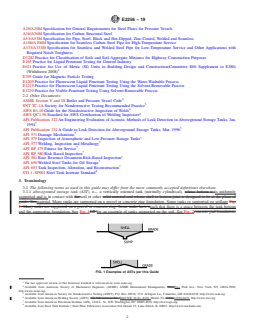
Donata Ct. Lake Zurich, IL 60047, http://www.steeltank.com FIG. 1 Examples of ASTs per this Guide
E2256 − 19
and potential damage or harm to adjacent lands that may give
risetoadversepublicrelationsorregulatoryaction.Inaddition,
releases of petroleum products introduce potential fire or
explosive conditions.
5.3 Owners and operators of ASTs or their agents can use
this guide to help choose methods of evaluating the hydraulic
integrityoftheirrepairedornewtankbottoms.Selectionofthe
methods should be based on regulatory and economic criteria
that include operational and cost/benefit considerations.
5.4 This guide is intended for use by an individual experi-
enced in repair and construction ofASTs in petroleum service.
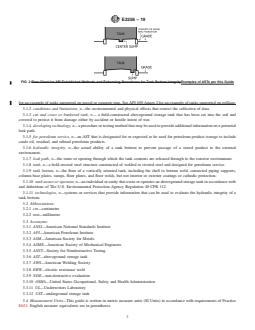
FIG. 2 Examples of ASTs per this Guide
5.5 This guide is intended for use when repairing or
building ASTs. This guide does not address suitability for use
3.3.5 ASNT—Society for Nondestructive Testing or imply useful life of an AST bottom.
3.3.6 AST—aboveground storage tank
5.6 This guide is intended to be used in conjunction with
and as a supplement to standards provided for hydraulic
3.3.7 AWS—American Welding Society
integrity in API 650 and API 653.
3.3.8 ERW—electric resistance weld
5.7 Procedures or methods included here may be supported
3.3.9 NDE—non-destructive evaluation
by a previously completed and documented performance
3.3.10 OSHA—United States Occupational, Safety and
evaluation(s)thatmaylenditselfasvaluableresultsvalidation.
Health Administration
6. Procedures
3.3.11 UL—Underwriters Laboratory
6.1 This section provides information on established prac-
3.3.12 UST—underground storage tank
tices described inAPI 650 andAPI 653. This section provides
3.4 Measurement Units—This guide is written in metric
information on other practices listed in this guide as optional
measure units (SI Units) in accordance with requirements of
during a hydrostatic test, and which may be used to assess the
PracticeE621.Englishmeasureequivalentsareinparentheses.
hydraulic integrity of the tank bottom. Also identified in this
section is the developing robotic and drone inspection technol-
4. Summary of Guide
ogy . Some of the procedures identified here are recognized to
4.1 This guide establishes a process and provides guidance
be voluntary when used for attaining an enhanced confidence
about practices and procedures that are called for in API 650
in the hydraulic integrity for a repaired or newly constructed
andAPI653,oravailableasoptionalselectionsandwhichwill
tank bottom. For those owners and operators that already have
lead to a better understanding about the hydraulic integrity of
procedures for determining the suitability of the tank bottom,
anAST’sbottom.Theinformationcontainedintheguideisset
this guide may serve as a reference when policy warrants a
out in three formats: a flowchart of the procedures and the
change in their methods.
appropriate point for employment in order to gather the most
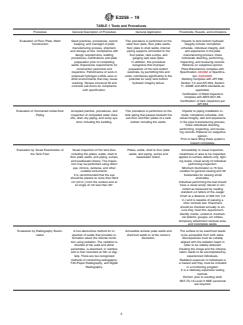
6.2 Table 1 identifies tests and procedures, and notes when
useful information; a table of the procedures briefly describing
application of those tests or procedures will provide the most
what and how they should be used in order to gather the most
useful information for assessing the hydraulic integrity of tank
useful information; and an expanded listing of the procedures
bottom.
to provide the guide user with procedure background and
expected results in order to determine the type and validity of
6.3 Fig. 3 is a flow chart identifying typical applications of
the information gathered.
the inspection procedures listed in Table 1. Table 1 supple-
ments the flow chart by listing the accepted tests and proce-
5. Significance and Use
dures as a readily available reference. These procedures,
5.1 Inspection, repair, and construction of ASTs in petro- although established chiefly to assess tank structural
leum service should follow at a minimum the requirements of soundness, are also useful for determining the hydraulic
API 650 and API 653. These standards describe methods for soundness of tank bottom construction when it has been
testing the weld quality and structural and hydraulic integrity repaired or newly constructed.
ofneworrepairedASTs.Withincreasingemphasisonprotect-
6.4 AppendixX1isadditionalinformationontheinspection
ing the environment and with environmental issues related to
methods described in Table 1.
the storing of petroleum materials in ASTs, owners and
operators of such tanks may want or need a guide devoted to
existing and enhanced methods for evaluating the hydraulic
integrity of new or repaired tank bottoms.
5.2 The consequences of a tank bottom failure include the
economic loss of product, cost of repair or replacing the tank
bottom,andexposuretothecostofenvironmentalremediation
E2256 − 19
TABLE 1 Tests and Procedures
Procedure General Description of Procedure General Application Thresholds, Results, and Limitations
Evaluation of Floor Plate, Weld Good practices, procedures, record This procedure is performed on the Impacts to tank bottom hydraulic
Construction keeping, and oversight of plate steel floor plate, floor plate welds, integrity include: completion
manufacturing process, shipment, floor plate to shell welds, internal schedule, individual integrity, skill
and storage at site. Compliance with piping supports connected to the and experience in the plate
design requirements, welding floor plates, tank sumps, and manufacturing process, those
procedures, certifications and plate gauging well wear plate. individuals directing, performing,
preparation prior to completing In addition, this procedure inspecting, and reviewing records.
welds. Experience requirements for recognizes that improper Reliance on subjective opinion.
construction personnel and preparation of the tank bottom Plate Manufacture complies with
inspectors. Performance of work in substrate, by permitting hills and Specification A6/A6M or Specifica-
proposed hydrogen sulfide uses or voids, contributes significantly to the tion A20/A20M.
other environments that may cause potential for early tank bottom Welding Complies with API 650,
cracking. Review structural fill and hydraulic integrity failure. Section 7.2 and API 653, Section
concrete sub-floors for compliance 11, ASME and AWS standards as
with specification. applicable.
Certification of Weld Inspectors
complies with AWS QC1-96.
Certification of tank inspectors per
API 653
Evaluation of Connected Under-floor Accepted practice, procedures, and This procedure is performed on the Impacts to piping installation in-
Piping inspection of completed water draw tank piping that passes beneath the clude: completion schedule, indi-
offs, drain dry piping, and sump sys- sub-floor and floor plates of a tank vidual integrity, skill and experience
tems including the bedding. bottom including the welds. in the pipe manufacturing process,
those individuals directing,
performing, inspecting, and review-
ing records. Reliance on subjective
opinion.
Prior to back filling these systems
inspect completely.
Evaluation by Visual Examination of Visual inspection of the tank floor, Plates, welds, shell to floor plate Accessibility to visual inspection,
the Tank Floor including the plates, welds, shell to welds, and piping, sumps and cleanliness of area to be inspected,
floor plate welds, and piping, sumps, wastewater drains. applies to surface defects only, light-
and wastewater drains. The inspec- ing levels, visual acuity of individual
tion may be performed using direct performing inspection.
eye, mirrors, cameras, and other Minimum illumination is 15 foot-
suitable instruments. candles for general viewing and 50
It is recommended that the eye footcandles for viewing small
should be placed no more than 60.9 anomalies.
cm (24 in.) from the surface and at Individual performing the test should
an angle of not less than 30°. have a visual acuity natural or cor-
rected as measured by reading
standard J-2 letters of the Jaeger
Chart at a distance of 300 mm (12
in.) and is capable of passing a
color contrast test. Examiners
should be checked annually to en-
sure they meet this requirement.
Identify cracks, undercut, mechani-
cal defects, gouges, arc strikes,
temporary attachment removal area,
and incomplete welds.
Evaluation by Radiography Exami- A non-destructive method for in- Accessible annular plate welds and The surface to be examined needs
nation spection of welds that provides in- shell butt welds or at the owner’s to be accessible from both sides.
formation about the internal condi- discretion. Discrepancies must be suitably
tion using radiation. The radiation is aligned with the radiation beam in
directed at the weld and either order to be reliably detected.
penetrates, is absorbed, or scatters Creating the image and the interpre-
and is then recorded on film or digi- tation needs to be accomplished by
tally. There are two recognized experienced individuals.
methods of conducting radiography: Radiation exposure to individuals is
Film/Paper Radiography, and Digital a hazard and they must be included
Radiography. in a monitoring program.
It is a relatively expensive testing
method.
Perform prior to erecting shell.
SNT-TC-1A Level II NDE personnel
are required.
E2256 − 19
TABLE 1 Continued
Procedure General Description of Procedure General Application Thresholds, Results, and Limitations
Evaluation by Wicking Examination Apply highly penetrating oil or dye Shell to bottom plate weld. Accessibility to viewing, cleanliness
of Corner Weld penetrant to opposite side of first of weld area, and visual acuity of
weld pass, and let stand for a period individual performing the test.
of time. Observe the welded side of Perform in dry conditions. Test must
the joint. be performed when ambient
temperature is high enough to allow
the oil or dye penetrant to flow.
Apply dye penetrant or highly
penetrating oil to opposite side of
first weld pass. Let sit for a
minimum of 4 h (12 h is the
preferred length of time). Observe
the weld side of the joint.
Identifies through weld pinholes,
porosity, and cracks not visible to
the eye.
Identifies a leak that passes oil
instead of air.
Evaluation by Bubble Test Pressure method locates leaks in a Tank floor fillet welded lapped Limited to small tanks or parts of
Examination (Pressure) pressurized component by the seams, butt welded seams, and tanks.
application of a solution or shell to bottom weld. For visual plus training on the
immersion in liquid that will form specific procedure used by the
bubbles as leakage gas passes manufacturer or fabricator. Training
through it. to meet the requirements of SNT-
TC-1A.
Evaluation by Bubble Test Examina- Apply solution and a vacuum to a Tank floor fillet welded lapped Accessibility requires minimum
tion (Vacuum) localized area. seams, butt welded seams, and clearance of 12.3 cm (6 in.) be-
Vacuum box technique. shell to bottom weld. tween bottom plate and obstruction
above test area for placement of
device and viewing.
Perform test in accordance with a
written procedure and ASME BPVC,
Section V, Art. 10 App II.
Individuals performing the test re-
quire visual acuity and training to
meet requirements of SNT-TC-1A.
Evaluation by Liquid Penetrant Apply penetrant to welds in the tank This applies to welds in the tank Acceptance Criteria: No recogniz-
floor. Discontinuities in the weld floor including the shell to bottom able indications that might indicate a
such as cracks or voids that are weld. through plate defect.
open to the surface will draw in the May be most useful in areas where Discontinuities must extend to the
penetrant. Any discontinuities should other physical weld checks cannot surface, and be accessible. The
show up against the developed be done due to access limitations. weld must be clean and free of dirt,
background. grease, lint, scale, flux, and weld
spatter, and so forth. The weld must
be uncoated.
Individual performing the procedure
should have natural or corrected
near distance acuity vision to read a
Jaeger Type 2 standard chart and
have the ability to distinguish color
during the observation of the tested
weld.
Individual should be a Level II or
Level III certification in accordance
with SNT-TC-1A.
Perform test in accordance with a
written procedure and ASME BPVC,
Section V, Art. 6 or Test Methods
E165, E1209, E1219, and E1220.
E2256 − 19
TABLE 1 Continued
Procedure General Description of Procedure General Application Thresholds, Results, and Limitations
Evaluation by Magnetic Particle The weld area to be inspected is Welds in the tank floor and sump Acceptance Criteria: No
Examination magnetized and ferromagnetic including the shell to bottom weld. recognizable indications that might
particles placed on the weld. A May be most useful in areas where indicate a through plate defect.
pattern is formed and is deformed other physical weld checks cannot Discontinuities below the surface
where discontinuities are present. be done due to access limitations. are difficult to detect and not all
The deformations are more discontinuities are defects. The weld
distinguishable for discontinuities must be accessible and be clean
near the surface of the weld. A and free of dirt, grease, lint, scale,
second test is conducted with the flux, and weld spatter, etc. Generally
magnetic field perpendicular to the the weld must not be coated. Time
original test orientation as a way of consuming.
picking up undetected discontinuities The individual performing the test
of the first test. The magnetic should have natural or corrected
particles are color contrasted or vision distance acuity vision to read
made viewable in fluorescent or a Jaeger Type 2, Standard Chart.
black light. They should be Level II or III
certified in accordance with SNT-TC-
1A.
Perform test in accordance with a
written standard and ASME BPVC,
Section V, Art. 7, or Guide E709.
Evaluation by Detectable Gas- Be- Testing of tank bottoms using de- One hundred percent of all floor If the subsurface of the floor or in-
neath Floor Injection tectable gas beneath the tank floor plate welds, floor to shell weld, terstitial space is below the water
is accomplished by injecting a de- patch plate welds, clip attachment table or saturated with water/
tectable gas, which is lighter than welds, sump welds, weld scars, product/ liquid, the dispersal of de-
air, beneath the tank floor in ad- tear-offs, or other defects away from tectable gas along the bottom side
equate quantity to allow dispersal weld seams should be tested. Spe- of the floor plates may be restricted
over the entire underside of the cial attention should be paid to three or impossible.
floor. A common gas used for this plate laps and areas of severe Method of floor construction must be
application is welding grade helium. bulges or deformations. considered. If the floor is anchored
The floor is then scanned with leak to a concrete pad, such as in a cut
detection equipment. and cover or bunkered tank, com-
partmentalization of floor plates or
floor sections may exist. In this
circumstance, it may be necessary
to drill numerous holes in a floor to
ensure complete dispersion on the
underside. In addition, there is a risk
of floor damage and failure of tank
floor anchoring system from exces-
sive pressure.
This method of testing can detect
leak paths smaller than can be de-
tected by vacuum box testing be-
cause of its greater sensitivity. Also
this method is useful for testing ar-
eas of a tank that normally would
not be accessible by other methods
and the general area of a tank bot-
tom in addition to the welds.
As a result of its sensitivity, the pro-
cedure should be conducted with
individuals possessing a higher level
of expertise.
Evaluation by Detectable Gas Above Testing of tank bottoms using de- The entire tank floor is tested so If the subsurface of the floor or in-
Floor in Liquid as Inoculate tectable tracer chemical (inoculate) long as detection tubes provide ad- terstitial space is below the water
inside is accomplished by injecting a equate coverage of the tank bottom. table or saturated with water/
volatile chemical into the receipt line product/ liquid, two options are avail-
or water draw off line at a concen- able:
tration of 1 to 10 parts per million (1) De-watering or purging prior to
(ppm). Inoculate may be injected in sample collection or,
gaseous form into an empty tank. (2) Extension of waiting time for mi-
Hollow tubes are installed under the gration of tracer in the liquid up to
tank bottom to extract air samples 60 days depending upon conditions
for analysis. A tank with a secondary and tank size.
containment bottom may have suit-
able detection tubes.
E2256 − 19
TABLE 1 Continued
Procedure General Description of Procedure General Application Thresholds, Results, and Limitations
Evaluation by Volumetric Level and Determines leaks in the tank floor Entire tank floor, including plate,
Temperature Measurement by tracking how a level of liquid in a sumps and their welds.
full tank changes over time while
accounting for natural variations
from product and tank temperature
changes, product evaporation, and
condensation, and so forth.
Evaluation by Mass Measurement Determines leaks in the tank floor Entire tank floor, including plate,
by tracking the amount of pressure sumps and their welds.
exerted by the product in the tank,
while accounting for natural
variations from tank temperature
changes, product evaporation, and
condensation, and so forth.
Evaluation by Acoustic Emission The test detects and locates leaks Floor plates (parent material), weld Type of soil and its porosity effect
Examination in a tank bottom by measuring the joints between the plates, sump(s), the frequency of the impulse. The
impulsive (intermittent) and repetitive and their weld joints, all of which degree of saturation with water or
sound of liquid escaping through a bear on a sand or similar type liquid effects the frequency of the
small leak path, while the tank is foundation. signal. Internal and external noise.
under a hydraulic load. It uses Tank linings may mask results by
sensors around the shell to detect obstructing the leak path.
the sound in conjunction with data In general, clusters of dots on a
collectors/converters to produce an tank map are an indicator of a
electronic signal, which can be possible leak, while random dots are
analyzed by algorithms to indicate allowances needed by the
the location of a possible leak path. algorithm-sensor testing setup. The
The duration of field measurements procedure should successfully
is normally less than 4 h. detect 0.5 mm hole during
development and field verification.
Evaluation of Magnetic Flux Magnetic Flux Leakage have been In general the method is used to This method has proven to be an
Leakage With UT Prove up applied to storage tank bottom inspect the floor of a storage tank. important inspection tool. Areas of
inspection for the past several Advancements on being able to concern are identified then the usual
years. The intent of this inspection perform this inspection when a tank practiceistousUTtomore
method is to provide indications of is in service are ongoing. thoroughly investigate the areas of
tank bottom plate thinning and to concern found by MFL inspection.
identify if there are holes through The effectiveness of the method
the bottom plate. varies depending on the equipment
used, the tank floor cleanliness,
unevenness of the tank floor, the
examination procedure and the skill
of the examiner. It is virtually
impossible to obtain 100% of the
tank floor including sumps, areas
under roof support columns, and
areas under internal piping such as
steam coils. Refer to API Std. 653,
Annex G for information on
qualification of tank bottom
examination procedures and
personnel.
Evaluation of Pulsed Eddy Current Eddy Current inspection techniques Eddy Current inspection Pulsed Eddy Current inspection is
Examination have been employed for several technologies have been adapted to used in on-stream and off-stream
years particularly in inspection of the inspection of the annular ring inspection of the annular ring area
heat exchanger tubes area of storage tanks. of storage tanks (the tank bottom
directly under the tank shell and for
at least 24 inches inside the tank
shell. Operator skill is required.
E2256 − 19
TABLE 1 Continued
Procedure General Description of Procedure General Application Thresholds, Results, and Limitations
Robotic and Drone Tank Inspection This developing technology uses Typically applications of most These methods hold the possibility
(A developing technology) robot or drones of several types to interest are tank floor and internal of being able to adequately inspect
inspect the tank floor and shell. shell inspections. the tank floor and internal shell while
the tank is in service. The intent of
these methods is to measure bottom
and shell thicknesses and to find
thin areas and holes in the tank
bottom. Issues include adequate
cleaning of the tank bottom and
shell to enable the equipment to
perform satisfactorily. In some tanks
there obstructions such as roof
column supports, internal heaters,
etc. that obstruct movement of the
robot or drone. Also most tanks
have bottom sumps that need
careful inspection. The equipment
will be operating in a possibly
hazardous environment and
adequate provisions are required for
safe operation
FIG. 3 Flowchart for Inspection of New Construction, Reconstruction, or Repair of Tank Bottoms
6.5 When using information provided in this section, con- mental characterizations should be reviewed. An owner and
siderations for schedule, operational, economic, and environ- operatorortheowners’andoperators’representativeshouldbe
E2256 − 19
familiar with conditions under which the tests and procedures 8. Keywords
8.1 abovegroundstoragetank;hydraulicintegrity;leak;leak
prevention repaired tank; newly constructed tank; recon-
can be used and in the case of the developing technologies,
structed tank; tank bottom; tank release; testing procedures
API 334 should be consulted.
7. Report
7.1 If a report is required it is identified within the indi-
vidual test procedure.
APPENDIXES
(Nonmandatory Information)
X1. EVALUATION METHODS
X1.1 Evaluation Methods (5)Service conditions that might include the presence of
hydrogen sulfide or conditions that may cause weld or plate
X1.1.1 Procedures Prior to Filling and After Filling the
cracking require the appropriate selection of materials, and
Tank:
quality control for manufacture and fabrication.
X1.1.1.1 The owner and operator of a tank, included by
X1.1.2.2 Summary of Test Parameters:
definition in this guide, will find that there are numerous
(1)Theuserwillneedtoensuregoodpractices,procedures
procedures associated with the determination of the hydraulic
andrecordkeeping,areusedthroughouttheprocesstoavoidor
integrity of a tank bottom. Of this total number of procedures
intercept the foregoing conditions or factors that contribute to
there can be at least nine that are conducted prior to filling the
tank bottom failure. Specification A36/A36M or other steels
tankandcanbeatleastanotherfourproceduresthatareapplied
foruseacceptedbyAPI650provideguidanceonoversightsby
with the tank either partially or completely filled to its safe fill
the owner or operator during the manufacturing process that
height.
can be used to establish the quality of the steel plate.
(2)This control is accomplished on the steel floor plate,
X1.1.2 Evaluation of Floor Plate, Weld Construction Prac-
floor plate welds, floor plate to shell welds, internal piping
tices:
supportsconnectedtothefloorplates,tanksumps,gagingwell
X1.1.2.1 Factors or conditions that contribute to tank bot-
wear plates, and steel used as wear plates for roof or pan legs,
tom failure are:
and all exposed plate surfaces.
(1)Imperfectionsthatmaybeincludedinsteelplateduring
X1.1.2.3 Evaluatingthequalityofconstructionandmaterial
manufacture.
isdependentontheschedule,integrity,skill,andexperienceof
(2)Gouging and tearing in steel plate can occur during
the manufacturing process, the individuals directing and per-
shipment and storage, and in moving the plates into final
forming the installation, and the individual inspecting and
position for welding. Such damage can be the result of
reviewing records required under this procedure. Tight con-
improper use of equipment for moving the plate or the
struction schedules may impact construction quality. The
dragging of the plates across one another or other construction
quality of workmanship is a subjective measure and the
materials and rocks.The gouges and tears can compromise the
experience of an inspector determines the ability to detect
structural integrity and intended service life of the tank.
defects in the materials and workmanship.
(3)Irregular surface continuities or voids in the structural
X1.1.2.4 Records:
fill or concrete foundation can be a significant condition
(1)The tank owner and operator or the owner and opera-
causing a bottom to fail and leak. The voids and projections
tor’srepresentativeshouldrequestreports,asrecommendedby
created by the sub-floor structural system irregularities will
Specification A6/A6M, Specification A20/A20M, API 650,
cause uneven stressing of the floor plates, seam welds, floor to
andAPI653.Rejectedconditionsrequirereplacementorrepair
shell weld, and sumps located in the bottom. The stress can
oftheaffectedmaterialuntilsuchmeetmaterialsandconstruc-
leadtoearlyfailureofthebottomwhenthetankisplacedback
tion requirements.
in service and under load from the stored product or the
X1.1.2.5 Hazards (Cautionary and Generic)—None.
columns and legs of floating pans or roofs.
(4)The use of incorrect welding procedures or unqualified X1.1.3 Evaluation of Connected Under-Floor Piping:
welderscanresultinsub-standardweldsthataremorelikelyto
X1.1.3.1 Connected under-floor piping and associated
fail. sumpsusedforwaterdraworstrippingpetroleumproductfrom
E2256 − 19
the bottom of the tank can be sources of a leak, and should be X1.1.4.6 Qualifications of Individuals Performing Test—
tested prior to burying. Such piping that is connected may be: Natural or corrected near distance acuity as measured by
(1) Water draw offs, (2) Drain dry piping, and (3) Sump reading standard J-1 letters of a standard Jaeger chart.
systems.
X1.1.4.7 Reference to Other Test Procedures—ASME
BPVC, Section V, Art. 9.
X1.1.3.2 Summary of Test Parameters:
(1)Piping should be manufactured under API accepted
X1.1.4.8 Test Reports—Test reports should be written and
standards for construction (refer to Specifications A53/A53M,
traceableandincludethefollowingpertinentinformation:date,
A106/A106M, and A333/A333M) and monitored for possible
name of inspector, type of test, equipment used, defects, and
leaks during hydrostatic testing. Additional requirements for
locations.
Electric Resistance Welded (ERW) piping may be necessary.
X1.1.4.9 Hazards (Cautionary and Generic)—Confined
(2)Preparation of the bedding or the foundation that the
space requirements apply.
piping rests on is very important, as piping and sumps that are
X1.1.5 Evaluation by Radiography Procedure:
notadequatelysupportedwillbestressed,causingpotentialfor
X1.1.5.1 General Description:
collapse or failure of welds. Refer to Practice D3282 for
(1)Radiographyisanon-destructivemethodforinspecting
information on classification of soils and soil aggregate mix-
welds that provides information about the internal condition,
tures.
utilizing radiation. The radiation that is directed at the weld is
(3)The quality of the welds completed on site can be
either absorbed, penetrated, or scattered and then recorded by
maintained by establishing welding procedures, certifying the
a device. There are two accepted methods of radiography
capability of the welders who will perform the work, and
inspection: Film/Paper Radiography, and Radioscopy. The
inspection of the completed work by certified inspectors.
most traditional manner for recording in on photographic film
X1.1.3.3 Application to Portion of the Tank Floor:
or paper, but recently digital radiography is typical. The
(1)This control is performed on the tank piping that is
amount of radiation transmitted to the film is a factor of
beneath the sub floor and floor plates of a tank bottom,
absorption over the length of the weld and is dependent on the
including the sump, bedding material, piping welds and sump
mass of various areas and intensity of the beam applied.
welds that are related to the connected piping to the bottom.
Interpretation of radiography should be conducted in a room
X1.1.3.4 Limitations:
with low levels of light. This approach permits observation of
(1)Theprocedureforevaluatingthequalityofconstruction
the image created in variations of light and dark on the film.
and material is dependent on the schedule, integrity, skill, and
The dark areas represent points where greater degrees of
experience of the manufacturing process, the individuals di-
penetration and hence an area of lower density. The lighter
recting and performing the installation, and the individual
areasrepresentimpededormoredifficultareastopenetrateand
inspecting and reviewing records required under this proce-
higher density. Absorption rates that differ by more than 1%
dure. The structural integrity and service life are subject to
are generally detectable when compared to surrounding mate-
degradation as installation schedules become tighter. The
rial areas.
quality of workmanship is a subjective measure under this
X1.1.5.2 Bothmakingoftheexposureandtheinterpretation
procedure and the experience of an inspector determines the
oftheexposurerequiretheskillsofindividualswithexperience
ability to detect defects in the materials and workmanship.
in their respective areas.
X1.1.3.5 Hazards (Cautionary and Generic)—None.
X1.1.5.3 Limitations:
X1.1.4 EvaluationbyVisualExaminationoftheTankFloor: (1)The surface to be examined needs to be accessible (no
obstruction to equipment or file placement) from both sides.
X1.1.4.1 Background and History:
Discrepanciesmustbesuitablyalignedwiththeradiationbeam
X1.1.4.2 General Description—Visual test may be direct
in order to be reliably detected.
type when the tank bottom or steel plate surface is readily
(2)It is a relatively expensive testing method.
accessible to place the eye within 60.9 cm (24 in.) of the
X1.1.5.4 Qualifications of Individuals Making and Inter-
surface at an angle of not less than 30°. The minimum
preting Exposure—Individuals performing this test should be
illumination is 15 footcandles for general viewing and 50
skilled, capable, and familiar with the techniques and proce-
footcandlesforviewingofsmallanomalies.Visualtestmaybe
dures recommended byASM Committee document on Radio-
remote by using mirrors, cameras, or other suitable instru-
graphic Inspection and ANSI/AWS B1.10.
ments. The test would detect surface defects such as cracking,
X1.1.5.5 Hazards (Cautionary and Generic):
weld undercut, corrosion, dents, gouges, weld scars, incom-
(1)Radiation exposure to individuals is a hazard and these
plete welds, and so forth.
individuals must be included in a medical monitoring program
X1.1.4.3 Summary of Test Parameters—Visual-direct type
as established by OSHA.
requires accessibility of the eye to within 60.9 cm (24 in.) of
(2)Confined space requirements apply as required by
objectatanangleofnotlessthan30°and15to50footcandles
OSHA.
of illumination. Remote type requires instruments.
X1.1.4.4 Application to Portions of Tank Floor—Allwelded X1.1.6 Evaluation by Wicking Examination of Corner Weld:
floor seams whether lapped or butt type.
X1.1.6.1 Background and History:
X1.1.4.5 Limitations—Accessibility to viewing, cleanliness (1)This test is a practical test because it provides informa-
ofweld(slagremoval,dirt,andsoforth).Surfacedefectsonly. tion regarding the actual hydraulic integrity of the weld with a
E2256 − 19
productlessviscousthantheproductbeingstored.Aleakcould ThecurrentAPIStandard650includesthistypeoftestforfloor
be easily located and repaired. lap joints in Section 7.3.3. The current API Standard 653
X1.1.6.2 General Description: includes this type of test for floor lap joints and corner joint in
(1)Wicking test of corner weld (shell to bottom weld) is Sections 12.1.6 and 12.1.7 and represents the industry norm.
the process of applying a highly penetrating oil or dye
X1.1.8.2 General Description:
penetrant to one side of a weld, then letting it stand for at least
(1)Vacuum method locates leaks in a pressure boundary
four (4) h (12 is preferred) and observing if it penetrates to the
that can not be directly pressurized. A solution is applied to a
other side of the weld.
local area and a differential pressure is created which produces
X1.1.6.3 Summary of Test Parameters—Requires proper oil
bubbles on the surface. This type of test is identified by API
type and minimum visual acuity.
650, Section 7.3.3 as a method for testing bottom plate lap
X1.1.6.4 Application to Portions of Tank Floor—Corner
welds and one option for the shell to bottom weld.
joint (shell to bottom weld).
X1.1.8.3 Summary of Test Parameters—Requires applica-
X1.1.6.5 Limitations—Accessibility to viewing, cleanliness
tion of vacuum to solution on a local area.
of weld (slag removal, dirt, and so forth). Dry conditions are
X1.1.8.4 Application to Portions of Tank Floor—All fillet
necessary for reliable test results. Ambient air temperature
welded lapped seams and corner joint (shell to bottom weld).
mustbehighenoughtoallowtheoilorpenetranttoflowfreely.
X1.1.8.5 Limitations—Requires minimum vertical clear-
X1.1.6.6 Qualifications of Individuals Performing Test—
ance of 6 in. between the bottom and any obstruction for
Same as for visual.
placement of device and accessibility to viewing the local area
X1.1.6.7 Reference to Other Test Procedures—API 653
being examined.
Section 12.1.6.
X1.1.8.6 Qualifications of Individuals Performing Test—
X1.1.6.8 Reports—Test reports should be written and pro-
Same as for visual plus training on the specific procedure used
videthefollowinginformation:date,nameofinspector,typeof
bythemanufacturerorfabricator.Trainingtomeettherequire-
test, equipment used, defects, and locations.
ments of SNT-TC-1A.
X1.1.6.9 Hazards (Cautionary and Generic)—Confined
X1.1.8.7 Reference to Other Test Procedures—ASME
space requirements apply.
BPVC, Section V, Art. 10, App. II.
X1.1.7 Evaluation by Bubble Test Examination-Pressure:
X1.1.8.8 Test Reports—Written,date,nameofinspectorand
X1.1.7.1 Background and History:
certification, test procedure and method, equipment used, test
(1)Thismethodhasitsrootsinthepressurevesselindustry
conditions, defects and locations.
andhasbeenanelementaltestforthesetanks.ThecurrentAPI
X1.1.8.9 Hazard
...
This document is not an ASTM standard and is intended only to provide the user of an ASTM standard an indication of what changes have been made to the previous version. Because
it may not be technically possible to adequately depict all changes accurately, ASTM recommends that users consult prior editions as appropriate. In all cases only the current version
of the standard as published by ASTM is to be considered the official document.
Designation: E2256 − 13 E2256 − 19
Standard Guide for
Hydraulic Integrity of New, Repaired, or Reconstructed
Aboveground Storage Tank Bottoms for Petroleum Service
This standard is issued under the fixed designation E2256; the number immediately following the designation indicates the year of
original adoption or, in the case of revision, the year of last revision. A number in parentheses indicates the year of last reapproval. A
superscript epsilon (´) indicates an editorial change since the last revision or reapproval.
1. Scope
1.1 This guide is intended to provide the reader with a knowledge of construction examination procedures and current
technologies that can be used to give an owner or operator of an aboveground storage tank (AST) in petroleum service, relevant
information on the hydraulic integrity of a new, repaired, or reconstructed tank bottom prior to return to service. This guide does
not pertain to horizontal ASTs, manufacture of tanks using UL 142, or to tanks constructed of concrete or other non-ferrous
materials.
1.2 The adoption of the mathodsmethods and technologies presented in this guide are not mandatory, rather they represent
options that may be selected to identify the likelihood of product leaking through a new, repaired, or reconstructed tank bottom.
1.3 This guide is not intended to suggest or treat any technology in a preferential manner.
1.4 The person responsible for applying this guide should be a knowledgeable individual with experience in the design,
inspection, construction, or combination thereof, of aboveground storage tanks for use in petroleum service, and should also be
certified under the requirements of API 653 when use is related to tank bottom repair.
1.5 Refer to API RP 575 for useful information and recommended practices for maintenance and inspection of atmospheric and
low pressure stirage tanks.
1.6 This guide is written in metric measure units (SI Units) in accordance with requirements of Practice E621. English measure
equivalents are in parentheses.
1.7 The applicability of this guide to the proposed tank configuration and service conditions should be established prior to use.
1.8 This guide complies with ASTM policy for development and subsequent use of a standard.
1.9 This guide is subject to revision at any time by the responsible technical committee and must be reviewed every five years
and if not revised, either reapproved or withdrawn. Your comments are invited either for revision of this guide or for additional
standards and should be addressed to ASTM International, 100 Barr Harbor Drive, W. Conshohocken, PA 19428.
1.10 This guide is not intended for use as a model code, ordinance or regulation.
1.11 This guide does not cover every tank bottom inspection procedure that may be properly applied.
1.12 This standard does not purport to address all of the safety concerns, if any, associated with its use. It is the responsibility
of the user of this standard to establish appropriate safety safety, health, and healthenvironmental practices and determine the
applicability of regulatory requirementslimitations prior to use.
1.13 This international standard was developed in accordance with internationally recognized principles on standardization
established in the Decision on Principles for the Development of International Standards, Guides and Recommendations issued
by the World Trade Organization Technical Barriers to Trade (TBT) Committee.
2. Referenced Documents
All documents refer to the latest edition.
2.1 ASTM Standards:
A6/A6M Specification for General Requirements for Rolled Structural Steel Bars, Plates, Shapes, and Sheet Piling
This guide is under the jurisdiction of ASTM Committee E50 on Environmental Assessment, Risk Management and Corrective Action and is the direct responsibility
of Subcommittee E50.01 on Storage Tanks.
Current edition approved Oct. 1, 2013Jan. 1, 2019. Published January 2014February 2019. Originally approved in 2003. Last previous edition approved in 20082013 as
E2256 – 03E2256 – 13.(2008). DOI: 10.1520/E2256-13.10.1520/E2256-19.
For referenced ASTM standards, visit the ASTM website, www.astm.org, or contact ASTM Customer Service at service@astm.org. For Annual Book of ASTM Standards
volume information, refer to the standard’s Document Summary page on the ASTM website.
Copyright © ASTM International, 100 Barr Harbor Drive, PO Box C700, West Conshohocken, PA 19428-2959. United States
E2256 − 19
A20/A20M Specification for General Requirements for Steel Plates for Pressure Vessels
A36/A36M Specification for Carbon Structural Steel
A53/A53M Specification for Pipe, Steel, Black and Hot-Dipped, Zinc-Coated, Welded and Seamless
A106/A106M Specification for Seamless Carbon Steel Pipe for High-Temperature Service
A333/A333M Specification for Seamless and Welded Steel Pipe for Low-Temperature Service and Other Applications with
Required Notch Toughness
D3282 Practice for Classification of Soils and Soil-Aggregate Mixtures for Highway Construction Purposes
E165 Practice for Liquid Penetrant Testing for General Industry
E621 Practice for Use of Metric (SI) Units in Building Design and Construction(Committee E06 Supplement to E380)
(Withdrawn 2008)
E709 Guide for Magnetic Particle Testing
E1209 Practice for Fluorescent Liquid Penetrant Testing Using the Water-Washable Process
E1219 Practice for Fluorescent Liquid Penetrant Testing Using the Solvent-Removable Process
E1220 Practice for Visible Penetrant Testing Using Solvent-Removable Process
2.2 Other Documents:
ASME Section V and IX Boiler and Pressure Vessel Code
SNT TC-1A Society for Nondestructive Testing Recommended Practice
AWS B1.10 Guide for the Nondestructive Inspection of Welds
AWS QC1-96 Standard for AWS Certification of Welding Inspectors
API Publication 322 An Engineering Evaluation of Acoustic Methods of Leak Detection in Aboveground Storage Tanks, Jan.
API Publication 334 A Guide to Leak Detection for Aboveground Storage Tanks, Mar. 1996
API 571 Damage Mechanisms
API 575 Inspection of Atmospheric and Low-Pressure Storage Tanks
API 577 Welding, Inspection and Metallurgy
API RP 479 Fitness for Service
API RP 580 Risk Based Inspection
API 581 Base Resource Document-Risk-Based Inspection
API 650 Welded Steel Tanks for Oil Storage
API 653 Tank Inspection, Alteration, and Reconstruction
STI 1–SP001 Steel Tank Institute Standard
3. Terminology
3.1 The following terms as used in this guide may differ from the more commonly accepted definitions elsewhere.
3.1.1 aboveground storage tank (AST), n— a vertically oriented tank (normally cylindrical), whose bottom is is uniformly
supported and is in contact with the soil or other solid material and whose shell to bottom joint is designed to be at the plane of
grade. Seematerial. Many tanks are supported on a gravel or concrete ring foundation. Some tanks re supported on grillage Fig.
1. Many tanks are supported on a gravel or concrete ring. Some tanks have asuch that there is a space between the tank bottom
and the supporting foundation. See Fig. 1full for an example of tanks supported on the soil. See Fig. 2concrete pad foundation.
FIG. 1 Examples of ASTs per this Guide
The last approved version of this historical standard is referenced on www.astm.org.
Available from American Society of Mechanical Engineers (ASME), ASME International Headquarters, ThreeTwo Park Ave., New York, NY 10016-5990,
http://www.asme.org.
Available from American Society for Nondestructive Testing (ASNT), P.O. Box 28518, 1711 Arlingate Ln., Columbus, OH 43228-0518, http://www.asnt.org.
Available from American Welding Society (AWS), 550 NW LeJeune Rd., 8669 NW 36 St., #130, Miami, FL 33126,33166-6672, http://www.aws.org.
Available from American Petroleum Institute (API), 1220 L. St., NW, Washington, DC 20005-4070, http://www.api.org.
Available from Steel Tank Institute / Steel Plate Fabricators Association 944 Donata Ct. Lake Zurich, IL 60047, http://www.steeltank.com
E2256 − 19
FIG. 2 Flow Chart for API Established Methods and Enhancing Procedures for Tank Bottom IntegrityExamples of ASTs per this Guide
for an example of tanks supported on gravel or concrete ring. See API 650 Annex I for an example of tanks supported on grillage.
3.1.2 conditions and limitations, n—the environmental and physical effects that restrict the collection of data.
3.1.3 cut and cover or bunkered tank, n— a field-constructed aboveground storage tank that has been cut into the soil and
covered to protect it from damage either by accident or hostile intent of war.
3.1.4 developing technology, n—a procedure or testing method that may be used to provide additional information on a potential
leak path.
3.1.5 for petroleum service, n—an AST that is designated for or expected to be used for petroleum product storage to include
crude oil, residual, and refined petroleum products.
3.1.6 hydraulic integrity, n—the actual ability of a tank bottom to prevent passage of a stored product to the external
environment.
3.1.7 leak path, n—the route or opening through which the tank contents are released through to the exterior environment.
3.1.8 tank, n—a field-erected steel structure constructed of welded or riveted steel and designed for petroleum service.
3.1.9 tank bottom, n—the floor of a vertically oriented tank, including the shell to bottom weld, connected piping supports,
column base plates, sumps, floor plates, and floor welds, but not interior or exterior coatings or cathodic protection.
3.1.10 tank owner or operator, n—an individual or entity that owns or operates an aboveground storage tank in accordance with
and definitions of The U.S. Environmental Protection Agency Regulation 40 CFR 112.
3.1.11 technologies, n—systems or services that provide information that can be used to evaluate the hydraulic integrity of a
tank bottom.
3.2 Abbreviations:
3.2.1 cm—centimetre
3.2.2 mm—millimetre
3.3 Acronyms:
3.3.1 ANSI—American National Standards Institute
3.3.2 API—American Petroleum Institute
3.3.3 ASM—American Society for Metals
3.3.4 ASME—American Society of Mechanical Engineers
3.3.5 ASNT—Society for Nondestructive Testing
3.3.6 AST—aboveground storage tank
3.3.7 AWS—American Welding Society
3.3.8 ERW—electric resistance weld
3.3.9 NDE—non-destructive evaluation
3.3.10 OSHA—United States Occupational, Safety and Health Administration
3.3.11 UL—Underwriters Laboratory
3.3.12 UST—underground storage tank
3.4 Measurement Units—This guide is written in metric measure units (SI Units) in accordance with requirements of Practice
E621. English measure equivalents are in parentheses.
E2256 − 19
4. Summary of Guide
4.1 This guide establishes a process and provides guidance about practices and procedures that are called for in API 650 and
API 653, or available as optional selections and which will lead to a better understanding about the hydraulic integrity of an AST’s
bottom. The information contained in the guide is set out in three formats: a flowchart of the procedures and the appropriate point
for employment in order to gather the most useful information; a table of the procedures briefly describing what and how they
should be used in order to gather the most useful information; and an expanded listing of the procedures to provide the guide user
with procedure background and expected results in order to determine the type and validity of the information gathered.
5. Significance and Use
5.1 Inspection, repair, and construction of ASTs in petroleum service should follow at a minimum the requirements of API 650
and API 653. These standards describe methods for testing the weld quality and structural and hydraulic integrity of new or
repaired ASTs. With increasing emphasis on protecting the environment and with environmental issues related to the storing of
petroleum materials in ASTs, owners and operators of such tanks may want or need a guide devoted to existing and enhanced
methods for evaluating the hydraulic integrity of new or repaired tank bottoms.
5.2 The consequences of a tank bottom failure include the economic loss of product, cost of repair or replacing the tank bottom,
and exposure to the cost of environmental remediation and potential damage or harm to adjacent lands that may give rise to adverse
public relations or regulatory action. In addition, releases of petroleum products introduce potential fire or explosive conditions.
5.3 Owners and operators of ASTs or their agents can use this guide to help choose methods of evaluating the hydraulic integrity
of their repaired or new tank bottoms. Selection of the methods should be based on regulatory and economic criteria that include
operational and cost/benefit considerations.
5.4 This guide is intended for use by an individual experienced in repair and construction of ASTs in petroleum service.
5.5 This guide is intended for use when repairing or building ASTs. This guide does not address suitability for use or imply
useful life of an AST bottom.
5.6 This guide is intended to be used in conjunction with and as a supplement to standards provided for hydraulic integrity in
API 650 and API 653.
5.7 Procedures or methods included here may be supported by a previously completed and documented performance
evaluation(s) that may lend itself as valuable results validation.
6. Procedures
6.1 This section provides information on established practices described in API 650 and API 653. This section provides
information on other practices listed in this guide as optional during a hydrostatic test, and which may be used to assess the
hydraulic integrity of the tank bottom. Also identified in this section are developing technologies that may be used in conjunction
with a hydro-test, and may produce supplemental information about the hydraulic integrity of the completed tank bottom
construction. is the developing robotic and drone inspection technology . Some of the procedures identified here are recognized
to be voluntary when used for attaining an enhanced confidence in the hydraulic integrity for a repaired or newly constructed tank
bottom. For those owners and operators that already have procedures for determining the suitability of the tank bottom, this guide
may serve as a reference when policy warrants a change in their methods.
6.2 Table 1 identifies tests and procedures, and notes when application of those tests or procedures will provide the most useful
information for assessing the hydraulic integrity of tank bottom.
6.3 Fig. 3 is a flow chart identifying typical applications of the inspection procedures listed in Table 1. Table 1 supplements the
flow chart by listing the accepted tests and procedures from API 650 and API 653, as a readily available reference, and also the
developing technologies. These API reference. These procedures, although established chiefly to assess tank structural soundness,
are also useful for determining the hydraulic soundness of tank bottom construction when it has been repaired or newly
constructed. Information relating to the developing technologies may be employed by an owner and operator in order to obtain
hydraulic integrity and other supplementary information during a hydrostatic test.
6.4 Appendix X1 is additional information on the inspection methods described in Table 1.
E2256 − 19
TABLE 1 Tests and Procedures
Procedure General Description of Procedure General Application Thresholds, Results, and Limitations
7.2Evaluation of Floor Plate, Weld Good practices, procedures, record This procedure is performed on the Impacts to tank bottom hydraulic
Construction keeping, and oversight of plate steel floor plate, floor plate welds, integrity include: completion
manufacturing process, shipment, floor plate to shell welds, internal schedule, individual integrity, skill
and storage at site. Compliance with piping supports connected to the and experience in the plate
design requirements, welding floor plates, tank sumps, and manufacturing process, those
procedures, certifications and plate gauging well wear plate. individuals directing, performing,
preparation prior to completing In addition, this procedure inspecting, and reviewing records.
welds. Experience requirements for recognizes that improper Reliance on subjective opinion.
construction personnel and preparation of the tank bottom Plate Manufacture complies with
inspectors. Performance of work in substrate, by permitting hills and Specification A6/A6M or Specifica-
proposed hydrogen sulfide uses or voids, contributes significantly to the tion A20/A20M.
other environments that may cause potential for early tank bottom Welding Complies with API 650,
cracking. Review structural fill and hydraulic integrity failure. Section 7.2 and API 653, Section
concrete sub-floors for compliance 11, ASME and AWS standards as
with specification. applicable.
Certification of Weld Inspectors
complies with AWS QC1-96.
Evaluation of Floor Plate, Weld Con- Good practices, procedures, record This procedure is performed on the Impacts to tank bottom hydraulic
struction keeping, and oversight of plate steel floor plate, floor plate welds, integrity include: completion
manufacturing process, shipment, floor plate to shell welds, internal schedule, individual integrity, skill
and storage at site. Compliance with piping supports connected to the and experience in the plate manu-
design requirements, welding floor plates, tank sumps, and gaug- facturing process, those individuals
procedures, certifications and plate ing well wear plate. directing, performing, inspecting,
preparation prior to completing In addition, this procedure recog- and reviewing records. Reliance on
welds. Experience requirements for nizes that improper preparation of subjective opinion.
construction personnel and inspec- the tank bottom substrate, by per- Plate Manufacture complies with
tors. Performance of work in pro- mitting hills and voids, contributes Specification A6/A6M or Specifica-
posed hydrogen sulfide uses or significantly to the potential for early tion A20/A20M.
other environments that may cause tank bottom hydraulic integrity fail- Welding Complies with API 650,
cracking. Review structural fill and ure. Section 7.2 and API 653, Section
concrete sub-floors for compliance 11, ASME and AWS standards as
with specification. applicable.
Certification of Weld Inspectors
complies with AWS QC1-96.
Certification of tank inspectors per
API 653
7.3 Evaluation of Connected Under- Accepted practice, procedures, and This procedure is performed on the Impacts to piping installation in-
floor Piping inspection of completed water draw tank piping that passes beneath the clude: completion schedule, indi-
offs, drain dry piping, and sump sys- sub-floor and floor plates of a tank vidual integrity, skill and experience
tems including the bedding. bottom including the welds. in the pipe manufacturing process,
those individuals directing,
performing, inspecting, and review-
ing records. Reliance on subjective
opinion.
Prior to back filling these systems
inspect completely.
Evaluation of Connected Under-floor Accepted practice, procedures, and This procedure is performed on the Impacts to piping installation in-
Piping inspection of completed water draw tank piping that passes beneath the clude: completion schedule, indi-
offs, drain dry piping, and sump sys- sub-floor and floor plates of a tank vidual integrity, skill and experience
tems including the bedding. bottom including the welds. in the pipe manufacturing process,
those individuals directing,
performing, inspecting, and review-
ing records. Reliance on subjective
opinion.
Prior to back filling these systems
inspect completely.
E2256 − 19
TABLE 1 Continued
Procedure General Description of Procedure General Application Thresholds, Results, and Limitations
7.4 Evaluation by Visual Visual inspection of the tank floor, Plates, welds, shell to floor plate Accessibility to visual inspection,
Examination of the Tank Floor including the plates, welds, shell to welds, and piping, sumps and cleanliness of area to be inspected,
floor plate welds, and piping, sumps, wastewater drains. applies to surface defects only,
and wastewater drains. The lighting levels, visual acuity of
inspection may be performed using individual performing inspection.
direct eye, mirrors, cameras, and Minimum illumination is 15
other suitable instruments. footcandles for general viewing and
The eye should be placed no more 50 footcandles for viewing small
than 60.9 cm (24 in.) from the anomalies.
surface and at an angle of not less Individual performing the test should
than 30°. have a visual acuity natural or
corrected as measured by reading
standard J-2 letters of the Jaeger
Chart.
Identify cracks, undercut,
mechanical defects, gouges, arc
strikes, temporary attachment
removal area, and incomplete
welds.
Evaluation by Visual Examination of Visual inspection of the tank floor, Plates, welds, shell to floor plate Accessibility to visual inspection,
the Tank Floor including the plates, welds, shell to welds, and piping, sumps and cleanliness of area to be inspected,
floor plate welds, and piping, sumps, wastewater drains. applies to surface defects only,
and wastewater drains. The lighting levels, visual acuity of
inspection may be performed using individual performing inspection.
direct eye, mirrors, cameras, and Minimum illumination is 15
other suitable instruments. footcandles for general viewing and
It is recommended that the eye 50 footcandles for viewing small
should be placed no more than 60.9 anomalies.
cm (24 in.) from the surface and at Individual performing the test should
an angle of not less than 30°. have a visual acuity natural or
corrected as measured by reading
standard J-2 letters of the Jaeger
Chart at a distance of 300 mm (12
in.) and is capable of passing a
color contrast test. Examiners
should be checked annually to
ensure they meet this requirement.
Identify cracks, undercut,
mechanical defects, gouges, arc
strikes, temporary attachment
removal area, and incomplete
welds.
7.5Evaluation by Radiography A non-destructive method for Accessible annular plate welds and The surface to be examined needs
Examination inspection of welds that provides shell butt welds or at the owner’s to be accessible from both sides.
information about the internal discretion. Discrepancies must be suitably
condition using radiation. The aligned with the radiation beam in
radiation is directed at the weld and order to be reliably detected.
either penetrates, is absorbed, or Creating the image and the
scatters and is then recorded on film interpretation needs to be
or by a device. There are two accomplished by experienced
recognized methods of conducting individuals.
radiography: Film/Paper Radiation exposure to individuals is
Radiography, and Radioscopy. a hazard and they must be included
in a monitoring program.
It is a relatively expensive testing
method.
Perform prior to erecting shell.
SNT-TC-1A Level II NDE personnel
are required.
E2256 − 19
TABLE 1 Continued
Procedure General Description of Procedure General Application Thresholds, Results, and Limitations
Evaluation by Radiography A non-destructive method for Accessible annular plate welds and The surface to be examined needs
Examination inspection of welds that provides shell butt welds or at the owner’s to be accessible from both sides.
information about the internal discretion. Discrepancies must be suitably
condition using radiation. The aligned with the radiation beam in
radiation is directed at the weld and order to be reliably detected.
either penetrates, is absorbed, or Creating the image and the
scatters and is then recorded on film interpretation needs to be
or digitally. There are two accomplished by experienced
recognized methods of conducting individuals.
radiography: Film/Paper Radiation exposure to individuals is
Radiography, and Digital a hazard and they must be included
Radiography. in a monitoring program.
It is a relatively expensive testing
method.
Perform prior to erecting shell.
SNT-TC-1A Level II NDE personnel
are required.
7.6Evaluation by Wicking Apply highly penetrating oil or dye Shell to bottom plate weld. Accessibility to viewing, cleanliness
Examination of Corner Weld penetrant to opposite side of first of weld area, and visual acuity of
weld pass, and let stand for a period individual performing the test.
of time. Observe the welded side of Perform in dry conditions. Test must
the joint. be performed when ambient
temperature is high enough to allow
the oil or dye penetrant to flow.
Apply dye penetrant or highly
penetrating oil to opposite side of
first weld pass. Let sit for a
minimum of 4 h (12 h is the
preferred length of time). Observe
the weld side of the joint.
Identifies through weld pinholes,
porosity, and cracks not visible to
the eye.
Identifies a leak that passes oil
instead of air.
Evaluation by Wicking Examination Apply highly penetrating oil or dye Shell to bottom plate weld. Accessibility to viewing, cleanliness
of Corner Weld penetrant to opposite side of first of weld area, and visual acuity of
weld pass, and let stand for a period individual performing the test.
of time. Observe the welded side of Perform in dry conditions. Test must
the joint. be performed when ambient
temperature is high enough to allow
the oil or dye penetrant to flow.
Apply dye penetrant or highly
penetrating oil to opposite side of
first weld pass. Let sit for a
minimum of 4 h (12 h is the
preferred length of time). Observe
the weld side of the joint.
Identifies through weld pinholes,
porosity, and cracks not visible to
the eye.
Identifies a leak that passes oil
instead of air.
7.7 Evaluation by Bubble Test Pressure method locates leaks in a Tank floor fillet welded lapped Limited to small tanks or parts of
Examination (Pressure) pressurized component by the seams, butt welded seams, and tanks.
application of a solution or shell to bottom weld. For visual plus training on the
immersion in liquid that will form specific procedure used by the
bubbles as leakage gas passes manufacturer or fabricator. Training
through it. to meet the requirements of SNT-
TC-1A.
Evaluation by Bubble Test Pressure method locates leaks in a Tank floor fillet welded lapped Limited to small tanks or parts of
Examination (Pressure) pressurized component by the seams, butt welded seams, and tanks.
application of a solution or shell to bottom weld. For visual plus training on the
immersion in liquid that will form specific procedure used by the
bubbles as leakage gas passes manufacturer or fabricator. Training
through it. to meet the requirements of SNT-
TC-1A.
E2256 − 19
TABLE 1 Continued
Procedure General Description of Procedure General Application Thresholds, Results, and Limitations
7.8 Evaluation by Bubble Test Apply solution and a vacuum to a Tank floor fillet welded lapped Accessibility requires minimum
Examination (Vacuum) localized area. seams, butt welded seams, and clearance of 15.3 cm (6 in.)
shell to bottom weld. between bottom plate and
obstruction above test area for
placement of device and viewing.
Perform test in accordance with a
written procedure and ASME BPVC,
Section V, Art. 10 App II.
Individuals performing the test
require visual acuity and training to
meet requirements of SNT-TC-1A.
Evaluation by Bubble Test Apply solution and a vacuum to a Tank floor fillet welded lapped Accessibility requires minimum
Examination (Vacuum) localized area. seams, butt welded seams, and clearance of 12.3 cm (6 in.)
Vacuum box technique. shell to bottom weld. between bottom plate and
obstruction above test area for
placement of device and viewing.
Perform test in accordance with a
written procedure and ASME BPVC,
Section V, Art. 10 App II.
Individuals performing the test
require visual acuity and training to
meet requirements of SNT-TC-1A.
7.9Evaluation by Liquid Penetrant Apply penetrant to welds in the tank This applies to welds in the tank Acceptance Criteria: No
floor. Discontinuities in the weld floor including the shell to bottom recognizable indications that might
such as cracks or voids that are weld. indicate a through plate defect.
open to the surface will draw in the May be most useful in areas where Discontinuities must extend to the
penetrant. Any discontinuities should other physical weld checks cannot surface, and be accessible. The
show up against the developed be done due to access limitations. weld must be clean and free of dirt,
background. grease, lint, scale, flux, and weld
spatter, and so forth. The weld must
be uncoated.
Individual performing the procedure
should have natural or corrected
near distance acuity vision to read a
Jaeger Type 2 standard chart and
have the ability to distinguish color
during the observation of the tested
weld.
Individual should be a Level II or
Level III certification in accordance
with SNT-TC-1A.
Perform test in accordance with a
written procedure and ASME BPVC,
Section V, Art. 6 or Test Methods
E165, E1209, E1219, and E1220.
Evaluation by Liquid Penetrant Apply penetrant to welds in the tank This applies to welds in the tank Acceptance Criteria: No recogniz-
floor. Discontinuities in the weld floor including the shell to bottom able indications that might indicate a
such as cracks or voids that are weld. through plate defect.
open to the surface will draw in the May be most useful in areas where Discontinuities must extend to the
penetrant. Any discontinuities should other physical weld checks cannot surface, and be accessible. The
show up against the developed be done due to access limitations. weld must be clean and free of dirt,
background. grease, lint, scale, flux, and weld
spatter, and so forth. The weld must
be uncoated.
Individual performing the procedure
should have natural or corrected
near distance acuity vision to read a
Jaeger Type 2 standard chart and
have the ability to distinguish color
during the observation of the tested
weld.
Individual should be a Level II or
Level III certification in accordance
with SNT-TC-1A.
Perform test in accordance with a
written procedure and ASME BPVC,
Section V, Art. 6 or Test Methods
E165, E1209, E1219, and E1220.
E2256 − 19
TABLE 1 Continued
Procedure General Description of Procedure General Application Thresholds, Results, and Limitations
7.10Evaluation by Magnetic Particle The weld area to be inspected is Welds in the tank floor and sump Acceptance Criteria: No
Examination magnetized and ferromagnetic including the shell to bottom weld. recognizable indications that might
particles placed on the weld. A May be most useful in areas where indicate a through plate defect.
pattern is formed and is deformed other physical weld checks cannot Discontinuities below the surface
where discontinuities are present. be done due to access limitations. are difficult to detect and not all
The deformations are more discontinuities are defects. The weld
distinguishable for discontinuities must be accessible and be clean
near the surface of the weld. A and free of dirt, grease, lint, scale,
second test is conducted with the flux, and weld spatter, etc. Generally
magnetic field perpendicular to the the weld must not be coated. Time
original test orientation as a way of consuming.
picking up undetected discontinuities The individual performing the test
of the first test. The magnetic should have natural or corrected
particles are color contrasted or vision distance acuity vision to read
made viewable in fluorescent or a Jaeger Type 2, Standard Chart.
black light. They should be Level II or III
certified in accordance with SNT-TC-
1A.
Perform test in accordance with a
written standard and ASME BPVC,
Section V, Art. 7, or Guide E709.
Evaluation by Magnetic Particle Ex- The weld area to be inspected is Welds in the tank floor and sump Acceptance Criteria: No recogniz-
amination magnetized and ferromagnetic par- including the shell to bottom weld. able indications that might indicate a
ticles placed on the weld. A pattern May be most useful in areas where through plate defect.
is formed and is deformed where other physical weld checks cannot Discontinuities below the surface
discontinuities are present. The de- be done due to access limitations. are difficult to detect and not all dis-
formations are more distinguishable continuities are defects. The weld
for discontinuities near the surface must be accessible and be clean
of the weld. A second test is con- and free of dirt, grease, lint, scale,
ducted with the magnetic field per- flux, and weld spatter, etc. Generally
pendicular to the original test orien- the weld must not be coated. Time
tation as a way of picking up consuming.
undetected discontinuities of the first The individual performing the test
test. The magnetic particles are should have natural or corrected
color contrasted or made viewable vision distance acuity vision to read
in fluorescent or black light. a Jaeger Type 2, Standard Chart.
They should be Level II or III certi-
fied in accordance with SNT-TC-1A.
Perform test in accordance with a
written standard and ASME BPVC,
Section V, Art. 7, or Guide E709.
7.11Evaluation by Detectable Gas- Testing of tank bottoms using de- One hundred percent of all floor If the subsurface of the floor or in-
Beneath Floor Injection tectable gas beneath the tank floor plate welds, floor to shell weld, terstitial space is below the water
is accomplished by injecting a de- patch plate welds, clip attachment table or saturated with water/
tectable gas, which is lighter than welds, sump welds, weld scars, product/ liquid, the dispersal of de-
air, beneath the tank floor in ad- tear-offs, or other defects away from tectable gas along the bottom side
equate quantity to allow dispersal weld seams should be tested. Spe- of the floor plates may be restricted
over the entire underside of the cial attention should be paid to three or impossible.
floor. A common gas used for this plate laps and areas of severe Method of floor construction must be
application is welding grade helium. bulges or deformations. considered. If the floor is anchored
The floor is then scanned with leak to a concrete pad, such as in a cut
detection equipment. and cover or bunkered tank, com-
partmentalization of floor plates or
floor sections may exist. In this
circumstance, it may be necessary
to drill numerous holes in a floor to
ensure complete dispersion on the
underside. In addition, there is a risk
of floor damage and failure of tank
floor anchoring system from exces-
sive pressure.
This method of testing can detect
leak paths smaller than can be de-
tected by vacuum box testing be-
cause of its greater sensitivity. Also
this method is useful for testing ar-
eas of a tank that normally would
not be accessible by other methods
and the general area of a tank bot-
tom in addition to the welds.
As a result of its sensitivity, the pro-
cedure should be conducted with
individuals possessing a higher level
of expertise.
E2256 − 19
TABLE 1 Continued
Procedure General Description of Procedure General Application Thresholds, Results, and Limitations
Evaluation by Detectable Gas- Testing of tank bottoms using One hundred percent of all floor If the subsurface of the floor or
Beneath Floor Injection detectable gas beneath the tank plate welds, floor to shell weld, interstitial space is below the water
floor is accomplished by injecting a patch plate welds, clip attachment table or saturated with water/
detectable gas, which is lighter than welds, sump welds, weld scars, product/ liquid, the dispersal of
air, beneath the tank floor in tear-offs, or other defects away from detectable gas along the bottom
adequate quantity to allow dispersal weld seams should be tested. side of the floor plates may be
over the entire underside of the Special attention should be paid to restricted or impossible.
floor. A common gas used for this three plate laps and areas of severe Method of floor construction must be
application is welding grade helium. bulges or deformations. considered. If the floor is anchored
The floor is then scanned with leak to a concrete pad, such as in a cut
detection equipment. and cover or bunkered tank,
compartmentalization of floor plates
or floor sections may exist. In this
circumstance, it may be necessary
to drill numerous holes in a floor to
ensure complete dispersion on the
underside. In addition, there is a risk
of floor damage and failure of tank
floor anchoring system from
excessive pressure.
This method of testing can detect
leak paths smaller than can be
detected by vacuum box testing
because of its greater sensitivity.
Also this method is useful for testing
areas of a tank that normally would
not be accessible by other methods
and the general area of a tank
bottom in addition to the welds.
As a result of its sensitivity, the
procedure should be conducted with
individuals possessing a higher level
of expertise.
7.12 Evaluation by Detectable Gas Testing of tank bottoms using The entire tank floor is tested so If the subsurface of the floor or
Above Floor in Liquid as Inoculate detectable tracer chemical long as detection tubes provide interstitial space is below the water
(inoculate) inside is accomplished by adequate coverage of the tank table or saturated with water/
injecting a volatile chemical into the bottom. product/ liquid, two options are
receipt line or water draw off line at available:
a concentration of 1 to 10 parts per (1) De-watering or purging prior to
million (ppm). Inoculate may be sample collection or,
injected in gaseous form into an (2) Extension of waiting time for
empty tank. Hollow tubes are migration of tracer in the liquid up to
installed under the tank bottom to 60 days depending upon conditions
extract air samples for analysis. A and tank size.
tank with a secondary containment
bottom may have suitable detection
tubes.
Evaluation by Detectable Gas Above Testing of tank bottoms using The entire tank floor is tested so If the subsurface of the floor or
Floor in Liquid as Inoculate detectable tracer chemical long as detection tubes provide interstitial space is below the water
(inoculate) inside is accomplished by adequate coverage of the tank table or saturated with water/
injecting a volatile chemical into the bottom. product/ liquid, two options are
receipt line or water draw off line at available:
a concentration of 1 to 10 parts per (1) De-watering or purging prior to
million (ppm). Inoculate may be sample collection or,
injected in gaseous form into an (2) Extension of waiting time for
empty tank. Hollow tubes are migration of tracer in the liquid up to
installed under the tank bottom to 60 days depending upon conditions
extract air samples for analysis. A and tank size.
tank with a secondary containment
bottom may have suitable detection
tubes.
7.13.2.1 (1) Evaluation by Determines leaks in the tank floor Entire tank floor, including plate, This is a developing technology—
Volumetric Level and Temperature by tracking how a level of liquid in a sumps and their welds. See Section 7, Evaluation Methods.
Measurement (A Developing full tank changes over time while
Technology) accounting for natural variations
from product and tank temperature
changes, product evaporation, and
condensation, and so forth.
E2256 − 19
TABLE 1 Continued
Procedure General Description of Procedure General Application Thresholds, Results, and Limitations
Evaluation by Volumetric Level and Determines leaks in the tank floor Entire tank floor, including plate,
Temperature Measurement by tracking how a level of liquid in a sumps and their welds.
full tank changes over time while
accounting for natural variations
from product and tank temperature
changes, product evaporation, and
condensation, and so forth.
7.13.2.1 (2) Evaluation by Mass Determines leaks in the tank floor Entire tank floor, including plate, This is a developing technology—
Measurement (A Developing by tracking the amount of pressure sumps and their welds. See Section 7, Evaluation Methods.
Technology) exerted by the product in the tank,
while accounting for natural
variations from tank temperature
changes, product evaporation, and
condensation, and so forth.
Evaluation by Mass Measurement Determines leaks in the tank floor Entire tank floor, including plate,
by tracking the amount of pressure sumps and their welds.
exerted by the product in the tank,
while accounting for natural
variations from tank temperature
changes, product evaporation, and
condensation, and so forth.
7.14 Evaluation by Acoustic The test detects and locates leaks Floor plates (parent material), weld Type of soil and its porosity effect
Emission Examination (A developing in a tank bottom by measuring the joints between the plates, sump(s), the frequency of the impulse. The
technology) impulsive (intermittent) and repetitive and their weld joints, all of which degree of saturation with water or
sound of liquid escaping through a bear on a sand or similar type liquid effects the frequency of the
small leak path, while the tank is foundation. signal. Internal and external noise.
under a hydraulic load. It uses Tank linings may mask results by
sensors around the shell to detect obstructing the leak path. This is a
the sound in conjunction with data developing technology.
collectors/converters to produce an In general, clusters of dots on a
electronic signal, which can be tank map are an indicator of a
analyzed by algorithms to indicate possible leak, while random dots are
the location of a possible leak path. allowances needed by the
The duration of field measurements algorithm-sensor testing setup. The
is normally less than 4 h. procedure should successfully
detect 0.5 mm hole during
development and field verification.
Evaluation by Acoustic Emission The test detects and locates leaks Floor plates (parent material), weld Type of soil and its porosity effect
Examination in a tank bottom by measuring the joints between the plates, sump(s), the frequency of the impulse. The
impulsive (intermittent) and repetitive and their weld joints, all of which degree of saturation with water or
sound of liquid escaping through a bear on a sand or similar type liquid effects the frequency of the
small leak path, while the tank is foundation. signal. Internal and external noise.
under a hydraulic load. It uses Tank linings may mask results by
sensors around the shell to detect obstructing the leak path.
the sound in conjunction with data In general, clusters of dots on a
collectors/converters to produce an tank map are an indicator of a
electronic signal, which can be possible leak, while random dots are
analyzed by algorithms to indicate allowances needed by the
the location of a possible leak path. algorithm-sensor testing setup. The
The duration of field measurements procedure should successfully
is normally less than 4 h. detect 0.5 mm hole during
development and field verification.
6.5 When using information provided in this section, considerations for schedule, operational, economic, and environmental
characterizations should be reviewed. An owner and operator or the owners’ and operators’ representative should be familiar with
conditions under which the tests and procedures
can be used and in the case of the developing technologies, API 334 should be consulted.
E2256 − 19
TABLE 1 Continued
Procedure General Description of Procedure General Application Thresholds, Results, and Limitations
Evaluation of Magnetic Flux Magnetic Flux Leakage have been In general the method is used to This method has proven to be an
Leakage With UT Prove up applied to storage tank bottom inspect the floor of a storage tank. important inspection tool. Areas of
inspection for the past several Advancements on being able to concern are identified then the usual
years. The intent of this inspection perform this inspection when a tank practice is to us UT to more
method is to provide indications of is in service are ongoing. thoroughly investigate the areas of
tank bottom plate thinning and to concern fou
...