

ASTM E2942-22
(Guide)Standard Guide for Security of Tank Farm Installations for Compliance with Spill Prevention, Control and Countermeasure Plan (SPCC) Regulations
General Information
- Abstract
SCOPE
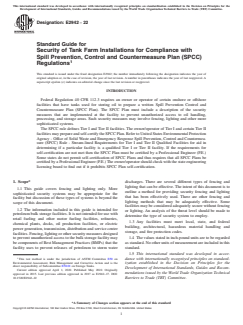
1.1 This guide covers fencing and lighting only. More sophisticated security systems may be appropriate for the facility but discussion of these types of systems is beyond the scope of this document.
1.2 The information included in this guide is intended for petroleum bulk storage facilities. It is not intended for use with retail fueling and other motor fueling facilities, refineries, chemical plants, docks, oil production facilities, or electric power generation, transmission, distribution and service center facilities. Fencing, lighting or other security measures designed to prevent unauthorized access to the bulk storage facility may be components of Best Management Practices (BMPs) that the facility uses to prevent releases of petroleum to storm water discharges. There are several different types of fencing and lighting that can be effective. The intent of this document is to outline a method for providing security fencing and lighting that has been effectively used. There are other fencing and lighting methods that may be adequately effective. Some facilities may be considered adequately secure without fencing or lighting. An analysis of the threat level should be made to determine the type of security system to employ.
1.3 Any facilities must meet local, state, and federal building, architectural, hazardous material handling and storage, and fire protection codes.
1.4 The values stated in inch-pound units are to be regarded as standard. No other units of measurement are included in this standard.
1.5 This international standard was developed in accordance with internationally recognized principles on standardization established in the Decision on Principles for the Development of International Standards, Guides and Recommendations issued by the World Trade Organization Technical Barriers to Trade (TBT) Committee.
- Status
- Published
- Publication Date
- 31-Mar-2022
- Technical Committee
- E50 - Environmental Assessment, Risk Management and Corrective Action
- Drafting Committee
- E50.01 - Storage Tanks
Buy Documents
ASTM E2942-22 - Standard Guide for Security of Tank Farm Installations for Compliance with Spill Prevention, Control and Countermeasure Plan (SPCC) Regulations
REDLINE ASTM E2942-22 - Standard Guide for Security of Tank Farm Installations for Compliance with Spill Prevention, Control and Countermeasure Plan (SPCC) Regulations
Overview
ASTM E2942-22: Standard Guide for Security of Tank Farm Installations for Compliance with Spill Prevention, Control, and Countermeasure (SPCC) Plan Regulations provides essential guidance on the use of fencing and lighting systems to enhance the security of petroleum bulk storage facilities. This guide is designed to help owners and operators comply with federal SPCC regulations (40 CFR 112.3), which require effective security measures to prevent unauthorized access that could lead to accidental releases and spills. The standard focuses on practical and proven methods for implementing security fencing and lighting as part of a facility's best management practices (BMPs).
Key Topics
Scope and Purpose
- Covers only fencing and lighting for tank farm security
- Intended for petroleum bulk storage facilities, not applicable to retail fueling stations, refineries, or other industrial premises
- Emphasizes threat-level assessment to determine appropriate security measures
Types of Security Measures
- Chain-link security fencing and related components
- Security lighting for facility perimeters and critical operational areas
- Recommendations for effective implementation and maintenance
Legal and Regulatory Compliance
- Addresses requirements for compliance with local, state, and federal building, hazardous material, and fire protection codes
- Aligns with SPCC plan regulations mandated by the Environmental Protection Agency (EPA)
Risk and Threat Assessment
- Encourages a site-specific analysis to determine suitable fencing and lighting configurations
- Recommends consulting with local law enforcement and referencing ANSI/API Standard 780 for security risk assessment
Applications
ASTM E2942-22 is applicable to:
Designing Security for Bulk Storage Facilities:
Facility managers and engineers can use this guide to select and install fencing and lighting configurations that mitigate unauthorized access and reduce spill risks.SPCC Plan Development and Compliance:
Owners/operators must detail implemented security measures in their SPCC plans. This standard supports compliance efforts by outlining accepted practices.Facility Upgrades and Inspections:
During renovations or regulatory audits, this guide serves as a reference for ensuring current fencing and lighting systems meet required standards.Best Management Practices Implementation:
Security measures outlined here are important components of BMPs for stormwater pollution prevention, as they help reduce the likelihood of contaminant releases due to intrusion or vandalism.
Related Standards
Facilities utilizing ASTM E2942-22 should also be familiar with these related standards and resources:
ASTM Standards
- ASTM A121: Metallic-Coated Carbon Steel Barbed Wire
- ASTM A392: Zinc-Coated Steel Chain-Link Fence Fabric
- ASTM F567: Installation of Chain-Link Fence
- ASTM F1043: Strength and Protective Coatings on Steel Industrial Fence Framework
- ASTM F1083: Galvanized Welded Steel Pipe for Fence Structures
- ASTM F900: Industrial and Commercial Steel Swing Gates
Federal and Industry Standards
- NFPA 70: National Electrical Code (for lighting installations)
- IES G-1-16: Guide for Security Lighting
- Federal Regulation 40 CFR 112: Oil Pollution Prevention (SPCC Rule)
- ANSI/API Standard 780: Security Risk Assessment Methodology
Guidance from Professional Organizations
- Chain Link Fence Manufacturers Institute security fencing guides
- Department of Transportation specifications for fencing systems
Practical Value
By following ASTM E2942-22, facility operators can:
- Enhance physical security of tank farms with effective and compliant fencing and lighting
- Simplify SPCC plan documentation and reduce regulatory risks
- Minimize the threat of unauthorized access, theft, or vandalism, ultimately protecting the environment from potential petroleum spills
- Align with industry best practices and satisfy expectations from regulators and insurers
Keywords: tank farm security, SPCC plan, spill prevention, security fencing, security lighting, petroleum bulk storage compliance, facility protection, regulatory compliance, best management practices.
Relations
- Effective Date
- 01-Jun-2017
- Effective Date
- 01-Feb-2017
- Effective Date
- 01-Jun-2016
- Effective Date
- 01-Feb-2016
- Effective Date
- 01-Jan-2016
- Effective Date
- 01-Oct-2014
- Effective Date
- 01-Aug-2014
- Effective Date
- 01-Apr-2014
- Effective Date
- 01-Apr-2014
- Effective Date
- 15-Nov-2013
- Effective Date
- 01-Nov-2013
- Effective Date
- 01-Mar-2013
- Effective Date
- 15-Nov-2012
- Effective Date
- 01-Dec-2011
- Effective Date
- 01-Dec-2011
Buy Documents
ASTM E2942-22 - Standard Guide for Security of Tank Farm Installations for Compliance with Spill Prevention, Control and Countermeasure Plan (SPCC) Regulations
REDLINE ASTM E2942-22 - Standard Guide for Security of Tank Farm Installations for Compliance with Spill Prevention, Control and Countermeasure Plan (SPCC) Regulations
Get Certified
Connect with accredited certification bodies for this standard

Element Materials Technology
Materials testing and product certification.

ABS Group Brazil
ABS Group certification services in Brazil.

ABS Quality Evaluations Inc.
American Bureau of Shipping quality certification.
Sponsored listings
Frequently Asked Questions
ASTM E2942-22 is a guide published by ASTM International. Its full title is "Standard Guide for Security of Tank Farm Installations for Compliance with Spill Prevention, Control and Countermeasure Plan (SPCC) Regulations". This standard covers: SCOPE 1.1 This guide covers fencing and lighting only. More sophisticated security systems may be appropriate for the facility but discussion of these types of systems is beyond the scope of this document. 1.2 The information included in this guide is intended for petroleum bulk storage facilities. It is not intended for use with retail fueling and other motor fueling facilities, refineries, chemical plants, docks, oil production facilities, or electric power generation, transmission, distribution and service center facilities. Fencing, lighting or other security measures designed to prevent unauthorized access to the bulk storage facility may be components of Best Management Practices (BMPs) that the facility uses to prevent releases of petroleum to storm water discharges. There are several different types of fencing and lighting that can be effective. The intent of this document is to outline a method for providing security fencing and lighting that has been effectively used. There are other fencing and lighting methods that may be adequately effective. Some facilities may be considered adequately secure without fencing or lighting. An analysis of the threat level should be made to determine the type of security system to employ. 1.3 Any facilities must meet local, state, and federal building, architectural, hazardous material handling and storage, and fire protection codes. 1.4 The values stated in inch-pound units are to be regarded as standard. No other units of measurement are included in this standard. 1.5 This international standard was developed in accordance with internationally recognized principles on standardization established in the Decision on Principles for the Development of International Standards, Guides and Recommendations issued by the World Trade Organization Technical Barriers to Trade (TBT) Committee.
SCOPE 1.1 This guide covers fencing and lighting only. More sophisticated security systems may be appropriate for the facility but discussion of these types of systems is beyond the scope of this document. 1.2 The information included in this guide is intended for petroleum bulk storage facilities. It is not intended for use with retail fueling and other motor fueling facilities, refineries, chemical plants, docks, oil production facilities, or electric power generation, transmission, distribution and service center facilities. Fencing, lighting or other security measures designed to prevent unauthorized access to the bulk storage facility may be components of Best Management Practices (BMPs) that the facility uses to prevent releases of petroleum to storm water discharges. There are several different types of fencing and lighting that can be effective. The intent of this document is to outline a method for providing security fencing and lighting that has been effectively used. There are other fencing and lighting methods that may be adequately effective. Some facilities may be considered adequately secure without fencing or lighting. An analysis of the threat level should be made to determine the type of security system to employ. 1.3 Any facilities must meet local, state, and federal building, architectural, hazardous material handling and storage, and fire protection codes. 1.4 The values stated in inch-pound units are to be regarded as standard. No other units of measurement are included in this standard. 1.5 This international standard was developed in accordance with internationally recognized principles on standardization established in the Decision on Principles for the Development of International Standards, Guides and Recommendations issued by the World Trade Organization Technical Barriers to Trade (TBT) Committee.
ASTM E2942-22 is classified under the following ICS (International Classification for Standards) categories: 75.200 - Petroleum products and natural gas handling equipment. The ICS classification helps identify the subject area and facilitates finding related standards.
ASTM E2942-22 has the following relationships with other standards: It is inter standard links to ASTM F1043-17a, ASTM F1043-17, ASTM F1043-16a, ASTM F1043-16, ASTM F1083-16, ASTM F1043-14, ASTM F567-14a, ASTM F626-14, ASTM F567-14, ASTM F1083-13, ASTM F1043-13, ASTM F626-08(2013), ASTM F1043-12, ASTM F900-11, ASTM F567-11a. Understanding these relationships helps ensure you are using the most current and applicable version of the standard.
ASTM E2942-22 is available in PDF format for immediate download after purchase. The document can be added to your cart and obtained through the secure checkout process. Digital delivery ensures instant access to the complete standard document.
Standards Content (Sample)
This international standard was developed in accordance with internationally recognized principles on standardization established in the Decision on Principles for the
Development of International Standards, Guides and Recommendations issued by the World Trade Organization Technical Barriers to Trade (TBT) Committee.
Designation: E2942 − 22
Standard Guide for
Security of Tank Farm Installations for Compliance with
Spill Prevention, Control and Countermeasure Plan (SPCC)
Regulations
This standard is issued under the fixed designation E2942; the number immediately following the designation indicates the year of
original adoption or, in the case of revision, the year of last revision. A number in parentheses indicates the year of last reapproval. A
superscript epsilon (´) indicates an editorial change since the last revision or reapproval.
INTRODUCTION
Federal Regulation 40 CFR 112.3 requires an owner or operator of certain onshore or offshore
facilities that have tanks used for storing oil to prepare a written Spill Prevention Control and
Countermeasure Plan (SPCC Plan). The SPCC Plan must include a description of the security
measures that are implemented at the facility to prevent unauthorized access to oil handling,
processing, and storage areas. Such security measures may involve fencing, lighting and other more
sophisticated systems.
The SPCC rule defines Tier I and Tier II facilities. The owner/operator of Tier I and certain Tier II
facilitiesmayprepareandself-certifytheSPCCPlan.RefertoUnitedStatesEnvironmentalProtection
Agency - Office of Solid Waste and Emergency Response Spill Prevention, Control and Countermea-
sure (SPCC) Rule - Stream-lined Requirements for Tier I and Tier II Qualified Facilities for aid in
determining if a particular facility is a qualified Tier I or Tier II facility. If the requirements for
self-certification are not met then the SPCC Plan must be certified by a Professional Engineer (P.E.)
Some states do not permit self-certification of SPCC Plans and thus requires that all SPCC Plans be
certified by a Professional Engineer (P.E.)The owner/operator should check with the state engineering
licensing board to find out if it prohibits SPCC Plan self-certification.
1. Scope* discharges. There are several different types of fencing and
lighting that can be effective. The intent of this document is to
1.1 This guide covers fencing and lighting only. More
outline a method for providing security fencing and lighting
sophisticated security systems may be appropriate for the
that has been effectively used. There are other fencing and
facility but discussion of these types of systems is beyond the
lighting methods that may be adequately effective. Some
scope of this document.
facilities may be considered adequately secure without fencing
1.2 The information included in this guide is intended for
or lighting. An analysis of the threat level should be made to
petroleum bulk storage facilities. It is not intended for use with
determine the type of security system to employ.
retail fueling and other motor fueling facilities, refineries,
1.3 Any facilities must meet local, state, and federal
chemical plants, docks, oil production facilities, or electric
building, architectural, hazardous material handling and
power generation, transmission, distribution and service center
storage, and fire protection codes.
facilities.Fencing,lightingorothersecuritymeasuresdesigned
to prevent unauthorized access to the bulk storage facility may 1.4 The values stated in inch-pound units are to be regarded
be components of Best Management Practices (BMPs) that the as standard. No other units of measurement are included in this
facility uses to prevent releases of petroleum to storm water standard.
1.5 This international standard was developed in accor-
dance with internationally recognized principles on standard-
This test method is under the jurisdiction of ASTM Committee E50 on
Environmental Assessment, Risk Management and Corrective Action and is the
ization established in the Decision on Principles for the
direct responsibility of Subcommittee E50.01 on Storage Tanks.
Development of International Standards, Guides and Recom-
Current edition approved April 1, 2022. Published May 2022. Originally
mendations issued by the World Trade Organization Technical
approved in 2015. Last previous edition approved in 2017 as E2942–17. DOI:
10.1520/E2942–22 Barriers to Trade (TBT) Committee.
*A Summary of Changes section appears at the end of this standard
Copyright © ASTM International, 100 Barr Harbor Drive, PO Box C700, West Conshohocken, PA 19428-2959. United States
E2942 − 22
2. Referenced Documents 2.6 Federal Standards:
2 Federal Specification RR-F-191K/GEN Fencing, Wire and
2.1 ASTM Standards:
Post Metal (And Gates, Chain Link Fence Fabric, and
A121 Specification for Metallic-Coated Carbon Steel
Accessories-(General Specification)
Barbed Wire
RR-F-191/1 Fencing, Wire and Post, Metal (Chain-Link
A123 Specification for Zinc (Hot-Dip Galvanized) Coatings
Fence Fabric)
on Iron and Steel Products
RR-F-191/2 Fencing, Wire and Post, Metal (Chain- Link
A392 Specification for Zinc-Coated Steel Chain-Link Fence
Fence Gates)
Fabric
RR-F-191/3 Fencing, Wire and Post, Metal (Chain-Link
A817 Specification for Metallic-Coated Steel Wire for
Fence Posts, Top Rails, and Braces)
Chain-Link Fence Fabric and Marcelled Tension Wire
RR-F-191/4 Fencing, Wire and Post, Metal (Chain-Link
F567 Practice for Installation of Chain-Link Fence
Fence Accessories)
F626 Specification for Fence Fittings
2.7 Lighting:
F900 Specification for Industrial and Commercial Steel
NFPA 70 National Electric Code – Introduction, Chapter 1,
Swing Gates
Chapter 2, Chapter 3, Chapter 4, Article 410 –
F1043 Specification for Strength and Protective Coatings on
International Building Code Section 1205
Steel Industrial Fence Framework
IES G-1-16 Guide for Security Lighting for People,
F1083 Specification for Pipe, Steel, Hot-Dipped Zinc-
Property, and Critical Infrastructure, Illumination Society
Coated (Galvanized) Welded, for Fence Structures
of North America
F1184 Specification for Industrial and Commercial Horizon-
tal Slide Gates
3. Terminology
2.2 American National Standards Institute/American Petro-
3.1 Definitions:
leum Institute
3.1.1 foot candle, n—is a non-SI unit of illuminance or light
ANSI/API Standard 780 Security RiskAssessment Method-
intensity, abbreviated fc, lm/ft , ft-c.
ology for the Petroleum and Petrochemical Industries
4 3.1.1.1 Discussion—The SI unit is lux. One foot candle is
2.3 Chain Link Fence Manufacturers Institute:
approximately equal to 10.764 lux.
CLF–SFR0111 Security Fencing Recommendations The
Tested and Proven Performance of Security Grade Chain
4. Threat Level
Link Fencing Systems
4.1 The first step is for the owner to investigate and
CLF-WLG 0110 Chain Link Fence Wind Load Guide for
determine the perceived threat level. From that determination a
Selection of Line Post and Line Post Spacing
judgment on the type and extent of fencing and the type and
CLF-PM0610 Product Manual
extent of lighting can be made. Helpful references are detailed
2.4 United States Department of Transportation:
in Section 2 above. Contacting the Department of Homeland
AC150/5370 – 10F
Security(DHS)toobtainasecurityanalysisandavulnerability
Item F-161 – Wire fence With Steel Posts (Class C and D
study may be helpful. Further contacting the local police
Fence)
department or sheriff for guidance on security strategies in the
Item F-162 – Chain Link Fence Item
local area based on familiarity with the threat characteristics of
Item F-163 – Wildlife Deterrent Fence
the area will be helpful.
Item F-164 – Wildlife Exclusion Fence
4.2 Another document that may be useful in identifying the
2.5 United States Environmental Protection Agency:
threat level and evaluating the risk involved is ASNI/API
Federal Regulation 40 CFR 112 Oil Prevention Pollution
Standard 780 – Security RiskAssessment Methodology for the
Office of Solid Waste and Emergency Response – Spill
Petroleum and Petrochemical Industries.
Prevention, Control, and Countermeasure (SPCC) Rule –
Streamlined Requirements for Tier I and Tier II Qualified
5. Fencing Systems
Facilities
5.1 The reference documents describe fencing systems that
United States Environmental Protection Agency 40 FR
are more secure and fencing systems that are less secure. The
112 Oil Pollution Prevention
owner should perform a risk analysis and determine the
appropriate fencing system for the facilities to be protected.
For referenced ASTM standards, visit the ASTM website, www.astm.org, or
NOTE 1—Some fence types may be restricted by local codes.
contact ASTM Customer Service at service@astm.org. For Annual Book of ASTM
Standards volume information, refer to the standard’s Document Summary page on
the ASTM website.
3 7
Available fromAmerican National Standards Institute (ANSI), 25 W. 43rd St., DLA Document Services Building 4/D 700 Robbins Avenue Philadelphia, PA
4th Floor, New York, NY 10036, http://www.ansi.org. 19111-5094 http://quicksearch.dla.mil/
4 8
Chain Link Fence Manufacturers Institute (CLFMI) 10015 Old Columbia Rd. NFPA, National Fire ProtectionAssociation, 1 Batterymarch Park, Quincy, MA
Suite B215 Columbia, MD 21046. http://www.chainlinkinfo.org 02169. https://www.nfpa.org/
5 9
United States Department of Transportation, 1200 New Jersey Avenue, SE International Building Code, by the International Code Council, 4051 Floss-
Washington, DC 20590 855-368-4200, https://www.transportation.gov moor Road, Country Club Hills, IL 60478. https://codes.iccsafe.org/
6 10
USEPA William Jefferson Clinton Building North, USEPA William Jefferson Illumination Society of North America, 120 Wall St. Fl 17, New York, NY
Clinton Building North, Washington, DC 20004. https://www.epa.gov/ 10005-4026. https://www.ies.org/
E2942 − 22
6. Fencing Details 7.2 Facilities should be equipped with lights to prevent acts
of vandalism and to allow facility personnel to discover
6.1 A chain-link fence is one type of fencing that has been
discharges that occur at night.
used successfully with the type of facilities described in 1.2.
There are other fencing details that will provide adequate
NOTE 2—Lighting may not be helpful for security where a perpetrator
has no fear of being caught and there are no patrols or other surveillance.
security Refer to Appendix X1 for typical chain-link fence
details.
7.3 The lighting system used to provide the required illu-
mination levels should be designed to provide the average
7. Illumination
illumination when the lighting is in operation.
7.1 The illumination values included in Appendix X2 have
8. Keywords
been used successfully for these types of facilities. The owner
should determine if other illumination values are better suited 8.1 fencing; lighting; SPCC plan; tank farm security; tank
to the facilities involved. farm security fencing; tank farm security lighting
APPENDIXES
(Nonmandatory Information)
X1. CHAIN-LINK FENCING DETAILS
INTRODUCTION
This appendix covers chain-link fencing
...
This document is not an ASTM standard and is intended only to provide the user of an ASTM standard an indication of what changes have been made to the previous version. Because
it may not be technically possible to adequately depict all changes accurately, ASTM recommends that users consult prior editions as appropriate. In all cases only the current version
of the standard as published by ASTM is to be considered the official document.
Designation: E2942 − 17 E2942 − 22
Standard Guide for
Security of Tank Farm Installations for Compliance with
Spill Prevention, Control and Countermeasure Plan (SPCC)
Regulations
This standard is issued under the fixed designation E2942; the number immediately following the designation indicates the year of
original adoption or, in the case of revision, the year of last revision. A number in parentheses indicates the year of last reapproval. A
superscript epsilon (´) indicates an editorial change since the last revision or reapproval.
INTRODUCTION
Federal Regulation 40 CFR 112.3 requires an owner or operator of certain onshore or offshore
facilities that have tanks used for storing oil to prepare a written Spill Prevention Control and
Countermeasure Plan (SPCC Plan). The SPCC Plan must include a description of the security
measures that are implemented at the facility to prevent unauthorized access to oil handling,
processing, and storage areas. Such security measures may involve fencing, lighting and other more
sophisticated systems.
The SPCC rule defines Tier I and Tier II facilities. The owner/operator of Tier I and certain Tier II
facilities may prepare and self-certify the SPCC Plan. Refer to United States Environmental Protection
Agency - Office of Solid Waste and Emergency Response Spill Prevention, Control and Countermea-
sure (SPCC) Rule - Stream-lined Requirements for Tier I and Tier II Qualified Facilities for aid in
determining if a particular facility is a qualified Tier I or Tier II facility. If the requirements for
self-certification are not met then the SPCC Plan must be certified by a Professional Engineer (P.E.)
Some states do not permit self-certification of SPCC Plans and thus requires that all SPCC Plans be
certified by a Professional Engineer (P.E.) The owner/operator should check with the state engineering
licensing board to find out if it prohibits SPCC Plan self-certification.
1. Scope*
1.1 This guide covers fencing and lighting only. More sophisticated security systems may be appropriate for the facility but
discussion of these types of systems is beyond the scope of this document.
1.2 The information included in this guide is intended for petroleum bulk storage facilities. It is not intended for use with retail
fueling and other motor fueling facilities, refineries, chemical plants, docks, oil production facilities, or electric power generation,
transmission, distribution and service center facilities. Fencing, lighting or other security measures designed to prevent
unauthorized access to the bulk storage facility may be components of Best Management Practices (BMPs) that the facility uses
to prevent releases of petroleum to storm water discharges. There are several different types of fencing and lighting that can be
effective. The intent of this document is to outline a method for providing security fencing and lighting that has been effectively
used. There are other fencing and lighting methods that may be adequately effective. Some facilities may be considered adequately
secure without fencing or lighting. An analysis of the threat level should be made to determine the type of security system to
employ.
This test method is under the jurisdiction of ASTM Committee E50 on Environmental Assessment, Risk Management and Corrective Action and is the direct
responsibility of Subcommittee E50.01 on Storage Tanks.
Current edition approved Aug. 1, 2017April 1, 2022. Published August 2017May 2022. Originally approved in 2015. Last previous edition approved in 20152017 as
E2942–15.–17. DOI: 10.1520/E2942–1710.1520/E2942–22
*A Summary of Changes section appears at the end of this standard
Copyright © ASTM International, 100 Barr Harbor Drive, PO Box C700, West Conshohocken, PA 19428-2959. United States
E2942 − 22
1.3 Any facilities must meet local, state, and federal building, architectural, hazardous material handling and storage, and fire
protection codes.
1.4 The values stated in inch-pound units are to be regarded as standard. No other units of measurement are included in this
standard.
1.5 This international standard was developed in accordance with internationally recognized principles on standardization
established in the Decision on Principles for the Development of International Standards, Guides and Recommendations issued
by the World Trade Organization Technical Barriers to Trade (TBT) Committee.
2. Referenced Documents
2.1 ASTM Standards:
A121 Specification for Metallic-Coated Carbon Steel Barbed Wire
A123 Specification for Zinc (Hot-Dip Galvanized) Coatings on Iron and Steel Products
A392 Specification for Zinc-Coated Steel Chain-Link Fence Fabric
A567/A567M Specification for Castings, Iron, Cobalt, and Nickel-Base Alloy, for High Strength at Elevated Temperatures
(Withdrawn 1987)
A817 Specification for Metallic-Coated Steel Wire for Chain-Link Fence Fabric and Marcelled Tension Wire
F567 Practice for Installation of Chain-Link Fence
F626 Specification for Fence Fittings
F900 Specification for Industrial and Commercial Steel Swing Gates
F1043 Specification for Strength and Protective Coatings on Steel Industrial Fence Framework
F1083 Specification for Pipe, Steel, Hot-Dipped Zinc-Coated (Galvanized) Welded, for Fence Structures
F1184 Specification for Industrial and Commercial Horizontal Slide Gates
2.2 American National Standards Institute/American Petroleum Institute
ANSI/API Standard 780 Security Risk Assessment Methodology for the Petroleum and Petrochemical Industries
2.3 Chain Link Fence Manufacturers Institute:
CLF–SFR0111 Security Fencing Recommendations The Tested and Proven Performance of Security Grade Chain Link Fencing
Systems
CLF-WLG 0110 Chain Link Fence Wind Load Guide for Selection of Line Post and Line Post Spacing
CLF-PM0610 Product Manual
2.4 United States Department of Transportation:
AC150/5370 – 10F
Item F-161 – Wire fence With Steel Posts (Class C and D Fence)
Item F-162 – Chain Link Fence Item
Item F-163 – Wildlife Deterrent Fence
Item F-164 – Wildlife Exclusion Fence
2.5 United States Environmental Protection Agency:
Federal Regulation 40 CFR 112 Oil Prevention Pollution Office of Solid Waste and Emergency Response – Spill Prevention,
Control, and Countermeasure (SPCC) Rule – Streamlined Requirements for Tier I and Tier II Qualified Facilities
United States Environmental Protection Agency 40 FR 112 Oil Pollution Prevention
2.6 Federal Standards:
Federal Specification RR-F-191K/GEN Fencing, Wire and Post Metal (And Gates, Chain Link Fence Fabric, and Accessories-
(General Specification)
RR-F-191/1 Fencing, Wire and Post, Metal (Chain-Link Fence Fabric)
RR-F-191/2 Fencing, Wire and Post, Metal (Chain- Link Fence Gates)
RR-F-191/3 Fencing, Wire and Post, Metal (Chain-Link Fence Posts, Top Rails, and Braces)
RR-F-191/4 Fencing, Wire and Post, Metal (Chain-Link Fence Accessories)
For referenced ASTM standards, visit the ASTM website, www.astm.org, or contact ASTM Customer Service at service@astm.org. For Annual Book of ASTM Standards
volume information, refer to the standard’s Document Summary page on the ASTM website.
Available from American National Standards Institute (ANSI), 25 W. 43rd St., 4th Floor, New York, NY 10036, http://www.ansi.org.
Chain Link Fence Manufacturers Institute (CLFMI) 10015 Old Columbia Rd. Suite B215 Columbia, MD 21046. http://www.chainlinkinfo.org
United States Department of Transportation, 1200 New Jersey Avenue, SE Washington, DC 20590 855-368-4200, https://www.transportation.gov
USEPA William Jefferson Clinton Building North, USEPA William Jefferson Clinton Building North, Washington, DC 20004. https://www.epa.gov/
DLA Document Services Building 4/D 700 Robbins Avenue Philadelphia, PA 19111-5094 http://quicksearch.dla.mil/
E2942 − 22
2.7 Lighting:
NFPA 70 National Electric Code – Introduction, Chapter 1, Chapter 2, Chapter 3, Chapter 4, Article 410 –
International Building Code Section 1205
Illumination Society of North AmericaIES G-1-16 Guide for Security Lighting for People, Property, and Critical Infrastructure,
Illumination Society of North America
United States Environmental Protection Agency 40 FR 112 Oil Pollution Prevention
3. Terminology
3.1 Definitions:
3.1.1 foot candle—candle, n—is a non-SI unit of illuminance or light intensity, abbreviated fc, lm/ft , ft-c.
3.1.1.1 Discussion—
The SI unit is lux. One foot candle is approximately equal to 10.764 lux.
4. Threat Level
4.1 The first step is for the owner to investigate and determine the perceived threat level. From that determination a judgment on
the type and extent of fencing and the type and extent of lighting can be made. Helpful references are detailed in Section 2 above.
Contacting the Department of Homeland Security (DHS) to obtain a security analysis and a vulnerability study may be helpful.
Further contacting the local police department or sheriff for guidance on security strategies in the local area based on familiarity
with the threat characteristics of the area will be helpful.
4.2 Another document that may be useful in identifying the threat level and evaluating the risk involved is ASNI/API Standard
780 – Security Risk Assessment Methodology for the Petroleum and Petrochemical Industries.
5. Fencing Systems
5.1 The reference documents describe fencing systems that are more secure and fencing systems that are less secure. The owner
should perform a risk analysis and determine the appropriate fencing system for the facilities to be protected.
NOTE 1—Some fence types may be restricted by local codes.
6. Fencing Details
6.1 A chain-link fence is one type of fencing that has been used successfully with the type of facilities described in 1.2. There are
other fencing details that will provide adequate security Refer to Appendix X1 for typical chain-link fence details.
7. Illumination
7.1 The illumination values included in Appendix X2 have been used successfully for these types of facilities. The owner should
determine if other illumination values are better suited to the facilities involved.
7.2 Facilities should be equipped with lights to prevent acts of vandalism and to allow facility personnel to discover discharges
that occur at night.
NOTE 2—Lighting may not be helpful for security where a perpetrator has no fear of being caught and there are no patrols or other surveillance.
7.3 The lighting system used to provide the required illumination levels should be designed to provide the average illumination
when the lighting is in operation.
8. Keywords
8.1 fencing; lighting; SPCC plan; tank farm security; tank farm security fencing; tank farm security lighting
NFPA, National Fire Protection Association, 1 Batterymarch Park, Quincy, MA 02169. https://www.nfpa.org/
International Building Code, by the International Code Council, 4051 Flossmoor Road, Country Club Hills, IL 60478. https://codes.iccsafe.org/
Illumination Society of North America, 120 Wall St. Fl 17, New York, NY 10005-4026. https://www.ies.org/
E2942 − 22
APPENDIXES
(Nonmandatory Information)
X1. CHAIN-LINK FENCING DETAILS
INTRODUCTION
This appendix covers chain-link fencing details. It is being provided f
...