

ASTM B837-19
(Specification)Standard Specification for Seamless Copper Tube for Natural Gas and Liquified Petroleum (LP) Gas Fuel Distribution Systems
General Information
- Abstract
SIGNIFICANCE AND USE
18.1 For purpose of determining compliance with the specified limits for requirements of the properties listed in Table 5, an observed value or calculated value shall be rounded as indicated in accordance with the rounding method of Practice E29.
SCOPE
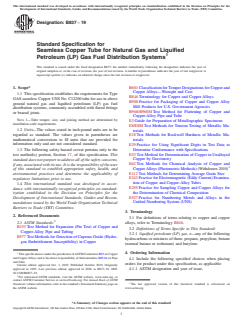
1.1 This specification establishes the requirements for Type GAS seamless Copper UNS No. C12200 tube for use in above ground natural gas and liquified petroleum (LP) gas fuel distribution systems, commonly assembled with flared fittings or brazed joints.
Note 1: Tube temper, size, and joining method are determined by installation code requirements.
1.2 Units—The values stated in inch-pound units are to be regarded as standard. The values given in parentheses are mathematical conversions to SI units that are provided for information only and are not considered standard.
1.3 The following safety hazard caveat pertains only to the test method(s) portion, Section 17, of this specification. This standard does not purport to address all of the safety concerns, if any, associated with its use. It is the responsibility of the user of this standard to establish appropriate safety, health, and environmental practices and determine the applicability of regulatory limitations prior to use.
1.4 This international standard was developed in accordance with internationally recognized principles on standardization established in the Decision on Principles for the Development of International Standards, Guides and Recommendations issued by the World Trade Organization Technical Barriers to Trade (TBT) Committee.
- Status
- Published
- Publication Date
- 30-Sep-2019
- Technical Committee
- B05 - Copper and Copper Alloys
- Drafting Committee
- B05.04 - Pipe and Tube
Buy Documents
ASTM B837-19 - Standard Specification for Seamless Copper Tube for Natural Gas and Liquified Petroleum (LP) Gas Fuel Distribution Systems
REDLINE ASTM B837-19 - Standard Specification for Seamless Copper Tube for Natural Gas and Liquified Petroleum (LP) Gas Fuel Distribution Systems
Overview
ASTM B837-19 is the internationally recognized standard specification established by ASTM International for seamless copper tube-specifically Type GAS Copper UNS No. C12200-used in above-ground natural gas and liquified petroleum (LP) gas fuel distribution systems. This standard outlines the critical requirements for chemical composition, mechanical and physical properties, dimensions, tolerances, product marking, packaging, and testing methods to ensure safety, reliability, and performance in gas fuel distribution applications.
Key Topics
Material Requirements and Manufacturing
- Specifies seamless copper tubes made from Copper UNS No. C12200.
- Tubing is processed through hot- and cold-working and annealing to achieve uniform structure.
- Offers two tempers: soft anneal (O60) and drawn general purpose (H58), as determined by installation codes.
Mechanical and Chemical Properties
- Tubes must conform to strict limits for copper content (minimum 99.9% including silver) and phosphorus.
- Mechanical strength, Rockwell hardness, and grain size requirements apply based on temper.
Testing and Quality Assurance
- Mandates various standard tests including tensile, hardness, expansion (pin test), flattening, electromagnetic (eddy-current), and hydrogen embrittlement susceptibility.
- Quality control procedures for sampling, retesting, and analysis methods are detailed for compliance.
Dimensions and Tolerances
- Standard tube sizes, wall thickness, lengths, and tolerances are defined for both straight lengths and coils.
- Dimensional conformity is essential for ensuring safe assembly using flared fittings or brazed joints.
Identification and Packaging
- Clear marking requirements for product identification: “Type GAS” and manufacturer’s name or trademark are incised at intervals, with a yellow stripe on hard straight lengths.
- Packaging must safeguard products during transport and comply with order-specific requirements.
Ordering Guidelines
- Outlines all necessary information to include when ordering tubes, such as size, quantity, temper, length, and any optional tests, certifications, or reports.
Applications
Natural Gas Fuel Distribution
- Used extensively in residential, commercial, and light industrial settings for above-ground natural gas fuel piping systems.
Liquefied Petroleum (LP) Gas Distribution
- Suitable for propane, butane, and their mixtures as defined under LP gas, providing a reliable conduit for pressurized fuel distribution.
Assembly with Flared Fittings or Brazed Joints
- Tubes specified by ASTM B837-19 are commonly integrated into fuel distribution systems using industry-standard assembly techniques such as flared fittings or brazed joints.
Compliance with Installation Codes
- Ensures that the copper tubing meets installation code requirements, promoting safety and long-term system integrity.
Related Standards
- ASTM B601: Classification for Temper Designations for Copper and Copper Alloys
- ASTM B577: Test Methods for Detection of Cuprous Oxide (Hydrogen Embrittlement Susceptibility)
- ASTM B900: Practice for Packaging of Copper and Copper Alloy Products for U.S. Government Agencies
- ASTM B153: Expansion (Pin Test) of Copper and Copper Alloy Tubing
- ASTM E8/E8M: Test Methods for Tension Testing of Metallic Materials
- ASTM E18: Rockwell Hardness Test Methods
- ASTM E29: Significant Digits in Test Data to Determine Conformance
- ASTM E243: Electromagnetic (Eddy Current) Examination of Copper Tubes
Practical Value
Compliance with ASTM B837-19 assures stakeholders-including manufacturers, installers, and regulatory authorities-of the consistent quality, material integrity, and safe performance of seamless copper tube in demanding fuel gas distribution applications. This standard delivers confidence for use in natural gas and LP gas systems, supporting both code compliance and operational reliability in fuel delivery infrastructure.
Keywords: ASTM B837, seamless copper tube, Type GAS, natural gas distribution, liquified petroleum gas, LP gas, C12200, fuel distribution, flared fittings, brazed joints, mechanical properties, testing, packaging, product identification.
Relations
- Effective Date
- 01-Oct-2019
- Effective Date
- 01-Jan-2024
- Effective Date
- 01-Aug-2019
- Effective Date
- 01-Apr-2019
- Effective Date
- 01-Jan-2019
- Effective Date
- 01-Oct-2018
- Effective Date
- 01-Jul-2018
- Effective Date
- 01-Jun-2018
- Effective Date
- 01-Mar-2018
- Effective Date
- 01-Jul-2017
- Effective Date
- 01-Oct-2016
- Effective Date
- 15-Jul-2016
- Effective Date
- 01-Apr-2016
- Effective Date
- 01-Feb-2015
- Effective Date
- 01-Dec-2013
Buy Documents
ASTM B837-19 - Standard Specification for Seamless Copper Tube for Natural Gas and Liquified Petroleum (LP) Gas Fuel Distribution Systems
REDLINE ASTM B837-19 - Standard Specification for Seamless Copper Tube for Natural Gas and Liquified Petroleum (LP) Gas Fuel Distribution Systems
Get Certified
Connect with accredited certification bodies for this standard

Element Materials Technology
Materials testing and product certification.

ABS Group Brazil
ABS Group certification services in Brazil.

ABS Quality Evaluations Inc.
American Bureau of Shipping quality certification.
Sponsored listings
Frequently Asked Questions
ASTM B837-19 is a technical specification published by ASTM International. Its full title is "Standard Specification for Seamless Copper Tube for Natural Gas and Liquified Petroleum (LP) Gas Fuel Distribution Systems". This standard covers: SIGNIFICANCE AND USE 18.1 For purpose of determining compliance with the specified limits for requirements of the properties listed in Table 5, an observed value or calculated value shall be rounded as indicated in accordance with the rounding method of Practice E29. SCOPE 1.1 This specification establishes the requirements for Type GAS seamless Copper UNS No. C12200 tube for use in above ground natural gas and liquified petroleum (LP) gas fuel distribution systems, commonly assembled with flared fittings or brazed joints. Note 1: Tube temper, size, and joining method are determined by installation code requirements. 1.2 Units—The values stated in inch-pound units are to be regarded as standard. The values given in parentheses are mathematical conversions to SI units that are provided for information only and are not considered standard. 1.3 The following safety hazard caveat pertains only to the test method(s) portion, Section 17, of this specification. This standard does not purport to address all of the safety concerns, if any, associated with its use. It is the responsibility of the user of this standard to establish appropriate safety, health, and environmental practices and determine the applicability of regulatory limitations prior to use. 1.4 This international standard was developed in accordance with internationally recognized principles on standardization established in the Decision on Principles for the Development of International Standards, Guides and Recommendations issued by the World Trade Organization Technical Barriers to Trade (TBT) Committee.
SIGNIFICANCE AND USE 18.1 For purpose of determining compliance with the specified limits for requirements of the properties listed in Table 5, an observed value or calculated value shall be rounded as indicated in accordance with the rounding method of Practice E29. SCOPE 1.1 This specification establishes the requirements for Type GAS seamless Copper UNS No. C12200 tube for use in above ground natural gas and liquified petroleum (LP) gas fuel distribution systems, commonly assembled with flared fittings or brazed joints. Note 1: Tube temper, size, and joining method are determined by installation code requirements. 1.2 Units—The values stated in inch-pound units are to be regarded as standard. The values given in parentheses are mathematical conversions to SI units that are provided for information only and are not considered standard. 1.3 The following safety hazard caveat pertains only to the test method(s) portion, Section 17, of this specification. This standard does not purport to address all of the safety concerns, if any, associated with its use. It is the responsibility of the user of this standard to establish appropriate safety, health, and environmental practices and determine the applicability of regulatory limitations prior to use. 1.4 This international standard was developed in accordance with internationally recognized principles on standardization established in the Decision on Principles for the Development of International Standards, Guides and Recommendations issued by the World Trade Organization Technical Barriers to Trade (TBT) Committee.
ASTM B837-19 is classified under the following ICS (International Classification for Standards) categories: 75.200 - Petroleum products and natural gas handling equipment. The ICS classification helps identify the subject area and facilitates finding related standards.
ASTM B837-19 has the following relationships with other standards: It is inter standard links to ASTM B837-18, ASTM E8/E8M-24, ASTM B846-19a, ASTM B577-19, ASTM B846-19, ASTM B601-18a, ASTM E18-18, ASTM E243-18, ASTM B601-18, ASTM E18-17, ASTM B601-16, ASTM E8/E8M-16, ASTM B577-16, ASTM E8/E8M-15, ASTM E243-13. Understanding these relationships helps ensure you are using the most current and applicable version of the standard.
ASTM B837-19 is available in PDF format for immediate download after purchase. The document can be added to your cart and obtained through the secure checkout process. Digital delivery ensures instant access to the complete standard document.
Standards Content (Sample)
This international standard was developed in accordance with internationally recognized principles on standardization established in the Decision on Principles for the
Development of International Standards, Guides and Recommendations issued by the World Trade Organization Technical Barriers to Trade (TBT) Committee.
Designation:B837 −19
Standard Specification for
Seamless Copper Tube for Natural Gas and Liquified
Petroleum (LP) Gas Fuel Distribution Systems
This standard is issued under the fixed designation B837; the number immediately following the designation indicates the year of
original adoption or, in the case of revision, the year of last revision.Anumber in parentheses indicates the year of last reapproval.A
superscript epsilon (´) indicates an editorial change since the last revision or reapproval.
1. Scope* B601ClassificationforTemperDesignationsforCopperand
Copper Alloys—Wrought and Cast
1.1 This specification establishes the requirements for Type
B846Terminology for Copper and Copper Alloys
GAS seamless Copper UNS No. C12200 tube for use in above
B900Practice for Packaging of Copper and Copper Alloy
ground natural gas and liquified petroleum (LP) gas fuel
Mill Products for U.S. Government Agencies
distribution systems, commonly assembled with flared fittings
B968/B968MTest Method for Flattening of Copper and
or brazed joints.
Copper-Alloy Pipe and Tube
NOTE 1—Tube temper, size, and joining method are determined by
E3Guide for Preparation of Metallographic Specimens
installation code requirements.
E8/E8MTest Methods for Tension Testing of Metallic Ma-
1.2 Units—The values stated in inch-pound units are to be
terials
regarded as standard. The values given in parentheses are
E18Test Methods for Rockwell Hardness of Metallic Ma-
mathematical conversions to SI units that are provided for
terials
information only and are not considered standard.
E29Practice for Using Significant Digits in Test Data to
Determine Conformance with Specifications
1.3 The following safety hazard caveat pertains only to the
E53Test Method for Determination of Copper in Unalloyed
test method(s) portion, Section 17, of this specification. This
Copper by Gravimetry
standard does not purport to address all of the safety concerns,
E62Test Methods for Chemical Analysis of Copper and
if any, associated with its use. It is the responsibility of the user
CopperAlloys(PhotometricMethods)(Withdrawn2010)
of this standard to establish appropriate safety, health, and
E112Test Methods for Determining Average Grain Size
environmental practices and determine the applicability of
E243PracticeforElectromagnetic(EddyCurrent)Examina-
regulatory limitations prior to use.
tion of Copper and Copper-Alloy Tubes
1.4 This international standard was developed in accor-
E255Practice for Sampling Copper and Copper Alloys for
dance with internationally recognized principles on standard-
the Determination of Chemical Composition
ization established in the Decision on Principles for the
E527Practice for Numbering Metals and Alloys in the
Development of International Standards, Guides and Recom-
Unified Numbering System (UNS)
mendations issued by the World Trade Organization Technical
Barriers to Trade (TBT) Committee.
3. Terminology
2. Referenced Documents
3.1 For definitions of terms relating to copper and copper
2.1 ASTM Standards:
alloys, refer to Terminology B846.
B153Test Method for Expansion (Pin Test) of Copper and
3.2 Definitions of Terms Specific to This Standard:
Copper-Alloy Pipe and Tubing
3.2.1 liquified petroleum (LP) gas, n—any of the following
B577TestMethodsforDetectionofCuprousOxide(Hydro-
hydrocarbons or mixtures of them: propane, propylene, butane
gen Embrittlement Susceptibility) in Copper
(normal butane or isobutane) and butylene.
4. Ordering Information
ThisspecificationisunderthejurisdictionofASTMCommitteeB05onCopper
and CopperAlloys and is the direct responsibility of Subcommittee B05.04 on Pipe
4.1 Include the following specified choices when placing
and Tube.
orders for product under this specification, as applicable:
Current edition approved Oct. 1, 2019. Published October 2019. Originally
approved in 1993. Last previous edition approved in 2018 as B837–18. DOI: 4.1.1 ASTM designation and year of issue,
10.1520/B0837–19.
For referenced ASTM standards, visit the ASTM website, www.astm.org, or
contact ASTM Customer Service at service@astm.org. For Annual Book of ASTM
Standards volume information, refer to the standard’s Document Summary page on The last approved version of this historical standard is referenced on
the ASTM website. www.astm.org.
*A Summary of Changes section appears at the end of this standard
Copyright © ASTM International, 100 Barr Harbor Drive, PO Box C700, West Conshohocken, PA 19428-2959. United States
B837−19
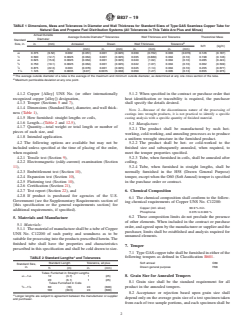
TABLE 1 Dimensions, Mass and Tolerances in Diameter and Wall Thickness for Standard Sizes of Type GAS Seamless Copper Tube for
Natural Gas and Propane Fuel Distribution Systems (All Tolerances in This Table Are Plus and Minus)
Actual Outside
A
Average Outside Diameter Tolerances Wall Thickness and Tolerance Theoretical Mass
Diameter
Standard
B
Size, in. in. (mm) Annealed Drawn Wall Thickness Tolerance
lb/ft (kg/m)
in. (mm) in. (mm) in. (mm) in. (mm)
⁄8 0.375 (9.52) 0.002 (0.051) 0.001 (0.025) 0.030 (0.762) 0.003 (0.076) 0.126 (0.187)
⁄2 0.500 (12.7) 0.0025 (0.064) 0.001 (0.025) 0.035 (0.889) 0.004 (0.10) 0.198 (0.146)
⁄8 0.625 (15.9) 0.0025 (0.064) 0.001 (0.025) 0.040 (1.02) 0.004 (0.10) 0.285 (0.424)
⁄4 0.750 (19.1) 0.0025 (0.064) 0.001 (0.025) 0.042 (1.07) 0.004 (0.10) 0.362 (0.539)
⁄8 0.875 (22.3) 0.003 (0.076) 0.001 (0.025) 0.045 (1.14) 0.004 (0.10) 0.455 (0.677)
1 ⁄8 1.125 (29) 0.0035 (0.07) 0.0015 (0.038) 0.050 (1.27) 0.005 (0.13) 0.655 (0.975)
A
The average outside diameter of a tube is the average of the maximum and minimum outside diameter, as determined at any one cross section of the tube.
B
Maximum permissible deviation at any one point.
4.1.2 Copper [Alloy] UNS No. (or other internationally 5.1.2 When specified in the contract or purchase order that
recognized copper [alloy]) designation, heat identification or traceability is required, the purchaser
4.1.3 Temper (Sections 5 and 7), shall specify the details desired.
4.1.4 Dimensions (Standard Size), diameter, and wall thick-
NOTE 2—Because of the discontinuous nature of the processing of
ness (Table 1),
castings into wrought products, it is not practical to identify a specific
4.1.5 How furnished: straight lengths or coils,
casting analysis with a specific quantity of finished material.
4.1.6 Length—(Table 2 and 12.5),
5.2 Manufacture:
4.1.7 Quantity—total weight or total length or number of
5.2.1 The product shall be manufactured by such hot-
pieces of each size, and
working, cold-working, and annealing processes as to produce
4.1.8 Intended application.
a uniform wrought structure in the furnished product.
4.2 The following options are available but may not be 5.2.2 The product shall be hot- or cold-worked to the
included unless specified at the time of placing of the order, finished size and subsequently annealed, when required, to
when required: meet the temper properties specified.
4.2.1 Tensile test (Section 9), 5.2.3 Tube, when furnished in coils, shall be annealed after
4.2.2 Electromagnetic (eddy-current) examination (Section coiling.
11), 5.2.4 Tube, when furnished in straight lengths, shall be
4.2.3 Embrittlement test (Section 10), normally furnished in the H58 (Drawn General Purpose)
4.2.4 Expansion test (Section 10), temper, except when the O60 (SoftAnneal) temper is specified
4.2.5 Flattening test (Section 10), in the purchase order or contract.
4.2.6 Certification (Section 21),
4.2.7 Test report (Section 22), and
6. Chemical Composition
4.2.8 If product is purchased for agencies of the U.S.
6.1 The chemical composition shall conform to the follow-
Government (see the Supplementary Requirements section of
ing chemical requirements of Copper UNS No. C12200:
{this specification or the general requirements section} for
Copper (incl. silver) 99.9 % min.
additional requirements, if specified).
Phosphorus 0.015 to 0.040 %
6.2 These composition limits do not preclude the presence
5. Materials and Manufacture
of other elements. When included in the contract or purchase
5.1 Materials:
order,andagreeduponbythemanufacturerorsupplierandthe
5.1.1 ThematerialofmanufactureshallbeatubeofCopper
purchaser, limits shall be established and analysis required for
UNS No. C12200 of such purity and soundness as to be
unnamed elements.
suitableforprocessingintotheproductsprescribedherein.The
finished tube shall have the properties and characteristics
7. Temper
prescribed in this specification and shall be cold drawn to size.
7.1 TypeGAScoppertubeshallbefurnishedineitherofthe
A
following tempers as defined in Classification B601.
TABLE 2 Standard Lengths and Tolerances
Soft anneal O60
Standard Length Tolerance, all plus
Standard Size,
Drawn general purpose H58
in.
ft. (m) in. (mm)
Tubes Furnished in Straight Lengths
3 1
8. Grain Size for Annealed Tempers
⁄8 –1 ⁄8 12 (3.7) 1 (25)
20 (6.1) 1 (25)
8.1 Grain size shall be the standard requirement for all
Tubes Furnished in Coils
3 1
⁄8 –1 ⁄8 60 (18) 24 (600) product in the annealed tempers.
100 (30.5) 24 (600)
8.2 Acceptance or rejection based upon grain size shall
A
Longer lengths are subject to agreement between the manufacturer or supplier
depend only on the average grain size of a test specimen taken
and purchaser.
from each of two sample portions, and each specimen shall be
B837−19
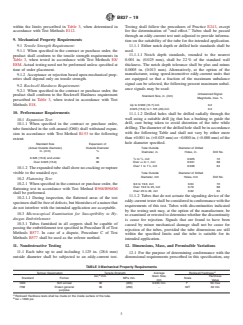
within the limits prescribed in Table 3, when determined in Testing shall follow the procedures of Practice E243, except
accordance with Test Methods E112. for the determination of “end effect.” Tubes shall be passed
through an eddy-current test unit adjusted to provide informa-
9. Mechanical Property Requirements
tion on the suitability of the tube for the intended application.
11.1.1 Either notch depth or drilled hole standards shall be
9.1 Tensile Strength Requirement:
9.1.1 When specified in the contract or purchase order, the used.
11.1.1.1 Notch depth standards, rounded to the nearest
product shall conform to the tensile strength requirements in
Table 3, when tested in accordance with Test Methods E8/ 0.001 in. (0.025 mm), shall be 22% of the standard wall
thickness. The notch depth tolerance shall be plus and minus
E8M.Actual testing need not be performed unless specified at
time of order placement. 0.0005 in. (0.013 mm). Alternatively, at the option of the
manufacturer, using speed-insensitive eddy-current units that
9.1.2 Acceptance or rejection based upon mechanical prop-
erties shall depend only on tensile strength. are equipped so that a fraction of the maximum unbalance
signal can be selected, the following percent maximum unbal-
9.2 Rockwell Hardness Requirement:
ance signals may be used:
9.2.1 When specified in the contract or purchase order, the
Unbalanced Signal
product shall conform to the Rockwell Hardness requirement
Standard Size, in. (mm)
Magnitude, max. %
prescribed in Table 3, when tested in accordance with Test
Methods E18. Up to 0.500 (12.7) incl. 0.2
0.625 (15.9) to 1.125 (29) incl. 0.3
10. Performance Requirements
11.1.1.2 Drilled holes shall be drilled radially through the
wall using a suitable drill jig that has a bushing to guide the
10.1 Expansion Test:
drill, care being taken to avoid distortion of the tube while
10.1.1 When specified in the contract or purchase order,
drilling.Thediameterofthedrilledholeshallbeinaccordance
tube furnished in the soft-anneal (O60) shall withstand expan-
with the following Table and shall not vary by either more
sion in accordance with Test Method B153 to the following
than+0.001 in. (+0.025 mm) or−0.000 in. (−0.000 mm) of the
extent:
hole diameter specified.
Standard Size Expansion of
(Actual Outside Diameter) Outside Diameter
Tube Outside Diameter of Drilled
in. (mm) %
Diameter, in. Holes, in. Drill No.
3 3
0.625 (15.9) and under 40
⁄8 to ⁄4, incl 0.025 72
Over 0.625 (15.9) 30
Over ⁄4 to 1, incl 0.031 68
Over 1 to 1 ⁄8, incl 0.036 64
10.1.2 Theexpandedtubeshallshownocrackingorrupture
visible to the unaided eye.
Tube Outside Diameter of Drilled
Diameter, mm Holes, mm Drill No.
10.2 Flattening Test:
10.2.1 When specified in the contract or purchase order, the 9.0 to 19.0, incl 0.64 72
Over 19.0 to 25, incl 0.79 68
flattening test in accordance with Test Method B968/B968M
Over 25 to 29, incl 0.92 64
shall be performed.
11.1.2 Tubes that do not actuate the signaling device of the
10.2.1.1 During inspection, the flattened areas of the test
eddy-currenttestershallbeconsideredinconformancewiththe
specimenshallbefreeofdefects,butblemishesofanaturethat
requirements of this test. Tubes with discontinuities indicated
do not interfere with the intended application are acceptable.
by the testing unit may, at the option of the manufacturer, be
10.3 Microscopical Examination for Susceptibility to Hy-
re-examined or retested to determine whether the discontinuity
drogen Embrittlement:
is cause for rejection. Signals that are found to have been
10.3.1 Tubes furnished in all coppers shall be capable of
caused by minor mechanical damage shall not be cause for
passing the embrittlement test specified in Procedure B ofTest
rejection of the tubes, provided the tube dimensions are still
Methods B577. In case of a dispute, Procedure C of Test
within the specified limits and the tube is suitable for its
Methods B577 shall be used as the referee method.
intended application.
11. Nondestructive Testing
12. Dimensions, Mass, and Permissible Variations
11.1 Each tube up to and including 1.125 in. (28.6 mm) 12.1 For the purpose of determining conformance with the
outside diameter shall be subjected to an eddy-current test. dimensional requirements prescribed in this specification, any
TABLE 3 Mechanical Property Requirements
A
Temper Designation Tensile Strength Average Rockwell Hardness
B
ksi, min. Grain Size, Hardness
Standard Former MPa min. Scale
mm Value
O60 Soft anneal 30 (205) 0.035 min. F 50 max
H58 Drawn general 36 (250) . 30T 30 min
purpose
A
Rockwell Hardness tests shall be made on the inside surface of the tube.
B
ksi = 1000 psi.
B837−19
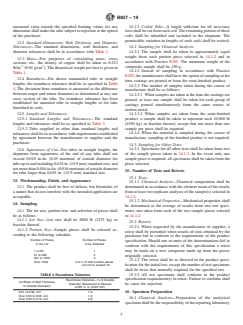
measured value outside the specified limiting values for any 14.1.3 Coiled Tube—A length sufficient for all necessary
dimensionshallmakethetubesubjecttorejectionattheoption testsshallbecutfromeachcoil.Theremainingportionofthese
of the purchaser. coils shall be identified and included in the shipment. The
permissible variation in lengths of such coils shall be waived.
12.2 Standard Dimensions, Wall Thickness, and Diameter
Tolerances—The standard dimensions, wall thickness, and 14.2 Sampling for Chemical Analysis:
diameter tolerances shall be in accordance with Table 1. 14.2.1 The sample shall be taken in approximately equal
weight from each portion piece selected in 14.1.2 and in
12.3 Mass—For purposes of calculating mass, cross
accordance with Practice E255. The minimum weight of the
sections, etc., the density of copper shall be taken as 0.323
3 3 composite sample shall be 150 g.
lb/in. (8.94 g/cm ).The theoretical weight per foot is given in
14.2.2 Instead of sampling in accordance with Practice
Table 1.
E255,themanufacturershallhavetheoptionofsamplingatthe
12.4 Roundness—For drawn unannealed tube in straight
time castings are poured or from the semi-finished product.
lengths, the roundness tolerance shall be as specified in Table
14.2.3 The number of samples taken during the course of
4. The deviation from roundness is measured as the difference
manufacture shall be as follows:
between major and minor diameters as determined at any one
14.2.3.1 Whensamplesaretakenatthetimethecastingsare
cross section of the tube. No roundness tolerance has been
poured, at least one sample shall be taken for each group of
established for annealed tube in straight lengths or for tube
castings poured simultaneously from the same source of
furnished in coils.
molten metal.
12.5 Lengths and Tolerances: 14.2.3.2 When samples are taken from the semi-finished
product, a sample shall be taken to represent each 10000 lb
12.5.1 Standard Lengths and Tolerances—The standard
lengths and tolerances shall be as specified in Table 2. (4550 kg) or fraction thereof, except that not more than one
sample per piece shall be required.
12.5.2 Tube supplied in other than standard lengths and
tolerancesshallbeinaccordancewithrequirementsestablished 14.2.4 When the material is sampled during the course of
manufacture, sampling of the finished product is not required.
by agreement between the manufacturer or supplier and the
purchaser.
14.3 Sampling for Other Tests:
14.3.1 Specimens for all other tests shall be taken from two
12.6 Squareness of Cut—For tubes in straight lengths, the
departure from squareness of
...
This document is not an ASTM standard and is intended only to provide the user of an ASTM standard an indication of what changes have been made to the previous version. Because
it may not be technically possible to adequately depict all changes accurately, ASTM recommends that users consult prior editions as appropriate. In all cases only the current version
of the standard as published by ASTM is to be considered the official document.
Designation: B837 − 18 B837 − 19
Standard Specification for
Seamless Copper Tube for Natural Gas and Liquified
Petroleum (LP) Gas Fuel Distribution Systems
This standard is issued under the fixed designation B837; the number immediately following the designation indicates the year of
original adoption or, in the case of revision, the year of last revision. A number in parentheses indicates the year of last reapproval. A
superscript epsilon (´) indicates an editorial change since the last revision or reapproval.
1. Scope*
1.1 This specification establishes the requirements for Type GAS seamless Copper UNS No. C12200 tube for use in above
ground natural gas and liquified petroleum (LP) gas fuel distribution systems, commonly assembled with flared fittings or brazed
joints.
NOTE 1—Tube temper, size, and joining method are determined by installation code requirements.
1.2 Units—The values stated in inch-pound units are to be regarded as standard. The values given in parentheses are
mathematical conversions to SI units whichthat are provided for information only and are not considered standard.
1.3 The following safety hazard caveat pertains only to the test method(s) portion, Section 17, of this specification. This
standard does not purport to address all of the safety concerns, if any, associated with its use. It is the responsibility of the user
of this standard to establish appropriate safety, health, and environmental practices and determine the applicability of regulatory
limitations prior to use.
1.4 This international standard was developed in accordance with internationally recognized principles on standardization
established in the Decision on Principles for the Development of International Standards, Guides and Recommendations issued
by the World Trade Organization Technical Barriers to Trade (TBT) Committee.
2. Referenced Documents
2.1 ASTM Standards:
B153 Test Method for Expansion (Pin Test) of Copper and Copper-Alloy Pipe and Tubing
B577 Test Methods for Detection of Cuprous Oxide (Hydrogen Embrittlement Susceptibility) in Copper
B601 Classification for Temper Designations for Copper and Copper Alloys—Wrought and Cast
B846 Terminology for Copper and Copper Alloys
B900 Practice for Packaging of Copper and Copper Alloy Mill Products for U.S. Government Agencies
B968/B968M Test Method for Flattening of Copper and Copper-Alloy Pipe and Tube
E3 Guide for Preparation of Metallographic Specimens
E8/E8M Test Methods for Tension Testing of Metallic Materials
E18 Test Methods for Rockwell Hardness of Metallic Materials
E29 Practice for Using Significant Digits in Test Data to Determine Conformance with Specifications
E53 Test Method for Determination of Copper in Unalloyed Copper by Gravimetry
E62 Test Methods for Chemical Analysis of Copper and Copper Alloys (Photometric Methods) (Withdrawn 2010)
E112 Test Methods for Determining Average Grain Size
E243 Practice for Electromagnetic (Eddy Current) Examination of Copper and Copper-Alloy Tubes
E255 Practice for Sampling Copper and Copper Alloys for the Determination of Chemical Composition
E527 Practice for Numbering Metals and Alloys in the Unified Numbering System (UNS)
This specification is under the jurisdiction of ASTM Committee B05 on Copper and Copper Alloys and is the direct responsibility of Subcommittee B05.04 on Pipe and
Tube.
Current edition approved Nov. 1, 2018Oct. 1, 2019. Published December 2018October 2019. Originally approved in 1993. Last previous edition approved in 20102018
as B837–10.–18. DOI: 10.1520/B0837–18.10.1520/B0837–19.
For referenced ASTM standards, visit the ASTM website, www.astm.org, or contact ASTM Customer Service at service@astm.org. For Annual Book of ASTM Standards
volume information, refer to the standard’s Document Summary page on the ASTM website.
The last approved version of this historical standard is referenced on www.astm.org.
*A Summary of Changes section appears at the end of this standard
Copyright © ASTM International, 100 Barr Harbor Drive, PO Box C700, West Conshohocken, PA 19428-2959. United States
B837 − 19
3. Terminology
3.1 For definitions of terms relating to copper and copper alloys, refer to Terminology B846.
3.2 Definitions of Terms Specific to This Standard:
3.2.1 liquified petroleum (LP) gas, n—any of the following hydrocarbons or mixtures of them: propane, propylene, butane
(normal butane or isobutane) and butylene.
4. Ordering Information
4.1 Include the following specified choices when placing orders for product under this specification, as applicable:
4.1.1 ASTM designation and year of issue,
4.1.2 Copper [Alloy] UNS No. (or other internationally recognized copper [alloy]) designation,
4.1.3 Temper (Sections 5 and 7),
4.1.4 Dimensions (Standard Size), diameter, and wall thickness (Table 1),
4.1.5 How furnished: straight lengths or coils,
4.1.6 Length—(Table 2 and 12.5),
4.1.7 Quantity—total weight or total length or number of pieces of each size, and
4.1.8 Intended application.
4.2 The following options are available but may not be included unless specified at the time of placing of the order, when
required:
4.2.1 Tensile test (Section 9),
4.2.2 Electromagnetic (eddy-current) examination (Section 11),
4.2.3 Embrittlement test (Section 10),
4.2.4 Expansion test (Section 10),
4.2.5 Flattening test (Section 10),
4.2.6 Certification (Section 21),
4.2.7 Test report (Section 22), and
4.2.8 If product is purchased for agencies of the U.S. Government (see the Supplementary Requirements section of {this
specification or the general requirements section} for additional requirements, if specified).
5. Materials and Manufacture
5.1 Materials:
5.1.1 The material of manufacture shall be a tube of Copper UNS No. C12200 of such purity and soundness as to be suitable
for processing into the products prescribed herein. The finished tube shall have the properties and characteristics prescribed in this
specification and shall be cold drawn to size.
5.1.2 When specified in the contract or purchase order that heat identification or traceability is required, the purchaser shall
specify the details desired.
NOTE 2—Because of the discontinuous nature of the processing of castings into wrought products, it is not practical to identify a specific casting
analysis with a specific quantity of finished material.
5.2 Manufacture:
5.2.1 The product shall be manufactured by such hot-working, cold-working, and annealing processes as to produce a uniform
wrought structure in the furnished product.
5.2.2 The product shall be hot- or cold-worked to the finished size and subsequently annealed, when required, to meet the
temper properties specified.
5.2.3 Tube, when furnished in coils, shall be annealed after coiling.
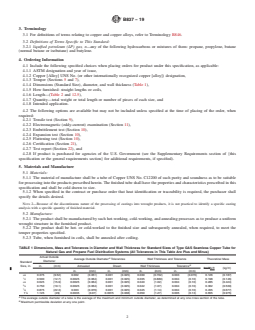
TABLE 1 Dimensions, Mass and Tolerances in Diameter and Wall Thickness for Standard Sizes of Type GAS Seamless Copper Tube for
Natural Gas and Propane Fuel Distribution Systems (All Tolerances in This Table Are Plus and Minus)
Actual Outside
A
Average Outside Diameter Tolerances Wall Thickness and Tolerance Theoretical Mass
Diameter
Standard
B
Size, in. in. (mm) Annealed Drawn Wall Thickness Tolerance
lbs/ftlb/ft (kg/m)
in. (mm) in. (mm) in. (mm) in. (mm)
⁄8 0.375 (9.52) 0.002 (0.051) 0.001 (0.025) 0.030 (0.762) 0.003 (0.076) 0.126 (0.187)
⁄2 0.500 (12.7) 0.0025 (0.064) 0.001 (0.025) 0.035 (0.889) 0.004 (0.10) 0.198 (0.146)
⁄8 0.625 (15.9) 0.0025 (0.064) 0.001 (0.025) 0.040 (1.02) 0.004 (0.10) 0.285 (0.424)
⁄4 0.750 (19.1) 0.0025 (0.064) 0.001 (0.025) 0.042 (1.07) 0.004 (0.10) 0.362 (0.539)
⁄8 0.875 (22.3) 0.003 (0.076) 0.001 (0.025) 0.045 (1.14) 0.004 (0.10) 0.455 (0.677)
1 ⁄8 1.125 (29) 0.0035 (0.07) 0.0015 (0.038) 0.050 (1.27) 0.005 (0.13) 0.655 (0.975)
A
The average outside diameter of a tube is the average of the maximum and minimum outside diameter, as determined at any one cross section of the tube.
B
Maximum permissible deviation at any one point.
B837 − 19
A
TABLE 2 Standard Lengths and Tolerances
Standard Length Tolerance, all plus
Standard Size,
in.
ft. (m) in. (mm)
Tubes Furnished in Straight Lengths
3 1
⁄8 –1 ⁄8 12 (3.7) 1 (25)
20 (6.1) 1 (25)
Tubes Furnished in Coils
3 1
⁄8 –1 ⁄8 60 (18) 24 (600)
100 (30.5) 24 (600)
A
Longer lengths are subject to agreement between the manufacturer or supplier
and purchaser.
5.2.4 Tube, when furnished in straight lengths, shall be normally furnished in the H58 (Drawn General Purpose) temper, except
when the O60 (Soft Anneal) temper is specified in the purchase order or contract.
6. Chemical Composition
6.1 The chemical composition shall conform to the following chemical requirements of Copper UNS No. C12200:
Copper (incl. silver) 99.9 % min.
Phosphorus 0.015 to 0.040 %
6.2 These composition limits do not preclude the presence of other elements. When included in the contract or purchase order,
and agreed upon by the manufacturer or supplier and the purchaser, limits shall be established and analysis required for unnamed
elements.
7. Temper
7.1 Type GAS copper tube shall be furnished in either of the following tempers as defined in Classification B601.
Soft anneal O60
Drawn general purpose H58
8. Grain Size for Annealed Tempers
8.1 Grain size shall be the standard requirement for all product in the annealed tempers.
8.2 Acceptance or rejection based upon grain size shall depend only on the average grain size of a test specimen taken from
each of two sample portions, and each specimen shall be within the limits prescribed in Table 3, when determined in accordance
with Test Methods E112.
9. Mechanical Property Requirements
9.1 Tensile Strength Requirement:
9.1.1 When specified in the contract or purchase order, the product shall conform to the tensile strength requirements in Table
3, when tested in accordance with Test Methods E8/E8M. Actual testing need not be performed unless specified at time of order
placement.
9.1.2 Acceptance or rejection based upon mechanical properties shall depend only on tensile strength.
9.2 Rockwell Hardness Requirement:
9.2.1 When specified in the contract or purchase order, the product shall conform to the Rockwell Hardness requirement
prescribed in Table 3, when tested in accordance with Test Methods E18.
10. Performance Requirements
10.1 Expansion Test:
10.1.1 When specified in the contract or purchase order, tube furnished in the soft-anneal (O60) shall withstand expansion in
accordance with Test Method B153 to the following extent:
TABLE 3 Mechanical Property Requirements
A
Temper Designation Tensile Strength Average Rockwell Hardness
B
ksi, min. Grain Size, Hardness
Standard Former MPa min. Scale
mm Value
O60 Soft anneal 30 (205) 0.035 min. F 50 max
H58 Drawn general 36 (250) . 30T 30 min
purpose
A
Rockwell Hardness tests shall be made on the inside surface of the tube.
B
ksi = 1000 psi.
B837 − 19
Standard Size Expansion of
(Actual Outside Diameter) Outside Diameter
in. (mm) %
0.625 (15.9) and under 40
Over 0.625 (15.9) 30
10.1.2 The expanded tube shall show no cracking or rupture visible to the unaided eye.
10.2 Flattening Test:
10.2.1 When specified in the contract or purchase order, the flattening test in accordance with Test Method B968/B968M shall
be performed.
10.2.1.1 During inspection, the flattened areas of the test specimen shall be free of defects, but blemishes of a nature that do
not interfere with the intended application are acceptable.
10.3 Microscopical Examination for Susceptibility to Hydrogen Embrittlement:
10.3.1 Tubes furnished in all coppers shall be capable of passing the embrittlement test specified in Procedure B of Test Methods
B577. In case of a dispute, Procedure C of Test Methods B577 shall be used as the referee method.
11. Nondestructive Testing
11.1 Each tube up to and including 1.125 in. (28.6 mm) outside diameter shall be subjected to an eddy-current test. Testing shall
follow the procedures of Practice E243, except for the determination of “end effect.” Tubes shall be passed through an eddy-current
test unit adjusted to provide information on the suitability of the tube for the intended application.
11.1.1 Either notch depth or drilled hole standards shall be used.
11.1.1.1 Notch depth standards, rounded to the nearest 0.001 in. (0.025 mm), shall be 22 % of the standard wall thickness. The
notch depth tolerance shall be plus and minus 0.0005 in. (0.013 mm). Alternatively, at the option of the manufacturer, using
speed-insensitive eddy-current units that are equipped so that a fraction of the maximum unbalance signal can be selected, the
following percent maximum unbalance signals may be used:
Unbalanced Signal
Standard Size, in. (mm)
Magnitude, max. %
Up to 0.500 (12.7) incl. 0.2
0.625 (15.9) to 1.125 (29) incl. 0.3
11.1.1.2 Drilled holes shall be drilled radially through the wall using a suitable drill jig that has a bushing to guide the drill, care
being taken to avoid distortion of the tube while drilling. The diameter of the drilled hole shall be in accordance with the following
Table and shall not vary by either more than +0.001 in. ( +0.025(+0.025 mm) or −0.000 in. (−0.000 mm) of the hole diameter
specified.
Tube Outside Diameter of Drilled
Diameter, in. Holes, in. Drill No.
3 3
⁄8 to ⁄4, incl 0.025 72
Over ⁄4 to 1, incl 0.031 68
Over 1 to 1 ⁄8, incl 0.036 64
Tube Outside Diameter of Drilled
Diameter, mm Holes, mm Drill No.
9.0 to 19.0, incl 0.64 72
Over 19.0 to 25, incl 0.79 68
Over 25 to 29, incl 0.92 64
11.1.2 Tubes that do not actuate the signaling device of the eddy-current tester shall be considered in conformance with the
requirements of this test. Tubes with discontinuities indicated by the testing unit may, at the option of the manufacturer, be
re-examined or retested to determine whether the discontinuity is cause for rejection. Signals that are found to have been caused
by minor mechanical damage shall not be cause for rejection of the tubes, provided the tube dimensions are still within the specified
limits and the tube is suitable for its intended application.
12. Dimensions, Mass, and Permissible Variations
12.1 For the purpose of determining conformance with the dimensional requirements prescribed in this specification, any
measured value outside the specified limiting values for any dimension shall make the tube subject to rejection at the option of
the purchaser.
12.2 Standard Dimensions, Wall Thickness, and Diameter Tolerances—The standard dimensions, wall thickness, and diameter
tolerances shall be in accordance with Table 1.
12.3 Mass—For purposes of calculating mass, cross sections, etc., the density of copper shall be taken as 0.323 lb/in. (8.94
g/cm ). The theoretical weight per foot is given in Table 1.
B837 − 19
12.4 Roundness—For drawn unannealed tube in straight lengths, the roundness tolerance shall be as specified in Table 4. The
deviation from roundness is measured as the difference between major and minor diameters as determined at any one cross section
of the tube. No roundness tolerance has been established for annealed tube in straight lengths or for tube furnished in coils.
12.5 Lengths and Tolerances:
12.5.1 Standard Lengths and Tolerances—The standard lengths and tolerances shall be as specified in Table 2.
12.5.2 Tube supplied in other than standard lengths and tolerances shall be in accordance with requirements established by
agreement between the manufacturer or supplier and the purchaser.
12.6 Squareness of Cut—For tubes in straight lengths, the departure from squareness of the end of any tube shall not exceed
0.010 in./in. (0.25 mm/mm) of outside diameter for tube up to and including 0.625 in. (15.9 mm) standard size; and not more than
0.016 in./in. (0.016 mm/mm) of outside diameter for tube larger than 0.625 in. (15.9 mm) standard size.
13. Workmanship, Finish, and Appearance
13.1 The product shall be free of defects, but blemishes of a nature that do not interfere with the intended application are
acceptable.
14. Sampling
14.1 The lot size, portion size, and selection of pieces shall be as follows:
14.1.1 Lot Size—Lot size shall be 5000 lb (2275 kg) or fraction thereof.
14.1.2 Portion Size—Sample pieces shall be selected according to the following schedule:
Number of Pieces Number of Pieces
in the Lot to be Selected
1 to 50 1
51 to 200 2
201 to 1500 3
Over 1500 0.2 % of total number pieces
but not to exceed 10
14.1.3 Coiled Tube—A length sufficient for all necessary tests shall be cut from each coil. The remaining portion of these coils
shall be identified and included in the shipment. The permissible variation in lengths of such coils shall be waived.
14.2 Sampling for Chemical Analysis:
14.2.1 The sample shall be taken in approximately equal weight from each portion piece selected in 14.1.2 and in accordance
with Practice E255. The minimum weight of the composite sample shall be 150 g.
14.2.2 Instead of sampling in accordance with Practice E255, th
...