

ASTM D6849-22
(Practice)Standard Practice for Storage and Use of Liquefied Petroleum Gases (LPG) in Sample Cylinders for LPG Test Methods
General Information
- Abstract
SIGNIFICANCE AND USE
5.1 LPG samples can change composition during storage and use from preferential vaporization of lighter (lower molecular weight) hydrocarbon components, dissolved inert gases (N2, Ar, He, and so forth) and other dissolved gases/liquids (NH3, CO2, H2S, H2O, etc.). Careful selection of cylinder type, cylinder volume, and use of inert gas for pressurizing cylinders is required to ensure that composition changes are small enough to maintain the integrity of LPG when used as a QC reference material for various LPG test methods.
5.2 Monitoring of ongoing precision and bias on QC materials using control chart techniques in accordance with Practice D6299 can be used to establish the need for calibration or maintenance.
SCOPE
1.1 This practice covers information for the storage and use of LPG samples in standard cylinders of the type used in sampling method, Practice D1265 and floating piston cylinders used in sampling method, Practice D3700.
1.2 This practice is especially applicable when the LPG sample is used as a quality control (QC) reference material for LPG test methods, such as gas chromatography (GC) analysis (Test Method D2163) or vapor pressure (Test Method D6897) that use only a few mL per test, since relatively small portable Department of Transportation (DOT) cylinders (for example, 20 lb common barbecue cylinders, or common Mower/Forklift cylinders) can be used.
1.2.1 Modification of the pressure relief (QCC1) valve on single access port cylinders may prohibit the collection or transport of cylinders outside of permitted facilities such as refineries, gas plants or pipeline stations. No modification is generally required for multi-port mower/forklift cylinders that have a separate access port for pressure relief and additional access ports for filling, liquid/vapor withdrawal or liquid level indication. Consult the Authority having Jurisdiction for detailed regional regulatory requirements for transport of LPG in pressurized cylinders.
1.3 This practice can be applied to other test methods. However, test methods that require a large amount of sample per test (for example, manual vapor pressure Test Method D1267) will require QC volumes in excess of 1000 L if stored in standard DOT cylinders or American Society of Mechanical Engineers (ASME) vessels.
1.3.1 Test methods for trace materials that may be sensitive to vessel surfaces (for example H2O, H2S/sulfur, or trace residues) could preferably use aluminum, stainless steel or internally coated vessels to minimize surface absorption/reaction or larger vessels to minimize surface/volume ratio.
1.4 This international standard was developed in accordance with internationally recognized principles on standardization established in the Decision on Principles for the Development of International Standards, Guides and Recommendations issued by the World Trade Organization Technical Barriers to Trade (TBT) Committee.
- Status
- Published
- Publication Date
- 30-Apr-2022
- Technical Committee
- D02 - Petroleum Products, Liquid Fuels, and Lubricants
- Drafting Committee
- D02.08 - Volatility
Buy Documents

ASTM D6849-22 - Standard Practice for Storage and Use of Liquefied Petroleum Gases (LPG) in Sample Cylinders for LPG Test Methods
REDLINE ASTM D6849-22 - Standard Practice for Storage and Use of Liquefied Petroleum Gases (LPG) in Sample Cylinders for LPG Test Methods
Overview
ASTM D6849-22 is a standard practice developed by ASTM International for the storage and use of liquefied petroleum gases (LPG) in sample cylinders, specifically for use in LPG test methods. This standard provides guidance to ensure that LPG sample integrity is maintained when used as quality control (QC) reference materials for laboratory analyses, such as gas chromatography (GC) and vapor pressure tests. Given the tendency for LPG compositions to shift due to preferential vaporization of lighter components and dissolved gases, ASTM D6849-22 outlines best practices for sample cylinder selection, storage conditions, and handling procedures.
Key Topics
Cylinder Selection and Volume
- Recommends careful selection of cylinder type and volume to limit changes in LPG composition during storage.
- Addresses both standard 80% fill cylinders (typical DOT or ASME types) and floating piston cylinders.
Sample Integrity & Quality Control
- Emphasizes maintaining sample composition for quality control.
- Describes how improper storage or cylinder selection can lead to bias or loss of sample integrity, impacting measurement precision.
Use of Inert Gases
- Discusses the controlled use of inert gases (e.g., helium or nitrogen) to pressurize cylinders.
- Warns about the potential solubility of these gases in LPG, which can alter test results, especially for vapor pressure and GC analyses.
Sampling and Handling Procedures
- Provides guidelines for the safe sampling and transport of LPG.
- Covers regulatory considerations for modified pressure relief valves on transport cylinders.
Control Chart Monitoring
- Encourages the application of statistical quality control techniques, such as control charts, (referencing ASTM D6299) to monitor reference material stability and detect the need for recalibration.
Applications
This standard is widely used in industries that require accurate LPG testing, such as:
Laboratory Analysis
- Ensures LPG samples used for routine laboratory tests (e.g., gas chromatography or vapor pressure determination) remain representative of bulk supplies.
Quality Assurance in LPG Production
- Supports producers, refiners, and pipeline operators in maintaining QC reference materials validated against recognized test methods.
- Useful for ensuring compliance with regulatory and industry requirements concerning LPG sampling, storage, and certification.
Transport and Storage for Testing
- Provides procedures for safely transporting and storing LPG test samples in portable DOT cylinders, which are common in field and plant environments.
- Specifies preferred practices for handling QC materials across the supply chain.
Related Standards
This standard practice is directly linked to several other ASTM standards for LPG testing and control:
- ASTM D1265 - Practice for Sampling Liquefied Petroleum (LP) Gases, Manual Method
- ASTM D1267 - Test Method for Gauge Vapor Pressure of LP-Gas
- ASTM D2163 - Test Method for Determination of Hydrocarbons in LPG by Gas Chromatography
- ASTM D3700 - Practice for Obtaining LPG Samples Using a Floating Piston Cylinder
- ASTM D6299 - Practice for Applying Statistical Quality Assurance and Control Charting Techniques in Analytical Measurement
- ASTM D6897 - Test Method for Vapor Pressure of LPG (Expansion Method)
Practical Value
By following ASTM D6849-22, laboratories and facilities can:
- Maintain reliable and stable LNG QC reference standards over time.
- Reduce the risk of test result discrepancies due to sample degradation or improper handling.
- Monitor and adjust for long-term trends in sample performance, optimizing QC batch use and minimizing waste.
- Comply with international regulations and safety requirements for LPG sample storage and transportation.
Adherence to this standard is essential for anyone involved in LPG quality control and laboratory testing, ensuring accurate and repeatable results across the LPG supply chain.
Relations
- Effective Date
- 01-Dec-2023
- Effective Date
- 01-Dec-2023
- Effective Date
- 15-Dec-2017
- Effective Date
- 15-Nov-2017
- Effective Date
- 01-Jan-2017
- Effective Date
- 01-Jan-2014
- Effective Date
- 01-Oct-2013
- Effective Date
- 01-Nov-2012
- Effective Date
- 01-Nov-2012
- Effective Date
- 01-Mar-2010
- Effective Date
- 01-Mar-2010
- Effective Date
- 01-Nov-2009
- Effective Date
- 15-Oct-2008
- Effective Date
- 01-Nov-2007
- Effective Date
- 01-Nov-2007
Buy Documents
ASTM D6849-22 - Standard Practice for Storage and Use of Liquefied Petroleum Gases (LPG) in Sample Cylinders for LPG Test Methods
REDLINE ASTM D6849-22 - Standard Practice for Storage and Use of Liquefied Petroleum Gases (LPG) in Sample Cylinders for LPG Test Methods
Get Certified
Connect with accredited certification bodies for this standard

Element Materials Technology
Materials testing and product certification.

ABS Group Brazil
ABS Group certification services in Brazil.

ABS Quality Evaluations Inc.
American Bureau of Shipping quality certification.
Sponsored listings
Frequently Asked Questions
ASTM D6849-22 is a standard published by ASTM International. Its full title is "Standard Practice for Storage and Use of Liquefied Petroleum Gases (LPG) in Sample Cylinders for LPG Test Methods". This standard covers: SIGNIFICANCE AND USE 5.1 LPG samples can change composition during storage and use from preferential vaporization of lighter (lower molecular weight) hydrocarbon components, dissolved inert gases (N2, Ar, He, and so forth) and other dissolved gases/liquids (NH3, CO2, H2S, H2O, etc.). Careful selection of cylinder type, cylinder volume, and use of inert gas for pressurizing cylinders is required to ensure that composition changes are small enough to maintain the integrity of LPG when used as a QC reference material for various LPG test methods. 5.2 Monitoring of ongoing precision and bias on QC materials using control chart techniques in accordance with Practice D6299 can be used to establish the need for calibration or maintenance. SCOPE 1.1 This practice covers information for the storage and use of LPG samples in standard cylinders of the type used in sampling method, Practice D1265 and floating piston cylinders used in sampling method, Practice D3700. 1.2 This practice is especially applicable when the LPG sample is used as a quality control (QC) reference material for LPG test methods, such as gas chromatography (GC) analysis (Test Method D2163) or vapor pressure (Test Method D6897) that use only a few mL per test, since relatively small portable Department of Transportation (DOT) cylinders (for example, 20 lb common barbecue cylinders, or common Mower/Forklift cylinders) can be used. 1.2.1 Modification of the pressure relief (QCC1) valve on single access port cylinders may prohibit the collection or transport of cylinders outside of permitted facilities such as refineries, gas plants or pipeline stations. No modification is generally required for multi-port mower/forklift cylinders that have a separate access port for pressure relief and additional access ports for filling, liquid/vapor withdrawal or liquid level indication. Consult the Authority having Jurisdiction for detailed regional regulatory requirements for transport of LPG in pressurized cylinders. 1.3 This practice can be applied to other test methods. However, test methods that require a large amount of sample per test (for example, manual vapor pressure Test Method D1267) will require QC volumes in excess of 1000 L if stored in standard DOT cylinders or American Society of Mechanical Engineers (ASME) vessels. 1.3.1 Test methods for trace materials that may be sensitive to vessel surfaces (for example H2O, H2S/sulfur, or trace residues) could preferably use aluminum, stainless steel or internally coated vessels to minimize surface absorption/reaction or larger vessels to minimize surface/volume ratio. 1.4 This international standard was developed in accordance with internationally recognized principles on standardization established in the Decision on Principles for the Development of International Standards, Guides and Recommendations issued by the World Trade Organization Technical Barriers to Trade (TBT) Committee.
SIGNIFICANCE AND USE 5.1 LPG samples can change composition during storage and use from preferential vaporization of lighter (lower molecular weight) hydrocarbon components, dissolved inert gases (N2, Ar, He, and so forth) and other dissolved gases/liquids (NH3, CO2, H2S, H2O, etc.). Careful selection of cylinder type, cylinder volume, and use of inert gas for pressurizing cylinders is required to ensure that composition changes are small enough to maintain the integrity of LPG when used as a QC reference material for various LPG test methods. 5.2 Monitoring of ongoing precision and bias on QC materials using control chart techniques in accordance with Practice D6299 can be used to establish the need for calibration or maintenance. SCOPE 1.1 This practice covers information for the storage and use of LPG samples in standard cylinders of the type used in sampling method, Practice D1265 and floating piston cylinders used in sampling method, Practice D3700. 1.2 This practice is especially applicable when the LPG sample is used as a quality control (QC) reference material for LPG test methods, such as gas chromatography (GC) analysis (Test Method D2163) or vapor pressure (Test Method D6897) that use only a few mL per test, since relatively small portable Department of Transportation (DOT) cylinders (for example, 20 lb common barbecue cylinders, or common Mower/Forklift cylinders) can be used. 1.2.1 Modification of the pressure relief (QCC1) valve on single access port cylinders may prohibit the collection or transport of cylinders outside of permitted facilities such as refineries, gas plants or pipeline stations. No modification is generally required for multi-port mower/forklift cylinders that have a separate access port for pressure relief and additional access ports for filling, liquid/vapor withdrawal or liquid level indication. Consult the Authority having Jurisdiction for detailed regional regulatory requirements for transport of LPG in pressurized cylinders. 1.3 This practice can be applied to other test methods. However, test methods that require a large amount of sample per test (for example, manual vapor pressure Test Method D1267) will require QC volumes in excess of 1000 L if stored in standard DOT cylinders or American Society of Mechanical Engineers (ASME) vessels. 1.3.1 Test methods for trace materials that may be sensitive to vessel surfaces (for example H2O, H2S/sulfur, or trace residues) could preferably use aluminum, stainless steel or internally coated vessels to minimize surface absorption/reaction or larger vessels to minimize surface/volume ratio. 1.4 This international standard was developed in accordance with internationally recognized principles on standardization established in the Decision on Principles for the Development of International Standards, Guides and Recommendations issued by the World Trade Organization Technical Barriers to Trade (TBT) Committee.
ASTM D6849-22 is classified under the following ICS (International Classification for Standards) categories: 75.200 - Petroleum products and natural gas handling equipment. The ICS classification helps identify the subject area and facilitates finding related standards.
ASTM D6849-22 has the following relationships with other standards: It is inter standard links to ASTM D6299-23a, ASTM D1265-23a, ASTM D6299-17b, ASTM D6299-17a, ASTM D6299-17, ASTM D2163-14, ASTM D6299-13e1, ASTM D1267-12, ASTM D3700-12, ASTM D6299-10, ASTM D6299-10e2, ASTM D6299-09, ASTM D6299-08, ASTM D6299-07e1, ASTM D6299-07. Understanding these relationships helps ensure you are using the most current and applicable version of the standard.
ASTM D6849-22 is available in PDF format for immediate download after purchase. The document can be added to your cart and obtained through the secure checkout process. Digital delivery ensures instant access to the complete standard document.
Standards Content (Sample)
This international standard was developed in accordance with internationally recognized principles on standardization established in the Decision on Principles for the
Development of International Standards, Guides and Recommendations issued by the World Trade Organization Technical Barriers to Trade (TBT) Committee.
Designation: D6849 −22
Standard Practice for
Storage and Use of Liquefied Petroleum Gases (LPG) in
Sample Cylinders for LPG Test Methods
This standard is issued under the fixed designation D6849; the number immediately following the designation indicates the year of
original adoption or, in the case of revision, the year of last revision. A number in parentheses indicates the year of last reapproval. A
superscript epsilon (´) indicates an editorial change since the last revision or reapproval.
1. Scope* 1.4 This international standard was developed in accor-
dance with internationally recognized principles on standard-
1.1 This practice covers information for the storage and use
ization established in the Decision on Principles for the
of LPG samples in standard cylinders of the type used in
Development of International Standards, Guides and Recom-
sampling method, Practice D1265 and floating piston cylinders
mendations issued by the World Trade Organization Technical
used in sampling method, Practice D3700.
Barriers to Trade (TBT) Committee.
1.2 This practice is especially applicable when the LPG
sample is used as a quality control (QC) reference material for 2. Referenced Documents
LPG test methods, such as gas chromatography (GC) analysis
2.1 ASTM Standards:
(Test Method D2163) or vapor pressure (Test Method D6897)
D1265 Practice for Sampling Liquefied Petroleum (LP)
that use only a few mL per test, since relatively small portable
Gases, Manual Method
Department of Transportation (DOT) cylinders (for example,
D1267 Test Method for Gauge Vapor Pressure of Liquefied
20 lb common barbecue cylinders, or common Mower/Forklift
Petroleum (LP) Gases (LP-Gas Method)
cylinders) can be used.
D2163 Test Method for Determination of Hydrocarbons in
1.2.1 Modification of the pressure relief (QCC1) valve on
Liquefied Petroleum (LP) Gases and Propane/Propene
single access port cylinders may prohibit the collection or
Mixtures by Gas Chromatography
transport of cylinders outside of permitted facilities such as
D3700 Practice for Obtaining LPG Samples Using a Float-
refineries, gas plants or pipeline stations. No modification is
ing Piston Cylinder
generally required for multi-port mower/forklift cylinders that
D6299 Practice for Applying Statistical Quality Assurance
have a separate access port for pressure relief and additional
and Control Charting Techniques to Evaluate Analytical
access ports for filling, liquid/vapor withdrawal or liquid level
Measurement System Performance
indication. Consult the Authority having Jurisdiction for de-
D6897 Test Method for Vapor Pressure of Liquefied Petro-
tailed regional regulatory requirements for transport of LPG in
leum Gases (LPG) (Expansion Method)
pressurized cylinders.
3. Terminology
1.3 This practice can be applied to other test methods.
3.1 Definitions:
However, test methods that require a large amount of sample
3.1.1 floating piston cylinder (FPC), n—high-pressure
per test (for example, manual vapor pressure Test Method
sample container with a free-floating internal piston that
D1267) will require QC volumes in excess of 1000 L if stored
effectively divides the container into two separate compart-
in standard DOT cylinders orAmerican Society of Mechanical
ments.
Engineers (ASME) vessels.
3.1.1.1 Discussion—A floating piston cylinder is used to
1.3.1 Test methods for trace materials that may be sensitive
collect a sample of liquid under pressure without the formation
to vessel surfaces (for example H O, H S/sulfur, or trace
2 2
of a gaseous phase which can result in changes in the
residues) could preferably use aluminum, stainless steel or
composition of the liquid sample.
internally coated vessels to minimize surface absorption/
reaction or larger vessels to minimize surface/volume ratio.
3.1.2 high-pressure sample cylinder, n—a container used for
storage and transportation of a sample obtained at pressures
above atmospheric pressure.
This practice is under the jurisdiction of ASTM Committee D02 on Petroleum
Products, Liquid Fuels, and Lubricants and is the direct responsibility of Subcom-
mittee D02.08 on Volatility. For referenced ASTM standards, visit the ASTM website, www.astm.org, or
CurrenteditionapprovedMay1,2022.PublishedJuly2022.Originallyapproved contact ASTM Customer Service at service@astm.org. For Annual Book of ASTM
in 2002. Last previous edition approved in 2021 as D6849 – 13 (2021). DOI: Standards volume information, refer to the standard’s Document Summary page on
10.1520/D6849-22. the ASTM website.
*A Summary of Changes section appears at the end of this standard
Copyright © ASTM International, 100 Barr Harbor Drive, PO Box C700, West Conshohocken, PA 19428-2959. United States
D6849 − 22
material is the cause for the out-of-control situation.
3.1.2.1 Discussion—This type of sample cylinder, some-
timescalleda‘standard80 %fillcylinder’,whenusedforLPG
7. Use of Floating Piston Cylinders for LPG Samples
typically contains both liquid and vapor phase material.
7.1 Minimum LPG sample volume can be determined in
3.1.3 liquefied petroleum gas, (LP Gas, LPG), n—a narrow
accordance with Practice D6299.
boiling range mixture of hydrocarbons consisting of propane,
NOTE 2—Estimating the minimum LPG sample volume needed in-
propylene, butanes and butylenes, individually or in specified
cludes such things as the sample volume needed to conduct the appropri-
combinations, with limited amounts of other hydrocarbons and
ate test(s) and the number of analytical measurements that are expected to
naturally occurring non-hydrocarbons.
be made over the intended period of use.
3.1.3.1 Discussion—LPG is typically maintained in a liquid
7.2 Floating piston cylinders (see Fig. 1) are preferred for
state by containing it within a closed container or storage tank
LPG sample materials for tests involving accurate determina-
that can withstand the vapor pressure of the LPG at ambient
tion of light gases.
temperature, or at a low temperature in refrigerated storage.
7.3 Excessive inert gas pressure should be avoided for long
3.1.4 maximum fill volume (reduced fill volume), n—the
term storage of vapor pressure QC or calibrant materials in
volumeofacontainerthatmaybesafelyoccupiedbytheliquid
floating piston cylinders. Leakage of inert gas past worn or
sample, usually expressed as a percentage of the total capacity.
damaged floating piston seals can cause an increase in dis-
3.1.4.1 Discussion—Some regulatory agencies use the ex-
solved gas concentration and vapor pressure of the QC sample
pressions ‘maximum fill density’ and ‘reduced fill density.’
material.
4. Summary of Practice
8. Use of Standard 80 % Fill Cylinders for LPG QC
4.1 This practice provides information for the design and
Materials
operation of LPG sample storage cylinders taking into account
8.1 Common 80 % filled storage tanks or cylinders can be
properties of LPG and types of cylinders in common use for
used for LPG QC materials provided that the QC material
storage of LPG.
batch volume is sufficiently large to avoid adverse short term
4.2 This practice provides additional guidelines to Practice
vaporization effects.
D6299 to determine the minimum volume of LPG sample
8.2 The total initial volume and the minimum unused
material required, when used as a QC reference material.
volume of QC materials stored in standard 80 % fill cylinders
mustbecontrolledtoensurethatintheshortterm,composition
5. Significance and Use
is constant relative to the precision of the test method.
5.1 LPG samples can change composition during storage
8.2.1 As liquid is withdrawn from LPG cylinders, a small
and use from preferential vaporization of lighter (lower mo-
amount of the remaining liquid must vaporize to replace the
lecular weight) hydrocarbon components, dissolved inert gases
(N , Ar, He, and so forth) and other dissolved gases/liquids
(NH ,CO ,H S, H O, etc.). Careful selection of cylinder type,
3 2 2 2
cylinder volume, and use of inert gas for pressurizing cylinders
is required to ensure that composition changes are small
enough to maintain the integrity of LPG when used as a QC
reference material for various LPG test methods.
5.2 Monitoring of ongoing precision and bias on QC mate-
rials using control chart techniques in accordance with Practice
D6299 can be used to establish the need for calibration or
maintenance.
6. Reference Materials
6.1 The LPG QC reference material should have a vapor
pressure and composition in the range of the samples regularly
tested by the equipment. This is particularly important for
LPG/natural gas liquid (NGL) mixtures near the critical
temperature, as these liquids have large thermal and pressure
expansion coefficients.
6.2 LPG QC reference materials should be stored in an
environment suitable for long
...
This document is not an ASTM standard and is intended only to provide the user of an ASTM standard an indication of what changes have been made to the previous version. Because
it may not be technically possible to adequately depict all changes accurately, ASTM recommends that users consult prior editions as appropriate. In all cases only the current version
of the standard as published by ASTM is to be considered the official document.
Designation: D6849 − 13 (Reapproved 2021) D6849 − 22
Standard Practice for
Storage and Use of Liquefied Petroleum Gases (LPG) in
Sample Cylinders for LPG Test Methods
This standard is issued under the fixed designation D6849; the number immediately following the designation indicates the year of
original adoption or, in the case of revision, the year of last revision. A number in parentheses indicates the year of last reapproval. A
superscript epsilon (´) indicates an editorial change since the last revision or reapproval.
1. Scope Scope*
1.1 This practice covers information for the storage and use of LPG samples in standard cylinders of the type used in sampling
method, Practice D1265 and floating piston cylinders used in sampling method, Practice D3700.
1.2 This practice is especially applicable when the LPG sample is used as a quality control (QC) reference material for LPG test
methods, such as gas chromatography (GC) analysis (Test Method D2163) or vapor pressure (Test Method D6897) that use only
a few mL per test, since relatively small portable Department of Transportation (DOT) cylinders (for example, 20 lb common
barbecue cylinders, or common Mower/Forklift cylinders) can be used. This practice can be applied to other test methods.
However, test methods that require a large amount of sample per test (for example, manual vapor pressure Test Method D1267)
will require QC volumes in excess of 1000 L if stored in standard DOT cylinders or American Society of Mechanical Engineers
(ASME) vessels.
1.2.1 Modification of the pressure relief (QCC1) valve on single access port cylinders may prohibit the collection or transport of
cylinders outside of permitted facilities such as refineries, gas plants or pipeline stations. No modification is generally required for
multi-port mower/forklift cylinders that have a separate access port for pressure relief and additional access ports for filling,
liquid/vapor withdrawal or liquid level indication. Consult the Authority having Jurisdiction for detailed regional regulatory
requirements for transport of LPG in pressurized cylinders.
1.3 This practice can be applied to other test methods. However, test methods that require a large amount of sample per test (for
example, manual vapor pressure Test Method D1267) will require QC volumes in excess of 1000 L if stored in standard DOT
cylinders or American Society of Mechanical Engineers (ASME) vessels.
1.3.1 Test methods for trace materials that may be sensitive to vessel surfaces (for example H O, H S/sulfur, or trace residues)
2 2
could preferably use aluminum, stainless steel or internally coated vessels to minimize surface absorption/reaction or larger vessels
to minimize surface/volume ratio.
1.4 This international standard was developed in accordance with internationally recognized principles on standardization
established in the Decision on Principles for the Development of International Standards, Guides and Recommendations issued
by the World Trade Organization Technical Barriers to Trade (TBT) Committee.
This practice is under the jurisdiction of ASTM Committee D02 on Petroleum Products, Liquid Fuels, and Lubricants and is the direct responsibility of Subcommittee
D02.08 on Volatility.
Current edition approved Dec. 1, 2021May 1, 2022. Published December 2021July 2022. Originally approved in 2002. Last previous edition approved in 20132021 as
D6849 – 13.D6849 – 13 (2021). DOI: 10.1520/D6849-13R21.10.1520/D6849-22.
*A Summary of Changes section appears at the end of this standard
Copyright © ASTM International, 100 Barr Harbor Drive, PO Box C700, West Conshohocken, PA 19428-2959. United States
D6849 − 22
2. Referenced Documents
2.1 ASTM Standards:
D1265 Practice for Sampling Liquefied Petroleum (LP) Gases, Manual Method
D1267 Test Method for Gauge Vapor Pressure of Liquefied Petroleum (LP) Gases (LP-Gas Method)
D2163 Test Method for Determination of Hydrocarbons in Liquefied Petroleum (LP) Gases and Propane/Propene Mixtures by
Gas Chromatography
D3700 Practice for Obtaining LPG Samples Using a Floating Piston Cylinder
D6299 Practice for Applying Statistical Quality Assurance and Control Charting Techniques to Evaluate Analytical Measure-
ment System Performance
D6897 Test Method for Vapor Pressure of Liquefied Petroleum Gases (LPG) (Expansion Method)
3. Terminology
3.1 Definitions:
3.1.1 floating piston cylinder (FPC), n—high-pressure sample container with a free-floating internal piston that effectively divides
the container into two separate compartments.
3.1.1.1 Discussion—
A floating piston cylinder is used to collect a sample of liquid under pressure without the formation of a gaseous phase which can
result in changes in the composition of the liquid sample.
3.1.2 high-pressure sample cylinder, n—a container used for storage and transportation of a sample obtained at pressures above
atmospheric pressure.
3.1.2.1 Discussion—
This type of sample cylinder, sometimes called a ‘standard 80 % fill cylinder’, when used for LPG typically contains both liquid
and vapor phase material.
3.1.3 liquefied petroleum gas, (LP Gas, LPG), n—a narrow boiling range mixture of hydrocarbons consisting of propane,
propylene, butanes and butylenes, individually or in specified combinations, with limited amounts of other hydrocarbons and
naturally occurring non-hydrocarbons.
3.1.3.1 Discussion—
LPG is typically maintained in a liquid state by containing it within a closed container or storage tank that can withstand the vapor
pressure of the LPG at ambient temperature, or at a low temperature in refrigerated storage.
3.1.4 maximum fill volume (reduced fill volume), n—the volume of a container that may be safely occupied by the liquid sample,
usually expressed as a percentage of the total capacity.
3.1.4.1 Discussion—
Some regulatory agencies use the expressions ‘maximum fill density’ and ‘reduced fill density.’
4. Summary of Practice
4.1 This practice provides information for the design and operation of LPG sample storage cylinders taking into account properties
of LPG and types of cylinders in common use for storage of LPG.
4.2 This practice provides additional guidelines to Practice D6299 to determine the minimum volume of LPG sample material
required, when used as a QC reference material.
5. Significance and Use
5.1 LPG samples can change composition during storage and use from preferential vaporization of lighter (lower molecular
weight) hydrocarbon components, dissolved inert gases (N , Ar, He, and so forth) and other dissolved gases/liquids (NH , CO ,
2 3 2
H S, H O, etc.). Careful selection of cylinder type, cylinder volume, and use of inert gas for pressurizing cylinders is required to
2 2
ensure that composition changes are small enough to maintain the integrity of LPG when used as a QC reference material for
various LPG test methods.
For referenced ASTM standards, visit the ASTM website, www.astm.org, or contact ASTM Customer Service at service@astm.org. For Annual Book of ASTM Standards
volume information, refer to the standard’s Document Summary page on the ASTM website.
D6849 − 22
5.2 Monitoring of ongoing precision and bias on QC materials using control chart techniques in accordance with Practice D6299
can be used to establish the need for calibration or maintenance.
6. Reference Materials
6.1 The LPG QC reference material should have a vapor pressure and composition in the range of the samples regularly tested
by the equipment. This is particularly important for LPG/natural gas liquid (NGL) mixtures near the critical temperature, as these
liquids have large thermal and pressure expansion coefficients.
6.2 LPG QC reference materials should be stored in an environment suitable for long term storage without significant sample
degradation for the test(s) being performed.
NOTE 1—As an example, evidence of a long term shift or bias in the LPG QC reference material results obtained relative to the established statistical
control limits and average value determined for the test initially, may indicate that the composition of the LPG QC reference material has significantly
degraded or changed over time. An investigation should be conducted to determine if the long term stability of the QC reference material is the cause
for the out-of-control situation.
7. Use of Floating Piston Cylinders for LPG Samples
7.1 Minimum LPG sample volume can be determined in accordance with Practice D6299.
NOTE 2—Estimating the minimum LPG sample volume needed includes such things as the sample volume needed to conduct the appropriate test(s) and
the number of analytical measurements that are expected to be made over the intended period of use.
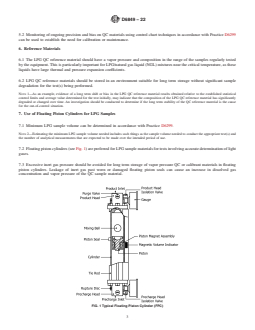
7.2 Floating piston cylinders (see Fig. 1) are preferred for LPG sample materials for tests involving accurate determination of light
gases.
7.3 Excessive inert gas pressure should be avoided for long term storage of vapor pressure QC or calibrant materials in floating
piston cylinders. Leakage of inert
...