

ASTM A106/A106M-19a
(Specification)Standard Specification for Seamless Carbon Steel Pipe for High-Temperature Service
General Information
- Abstract
ABSTRACT
This specification covers carbon steel pipe for high-temperature service. These pipes are suitable for welding, bending, flanging, and similar forming operations. Mechanical testing of the specimens shall include tensile, bending, flattening, hydrostatic and nondestructive electric tests. Specimens undergoing bending tests shall consist of sections cut from a pipe. For flattening tests, the specimens shall be smooth on the ends and burr-free, except when made on crop ends. All tests shall be performed in room temperature. If any test specimen shows flaws it can be discarded and substituted for another test specimen. Before testing, if a specimen has scribe scratches, a retest shall be allowed. A retest shall also be allowed if a specimen breaks in an inside or outside surface flaw.
SCOPE
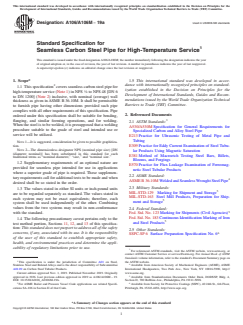
1.1 This specification2 covers seamless carbon steel pipe for high-temperature service (Note 1) in NPS 1/8 to NPS 48 [DN 6 to DN 1200] (Note 2) inclusive, with nominal (average) wall thickness as given in ASME B 36.10M. It shall be permissible to furnish pipe having other dimensions provided such pipe complies with all other requirements of this specification. Pipe ordered under this specification shall be suitable for bending, flanging, and similar forming operations, and for welding. When the steel is to be welded, it is presupposed that a welding procedure suitable to the grade of steel and intended use or service will be utilized.
Note 1: It is suggested, consideration be given to possible graphitization.
Note 2: The dimensionless designator NPS (nominal pipe size) [DN (diameter nominal)] has been substituted in this standard for such traditional terms as “nominal diameter,” “size,” and “nominal size.”
1.2 Supplementary requirements of an optional nature are provided for seamless pipe intended for use in applications where a superior grade of pipe is required. These supplementary requirements call for additional tests to be made and when desired shall be so stated in the order.
1.3 The values stated in either SI units or inch-pound units are to be regarded separately as standard. The values stated in each system may not be exact equivalents; therefore, each system shall be used independently of the other. Combining values from the two systems may result in non-conformance with the standard.
1.4 The following precautionary caveat pertains only to the test method portion, Sections 11, 12, and 13 of this specification: This standard does not purport to address all of the safety concerns, if any, associated with its use. It is the responsibility of the user of this standard to establish appropriate safety, health, and environmental practices and determine the applicability of regulatory limitations prior to use.
1.5 This international standard was developed in accordance with internationally recognized principles on standardization established in the Decision on Principles for the Development of International Standards, Guides and Recommendations issued by the World Trade Organization Technical Barriers to Trade (TBT) Committee.
- Status
- Published
- Publication Date
- 31-Oct-2019
- Technical Committee
- A01 - Steel, Stainless Steel and Related Alloys
- Drafting Committee
- A01.09 - Carbon Steel Tubular Products
Buy Documents
ASTM A106/A106M-19a - Standard Specification for Seamless Carbon Steel Pipe for High-Temperature Service
REDLINE ASTM A106/A106M-19a - Standard Specification for Seamless Carbon Steel Pipe for High-Temperature Service
Overview
ASTM A106/A106M-19a is a globally recognized standard specification developed by ASTM International for seamless carbon steel pipe intended for high-temperature service. This standard outlines the requirements for manufacturing, testing, and certification of seamless carbon steel pipes, making them suitable for various industrial applications involving elevated temperatures and pressure. The specification covers pipes from NPS 1/8 to NPS 48 (DN 6 to DN 1200), consistent with ASME B36.10M dimensions. ASTM A106 pipes are widely used in industries such as oil and gas, power generation, and petrochemical plants due to their strength, durability, and ability to withstand extreme conditions.
Key Topics
- Scope and Size Range: Covers seamless carbon steel pipes for high-temperature service in nominal sizes NPS 1/8 to NPS 48.
- Forming and Fabrication: Pipes are suitable for welding, bending, flanging, and other forming operations.
- Grades and Manufacture: Specifies requirements for different grades and manufacturing processes, including hot-finished or cold-drawn pipes.
- Mechanical Testing: Includes tensile, bending, flattening, hydrostatic pressure testing, and nondestructive electric tests to ensure pipe integrity.
- Chemical Requirements: Details maximum levels for carbon, manganese, phosphorus, sulfur, silicon, and other elements ensuring consistent steel quality.
- Dimensional Tolerances: Outlines acceptable variations for diameter, wall thickness, and length for precise fabrication.
- Marking and Certification: Mandates clear product marking, heat number traceability, and the provision of chemical analysis reports.
Applications
The ASTM A106/A106M-19a specification is essential for applications where piping must reliably transport fluids at high temperatures and pressures. Key uses include:
- Oil and Gas Industry: For gathering lines, refinery piping, and transmission lines that experience high thermal and pressure variations.
- Power Plants: Utilized in steam lines, boiler tubes, and heat exchangers where resistance to temperature and pressure cycling is critical.
- Petrochemical Plants: Used to convey process fluids under high temperatures, especially in chemical reactors and distillation columns.
- Industrial Piping Systems: Suitable for general-purpose pipelines in manufacturing and processing plants requiring robust performance.
- Infrastructure Projects: Implementation in district heating systems, gas distribution networks, and large-scale utility piping.
Seamless carbon steel pipes compliant with ASTM A106 offer advantages such as excellent weldability, structural integrity after forming or bending, and consistent mechanical properties essential for demanding service conditions.
Related Standards
To ensure compatibility, safety, and quality, ASTM A106/A106M-19a references and works alongside several related standards:
- ASME B36.10M: Welded and seamless wrought steel pipe dimensions.
- ASTM A530/A530M: General requirements for specialized carbon and alloy steel pipe.
- ASTM Practices for Testing:
- E213: Ultrasonic testing of metal pipe and tubing.
- E309: Eddy current examination of steel tubular products.
- E381: Macroetch testing for steel bars and forgings.
- E570: Flux leakage examination for ferromagnetic steel tubular products.
- MIL-STD-129/163, Fed. Std. No. 123/183: Specifications for marking, shipping, and storage, relevant for government procurement.
- SSPC-SP6: Standard for commercial blast cleaning of steel pipe surfaces.
For ASME Boiler and Pressure Vessel Code applications, users should refer to Specification SA-106.
Keywords: ASTM A106, seamless carbon steel pipe, high-temperature service, pipe specification, oil and gas piping, ASME, mechanical testing, pipe standards
By adhering to ASTM A106/A106M-19a, manufacturers, engineers, and end-users can ensure quality, safety, and regulatory compliance in high-temperature carbon steel piping applications worldwide.
Relations
- Effective Date
- 01-Nov-2019
- Effective Date
- 01-Jun-2020
- Effective Date
- 01-Jun-2015
- Effective Date
- 01-Jun-2015
- Effective Date
- 01-May-2012
- Effective Date
- 15-Feb-2011
- Effective Date
- 01-Apr-2010
- Effective Date
- 01-Jun-2009
- Effective Date
- 01-Jun-2009
- Refers
ASTM E381-01(2006) - Standard Method of Macroetch Testing Steel Bars, Billets, Blooms, and Forgings - Effective Date
- 01-Oct-2006
- Effective Date
- 01-Jul-2006
- Effective Date
- 01-Oct-2004
- Effective Date
- 01-Mar-2004
- Effective Date
- 01-Jan-2004
- Effective Date
- 01-Jan-2004
Buy Documents
ASTM A106/A106M-19a - Standard Specification for Seamless Carbon Steel Pipe for High-Temperature Service
REDLINE ASTM A106/A106M-19a - Standard Specification for Seamless Carbon Steel Pipe for High-Temperature Service
Get Certified
Connect with accredited certification bodies for this standard

Institut za varilstvo d.o.o. (Welding Institute)
Slovenia's leading welding institute since 1952. ISO 3834, EN 1090, pressure equipment certification, NDT personnel, welder qualification. Only IIW Au
Sponsored listings
Frequently Asked Questions
ASTM A106/A106M-19a is a technical specification published by ASTM International. Its full title is "Standard Specification for Seamless Carbon Steel Pipe for High-Temperature Service". This standard covers: ABSTRACT This specification covers carbon steel pipe for high-temperature service. These pipes are suitable for welding, bending, flanging, and similar forming operations. Mechanical testing of the specimens shall include tensile, bending, flattening, hydrostatic and nondestructive electric tests. Specimens undergoing bending tests shall consist of sections cut from a pipe. For flattening tests, the specimens shall be smooth on the ends and burr-free, except when made on crop ends. All tests shall be performed in room temperature. If any test specimen shows flaws it can be discarded and substituted for another test specimen. Before testing, if a specimen has scribe scratches, a retest shall be allowed. A retest shall also be allowed if a specimen breaks in an inside or outside surface flaw. SCOPE 1.1 This specification2 covers seamless carbon steel pipe for high-temperature service (Note 1) in NPS 1/8 to NPS 48 [DN 6 to DN 1200] (Note 2) inclusive, with nominal (average) wall thickness as given in ASME B 36.10M. It shall be permissible to furnish pipe having other dimensions provided such pipe complies with all other requirements of this specification. Pipe ordered under this specification shall be suitable for bending, flanging, and similar forming operations, and for welding. When the steel is to be welded, it is presupposed that a welding procedure suitable to the grade of steel and intended use or service will be utilized. Note 1: It is suggested, consideration be given to possible graphitization. Note 2: The dimensionless designator NPS (nominal pipe size) [DN (diameter nominal)] has been substituted in this standard for such traditional terms as “nominal diameter,” “size,” and “nominal size.” 1.2 Supplementary requirements of an optional nature are provided for seamless pipe intended for use in applications where a superior grade of pipe is required. These supplementary requirements call for additional tests to be made and when desired shall be so stated in the order. 1.3 The values stated in either SI units or inch-pound units are to be regarded separately as standard. The values stated in each system may not be exact equivalents; therefore, each system shall be used independently of the other. Combining values from the two systems may result in non-conformance with the standard. 1.4 The following precautionary caveat pertains only to the test method portion, Sections 11, 12, and 13 of this specification: This standard does not purport to address all of the safety concerns, if any, associated with its use. It is the responsibility of the user of this standard to establish appropriate safety, health, and environmental practices and determine the applicability of regulatory limitations prior to use. 1.5 This international standard was developed in accordance with internationally recognized principles on standardization established in the Decision on Principles for the Development of International Standards, Guides and Recommendations issued by the World Trade Organization Technical Barriers to Trade (TBT) Committee.
ABSTRACT This specification covers carbon steel pipe for high-temperature service. These pipes are suitable for welding, bending, flanging, and similar forming operations. Mechanical testing of the specimens shall include tensile, bending, flattening, hydrostatic and nondestructive electric tests. Specimens undergoing bending tests shall consist of sections cut from a pipe. For flattening tests, the specimens shall be smooth on the ends and burr-free, except when made on crop ends. All tests shall be performed in room temperature. If any test specimen shows flaws it can be discarded and substituted for another test specimen. Before testing, if a specimen has scribe scratches, a retest shall be allowed. A retest shall also be allowed if a specimen breaks in an inside or outside surface flaw. SCOPE 1.1 This specification2 covers seamless carbon steel pipe for high-temperature service (Note 1) in NPS 1/8 to NPS 48 [DN 6 to DN 1200] (Note 2) inclusive, with nominal (average) wall thickness as given in ASME B 36.10M. It shall be permissible to furnish pipe having other dimensions provided such pipe complies with all other requirements of this specification. Pipe ordered under this specification shall be suitable for bending, flanging, and similar forming operations, and for welding. When the steel is to be welded, it is presupposed that a welding procedure suitable to the grade of steel and intended use or service will be utilized. Note 1: It is suggested, consideration be given to possible graphitization. Note 2: The dimensionless designator NPS (nominal pipe size) [DN (diameter nominal)] has been substituted in this standard for such traditional terms as “nominal diameter,” “size,” and “nominal size.” 1.2 Supplementary requirements of an optional nature are provided for seamless pipe intended for use in applications where a superior grade of pipe is required. These supplementary requirements call for additional tests to be made and when desired shall be so stated in the order. 1.3 The values stated in either SI units or inch-pound units are to be regarded separately as standard. The values stated in each system may not be exact equivalents; therefore, each system shall be used independently of the other. Combining values from the two systems may result in non-conformance with the standard. 1.4 The following precautionary caveat pertains only to the test method portion, Sections 11, 12, and 13 of this specification: This standard does not purport to address all of the safety concerns, if any, associated with its use. It is the responsibility of the user of this standard to establish appropriate safety, health, and environmental practices and determine the applicability of regulatory limitations prior to use. 1.5 This international standard was developed in accordance with internationally recognized principles on standardization established in the Decision on Principles for the Development of International Standards, Guides and Recommendations issued by the World Trade Organization Technical Barriers to Trade (TBT) Committee.
ASTM A106/A106M-19a is classified under the following ICS (International Classification for Standards) categories: 23.040.10 - Iron and steel pipes. The ICS classification helps identify the subject area and facilitates finding related standards.
ASTM A106/A106M-19a has the following relationships with other standards: It is inter standard links to ASTM A106/A106M-19, ASTM E570-20, ASTM E570-15e1, ASTM E570-15, ASTM A530/A530M-12, ASTM E309-11, ASTM A530/A530M-04a(2010), ASTM E570-09, ASTM E213-09, ASTM E381-01(2006), ASTM E309-95(2006), ASTM A530/A530M-04a, ASTM A530/A530M-04, ASTM E570-97(2004)e1, ASTM E213-04. Understanding these relationships helps ensure you are using the most current and applicable version of the standard.
ASTM A106/A106M-19a is available in PDF format for immediate download after purchase. The document can be added to your cart and obtained through the secure checkout process. Digital delivery ensures instant access to the complete standard document.
Standards Content (Sample)
This international standard was developed in accordance with internationally recognized principles on standardization established in the Decision on Principles for the
Development of International Standards, Guides and Recommendations issued by the World Trade Organization Technical Barriers to Trade (TBT) Committee.
Designation:A106/A106M −19a Used in USDOE-NE standards
Standard Specification for
Seamless Carbon Steel Pipe for High-Temperature Service
This standard is issued under the fixed designationA106/A106M; the number immediately following the designation indicates the year
of original adoption or, in the case of revision, the year of last revision. A number in parentheses indicates the year of last reapproval.
A superscript epsilon (´) indicates an editorial change since the last revision or reapproval.
1. Scope* 1.5 This international standard was developed in accor-
dance with internationally recognized principles on standard-
1.1 This specification covers seamless carbon steel pipe for
ization established in the Decision on Principles for the
high-temperature service (Note 1)inNPS ⁄8 to NPS 48 [DN 6
Development of International Standards, Guides and Recom-
to DN 1200] (Note 2) inclusive, with nominal (average) wall
mendations issued by the World Trade Organization Technical
thickness as given inASME B 36.10M. It shall be permissible
Barriers to Trade (TBT) Committee.
to furnish pipe having other dimensions provided such pipe
complies with all other requirements of this specification. Pipe
2. Referenced Documents
ordered under this specification shall be suitable for bending,
flanging, and similar forming operations, and for welding.
2.1 ASTM Standards:
Whenthesteelistobewelded,itispresupposedthatawelding
A530/A530M Specification for General Requirements for
procedure suitable to the grade of steel and intended use or
Specialized Carbon and Alloy Steel Pipe
service will be utilized.
E213 Practice for Ultrasonic Testing of Metal Pipe and
Tubing
NOTE 1—It is suggested, consideration be given to possible graphitiza-
tion.
E309 Practice for Eddy Current Examination of Steel Tubu-
NOTE 2—The dimensionless designator NPS (nominal pipe size) [DN
lar Products Using Magnetic Saturation
(diameter nominal)] has been substituted in this standard for such
E381 Method of Macroetch Testing Steel Bars, Billets,
traditional terms as “nominal diameter,” “size,” and “nominal size.”
Blooms, and Forgings
1.2 Supplementary requirements of an optional nature are
E570 Practice for Flux Leakage Examination of Ferromag-
provided for seamless pipe intended for use in applications
netic Steel Tubular Products
where a superior grade of pipe is required. These supplemen-
2.2 ASME Standard:
tary requirements call for additional tests to be made and when
ASMEB 36.10M WeldedandSeamlessWroughtSteelPipe
desired shall be so stated in the order.
2.3 Military Standards:
1.3 The values stated in either SI units or inch-pound units
MIL-STD-129 Marking for Shipment and Storage
are to be regarded separately as standard. The values stated in
MIL-STD-163 Steel Mill Products, Preparation for Ship-
each system may not be exact equivalents; therefore, each
ment and Storage
system shall be used independently of the other. Combining
values from the two systems may result in non-conformance
2.4 Federal Standard:
with the standard.
Fed. Std. No. 123 Marking for Shipments (Civil Agencies)
Fed. Std. No. 183 Continuous Identification Marking of Iron
1.4 The following precautionary caveat pertains only to the
and Steel Products
test method portion, Sections 11, 12, and 13 of this specifica-
tion: This standard does not purport to address all of the safety
2.5 Other Standards:
concerns, if any, associated with its use. It is the responsibility
SSPC-SP 6 Surface Preparation Specification No. 6
of the user of this standard to establish appropriate safety,
health, and environmental practices and determine the appli-
cability of regulatory limitations prior to use.
For referenced ASTM standards, visit the ASTM website, www.astm.org, or
contact ASTM Customer Service at service@astm.org. For Annual Book of ASTM
Standards volume information, refer to the standard’s Document Summary page on
This specification is under the jurisdiction of Committee A01 on Steel, the ASTM website.
Stainless Steel and Related Alloys and is the direct responsibility of Subcommittee Available from American Society of Mechanical Engineers (ASME), ASME
A01.09 on Carbon Steel Tubular Products. International Headquarters, Two Park Ave., New York, NY 10016-5990, http://
Current edition approved Nov. 1, 2019. Published November 2019. Originally www.asme.org.
approved in 1926. Last previous edition approved in 2019 as A106/A106M – 19. Available from Standardization Documents Order Desk, DODSSP, Bldg. 4,
DOI: 10.1520/A0106_A0106M-19A. Section D, 700 Robbins Ave., Philadelphia, PA 19111-5098.
2 6
For ASME Boiler and Pressure Vessel Code applications see related Specifi- Available from Society for Protective Coatings (SSPC), 40 24th St., 6th Floor,
cations SA-106 in Section II of that Code. Pittsburgh, PA 15222-4656, http://www.sspc.org.
*A Summary of Changes section appears at the end of this standard
Copyright © ASTM International, 100 Barr Harbor Drive, PO Box C700, West Conshohocken, PA 19428-2959. United States
A106/A106M−19a
3. Ordering Information 4.3 For pipe NPS 1 ⁄2 [DN 40] and under, it shall be
permissible to furnish hot finished or cold drawn.
3.1 The inclusion of the following, as required will describe
the desired material adequately, when ordered under this 4.4 Unless otherwise specified, pipe NPS 2 [DN 50] and
specification: over shall be furnished hot finished. When agreed upon
3.1.1 Quantity (feet, metres, or number of lengths), between the manufacturer and the purchaser, it is permissible
3.1.2 Name of material (seamless carbon steel pipe), to furnish cold-drawn pipe.
3.1.3 Grade (Table 1),
5. Heat Treatment
3.1.4 Manufacture (hot-finished or cold-drawn),
3.1.5 Size (NPS [DN] and weight class or schedule number,
5.1 Hot-finished pipe need not be heat treated. When hot-
or both; outside diameter and nominal wall thickness; or inside
finished pipe is heat treated, it shall be heat treated at a
diameter and nominal wall thickness),
temperature of 1200 °F [650 °C] or higher.
3.1.6 Special outside diameter tolerance pipe (16.2.2),
5.2 Cold-drawn pipe shall be heat treated after the final cold
3.1.7 Inside diameter tolerance pipe, over 10 in. [250 mm]
draw pass at a temperature of 1200 °F [650 °C] or higher.
ID (16.2.3),
3.1.8 Length (specific or random, Section 17),
6. General Requirements
3.1.9 Optional requirements (S1 to S9),
6.1 Material furnished to this specification shall conform to
3.1.10 Test report required (Section on Certification of
the applicable requirements of the current edition of Specifi-
Specification A530/A530M),
cation A530/A530M unless otherwise provided herein.
3.1.11 Specification designation (A106 or A106M, includ-
ing year-date),
7. Chemical Composition
3.1.12 End use of material,
7.1 The steel shall conform to the requirements as to
3.1.13 Hydrostatic test in accordance with Specification
chemical composition prescribed in Table 1.
A530/A530M or 13.3 of this specification, or NDE in accor-
dance with Section 14 of this specification.
8. Heat Analysis
3.1.14 Special requirements.
8.1 An analysis of each heat of steel shall be made by the
steel manufacturer to determine the percentages of the ele-
4. Process
ments specified in Section 7. If the secondary melting pro-
4.1 The steel shall be killed steel, with the primary melting
cesses of 5.1 are employed, the heat analysis shall be obtained
process being open-hearth, basic-oxygen, or electric-furnace,
from one remelted ingot or the product of one remelted ingot
possibly combined with separate degassing or refining. If
of each primary melt. The chemical composition thus
secondary melting, using electroslag remelting or vacuum-arc
determined, or that determined from a product analysis made
remelting is subsequently employed, the heat shall be defined
by the manufacturer, if the latter has not manufactured the
as all of the ingots remelted from a single primary heat.
steel, shall be reported to the purchaser or the purchaser’s
4.2 Steel cast in ingots or strand cast is permissible. When
representative, and shall conform to the requirements specified
steels of different grades are sequentially strand cast, identifi-
in Section 7.
cation of the resultant transition material is required. The
9. Product Analysis
producer shall remove the transition material by any estab-
lished procedure that positively separates the grades.
9.1 At the request of the purchaser, analyses of two pipes
from each lot (see 20.1) shall be made by the manufacturer
from the finished pipe. The results of these analyses shall be
reported to the purchaser or the purchaser’s representative and
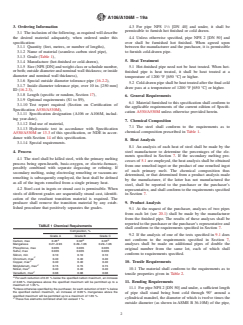
TABLE 1 Chemical Requirements
shall conform to the requirements specified in Section 7.
Composition, %
9.2 If the analysis of one of the tests specified in 9.1 does
Grade A Grade B Grade C
A B B not conform to the requirements specified in Section 7,
Carbon, max 0.25 0.30 0.35
Manganese 0.27–0.93 0.29–1.06 0.29–1.06 analyses shall be made on additional pipes of double the
Phosphorus, max 0.035 0.035 0.035
original number from the same lot, each of which shall
Sulfur, max 0.035 0.035 0.035
conform to requirements specified.
Silicon, min 0.10 0.10 0.10
C
Chromium, max 0.40 0.40 0.40
C
Copper, max 0.40 0.40 0.40
10. Tensile Requirements
C
Molybdenum, max 0.15 0.15 0.15
C
10.1 The material shall conform to the requirements as to
Nickel, max 0.40 0.40 0.40
C
Vanadium, max 0.08 0.08 0.08
tensile properties given in Table 2.
A
For each reduction of 0.01 % below the specified carbon maximum, an increase
of 0.06 % manganese above the specified maximum will be permitted up to a
11. Bending Requirements
maximum of 1.35 %.
B
Unless otherwise specified by the purchaser, for each reduction of 0.01 % below 11.1 For pipe NPS 2 [DN 50] and under, a sufficient length
the specified carbon maximum, an increase of 0.06 % manganese above the
of pipe shall stand being bent cold through 90° around a
specified maximum will be permitted up to a maximum of 1.65 %.
C cylindrical mandrel, the diameter of which is twelve times the
These five elements combined shall not exceed 1 %.
outside diameter (as shown in ASME B 36.10M) of the pipe,
A106/A106M−19a
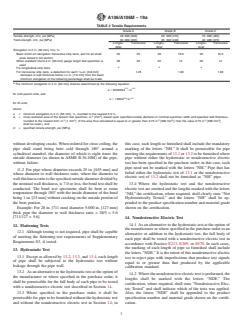
TABLE 2 Tensile Requirements
Grade A Grade B Grade C
Tensile strength, min, psi [MPa] 48 000 [330] 60 000 [415] 70 000 [485]
Yield strength, min, psi [MPa] 30 000 [205] 35 000 [240] 40 000 [275]
Longitu- Transverse Longitu- Transverse Longitu- Transverse
dinal dinal dinal
Elongation in 2 in. [50 mm], min, %:
Basic minimum elongation transverse strip tests, and for all small 35 25 30 16.5 30 16.5
sizes tested in full section
When standard round 2-in. [50-mm] gauge length test specimen is 28 20 22 12 20 12
used
AA A
For longitudinal strip tests
For transverse strip tests, a deduction for each ⁄32-in. [0.8-mm] 1.25 1.00 1.00
decrease in wall thickness below ⁄16 in. [7.9 mm] from the basic
minimum elongation of the following percentage shall be made
A
The minimum elongation in 2 in. [50 mm] shall be determined by the following equation:
0.2 0.9
e 5 625000A / U
for inch-pound units, and
0.2 0.9
e 5 1940A /U
for SI units,
where:
e = minimum elongation in 2 in. [50 mm], %, rounded to the nearest 0.5 %,
2 2
A = cross-sectional area of the tension test specimen, in. [mm ], based upon specified outside diameter or nominal specimen width and specified wall thickness,
2 2 2 2 2 2
rounded to the nearest 0.01 in. [1 mm ]. (If the area thus calculated is equal to or greater than 0.75 in. [500 mm ], then the value 0.75 in. [500 mm ]
shall be used.), and
U = specified tensile strength, psi [MPa].
without developing cracks.When ordered for close coiling, the this case, each length so furnished shall include the mandatory
pipe shall stand being bent cold through 180° around a marking of the letters “NH.” It shall be permissible for pipe
cylindrical mandrel, the diameter of which is eight times the meeting the requirements of 13.1 or 13.2 to be furnished where
outside diameter (as shown in ASME B 36.10M) of the pipe, pipe without either the hydrostatic or nondestructive electric
without failure. test has been specified in the purchase order; in this case, such
pipe need not be marked with the letters “NH.” Pipe that has
11.2 For pipe whose diameter exceeds 25 in. [635 mm] and
failed either the hydrostatic test of 13.1 or the nondestructive
whose diameter to wall thickness ratio, where the diameter to
electric test of 13.2 shall not be furnished as “NH” pipe.
wallthicknessratioisthespecifiedoutsidediameterdividedby
the nominal wall thickness, is 7.0 or less, the bend test shall be
13.4 Where the hydrostatic test and the nondestructive
conducted. The bend test specimens shall be bent at room electric test are omitted and the lengths marked with the letters
temperature through 180° with the inside diameter of the bend
“NH,” the certification, where required, shall clearly state “Not
being 1 in. [25 mm] without cracking on the outside portion of Hydrostatically Tested,” and the letters “NH” shall be ap-
the bent portion.
pended to the product specification number and material grade
Example: For 28 in. [711 mm] diameter 5.000 in. [127 mm] shown on the certification.
thick pipe the diameter to wall thickness ratio = 28/5 = 5.6
[711/127 = 5.6].
14. Nondestructive Electric Test
14.1 As an alternative to the hydrostatic test at the option of
12. Flattening Tests
themanufacturerorwherespecifiedinthepurchaseorderasan
12.1 Although testing is not required, pipe shall be capable
alternative or addition to the hydrostatic test, the full body of
of meeting the flattening test requirements of Supplementary
each pipe shall be tested with a nondestructive electric test in
Requirement S3, if tested.
accordance with Practice E213, E309,or E570. In such cases,
the marking of each length of pipe so furnished shall include
13. Hydrostatic Test
the letters “NDE.” It is the intent of this nondestructive electric
13.1 Except as allowed by 13.2, 13.3, and 13.4, each length
test to reject pipe with imperfections that produce test signals
of pipe shall be subjected to the hydrostatic test without
equal to or greater than that produced by the applicable
leakage through the pipe wall.
calibration standard.
13.2 Asanalternativetothehydrostatictestattheoptionof
14.2 Wherethenondestructiveelectrictestisperformed,the
the manufacturer or where specified in the purchase order, it
lengths shall be marked with the letters “NDE.” The
shall be permissible for the full body of each pipe to be tested
certification, where required, shall state “Nondestructive Elec-
with a nondestructive electric test described in Section 14.
tric Tested” and shall indicate which of the tests was applied.
13.3 Where specified in the purchase order, it shall be Also, the letters “NDE” shall be appended to the product
permissibleforpipetobefurnishedwithoutthehydrostatictest specification number and material grade shown on the certifi-
and without the nondestructive electric test in Section 14;in cation.
A106/A106M−19a
14.3 The following information is for the benefit of the user milled tangential to the surface and transverse to the longitu-
of this specification: dinal axis of the pipe. The notch shall have a depth not
14.3.1 The reference standards defined in 14.4 through 14.6 exceeding12 ⁄2 %ofthespecifiedwallthicknessofthepipeor
are convenient standards for calibration of nondestructive 0.004 in. [0.1 mm], whichever is greater.
testing equipment.The dimensions of such standards are not to
14.5.3 Longitudinal Notch—A notch 0.031 in. [0.8 mm] or
be construed as the minimum sizes of imperfections detectable
less in width shall be machined in a radial plane parallel to the
by such equipment.
tube axis on the outside surface of the pipe, to have a depth not
14.3.2 The ultrasonic testing referred to in this specification
exceeding12 ⁄2 %ofthespecifiedwallthicknessofthetubeor
is capable of detecting the presence and location of significant
0.004 in. [0.1 mm], whichever is greater. The length of the
longitudinally or circumferentially oriented imperfections;
notch shall be compatible with the testing method.
however, different techniques need to be employed for the
14.5.4 Compatibility—The discontinuity in the calibration
detection of such differently oriented imperfections. Ultrasonic
pipe shall be compatible with the testing equipment and the
testing is not necessarily capable of detecting short, deep
method being used.
imperfections.
14.6 For flux leakage testing, the longitudinal calibration
14.3.3 The eddy current examination referenced in this
reference notches shall be straight-sided notches machined in a
specification has the capability of detecting significant
radialplaneparalleltothepipeaxis.Forwallthicknessesunder
imperfections, especially of the short abrupt type.
⁄2 in. [12.7 mm], outside and inside notches shall be used; for
14.3.4 The flux leakage examination referred to in this
wall thicknesses equal to and above ⁄2 in. [12.7 mm], only an
specification is capable of detecting the presence and location
outside notch shall be used. Notch depth shall not exceed
of significant longitudinally or transversely oriented imperfec-
12 ⁄2 % of the specified wall thickness, or 0.004 in. [0.1 mm],
tions; however, different techniques need to be employed for
whichever is greater. Notch length shall not exceed 1 in. [25
the detection of such differently oriented imperfections.
mm], and the width shall not exceed the depth. Outside
14.3.5 The hydrostatic test referred to in Section 13 has the
diameter and inside diameter notches shall be located suffi-
capability of finding defects of a size permitting the test fluid
ciently apart to allow separation and identification of the
to leak through the tube wall and may be either visually seen
signals.
or detected by a loss of pressure. Hydrostatic testing is not
necessarily capable of detecting very tight, through-the-wall 14.7 Pipe containing one or more imperfections that pro-
imperfections or imperfections that extend an appreciable
duceasignalequaltoorgreaterthanthesignalproducedbythe
distance into the wall without complete penetration. calibration standard shall be rejected or the area producing the
14.3.6 A purchaser interested in ascertaining the nature
signal shall be reexamined.
(type, size, location, and orientation) of discontinuities that can
14.7.1 Test signals produced by imperfections which cannot
bedetectedinthespecificapplicationsoftheseexaminationsis
beidentified,orproducedbycracksorcrack-likeimperfections
directed to discuss this with the manufacturer of the tubular
shall result in rejection of the pipe, unless it is repaired and
product.
retested. To be accepted, the pipe must pass the same specifi-
cation test to which it was originally subjected, provided that
14.4 For ultrasonic testing, the calibration reference notches
the remaining wall thickness is not decreased below that
shall be, at the option of the producer, any one of the three
permitted by this specification.The OD at the point of grinding
common notch shapes shown in Practice E213. The depth of
1 may be reduced by the amount so reduced.
notchshallnotexceed12 ⁄2 %ofthespecifiedwallthicknessof
14.7.2 Testsignalsproducedbyvisualimperfectionssuchas
the pipe or 0.004 in. [0.1 mm], whichever is greater.
those listed below may be evaluated in accordance with the
14.5 For eddy current testing, the calibration pipe shall
provisions of Section 18:
contain, at the option of the producer, any one of the following
14.7.2.1 Dinges,
discontinuities to establish a minimum sensitivity level for
14.7.2.2 Straightener marks,
rejection:
14.7.2.3 Cutting chips,
14.5.1 Drilled Hole—The calibration pipe shall contain
14.7.2.4 Scratches,
depending upon the pipe diameter three holes spaced 120°
apart or four holes spaced 90° apart and sufficiently separated 14.7.2.5 Steel die stamps,
longitudinally to ensure separately distinguishable responses.
14.7.2.6 Stop marks, or
The holes shall be drilled radially and completely through the
14.7.2.7 Pipe reducer ripple.
pipewall,carebeingtakentoavoiddistortionofthepipewhile
14.8 The test methods described in this section are not
drilling. Depending upon the pipe diameter the calibration pipe
necessarily capable of inspecting the end portion of pipes, a
shall contain the following hole:
condition referred to as “end effect.” The length of such end
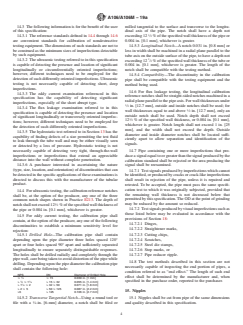
NPS DN Diameter of Drilled Hole
effect shall be determined by the manufacturer and, when
# ⁄2 # 15 0.039 in. [1 mm]
1 1
> ⁄2 # 1 ⁄4 >15 # 32 0.055 in. [1.4 mm] specified in the purchase order, reported to the purchaser.
>1 ⁄4 #2>32 # 50 0.071 in. [1.8 mm]
>2 #5>50 # 125 0.087 in. [2.2 mm]
15. Nipples
>5 > 125 0.106 in. [2.7 mm]
14.5.2 Transverse Tangential Notch—Using a round tool or 15.1 Nipples shall be cut fr
...
This document is not an ASTM standard and is intended only to provide the user of an ASTM standard an indication of what changes have been made to the previous version. Because
it may not be technically possible to adequately depict all changes accurately, ASTM recommends that users consult prior editions as appropriate. In all cases only the current version
of the standard as published by ASTM is to be considered the official document.
Designation: A106/A106M − 19 A106/A106M − 19a Used in USDOE-NE standards
Standard Specification for
Seamless Carbon Steel Pipe for High-Temperature Service
This standard is issued under the fixed designation A106/A106M; the number immediately following the designation indicates the year
of original adoption or, in the case of revision, the year of last revision. A number in parentheses indicates the year of last reapproval.
A superscript epsilon (´) indicates an editorial change since the last revision or reapproval.
1. Scope*
1.1 This specification covers seamless carbon steel pipe for high-temperature service (Note 1) in NPS ⁄8 to NPS 48 [DN 6 to
DN 1200] (Note 2) inclusive, with nominal (average) wall thickness as given in ASME B 36.10M. It shall be permissible to furnish
pipe having other dimensions provided such pipe complies with all other requirements of this specification. Pipe ordered under this
specification shall be suitable for bending, flanging, and similar forming operations, and for welding. When the steel is to be
welded, it is presupposed that a welding procedure suitable to the grade of steel and intended use or service will be utilized.
NOTE 1—It is suggested, consideration be given to possible graphitization.
NOTE 2—The dimensionless designator NPS (nominal pipe size) [DN (diameter nominal)] has been substituted in this standard for such traditional
terms as “nominal diameter,” “size,” and “nominal size.”
1.2 Supplementary requirements of an optional nature are provided for seamless pipe intended for use in applications where a
superior grade of pipe is required. These supplementary requirements call for additional tests to be made and when desired shall
be so stated in the order.
1.3 The values stated in either SI units or inch-pound units are to be regarded separately as standard. The values stated in each
system may not be exact equivalents; therefore, each system shall be used independently of the other. Combining values from the
two systems may result in non-conformance with the standard.
1.4 The following precautionary caveat pertains only to the test method portion, Sections 11, 12, and 13 of this specification:
This standard does not purport to address all of the safety concerns, if any, associated with its use. It is the responsibility of the
user of this standard to establish appropriate safety, health, and environmental practices and determine the applicability of
regulatory limitations prior to use.
1.5 This international standard was developed in accordance with internationally recognized principles on standardization
established in the Decision on Principles for the Development of International Standards, Guides and Recommendations issued
by the World Trade Organization Technical Barriers to Trade (TBT) Committee.
2. Referenced Documents
2.1 ASTM Standards:
A530/A530M Specification for General Requirements for Specialized Carbon and Alloy Steel Pipe
E213 Practice for Ultrasonic Testing of Metal Pipe and Tubing
E309 Practice for Eddy Current Examination of Steel Tubular Products Using Magnetic Saturation
E381 Method of Macroetch Testing Steel Bars, Billets, Blooms, and Forgings
E570 Practice for Flux Leakage Examination of Ferromagnetic Steel Tubular Products
2.2 ASME Standard:
ASME B 36.10M Welded and Seamless Wrought Steel Pipe
2.3 Military Standards:
MIL-STD-129 Marking for Shipment and Storage
MIL-STD-163 Steel Mill Products, Preparation for Shipment and Storage
This specification is under the jurisdiction of Committee A01 on Steel, Stainless Steel and Related Alloys and is the direct responsibility of Subcommittee A01.09 on
Carbon Steel Tubular Products.
Current edition approved May 1, 2019Nov. 1, 2019. Published May 2019November 2019. Originally approved in 1926. Last previous edition approved in 20182019 as
A106/A106M – 18.A106/A106M – 19. DOI: 10.1520/A0106_A0106M-19.10.1520/A0106_A0106M-19A.
For ASME Boiler and Pressure Vessel Code applications see related Specifications SA-106 in Section II of that Code.
For referenced ASTM standards, visit the ASTM website, www.astm.org, or contact ASTM Customer Service at service@astm.org. For Annual Book of ASTM Standards
volume information, refer to the standard’s Document Summary page on the ASTM website.
Available from American Society of Mechanical Engineers (ASME), ASME International Headquarters, Two Park Ave., New York, NY 10016-5990, http://
www.asme.org.
Available from Standardization Documents Order Desk, DODSSP, Bldg. 4, Section D, 700 Robbins Ave., Philadelphia, PA 19111-5098.
*A Summary of Changes section appears at the end of this standard
Copyright © ASTM International, 100 Barr Harbor Drive, PO Box C700, West Conshohocken, PA 19428-2959. United States
A106/A106M − 19a
2.4 Federal Standard:
Fed. Std. No. 123 Marking for Shipments (Civil Agencies)
Fed. Std. No. 183 Continuous Identification Marking of Iron and Steel Products
2.5 Other Standards:
SSPC-SP 6 Surface Preparation Specification No. 6
3. Ordering Information
3.1 The inclusion of the following, as required will describe the desired material adequately, when ordered under this
specification:
3.1.1 Quantity (feet, metres, or number of lengths),
3.1.2 Name of material (seamless carbon steel pipe),
3.1.3 Grade (Table 1),
3.1.4 Manufacture (hot-finished or cold-drawn),
3.1.5 Size (NPS [DN] and weight class or schedule number, or both; outside diameter and nominal wall thickness; or inside
diameter and nominal wall thickness),
3.1.6 Special outside diameter tolerance pipe (16.2.2),
3.1.7 Inside diameter tolerance pipe, over 10 in. [250 mm] ID (16.2.3),
3.1.8 Length (specific or random, Section 17),
3.1.9 Optional requirements (Section(S1 9 and S1 to S8),S9),
3.1.10 Test report required (Section on Certification of Specification A530/A530M),
3.1.11 Specification designation (A106 or A106M, including year-date),
3.1.12 End use of material,
3.1.13 Hydrostatic test in accordance with Specification A530/A530M or 13.3 of this specification, or NDE in accordance with
Section 14 of this specification.
3.1.14 Special requirements.
4. Process
4.1 The steel shall be killed steel, with the primary melting process being open-hearth, basic-oxygen, or electric-furnace,
possibly combined with separate degassing or refining. If secondary melting, using electroslag remelting or vacuum-arc remelting
is subsequently employed, the heat shall be defined as all of the ingots remelted from a single primary heat.
4.2 Steel cast in ingots or strand cast is permissible. When steels of different grades are sequentially strand cast, identification
of the resultant transition material is required. The producer shall remove the transition material by any established procedure that
positively separates the grades.
4.3 For pipe NPS 1 ⁄2 [DN 40] and under, it shall be permissible to furnish hot finished or cold drawn.
4.4 Unless otherwise specified, pipe NPS 2 [DN 50] and over shall be furnished hot finished. When agreed upon between the
manufacturer and the purchaser, it is permissible to furnish cold-drawn pipe.
TABLE 1 Chemical Requirements
Composition, %
Grade A Grade B Grade C
A B B
Carbon, max 0.25 0.30 0.35
Manganese 0.27–0.93 0.29–1.06 0.29–1.06
Phosphorus, max 0.035 0.035 0.035
Sulfur, max 0.035 0.035 0.035
Silicon, min 0.10 0.10 0.10
C
Chromium, max 0.40 0.40 0.40
C
Copper, max 0.40 0.40 0.40
C
Molybdenum, max 0.15 0.15 0.15
C
Nickel, max 0.40 0.40 0.40
C
Vanadium, max 0.08 0.08 0.08
A
For each reduction of 0.01 % below the specified carbon maximum, an increase
of 0.06 % manganese above the specified maximum will be permitted up to a
maximum of 1.35 %.
B
Unless otherwise specified by the purchaser, for each reduction of 0.01 % below
the specified carbon maximum, an increase of 0.06 % manganese above the
specified maximum will be permitted up to a maximum of 1.65 %.
C
These five elements combined shall not exceed 1 %.
Available from Society for Protective Coatings (SSPC), 40 24th St., 6th Floor, Pittsburgh, PA 15222-4656, http://www.sspc.org.
A106/A106M − 19a
5. Heat Treatment
5.1 Hot-finished pipe need not be heat treated. When hot-finished pipe is heat treated, it shall be heat treated at a temperature
of 1200 °F [650 °C] or higher.
5.2 Cold-drawn pipe shall be heat treated after the final cold draw pass at a temperature of 1200 °F [650 °C] or higher.
6. General Requirements
6.1 Material furnished to this specification shall conform to the applicable requirements of the current edition of Specification
A530/A530M unless otherwise provided herein.
7. Chemical Composition
7.1 The steel shall conform to the requirements as to chemical composition prescribed in Table 1.
8. Heat Analysis
8.1 An analysis of each heat of steel shall be made by the steel manufacturer to determine the percentages of the elements
specified in Section 7. If the secondary melting processes of 5.1 are employed, the heat analysis shall be obtained from one
remelted ingot or the product of one remelted ingot of each primary melt. The chemical composition thus determined, or that
determined from a product analysis made by the manufacturer, if the latter has not manufactured the steel, shall be reported to the
purchaser or the purchaser’s representative, and shall conform to the requirements specified in Section 7.
9. Product Analysis
9.1 At the request of the purchaser, analyses of two pipes from each lot (see 20.1) shall be made by the manufacturer from the
finished pipe. The results of these analyses shall be reported to the purchaser or the purchaser’s representative and shall conform
to the requirements specified in Section 7.
9.2 If the analysis of one of the tests specified in 9.1 does not conform to the requirements specified in Section 7, analyses shall
be made on additional pipes of double the original number from the same lot, each of which shall conform to requirements
specified.
10. Tensile Requirements
10.1 The material shall conform to the requirements as to tensile properties given in Table 2.
11. Bending Requirements
11.1 For pipe NPS 2 [DN 50] and under, a sufficient length of pipe shall stand being bent cold through 90° around a cylindrical
mandrel, the diameter of which is twelve times the outside diameter (as shown in ASME B 36.10M) of the pipe, without
TABLE 2 Tensile Requirements
Grade A Grade B Grade C
Tensile strength, min, psi [MPa] 48 000 [330] 60 000 [415] 70 000 [485]
Yield strength, min, psi [MPa] 30 000 [205] 35 000 [240] 40 000 [275]
Longitu- Transverse Longitu- Transverse Longitu- Transverse
dinal dinal dinal
Elongation in 2 in. [50 mm], min, %:
Basic minimum elongation transverse strip tests, and for all small 35 25 30 16.5 30 16.5
sizes tested in full section
When standard round 2-in. [50-mm] gauge length test specimen is 28 20 22 12 20 12
used
A A A
For longitudinal strip tests
For transverse strip tests, a deduction for each ⁄32-in. [0.8-mm] 1.25 1.00 1.00
decrease in wall thickness below ⁄16 in. [7.9 mm] from the basic
minimum elongation of the following percentage shall be made
A
The minimum elongation in 2 in. [50 mm] shall be determined by the following equation:
0.2 0.9
e 5625000A / U
for inch-pound units, and
0.2 0.9
e 51940A /U
for SI units,
where:
e = minimum elongation in 2 in. [50 mm], %, rounded to the nearest 0.5 %,
2 2
A = cross-sectional area of the tension test specimen, in. [mm ], based upon specified outside diameter or nominal specimen width and specified wall thickness,
2 2 2 2 2 2
rounded to the nearest 0.01 in. [1 mm ]. (If the area thus calculated is equal to or greater than 0.75 in. [500 mm ], then the value 0.75 in. [500 mm ]
shall be used.), and
U = specified tensile strength, psi [MPa].
A106/A106M − 19a
developing cracks. When ordered for close coiling, the pipe shall stand being bent cold through 180° around a cylindrical mandrel,
the diameter of which is eight times the outside diameter (as shown in ASME B 36.10M) of the pipe, without failure.
11.2 For pipe whose diameter exceeds 25 in. [635 mm] and whose diameter to wall thickness ratio, where the diameter to wall
thickness ratio is the specified outside diameter divided by the nominal wall thickness, is 7.0 or less, the bend test shall be
conducted. The bend test specimens shall be bent at room temperature through 180° with the inside diameter of the bend being
1 in. [25 mm] without cracking on the outside portion of the bent portion.
Example: For 28 in. [711 mm] diameter 5.000 in. [127 mm] thick pipe the diameter to wall thickness ratio = 28/5 = 5.6 [711/127
= 5.6].
12. Flattening Tests
12.1 Although testing is not required, pipe shall be capable of meeting the flattening test requirements of Supplementary
Requirement S3, if tested.
13. Hydrostatic Test
13.1 Except as allowed by 13.2, 13.3, and 13.4, each length of pipe shall be subjected to the hydrostatic test without leakage
through the pipe wall.
13.2 As an alternative to the hydrostatic test at the option of the manufacturer or where specified in the purchase order, it shall
be permissible for the full body of each pipe to be tested with a nondestructive electric test described in Section 14.
13.3 Where specified in the purchase order, it shall be permissible for pipe to be furnished without the hydrostatic test and
without the nondestructive electric test in Section 14; in this case, each length so furnished shall include the mandatory marking
of the letters “NH.” It shall be permissible for pipe meeting the requirements of 13.1 or 13.2 to be furnished where pipe without
either the hydrostatic or nondestructive electric test has been specified in the purchase order; in this case, such pipe need not be
marked with the letters “NH.” Pipe that has failed either the hydrostatic test of 13.1 or the nondestructive electric test of 13.2 shall
not be furnished as “NH” pipe.
13.4 Where the hydrostatic test and the nondestructive electric test are omitted and the lengths marked with the letters “NH,”
the certification, where required, shall clearly state “Not Hydrostatically Tested,” and the letters “NH” shall be appended to the
product specification number and material grade shown on the certification.
14. Nondestructive Electric Test
14.1 As an alternative to the hydrostatic test at the option of the manufacturer or where specified in the purchase order as an
alternative or addition to the hydrostatic test, the full body of each pipe shall be tested with a nondestructive electric test in
accordance with Practice E213, E309, or E570. In such cases, the marking of each length of pipe so furnished shall include the
letters “NDE.” It is the intent of this nondestructive electric test to reject pipe with imperfections that produce test signals equal
to or greater than that produced by the applicable calibration standard.
14.2 Where the nondestructive electric test is performed, the lengths shall be marked with the letters “NDE.” The certification,
where required, shall state “Nondestructive Electric Tested” and shall indicate which of the tests was applied. Also, the letters
“NDE” shall be appended to the product specification number and material grade shown on the certification.
14.3 The following information is for the benefit of the user of this specification:
14.3.1 The reference standards defined in 14.4 through 14.6 are convenient standards for calibration of nondestructive testing
equipment. The dimensions of such standards are not to be construed as the minimum sizes of imperfections detectable by such
equipment.
14.3.2 The ultrasonic testing referred to in this specification is capable of detecting the presence and location of significant
longitudinally or circumferentially oriented imperfections; however, different techniques need to be employed for the detection of
such differently oriented imperfections. Ultrasonic testing is not necessarily capable of detecting short, deep imperfections.
14.3.3 The eddy current examination referenced in this specification has the capability of detecting significant imperfections,
especially of the short abrupt type.
14.3.4 The flux leakage examination referred to in this specification is capable of detecting the presence and location of
significant longitudinally or transversely oriented imperfections; however, different techniques need to be employed for the
detection of such differently oriented imperfections.
14.3.5 The hydrostatic test referred to in Section 13 has the capability of finding defects of a size permitting the test fluid to
leak through the tube wall and may be either visually seen or detected by a loss of pressure. Hydrostatic testing is not necessarily
capable of detecting very tight, through-the-wall imperfections or imperfections that extend an appreciable distance into the wall
without complete penetration.
14.3.6 A purchaser interested in ascertaining the nature (type, size, location, and orientation) of discontinuities that can be
detected in the specific applications of these examinations is directed to discuss this with the manufacturer of the tubular product.
A106/A106M − 19a
14.4 For ultrasonic testing, the calibration reference notches shall be, at the option of the producer, any one of the three common
notch shapes shown in Practice E213. The depth of notch shall not exceed 12 ⁄2 % of the specified wall thickness of the pipe or
0.004 in. [0.1 mm], whichever is greater.
14.5 For eddy current testing, the calibration pipe shall contain, at the option of the producer, any one of the following
discontinuities to establish a minimum sensitivity level for rejection:
14.5.1 Drilled Hole—The calibration pipe shall contain depending upon the pipe diameter three holes spaced 120° apart or four
holes spaced 90° apart and sufficiently separated longitudinally to ensure separately distinguishable responses. The holes shall be
drilled radially and completely through the pipe wall, care being taken to avoid distortion of the pipe while drilling. Depending
upon the pipe diameter the calibration pipe shall contain the following hole:
NPS DN Diameter of Drilled Hole
# ⁄2 # 15 0.039 in. [1 mm]
1 1
> ⁄2 # 1 ⁄4 > 15 # 32 0.055 in. [1.4 mm]
> 1 ⁄4 # 2 > 32 # 50 0.071 in. [1.8 mm]
> 2 # 5 > 50 # 125 0.087 in. [2.2 mm]
>5 > 125 0.106 in. [2.7 mm]
14.5.2 Transverse Tangential Notch—Using a round tool or file with a ⁄4-in. [6-mm] diameter, a notch shall be filed or milled
tangential to the surface and transverse to the longitudinal axis of the pipe. The notch shall have a depth not exceeding 12 ⁄2 %
of the specified wall thickness of the pipe or 0.004 in. [0.1 mm], whichever is greater.
14.5.3 Longitudinal Notch—A notch 0.031 in. [0.8 mm] or less in width shall be machined in a radial plane parallel to the tube
axis on the outside surface of the pipe, to have a depth not exceeding 12 ⁄2 % of the specified wall thickness of the tube or 0.004
in. [0.1 mm], whichever is greater. The length of the notch shall be compatible with the testing method.
14.5.4 Compatibility—The discontinuity in the calibration pipe shall be compatible with the testing equipment and the method
being used.
14.6 For flux leakage testing, the longitudinal calibration reference notches shall be straight-sided notches machined in a radial
plane parallel to the pipe axis. For wall thicknesses under ⁄2 in. [12.7 mm], outside and inside notches shall be used; for wall
1 1
thicknesses equal to and above ⁄2 in. [12.7 mm], only an outside notch shall be used. Notch depth shall not exceed 12 ⁄2 % of the
specified wall thickness, or 0.004 in. [0.1 mm], whichever is greater. Notch length shall not exceed 1 in. [25 mm], and the width
shall not exceed the depth. Outside diameter and inside diameter notches shall be located sufficiently apart to allow separation and
identification of the signals.
14.7 Pipe containing one or more imperfections that produce a signal equal to or greater than the signal produced by the
calibration standard shall be rejected or the area producing the signal shall be reexamined.
14.7.1 Test signals produced by imperfections which cannot be identified, or produced by cracks or crack-like imperfections
shall result in rejection of the pipe, unless it is repaired and retested. To be accepted, the pipe must pass the same specification test
to which it was originally subjected, provided that the remaining wall thickness is not decreased below that permitted by this
specification. The OD at the point of grinding may be reduced by the amount so reduced.
14.7.2 Test signals produced by visual imperfections such as those listed below may be evaluated in accordance with the
provisions of Section 18:
14.7.2.1 Dinges,
14.7.2.2 Straightener marks,
14.7.2.3 Cutting chips,
14.7.2.4 Scratches,
14.7.2.5 Steel die stamps,
14.7.2.6 Stop marks, or
14.7.2.7 Pipe reducer ripple.
14.8 The test methods described in this section are not necessarily capable of inspecting the end portion of pipes, a condition
referred to as “end effect.” The length of such end effect shall be determined by the manufacturer and, when specified
...