

ASTM D6743-20
(Test Method)Standard Test Method for Thermal Stability of Organic Heat Transfer Fluids
General Information
- Abstract
SIGNIFICANCE AND USE
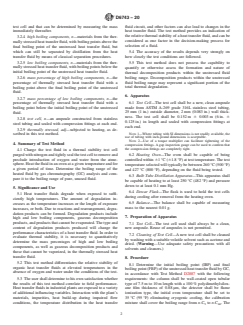
5.1 Heat transfer fluids degrade when exposed to sufficiently high temperatures. The amount of degradation increases as the temperature increases or the length of exposure increases, or both. Due to reactions and rearrangement, degradation products can be formed. Degradation products include high and low boiling components, gaseous decomposition products, and products that cannot be evaporated. The type and content of degradation products produced will change the performance characteristics of a heat transfer fluid. In order to evaluate thermal stability, it is necessary to quantitatively determine the mass percentages of high and low boiling components, as well as gaseous decomposition products and those that cannot be vaporized, in the thermally stressed heat transfer fluid.
5.2 This test method differentiates the relative stability of organic heat transfer fluids at elevated temperatures in the absence of oxygen and water under the conditions of the test.
5.3 The user shall determine to his own satisfaction whether the results of this test method correlate to field performance. Heat transfer fluids in industrial plants are exposed to a variety of additional influencing variables. Interaction with the plant's materials, impurities, heat build-up during impaired flow conditions, the temperature distribution in the heat transfer fluid circuit, and other factors can also lead to changes in the heat transfer fluid. The test method provides an indication of the relative thermal stability of a heat transfer fluid, and can be considered as one factor in the decision-making process for selection of a fluid.
5.4 The accuracy of the results depends very strongly on how closely the test conditions are followed.
5.5 This test method does not possess the capability to quantify or otherwise assess the formation and nature of thermal decomposition products within the unstressed fluid boiling range. Decomposition products within the unstressed fluid boiling range may ...
SCOPE
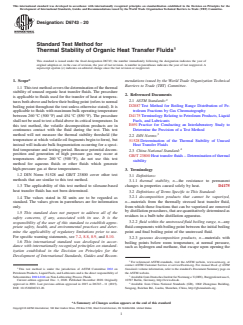
1.1 This test method covers the determination of the thermal stability of unused organic heat transfer fluids. The procedure is applicable to fluids used for the transfer of heat at temperatures both above and below their boiling point (refers to normal boiling point throughout the text unless otherwise stated). It is applicable to fluids with maximum bulk operating temperature between 260 °C (500 °F) and 454 °C (850 °F). The procedure shall not be used to test a fluid above its critical temperature. In this test method, the volatile decomposition products are in continuous contact with the fluid during the test. This test method will not measure the thermal stability threshold (the temperature at which volatile oil fragments begin to form), but instead will indicate bulk fragmentation occurring for a specified temperature and testing period. Because potential decomposition and generation of high pressure gas may occur at temperatures above 260 °C (500 °F), do not use this test method for aqueous fluids or other fluids which generate high-pressure gas at these temperatures.
1.2 DIN Norm 51528 and GB/T 23800 cover other test methods that are similar to this test method.
1.3 The applicability of this test method to siloxane-based heat transfer fluids has not been determined.
1.4 The values stated in SI units are to be regarded as standard. The values given in parentheses are for information only.
1.5 This standard does not purport to address all of the safety concerns, if any, associated with its use. It is the responsibility of the user of this standard to establish appropriate safety, health, and environmental practices and determine the applicability of regulatory limitations prior to use. For specific warning statements, see 7.2, 8.8, 8.9, and 8.10.
1.6 This international standard was developed in accordance with internationally recognized principles on standardization established in the Decision on Prin...
- Status
- Published
- Publication Date
- 30-Nov-2020
- Technical Committee
- D02 - Petroleum Products, Liquid Fuels, and Lubricants
- Drafting Committee
- D02.L0.06 - Non-Lubricating Process Fluids
Overview
ASTM D6743-20: Standard Test Method for Thermal Stability of Organic Heat Transfer Fluids is an internationally recognized standard developed by ASTM International. This test method is focused on determining the thermal stability of unused organic heat transfer fluids under controlled laboratory conditions. Thermal stability is a critical factor in evaluating the suitability and longevity of organic heat transfer fluids used in industrial systems. Understanding how these fluids degrade at elevated temperatures is essential for ensuring consistent heat transfer performance, safety, and long equipment life.
The standard is applicable to a wide range of organic fluids operating between 260 °C (500 °F) and 454 °C (850 °F), but should not be used above the fluid's critical temperature. It excludes aqueous fluids or those that may produce high-pressure gas under test conditions.
Key Topics
- Thermal Stability Evaluation: The method assesses the resistance of organic heat transfer fluids to degradation when exposed to high temperatures. Degradation can result in the formation of byproducts such as high boiling components, low boiling components, gaseous decomposition products, and non-volatile residues.
- Controlled Test Conditions: Testing is performed in the absence of oxygen and water to isolate the effects of heat alone on the fluid.
- Quantitative Determination: The method involves measuring mass percentages of various degradation products to provide an indication of the relative stability of different fluids.
- Significance for System Performance: Degradation products can negatively affect heat transfer, fluid life, and system reliability. The standard aids in the comparison and selection of fluids based on their thermal stability under set conditions.
- Safety Considerations: Users must take appropriate precautions due to the potential for high pressures and flammable vapors at elevated temperatures.
Applications
ASTM D6743-20 is widely used in the following contexts:
- Industrial Heat Transfer Systems: For refineries, chemical plants, and manufacturing facilities where organic heat transfer fluids are commonly used in heating and cooling loops.
- Fluid Selection & Procurement: Provides critical comparative data for manufacturers and plant operators when choosing heat transfer fluids intended for high-temperature service.
- Quality Assurance & R&D: Assists in evaluating new formulations or batches of heat transfer fluid to ensure they meet thermal stability criteria before deployment.
- Predictive Maintenance: Results from this standardized test can inform maintenance schedules and replacement intervals by predicting fluid degradation rates.
By providing standardized, reproducible results, ASTM D6743-20 supports safer operation and optimal thermal performance in demanding industrial environments.
Related Standards
- ASTM D2887: Test Method for Boiling Range Distribution of Petroleum Fractions by Gas Chromatography - utilized within D6743-20 for the analysis of boiling points in degraded and un-degraded samples.
- DIN 51528: Determination of the Thermal Stability of Unused Heat Transfer Fluids - a similar European standard for thermal stability testing.
- GB/T 23800: Heat Transfer Fluids - Determination of Thermal Stability (China National Standard) - references analogous procedures.
- ASTM D4175: Terminology Relating to Petroleum Products, Liquid Fuels, and Lubricants - provides essential definitions relevant to heat transfer fluids.
Practical Value
ASTM D6743-20 provides plant managers, quality engineers, and product developers with a reliable tool for assessing the thermal degradation of organic heat transfer fluids. By quantifying the formation of degradation products, the standard helps maintain effective heat transfer, minimize unplanned downtime, and ensure the safety and efficiency of thermal systems. Adhering to this method enables informed, evidence-based decisions regarding fluid selection, monitoring, and maintenance, ultimately leading to enhanced operational reliability and reduced life-cycle costs for industrial heat transfer applications.
Relations
- Refers
ASTM D4175-23a - Standard Terminology Relating to Petroleum Products, Liquid Fuels, and Lubricants - Effective Date
- 15-Dec-2023
- Refers
ASTM D4175-23e1 - Standard Terminology Relating to Petroleum Products, Liquid Fuels, and Lubricants - Effective Date
- 01-Jul-2023
- Effective Date
- 01-Jul-2023
- Effective Date
- 01-Jul-2019
- Effective Date
- 01-Jul-2015
- Effective Date
- 01-May-2013
- Effective Date
- 01-May-2013
- Effective Date
- 01-Nov-2012
- Effective Date
- 01-Nov-2011
- Effective Date
- 01-Oct-2008
- Effective Date
- 01-Aug-2006
- Effective Date
- 01-Nov-2005
- Effective Date
- 01-Jul-2004
- Effective Date
- 01-May-2004
- Effective Date
- 01-Nov-2003
Get Certified
Connect with accredited certification bodies for this standard

DNV
DNV is an independent assurance and risk management provider.

Lloyd's Register
Lloyd's Register is a global professional services organisation specialising in engineering and technology.
DNV Energy Systems
Energy and renewable energy certification.
Sponsored listings
Frequently Asked Questions
ASTM D6743-20 is a standard published by ASTM International. Its full title is "Standard Test Method for Thermal Stability of Organic Heat Transfer Fluids". This standard covers: SIGNIFICANCE AND USE 5.1 Heat transfer fluids degrade when exposed to sufficiently high temperatures. The amount of degradation increases as the temperature increases or the length of exposure increases, or both. Due to reactions and rearrangement, degradation products can be formed. Degradation products include high and low boiling components, gaseous decomposition products, and products that cannot be evaporated. The type and content of degradation products produced will change the performance characteristics of a heat transfer fluid. In order to evaluate thermal stability, it is necessary to quantitatively determine the mass percentages of high and low boiling components, as well as gaseous decomposition products and those that cannot be vaporized, in the thermally stressed heat transfer fluid. 5.2 This test method differentiates the relative stability of organic heat transfer fluids at elevated temperatures in the absence of oxygen and water under the conditions of the test. 5.3 The user shall determine to his own satisfaction whether the results of this test method correlate to field performance. Heat transfer fluids in industrial plants are exposed to a variety of additional influencing variables. Interaction with the plant's materials, impurities, heat build-up during impaired flow conditions, the temperature distribution in the heat transfer fluid circuit, and other factors can also lead to changes in the heat transfer fluid. The test method provides an indication of the relative thermal stability of a heat transfer fluid, and can be considered as one factor in the decision-making process for selection of a fluid. 5.4 The accuracy of the results depends very strongly on how closely the test conditions are followed. 5.5 This test method does not possess the capability to quantify or otherwise assess the formation and nature of thermal decomposition products within the unstressed fluid boiling range. Decomposition products within the unstressed fluid boiling range may ... SCOPE 1.1 This test method covers the determination of the thermal stability of unused organic heat transfer fluids. The procedure is applicable to fluids used for the transfer of heat at temperatures both above and below their boiling point (refers to normal boiling point throughout the text unless otherwise stated). It is applicable to fluids with maximum bulk operating temperature between 260 °C (500 °F) and 454 °C (850 °F). The procedure shall not be used to test a fluid above its critical temperature. In this test method, the volatile decomposition products are in continuous contact with the fluid during the test. This test method will not measure the thermal stability threshold (the temperature at which volatile oil fragments begin to form), but instead will indicate bulk fragmentation occurring for a specified temperature and testing period. Because potential decomposition and generation of high pressure gas may occur at temperatures above 260 °C (500 °F), do not use this test method for aqueous fluids or other fluids which generate high-pressure gas at these temperatures. 1.2 DIN Norm 51528 and GB/T 23800 cover other test methods that are similar to this test method. 1.3 The applicability of this test method to siloxane-based heat transfer fluids has not been determined. 1.4 The values stated in SI units are to be regarded as standard. The values given in parentheses are for information only. 1.5 This standard does not purport to address all of the safety concerns, if any, associated with its use. It is the responsibility of the user of this standard to establish appropriate safety, health, and environmental practices and determine the applicability of regulatory limitations prior to use. For specific warning statements, see 7.2, 8.8, 8.9, and 8.10. 1.6 This international standard was developed in accordance with internationally recognized principles on standardization established in the Decision on Prin...
SIGNIFICANCE AND USE 5.1 Heat transfer fluids degrade when exposed to sufficiently high temperatures. The amount of degradation increases as the temperature increases or the length of exposure increases, or both. Due to reactions and rearrangement, degradation products can be formed. Degradation products include high and low boiling components, gaseous decomposition products, and products that cannot be evaporated. The type and content of degradation products produced will change the performance characteristics of a heat transfer fluid. In order to evaluate thermal stability, it is necessary to quantitatively determine the mass percentages of high and low boiling components, as well as gaseous decomposition products and those that cannot be vaporized, in the thermally stressed heat transfer fluid. 5.2 This test method differentiates the relative stability of organic heat transfer fluids at elevated temperatures in the absence of oxygen and water under the conditions of the test. 5.3 The user shall determine to his own satisfaction whether the results of this test method correlate to field performance. Heat transfer fluids in industrial plants are exposed to a variety of additional influencing variables. Interaction with the plant's materials, impurities, heat build-up during impaired flow conditions, the temperature distribution in the heat transfer fluid circuit, and other factors can also lead to changes in the heat transfer fluid. The test method provides an indication of the relative thermal stability of a heat transfer fluid, and can be considered as one factor in the decision-making process for selection of a fluid. 5.4 The accuracy of the results depends very strongly on how closely the test conditions are followed. 5.5 This test method does not possess the capability to quantify or otherwise assess the formation and nature of thermal decomposition products within the unstressed fluid boiling range. Decomposition products within the unstressed fluid boiling range may ... SCOPE 1.1 This test method covers the determination of the thermal stability of unused organic heat transfer fluids. The procedure is applicable to fluids used for the transfer of heat at temperatures both above and below their boiling point (refers to normal boiling point throughout the text unless otherwise stated). It is applicable to fluids with maximum bulk operating temperature between 260 °C (500 °F) and 454 °C (850 °F). The procedure shall not be used to test a fluid above its critical temperature. In this test method, the volatile decomposition products are in continuous contact with the fluid during the test. This test method will not measure the thermal stability threshold (the temperature at which volatile oil fragments begin to form), but instead will indicate bulk fragmentation occurring for a specified temperature and testing period. Because potential decomposition and generation of high pressure gas may occur at temperatures above 260 °C (500 °F), do not use this test method for aqueous fluids or other fluids which generate high-pressure gas at these temperatures. 1.2 DIN Norm 51528 and GB/T 23800 cover other test methods that are similar to this test method. 1.3 The applicability of this test method to siloxane-based heat transfer fluids has not been determined. 1.4 The values stated in SI units are to be regarded as standard. The values given in parentheses are for information only. 1.5 This standard does not purport to address all of the safety concerns, if any, associated with its use. It is the responsibility of the user of this standard to establish appropriate safety, health, and environmental practices and determine the applicability of regulatory limitations prior to use. For specific warning statements, see 7.2, 8.8, 8.9, and 8.10. 1.6 This international standard was developed in accordance with internationally recognized principles on standardization established in the Decision on Prin...
ASTM D6743-20 is classified under the following ICS (International Classification for Standards) categories: 27.060.30 - Boilers and heat exchangers; 71.100.99 - Other products of the chemical industry. The ICS classification helps identify the subject area and facilitates finding related standards.
ASTM D6743-20 has the following relationships with other standards: It is inter standard links to ASTM D4175-23a, ASTM D4175-23e1, ASTM D2887-23, ASTM D2887-19, ASTM D2887-15, ASTM D2887-13, ASTM E691-13, ASTM D2887-12, ASTM E691-11, ASTM E691-08, ASTM D2887-06, ASTM E691-05, ASTM D2887-04a, ASTM D2887-04, ASTM D2887-03. Understanding these relationships helps ensure you are using the most current and applicable version of the standard.
ASTM D6743-20 is available in PDF format for immediate download after purchase. The document can be added to your cart and obtained through the secure checkout process. Digital delivery ensures instant access to the complete standard document.
Standards Content (Sample)
This international standard was developed in accordance with internationally recognized principles on standardization established in the Decision on Principles for the
Development of International Standards, Guides and Recommendations issued by the World Trade Organization Technical Barriers to Trade (TBT) Committee.
Designation: D6743 − 20
Standard Test Method for
Thermal Stability of Organic Heat Transfer Fluids
This standard is issued under the fixed designation D6743; the number immediately following the designation indicates the year of
original adoption or, in the case of revision, the year of last revision. A number in parentheses indicates the year of last reapproval. A
superscript epsilon (´) indicates an editorial change since the last revision or reapproval.
1. Scope* mendations issued by the World Trade Organization Technical
Barriers to Trade (TBT) Committee.
1.1 Thistestmethodcoversthedeterminationofthethermal
stability of unused organic heat transfer fluids. The procedure
2. Referenced Documents
is applicable to fluids used for the transfer of heat at tempera-
2.1 ASTM Standards:
turesbothaboveandbelowtheirboilingpoint(referstonormal
D2887 Test Method for Boiling Range Distribution of Pe-
boiling point throughout the text unless otherwise stated). It is
troleum Fractions by Gas Chromatography
applicable to fluids with maximum bulk operating temperature
D4175 Terminology Relating to Petroleum Products, Liquid
between 260 °C (500 °F) and 454 °C (850 °F). The procedure
Fuels, and Lubricants
shall not be used to test a fluid above its critical temperature. In
E691 Practice for Conducting an Interlaboratory Study to
this test method, the volatile decomposition products are in
Determine the Precision of a Test Method
continuous contact with the fluid during the test. This test
method will not measure the thermal stability threshold (the
2.2 DIN Norms:
temperature at which volatile oil fragments begin to form), but
51528 Determination of the Thermal Stability of Unused
instead will indicate bulk fragmentation occurring for a speci-
Heat Transfer Fluids
fied temperature and testing period. Because potential decom-
2.3 China National Standard:
position and generation of high pressure gas may occur at
GB/T 23800 Heat transfer fluids – Determination of thermal
temperatures above 260 °C (500 °F), do not use this test
stability
method for aqueous fluids or other fluids which generate
high-pressure gas at these temperatures.
3. Terminology
1.2 DIN Norm 51528 and GB/T 23800 cover other test
3.1 Definitions:
methods that are similar to this test method.
3.1.1 thermal stability, n—the resistance to permanent
changes in properties caused solely by heat. D4175
1.3 The applicability of this test method to siloxane-based
heat transfer fluids has not been determined.
3.2 Definitions of Terms Specific to This Standard:
3.2.1 decomposition products that cannot be vaporized,
1.4 The values stated in SI units are to be regarded as
n—materials from the thermally stressed heat transfer fluid,
standard. The values given in parentheses are for information
from which those fractions that can be vaporized are removed
only.
by distillation procedures, that are quantitatively determined as
1.5 This standard does not purport to address all of the
residues in a bulb tube distillation apparatus.
safety concerns, if any, associated with its use. It is the
3.2.2 fluid within the unstressed fluid boiling range, n—any
responsibility of the user of this standard to establish appro-
fluid components with boiling point between the initial boiling
priate safety, health, and environmental practices and deter-
point and final boiling point of the unstressed fluid.
mine the applicability of regulatory limitations prior to use.
For specific warning statements, see 7.2, 8.8, 8.9, and 8.10.
3.2.3 gaseous decomposition products, n—materials with
1.6 This international standard was developed in accor-
boiling points below room temperature, at normal pressure,
dance with internationally recognized principles on standard-
such as hydrogen and methane, that escape upon opening the
ization established in the Decision on Principles for the
Development of International Standards, Guides and Recom-
For referenced ASTM standards, visit the ASTM website, www.astm.org, or
contact ASTM Customer Service at service@astm.org. For Annual Book of ASTM
This test method is under the jurisdiction of ASTM Committee D02 on Standards volume information, refer to the standard’s Document Summary page on
Petroleum Products, Liquid Fuels, and Lubricants and is the direct responsibility of the ASTM website.
Subcommittee D02.L0.06 on Non-Lubricating Process Fluids. AvailablefromDeutschesInstitutfurNormunge.V.(DIN),Burggrafenstrasse6,
Current edition approved Dec. 1, 2020. Published December 2020. Originally 10787 Berlin, Germany, http://www.din.de.
approved in 2001. Last previous edition approved in 2015 as D6743 – 11 (2015). Available from China National Standards (GB), 106# Zhongmao Building,
DOI: 10.1520/D6743-20. Sungang, Beizhan Rd., Luohu, Shenzhen, China, http://gbstandards.org.
*A Summary of Changes section appears at the end of this standard
Copyright © ASTM International, 100 Barr Harbor Drive, PO Box C700, West Conshohocken, PA 19428-2959. United States
D6743 − 20
test cell and that can be determined by measuring the mass fluid circuit, and other factors can also lead to changes in the
immediately thereafter. heat transfer fluid. The test method provides an indication of
the relative thermal stability of a heat transfer fluid, and can be
3.2.4 high boiling components, n—materials from the ther-
considered as one factor in the decision-making process for
mally stressed heat transfer fluid, with boiling points above the
selection of a fluid.
final boiling point of the unstressed heat transfer fluid, but
which can still be separated by distillation from the heat
5.4 The accuracy of the results depends very strongly on
transfer fluid by means of classical separation procedures.
how closely the test conditions are followed.
3.2.5 low boiling components, n—materials from the ther-
5.5 This test method does not possess the capability to
mally stressed heat transfer fluid, with boiling points below the
quantify or otherwise assess the formation and nature of
initial boiling point of the unstressed heat transfer fluid.
thermal decomposition products within the unstressed fluid
boiling range. Decomposition products within the unstressed
3.2.6 mass percentage of high boiling components, n—the
fluid boiling range may represent a significant portion of the
percentage of thermally stressed heat transfer fluid with a
total thermal degradation.
boiling point above the final boiling point of the unstressed
fluid.
6. Apparatus
3.2.7 mass percentage of low boiling components, n—the
6.1 Test Cell—The test cell shall be a new, clean ampoule
percentage of thermally stressed heat transfer fluid with a
made from ASTM A-269 grade 316L stainless steel tubing,
boiling point below the initial boiling point of the unstressed
25 mm (1 in.) outside diameter, 2 mm (0.083 in.) wall thick-
fluid.
ness. The test cell shall be 0.152 m 6 0.003 m (6 in. 6
3.2.8 test cell, n—an ampoule constructed from stainless
0.125 in.) in length and sealed with compression fittings at
steel tubing and sealed with compression fittings at each end.
each end.
3.2.9 thermally stressed, adj—subjected to heating, as de-
NOTE 1—Where tubing with SI dimensions is not readily available, the
scribed in this test method.
use of tubing with inch-pound dimensions is acceptable.
NOTE 2—Use of a torque multiplier can facilitate tightening of the
4. Summary of Test Method
compression fittings. A gap inspection gauge can be used to confirm that
the compression fittings are completely tight.
4.1 Charge the test fluid in a thermal stability test cell
purgedwithnitrogenandtightlysealthetestcelltoremoveand
6.2 Heating Oven—The oven shall be capable of being
preclude introduction of oxygen and water from the atmo-
controlled within 61°C(61.8 °F) at test temperature.The test
sphere. Heat the fluid in an oven at a given temperature and for
temperature selected will typically be between 260 °C (500 °F)
a given period of time. Determine the boiling range of the
and 427 °C (800 °F), depending on the fluid being tested.
heated fluid by gas chromatography (GC) analysis and com-
6.3 Bulb Tube Distillation Apparatus—This apparatus shall
pare it to the boiling range of pure, unused fluid.
be capable of heating to at least 250 °C (482 °F) and pressure
down to at least 0.1 mm Hg.
5. Significance and Use
6.4 Dewar Flask—The flask is used to hold the test cells
5.1 Heat transfer fluids degrade when exposed to suffi-
during cooling after removal from the heating oven.
ciently high temperatures. The amount of degradation in-
6.5 Balance—The balance shall be capable of measuring
creases as the temperature increases or the length of exposure
mass to the nearest 0.01 g.
increases, or both. Due to reactions and rearrangement, degra-
dation products can be formed. Degradation products include
7. Preparation of Apparatus
high and low boiling components, gaseous decomposition
products, and products that cannot be evaporated.The type and
7.1 Test Cell—The test cell used shall always be a clean,
content of degradation products produced will change the
new ampoule. Reuse of ampoules is not permitted.
performance characteristics of a heat transfer fluid. In order to
7.2 Cleaning of Test Cell—A new test cell shall be cleaned
evaluate thermal stability, it is necessary to quantitatively
by washing with a suitable volatile solvent such as acetone and
determine the mass percentages of high and low boiling
dried. (Warning—Use adequate safety precautions with all
components, as well as gaseous decomposition products and
solvents and cleaners.)
those that cannot be vaporized, in the thermally stressed heat
transfer fluid.
8. Procedure
5.2 This test method differentiates the relative stability of
8.1 Determine the initial boiling point (IBP) and final
organic heat transfer fluids at elevated temperatures in the
boiling point (FBP) of the unstressed heat transfer fluid by GC,
absence of oxygen and water under the conditions of the test.
in accordance with Test Method D2887 with the following
5.3 The user shall determine to his own satisfaction whether requirements: the column shall be wall-coated open tubular
the results of this test method correlate to field performance. type of 7.5 m to 10 m length with a 100 % polydimethylsilox-
Heat transfer fluids in industrial plants are exposed to a variety ane film thickness of 0.88 µm, the detector shall be flame
of additional influencing variables. Interaction with the plant’s ionization type, the initial oven temperature shall be set to
materials, impurities, heat build-up during impaired flow 35 °C (95 °F) eliminating cryogenic cooling, the calibration
conditions, the temperature distribution in the heat transfer mixture shall cover the boiling range from n-C to n-C . The
5 60
D6743 − 20
following GC parameters are recommended: oven temperature (Warning—If fluid leaks out due to improper sealing of the
rate 10 °C (18 °F) per minute, oven final temperature 375 °C test cell, there may be the potential of flammable vapors inside
(707 °F), time at oven final temperature 3 min, injector initial the oven. The oven design and installation should consider this
temperature 100 °C (212 °F), injector temperature rate 10 °C possibility.)
(18 °F) per minute, injector final temperature 375 °C (707 °F),
8.9 At the conclusion of the heating period, shut off the
detector temperature 375 °C (707 °F).
oven. Do not immediately remove the test cell. Leave the oven
8.2 Measure the mass of a clean, dry test cell including
closed and allow the oven and the test cell to cool to ambient
compression fittings to the nearest 0.01 g. Pour the unstressed temperature to reduce the internal pressure. (Warning—
heat transfer fluid into the clean, dry test cell in a vertical
Pressure inside the test cell may reach several thousand kPa
position. The quantity of heat transfer fluid transferred to the during the test.)
test cell shall be 27 g 6 0.2 g. Invert the test cell in a vertical
8.10 Remove the test cell from the oven. (Warning—Use
position and allow it to drain until all free-flowing material has
adequate safety precautions when removing the test cells from
been removed. More viscous fluids may require as long as
the oven in case some portion of the equipment is still hot.)
15 min to drain completely. At the end of the draining period,
8.11 Carefully measure the mass of the test cell to the
tapthetestcelltoremoveadropclingingtotheopenendofthe
nearest 0.01 g. If the evaporation loss of gaseous decomposi-
test cell—do not wipe away any fluid. Measure the mass of the
tion products is calculated at greater than 0.5 % by mass, the
test cell and its remaining contents including compression
test should be repeated since this would indicate tube leakage.
fittings to the nearest 0.01 g.
8.12 PlacethetestcellinaDewarflaskcontainingacooling
NOTE 3—The intent is to perform this step only once for each heat
transfer fluid being tested at this time. mixture of acetone or isopropanol and dry ice. Allow the test
cell to cool to at least –78 °C (–108.4 °F). The duration of
8.3 Measure the mass of a clean, dry test cell including
cooling is approximately 5 min to 10 min. Stand the test cell in
compressionfittingstoth
...
This document is not an ASTM standard and is intended only to provide the user of an ASTM standard an indication of what changes have been made to the previous version. Because
it may not be technically possible to adequately depict all changes accurately, ASTM recommends that users consult prior editions as appropriate. In all cases only the current version
of the standard as published by ASTM is to be considered the official document.
Designation: D6743 − 11 (Reapproved 2015) D6743 − 20
Standard Test Method for
Thermal Stability of Organic Heat Transfer Fluids
This standard is issued under the fixed designation D6743; the number immediately following the designation indicates the year of
original adoption or, in the case of revision, the year of last revision. A number in parentheses indicates the year of last reapproval. A
superscript epsilon (´) indicates an editorial change since the last revision or reapproval.
1. Scope Scope*
1.1 This test method covers the determination of the thermal stability of unused organic heat transfer fluids. The procedure is
applicable to fluids used for the transfer of heat at temperatures both above and below their boiling point (refers to normal boiling
point throughout the text unless otherwise stated). It is applicable to fluids with maximum bulk operating temperature between
260 °C (500 °F) and 454 °C (850 °F). The procedure shall not be used to test a fluid above its critical temperature. In this test
method, the volatile decomposition products are in continuous contact with the fluid during the test. This test method will not
measure the thermal stability threshold (the temperature at which volatile oil fragments begin to form), but instead will indicate
bulk fragmentation occurring for a specified temperature and testing period. Because potential decomposition and generation of
high pressure gas may occur at temperatures above 260 °C (500 °F), do not use this test method for aqueous fluids or other fluids
which generate high-pressure gas at these temperatures.
1.2 DIN Norm 51528 covers a test method that isand GB/T 23800 cover other test methods that are similar to this test method.
1.3 The applicability of this test method to siloxane-based heat transfer fluids has not been determined.
1.4 The values stated in SI units are to be regarded as standard. The values given in parentheses are for information only.
1.5 This standard does not purport to address all of the safety concerns, if any, associated with its use. It is the responsibility
of the user of this standard to establish appropriate safety safety, health, and healthenvironmental practices and determine the
applicability of regulatory limitations prior to use. For specific warning statements, see 7.2, 8.8, 8.9, and 8.10.
1.6 This international standard was developed in accordance with internationally recognized principles on standardization
established in the Decision on Principles for the Development of International Standards, Guides and Recommendations issued
by the World Trade Organization Technical Barriers to Trade (TBT) Committee.
2. Referenced Documents
2.1 ASTM Standards:
D2887 Test Method for Boiling Range Distribution of Petroleum Fractions by Gas Chromatography
D4175 Terminology Relating to Petroleum Products, Liquid Fuels, and Lubricants
E691 Practice for Conducting an Interlaboratory Study to Determine the Precision of a Test Method
2.2 DIN Norms:
51528 Determination of the Thermal Stability of Unused Heat Transfer Fluids
This test method is under the jurisdiction of ASTM Committee D02 on Petroleum Products, Liquid Fuels, and Lubricants and is the direct responsibility of Subcommittee
D02.L0.06 on Non-Lubricating Process Fluids.
Current edition approved July 1, 2015Dec. 1, 2020. Published July 2015December 2020. Originally approved in 2001. Last previous edition approved in 20112015 as
D6743 – 11.D6743 – 11 (2015). DOI: 10.1520/D6743-11R15.10.1520/D6743-20.
For referenced ASTM standards, visit the ASTM website, www.astm.org, or contact ASTM Customer Service at service@astm.org. For Annual Book of ASTM Standards
volume information, refer to the standard’s Document Summary page on the ASTM website.
Available from Deutsches Institut fur Normung e.V.(DIN), Burggrafenstrasse 6, 10787 Berlin, Germany, http://www.din.de.
*A Summary of Changes section appears at the end of this standard
Copyright © ASTM International, 100 Barr Harbor Drive, PO Box C700, West Conshohocken, PA 19428-2959. United States
D6743 − 20
2.3 China National Standard:
GB/T 23800 Heat transfer fluids – Determination of thermal stability
3. Terminology
3.1 Definitions:
3.1.1 thermal stability, n—the resistance to permanent changes in properties caused solely by heat. D4175
3.2 Definitions of Terms Specific to This Standard:
3.2.1 decomposition products that cannot be vaporized, n—materials from the thermally stressed heat transfer fluid, from which
those fractions that can be vaporized are removed by distillation procedures, that are quantitatively determined as residues in a bulb
tube distillation apparatus.
3.2.2 fluid within the unstressed fluid boiling range, n—any fluid components with boiling point between the initial boiling point
and final boiling point of the unstressed fluid.
3.2.3 gaseous decomposition products, n—materials with boiling points below room temperature, at normal pressure, such as
hydrogen and methane, that escape upon opening the test cell and that can be determined by measuring the mass immediately
thereafter.
3.2.4 high boiling components, n—materials from the thermally stressed heat transfer fluid, with boiling points above the final
boiling point of the unstressed heat transfer fluid, but which can still be separated by distillation from the heat transfer fluid by
means of classical separation procedures.
3.2.5 low boiling components, n—materials from the thermally stressed heat transfer fluid, with boiling points below the initial
boiling point of the unstressed heat transfer fluid.
3.2.6 mass percentage of high boiling components, n—the percentage of thermally stressed heat transfer fluid with a boiling point
above the final boiling point of the unstressed fluid.
3.2.7 mass percentage of low boiling components, n—the percentage of thermally stressed heat transfer fluid with a boiling point
below the initial boiling point of the unstressed fluid.
3.2.8 test cell, n—an ampoule constructed from stainless steel tubing and sealed with compression fittings at each end.
3.2.9 thermally stressed, adj—subjected to heating, as described in this test method.
4. Summary of Test Method
4.1 Charge the test fluid in a thermal stability test cell purged with nitrogen and tightly seal the test cell to remove and preclude
introduction of oxygen and water from the atmosphere. Heat the fluid in an oven at a given temperature and for a given period
of time. Determine the boiling range of the heated fluid by gas chromatography (GC) analysis and compare it to the boiling range
of pure, unused fluid.
5. Significance and Use
5.1 Heat transfer fluids degrade when exposed to sufficiently high temperatures. The amount of degradation increases as the
temperature increases or the length of exposure increases, or both. Due to reactions and rearrangement, degradation products can
be formed. Degradation products include high and low boiling components, gaseous decomposition products, and products that
cannot be evaporated. The type and content of degradation products produced will change the performance characteristics of a heat
transfer fluid. In order to evaluate thermal stability, it is necessary to quantitatively determine the mass percentages of high and
low boiling components, as well as gaseous decomposition products and those that cannot be vaporized, in the thermally stressed
heat transfer fluid.
Available from China National Standards (GB), 106# Zhongmao Building, Sungang, Beizhan Rd., Luohu, Shenzhen, China, http://gbstandards.org.
D6743 − 20
5.2 This test method differentiates the relative stability of organic heat transfer fluids at elevated temperatures in the absence of
oxygen and water under the conditions of the test.
5.3 The user shall determine to his own satisfaction whether the results of this test method correlate to field performance. Heat
transfer fluids in industrial plants are exposed to a variety of additional influencing variables. Interaction with the plant’s materials,
impurities, heat build-up during impaired flow conditions, the temperature distribution in the heat transfer fluid circuit, and other
factors can also lead to changes in the heat transfer fluid. The test method provides an indication of the relative thermal stability
of a heat transfer fluid, and can be considered as one factor in the decision-making process for selection of a fluid.
5.4 The accuracy of the results depends very strongly on how closely the test conditions are followed.
5.5 This test method does not possess the capability to quantify or otherwise assess the formation and nature of thermal
decomposition products within the unstressed fluid boiling range. Decomposition products within the unstressed fluid boiling range
may represent a significant portion of the total thermal degradation.
6. Apparatus
6.1 Test Cell—The test cell shall be a new, clean ampoule made from ASTM A-269 grade 316L stainless steel tubing, 25 mm
(1 in.) outside diameter, 2 mm (0.083 in.) wall thickness. The test cell shall be 0.152 m 6 0.003 m (6 in. 6 0.125 in.) in length
and sealed with compression fittings at each end.
NOTE 1—Where tubing with SI dimensions is not readily available, the use of tubing with inch-pound dimensions is acceptable.
NOTE 2—Use of a torque multiplier can facilitate tightening of the compression fittings. A gap inspection gauge can be used to confirm that the
compression fittings are completely tight.
6.2 Heating Oven—The oven shall be capable of being controlled within 61 °C (61.8 °F) at test temperature. The test temperature
selected will typically be between 260 °C (500 °F) and 427 °C (800 °F), depending on the fluid being tested.
6.3 Bulb Tube Distillation Apparatus—This apparatus shall be capable of heating to at least 250 °C (482 °F) and pressure down
to at least 0.1 mm Hg.
6.4 Dewar Flask—The flask is used to hold the test cells during cooling after removal from the heating oven.
6.5 Balance—The balance shall be capable of measuring mass to the nearest 0.01 g.
7. Preparation of Apparatus
7.1 Test Cell—The test cell used shall always be a clean, new ampoule. Reuse of ampoules is not permitted.
7.2 Cleaning of Test Cell—A new test cell shall be cleaned by washing with a suitable volatile solvent such as acetone and dried.
(Warning—Use adequate safety precautions with all solvents and cleaners.)
8. Procedure
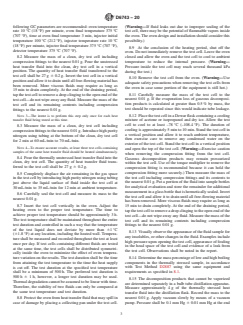
8.1 Determine the initial boiling point (IBP) and final boiling point (FBP) of the unstressed heat transfer fluid by GC, in
accordance with Test Method D2887 with the following requirements: the column shall be wall-coated open tubular type of 7.5 m
to 10 m length with a 100 % polydimethylsiloxane film thickness of 0.88 μm, the detector shall be flame ionization type, the initial
oven temperature shall be set to 35 °C (95 °F) eliminating cryogenic cooling, the calibration mixture shall cover the boiling range
from n-C to n-C . The following GC parameters are recommended: oven temperature rate 10 °C (18 °F) per minute, oven final
5 60
temperature 375 °C (707 °F), time at oven final temperature 3 min, injector initial temperature 100 °C (212 °F), injector
temperature rate 10 °C (18 °F) per minute, injector final temperature 375 °C (707 °F), detector temperature 375 °C (707 °F).
8.2 Measure the mass of a clean, dry test cell including compression fittings to the nearest 0.01 g. Pour the unstressed heat transfer
D6743 − 20
fluid into the clean, dry test cell in a vertical position. The quantity of heat transfer fluid transferred to the test cell shall be 27 g
6 0.2 g. Invert the test cell in a vertical position and allow it to drain until all free-flowing material has been removed. More
viscous fluids may require as long as 15 min to drain completely. At the end of the draining period, tap the test cell to remove a
drop clinging to the open end of the test cell—do not wipe away any fluid. Measure the mass of the test cell and its remaining
contents including compression fittings to the nearest 0.01 g.
NOTE 3—The intent is to perform this step only once for each heat transfer fluid being tested at this time.
8.3 Measure the mass of a clean, dry test cell including compression fittings to the nearest 0.01 g. Introduce high purity nitrogen
using tubing at the bottom of the clean, dry test cell for 2 min at 60 mL ⁄min to 70 mL ⁄min.
NOTE 4—To ensure accurate results, at least three test cells containing samples of the same heat transfer fluid should be heated simultaneously.
8.4 Pour the thermally unstressed heat transfer fluid into the clean, dry test cell. The quantity of heat transfer fluid transferred to
the test cell shall be 27 g 6 0.2 g.
8.5 Completely displace the air remaining in the gas space in the test cell by introducing high purity nitrogen using tubing just
above the liquid surface of fluid inside the test cell at 30 mL ⁄min to 35 mL ⁄min for 12 min at ambient temperature.
8.6 Carefully seal the test cell and measure its mass to the nearest 0.01 g.
8.7 Insert the test cell vertically in the oven. Adjust the heating oven to the proper test temperature. The time to achieve proper
test temperature should be approximately 3 h. The test temperature shall be maintained throughout the entire test duration and
controlled in such a way that the temperature of the test liquid does not deviate by more than 61 °C (6
...