

ASTM D5615-23
(Practice)Standard Practice for Operating Characteristics of Home Reverse Osmosis Devices
General Information
- Abstract
SIGNIFICANCE AND USE
5.1 Home reverse osmosis devices are typically used to remove salts and other impurities from drinking water at the point of use. They are usually operated at tap water line pressure, with water containing up to several hundred milligrams per litre of total dissolved solids. This practice permits measurement of the performance of home reverse osmosis devices using a standard set of conditions and is intended for short-term testing (less than 24 h). This practice can be used to determine changes that may have occurred in the operating characteristics of home reverse osmosis devices during use, but it is not intended to be used for system design. This practice does not necessarily determine the device’s performance when solutes other than sodium chloride are present. Use Practice D4516 and Test Methods D4194 to standardize actual field data to a standard set of conditions.
5.2 This practice is applicable for spiral-wound devices.
SCOPE
1.1 This practice covers determination of the operating characteristics of home reverse osmosis devices using standard test conditions. It does not necessarily determine the characteristics of the devices operating on natural waters.
1.2 This practice is applicable for spiral-wound devices.
1.3 The values stated in SI units are to be regarded as standard. The values given in parentheses after SI units are provided for information only and are not considered standard.
1.4 This standard does not purport to address all of the safety concerns, if any, associated with its use. It is the responsibility of the user of this standard to establish appropriate safety, health, and environmental practices and determine the applicability of regulatory limitations prior to use.
1.5 This international standard was developed in accordance with internationally recognized principles on standardization established in the Decision on Principles for the Development of International Standards, Guides and Recommendations issued by the World Trade Organization Technical Barriers to Trade (TBT) Committee.
- Status
- Published
- Publication Date
- 31-Oct-2023
- Technical Committee
- D19 - Water
- Drafting Committee
- D19.08 - Membranes and Ion Exchange Materials
Buy Documents

ASTM D5615-23 - Standard Practice for Operating Characteristics of Home Reverse Osmosis Devices
REDLINE ASTM D5615-23 - Standard Practice for Operating Characteristics of Home Reverse Osmosis Devices
Overview
ASTM D5615-23: Standard Practice for Operating Characteristics of Home Reverse Osmosis Devices provides guidelines for assessing the performance of home reverse osmosis (RO) devices. Developed by ASTM International, this standard is aimed at determining the operating characteristics of spiral-wound RO devices specifically designed for household water purification at the point of use. The practice establishes a standardized method for short-term testing (less than 24 hours) to measure how efficiently these devices remove salts and other impurities from drinking water under controlled laboratory conditions.
This standard is essential for manufacturers, water quality professionals, and end-users who need to evaluate the operational reliability and effectiveness of home RO devices using a consistent and reproducible approach.
Key Topics
Key aspects covered by ASTM D5615-23 include:
- Scope and Applicability: Focuses on home reverse osmosis devices, particularly spiral-wound designs operated at typical tap water line pressures.
- Standard Test Conditions: Uses controlled laboratory conditions, with specific parameters for feed water composition (e.g., sodium chloride solution), pressure, temperature, and flow rates.
- Performance Metrics: Evaluation includes measuring permeate flow rate and sodium chloride rejection, with calculations standardized for temperature corrections and solute passage.
- Short-Term Testing: Intended for short-duration evaluation to assess immediate changes in operating characteristics, not long-term durability or system design.
- Quality Control and Safety: Emphasizes the importance of appropriate safety, health, and environmental practices during testing and operation.
Applications
ASTM D5615-23 is practically valuable in several home water treatment scenarios:
- Product Evaluation: Manufacturers use this practice to confirm and demonstrate the performance claims of new or existing home reverse osmosis devices.
- Regulatory Compliance: Provides a benchmark for compliance testing and certification of household RO systems, supporting public health and safety initiatives.
- Performance Monitoring: Homeowners, installers, and maintenance professionals can use the outlined methods to monitor RO device performance over time or after repairs.
- Comparative Testing: Offers a standard method for comparing different models or brands of home RO devices under equivalent conditions.
By employing this standard, stakeholders can ensure that devices reliably reduce total dissolved solids and key contaminants from residential tap water, contributing to higher water quality at the point of use.
Related Standards
Several other ASTM standards complement ASTM D5615-23, contributing to comprehensive testing and standardization in water treatment:
- ASTM D4194 - Test Methods for Operating Characteristics of Reverse Osmosis and Nanofiltration Devices
- ASTM D4516 - Practice for Standardizing Reverse Osmosis Performance Data
- ASTM D1125 - Test Methods for Electrical Conductivity and Resistivity of Water
- ASTM D512 - Test Methods for Chloride Ion in Water
- ASTM D1293 - Test Methods for pH of Water
- ASTM D1193 - Specification for Reagent Water
- ASTM D6161 - Terminology Used for Microfiltration, Ultrafiltration, Nanofiltration, and Reverse Osmosis Membrane Processes
For best results, users should reference these related documents to ensure testing protocols are compatible and data is standardized across various water quality assessment contexts.
Keywords: home reverse osmosis, RO devices, water purification, operating characteristics, ASTM D5615-23, point-of-use water treatment, water quality standards, spiral-wound RO, performance testing
Relations
- Replaces
ASTM D5615-21 - Standard Practice for Operating Characteristics of Home Reverse Osmosis Devices - Effective Date
- 01-Nov-2023
- Effective Date
- 01-May-2020
- Effective Date
- 01-May-2020
Buy Documents
ASTM D5615-23 - Standard Practice for Operating Characteristics of Home Reverse Osmosis Devices
REDLINE ASTM D5615-23 - Standard Practice for Operating Characteristics of Home Reverse Osmosis Devices
Get Certified
Connect with accredited certification bodies for this standard

ECOCERT
Organic and sustainability certification.

CIS Institut d.o.o.
Personal Protective Equipment (PPE) certification body. Notified Body NB-2890 for EU Regulation 2016/425 PPE.

Eurofins Food Testing Global
Global leader in food, environment, and pharmaceutical product testing.
Sponsored listings
Frequently Asked Questions
ASTM D5615-23 is a standard published by ASTM International. Its full title is "Standard Practice for Operating Characteristics of Home Reverse Osmosis Devices". This standard covers: SIGNIFICANCE AND USE 5.1 Home reverse osmosis devices are typically used to remove salts and other impurities from drinking water at the point of use. They are usually operated at tap water line pressure, with water containing up to several hundred milligrams per litre of total dissolved solids. This practice permits measurement of the performance of home reverse osmosis devices using a standard set of conditions and is intended for short-term testing (less than 24 h). This practice can be used to determine changes that may have occurred in the operating characteristics of home reverse osmosis devices during use, but it is not intended to be used for system design. This practice does not necessarily determine the device’s performance when solutes other than sodium chloride are present. Use Practice D4516 and Test Methods D4194 to standardize actual field data to a standard set of conditions. 5.2 This practice is applicable for spiral-wound devices. SCOPE 1.1 This practice covers determination of the operating characteristics of home reverse osmosis devices using standard test conditions. It does not necessarily determine the characteristics of the devices operating on natural waters. 1.2 This practice is applicable for spiral-wound devices. 1.3 The values stated in SI units are to be regarded as standard. The values given in parentheses after SI units are provided for information only and are not considered standard. 1.4 This standard does not purport to address all of the safety concerns, if any, associated with its use. It is the responsibility of the user of this standard to establish appropriate safety, health, and environmental practices and determine the applicability of regulatory limitations prior to use. 1.5 This international standard was developed in accordance with internationally recognized principles on standardization established in the Decision on Principles for the Development of International Standards, Guides and Recommendations issued by the World Trade Organization Technical Barriers to Trade (TBT) Committee.
SIGNIFICANCE AND USE 5.1 Home reverse osmosis devices are typically used to remove salts and other impurities from drinking water at the point of use. They are usually operated at tap water line pressure, with water containing up to several hundred milligrams per litre of total dissolved solids. This practice permits measurement of the performance of home reverse osmosis devices using a standard set of conditions and is intended for short-term testing (less than 24 h). This practice can be used to determine changes that may have occurred in the operating characteristics of home reverse osmosis devices during use, but it is not intended to be used for system design. This practice does not necessarily determine the device’s performance when solutes other than sodium chloride are present. Use Practice D4516 and Test Methods D4194 to standardize actual field data to a standard set of conditions. 5.2 This practice is applicable for spiral-wound devices. SCOPE 1.1 This practice covers determination of the operating characteristics of home reverse osmosis devices using standard test conditions. It does not necessarily determine the characteristics of the devices operating on natural waters. 1.2 This practice is applicable for spiral-wound devices. 1.3 The values stated in SI units are to be regarded as standard. The values given in parentheses after SI units are provided for information only and are not considered standard. 1.4 This standard does not purport to address all of the safety concerns, if any, associated with its use. It is the responsibility of the user of this standard to establish appropriate safety, health, and environmental practices and determine the applicability of regulatory limitations prior to use. 1.5 This international standard was developed in accordance with internationally recognized principles on standardization established in the Decision on Principles for the Development of International Standards, Guides and Recommendations issued by the World Trade Organization Technical Barriers to Trade (TBT) Committee.
ASTM D5615-23 is classified under the following ICS (International Classification for Standards) categories: 13.060.50 - Examination of water for chemical substances; 71.040.50 - Physicochemical methods of analysis. The ICS classification helps identify the subject area and facilitates finding related standards.
ASTM D5615-23 has the following relationships with other standards: It is inter standard links to ASTM D5615-21, ASTM D1129-13(2020)e2, ASTM D1129-13(2020)e1. Understanding these relationships helps ensure you are using the most current and applicable version of the standard.
ASTM D5615-23 is available in PDF format for immediate download after purchase. The document can be added to your cart and obtained through the secure checkout process. Digital delivery ensures instant access to the complete standard document.
Standards Content (Sample)
This international standard was developed in accordance with internationally recognized principles on standardization established in the Decision on Principles for the
Development of International Standards, Guides and Recommendations issued by the World Trade Organization Technical Barriers to Trade (TBT) Committee.
Designation: D5615 − 23
Standard Practice for
Operating Characteristics of Home Reverse Osmosis
Devices
This standard is issued under the fixed designation D5615; the number immediately following the designation indicates the year of
original adoption or, in the case of revision, the year of last revision. A number in parentheses indicates the year of last reapproval. A
superscript epsilon (´) indicates an editorial change since the last revision or reapproval.
1. Scope D4194 Test Methods for Operating Characteristics of Re-
verse Osmosis and Nanofiltration Devices
1.1 This practice covers determination of the operating
D4516 Practice for Standardizing Reverse Osmosis Perfor-
characteristics of home reverse osmosis devices using standard
mance Data
test conditions. It does not necessarily determine the charac-
D6161 Terminology Used for Microfiltration, Ultrafiltration,
teristics of the devices operating on natural waters.
Nanofiltration, and Reverse Osmosis Membrane Processes
1.2 This practice is applicable for spiral-wound devices.
3. Terminology
1.3 The values stated in SI units are to be regarded as
3.1 Definitions:
standard. The values given in parentheses after SI units are
3.1.1 For definitions of terms used in this standard, refer to
provided for information only and are not considered standard.
Terminology D1129.
1.4 This standard does not purport to address all of the
3.1.2 For descriptions of terms relating to reverse osmosis,
safety concerns, if any, associated with its use. It is the
refer to Test Methods D4194 and Terminology D6161.
responsibility of the user of this standard to establish appro-
priate safety, health, and environmental practices and deter-
4. Summary of Practice
mine the applicability of regulatory limitations prior to use.
4.1 This practice consists of determining the permeate flow
1.5 This international standard was developed in accor-
rate and sodium chloride rejection for reverse osmosis devices
dance with internationally recognized principles on standard-
at 345 kPa (50-psi) feed gauge pressure, 25 °C and 22 %
ization established in the Decision on Principles for the
conversion using an aqueous 300 mg ⁄L sodium chloride solu-
Development of International Standards, Guides and Recom-
tion.
mendations issued by the World Trade Organization Technical
Barriers to Trade (TBT) Committee.
5. Significance and Use
5.1 Home reverse osmosis devices are typically used to
2. Referenced Documents
remove salts and other impurities from drinking water at the
2.1 ASTM Standards:
point of use. They are usually operated at tap water line
D512 Test Methods for Chloride Ion In Water pressure, with water containing up to several hundred milli-
D1125 Test Methods for Electrical Conductivity and Resis-
grams per litre of total dissolved solids. This practice permits
tivity of Water measurement of the performance of home reverse osmosis
D1129 Terminology Relating to Water
devices using a standard set of conditions and is intended for
D1193 Specification for Reagent Water short-term testing (less than 24 h). This practice can be used to
D1293 Test Methods for pH of Water
determine changes that may have occurred in the operating
D2777 Practice for Determination of Precision and Bias of characteristics of home reverse osmosis devices during use, but
Applicable Test Methods of Committee D19 on Water
it is not intended to be used for system design. This practice
does not necessarily determine the device’s performance when
solutes other than sodium chloride are present. Use Practice
1 D4516 and Test Methods D4194 to standardize actual field data
This practice is under the jurisdiction of ASTM Committee D19 on Water and
is the direct responsibility of Subcommittee D19.08 on Membranes and Ion
to a standard set of conditions.
Exchange Materials.
5.2 This practice is applicable for spiral-wound devices.
Current edition approved Nov. 1, 2023. Published November 2023. Originally
approved in 1994. Last previous edition approved in 2021 as D5615 – 21. DOI:
6. Apparatus
10.1520/D5615-23.
For referenced ASTM standards, visit the ASTM website, www.astm.org, or
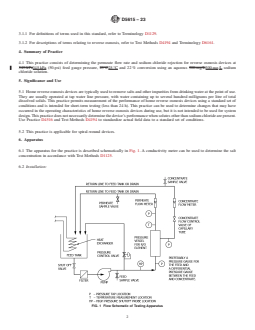
6.1 The apparatus for the practice is described schematically
contact ASTM Customer Service at service@astm.org. For Annual Book of ASTM
in Fig. 1. A conductivity meter can be used to determine the salt
Standards volume information, refer to the standard’s Document Summary page on
the ASTM website. concentration in accordance with Test Methods D1125.
Copyright © ASTM International, 100 Barr Harbor Drive, PO Box C700, West Conshohocken, PA 19428-2959. United States
D5615 − 23
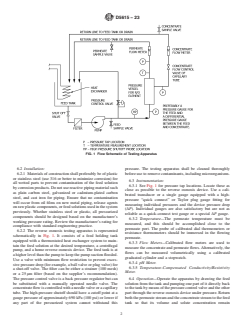
FIG. 1 Flow Schematic of Testing Apparatus
6.2 Installation: pressure. The testing apparatus shall be cleaned thoroughly
6.2.1 Materials of construction shall preferably be of plastic before use to remove contaminants, including microorganisms.
or stainless steel (use 316 or better to minimize corrosion) for
6.3 Instrumentation:
all wetted parts to prevent contamination of the feed solution
6.3.1 See Fig. 1 for pressure tap locations. Locate these as
by corrosion products. Do not use reactive piping material such
close as possible to the reverse osmosis device. Use a cali-
as plain carbon steel, galvanized or cadmium-plated carbon
brated transducer or a single gauge equipped with a high-
steel, and cast iron for piping. Ensure that no contamination
pressure “quick connect” or Taylor plug gauge fitting for
will occur from oil films on new metal piping, release agents
measuring individual pressures and the device pressure drop
on raw plastic components, or feed solutions used in the system
(ΔP). Individual gauges are also satisfactory but are not as
previously. Whether stainless steel or plastic, all pressurized
reliable as a quick-connect test gauge or a special ΔP gauge.
components should be designed based on the manufacturer’s
6.3.2 Temperature—The permeate temperature must be
working pressure rating. Review the manufacturer’s rating for
measured, and this should be accomplished close to the
compliance with standard engineering practice.
permeate port. The probe of calibrated dial thermometers or
6.2.2 The reverse osmosis testing apparatus is represented
resistance thermometers should be immersed in the flowing
schematically in Fig. 1. It consists of a feed holding tank
permeate.
equipped with a thermostated heat exchanger system to main-
6.3.3 Flow Meters—Calibrated flow meters are used to
tain the feed solution at the desired temperature, a centrifugal
measure the concentrate and permeate flows. Alternatively, the
pump, and a home reverse osmosis device. The feed tank is at
flows can be measured volumetrically using a calibrated
a higher level than the pump to keep the pump suction flooded.
graduated cylinder and a stopwatch.
Use a valve with minimum flow restriction to prevent exces-
6.3.4 pH Meter.
sive pressure drop (for example, a ball valve or plug valve) for
6.3.5 Temperature-Compensated Conductivity/Resistivity
a shut-off valve. The filter can be either a strainer (100 mesh)
Meter.
or a 25 μm filter (based on the supplier’s recommendation).
The pressure control valve is a back pressure regulator but can 6.4 Operation—Operate the apparatus by drawing the feed
be substituted with a manually operated needle valve. The solution from the tank and pumping one part of it directly back
concentrate flow is controlled with a needle valve or a capillary to the tank by means of the pressure control valve and the other
tube. The high-pressure shutoff should have a cutoff point at a part through the reverse osmosis device under pressure. Return
gauge pressure of approximately 690 kPa (100 psi) or lower if both the permeate stream and the concentrate stream to the feed
any part of the pressurized system cannot withstand this tank so that its volume and solute concentration remain
D5615 − 23
constant. Direct the return flows in the feed tank to provide valve or the length of the capillary tube. The pressure control
adequate mixing. Use the heat exchanger coils in the feed tank valve may need to be adjusted simultaneously to keep the feed
to increase the feed to the specified operating temperature and pressure constant.
thereafter to remove the energy load generated by the pump. 8.1.8 Check and adjust the cooling system in the feed tank
to provide a permeate temperature of 25 °C 6 1 °C.
7. Reagents
8.2 Data Recording:
7.1 Purity of Reagents—Reagent grade chemicals shall be
8.2.1 One hour after startup, measure and record the follow-
used in all tests. Unless otherwise indicated, it is intended that
ing on a dat
...
This document is not an ASTM standard and is intended only to provide the user of an ASTM standard an indication of what changes have been made to the previous version. Because
it may not be technically possible to adequately depict all changes accurately, ASTM recommends that users consult prior editions as appropriate. In all cases only the current version
of the standard as published by ASTM is to be considered the official document.
Designation: D5615 − 21 D5615 − 23
Standard Practice for
Operating Characteristics of Home Reverse Osmosis
Devices
This standard is issued under the fixed designation D5615; the number immediately following the designation indicates the year of
original adoption or, in the case of revision, the year of last revision. A number in parentheses indicates the year of last reapproval. A
superscript epsilon (´) indicates an editorial change since the last revision or reapproval.
1. Scope
1.1 This practice covers determination of the operating characteristics of home reverse osmosis devices using standard test
conditions. It does not necessarily determine the characteristics of the devices operating on natural waters.
1.2 This practice is applicable for spiral-wound devices.
1.3 The values stated in SI units are to be regarded as standard. The values given in parentheses after SI units are provided for
information only and are not considered standard.
1.4 This standard does not purport to address all of the safety concerns, if any, associated with its use. It is the responsibility
of the user of this standard to establish appropriate safety, health, and environmental practices and determine the applicability of
regulatory limitations prior to use.
1.5 This international standard was developed in accordance with internationally recognized principles on standardization
established in the Decision on Principles for the Development of International Standards, Guides and Recommendations issued
by the World Trade Organization Technical Barriers to Trade (TBT) Committee.
2. Referenced Documents
2.1 ASTM Standards:
D512 Test Methods for Chloride Ion In Water
D1125 Test Methods for Electrical Conductivity and Resistivity of Water
D1129 Terminology Relating to Water
D1193 Specification for Reagent Water
D1293 Test Methods for pH of Water
D2777 Practice for Determination of Precision and Bias of Applicable Test Methods of Committee D19 on Water
D4194 Test Methods for Operating Characteristics of Reverse Osmosis and Nanofiltration Devices
D4516 Practice for Standardizing Reverse Osmosis Performance Data
D6161 Terminology Used for Microfiltration, Ultrafiltration, Nanofiltration, and Reverse Osmosis Membrane Processes
3. Terminology
3.1 Definitions:
This practice is under the jurisdiction of ASTM Committee D19 on Water and is the direct responsibility of Subcommittee D19.08 on Membranes and Ion Exchange
Materials.
Current edition approved May 1, 2021Nov. 1, 2023. Published January 2023November 2023. Originally approved in 1994. Last previous edition approved in 20202021
as D5615 – 20.D5615 – 21. DOI: 10.1520/D5615-21.10.1520/D5615-23.
For referenced ASTM standards, visit the ASTM website, www.astm.org, or contact ASTM Customer Service at service@astm.org. For Annual Book of ASTM Standards
volume information, refer to the standard’s Document Summary page on the ASTM website.
Copyright © ASTM International, 100 Barr Harbor Drive, PO Box C700, West Conshohocken, PA 19428-2959. United States
D5615 − 23
3.1.1 For definitions of terms used in this standard, refer to Terminology D1129.
3.1.2 For descriptions of terms relating to reverse osmosis, refer to Test Methods D4194 and Terminology D6161.
4. Summary of Practice
4.1 This practice consists of determining the permeate flow rate and sodium chloride rejection for reverse osmosis devices at
345-kPa345 kPa (50-psi) feed gauge pressure, 25°C25 °C and 22 % conversion using an aqueous 300-mg/L300 mg ⁄L sodium
chloride solution.
5. Significance and Use
5.1 Home reverse osmosis devices are typically used to remove salts and other impurities from drinking water at the point of use.
They are usually operated at tap water line pressure, with water containing up to several hundred milligrams per litre of total
dissolved solids. This practice permits measurement of the performance of home reverse osmosis devices using a standard set of
conditions and is intended for short-term testing (less than 24 h). This practice can be used to determine changes that may have
occurred in the operating characteristics of home reverse osmosis devices during use, but it is not intended to be used for system
design. This practice does not necessarily determine the device’s performance when solutes other than sodium chloride are present.
Use Practice D4516 and Test Methods D4194 to standardize actual field data to a standard set of conditions.
5.2 This practice is applicable for spiral-wound devices.
6. Apparatus
6.1 The apparatus for the practice is described schematically in Fig. 1. A conductivity meter can be used to determine the salt
concentration in accordance with Test Methods D1125.
6.2 Installation:
FIG. 1 Flow Schematic of Testing Apparatus
D5615 − 23
6.2.1 Materials of construction shall preferably be of plastic or stainless steel (use 316 or better to minimize corrosion) for all
wetted parts to prevent contamination of the feed solution by corrosion products. Do not use reactive piping material such as plain
carbon steel, galvanized or cadmium-plated carbon steel, and cast iron for piping. Ensure that no contamination will occur from
oil films on new metal piping, release agents on raw plastic components, or feed solutions used in the system previously. Whether
stainless steel or plastic, all pressurized components should be designed based on the manufacturer’s working pressure rating.
Review the manufacturer’s rating for compliance with standard engineering practice.
6.2.2 The reverse osmosis testing apparatus is represented schematically in Fig. 1. It consists of a feed holding tank equipped with
a thermostated heat exchanger system to maintain the feed solution at the desired temperature, a centrifugal pump, and a home
reverse osmosis device. The feed tank is at a higher level than the pump to keep the pump suction flooded. Use a valve with
minimum flow restriction to prevent excessive pressure drop (for example, a ball valve or plug valve) for a shut-off valve. The filter
can be either a strainer (100 mesh) or a 25-μm25 μm filter (based on the supplier’s recommendation). The pressure control valve
is a back pressure regulator but can be substituted with a manually operated needle valve. The concentrate flow is controlled with
a needle valve or a capillary tube. The high-pressure shutoff should have a cutoff point at a gauge pressure of approximately 690
kPa (100 psi) or lower if any part of the pressurized system cannot withstand this pressure. The testing apparatus shall be cleaned
thoroughly before use to remove contaminants, including microorganisms.
6.3 Instrumentation:
6.3.1 See Fig. 1 for pressure tap locations. Locate these as close as possible to the reverse osmosis device. Use a calibrated
transducer or a single gauge equipped with a high-pressure “quick connect” or Taylor plug gauge fitting for measuring individual
pressures and the device pressure drop (ΔP). Individual gauges are also satisfactory but are not as reliable as a quick-connect test
gauge or a special ΔP gauge.
6.3.2 Temperature—The permeate temperature must be measured, and this should be accomplished close to the permeate port. The
probe of calibrated dial thermometers or resistance thermometers should be immersed in the flowing permeate.
6.3.3 Flow Meters—Calibrated flow meters are used to measure the concentrate and permeate flows. Alternatively, the flows can
be measured volumetrically using a calibrated graduated cylinder and a stopwatch.
6.3.4 pH Meter.
6.3.5 Temperature-Compensated Conductivity/Resistivity Meter.
6.4 Operation—Operate the apparatus by drawing the feed solution from the tank and pumping one part of it directly back to the
tank by means of the pressure control valve and the other part through the reverse osmosis device under pressure. Return both the
permeate stream and the concentrate stream to the feed tank so that its volume and solute concentration remain constant. Direct
the return flows in the feed tank to provide adequate mixing. Use the heat exchanger coils in the feed tank to increase the feed
to the specified operating temperature and thereafter to remove the energy load generated by the pump.
7. Reagents
7.1 Purity of Reagents—Reagent grade chemicals shall be used in all tests. Unless otherwise indicated, it is intended that all
reagents conform to the specifications of the Committee on Analytical Reagents of the American Chemical Society where such
specifications are available. Other grades may be used, provided it is first ascertained that the reagent is of sufficiently high purity
to permit its use without lessening the accuracy of the determination.
7.2 Purity of Water—Unless otherw
...