

ASTM E3274-24
(Guide)Standard Guide for Management of Investigation-Derived Waste Associated with PFAS
General Information
- Abstract
SIGNIFICANCE AND USE
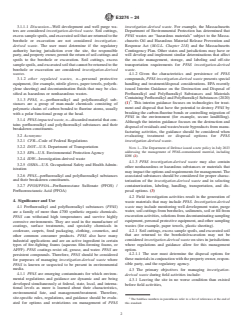
4.1 Perfluoroalkyl and polyfluoroalkyl substances (PFAS) are a family of more than 4700 synthetic organic chemicals. PFAS can withstand high temperatures and survive highly corrosive environments. They are used in the manufacture of coatings, surface treatments, and specialty chemicals in cookware, carpets, food packaging, clothing, cosmetics, and other common consumer products. PFAS also have many industrial applications and are an active ingredient in certain types of fire-fighting foams (aqueous film-forming foams, or AFFF). PFAS coatings resist oil, grease, and water. PFAS are persistent compounds. Therefore, PFAS should be considered for purposes of managing investigation-derived waste where PFAS is known or suspected to be present in environmental media.
4.1.1 PFAS are emerging contaminants for which environmental regulations and guidance are dynamic and are being developed simultaneously at federal, state, local, and international levels as more is learned about their characteristics, environmental fate, and management/treatment. Therefore, site-specific rules, regulations, and guidance should be evaluated for options and restrictions on management of PFAS investigation-derived waste. For example, the Massachusetts Department of Environmental Protection has determined that PFAS wastes are “hazardous materials” subject to the Massachusetts Oil and Hazardous Material Release Prevention and Response Act (M.G.L. Chapter 21E) and the Massachusetts Contingency Plan. Other states and jurisdictions may have or will develop and implement similar determinations that affect the on-site management, storage, and labeling and off-site transportation requirements for PFAS investigation-derived waste.
4.1.2 Given the characteristics and persistence of PFAS compounds, PFAS investigation-derived waste presents special handling and treatment/disposal considerations. EPA recently issued Interim Guidance on the Destruction and Disposal of Perfluoralkyl and Polyfluoralky...
SCOPE
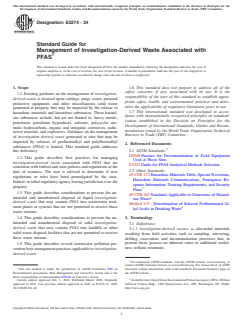
1.1 Existing guidance on the management of investigation-derived waste is focused upon cuttings, purge water, personal protective equipment, and other miscellaneous solid waste generated at property that may be impacted by the release of hazardous materials and hazardous substances. These hazardous substances include, but are not limited to, heavy metals, petroleum, petroleum byproducts, solvents, polycyclic aromatic hydrocarbons, organic and inorganic corrosives, radioactive material, and explosives. Guidance on the management of investigation derived waste generated at sites that may be impacted by releases of perfluoroalkyl and polyfluoroalkyl substances (PFAS) is limited. This standard guide addresses this deficiency
1.2 This guide describes best practices for managing investigation-derived waste associated with PFAS that are consistent with federal and state policies and regulations at the date of issuance. The user is advised to determine if new regulations or rules have been promulgated by the state, federal, or tribal regulatory agency having jurisdiction over the property.
1.3 This guide describes considerations to prevent the unintended and unauthorized disposal of liquid investigation-derived waste that may contain PFAS into wastewater treatment plants or systems that are not permitted to receive these waste streams.
1.4 This guide describes considerations to prevent the unintended and unauthorized disposal of solid investigation-derived waste that may contain PFAS into landfills or other solid waste disposal facilities that are not permitted to receive these waste streams.
1.5 This guide describes several stormwater pollution prevention best management practices applicable to investigation-derived waste.
1.6 This standard does not purport to address all of the safety concerns, if any, associated with its use. It is the responsibility of the user of this standard to establish appropriate safety,...
- Status
- Published
- Publication Date
- 31-Jan-2024
- Technical Committee
- E50 - Environmental Assessment, Risk Management and Corrective Action
- Drafting Committee
- E50.04 - Corrective Action
Buy Documents
ASTM E3274-24 - Standard Guide for Management of Investigation-Derived Waste Associated with PFAS
REDLINE ASTM E3274-24 - Standard Guide for Management of Investigation-Derived Waste Associated with PFAS
Overview
ASTM E3274-24: Standard Guide for Management of Investigation-Derived Waste Associated with PFAS provides best practices for handling, labeling, storage, treatment, and disposal of investigation-derived waste (IDW) that may be contaminated with perfluoroalkyl and polyfluoroalkyl substances (PFAS). PFAS are a diverse group of over 4,700 synthetic chemicals renowned for their chemical resistance and environmental persistence. Used widely in consumer products and industrial applications, PFAS present unique challenges for environmental investigations due to their persistence and evolving regulatory landscape.
This standard addresses the deficiency in existing guidance by focusing specifically on proper management of PFAS-containing waste generated from site investigations, including soil cuttings, purge water, and contaminated protective equipment. It emphasizes compliance with current federal, state, and local regulations and underscores the importance of ongoing regulatory review due to the rapidly developing status of PFAS-related policies.
Key Topics
- PFAS Characteristics and Risks: PFAS compounds persist in the environment and resist conventional degradation, making their management essential at sites of known or suspected contamination.
- Types of Investigation-Derived Waste: Includes soil cuttings, purge/development water, decontamination fluids, personal protective equipment, and related materials.
- Regulatory Compliance: Guidance aligns with dynamic federal, state, local, and, where applicable, international regulations on PFAS waste management. Users are advised to review the latest rules for their specific jurisdiction.
- Waste Characterization and Labeling: Outlines requirements for properly labeling IDW containers, including project information, container identification, and content descriptions, to ensure traceability and regulatory compliance.
- Handling and Storage: Details best practices for safe movement, temporary staging, and storage of PFAS-impacted waste, including secondary containment, weather-resistant labeling, and routine inspection.
- Disposal Considerations: Prevents unauthorized disposal of liquid waste into wastewater facilities and solid waste into landfills that are not permitted to accept PFAS waste. Recommends careful site selection for final treatment or disposal, often necessitating approval from regulatory and facility operators.
- Stormwater Pollution Prevention: Advises best management practices to prevent stormwater contamination during storage and handling of PFAS investigation-derived waste, such as covered storage and decontamination procedures.
Applications
ASTM E3274-24 is crucial for:
- Environmental consultants conducting site assessments and remediation activities at locations impacted by PFAS.
- Regulatory compliance officers ensuring that all handling, storage, transportation, and disposal of PFAS-related investigation waste meet evolving legal requirements.
- Industrial facilities and government agencies responsible for managing waste streams containing potential PFAS contamination, including the Department of Defense sites and municipal or private landfills and wastewater treatment plants.
- Sampling and laboratory professionals developing site-specific Sampling and Analysis Plans to ensure accurate waste characterization and compliance in managing investigation-derived waste.
The guide is applicable to waste streams such as drill cuttings, monitoring well purge water, disposable field equipment, and decontamination rinsates. Emphasis is placed on preventing further environmental contamination and ensuring that waste is directed only to facilities authorized and equipped to handle PFAS.
Related Standards
- ASTM D5088: Practice for Decontamination of Field Equipment Used at Waste Sites.
- ASTM E3302: Guide for PFAS Analytical Methods Selection.
- 49 CFR 172 & 40 CFR 262: US regulations governing hazardous materials labeling, communication, and hazardous waste generator requirements.
- EPA Method 537: For the determination of selected perfluorinated alkyl acids in water.
- EPA Interim Guidance on PFAS Destruction and Disposal: Offers additional perspectives on eligible technologies and best practices.
Implementing ASTM E3274-24 ensures standardized, defensible, and regulatory-compliant management of PFAS-contaminated investigation-derived waste, protecting the environment, human health, and organizational liability.
Relations
- Replaces
ASTM E3274-21 - Standard Guide for Management of Investigation-Derived Waste Associated with PFAS - Effective Date
- 01-Feb-2024
- Effective Date
- 01-Feb-2024
Buy Documents
ASTM E3274-24 - Standard Guide for Management of Investigation-Derived Waste Associated with PFAS
REDLINE ASTM E3274-24 - Standard Guide for Management of Investigation-Derived Waste Associated with PFAS
Get Certified
Connect with accredited certification bodies for this standard

ECOCERT
Organic and sustainability certification.

Eurofins Food Testing Global
Global leader in food, environment, and pharmaceutical product testing.

Intertek Bangladesh
Intertek certification and testing services in Bangladesh.
Sponsored listings
Frequently Asked Questions
ASTM E3274-24 is a guide published by ASTM International. Its full title is "Standard Guide for Management of Investigation-Derived Waste Associated with PFAS". This standard covers: SIGNIFICANCE AND USE 4.1 Perfluoroalkyl and polyfluoroalkyl substances (PFAS) are a family of more than 4700 synthetic organic chemicals. PFAS can withstand high temperatures and survive highly corrosive environments. They are used in the manufacture of coatings, surface treatments, and specialty chemicals in cookware, carpets, food packaging, clothing, cosmetics, and other common consumer products. PFAS also have many industrial applications and are an active ingredient in certain types of fire-fighting foams (aqueous film-forming foams, or AFFF). PFAS coatings resist oil, grease, and water. PFAS are persistent compounds. Therefore, PFAS should be considered for purposes of managing investigation-derived waste where PFAS is known or suspected to be present in environmental media. 4.1.1 PFAS are emerging contaminants for which environmental regulations and guidance are dynamic and are being developed simultaneously at federal, state, local, and international levels as more is learned about their characteristics, environmental fate, and management/treatment. Therefore, site-specific rules, regulations, and guidance should be evaluated for options and restrictions on management of PFAS investigation-derived waste. For example, the Massachusetts Department of Environmental Protection has determined that PFAS wastes are “hazardous materials” subject to the Massachusetts Oil and Hazardous Material Release Prevention and Response Act (M.G.L. Chapter 21E) and the Massachusetts Contingency Plan. Other states and jurisdictions may have or will develop and implement similar determinations that affect the on-site management, storage, and labeling and off-site transportation requirements for PFAS investigation-derived waste. 4.1.2 Given the characteristics and persistence of PFAS compounds, PFAS investigation-derived waste presents special handling and treatment/disposal considerations. EPA recently issued Interim Guidance on the Destruction and Disposal of Perfluoralkyl and Polyfluoralky... SCOPE 1.1 Existing guidance on the management of investigation-derived waste is focused upon cuttings, purge water, personal protective equipment, and other miscellaneous solid waste generated at property that may be impacted by the release of hazardous materials and hazardous substances. These hazardous substances include, but are not limited to, heavy metals, petroleum, petroleum byproducts, solvents, polycyclic aromatic hydrocarbons, organic and inorganic corrosives, radioactive material, and explosives. Guidance on the management of investigation derived waste generated at sites that may be impacted by releases of perfluoroalkyl and polyfluoroalkyl substances (PFAS) is limited. This standard guide addresses this deficiency 1.2 This guide describes best practices for managing investigation-derived waste associated with PFAS that are consistent with federal and state policies and regulations at the date of issuance. The user is advised to determine if new regulations or rules have been promulgated by the state, federal, or tribal regulatory agency having jurisdiction over the property. 1.3 This guide describes considerations to prevent the unintended and unauthorized disposal of liquid investigation-derived waste that may contain PFAS into wastewater treatment plants or systems that are not permitted to receive these waste streams. 1.4 This guide describes considerations to prevent the unintended and unauthorized disposal of solid investigation-derived waste that may contain PFAS into landfills or other solid waste disposal facilities that are not permitted to receive these waste streams. 1.5 This guide describes several stormwater pollution prevention best management practices applicable to investigation-derived waste. 1.6 This standard does not purport to address all of the safety concerns, if any, associated with its use. It is the responsibility of the user of this standard to establish appropriate safety,...
SIGNIFICANCE AND USE 4.1 Perfluoroalkyl and polyfluoroalkyl substances (PFAS) are a family of more than 4700 synthetic organic chemicals. PFAS can withstand high temperatures and survive highly corrosive environments. They are used in the manufacture of coatings, surface treatments, and specialty chemicals in cookware, carpets, food packaging, clothing, cosmetics, and other common consumer products. PFAS also have many industrial applications and are an active ingredient in certain types of fire-fighting foams (aqueous film-forming foams, or AFFF). PFAS coatings resist oil, grease, and water. PFAS are persistent compounds. Therefore, PFAS should be considered for purposes of managing investigation-derived waste where PFAS is known or suspected to be present in environmental media. 4.1.1 PFAS are emerging contaminants for which environmental regulations and guidance are dynamic and are being developed simultaneously at federal, state, local, and international levels as more is learned about their characteristics, environmental fate, and management/treatment. Therefore, site-specific rules, regulations, and guidance should be evaluated for options and restrictions on management of PFAS investigation-derived waste. For example, the Massachusetts Department of Environmental Protection has determined that PFAS wastes are “hazardous materials” subject to the Massachusetts Oil and Hazardous Material Release Prevention and Response Act (M.G.L. Chapter 21E) and the Massachusetts Contingency Plan. Other states and jurisdictions may have or will develop and implement similar determinations that affect the on-site management, storage, and labeling and off-site transportation requirements for PFAS investigation-derived waste. 4.1.2 Given the characteristics and persistence of PFAS compounds, PFAS investigation-derived waste presents special handling and treatment/disposal considerations. EPA recently issued Interim Guidance on the Destruction and Disposal of Perfluoralkyl and Polyfluoralky... SCOPE 1.1 Existing guidance on the management of investigation-derived waste is focused upon cuttings, purge water, personal protective equipment, and other miscellaneous solid waste generated at property that may be impacted by the release of hazardous materials and hazardous substances. These hazardous substances include, but are not limited to, heavy metals, petroleum, petroleum byproducts, solvents, polycyclic aromatic hydrocarbons, organic and inorganic corrosives, radioactive material, and explosives. Guidance on the management of investigation derived waste generated at sites that may be impacted by releases of perfluoroalkyl and polyfluoroalkyl substances (PFAS) is limited. This standard guide addresses this deficiency 1.2 This guide describes best practices for managing investigation-derived waste associated with PFAS that are consistent with federal and state policies and regulations at the date of issuance. The user is advised to determine if new regulations or rules have been promulgated by the state, federal, or tribal regulatory agency having jurisdiction over the property. 1.3 This guide describes considerations to prevent the unintended and unauthorized disposal of liquid investigation-derived waste that may contain PFAS into wastewater treatment plants or systems that are not permitted to receive these waste streams. 1.4 This guide describes considerations to prevent the unintended and unauthorized disposal of solid investigation-derived waste that may contain PFAS into landfills or other solid waste disposal facilities that are not permitted to receive these waste streams. 1.5 This guide describes several stormwater pollution prevention best management practices applicable to investigation-derived waste. 1.6 This standard does not purport to address all of the safety concerns, if any, associated with its use. It is the responsibility of the user of this standard to establish appropriate safety,...
ASTM E3274-24 is classified under the following ICS (International Classification for Standards) categories: 71.040.01 - Analytical chemistry in general; 71.080.01 - Organic chemicals in general. The ICS classification helps identify the subject area and facilitates finding related standards.
ASTM E3274-24 has the following relationships with other standards: It is inter standard links to ASTM E3274-21, ASTM E3358-23a. Understanding these relationships helps ensure you are using the most current and applicable version of the standard.
ASTM E3274-24 is available in PDF format for immediate download after purchase. The document can be added to your cart and obtained through the secure checkout process. Digital delivery ensures instant access to the complete standard document.
Standards Content (Sample)
This international standard was developed in accordance with internationally recognized principles on standardization established in the Decision on Principles for the
Development of International Standards, Guides and Recommendations issued by the World Trade Organization Technical Barriers to Trade (TBT) Committee.
Designation: E3274 − 24
Standard Guide for
Management of Investigation-Derived Waste Associated with
PFAS
This standard is issued under the fixed designation E3274; the number immediately following the designation indicates the year of
original adoption or, in the case of revision, the year of last revision. A number in parentheses indicates the year of last reapproval. A
superscript epsilon (´) indicates an editorial change since the last revision or reapproval.
1. Scope 1.6 This standard does not purport to address all of the
safety concerns, if any, associated with its use. It is the
1.1 Existing guidance on the management of investigation-
responsibility of the user of this standard to establish appro-
derived waste is focused upon cuttings, purge water, personal
priate safety, health, and environmental practices and deter-
protective equipment, and other miscellaneous solid waste
mine the applicability of regulatory limitations prior to use.
generated at property that may be impacted by the release of
1.7 This international standard was developed in accor-
hazardous materials and hazardous substances. These hazard-
dance with internationally recognized principles on standard-
ous substances include, but are not limited to, heavy metals,
ization established in the Decision on Principles for the
petroleum, petroleum byproducts, solvents, polycyclic aro-
Development of International Standards, Guides and Recom-
matic hydrocarbons, organic and inorganic corrosives, radio-
mendations issued by the World Trade Organization Technical
active material, and explosives. Guidance on the management
Barriers to Trade (TBT) Committee.
of investigation derived waste generated at sites that may be
impacted by releases of perfluoroalkyl and polyfluoroalkyl
2. Referenced Documents
substances (PFAS) is limited. This standard guide addresses
2.1 ASTM Standards:
this deficiency
D5088 Practice for Decontamination of Field Equipment
1.2 This guide describes best practices for managing
Used at Waste Sites
investigation-derived waste associated with PFAS that are
E3302 Guide for PFAS Analytical Methods Selection
consistent with federal and state policies and regulations at the
2.2 Other Standards:
date of issuance. The user is advised to determine if new
49 CFR 172 Hazardous Materials Table, Special Provisions,
regulations or rules have been promulgated by the state,
Hazardous Materials Communications, Emergency Re-
federal, or tribal regulatory agency having jurisdiction over the
sponse Information, Training Requirements, and Security
property.
Plans
1.3 This guide describes considerations to prevent the un-
49 CFR 262 Standards Applicable to Generators of Hazard-
intended and unauthorized disposal of liquid investigation- 3
ous Waste
derived waste that may contain PFAS into wastewater treat-
Method 537 : Determination of Selected Perfluorinated Al-
ment plants or systems that are not permitted to receive these 4
kyl Acids in Drinking Water
waste streams.
3. Terminology
1.4 This guide describes considerations to prevent the un-
intended and unauthorized disposal of solid investigation-
3.1 Definitions:
derived waste that may contain PFAS into landfills or other
3.1.1 investigation-derived wastes, n—discarded materials
solid waste disposal facilities that are not permitted to receive
resulting from field activities such as sampling, surveying,
these waste streams.
drilling, excavation, and decontamination processes that, in
present form, possess no inherent value or additional useful-
1.5 This guide describes several stormwater pollution pre-
ness without treatment.
vention best management practices applicable to investigation-
derived waste.
For referenced ASTM standards, visit the ASTM website, www.astm.org, or
contact ASTM Customer Service at service@astm.org. For Annual Book of ASTM
This test method is under the jurisdiction of ASTM Committee E50 on Standards volume information, refer to the standard’s Document Summary page on
Environmental Assessment, Risk Management and Corrective Action and is the the ASTM website.
direct responsibility of Subcommittee E50.04 on Corrective Action.
Current edition approved Feb. 1, 2024. Published March 2024. Originally Available from United States Environmental Protection Agency (EPA), William
approved in 2021. Last previous edition approved in 2021 as E3274–21. DOI: Jefferson Clinton Bldg., 1200 Pennsylvania Ave., NW, Washington, DC 20460,
10.1520/E3274–24 http://www.epa.gov.
Copyright © ASTM International, 100 Barr Harbor Drive, PO Box C700, West Conshohocken, PA 19428-2959. United States
E3274 − 24
3.1.1.1 Discussion—Well development and well purge wa- investigation-derived waste. For example, the Massachusetts
ters are considered investigation-derived waste. Soil cuttings, Department of Environmental Protection has determined that
excess sample spoils, and excavated soil that are returned to the PFAS wastes are “hazardous materials” subject to the Massa-
borehole or excavation are not considered investigation- chusetts Oil and Hazardous Material Release Prevention and
derived waste. The user must determine if the regulatory Response Act (M.G.L. Chapter 21E) and the Massachusetts
authority having jurisdiction over the site, the responsible Contingency Plan. Other states and jurisdictions may have or
party, and property owner, permit the return of soil cuttings and will develop and implement similar determinations that affect
spoils to the borehole or excavation. Soil cuttings, excess the on-site management, storage, and labeling and off-site
sample spoils, and excavated soil that cannot be returned to the transportation requirements for PFAS investigation-derived
borehole or excavation are considered investigation-derived waste.
wastes. 4.1.2 Given the characteristics and persistence of PFAS
3.1.2 other regulated wastes, n—personal protective compounds, PFAS investigation-derived waste presents special
equipment, (for example, nitrile gloves, paper towels, polyeth- handling and treatment/disposal considerations. EPA recently
ylene sheeting) and decontamination fluids that may be clas- issued Interim Guidance on the Destruction and Disposal of
sified as hazardous or nonhazardous wastes. Perfluoralkyl and Polyfluoralkyl Substances and Materials
Containing Perfluoralkyl and Polyfluoralkyl Substances (2020)
3.1.3 PFAS, n—perfluoroalkyl and polyfluoroalkyl sub-
(1) . This interim guidance focuses on technologies for treat-
stances are a group of man-made chemicals consisting of
ment and disposal that have the potential to destroy PFAS by
polymeric chains of carbon bonded to fluorine atoms, usually
breaking the carbon-fluorine bonds or controlling migration of
with a polar functional group at the head.
PFAS in the environment (for example, secure landfilling).
3.1.4 PFAS-impacted waste, n—discarded material that con-
Although the interim guidance focuses on the destruction and
tains perfluoroalkyl and polyfluoroalkyl substances and their
disposal of residuals and wastes/waste byproducts from manu-
breakdown constituents.
facturing activities, the guidance should be considered when
3.2 Acronyms:
evaluating treatment or disposal options for PFAS
3.2.1 CFR—Code of Federal Regulations
investigation-derived waste.
3.2.2 DOT—U.S. Department of Transportation
NOTE 1—The Department of Defense issued a new policy in July 2023
addressing the management of PFAS-contaminated material, including
3.2.3 EPA—U.S. Environmental Protection Agency
IDW (2).
3.2.4 IDW—Investigation-derived waste
4.1.3 PFAS investigation-derived waste may also contain
3.2.5 OSHA—U.S. Occupational Safety and Health Admin-
other nonhazardous or hazardous substances or materials that
istration
may impact the options and requirements for management. The
3.2.6 PFAS—perfluoroalkyl and polyfluoroalkyl substances
associated substances should be considered for proper charac-
and their breakdown constituents.
terization of the investigation-derived waste and in selecting
containerization, labeling, handling, transportation, and dis-
3.2.7 PFOS/PFOA—Perfluorooctane Sulfonate (PFOS) /
posal options. (3)
Perfluorooctanoic Acid (PFOA)
4.2 Field investigation activities result in the generation of
4. Significance and Use
waste materials that may include PFAS. Investigation-derived
waste may include monitoring well development water, purge
4.1 Perfluoroalkyl and polyfluoroalkyl substances (PFAS)
water, soil cuttings from boreholes, sediments, soil or fill from
are a family of more than 4700 synthetic organic chemicals.
excavation activities, solutions from decontaminating sampling
PFAS can withstand high temperatures and survive highly
equipment, personal protective equipment, and other sampling
corrosive environments. They are used in the manufacture of
wastes (for example, paper towels, plastic sheeting).
coatings, surface treatments, and specialty chemicals in
4.2.1 Soil cuttings, excess sample spoils, and excavated soil
cookware, carpets, food packaging, clothing, cosmetics, and
that are returned to the borehole/excavation may not be
other common consumer products. PFAS also have many
considered investigation-derived waste on sites in jurisdictions
industrial applications and are an active ingredient in certain
where regulations and guidance allow for this management
types of fire-fighting foams (aqueous film-forming foams, or
option.
AFFF). PFAS coatings resist oil, grease, and water. PFAS are
4.2.1.1 The user must determine the disposal options for
persistent compounds. Therefore, PFAS should be considered
these materials in conjunction with the property owner, respon-
for purposes of managing investigation-derived waste where
sible party, and the regulatory agency.
PFAS is known or suspected to be present in environmental
media.
4.3 The primary objectives for managing investigation-
4.1.1 PFAS are emerging contaminants for which environ-
derived waste during field activities include:
mental regulations and guidance are dynamic and are being
4.3.1 Leaving the site in no worse condition than existed
developed simultaneously at federal, state, local, and interna-
before field activities,
tional levels as more is learned about their characteristics,
environmental fate, and management/treatment. Therefore,
site-specific rules, regulations, and guidance should be evalu-
The boldface numbers in parentheses refer to a list of references at the end of
ated for options and restrictions on management of PFAS this standard.
E3274 − 24
4.3.2 Removing wastes that pose an immediate threat to 4.6 Investigation-derived waste Container Storage
human health or the environment, 4.6.1 Stage containerized investigation-derived waste
4.3.3 Segregating wastes above background or threshold awaiting results of chemical analysis at a pre-determined
concentrations, location on the site.
4.3.4 Complying with federal, state, local, regulations, 4.6.2 Store containers such that the labels can be easily read.
4.3.5 Minimizing the quantity of investigation-derived 4.6.3 Provide a secondary/spill container for liquid
waste, and
investigation-derived waste storage (for example, drums and
4.3.6 Properly containerizing, managing, and disposing of intermediate bulk containers shall not be stored in direct
investigation-derived waste. contact with the ground). In addition, liquid IDW should be
staged in secondary containment that conforms to the
4.4 Container Labeling:
applicable, federal, provincial, state, or tribal regulations for
4.4.1 In accordance with the OSHA Hazard Communication
hazardous waste accumulation areas.
Standard (4) or other applicable jurisdictional requirements, an
4.6.4 The user must determine if federal, state, local,
“investigation-derived waste container” or “Waste Awaiting
provincial, or tribal regulations impose additional requirements
Designation” label shall be applied to each drum, intermediate
for the temporary storage of investigation-derived waste,
bulk container, portable tank, or other container using indelible
including those pertaining to storage requirements and limita-
marking. Labeling or marking requirements for investigation
tions for hazardous materials or hazardous wastes. These
derived waste are as detailed below and should be referenced
requirements may include periodic inspections of the contain-
in the site’s Health and Safety Plan and Sampling and Analysis
ers and implementation of stormwater pollution prevention
Plan.
Best Management Practices (see 5.6).
4.4.1.1 Include the following information on labels and
markings: project name, generation date, location of waste
5. Additional Considerations
origin, container identification number, sample number (if
applicable), and contents (that is, decontamination water).
5.1 The characterization, containerization, labeling,
4.4.1.2 Apply each label or marking to the upper one-third
management, transportation, and disposal of PFAS-impacted
of the container at least twice, on opposite sides. investigation-derived waste should be addressed in the Sam-
4.4.1.3 Position labels or markings on a smooth part of the pling and Analysis Plan for the investigation. Consideration
container. The label must not be affixed across container bungs, should be given to the concentrations of PFAS in the
seams, ridges, or dents. investigation-derived waste and other substances that may
4.4.1.4 Use weather-resistive material for labels and mark- impact the proper disposition of the waste. (see Guide E3302
ings and permanent markers or paint pens capable of enduring for analytical methods that may be used to characterize
the expected weather conditions. If markings are used, the investigation-derived waste). Based on the persistence of PFAS
color must be easily distinguishable from the container color. compounds and current uncertainties in characterization and
4.4.1.5 Secure labels in a manner to ensure that they remain control of PFAS in the environment, selected disposal options
affixed to the container. should focus on treatment that provides for destruction of PFAS
4.4.2 Labeling or marking requirements for containers of or controlling future migration of PFAS in the environment (5).
investigation-derived waste that is determined to be hazardous EPA’s Interim Guidance on the Destruction and Disposal of
material and is expected to be transported offsite must be in Perfluoralkyl and Polyfluoralkyl Substances and Materials
accordance with the requirements of U.S. Department of Containing Perfluoralkyl and Polyfluoralkyl Substances pro-
Transportation (DOT) hazardous material regulations (see 49 vides guidance and information that may be useful in deter-
CFR 172). Wastes determined to be hazardous waste or subject mining and selecting methods for final disposition of PFAS
to stat
...
This document is not an ASTM standard and is intended only to provide the user of an ASTM standard an indication of what changes have been made to the previous version. Because
it may not be technically possible to adequately depict all changes accurately, ASTM recommends that users consult prior editions as appropriate. In all cases only the current version
of the standard as published by ASTM is to be considered the official document.
Designation: E3274 − 21 E3274 − 24
Standard Guide for
Management of Investigation-Derived Waste Associated with
PFAS
This standard is issued under the fixed designation E3274; the number immediately following the designation indicates the year of
original adoption or, in the case of revision, the year of last revision. A number in parentheses indicates the year of last reapproval. A
superscript epsilon (´) indicates an editorial change since the last revision or reapproval.
1. Scope
1.1 Existing guidance on the management of investigation-derived waste is focused upon cuttings, purge water, personal protective
equipment, and other miscellaneous solid waste generated at property that may be impacted by the release of hazardous materials
and hazardous substances. These hazardous substances include, but are not limited to, heavy metals, petroleum, petroleum
byproducts, solvents, polycyclic aromatic hydrocarbons, organic and inorganic corrosives, radioactive material, and explosives.
Guidance on the management of investigation derived waste generated at sites that may be impacted by releases of perfluoroalkyl
and polyfluoroalkyl substances (PFAS) is limited. This standard guide addresses this deficiency
1.2 This guide describes best practices for managing investigation-derived waste associated with PFAS that are consistent with
federal and state policies and regulations at the date of issuance. The user is advised to determine if new regulations or rules have
been promulgated by the state, federal, or tribal regulatory agency having jurisdiction over the property.
1.3 This guide describes considerations to prevent the unintended and unauthorized disposal of liquid investigation-derived waste
that may contain PFAS into wastewater treatment plants or systems that are not permitted to receive these waste streams.
1.4 This guide describes considerations to prevent the unintended and unauthorized disposal of solid investigation-derived waste
that may contain PFAS into landfills or other solid waste disposal facilities that are not permitted to receive these waste streams.
1.5 This guide describes several stormwater pollution prevention best management practices applicable to investigation-derived
waste.
1.6 This standard does not purport to address all of the safety concerns, if any, associated with its use. It is the responsibility
of the user of this standard to establish appropriate safety, health, and environmental practices and determine the applicability of
regulatory limitations prior to use.
1.7 This international standard was developed in accordance with internationally recognized principles on standardization
established in the Decision on Principles for the Development of International Standards, Guides and Recommendations issued
by the World Trade Organization Technical Barriers to Trade (TBT) Committee.
2. Referenced Documents
2.1 ASTM Standards:
This test method is under the jurisdiction of ASTM Committee E50 on Environmental Assessment, Risk Management and Corrective Action and is the direct
responsibility of Subcommittee E50.04 on Corrective Action.
Current edition approved June 1, 2021Feb. 1, 2024. Published August 2021March 2024. Originally approved in 2021. Last previous edition approved in 2021 as E3274–21.
DOI: 10.1520/E3274–2110.1520/E3274–24
For referenced ASTM standards, visit the ASTM website, www.astm.org, or contact ASTM Customer Service at service@astm.org. For Annual Book of ASTM Standards
volume information, refer to the standard’s Document Summary page on the ASTM website.
Copyright © ASTM International, 100 Barr Harbor Drive, PO Box C700, West Conshohocken, PA 19428-2959. United States
E3274 − 24
D5088 Practice for Decontamination of Field Equipment Used at Waste Sites
E3302 Guide for PFAS Analytical Methods Selection
2.2 Other Standards:
49 CFR 172 Hazardous Materials Table, Special Provisions, Hazardous Materials Communications, Emergency Response
Information, Training Requirements, and Security Plans
49 CFR 262 Standards Applicable to Generators of Hazardous Waste
Method 537 : Determination of Selected Perfluorinated Alkyl Acids in Drinking Water
3. Terminology
3.1 Definitions:
3.1.1 investigation-derived wastes, n—discarded materials resulting from field activities such as sampling, surveying, drilling,
excavation, and decontamination processes that, in present form, possess no inherent value or additional usefulness without
treatment.
3.1.1.1 Discussion—
Well development and well purge waters are considered investigation-derived waste. Soil cuttings, excess sample spoils, and
excavated soil that are returned to the borehole or excavation are not considered investigation-derived waste. The user must
determine if the regulatory authority having jurisdiction over the site, the responsible party, and property owner, permit the return
of soil cuttings and spoils to the borehole or excavation. Soil cuttings, excess sample spoils, and excavated soil that cannot be
returned to the borehole or excavation are considered investigation-derived wastes.
3.1.2 other regulated wastes, n—personal protective equipment, (for example, nitrile gloves, paper towels, polyethylene sheeting)
and decontamination fluids that may be classified as hazardous or nonhazardous wastes.
3.1.3 PFAS, n—perfluoroalkyl and polyfluoroalkyl substances are a group of man-made chemicals consisting of polymeric chains
of carbon bonded to fluorine atoms, usually with a polar functional group at the head.
3.1.4 PFAS-impacted waste, n—discarded material that contains perfluoroalkyl and polyfluoroalkyl substances and their
breakdown constituents.
3.2 Acronyms:
3.2.1 CFR—Code of Federal Regulations
3.2.2 DOT—U.S. Department of Transportation
3.2.3 EPA—U.S. Environmental Protection Agency
3.2.4 IDW—Investigation-derived waste
3.2.5 OSHA—U.S. Occupational Safety and Health Administration
3.2.6 PFAS—perfluoroalkyl and polyfluoroalkyl substances and their breakdown constituents.
3.2.7 PFOS/PFOA—Perfluorooctane Sulfonate (PFOS) / Perfluorooctanoic Acid (PFOA)
4. Significance and Use
4.1 Perfluoroalkyl and polyfluoroalkyl substances (PFAS) are a family of more than 4700 synthetic organic chemicals. PFAS can
withstand high temperatures and survive highly corrosive environments. They are used in the manufacture of coatings, surface
treatments, and specialty chemicals in cookware, carpets, food packaging, clothing, cosmetics, and other common consumer
products. PFAS also have many industrial applications and are an active ingredient in certain types of fire-fighting foams (aqueous
Available from United States Environmental Protection Agency (EPA), William Jefferson Clinton Bldg., 1200 Pennsylvania Ave., NW, Washington, DC 20460,
http://www.epa.gov.
E3274 − 24
film-forming foams, or AFFF). PFAS coatings resist oil, grease, and water. PFAS are persistent compounds. Therefore, PFAS should
be considered for purposes of managing investigation-derived waste where PFAS is known or suspected to be present in
environmental media.
4.1.1 PFAS are emerging contaminants for which environmental regulations and guidance are dynamic and are being developed
simultaneously at federal, state, local, and international levels as more is learned about their characteristics, environmental fate,
and management/treatment. Therefore, site-specific rules, regulations, and guidance should be evaluated for options and
restrictions on management of PFASinvestigation-derived waste. For example, the Massachusetts Department of Environmental
Protection has determined that PFAS wastes are “hazardous materials” subject to the Massachusetts Oil and Hazardous Material
Release Prevention and Response Act (M.G.L. Chapter 21E) and the Massachusetts Contingency Plan. Other states and
jurisdictions may have or will develop and implement similar determinations that affect the on-site management, storage, and
labeling and off-site transportation requirements for PFASinvestigation-derived waste.
4.1.2 Given the characteristics and persistence of PFAS compounds, PFASinvestigation-derived waste presents special handling
and treatment/disposal considerations. EPA recently issued Interim Guidance on the Destruction and Disposal of Perfluoralkyl and
Polyfluoralkyl Substances and Materials Containing Perfluoralkyl and Polyfluoralkyl Substances (2020) (1) . This interim
guidance focuses on technologies for treatment and disposal that have the potential to destroy PFAS by breaking the carbon-fluorine
bonds or controlling migration of PFAS in the environment (for example, secure landfilling). Although the interim guidance focuses
on the destruction and disposal of residuals and wastes/waste byproducts from manufacturing activities, the guidance should be
considered when evaluating treatment or disposal options for PFASinvestigation-derived waste.
NOTE 1—The Department of Defense issued a new policy in July 2023 addressing the management of PFAS-contaminated material, including IDW (2).
4.1.3 PFASinvestigation-derived waste may also contain other nonhazardous or hazardous substances or materials that may impact
the options and requirements for management. The associated substances should be considered for proper characterization of the
investigation-derived waste and in selecting containerization, labeling, handling, transportation, and disposal options. (23)
4.2 Field investigation activities result in the generation of waste materials that may include PFAS.Investigation-derived waste
may include monitoring well development water, purge water, soil cuttings from boreholes, sediments, soil or fill from excavation
activities, solutions from decontaminating sampling equipment, personal protective equipment, and other sampling wastes (for
example, paper towels, plastic sheeting).
4.2.1 Soil cuttings, excess sample spoils, and excavated soil that are returned to the borehole/excavation may not be considered
investigation-derived waste on sites in jurisdictions where regulations and guidance allow for this management option.
4.2.1.1 The user must determine the disposal options for these materials in conjunction with the property owner, responsible party,
and the regulatory agency.
4.3 The primary objectives for managing investigation-derived waste during field activities include:
4.3.1 Leaving the site in no worse condition than existed before field activities,
4.3.2 Removing wastes that pose an immediate threat to human health or the environment,
4.3.3 Segregating wastes above background or threshold concentrations,
4.3.4 Complying with federal, state, local, regulations,
4.3.5 Minimizing the quantity of investigation-derived waste, and
4.3.6 Properly containerizing, managing, and disposing of investigation-derived waste.
4.4 Container Labeling:
4.4.1 In accordance with the OSHA Hazard Communication Standard (34) or other applicable jurisdictional requirements, an
The boldface numbers in parentheses refer to a list of references at the end of this standard.
E3274 − 24
“investigation-derived waste container” or “Waste Awaiting Designation” label shall be applied to each drum, intermediate bulk
container, portable tank, or other container using indelible marking. Labeling or marking requirements for investigation derived
waste are as detailed below and should be referenced in the site’s Health and Safety Plan and Sampling and Analysis Plan.
4.4.1.1 Include the following information on labels and markings: project name, generation date, location of waste origin,
container identification number, sample number (if applicable), and contents (that is, decontamination water).
4.4.1.2 Apply each label or marking to the upper one-third of the container at least twice, on opposite sides.
4.4.1.3 Position labels or markings on a smooth part of the container. The label must not be affixed across container bungs, seams,
ridges, or dents.
4.4.1.4 Use weather-resistive material for labels and markings and permanent markers or paint pens capable of enduring the
expected weather conditions. If markings are used, the color must be easily distinguishable from the container color.
4.4.1.5 Secure labels in a manner to ensure that they remain affixed to the container.
4.4.2 Labeling or marking requirements for containers of investigation-derived waste that is determined to be hazardous material
and is expected to be transported offsite must be in accordance with the requirements of U.S. Department of Transportation (DOT)
hazardous material regulations (see 49 CFR 172). Wastes determined to be hazardous waste or subject to state, provincial, or tribal
regulation will be staged onsite in accordance with the requirements of U.S. EPA hazardous waste regulations (40 CFR 262) or
other applicable jurisdictional requirements regarding labeling and marking until disposal options are determined by the property
owner, responsible party, or the site operator.
4.5 Investigation-derived waste Container Movement Predetermine staging areas for investigation-derived waste containers in
accordance with the site’s Health and Safety Plan and Sampling and Analysis Plan. Determine the methods and personnel required
to safely transport investigation-derived waste containers to the staging area before field mobilization. Handling and transport
equipment will be consistent with the associated weight for both lifting and transporting. Transportation of investigation-derived
waste that is considered to be DOT hazardous material offsite via a public roadway is prohibited unless the requirements of 49 CFR
172 or applicable national regulations are met.
4.6 Investigation-derived waste Container Storage
4.6.1 Stage containerized investigation-derived waste awaiting results of chemical analysis at a pre-determined location on the
site.
4.6.2 Store containers such that the labels can be easily read.
4.6.3 Provide a secondary/spill container for liquid investigation-derived waste storage (for example, drums and intermediate bulk
containers shall not be stored in direct contact with the ground). In addition, liquid IDW should be staged in secondary containment
that conforms to the applicable, federal, provincial, state, or tribal regulations for hazardous waste accumulation areas.
4.6.4 The user must determine if federal, state, local, provincial, or tribal regulations impose additional requirements for the
temporary storage of investigation-derived waste, including those pertaining to storage requirements and limitations for hazardous
materials or hazardous wastes. These requirements may include periodic inspections of the containers and implementation of
stormwater pollution prevention Best Management Practices (see 5.6).
5. Additional Considerations
5.1 The characterization, containerization, labeling, ma
...