

ASTM B296-20
(Practice)Standard Practice for Temper Designations of Magnesium Alloys, Cast and Wrought
General Information
- Abstract
ABSTRACT
This practice covers a system for designating the tempers of magnesium alloys, cast and wrought. The designations for temper are used for all forms of magnesium and magnesium-alloy products except ingots and are based on the sequence of basic treatments used to produce the various tempers. The temper designation follows the alloy designation, the two being separated by a dash.
SCOPE
1.1 This practice covers a system for designating the tempers of magnesium alloys, cast and wrought. The designations used in ASTM specifications under the jurisdiction of Committee B07 for magnesium alloy castings and wrought products conform to this practice.2
1.2 This international standard was developed in accordance with internationally recognized principles on standardization established in the Decision on Principles for the Development of International Standards, Guides and Recommendations issued by the World Trade Organization Technical Barriers to Trade (TBT) Committee.
- Status
- Published
- Publication Date
- 30-Apr-2020
- Technical Committee
- B07 - Light Metals and Alloys
- Drafting Committee
- B07.04 - Magnesium Alloy Cast and Wrought Products
Buy Documents


ASTM B296-20 - Standard Practice for Temper Designations of Magnesium Alloys, Cast and Wrought

REDLINE ASTM B296-20 - Standard Practice for Temper Designations of Magnesium Alloys, Cast and Wrought
Overview
ASTM B296-20, Standard Practice for Temper Designations of Magnesium Alloys, Cast and Wrought, establishes a unified system for designating the tempers of magnesium and magnesium-alloy products. This practice applies to all forms except ingots and is maintained under the jurisdiction of ASTM Committee B07 on Light Metals and Alloys. The temper designation system defined by ASTM B296-20 is essential for identifying the specific thermal and mechanical treatments applied to magnesium alloy castings and wrought products, ensuring clarity and consistency in communication throughout the supply chain.
Key Topics
- Temper Designation System: ASTM B296-20 introduces a coding method that uses a combination of letters and numbers to indicate specific tempers. The temper designation follows the alloy designation and is separated by a dash (e.g., AZ91-T6).
- Basic Temper Codes: The practice outlines the major temper designations:
- F - As fabricated
- O - Annealed, recrystallized (for wrought products)
- H - Strain hardened, with subdivisions indicating particular strain hardening and progress to the final strength
- W - Solution heat treated, representing an unstable temper
- T - Thermally treated to achieve stable tempers other than F, O, or H, with various subdivisions specifying specific thermal histories
- Subdivisions and Digits: Additional digits after the basic temper code further specify the sequence and degree of mechanical or thermal treatment, enabling precise identification of properties.
- International Principles: This standard aligns with globally recognized principles, adhering to the World Trade Organization's guidelines for international standards development.
Applications
ASTM B296-20 plays a crucial role in industries where magnesium alloys are widely used, including aerospace, automotive, electronics, and manufacturing sectors. The standard is applied in the following scenarios:
- Material Specification: Ensures accurate temper condition identification in procurement, quality assurance, and engineering documentation.
- Design and Manufacturing: Enables engineers and manufacturers to select appropriate magnesium alloy tempers for specific strength, ductility, and performance requirements.
- Quality Control and Certification: Supports consistency in product performance, traceability, and compliance with customer and regulatory requirements for magnesium alloy products.
- International Trade: Facilitates unambiguous communication about magnesium alloy tempers in global markets, minimizing errors in supply chains and ensuring compatibility with other standards.
Related Standards
- ANSI H35.1/H35.1M - American National Standard Alloy and Temper Designation Systems for Aluminum, which provides a similar framework for aluminum alloy designations and is referenced in conjunction with ASTM B296-20.
- Other ASTM Magnesium Standards:
- Standards under the jurisdiction of ASTM Committee B07 address casting, wrought product specifications, and mechanical property requirements for magnesium alloys.
- World Trade Organization (WTO) TBT Guidelines: ASTM B296-20 is developed in accordance with WTO principles for transparency and international harmonization in standards.
Practical Value
By standardizing temper designations for magnesium alloys, ASTM B296-20 delivers clear benefits in the communication, specification, and use of magnesium materials. Organizations relying on magnesium alloys can confidently specify, source, and certify product temper conditions, supporting quality manufacturing, product performance, and regulatory compliance across international markets.
Keywords: ASTM B296-20, magnesium alloy temper, cast and wrought magnesium, temper designations, magnesium standards, thermal treatment, strain hardening, magnesium alloy specifications, ASTM Committee B07, international standard.
Relations
- Replaces
ASTM B296-03(2014) - Standard Practice for Temper Designations of Magnesium Alloys, Cast and Wrought - Effective Date
- 01-May-2020
- Effective Date
- 01-May-2020
- Effective Date
- 01-May-2020
- Effective Date
- 01-May-2020
- Effective Date
- 01-May-2020
- Effective Date
- 01-May-2020
Buy Documents
ASTM B296-20 - Standard Practice for Temper Designations of Magnesium Alloys, Cast and Wrought
REDLINE ASTM B296-20 - Standard Practice for Temper Designations of Magnesium Alloys, Cast and Wrought
Get Certified
Connect with accredited certification bodies for this standard

Element Materials Technology
Materials testing and product certification.

Inštitut za kovinske materiale in tehnologije
Institute of Metals and Technology. Materials testing, metallurgical analysis, NDT.
Sponsored listings
Frequently Asked Questions
ASTM B296-20 is a standard published by ASTM International. Its full title is "Standard Practice for Temper Designations of Magnesium Alloys, Cast and Wrought". This standard covers: ABSTRACT This practice covers a system for designating the tempers of magnesium alloys, cast and wrought. The designations for temper are used for all forms of magnesium and magnesium-alloy products except ingots and are based on the sequence of basic treatments used to produce the various tempers. The temper designation follows the alloy designation, the two being separated by a dash. SCOPE 1.1 This practice covers a system for designating the tempers of magnesium alloys, cast and wrought. The designations used in ASTM specifications under the jurisdiction of Committee B07 for magnesium alloy castings and wrought products conform to this practice.2 1.2 This international standard was developed in accordance with internationally recognized principles on standardization established in the Decision on Principles for the Development of International Standards, Guides and Recommendations issued by the World Trade Organization Technical Barriers to Trade (TBT) Committee.
ABSTRACT This practice covers a system for designating the tempers of magnesium alloys, cast and wrought. The designations for temper are used for all forms of magnesium and magnesium-alloy products except ingots and are based on the sequence of basic treatments used to produce the various tempers. The temper designation follows the alloy designation, the two being separated by a dash. SCOPE 1.1 This practice covers a system for designating the tempers of magnesium alloys, cast and wrought. The designations used in ASTM specifications under the jurisdiction of Committee B07 for magnesium alloy castings and wrought products conform to this practice.2 1.2 This international standard was developed in accordance with internationally recognized principles on standardization established in the Decision on Principles for the Development of International Standards, Guides and Recommendations issued by the World Trade Organization Technical Barriers to Trade (TBT) Committee.
ASTM B296-20 is classified under the following ICS (International Classification for Standards) categories: 77.120.20 - Magnesium and magnesium alloys. The ICS classification helps identify the subject area and facilitates finding related standards.
ASTM B296-20 has the following relationships with other standards: It is inter standard links to ASTM B296-03(2014), ASTM B107/B107M-13(2021), ASTM B199-17, ASTM B91-17, ASTM B80-23, ASTM B403-20. Understanding these relationships helps ensure you are using the most current and applicable version of the standard.
ASTM B296-20 is available in PDF format for immediate download after purchase. The document can be added to your cart and obtained through the secure checkout process. Digital delivery ensures instant access to the complete standard document.
Standards Content (Sample)
This international standard was developed in accordance with internationally recognized principles on standardization established in the Decision on Principles for the
Development of International Standards, Guides and Recommendations issued by the World Trade Organization Technical Barriers to Trade (TBT) Committee.
Designation: B296 − 20
Standard Practice for
Temper Designations of Magnesium Alloys, Cast and
Wrought
This standard is issued under the fixed designation B296; the number immediately following the designation indicates the year of
original adoption or, in the case of revision, the year of last revision. A number in parentheses indicates the year of last reapproval. A
superscript epsilon (´) indicates an editorial change since the last revision or reapproval.
This standard has been approved for use by agencies of the U.S. Department of Defense.
1. Scope 2.3 Basic temper designations consist of letters. Subdivi-
sions of the basic tempers, where required, are indicated by a
1.1 This practice covers a system for designating the tem-
digit or digits following the letter. These designate specific
pers of magnesium alloys, cast and wrought. The designations
sequences of basic treatments, but only operations recognized
used in ASTM specifications under the jurisdiction of Com-
as significantly influencing the characteristics of the product
mitteeB07formagnesiumalloycastingsandwroughtproducts
2 are indicated. Should some other variation of the same se-
conform to this practice.
quence of basic operations be applied to the same alloy,
1.2 This international standard was developed in accor-
resulting in different characteristics, then additional digits are
dance with internationally recognized principles on standard-
added to the designation.
ization established in the Decision on Principles for the
NOTE 1—In material specifications containing reference to two or more
Development of International Standards, Guides and Recom-
tempers of the same alloy which result in identical mechanical properties,
mendations issued by the World Trade Organization Technical
the distinction between the tempers should be covered in suitable
Barriers to Trade (TBT) Committee.
explanatory notes.
2. Basis of Codification 2.4 The temper designations and the subdivisions are fully
defined and explained in Table 1. A brief outline for quick
2.1 The designations for temper are used for all forms of
reference is given in Table 2.
magnesium and magnesium-alloy products except ingots and
are based on the sequence of basic treatments used to produce
3. Referenced Documents
the various tempers.
3.1 ANSI Standard:
2.2 The temper designation follows the alloy designation,
ANSI H35.1/H35.1M American National Standard Alloy
the two being separated by a dash.
and Temper Designation Systems for Aluminum
This practice is under the jurisdiction of the ASTM Committee B07 on Light
4. Keywords
Metals and Alloys and is the direct responsibility of Subcommittee B07.04 on
Magnesium Alloy Cast and Wrought Products.
4.1 cast and wrought alloys; magnesium alloys; temper
Current edition approved May 1, 2020. Published June 2020. Originally
designations
approved in 1954. Last previous edition approved in 2014 as B296 – 03 (2014).
DOI: 10.1520/B0296-20.
The designations used in ASTM Committee B07 specifications for aluminum-
alloy wrought and cast products conform to the American National Standard Available from American National Standards Institute (ANSI), 25 W. 43rd St.,
H35.1/H35.1M. 4th Floor, New York, NY 10036, http://www.ansi.org.
Copyright © ASTM International, 100 Barr Harbor Drive, PO Box C700, West Conshohocken, PA 19428-2959. United States
B296 − 20
TABLE 1 Temper Designations
Temper Designation and
Description
Sub-division (if any)
F As Fabricated —Applies to products that acquire some temper from shaping processes not having special control over the amount of
strain hardening or thermal treatment.
O Annealed, Recrystallized—Applies to the softest temper of wrought products.
H Strain Hardened (Wrought Products Only)—Applies to products that have their strength increased by strain hardening with or without
supplementary thermal treatments to produce partial softening. Two or more digits always follow the H.
H1 Strain Hardened Only—Applies to products that are strain hardened to obtain the desired mechanical properties without supplementary
thermal treatment. The number following this designation indicates the final degree of strain hardening.
H2 Strain Hardened and Then Partially Annealed—Applies to products that are strain hardened more than the desired final amount and then
reduced in strength to the desired final amount by partial annealing.
The number following this designation indicates the final degree of strain hardening remaining after the product has been partially
annealed.
H3 Strain Hardened and Then Stabilized—Applies to products that are strain hardened and then stabilized by a low temperature heating to
slightly lower their strength and increase ductility. This designation applies only to alloys which, unless stabilized, gradually age soften at
room temperature.
The number following this designation indicates the degree of strain hardening remaining after the product has been strain hardened
a specific amount and then stabilized.
Subdivisions The digit following the designations “H1,” “H2,” and “H3” indicates the final degree of strain hardening. Tempers between 0 (annealed)
of H1, H2, and H3 and 8 (full hard) are designated by numerals 1 through 7. Material having a strength about midway between that of the 0 temper and
that of the 8 temper is designated by the numeral 4 (half hard); between 0 and 4 by the numeral 2 (quarter hard); between 4 and 8 by
the numeral 6 (three-quarter hard); and so forth.
The third digit, when used, indicates a variation of a two-digit H temper. It is used when the degree of control
...
This document is not an ASTM standard and is intended only to provide the user of an ASTM standard an indication of what changes have been made to the previous version. Because
it may not be technically possible to adequately depict all changes accurately, ASTM recommends that users consult prior editions as appropriate. In all cases only the current version
of the standard as published by ASTM is to be considered the official document.
Designation: B296 − 03 (Reapproved 2014) B296 − 20
Standard Practice for
Temper Designations of Magnesium Alloys, Cast and
Wrought
This standard is issued under the fixed designation B296; the number immediately following the designation indicates the year of
original adoption or, in the case of revision, the year of last revision. A number in parentheses indicates the year of last reapproval. A
superscript epsilon (´) indicates an editorial change since the last revision or reapproval.
This standard has been approved for use by agencies of the U.S. Department of Defense.
1. Scope
1.1 This practice covers a system for designating the tempers of magnesium alloys, cast and wrought. The designations used
in ASTM specifications under the jurisdiction of Committee B07 for magnesium alloy castings and wrought products conform to
this practice.
1.2 This international standard was developed in accordance with internationally recognized principles on standardization
established in the Decision on Principles for the Development of International Standards, Guides and Recommendations issued
by the World Trade Organization Technical Barriers to Trade (TBT) Committee.
2. Basis of Codification
2.1 The designations for temper are used for all forms of magnesium and magnesium-alloy products except ingots and are based
on the sequence of basic treatments used to produce the various tempers.
2.2 The temper designation follows the alloy designation, the two being separated by a dash.
2.3 Basic temper designations consist of letters. Subdivisions of the basic tempers, where required, are indicated by a digit or
digits following the letter. These designate specific sequences of basic treatments, but only operations recognized as significantly
influencing the characteristics of the product are indicated. Should some other variation of the same sequence of basic operations
be applied to the same alloy, resulting in different characteristics, then additional digits are added to the designation.
NOTE 1—In material specifications containing reference to two or more tempers of the same alloy which result in identical mechanical properties, the
distinction between the tempers should be covered in suitable explanatory notes.
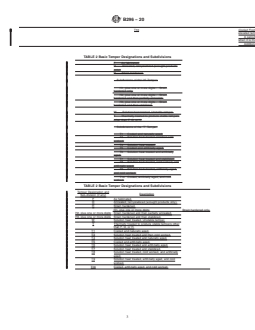
2.4 The temper designations and the subdivisions are fully defined and explained in Table 1. A brief outline for quick reference
is given in Table 2.
3. Referenced Documents
3.1 ANSI Standard:
ANSI H35.1/H35.1M American National Standard Alloy and Temper Designation Systems for Aluminum
4. Keywords
4.1 cast and wrought alloys; magnesium alloys; temper designations
This practice is under the jurisdiction of the ASTM Committee B07 on Light Metals and Alloys and is the direct responsibility of Subcommittee B07.04 on Magnesium
Alloy Cast and Wrought Products.
Current edition approved May 1, 2014May 1, 2020. Published June 2014June 2020. Originally approved in 1954. Last previous edition approved in 20082014 as B296 – 03
(2008).(2014). DOI: 10.1520/B0296-03R14.10.1520/B0296-20.
The designations used in ASTM Committee B07 specifications for aluminum-alloy wrought and cast products conform to the American National Standard
H 35.1H35.1/H35.1M.⁄H 35.1(M).
Available from American National Standards Institute (ANSI), 25 W. 43rd St., 4th Floor, New York, NY 10036, http://www.ansi.org.
Copyright © ASTM International, 100 Barr Harbor Drive, PO Box C700, West Conshohocken, PA 19428-2959. United States
B296 − 20
TABLE 1 Temper Designations
Temper
Designation
and Sub- Description
division (if
any)
F As Fabricated
treatment.
O Annealed, Recrystallized
H Strain Hardened
treatments to
Subdivisions of the 9H9 Temper:
H1 Strain Hardened
number following
H2 Strain Hardened
desired final amount
The number
H3 Strain Hardened
and increase
The number
stabilized.
The number following this designation indicates the degree of strain hardening remaining after the product has been strain hardened a specific
amount and then stabilized.
Subdivisions of the 9H1,9 9H2,9 and 9H39 Tempers:
The digit following the designations 9H1,9 9H2,9 and 9H39 indicates the final degree of strain hardening. Tempers between 0 (annealed) and 8 (full hard)
Subdivisions The digit following the designations “H1,” “H2,” and “H3” indicates the final degree of strain hardening. Tempers between 0 (annealed) and 8 (full hard)
of H1, H2, are designated by numerals 1 through 7. Material having a strength about midway between that of the 0 temper and that of the 8 temper is designated
and H3 by the numeral 4 (half hard); between 0 and 4 by the numeral 2 (quarter hard); between
...