

ASTM B91-17
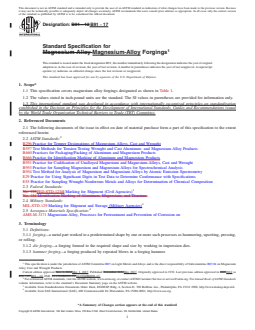
(Specification)Standard Specification for Magnesium-Alloy Forgings
General Information
- Abstract
ABSTRACT
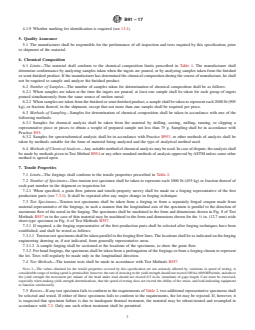
This specification covers UNS M11311, M11610, M11800, or M16600 magnesium alloy forgings. The conformance of each material to the required chemical composition can be determined using any suitable method of chemical analysis. Samples for chemical analysis should be taken when the ingots are poured or from the finished or semi-finished products by drilling, sawing, milling, turning, or clipping. The variations in testing speed do not seriously affect the obtained tensile property values. However, care must be exercised so that the testing speed does not exceed the ability of the equipment to function satisfactorily. Unless specified, forgings should be chrome pickled before shipment.
SCOPE
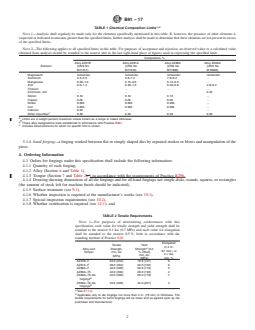
1.1 This specification covers magnesium alloy forgings designated as shown in Table 1. (A) Limits are in weight percent maximum unless shown as a range or stated otherwise.(B) These alloy designations were established in accordance with Practice B951.(C) Includes listed elements for which no specific limit is shown.
1.2 The values stated in inch-pound units are the standard. The SI values in parentheses are provided for information only.
1.3 This international standard was developed in accordance with internationally recognized principles on standardization established in the Decision on Principles for the Development of International Standards, Guides and Recommendations issued by the World Trade Organization Technical Barriers to Trade (TBT) Committee.
- Status
- Published
- Publication Date
- 30-Apr-2017
- Technical Committee
- B07 - Light Metals and Alloys
- Drafting Committee
- B07.04 - Magnesium Alloy Cast and Wrought Products
Overview
ASTM B91-17: Standard Specification for Magnesium-Alloy Forgings defines requirements for magnesium alloy forgings, specifically the following UNS alloys: M11311 (AZ31B), M11610 (AZ61A), M11800 (AZ80A), and M16600 (ZK60A). This standard covers chemical composition, mechanical properties, sampling, testing methods, inspection, certification, packaging, and marking for forgings designed for diverse industrial and defense applications.
Developed according to internationally recognized standardization principles, ASTM B91-17 ensures that magnesium alloy forgings meet rigorous quality, performance, and traceability requirements applicable across global supply chains.
Key Topics
Alloy Designations and Chemical Composition
The standard specifies chemical composition limits for each magnesium forging alloy. Compositions are typically verified through industry-accepted chemical analysis and sampling methods, including drilling, milling, or spectrochemical techniques.Mechanical Properties and Tensile Requirements
Each specified alloy must meet defined minimum values for tensile strength, yield strength, and elongation. These properties are verified using standard tension testing methods to ensure consistency in material performance.Ordering and Quality Assurance
Orders must clearly state alloy, quantity, temper, dimensions, surface treatment, inspection needs, and certification requirements. The manufacturer is responsible for all inspections and tests before shipment.Surface Finish and Corrosion Resistance
Unless otherwise specified, magnesium forgings are chrome pickled to increase resistance to surface tarnish and corrosion during transport and storage.Packaging and Product Marking
Magnesium forgings are packaged to prevent damage and marked for full traceability per shipping and defense standards.
Applications
ASTM B91-17 magnesium alloy forgings are essential in industries requiring lightweight, strong, and corrosion-resistant components. Typical applications include:
Aerospace
Structural and mechanical components where weight reduction is crucial.Defense and Military
Parts for vehicles, equipment, and armaments, benefiting from high strength-to-weight ratios.Automotive
Forged magnesium alloy components for drivetrain, chassis, and structural applications to improve fuel efficiency.Industrial Machinery
Lightweight and high-strength parts in processing or transport equipment.
These applications leverage the advantages of magnesium alloys, such as excellent machinability, formability, and a superior combination of strength and ductility, as specified by ASTM B91-17.
Related Standards
ASTM B91-17 references and complements several related standards that support the consistent production, sampling, and testing of magnesium alloys:
- ASTM B296 - Practice for Temper Designations of Magnesium Alloys, Cast and Wrought
- ASTM B557 - Test Methods for Tension Testing Wrought and Cast Aluminum- and Magnesium-Alloy Products
- ASTM B660 - Practices for Packaging/Packing of Aluminum and Magnesium Products
- ASTM B666 - Practice for Identification Marking of Aluminum and Magnesium Products
- ASTM B951 - Practice for Codification of Unalloyed Magnesium and Magnesium-Alloys, Cast and Wrought
- ASTM B953 - Practice for Sampling Magnesium and Magnesium Alloys for Spectrochemical Analysis
- ASTM B954 - Test Method for Analysis of Magnesium and Magnesium Alloys by Atomic Emission Spectrometry
- ASTM E29 - Practice for Using Significant Digits in Test Data
- AMS-M-3171 - Magnesium Alloy: Processes for Pretreatment and Prevention of Corrosion
By adhering to these and other referenced ASTM and industry standards, manufacturers and buyers can ensure magnesium-alloy forgings that meet precise specifications for performance, safety, and traceability.
Keywords: magnesium alloy forgings, ASTM B91-17, magnesium forging standard, mechanical properties, chemical composition, AZ31B, AZ61A, AZ80A, ZK60A, aerospace magnesium, industrial forgings, corrosion resistance, ASTM standards.
Relations
- Effective Date
- 01-May-2017
- Effective Date
- 01-Nov-2023
- Refers
ASTM B296-20 - Standard Practice for Temper Designations of Magnesium Alloys, Cast and Wrought - Effective Date
- 01-May-2020
- Effective Date
- 15-May-2014
- Refers
ASTM B296-03(2014) - Standard Practice for Temper Designations of Magnesium Alloys, Cast and Wrought - Effective Date
- 01-May-2014
- Effective Date
- 01-Nov-2011
- Effective Date
- 01-Jul-2010
- Effective Date
- 01-Feb-2010
- Effective Date
- 01-Jun-2009
- Effective Date
- 15-Oct-2008
- Effective Date
- 01-Oct-2008
- Refers
ASTM B296-03(2008) - Standard Practice for Temper Designations of Magnesium Alloys, Cast and Wrought - Effective Date
- 01-Mar-2008
- Effective Date
- 01-Mar-2008
- Effective Date
- 01-Jun-2007
- Effective Date
- 01-Jun-2007
Get Certified
Connect with accredited certification bodies for this standard

Element Materials Technology
Materials testing and product certification.

Inštitut za kovinske materiale in tehnologije
Institute of Metals and Technology. Materials testing, metallurgical analysis, NDT.
Sponsored listings
Frequently Asked Questions
ASTM B91-17 is a technical specification published by ASTM International. Its full title is "Standard Specification for Magnesium-Alloy Forgings". This standard covers: ABSTRACT This specification covers UNS M11311, M11610, M11800, or M16600 magnesium alloy forgings. The conformance of each material to the required chemical composition can be determined using any suitable method of chemical analysis. Samples for chemical analysis should be taken when the ingots are poured or from the finished or semi-finished products by drilling, sawing, milling, turning, or clipping. The variations in testing speed do not seriously affect the obtained tensile property values. However, care must be exercised so that the testing speed does not exceed the ability of the equipment to function satisfactorily. Unless specified, forgings should be chrome pickled before shipment. SCOPE 1.1 This specification covers magnesium alloy forgings designated as shown in Table 1. (A) Limits are in weight percent maximum unless shown as a range or stated otherwise.(B) These alloy designations were established in accordance with Practice B951.(C) Includes listed elements for which no specific limit is shown. 1.2 The values stated in inch-pound units are the standard. The SI values in parentheses are provided for information only. 1.3 This international standard was developed in accordance with internationally recognized principles on standardization established in the Decision on Principles for the Development of International Standards, Guides and Recommendations issued by the World Trade Organization Technical Barriers to Trade (TBT) Committee.
ABSTRACT This specification covers UNS M11311, M11610, M11800, or M16600 magnesium alloy forgings. The conformance of each material to the required chemical composition can be determined using any suitable method of chemical analysis. Samples for chemical analysis should be taken when the ingots are poured or from the finished or semi-finished products by drilling, sawing, milling, turning, or clipping. The variations in testing speed do not seriously affect the obtained tensile property values. However, care must be exercised so that the testing speed does not exceed the ability of the equipment to function satisfactorily. Unless specified, forgings should be chrome pickled before shipment. SCOPE 1.1 This specification covers magnesium alloy forgings designated as shown in Table 1. (A) Limits are in weight percent maximum unless shown as a range or stated otherwise.(B) These alloy designations were established in accordance with Practice B951.(C) Includes listed elements for which no specific limit is shown. 1.2 The values stated in inch-pound units are the standard. The SI values in parentheses are provided for information only. 1.3 This international standard was developed in accordance with internationally recognized principles on standardization established in the Decision on Principles for the Development of International Standards, Guides and Recommendations issued by the World Trade Organization Technical Barriers to Trade (TBT) Committee.
ASTM B91-17 is classified under the following ICS (International Classification for Standards) categories: 77.150.20 - Magnesium products. The ICS classification helps identify the subject area and facilitates finding related standards.
ASTM B91-17 has the following relationships with other standards: It is inter standard links to ASTM B91-12, ASTM B660-23, ASTM B296-20, ASTM B557-14, ASTM B296-03(2014), ASTM B951-11, ASTM B557-10, ASTM B951-10, ASTM B951-09, ASTM B660-08, ASTM E29-08, ASTM B296-03(2008), ASTM B951-08, ASTM B954-07, ASTM B953-07. Understanding these relationships helps ensure you are using the most current and applicable version of the standard.
ASTM B91-17 is available in PDF format for immediate download after purchase. The document can be added to your cart and obtained through the secure checkout process. Digital delivery ensures instant access to the complete standard document.
Standards Content (Sample)
This international standard was developed in accordance with internationally recognized principles on standardization established in the Decision on Principles for the
Development of International Standards, Guides and Recommendations issued by the World Trade Organization Technical Barriers to Trade (TBT) Committee.
Designation:B91 −17
Standard Specification for
Magnesium-Alloy Forgings
This standard is issued under the fixed designation B91; the number immediately following the designation indicates the year of original
adoption or, in the case of revision, the year of last revision.Anumber in parentheses indicates the year of last reapproval.Asuperscript
epsilon (´) indicates an editorial change since the last revision or reapproval.
This standard has been approved for use by agencies of the U.S. Department of Defense.
1. Scope* E29 Practice for Using Significant Digits in Test Data to
Determine Conformance with Specifications
1.1 This specification covers magnesium alloy forgings
E55 Practice for Sampling Wrought Nonferrous Metals and
designated as shown in Table 1.
Alloys for Determination of Chemical Composition
1.2 The values stated in inch-pound units are the standard.
2.3 Federal Standards:
TheSIvaluesinparenthesesareprovidedforinformationonly.
FED-STD-123H Marking for Shipment (Civil Agencies)
1.3 This international standard was developed in accor-
2.4 Military Standards:
dance with internationally recognized principles on standard- MIL-STD-129 Marking for Shipment and Storage (Military
ization established in the Decision on Principles for the
Agencies)
Development of International Standards, Guides and Recom- 2.5 Aerospace Materials Specification:
mendations issued by the World Trade Organization Technical
AMS-M-3171 MagnesiumAlloy, Processes for Pretreatment
Barriers to Trade (TBT) Committee. and Prevention of Corrosion on
3. Terminology
2. Referenced Documents
3.1 Definitions:
2.1 The following documents of the issue in effect on date
3.1.1 forging—a metal part worked to a predetermined
of material purchase form a part of this specification to the
shape by one or more such processes as hammering, upsetting,
extent referenced herein:
pressing, or rolling.
2.2 ASTM Standards:
3.1.2 die forging—a forging formed to the required shape
B296 Practice for Temper Designations of Magnesium
and size by working in impression dies.
Alloys, Cast and Wrought
3.1.3 hammer forging—a forging produced by repeated
B557 Test Methods for Tension Testing Wrought and Cast
blows in a forging hammer.
Aluminum- and Magnesium-Alloy Products
B660 Practices for Packaging/Packing of Aluminum and
3.1.4 hand forging—a forging worked between flat or sim-
Magnesium Products
ply shaped dies by repeated strokes or blows and manipulation
B666 Practice for Identification Marking of Aluminum and
of the piece.
Magnesium Products
4. Ordering Information
B951 PracticeforCodificationofUnalloyedMagnesiumand
Magnesium-Alloys, Cast and Wrought
4.1 Orders for forgings under this specification shall include
B953 Practice for Sampling Magnesium and Magnesium
the following information:
Alloys for Spectrochemical Analysis
4.1.1 Quantity of each forging,
B954 Test Method for Analysis of Magnesium and Magne- 4.1.2 Alloy (Section 6 and Table 1),
sium Alloys by Atomic Emission Spectrometry
4.1.3 Temper(Section7andTable2)inaccordancewiththe
requirements of Practice B296,
4.1.4 Drawing showing dimensions of all die forgings and
for all hand forgings not simple disks, rounds, squares, or
This specification is under the jurisdiction of ASTM Committee B07 on Light
Metals and Alloys and is the direct responsibility of Subcommittee B07.04 on rectangles (the amount of stock left for machine finish should
Magnesium Alloy Cast and Wrought Products.
be indicated),
Current edition approved May 1, 2017. Published May 2017. Originally
approved in 1932. Last previous edition approved in 2012 as B91 – 12. DOI:
10.1520/B0091-17. Available from Standardization Documents Order Desk, DODSSP, Bldg. 4,
For referenced ASTM standards, visit the ASTM website, www.astm.org, or Section D, 700 Robbins Ave., Philadelphia, PA 19111-5098, http://
contact ASTM Customer Service at service@astm.org. For Annual Book of ASTM www.dodssp.daps.mil.
Standards volume information, refer to the standard’s Document Summary page on Available from SAE International (SAE), 400 Commonwealth Dr.,Warrendale,
the ASTM website. PA 15096-0001, http://www.sae.org.
*A Summary of Changes section appears at the end of this standard
Copyright © ASTM International, 100 Barr Harbor Drive, PO Box C700, West Conshohocken, PA 19428-2959. United States
B91−17
A,B
TABLE 1 Chemical Composition Limits
NOTE 1—Analysis shall regularly be made only for the elements specifically mentioned in this table. If, however, the presence of other elements is
suspectedorindicatedinamountsgreaterthanthespecifiedlimits,furtheranalysisshallbemadetodeterminethattheseelementsarenotpresentinexcess
of the specified limits.
NOTE 2—The following applies to all specified limits in this table. For purposes of acceptance and rejection, an observed value or a calculated value
obtained from analysis should be rounded to the nearest unit in the last right-hand place of figures used in expressing the specified limit.
Composition, %
Alloy AZ31B Alloy AZ61A Alloy AZ80A Alloy ZK60A
Element (UNS No. (UNS No. (UNS No. (UNS No.
M11311) M11610) M11800) M16600)
Magnesium remainder remainder remainder remainder
Aluminum 2.5–3.5 5.8–7.2 7.8–9.2 .
Manganese 0.20–1.0 0.15–0.5 0.12–0.5 .
Zinc 0.6–1.4 0.40–1.5 0.20–0.8 4.8–6.2
Thorium . . . .
Zirconium, min . . 0.45
Silicon 0.10 0.10 0.10 .
Copper 0.05 0.05 0.05 .
Nickel 0.005 0.005 0.005 .
Iron 0.005 0.005 0.005 .
Calcium 0.04 . . .
C
Other impurities 0.30 0.30 0.30 0.30
A
Limits are in weight percent maximum unless shown as a range or stated otherwise.
B
These alloy designations were established in accordance with Practice B951.
C
Includes listed elements for which no specific limit is shown.
TABLE 2 Tensile Requirements
6. Chemical Composition
NOTE 1—For purposes of determining conformance with this
6.1 Limits—The material shall conform to the chemical
specification, each value for tensile strength and yield strength shall be
composition limits prescribed in Table 1. The manufacturer
rounded to the nearest 0.1 ksi (0.7 MPa) and each value for elongation
shalldetermineconformancebyanalyzingsamplestakenwhen
shall be rounded to the nearest 0.5 %, both in accordance with the
the ingots are poured, or by analyzing samples taken from the
rounding method of Practice E29.
finished or semi-finished product. If the manufacturer has
Elongation
Tensile Yield
in2in. determined the chemical composition during the course of
A
Alloy and Strength,
Strength (0.2
(51 mm), or
manufacture,heshallnotberequiredtosampleandanalyzethe
% offset),
Temper min, ksi
4×dia,
min, ksi
(MPa)
finished product.
(MPa) min, %
AZ31B–F 34.0 (234) 19.0 (131) 6
6.2 Number of Samples—The number of samples taken for
AZ61A–F 38.0 (262) 22.0 (152) 6
determination of chemical composition shall be as follows:
AZ80A–F 42.0 (290) 26.0 (179) 5
AZ80A–T5 42.0 (290) 28.0 (193) 2
6.2.1 When samples are taken at the time the ingots are
ZK60A–T5 die 42.0 (290) 26.0 (179) 7
poured, at least one sample shall be taken for each group of
B
forgings
ZK60A–T6 die 43.0 (296) 32.0 (221) 4 ingots poured simultaneously from the same source of molten
B
forgings
metal.
A
See X1.1.6.
6.2.2 When samples are taken from the finished or semi-
B
Applicable only to die forgings not more than 3 in. (76 mm) in thickness. The
finished product, a sample shall be taken to represent each
tensile requirements for hand forgings will be lower and as agreed upon by the
2000 lb (905 kg), or fraction thereof, in the shipment, except
purchaser and manufacturer.
that not more than one sample shall be required per piece.
6.3 Methods of Sampling—Samples for determination of
chemical composition shall be taken in accordance with one of
the following methods:
4.1.5 Surface treatment (see 9.1),
6.3.1 Samples for chemical analysis shall be taken from the
4.1.6 Whether inspection is required at the manufacturer’s
material by drilling, sawing, milling, turning, or clipping a
works (see 10.1),
representative piece or pieces to obtain a weight of prepared
4.1.7 Special inspection requirements (see 10.2),
sample not less than 75 g. Sampling shall be in accordance
4.1.8 Whether certification is required (see 12.1), and
with Practice E55.
4.1.9 Whether marking for identification is required (see
6.3.2 Samples for spectrochemical analysis shall be in
13.1).
accordance with Practice B953, or other methods of analysis
shall be taken by methods suitable for the form of material
5. Quality Assurance being analyzed and the type of analytical method used.
5.1 The manufacturer shall be responsible for the perfor- 6.4 Methods of Chemical Analysis—Any suitable method of
mance of all inspection and tests required by this specification, chemical analysis may be used. In case of dispute, the analysis
prior to shipment of the material. shall be made by methods given in Test Method B954 or any
B91−17
other standard methods of analysis approved by ASTM unless 9. Finish
some other method is agreed upon.
9.1 Unless otherwise specified, the forgings shall be chrome
pickled prior to shipment (see X1.1.7).
7. Tensile Properties
7.1 Limits—The forgings shall conform to the tensile prop-
10. Inspection
erties prescribed in Table 2.
10.1 If the purchaser desires that inspection be made at the
7.2 Number of Specimens—One tension test specimen shall
manufacturer’s works where the material is made, it shall be so
be taken to represent each 1000 lb (455 kg) or fraction thereof stated in the contract or purchase order.
of each part number in the shipment or inspection lot.
10.1.1 If the purchaser elects to have the inspection made at
7.2.1 Whe
...
This document is not an ASTM standard and is intended only to provide the user of an ASTM standard an indication of what changes have been made to the previous version. Because
it may not be technically possible to adequately depict all changes accurately, ASTM recommends that users consult prior editions as appropriate. In all cases only the current version
of the standard as published by ASTM is to be considered the official document.
Designation: B91 − 12 B91 − 17
Standard Specification for
Magnesium-Alloy Magnesium-Alloy Forgings
This standard is issued under the fixed designation B91; the number immediately following the designation indicates the year of original
adoption or, in the case of revision, the year of last revision. A number in parentheses indicates the year of last reapproval. A superscript
epsilon (´) indicates an editorial change since the last revision or reapproval.
This standard has been approved for use by agencies of the U.S. Department of Defense.
1. Scope*
1.1 This specification covers magnesium alloy forgings designated as shown in Table 1.
1.2 The values stated in inch-pound units are the standard. The SI values in parentheses are provided for information only.
1.3 This international standard was developed in accordance with internationally recognized principles on standardization
established in the Decision on Principles for the Development of International Standards, Guides and Recommendations issued
by the World Trade Organization Technical Barriers to Trade (TBT) Committee.
2. Referenced Documents
2.1 The following documents of the issue in effect on date of material purchase form a part of this specification to the extent
referenced herein:
2.2 ASTM Standards:
B296 Practice for Temper Designations of Magnesium Alloys, Cast and Wrought
B557 Test Methods for Tension Testing Wrought and Cast Aluminum- and Magnesium-Alloy Products
B660 Practices for Packaging/Packing of Aluminum and Magnesium Products
B666 Practice for Identification Marking of Aluminum and Magnesium Products
B951 Practice for Codification of Unalloyed Magnesium and Magnesium-Alloys, Cast and Wrought
B953 Practice for Sampling Magnesium and Magnesium Alloys for Spectrochemical Analysis
B954 Test Method for Analysis of Magnesium and Magnesium Alloys by Atomic Emission Spectrometry
E29 Practice for Using Significant Digits in Test Data to Determine Conformance with Specifications
E55 Practice for Sampling Wrought Nonferrous Metals and Alloys for Determination of Chemical Composition
2.3 Federal Standards:
No. 123FED-STD-123H Marking for Shipment (Civil Agencies)
No. 184 Identification Marking of Aluminum, Magnesium, and Titanium.
2.4 Military Standards:
MIL-STD-129 Marking for Shipment and Storage (Military Agencies)
2.5 Aerospace Materials Specification:
AMS-M-3171 Magnesium Alloy, Processes for Pretreatment and Prevention of Corrosion on
3. Terminology
3.1 Definitions:
3.1.1 forging—a metal part worked to a predetermined shape by one or more such processes as hammering, upsetting, pressing,
or rolling.
3.1.2 die forging—a forging formed to the required shape and size by working in impression dies.
3.1.3 hammer forging—a forging produced by repeated blows in a forging hammer.
This specification is under the jurisdiction of ASTM Committee B07 on Light Metals and Alloys and is the direct responsibility of Subcommittee B07.04 on Magnesium
Alloy Cast and Wrought Products.
Current edition approved Nov. 1, 2012May 1, 2017. Published November 2012May 2017. Originally approved in 1932. Last previous edition approved in 20072012 as
B91 – 07.B91 – 12. DOI: 10.1520/B0091-12.10.1520/B0091-17.
For referenced ASTM standards, visit the ASTM website, www.astm.org, or contact ASTM Customer Service at service@astm.org. For Annual Book of ASTM Standards
volume information, refer to the standard’s Document Summary page on the ASTM website.
Available from Standardization Documents Order Desk, DODSSP, Bldg. 4, Section D, 700 Robbins Ave., Philadelphia, PA 19111-5098, http://www.dodssp.daps.mil.
Available from SAE International (SAE), 400 Commonwealth Dr.,Warrendale, PA 15096-0001, http://www.sae.org.
*A Summary of Changes section appears at the end of this standard
Copyright © ASTM International, 100 Barr Harbor Drive, PO Box C700, West Conshohocken, PA 19428-2959. United States
B91 − 17
A,B
TABLE 1 Chemical Composition Limits
NOTE 1—Analysis shall regularly be made only for the elements specifically mentioned in this table. If, however, the presence of other elements is
suspected or indicated in amounts greater than the specified limits, further analysis shall be made to determine that these elements are not present in excess
of the specified limits.
NOTE 2—The following applies to all specified limits in this table. For purposes of acceptance and rejection, an observed value or a calculated value
obtained from analysis should be rounded to the nearest unit in the last right-hand place of figures used in expressing the specified limit.
Composition, %
Alloy AZ31B Alloy AZ61A Alloy AZ80A Alloy ZK60A
Element (UNS No. (UNS No. (UNS No. (UNS No.
M11311) M11610) M11800) M16600)
Magnesium remainder remainder remainder remainder
Aluminum 2.5–3.5 5.8–7.2 7.8–9.2 .
Manganese 0.20–1.0 0.15–0.5 0.12–0.5 .
Zinc 0.6–1.4 0.40–1.5 0.20–0.8 4.8–6.2
Thorium . . . .
Zirconium, min . . 0.45
Silicon 0.10 0.10 0.10 .
Copper 0.05 0.05 0.05 .
Nickel 0.005 0.005 0.005 .
Iron 0.005 0.005 0.005 .
Calcium 0.04 . . .
C
Other impurities 0.30 0.30 0.30 0.30
A
Limits are in weight percent maximum unless shown as a range or stated otherwise.
B
These alloy designations were established in accordance with Practice B951.
C
Includes listed elements for which no specific limit is shown.
3.1.4 hand forging—a forging worked between flat or simply shaped dies by repeated strokes or blows and manipulation of the
piece.
4. Ordering Information
4.1 Orders for forgings under this specification shall include the following information:
4.1.1 Quantity of each forging,
4.1.2 Alloy (Section 6 and Table 1),
4.1.3 Temper (Section 7 and Table 2), ) in accordance with the requirements of Practice B296,
4.1.4 Drawing showing dimensions of all die forgings and for all hand forgings not simple disks, rounds, squares, or rectangles
(the amount of stock left for machine finish should be indicated),
4.1.5 Surface treatment (see 9.1),
4.1.6 Whether inspection is required at the manufacturer’s works (see 10.1),
4.1.7 Special inspection requirements (see 10.2),
4.1.8 Whether certification is required (see 12.1), and
TABLE 2 Tensile Requirements
NOTE 1—For purposes of determining conformance with this
specification, each value for tensile strength and yield strength shall be
rounded to the nearest 0.1 ksi (0.7 MPa) and each value for elongation
shall be rounded to the nearest 0.5 %, both in accordance with the
rounding method of Practice E29.
Elongation
Tensile
Yield
in 2 in.
A
Alloy and Strength, Strength (0.2
(51 mm), or
% offset),
Temper min, ksi
4 × dia,
min, ksi
(MPa)
(MPa) min, %
AZ31B–F 34.0 (234) 19.0 (131) 6
AZ61A–F 38.0 (262) 22.0 (152) 6
AZ80A–F 42.0 (290) 26.0 (179) 5
AZ80A–T5 42.0 (290) 28.0 (193) 2
ZK60A–T5 die 42.0 (290) 26.0 (179) 7
B
forgings
ZK60A–T6 die 43.0 (296) 32.0 (221) 4
B
forgings
A
See X1.1.6.
B
Applicable only to die forgings not more than 3 in. (76 mm) in thickness. The
tensile requirements for hand forgings will be lower and as agreed upon by the
purchaser and manufacturer.
B91 − 17
4.1.9 Whether marking for identification is required (see 13.1).
5. Quality Assurance
5.1 The manufacturer shall be responsible for the performance of all inspection and tests required by this specification, prior
to shipment of the material.
6. Chemical Composition
6.1 Limits—The material shall conform to the chemical composition limits prescribed in Table 1. The manufacturer shall
determine conformance by analyzing samples taken when the ingots are poured, or by analyzing samples taken from the finished
or semi-finished product. If the manufacturer has determined the chemical composition during the course of manufacture, he shall
not be required to sample and analyze the finished product.
6.2 Number of Samples—The number of samples taken for determination of chemical composition shall be as follows:
6.2.1 When samples are taken at the time the ingots are poured, at least one sample shall be taken for each group of ingots
poured simultaneously from the same source of molten metal.
6.2.2 When samples are taken from the finished or semi-finished product, a sample shall be taken to represent each 2000 lb (905
kg), or fraction thereof, in the shipment, except that not more than one sample shall be required per piece.
6.3 Methods of Sampling—Samples for determination of chemical composition shall be taken in accordance with one of the
following methods:
6.3.1 Samples for chemical analysis shall be taken from the material by drilling, sawing, milling, turning, or clipping a
representative piece or pieces to obtain a weight of prepared sample not less than 75 g. Sampling shall be in accordance with
Practice E55.
6.3.2 Samples for spectrochemical analysis shall be in accordance with Practice B953, or other methods of analysis shall be
taken by methods suitable for the form of material being analyzed and the type of analytical method used.
6.4 Methods of Chemical Analysis—Any suitable method of chemical analysis may be used. In case of dispute, the analysis shall
be made by methods given in Test Method B954 or any other standard methods of analysis approved by ASTM unless some other
method is agreed upon.
7. Tensile Properties
7.1 Limits—The forgings shall conform to the tensile properties prescribed in Table 2.
7.2 Number of Specimens—One tension test specimen shall be taken to represent each 1000 lb (455 kg) or fraction thereof of
each part number in the shipment or inspection lot.
7.2.1 When specified, a grain flow pattern and tensile-property survey shall be made on a forging representative of the first
production parts (see 7.3.1). It shall be repeated after any major change in forging technique.
7.3 Test Specimens—Tension test specimens shall be taken from a forging or from a separately forged coupon made from
material representative of the forgings, in such a manner that the lo
...