

ASTM B557-15(2023)
(Test Method)Standard Test Methods for Tension Testing Wrought and Cast Aluminum- and Magnesium-Alloy Products
General Information
- Abstract
SIGNIFICANCE AND USE
4.1 Tension tests provide information on the strength and ductility of materials under uniaxial tensile stresses. This information may be useful in comparisons of materials, alloy development, quality control, and design under certain circumstances.
4.2 The results of tension tests of specimens machined to standardized dimensions from selected portions of a part or material may not totally represent the strength and ductility properties of the entire end product or its in-service behavior in different environments.
4.3 These test methods are considered satisfactory for acceptance testing of commercial shipments and have been used extensively in the trade for this purpose.
SCOPE
1.1 These test methods cover the tension testing of wrought and cast aluminum- and magnesium-alloy products, with the exception of aluminum foil,2 and are derived from Test Methods E8, which cover the tension testing of all metallic materials.
1.2 The values stated in inch-pound units are to be regarded as standard. No other units of measurement are included in this standard.
1.3 This standard does not purport to address all of the safety concerns, if any, associated with its use. It is the responsibility of the user of this standard to establish appropriate safety, health, and environmental practices and determine the applicability of regulatory limitations prior to use.
Note 1: Foil is sheet metal less than 0.0079 in. thick. There is an overlap in the thickness range 0.006 to 0.0079 in. defined for foil and sheet. Sheet products in this thickness range are supplied to sheet product specifications and foil products in this thickness range are supplied to foil product specifications. Exceptions to the provisions of these test methods may need to be made in individual specifications or test methods for a particular material.
Note 2: A complete metric companion to Test Methods B557 has been developed—Test Methods B557M; therefore, no metric equivalents are presented in these test methods.
1.4 This international standard was developed in accordance with internationally recognized principles on standardization established in the Decision on Principles for the Development of International Standards, Guides and Recommendations issued by the World Trade Organization Technical Barriers to Trade (TBT) Committee.
- Status
- Published
- Publication Date
- 31-Mar-2023
- Technical Committee
- B07 - Light Metals and Alloys
- Drafting Committee
- B07.05 - Testing
Overview
ASTM B557-15(2023), published by ASTM International, outlines standardized test methods for tension testing wrought and cast aluminum- and magnesium-alloy products. These procedures are essential for accurately determining the mechanical properties such as tensile strength and ductility of non-foil aluminum and magnesium alloys under uniaxial tensile load. By providing a consistent framework for tension testing, this standard facilitates material comparison, aids in alloy development, supports quality control initiatives, and underpins sound engineering design decisions.
Key Topics
- Material Coverage: Applies to both wrought and cast aluminum- and magnesium-alloy products, but explicitly excludes aluminum foil (sheet metal less than 0.0079 in. thick).
- Testing Equipment: Specifies requirements for testing machines and gripping devices to ensure accurate and repeatable tension test results. References are made to related ASTM practices for machine calibration and verification.
- Specimen Preparation: Emphasizes the importance of proper specimen machining and preparation. Specimen size, shape, and orientation requirements are detailed for different product forms such as plate, sheet, bar, rod, wire, extrusion profiles, tubes, forgings, and castings.
- Test Methods: Details procedures for measuring tensile properties, including the use of extensometers for strain measurement and protocols for marking gauge lengths.
- Measurement Units: All measurements and results are reported in inch-pound units. The standard does not include metric equivalents but refers to the companion metric standard, ASTM B557M.
- Significance of Testing: Results provide essential data for interpreting material performance, validating lot quality for commercial shipments, and informing the development and specification of alloys.
Applications
ASTM B557-15(2023) is widely used across industries engaging with aluminum and magnesium alloys, including aerospace, automotive, construction, and manufacturing sectors. The main practical applications include:
- Material Selection and Comparison: Enables engineers and material scientists to compare mechanical properties across different alloys and processing methods using standardized test data.
- Alloy Development: Supports the evaluation of new alloy formulations and process optimizations by providing uniform mechanical property data.
- Quality Control and Lot Acceptance: Serves as an acceptance criterion in commercial transactions, ensuring shipments of aluminum and magnesium products meet specified mechanical requirements.
- Design Validation: Informs structural and product design decisions by providing reliable values for tensile strength and ductility, critical for safety and durability assessments.
- Specification Compliance: Assists manufacturers and suppliers in demonstrating product compliance with ASTM material specifications relevant to aluminum and magnesium alloys.
Related Standards
To ensure comprehensive mechanical testing and maintain consistency across materials and testing procedures, ASTM B557-15(2023) references several related ASTM standards:
- ASTM E8: Test Methods for Tension Testing of Metallic Materials.
- ASTM E4: Practices for Force Calibration and Verification of Testing Machines.
- ASTM E6: Terminology Relating to Methods of Mechanical Testing.
- ASTM E29: Practice for Using Significant Digits in Test Data.
- ASTM E83: Practice for Verification and Classification of Extensometer Systems.
- ASTM E345: Test Methods for Tension Testing of Metallic Foil.
- ASTM E691: Practice for Conducting an Interlaboratory Study.
- ASTM E1012: Practice for Verification of Testing Frame and Specimen Alignment Under Tensile and Compressive Axial Force.
- ASTM B209: Specification for Aluminum and Aluminum-Alloy Sheet and Plate.
- ASTM B557M: Metric companion standard for tension testing wrought and cast products in SI units.
Conclusion
Adhering to ASTM B557-15(2023) is key for achieving consistent, reliable tensile testing of wrought and cast aluminum- and magnesium-alloy products. The standard ensures mechanical property data is credible for material selection, quality assurance, compliance, and design, supporting both manufacturers and end users in the metals industry. For organizations exporting or importing these metal products, compliance with ASTM B557 also aligns with international trade principles and minimizes technical barriers to trade.
Relations
- Effective Date
- 01-Jan-2024
- Effective Date
- 15-Jul-2016
- Effective Date
- 01-Jun-2014
- Effective Date
- 01-Nov-2013
- Effective Date
- 01-May-2013
- Effective Date
- 01-Jun-2012
- Effective Date
- 01-Jun-2012
- Effective Date
- 01-Nov-2011
- Effective Date
- 01-Nov-2010
- Effective Date
- 01-Jun-2010
- Effective Date
- 01-Jun-2010
- Effective Date
- 01-Jan-2010
- Effective Date
- 01-Nov-2009
- Effective Date
- 15-May-2009
- Effective Date
- 15-May-2009
Get Certified
Connect with accredited certification bodies for this standard

Element Materials Technology
Materials testing and product certification.

Inštitut za kovinske materiale in tehnologije
Institute of Metals and Technology. Materials testing, metallurgical analysis, NDT.
Sponsored listings
Frequently Asked Questions
ASTM B557-15(2023) is a standard published by ASTM International. Its full title is "Standard Test Methods for Tension Testing Wrought and Cast Aluminum- and Magnesium-Alloy Products". This standard covers: SIGNIFICANCE AND USE 4.1 Tension tests provide information on the strength and ductility of materials under uniaxial tensile stresses. This information may be useful in comparisons of materials, alloy development, quality control, and design under certain circumstances. 4.2 The results of tension tests of specimens machined to standardized dimensions from selected portions of a part or material may not totally represent the strength and ductility properties of the entire end product or its in-service behavior in different environments. 4.3 These test methods are considered satisfactory for acceptance testing of commercial shipments and have been used extensively in the trade for this purpose. SCOPE 1.1 These test methods cover the tension testing of wrought and cast aluminum- and magnesium-alloy products, with the exception of aluminum foil,2 and are derived from Test Methods E8, which cover the tension testing of all metallic materials. 1.2 The values stated in inch-pound units are to be regarded as standard. No other units of measurement are included in this standard. 1.3 This standard does not purport to address all of the safety concerns, if any, associated with its use. It is the responsibility of the user of this standard to establish appropriate safety, health, and environmental practices and determine the applicability of regulatory limitations prior to use. Note 1: Foil is sheet metal less than 0.0079 in. thick. There is an overlap in the thickness range 0.006 to 0.0079 in. defined for foil and sheet. Sheet products in this thickness range are supplied to sheet product specifications and foil products in this thickness range are supplied to foil product specifications. Exceptions to the provisions of these test methods may need to be made in individual specifications or test methods for a particular material. Note 2: A complete metric companion to Test Methods B557 has been developed—Test Methods B557M; therefore, no metric equivalents are presented in these test methods. 1.4 This international standard was developed in accordance with internationally recognized principles on standardization established in the Decision on Principles for the Development of International Standards, Guides and Recommendations issued by the World Trade Organization Technical Barriers to Trade (TBT) Committee.
SIGNIFICANCE AND USE 4.1 Tension tests provide information on the strength and ductility of materials under uniaxial tensile stresses. This information may be useful in comparisons of materials, alloy development, quality control, and design under certain circumstances. 4.2 The results of tension tests of specimens machined to standardized dimensions from selected portions of a part or material may not totally represent the strength and ductility properties of the entire end product or its in-service behavior in different environments. 4.3 These test methods are considered satisfactory for acceptance testing of commercial shipments and have been used extensively in the trade for this purpose. SCOPE 1.1 These test methods cover the tension testing of wrought and cast aluminum- and magnesium-alloy products, with the exception of aluminum foil,2 and are derived from Test Methods E8, which cover the tension testing of all metallic materials. 1.2 The values stated in inch-pound units are to be regarded as standard. No other units of measurement are included in this standard. 1.3 This standard does not purport to address all of the safety concerns, if any, associated with its use. It is the responsibility of the user of this standard to establish appropriate safety, health, and environmental practices and determine the applicability of regulatory limitations prior to use. Note 1: Foil is sheet metal less than 0.0079 in. thick. There is an overlap in the thickness range 0.006 to 0.0079 in. defined for foil and sheet. Sheet products in this thickness range are supplied to sheet product specifications and foil products in this thickness range are supplied to foil product specifications. Exceptions to the provisions of these test methods may need to be made in individual specifications or test methods for a particular material. Note 2: A complete metric companion to Test Methods B557 has been developed—Test Methods B557M; therefore, no metric equivalents are presented in these test methods. 1.4 This international standard was developed in accordance with internationally recognized principles on standardization established in the Decision on Principles for the Development of International Standards, Guides and Recommendations issued by the World Trade Organization Technical Barriers to Trade (TBT) Committee.
ASTM B557-15(2023) is classified under the following ICS (International Classification for Standards) categories: 77.150.10 - Aluminium products; 77.150.20 - Magnesium products. The ICS classification helps identify the subject area and facilitates finding related standards.
ASTM B557-15(2023) has the following relationships with other standards: It is inter standard links to ASTM E345-24, ASTM E345-16, ASTM E4-14, ASTM E345-93(2013)e1, ASTM E691-13, ASTM E1012-12, ASTM E1012-12e1, ASTM E691-11, ASTM B209-10, ASTM E83-10a, ASTM E4-10, ASTM E83-10, ASTM E4-09a, ASTM E6-09b, ASTM E6-09be1. Understanding these relationships helps ensure you are using the most current and applicable version of the standard.
ASTM B557-15(2023) is available in PDF format for immediate download after purchase. The document can be added to your cart and obtained through the secure checkout process. Digital delivery ensures instant access to the complete standard document.
Standards Content (Sample)
This international standard was developed in accordance with internationally recognized principles on standardization established in the Decision on Principles for the
Development of International Standards, Guides and Recommendations issued by the World Trade Organization Technical Barriers to Trade (TBT) Committee.
Designation: B557 − 15 (Reapproved 2023)
Standard Test Methods for
Tension Testing Wrought and Cast Aluminum- and
Magnesium-Alloy Products
This standard is issued under the fixed designation B557; the number immediately following the designation indicates the year of
original adoption or, in the case of revision, the year of last revision. A number in parentheses indicates the year of last reapproval. A
superscript epsilon (´) indicates an editorial change since the last revision or reapproval.
This standard has been approved for use by agencies of the U.S. Department of Defense.
1. Scope 2. Referenced Documents
2.1 ASTM Standards:
1.1 These test methods cover the tension testing of wrought
B209 Specification for Aluminum and Aluminum-Alloy
and cast aluminum- and magnesium-alloy products, with the
Sheet and Plate (Metric) B0209_B0209M
exception of aluminum foil, and are derived from Test
E4 Practices for Force Calibration and Verification of Test-
Methods E8, which cover the tension testing of all metallic
ing Machines
materials.
E6 Terminology Relating to Methods of Mechanical Testing
1.2 The values stated in inch-pound units are to be regarded
E8 Test Methods for Tension Testing of Metallic Materials
as standard. No other units of measurement are included in this
[Metric] E0008_E0008M
standard.
E29 Practice for Using Significant Digits in Test Data to
1.3 This standard does not purport to address all of the
Determine Conformance with Specifications
safety concerns, if any, associated with its use. It is the
E83 Practice for Verification and Classification of Exten-
responsibility of the user of this standard to establish appro-
someter Systems
priate safety, health, and environmental practices and deter-
E345 Test Methods of Tension Testing of Metallic Foil
mine the applicability of regulatory limitations prior to use.
E691 Practice for Conducting an Interlaboratory Study to
Determine the Precision of a Test Method
NOTE 1—Foil is sheet metal less than 0.0079 in. thick. There is an
E1012 Practice for Verification of Testing Frame and Speci-
overlap in the thickness range 0.006 to 0.0079 in. defined for foil and
sheet. Sheet products in this thickness range are supplied to sheet product
men Alignment Under Tensile and Compressive Axial
specifications and foil products in this thickness range are supplied to foil
Force Application
product specifications. Exceptions to the provisions of these test methods
may need to be made in individual specifications or test methods for a
3. Terminology
particular material.
3.1 The definitions of terms relating to tension testing
NOTE 2—A complete metric companion to Test Methods B557 has been
developed—Test Methods B557M; therefore, no metric equivalents are
appearing in Terminology E6 shall be considered as applying
presented in these test methods.
to the terms used in these test methods.
1.4 This international standard was developed in accor-
4. Significance and Use
dance with internationally recognized principles on standard-
ization established in the Decision on Principles for the 4.1 Tension tests provide information on the strength and
Development of International Standards, Guides and Recom-
ductility of materials under uniaxial tensile stresses. This
mendations issued by the World Trade Organization Technical information may be useful in comparisons of materials, alloy
Barriers to Trade (TBT) Committee.
development, quality control, and design under certain circum-
stances.
4.2 The results of tension tests of specimens machined to
These test methods are under the jurisdiction of ASTM Committee B07 on standardized dimensions from selected portions of a part or
Light Metals and Alloys and are the direct responsibility of Subcommittee B07.05
on Testing.
Current edition approved April 1, 2023. Published April 2023. Originally For referenced ASTM standards, visit the ASTM website, www.astm.org, or
approved in 1971. Last previous edition approved in 2015 as B557 – 15. DOI: contact ASTM Customer Service at service@astm.org. For Annual Book of ASTM
10.1520/B0557-15R23. Standards volume information, refer to the standard’s Document Summary page on
For test methods of tension testing of aluminum foil, see Test Methods E345. the ASTM website.
*A Summary of Changes section appears at the end of this standard
Copyright © ASTM International, 100 Barr Harbor Drive, PO Box C700, West Conshohocken, PA 19428-2959. United States
B557 − 15 (2023)
material may not totally represent the strength and ductility the specimens, when under load, shall be as nearly as possible
properties of the entire end product or its in-service behavior in in uniformly distributed pure axial tension (see 5.2.3 – 5.2.5).
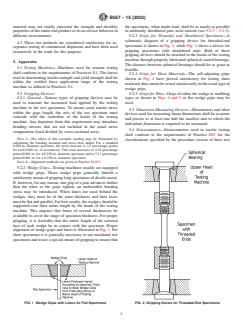
different environments. 5.2.3 Grips for Threaded and Shouldered Specimens—A
schematic diagram of a gripping device for threaded-end
4.3 These test methods are considered satisfactory for ac-
specimens is shown in Fig. 2, while Fig. 3 shows a device for
ceptance testing of commercial shipments and have been used
gripping specimens with shouldered ends. Both of these
extensively in the trade for this purpose.
gripping devices should be attached to the heads of the testing
machine through properly lubricated spherical-seated bearings.
5. Apparatus
The distance between spherical bearings should be as great as
5.1 Testing Machines—Machines used for tension testing
feasible.
shall conform to the requirements of Practices E4. The forces
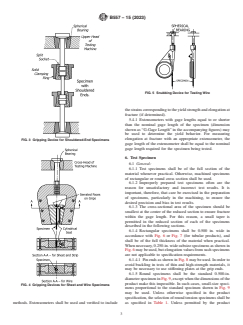
5.2.4 Grips for Sheet Materials—The self-adjusting grips
used in determining tensile strength and yield strength shall be
shown in Fig. 4 have proved satisfactory for testing sheet
within the verified force application range of the testing
materials that cannot be tested satisfactorily in the usual type of
machine as defined in Practices E4.
wedge grips.
5.2 Gripping Devices: 5.2.5 Grips for Wire—Grips of either the wedge or snubbing
types as shown in Figs. 4 and 5 or flat wedge grips may be
5.2.1 General—Various types of gripping devices may be
used to transmit the measured load applied by the testing used.
machine to the test specimens. To ensure axial tensile stress
5.3 Dimension-Measuring Devices—Micrometers and other
within the gage length, the axis of the test specimen must
devices used for measuring linear dimensions shall be accurate
coincide with the centerline of the heads of the testing
and precise to at least one half the smallest unit to which the
machine. Any departure from this requirement may introduce
individual dimension is required to be measured.
bending stresses that are not included in the usual stress
5.4 Extensometers—Extensometers used in tensile testing
computation (load divided by cross-sectional area).
shall conform to the requirements of Practice E83 for the
NOTE 3—The effect of this eccentric loading may be illustrated by
classifications specified by the procedure section of these test
calculating the bending moment and stress thus added. For a standard
0.500-in. diameter specimen, the stress increase is 1.5 percentage points
for each 0.001 in. of eccentricity. This error increases to 2.24 percentage
points/0.001 in. for a 0.350-in. diameter specimen and to 3.17 percentage
points/0.001 in. for a 0.250-in. diameter specimen.
NOTE 4—Alignment methods are given in Practice E1012.
5.2.2 Wedge Grips—Testing machines usually are equipped
with wedge grips. These wedge grips generally furnish a
satisfactory means of gripping long specimens of ductile metal.
If, however, for any reason, one grip of a pair advances farther
than the other as the grips tighten, an undesirable bending
stress may be introduced. When liners are used behind the
wedges, they must be of the same thickness and their faces
must be flat and parallel. For best results, the wedges should be
supported over their entire length by the heads of the testing
machine. This requires that liners of several thicknesses be
available to cover the range of specimen thickness. For proper
gripping, it is desirable that the entire length of the serrated
face of each wedge be in contact with the specimen. Proper
alignment of wedge grips and liners is illustrated in Fig. 1. For
short specimens it is generally necessary to use machined test
specimens and to use a special means of gripping to ensure that
FIG. 1 Wedge Grips with Liners for Flat Specimens FIG. 2 Gripping Device for Threaded-End Specimens
B557 − 15 (2023)
FIG. 5 Snubbing Device for Testing Wire
the strains corresponding to the yield strength and elongation at
fracture (if determined).
5.4.1 Extensometers with gage lengths equal to or shorter
than the nominal gage length of the specimen (dimension
shown as “G-Gage Length” in the accompanying figures) may
be used to determine the yield behavior. For measuring
elongation at fracture with an appropriate extensometer, the
FIG. 3 Gripping Device for Shouldered-End Specimens
gage length of the extensometer shall be equal to the nominal
gage length required for the specimen being tested.
6. Test Specimen
6.1 General:
6.1.1 Test specimens shall be of the full section of the
material whenever practical. Otherwise, machined specimens
of rectangular or round cross section shall be used.
6.1.2 Improperly prepared test specimens often are the
reason for unsatisfactory and incorrect test results. It is
important, therefore, that care be exercised in the preparation
of specimens, particularly in the machining, to ensure the
desired precision and bias in test results.
6.1.3 The cross-sectional area of the specimen should be
smallest at the center of the reduced section to ensure fracture
within the gage length. For this reason, a small taper is
permitted in the reduced section of each of the specimens
described in the following sections.
6.1.4 Rectangular specimens shall be 0.500 in. wide in
accordance with Fig. 6 or Fig. 7 (for tubular products), and
shall be of the full thickness of the material when practical.
When necessary, 0.250-in. wide subsize specimens as shown in
Fig. 6 may be used, but elongation values from such specimens
are not applicable to specification requirements.
6.1.4.1 Pin ends as shown in Fig. 8 may be used. In order to
avoid buckling in tests of thin and high-strength materials, it
may be necessary to use stiffening plates at the grip ends.
6.1.5 Round specimens shall be the standard 0.500-in.
diameter specimen in Fig. 9, except when the dimensions of the
product make this impossible. In such cases, small-size speci-
FIG. 4 Gripping Devices for Sheet and Wire Specimens
mens proportional to the standard specimen shown in Fig. 9
may be used. Unless otherwise specified in the product
specification, the selection of round tension specimens shall be
methods. Extensometers shall be used and verified to include as specified in Table 1. Unless permitted by the product
B557 − 15 (2023)
Dimensions, in.
Standard Specimen Sheet- Subsize Specimen
1 1
Type, ⁄2-in. Wide ⁄4-in. Wide
G—Gage length 2.000 ± 0.005 1.000 ± 0.003
W—Width (Note 1 and Note 2) 0.500 ± 0.010 0.250 ± 0.002
T—Thickness (Note 3) thickness of material thickness of material
1 1
R—Radius of fillet, min ⁄2 ⁄4
L—Overall length, min (Note 4) 8 4
1 1
A—Length of reduced section, min 2 ⁄4 1 ⁄4
B—Length of grip section, min (Note 5) 2 1 ⁄4
3 3
C—Width of grip section, approximate ⁄4 ⁄8
(Note 2 and Note 6)
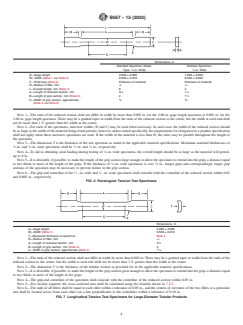
NOTE 1—The ends of the reduced section shall not differ in width by more than 0.002 in. for the 2.00-in. gage length specimen or 0.001 in. for the
1.00-in. gage length specimen. There may be a gradual taper in width from the ends of the reduced section to the center, but the width at each end shall
not be more than 1 % greater than the width at the center.
NOTE 2—For each of the specimens, narrower widths (W and C) may be used when necessary. In such cases the width of the reduced section should
be as large as the width of the material being tested permits; however, unless stated specifically, the requirements for elongation in a product specification
shall not apply when these narrower specimens are used. If the width of the material is less than W, the sides may be parallel throughout the length of
the specimen.
NOTE 3—The dimension T is the thickness of the test specimen as stated in the applicable material specifications. Maximum nominal thicknesses of
1 1 1 1
⁄2-in. and ⁄4-in. wide specimens shall be ⁄2 in. and ⁄4 in., respectively.
NOTE 4—To aid in obtaining axial loading during testing of ⁄4-in. wide specimens, the overall length should be as large as the material will permit,
up to 8 in.
NOTE 5—It is desirable, if possible, to make the length of the grip section large enough to allow the specimen to extend into the grips a distance equal
1 3
to two thirds or more of the length of the grips. If the thickness of ⁄2-in. wide specimens is over ⁄8 in., longer grips and correspondingly longer grip
sections of the specimen may be necessary to prevent failure in the grip section.
1 1
NOTE 6—The grip-end centerline of the ⁄2 –in. wide and ⁄4 –in. wide specimens shall coincide with the centerline of the reduced section within 0.01
and 0.005 in., respectively.
FIG. 6 Rectangular Tension Test Specimens
Dimensions, in.
G—Gage length 2.000 ± 0.005
W—Width (Note 1) 0.500 ± 0.010
T—Measured thickness of specimen Note 2
R—Radius of fillet, min ⁄2
A—Length of reduced section, min 2 ⁄4
B—Length of grip section, min (Note 3) 3
C—Width of grip section, approximate (Note 4) ⁄16
NOTE 1—The ends of the reduced section shall not differ in width by more than 0.002 in. There may be a gradual taper in width from the ends of the
reduced section to the center, but the width at each end shall not be more than 1 % greater than the width at the center.
NOTE 2—The dimension T is the thickness of the tubular section as provided for in the applicable material specifications.
NOTE 3—It is desirable, if possible, to make the length of the grip section great enough to allow the specimen to extend into the grips a distance equal
to two thirds or more of the length of the grips.
NOTE 4—The grip-end centerline of the specimen shall coincide with the centerline of the reduced section within 0.05 in.
NOTE 5—For circular segment, the cross-sectional area shall be calculated using the formula shown in 7.2.3.
NOTE 6—The radii of all fillets shall be equal to each other within a tolerance of 0.05 in., and the centers of curvature of the two fillets at a particular
end shall be located across from each other (on a line perpendicular to the centerline) within a tolerance of 0.10 in.
FIG. 7 Longitudinal Tension Test Specimens for Large-Diameter Tubular Products
B557 − 15 (2023)
Dimensions, in.
G—Gage length 2.000 ± 0.005
W—Width (Note 1) 0.500 ± 0.010
T—Thickness, max (Note 2) ⁄8
R—Radius of fillet, min (Note 3) ⁄2
L—Overall length, min 8
A—Length of reduced section, min 2 ⁄4
B— Length of grip section, min 2
C— Width of grip section, approximate 2
D— Diameter of hole for pin, min (Note 4) ⁄2
E— Edge distance from pin, approximate 1 ⁄2
F— Distance from hole to fillet, min ⁄2
NOTE 1—The ends of the reduced section shall differ in width by not more than 0.002 in. There may be a gradual taper in width from the ends of the
reduced section to the center, but the width at each end shall be not more than 1 % greater than the width at the center.
NOTE 2—The dimension T is the thickness of the test specimen as stated in the applicable product specifications.
NOTE 3—For some materials, a fillet radius R larger than ⁄2 in. may be needed.
NOTE 4—Holes must be on centerline of reduced section, within 60.002 in.
NOTE 5—Variations of dimensions C, D, E, F, and L may be used that will permit failure within the gage length.
FIG. 8 Pin-Loaded Tension Test Specimen with 2-in. Gage Length
Dimensions, in.
Standard
Nominal Diameter Small-Size Specimens Proportional to Standard
Specimen
0.500 0.350 0.250 0.160
G—Gage length 2.000 ± 0.005 1.400 ± 0.005 1.000 ± 0.005 0.640 ± 0.005
D—Diameter (Note 1) 0.500 ± 0.010 0.350 ± 0.007 0.250 ± 0.005 0.160 ± 0.003
3 1 3 5
R—Radius of fillet, min ⁄8 ⁄4 ⁄16 ⁄32
1 3 1 3
A—Length of reduced section, min (Note 2) 2 ⁄4 1 ⁄4 1 ⁄4 ⁄4
NOTE 1—The reduced section may have a gradual taper from the ends toward the center, with the ends not more than 1 % larger in diameter than the
center (controlling dimension).
NOTE 2—If desired, the length of the reduced section may be increased to accommodate an extensometer of any convenient gage length. Reference
marks for the measurement of elongation should, nevertheless, be spaced at the indicated gage length.
NOTE 3—The gage length and fillets shall be as shown, but the ends may be of any form to fit the holders of the testing machine in such a way that
the load shall be axial (see Fig. 10). If the ends are held in wedge grips it is desirable, if possible, to make the length of the grip section great enough
to allow the specimen to extend into the grips a distance equal to two thirds or more of the length of the grips.
NOTE 4—On the round specimens in Figs. 9 and 10, the gage lengths are equal to four times the nominal diameter. In some product specifications other
specimens may be provided for, but unless the 4-to-1 ratio is maintained within dimensional tolerances, the elongation values may not be comparable
with those obtained from the standard test specimen.
NOTE 5—The use of specimens smaller than 0.250-in. diameter shall be restricted to cases when the material to be tested is of insufficient size to obtain
larger specimens or when all parties agree to their use for acceptance testing. Smaller specimens require suitable equipment and greater skill in both
machining and testing.
NOTE 6—Four sizes of specimens often used have diameters of approximately 0.505, 0.357, 0.252, and 0.160 in., the reason being to permit easy
calculations of stress from loads, since the corresponding cross-sectional areas are equal or close to 0.200, 0.100, 0.0500, and 0.0200 in. , respectively.
Thus, when the actual diameters agree with these values, the stresses (or strengths) may be computed using the simple multiplying factors 5, 10, 20, and
50, respectively.
FIG. 9 Standard 0.500-in. Round Tension Test Specimen with 2-in. Gage Length and Examples of Small-Size Specimens Proportional to
the Standard Specimen
B557 − 15 (2023)
TABLE 1 Guidelines for Selecting Round Tensile Specimens
the result of tests of small specimens may be more variable due
Minimum Material to the increasing significance of variations in metallic structure
Specified Material Section Thickness Specimen
or the character of the surfaces. Low values derived from small
Thickness, in Length or Diameter, in
specimens should be carefully evaluated in accordance with
Width, in
8.1 to be certain that the results are valid.
0.250 through 0.374 1 ⁄2 0.160
0.375 through 0.499 2 ⁄2 0.250
6.1.7 While tensile strengths and yield strengths can prop-
0.500 through 0.624 3 ⁄4 0.350
erly be compared with results derived from test specimens of
0.625 and over 4 ⁄4 0.500
various dimensions, elongation values may vary with specimen
size and type. Therefore, elongation values should be obtained
with specimens of the type from which the published tensile
specification, the dimensions of the smallest specimen used
properties were established.
shall not be less than the following:
6.2 Type, Direction, and Location in Wrought Products—
Wrought Cast
This paragraph and subparagraphs provide the standard re-
Diameter of reduced section, in. 0.160 0.250
3 1
Length of reduced section, in. ⁄4 1 ⁄4 quirements for the testing of wrought products for the purpose
1 3
Radius of fillet, in. ⁄8 ⁄16
of quality control and lot release testing. Additions or excep-
15 3
Diameter of end section, in. ⁄64 ⁄8
tions to these requirements may need to be made in individual
Overall length, in.
1 3
With shouldered ends 1 ⁄2 2 ⁄8 specifications for a particular material or product.
With threaded ends 2 3
NOTE 5—These requirements also do not preclude the use of these test
With plain cylindrical ends 3 4
methods for purposes other than quality control as desired for research,
6.1.5.1 The shape of the ends of the specimens outside of
material evaluation, or other purpose utilizing other test locations, test
the gage length shall be suitable to the material and of a shape
directions, and test specimen sizes. In these cases, the general require-
to fit the holders or grips of the testing machine so that the ments in 6.1 should be followed for specimen type and the requirements
in Sections 5 and 7 shall be followed for test apparatus, testing, and
loads are applied axially. Fig. 10 shows specimens with various
analysis.
types of ends that have given satisfactory results.
6.1.6 Special care is required in the manufacture and testing 6.2.1 Sheet and Plate:
of smaller specimens because the effects of machining (for 6.2.1.1 Tension test specimens for non-heat-treatable alumi-
example, the amount of end load applied and the amount of num alloy sheet and plate shall be taken so that the specimen
axis is parallel to the direction of rolling (longitudinal speci-
heat generated) and testing (for example, eccentricity and gage
marking) variables are greater upon them than upon larger mens).
specimens. Therefore, the largest practical specimen shall
6.2.1.2 Tension test specimens for heat-treatable aluminum
always be used. With some types of materials, notably castings, alloy sheet (specified thickness less than 0.250 in.) shall be
Dimensions, in.
Specimen 1 Specimen 2 Specimen 3 Specimen 4 Specimen 5
G—Gage length 2.000 ± 0.005 2.000 ± 0.005 2.000 ± 0.005 2.000 ± 0.005 2.000 ± 0.005
D—Diameter (Note 1) 0.500 ± 0.010 0.500 ± 0.010 0.500 ± 0.010 0.500 ± 0.010 0.500 ± 0.010
3 3 1 3 3
R—Radius of fillet, min ⁄8 ⁄8 ⁄16 ⁄8 ⁄8
1 1 1 1
A—Length of reduced section 2 ⁄4 , min 2 ⁄4 , min 4, approximately 2 ⁄4 , min 2 ⁄4 , min
1 1 3 1
L—Overall length, approximate 5 5 ⁄2 5 ⁄2 4 ⁄4 9 ⁄2
3 3 1
B—Length of end section (Note 2) 1 ⁄8 , approximately 1, approximately ⁄4 approximately ⁄2, approximately 3, min
3 3 23 7 3
C—Diameter of end section ⁄4 ⁄4 ⁄32 ⁄8 ⁄4
5 3 5
E—Length of shoulder and fillet . ⁄8 . ⁄4 ⁄8
section, approximate
5 5 19
F—Diameter of shoulder . ⁄8 . ⁄8 ⁄32
NOTE 1—The reduced section may have a gradual taper from the ends toward the center with the ends not more than 0.005 in. larger in diameter than
the center.
NOTE 2—On Specimen 5 it is desirable, if possible, to make the length of the grip section great enough to allow the specimen to extend into the grips
a distance equal to two thirds or more of the length of the grips.
FIG. 10 Various Types of Ends for Standard Round Tension Test Specimen
B557 − 15 (2023)
taken so that the specimen axis is perpendicular to the direction 6.2.3.1 Round specimens shall be used whenever it is not
of rolling (long-transverse) for product widths 9 in. and greater, practical to use full-section specimens, except that rectangular
and in the longitudinal direction for widths less than 9 in. specimens may be used for extrusion profiles less than
6.2.1.3 Tension test specimens for heat-treatable aluminum 0.500 in. thick.
alloy plate (specified thickness of 0.250 in. and greater) shall 6.2.3.2 Specimens shall be taken in the longitudinal direc-
be taken in the long-transverse direction and, when specified, tion from the predominant section of the extrusion profile. The
in the longitudinal and short transverse (specimen axis perpen- specimens shall be taken from a location that most nearly
dicular to the surface of the rolled product) directions. Long satisfies the intent of Table 2.
transverse and longitudinal tensile test specimens are taken 6.2.4 Tube and Pipe—Specimens shall be taken in the
midway between the two plate surfaces for plate having a longitudinal direction.
specified thickness of 0.500 in. through 1.500 in., and midway 6.2.4.1 For all small tube (Note 8), particularly sizes 1 in.
between the center and surface of plate for plate having a and under in nominal outside diameter, and frequently for
specified thickness over 1.500 in. Short transverse tensile larger sizes, except as limited by the testing equipment, it is
specimens are taken so that the midpoint of the gage section standard practice to use tension test specimens of full-size
coincides with the plate mid-thickness plane. Short transverse tubular sections. Snug-fitting metal plugs shall be inserted far
testing, when specified, is applicable to plate having a specified enough into the ends of such tubular specimens to permit the
thickness of 1.500 in. and greater. testing machine jaws to grip the specimens properly. The plugs
shall not extend into that part of the specimen on which the
NOTE 6—ASTM Specification B209 lists thick plate products for which
elongation is measured. Fig. 11 shows a suitable form of plug,
short transverse tensile tests are required.
the location of the plugs in the specimen, and the location of
NOTE 7—In some cases, customer requirements may call for tensile
testing in the short transverse direction for plate with a specified thickness
the specimen in the grips of the testing machine.
less than 1.500 in. In these cases, the specimen geometry, preparation,
NOTE 8—The term “tube” is used to indicate tubular products in
sampling requirements, and test procedure shall be agreed upon by the
general, and includes pipe, tube, and tubing.
supplier and customer. The precautionary information in 6.1.6 and 6.1.7
should be considered in these cases. Because of potentially higher scatter
6.2.4.2 When it is not practical to test full-section
and specimen size effects, data from such tests should not be combined
specimens, 0.500-in. wide specimens in accordance with Fig. 7
with short transverse tensile test data from products having a specified
taken as in Fig. 12 shall be used if practical. Otherwise, round
thickness of 1.500 in. and greater which were tested using the specimen
geometry provided in Fig. 9. specimens in accordance with 6.1.5 shall be taken from the
center of wall thicknesses through 1.500 in.; for thicknesses
6.2.1.4 Tension test specimens for aluminum alloy sheet and
over 1.500 in., they shall be taken midway from center of
plate less than 0.500 in. thick shall be the standard rectangular
thickness to surface. If specimens of the type shown in Fig. 7
specimen. For plate thickness 0.500 in. and greater, the
are used and curved grip faces are not available, it is acceptable
standard 0.5 in. round specimen, or a smaller round specimen
to flatten (without heating) the grip ends of the test specimen.
proportional to it, shall be used. Material less than 0.75 in. in
The gage length area shall not be deformed.
width is tested in full section when the standard 0.5 in. round
6.2.5 Die Forgings—Round specimens shall be used for
specimen, or smaller round specimen proportional to it, cannot
section thicknesses 0.500 in. and greater. Either subsize round
be used.
or rectangular specimens may be used for section thicknesses
6.2.1.5 Tension test specimens for magnesium alloys shall
from 0.312 to 0.499 in. Rectangular specimens shall be used
be taken parallel to the direction of rolling.
for section thicknesses less than 0.312 in. The direction of the
6.2.2 Wire, Rod, and Bar:
6.2.2.1 Full-section specimens shall be used when practical.
It is permissible to reduce the section slightly throughout the
test section in order to ensure fracture within the gage length.
Otherwise, round specimens shall be used, except that for
rectangles less than 0.500-in. thick rectangular specimens of
the full thickness may be used.
6.2.2.2 Specimens shall be taken in the longitudinal direc-
tion from the locations specified in Table 2.
6.2.3 Extrusion Profiles:
TABLE 2 Location of Axis of Specimens in Rod, Bar, and
Extrusion Profiles
Location of Axis of Specimen with
Section Diameter, Respect to Thickness (T) and
Thickness or Width, Width (W) of Bar and Shapes or
NOTE 1—The diameter of the plug shall have a slight taper from the line
in. Diameter (D) of Rod
limiting the testing machine jaws to the curved section.
Thickness Width Diameter
FIG. 11 Metal Plugs for Testing Tubular Specimens, Proper Loca-
Up through 1.500, incl T/2 W/2 D/2
Over 1.500 T/4 W/4 D/4 tion of Plugs in Specimen, and of Specimen in Heads of Testing
Machine
B557 − 15 (2023)
from the midpoint of its axis to the end of the forging is at least
half the thickness of the forging.
6.3 Type of Specimen from Castings:
6.3.1 Test specimens shall be separately cast or, if called for
by product specification or customer requirements, machined
from the casting itself.
6.3.2 Cast Test Specimens—Cast test specimens shall be
prepared in accordance with the appropriate product specifica-
tion.
6.3.3 Specimens Machined from Castings:
6.3.3.1 Round specimens in accordance with Fig. 9 shall be
NOTE 1—The edges of the specimen shall be cut parallel to each other.
used for section thicknesses 0.500 in. and greater.
FIG. 12 Location from Which Longitudinal Tension Test Speci-
mens Are to Be Cut from Large-Diameter Tube 6.3.3.2 Either small-size round specimens proportional to
the standard specimen in Fig. 9 or rectangular specimens in
accordance with Fig. 6 may be used for section thicknesses
from 0.312 to 0.499 in., except as limited by 6.1.3.
specimens shall be in the longitudinal grain direction, unless
6.3.3.3 Rectangular specimens in accordance with Fig. 6
specimens in other directions are required. For aluminum die
shall be used for section thicknesses less than 0.312 in.
forgings, the longitudinal grain direction is defined as orienta-
6.3.3.4 All test specimens must have a machined finish of
tions parallel, within 615°, to the predominate grain flow. The
63 μin. RMS (57 μin. AA) or smoother.
long transverse grain direction is defined as perpendicular,
within 615°, to the longitudinal (predominate) grain direction
6.4 Specimen for Die Castings—For testing die castings the
and parallel, within 615°, to the parting plane. (Both condi-
test specimen shown in Fig. 13 shall be used unless otherwise
tions must be met.) The short transverse grain direction is
provided in the product specifications.
defined as perpendicular, within 615°, to the longitudinal
6.5 Specimens for Powdered Metals—For testing powdered
(predominate) grain direction and perpendicular, within 615°,
metals the test specimens shown in Figs. 14 and 15 shall be
to the parting plane. Specimens shall be taken from the center
used, unless otherwise provided in the product specifications.
of the predominant or thickest part of the forging from which
a coupon can be obtained, from a prolongation of the forging,
7. Procedure
or from separately forged coupons from the same stock and
7.1 Preparation of the Test Machine—Upon startup, or
representative of the forging.
following a prolonged period of machine inactivity, exercise or
6.2.6 Hand Forgings—Round specimens shall be used.
warmup the test machine to normal operating temperatures to
They shall be taken in the long-transverse direction, and when
minimize errors that may result from transient conditions.
specified, in the longitudinal and short-transverse directions. A
longitudinal specimen shall be taken so that its axis coincides 7.2 Measurement of Dimensions of Test Specimens:
with the longitudinal centerline of the forging. A long- 7.2.1 To determine the cross-sectional area of a tension test
transverse or short-transverse specimen shall be taken so that specimen, measure the dimensions of the cross section at the
the midpoint of its axis lies on the longitudinal centerline of the center of the reduced section. However, for referee testing of
forging. Each specimen shall be so chosen that the distance specimens under ⁄16 in. in their least dimension, measure the
Dimensions, in.
G—Gage length 2.000 ± 0.005
D—Diameter (see Note) 0.250 ± 0.005
R—Radius of filet, min 3
A—Length of reduced section, min 2 ⁄4
L—Overall length, min 9
B—Distance between grips, min 4 ⁄2
C—Diameter of end section, approximate ⁄8
NOTE 1—The reduced section may have a gradual taper from the ends toward the center, with the ends not more than 0.005 in. larger in diameter than
the center.
FIG. 13 Standard Tension Test Specimen for Die Castings
B557 − 15 (2023)
Pressing Area = 1.00 in.
Dimensions Specified except G, are Those of the Die.
Dimensions, in.
G—Gage length 1.000 ± 0.005
D—Width at center 0.225 ± 0.001
W—Width at end of reduced section 0.235 ± 0.001
T—Compact to this thickness 0.200 to 0.250
...