

ASTM B80-23
(Specification)Standard Specification for Magnesium-Alloy Sand Castings
General Information
- Abstract
ABSTRACT
This specification covers magnesium-alloy sand castings. The castings shall conform to the chemical composition limits specified. The castings may be subjected to such heat treatment as deemed necessary to produce material that will conform to the requirements specified. Heat treatment shall be performed on the whole casting and never on a portion. Foundry control shall consist of examination of the castings by radiographic or other approved methods for determining internal discontinuities until the gating, pouring, and other foundry practices have been established to produce castings meeting the quality standards. The tension test specimens representing the castings shall conform to the requirements.
SCOPE
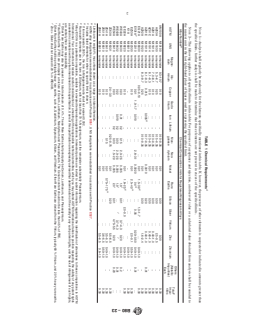
1.1 This specification covers magnesium-alloy sand castings designated as shown in Table 1.
1.2 The values stated in inch-pound units are to be regarded as the standard. The SI values in parentheses are provided for information only.
1.3 This standard does not purport to address all of the safety concerns, if any, associated with its use. It is the responsibility of the user of this standard to establish appropriate safety, health, and environmental practices and determine the applicability of regulatory limitations prior to use.
1.4 This international standard was developed in accordance with internationally recognized principles on standardization established in the Decision on Principles for the Development of International Standards, Guides and Recommendations issued by the World Trade Organization Technical Barriers to Trade (TBT) Committee.
- Status
- Published
- Publication Date
- 31-Mar-2023
- Technical Committee
- B07 - Light Metals and Alloys
- Drafting Committee
- B07.04 - Magnesium Alloy Cast and Wrought Products
Overview
ASTM B80-23: Standard Specification for Magnesium-Alloy Sand Castings defines the requirements for the production and evaluation of magnesium-alloy sand castings. Published by ASTM International, this standard covers chemical composition limits, mechanical property requirements, heat treatment procedures, foundry control methods, inspection protocols, and quality assurance. It is widely used in industries requiring lightweight yet strong components, such as aerospace, automotive, military, and industrial applications. Compliance ensures that castings meet stringent quality and safety expectations, providing reliability in critical end-use environments.
Key Topics
- Alloy Composition: Specifies chemical composition limits for various registered magnesium alloys, ensuring consistency in material properties.
- Heat Treatment: Outlines full-casting heat treatment protocols to achieve desired mechanical properties without treating partial sections, promoting uniformity.
- Mechanical Properties: Establishes minimum tensile and yield strength, as well as elongation requirements, for castings and test specimens.
- Inspection Methods: Requires radiographic, liquid penetrant, or other approved inspection methods to detect internal discontinuities and ensure casting integrity.
- Foundry Control: Mandates foundry process controls and quality standards during production, with particular attention to gating, pouring, and foundry practices.
- Sampling and Testing: Describes procedures for sampling, specimen preparation, and mechanical testing, referencing relevant ASTM practices and standards.
- Repair and Rejection: Specifies limitations on repairs (e.g., welding, impregnation, peening), acceptable methods, and procedures for the rejection and retesting of nonconformant castings.
- Marking and Packaging: Prescribes comprehensive guidelines for marking, identification, packaging, and shipping of finished castings.
Applications
Magnesium-alloy sand castings governed by ASTM B80-23 are ideal for applications where lightweight, high-strength materials are essential. Notable uses include:
- Aerospace Components: Aircraft housings, brackets, and complex assemblies requiring high strength-to-weight ratios.
- Automotive Parts: Engine components, transmission housings, and other structures where weight reduction enhances fuel efficiency.
- Defense and Military Equipment: Structural and functional parts subjected to rigorous mechanical performance and environmental resilience.
- Industrial Machinery: Lightweight casings and frames that benefit from the unique properties of magnesium alloys, such as damping and machinability.
- Custom and Prototype Production: Short-run or specialized parts where sand casting’s flexibility meets precise chemical and mechanical requirements.
The standard’s emphasis on quality control, material uniformity, and robust inspection makes it suited to critical applications where safety, durability, and performance cannot be compromised.
Related Standards
ASTM B80-23 references several key standards for enhanced guidance and compliance, including:
- ASTM B93/B93M - Magnesium Alloys in Ingot Form for Sand Castings, Permanent Mold Castings, and Die Castings
- ASTM B296 - Temper Designations of Magnesium Alloys, Cast and Wrought
- ASTM B557 - Test Methods for Tension Testing Wrought and Cast Aluminum- and Magnesium-Alloy Products
- ASTM B660 - Packaging of Aluminum and Magnesium Products
- ASTM B661 - Heat Treatment of Magnesium Alloys
- ASTM E29, E88, E94, E155, E165 - Practices and Guides for test data significance, sampling, radiographic examination, and inspection
- ANSI Z1.4 - Sampling Procedures and Tables for Inspection by Attributes
- Federal & Military Standards - Packaging, marking, impregnation, and heat treatment procedures
Compliance with these related standards ensures a comprehensive approach to quality assurance in magnesium-alloy sand castings.
Keywords: magnesium alloy sand castings, ASTM B80-23, magnesium-alloy specification, heat treatment, mechanical properties, foundry inspection, quality standards, aerospace casting, automotive casting, nonferrous castings
Relations
- Effective Date
- 01-Nov-2023
- Refers
ASTM B296-20 - Standard Practice for Temper Designations of Magnesium Alloys, Cast and Wrought - Effective Date
- 01-May-2020
- Effective Date
- 01-May-2018
- Effective Date
- 01-Sep-2017
- Effective Date
- 15-May-2014
- Refers
ASTM B296-03(2014) - Standard Practice for Temper Designations of Magnesium Alloys, Cast and Wrought - Effective Date
- 01-May-2014
- Effective Date
- 01-Nov-2011
- Effective Date
- 01-May-2011
- Effective Date
- 01-Sep-2010
- Refers
ASTM E155-10 - Standard Reference Radiographs for Inspection of Aluminum and Magnesium Castings - Effective Date
- 01-Sep-2010
- Effective Date
- 01-Jul-2010
- Effective Date
- 01-Feb-2010
- Effective Date
- 07-Dec-2009
- Effective Date
- 01-Jul-2009
- Effective Date
- 01-Jun-2009
Get Certified
Connect with accredited certification bodies for this standard

Element Materials Technology
Materials testing and product certification.

Inštitut za kovinske materiale in tehnologije
Institute of Metals and Technology. Materials testing, metallurgical analysis, NDT.
Sponsored listings
Frequently Asked Questions
ASTM B80-23 is a technical specification published by ASTM International. Its full title is "Standard Specification for Magnesium-Alloy Sand Castings". This standard covers: ABSTRACT This specification covers magnesium-alloy sand castings. The castings shall conform to the chemical composition limits specified. The castings may be subjected to such heat treatment as deemed necessary to produce material that will conform to the requirements specified. Heat treatment shall be performed on the whole casting and never on a portion. Foundry control shall consist of examination of the castings by radiographic or other approved methods for determining internal discontinuities until the gating, pouring, and other foundry practices have been established to produce castings meeting the quality standards. The tension test specimens representing the castings shall conform to the requirements. SCOPE 1.1 This specification covers magnesium-alloy sand castings designated as shown in Table 1. 1.2 The values stated in inch-pound units are to be regarded as the standard. The SI values in parentheses are provided for information only. 1.3 This standard does not purport to address all of the safety concerns, if any, associated with its use. It is the responsibility of the user of this standard to establish appropriate safety, health, and environmental practices and determine the applicability of regulatory limitations prior to use. 1.4 This international standard was developed in accordance with internationally recognized principles on standardization established in the Decision on Principles for the Development of International Standards, Guides and Recommendations issued by the World Trade Organization Technical Barriers to Trade (TBT) Committee.
ABSTRACT This specification covers magnesium-alloy sand castings. The castings shall conform to the chemical composition limits specified. The castings may be subjected to such heat treatment as deemed necessary to produce material that will conform to the requirements specified. Heat treatment shall be performed on the whole casting and never on a portion. Foundry control shall consist of examination of the castings by radiographic or other approved methods for determining internal discontinuities until the gating, pouring, and other foundry practices have been established to produce castings meeting the quality standards. The tension test specimens representing the castings shall conform to the requirements. SCOPE 1.1 This specification covers magnesium-alloy sand castings designated as shown in Table 1. 1.2 The values stated in inch-pound units are to be regarded as the standard. The SI values in parentheses are provided for information only. 1.3 This standard does not purport to address all of the safety concerns, if any, associated with its use. It is the responsibility of the user of this standard to establish appropriate safety, health, and environmental practices and determine the applicability of regulatory limitations prior to use. 1.4 This international standard was developed in accordance with internationally recognized principles on standardization established in the Decision on Principles for the Development of International Standards, Guides and Recommendations issued by the World Trade Organization Technical Barriers to Trade (TBT) Committee.
ASTM B80-23 is classified under the following ICS (International Classification for Standards) categories: 77.150.20 - Magnesium products. The ICS classification helps identify the subject area and facilitates finding related standards.
ASTM B80-23 has the following relationships with other standards: It is inter standard links to ASTM B660-23, ASTM B296-20, ASTM B951-11(2018), ASTM E88-11(2017), ASTM B557-14, ASTM B296-03(2014), ASTM B951-11, ASTM E88-11, ASTM E716-10, ASTM E155-10, ASTM B557-10, ASTM B951-10, ASTM B93/B93M-09, ASTM E165-09, ASTM B951-09. Understanding these relationships helps ensure you are using the most current and applicable version of the standard.
ASTM B80-23 is available in PDF format for immediate download after purchase. The document can be added to your cart and obtained through the secure checkout process. Digital delivery ensures instant access to the complete standard document.
Standards Content (Sample)
This international standard was developed in accordance with internationally recognized principles on standardization established in the Decision on Principles for the
Development of International Standards, Guides and Recommendations issued by the World Trade Organization Technical Barriers to Trade (TBT) Committee.
Designation: B80 − 23
Standard Specification for
Magnesium-Alloy Sand Castings
This standard is issued under the fixed designation B80; the number immediately following the designation indicates the year of original
adoption or, in the case of revision, the year of last revision. A number in parentheses indicates the year of last reapproval. A superscript
epsilon (´) indicates an editorial change since the last revision or reapproval.
This standard has been approved for use by agencies of the U.S. Department of Defense.
1. Scope B661 Practice for Heat Treatment of Magnesium Alloys
B951 Practice for Codification of Unalloyed Magnesium and
1.1 This specification covers magnesium-alloy sand cast-
Magnesium-Alloys, Cast and Wrought
ings designated as shown in Table 1.
E29 Practice for Using Significant Digits in Test Data to
1.2 The values stated in inch-pound units are to be regarded
Determine Conformance with Specifications
as the standard. The SI values in parentheses are provided for
E35 Test Methods for Chemical Analysis of Magnesium and
information only. 3
Magnesium Alloys (Withdrawn 2008)
1.3 This standard does not purport to address all of the E88 Practice for Sampling Nonferrous Metals and Alloys in
safety concerns, if any, associated with its use. It is the
Cast Form for Determination of Chemical Composition
responsibility of the user of this standard to establish appro- E94 Guide for Radiographic Examination Using Industrial
priate safety, health, and environmental practices and deter-
Radiographic Film
mine the applicability of regulatory limitations prior to use. E155 Reference Radiographs for Inspection of Aluminum
1.4 This international standard was developed in accor-
and Magnesium Castings
dance with internationally recognized principles on standard- E165 Practice for Liquid Penetrant Testing for General
ization established in the Decision on Principles for the
Industry
Development of International Standards, Guides and Recom- E527 Practice for Numbering Metals and Alloys in the
mendations issued by the World Trade Organization Technical
Unified Numbering System (UNS)
Barriers to Trade (TBT) Committee. E716 Practices for Sampling and Sample Preparation of
Aluminum and Aluminum Alloys for Determination of
2. Referenced Documents
Chemical Composition by Spark Atomic Emission Spec-
2.1 The following documents of the issue in effect on date trometry
2.3 Federal Standards:
of order acceptance form a part of this specification to the
Fed. Std. No. 123 Marking for Shipment (Civil Agencies)
extent referenced herein:
2 Fed. Std. No. 184 Identification Marking of Aluminum,
2.2 ASTM Standards:
Magnesium and Titanium
B93/B93M Specification for Magnesium Alloys in Ingot
2.4 Military Standards:
Form for Sand Castings, Permanent Mold Castings, and
MIL-STD-129 Marking for Shipment and Storage (Military
Die Castings
Agencies)
B296 Practice for Temper Designations of Magnesium
MIL-STD-276 Impregnation of Porous Non-ferrous Metal
Alloys, Cast and Wrought
Castings
B557 Test Methods for Tension Testing Wrought and Cast
MIL-I-13857 Impregnation of Metal Castings
Aluminum- and Magnesium-Alloy Products
MIL-M-46062 Magnesium Alloy Castings, High Strength
B660 Practices for Packaging/Packing of Aluminum and
MIL-M-6857 Heat Treatment of Magnesium Alloy Castings
Magnesium Products
2.5 ANSI Standard:
ANSI Z1.4 Sampling Procedures and Tables for Inspection
This specification is under the jurisdiction of ASTM Committee B07 on Light
by Attributes
Metals and Alloys and is the direct responsibility of Subcommittee B07.04 on
Magnesium Alloy Cast and Wrought Products.
Current edition approved April 1, 2023. Published April 2023. Originally The last approved version of this historical standard is referenced on
approved in 1930. Last previous edition approved in 2015 as B80 – 15. DOI: www.astm.org.
10.1520/B0080-23. Available from Standardization Documents Order Desk, DODSSP, Bldg. 4,
For referenced ASTM standards, visit the ASTM website, www.astm.org, or Section D, 700 Robbins Ave., Philadelphia, PA 19111-5098, http://
contact ASTM Customer Service at service@astm.org. For Annual Book of ASTM www.dodssp.daps.mil.
Standards volume information, refer to the standard’s Document Summary page on Available from American National Standards Institute (ANSI), 25 W. 43rd St.,
the ASTM website. 4th Floor, New York, NY 10036, http://www.ansi.org.
Copyright © ASTM International, 100 Barr Harbor Drive, PO Box C700, West Conshohocken, PA 19428-2959. United States
B80 − 23
A
TABLE 1 Chemical Requirements
NOTE 1—Analysis shall regularly be made only for the elements specifically mentioned in this table. If, however, the presence of other elements is suspected or indicated in amounts greater than
the specified limits, further analysis shall be made to determine that these elements are not present in excess of the specified limits.
NOTE 2—The following applies to all specified limits in this table: For purposes of acceptance and rejection, an observed value or a calculated value obtained from analysis shall be rounded to
the nearest unit in the last right-hand place of figures used in expressing the specified limit.
B
Alloy Number Chemical Composition Limits for Registered Magnesium Alloys
Others
C
Total
Magne- Alu- Gado- Man- Neo- Rare (Metallic
ASTM UNS Copper Iron Lithium Nickel Silicon Silver Yttrium Zinc Zirconium Impu-
sium minum linium ganese dymium Earths Impurities)
rities
Each
AM100A M10100 remainder 9.3–10.7 0.10 . . . 0.10–0.35 . 0.01 . 0.30 . 0.30 . . 0.30
AZ63A M11630 remainder 5.3–6.7 0.25 . . . 0.15–0.35 . 0.01 . 0.30 . 2.5–3.5 . . 0.30
AZ81A M11810 remainder 7.0–8.1 0.10 . . . 0.13–0.35 . 0.01 . 0.30 . 0.40–1.0 . . 0.30
AZ91C M11914 remainder 8.1–9.3 0.10 . . . 0.13–0.35 . 0.01 . 0.30 . 0.40–1.0 . . 0.30
D
AZ91E M11919 remainder 8.1–9.3 0.015 . 0.005 . 0.17–0.35 . 0.0010 . 0.20 . 0.40–1.0 . 0.01 0.30
AZ92A M11920 remainder 8.3–9.7 0.25 . . . 0.10–0.35 . 0.01 . 0.30 . 1.6–2.4 . . 0.30
E
EQ21A M18330 remainder . 0.05–0.10 . . . . . 0.01 1.5–3.0 . 1.3–1.7 . . 0.40–1.0 . 0.30
F G
EV31A M12310 remainder . 0.01 1.0–1.7 0.010 . . 2.6–3.1 0.0020 0.4 . 0.05 . 0.20–0.50 0.40–1.0 0.01 .
H
EZ33A M12330 remainder . 0.10 . . . . . 0.01 2.5–4.0 . . . 2.0–3.1 0.50–1.0 . 0.30
K1A M18010 remainder . . . . . . . . . . . . . 0.40–1.0 . 0.30
E
QE22A M18220 remainder . 0.10 . . . . . 0.01 1.8–2.5 . 2.0–3.0 . . 0.40–1.0 . 0.30
I
WE43A M18430 remainder . 0.03 . 0.01 0.2 0.15 2.0–2.5 0.005 1.9 0.01 3.7–4.3 0.20 0.40–1.0 0.2 .
I J J
WE43B M18432 remainder . 0.02 . 0.010 0.2 0.03 2.0–2.5 0.005 1.9 . 3.7–4.3 0.40–1.0 0.01 .
I
WE54A M18410 remainder . 0.03 . . 0.2 0.03 1.5–2.0 0.005 2.0 0.01 4.75–5.5 0.20 0.40–1.0 0.20 .
ZC63A M16331 remainder . 2.4–3.0 . . . 0.25–0.75 . 0.01 . 0.20 . 5.5–6.5 . . 0.30
H
ZE41A M16410 remainder . 0.10 . . . 0.15 . 0.01 0.75–1.75 . . 3.5–5.0 0.40–1.0 . 0.30
ZK51A M16510 remainder . 0.10 . . . . . 0.01 . . . 3.6–5.5 0.50–1.0 0.30
ZK61A M16610 remainder . 0.10 . . . . . 0.01 . . . 5.5–6.5 0.6–1.0 0.30
A
Limits are in weight % max unless shown as a range or stated otherwise.
B
ASTM alloy designations were established in accordance with Practice B951. UNS designations were established in accordance with Practice E527.
C
Includes listed elements for when no specific limit is shown.
D
If iron exceeds 0.005 %, the Iron to Manganese ratio shall not exceed 0.032.
E
Rare earth elements are in the form of Didymium, with not less than 70 % Neodymium, and the remainder substantially Praseodymium.
F
Alloy EV31A is a patented composition, suitable for elevated temperature applications. Interested parties are invited to submit information regarding the identification of alternatives to these compositions to ASTM
International. Your comments will receive careful consideration at a meeting of the responsible technical committee, which you may attend. ASTM International takes no position respecting the validity of any patent rights
asserted in connection with any item mentioned in this specification. Users of this specification are expressly advised that determination of the validity of any such patent rights, and the risk of infringement of such rights,
are entirely their own responsibility.
G
Other Rare Earths may also be present to a total maximum of 0.4 %. These Rare Earths shall principally be Cerium, Lanthanum, and Praseodymium.
H
Total Rare Earths (TRE) are principally a mixture of Cerium, Lanthanum, Neodymium and Praseodymium. The Cerium content should not be less than 45% of TRE.
I
Other Rare Earths shall be principally heavy rare earths, such as, Gadolinium, Dysprosium, Erbium, and Ytterbium. Other Rare Earths are derived from the Yttrium, typically 80 % Yttrium, and 20 % heavy rare earths.
J
Zinc + Silver shall not exceed 0.20 % in WE43B.
B80 − 23
3. Terminology 4.1.10 Whether pressure testing is required (15.4),
4.1.11 Whether source inspection is required (Section 17),
3.1 Definitions:
4.1.12 Whether repairs are permissible (Section 19),
3.1.1 casting lot, n—unless otherwise agreed, shall consist
4.1.13 Whether chemical analysis and mechanical property
of not more than 1000 lb of cleaned castings from the same
reports or certifications, or both, are required (Section 20), and
melt or heat, except where this weight limit may be exceeded
4.1.14 Whether special packaging is required for shipment
by a single casting. In such cases, each casting shall be
(Section 22).
considered a lot.
3.1.2 heat treat lot, n—for the purpose of mechanical
5. Responsibility for Quality Assurance
property testing, a lot shall consist of all castings heat treated
in the same furnace charge to the same temper. 5.1 Responsibility for Inspection—Unless otherwise speci-
fied in the contract or purchase order, the supplier is respon-
3.1.3 sand casting, n—metal object produced by pouring
sible for the performance of all inspection requirements as
molten metal into a sand mold and allowing it to solidify.
specified herein. Except as otherwise specified in the contract
or order, the supplier may use his own or any other facilities
4. Ordering Information
suitable for the performance of the inspection requirements
4.1 Orders for castings under this specification shall include
specified herein, unless disapproved by the purchaser. The
the following information:
purchaser reserves the right to perform any of the inspections
4.1.1 Applicable drawing or part number,
set forth in the specification where such inspections are deemed
4.1.2 Quantity of each casting,
necessary to ensure supplies and services conform to pre-
4.1.3 Specification number and title,
scribed requirements.
4.1.4 Alloy (Section 9 and Table 1),
4.1.5 Temper (Section 11, Table 2 and X1.2),
6. Material Requirements
4.1.6 Whether foundry control is required (Section 8),
4.1.7 Whether test specimens cut from castings are required 6.1 Unless otherwise specified, only magnesium alloy in-
in addition to, or instead of, separately cast test specimens gots or producer’s foundry scrap conforming to Specification
(Section 12 and Table X1.2), B93/B93M shall be used for pouring castings. Additions of
4.1.8 Whether liquid penetrant inspection is required (15.2), small amounts of grain refining elements and material for melt
4.1.9 Whether radiographic inspection is required (15.3), process losses are permitted.
TABLE 2 Tensile Requirements
NOTE 1—For purposes of determining conformance with this specification, each value for tensile strength and yield strength shall be rounded to the
nearest 0.1 ksi and each value for elongation shall be rounded to the nearest 0.5 %, both in accordance with the rounding method of Practice E29.
Alloy Number B
Tensile Strength, min, Elongation in 2 in., (50.8
A Yield Strength (0.2 %
Temper
ksi (MPa) offset), min, ksi (MPa) mm) min, %
ASTM UNS
C
AM100A M10100 T6 35.0(241) 17.0(117)
AZ63A M11630 F 26.0(179) 11.0(76) 4
T4 34.0(234) 11.0(76) 7
T5 26.0(179) 12.0(83) 2
T6 34.0(234) 16.0(110) 3
AZ81A M11810 T4 34.0(234) 11.0(76) 7
C
AZ91C M11914 F 23.0(158) 11.0(76)
T4 34.0(234) 11.0(76) 7
T5 23.0(158) 12.0(83) 2
T6 34.0(234) 16.0(110) 3
AZ91E M11919 T6 34.0(234) 16.0(110) 3
C
AZ92A M11920 F 23.0(158) 11.0(76)
T4 34.0(234) 11.0(76) 6
C
T5 23.0(158) 12.0(83)
T6 34.0(234) 18.0(124) 1
EQ21A M18330 T6 34.0(234) 25.0(172) 2
EV31A M12310 T6 36.0(248) 21.0(145) 2
EZ33A M12330 T5 20.0(138) 14.0(96) 2
K1A M18010 F 24.0(165) 6.0(41) 14
QE22A M18220 T6 35.0(241) 25.0(172) 2
WE43A M18430 T6 32.0(221) 25.0(172) 2
WE43B M18432 T6 32.0(221) 25.0(172) 2
WE54A M18410 T6 37.0(255) 26.0(179) 2
ZC63A M16331 T6 28.0(193) 18.0(124) 2
ZE41A M16410 T5 29.0(200) 19.5(133) 2.5
ZK51A M16510 T5 34.0(234) 20.0(138) 5
ZK61A M16610 T6 40.0(276) 26.0(179) 5
A
These temper designations were established in accordance with Practice B296.
B
See X1.4.1.
C
Not required.
B80 − 23
6.2 Pure materials and master alloys may be used provided tice B661. Heat treatment shall be performed on the whole
chemical analysis verifying conformance to Table 1 is done casting and never on a portion.
prior to pouring any castings.
11.2 Each heat treat furnace charge shall contain at least one
set of test bars of the same composition range as the castings.
7. Manufacture
The satisfactory heat treatment of the furnace charge shall be
7.1 The responsibility of furnishing castings that can be laid
determined by the results from these test bars, which must
out and machined to the finished dimensions within the conform to the requirements of Table 2 or Table X1.2 where
permissible variations specified, as shown on the blueprints or
required.
drawings, shall rest with the supplier, except when pattern
equipment is furnished by the purchaser. Sufficient stock shall
12. Tensile Requirements
be allowed for shrinkage, and where requested, for finishing;
12.1 Limits—The tension test specimens representing the
but castings of excessive weight shall not be furnished.
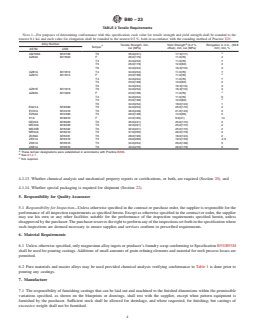
castings shall conform to the requirements of Table 2.
7.2 The castings may be subjected to such heat treatment as
12.2 Number of Tests—At least one tension test specimen
deemed necessary to produce material that will conform to the
shall be tested from each casting lot, or fraction thereof, to
requirements specified. Heat treatment shall be performed on
represent the castings poured from the same melt. If the
the whole of a casting, never on a part only, and shall be
castings are to be heat treated, the specimens shall be heat
applied in a manner that will produce the utmost uniformity.
treated with production castings of the same alloy and in the
same temper as the specimens. The specimens shall then be
8. Foundry Control
tested to judge the ability of their corresponding melts to
8.1 When specified, castings shall be produced under
respond to the type of heat treatment to which the specimens
foundry control approved by the purchaser. Foundry control
were subjected.
shall consist of examination of the castings by radiographic or
12.2.1 Test Specimens—The tension test specimens shall be
other approved methods for determining internal discontinui-
separately cast in the system sand mix in use and shall be cast
ties until the gating, pouring, and other foundry practices have
to size in accordance with the dimensions shown in Fig. 1 or
been established to produce castings meeting the quality
Fig. 2.
standards set by purchaser or agreed to between the purchaser
12.2.1.1 Placing chills within the gauge length (center
and the producer. When foundry practices have been so
portion that is 0.500 in. diameter in Figs. 1 and 2) is not
established, the production method shall not be significantly
allowed as it will produce mechanical properties not charac-
changed without demonstrating to the satisfaction of the
teristic of the alloy.
purchaser that the change does not adversely affect the quality
12.3 When specified, the tensile strength and yield strength
of the castings. Minor changes in pouring temperature of
values of specimens cut from castings shall conform to Table
650 °F from the established nominal temperature are permis-
X1.2. Elongation values shall not be less than 25 % of the
sible.
values specified in Table 2.
12.3.1 When tensile properties of castings are to be
9. Chemical Composition Requirements
determined, tension test specimens shall be cut from the
9.1 Limits—The castings shall conform to the chemical
locations designated on the drawing. If no locations are
composition limits prescribed in Table 1. Conformance shall be
designated, specimens shall be taken from each test casting to
determined by analyzing samples taken when the castings are
include at least one from the thinnest and one from thickest
poured, or by analyzing samples taken from the finished
section of the casting. At least three specimens are required.
product. If the chemical composition has been determined
12.3.2 The machined tension test specimen shall be the
during the course of manufacture, sampling and analysis of the
standard 0.500-in. diameter specimen or the largest smaller
finished product shall not be necessary.
size specimen proportional to the standard specimen shown in
Fig. 8 of Test Methods B557.
10. Sampling for Chemical Composition
12.3.3 Where a round specimen is not feasible a standard ⁄2
10.1 For determination of chemical composition, one
in. wide rectangular specimen shown in Fig. 6 of Test Methods
sample of each casting lot shall be taken in accordance with
B557 may be used, but in no case shall its area be less than that
Practice E88 for chemical analysis or Practice E716 for
of the sub size ⁄4 in. wide specimen.
spectrochemical analysis.
12.4 If any tension test specimen is improperly machined or
10.1.1 Samples for other methods of chemical analysis shall
shows flaws upon testing, it may be discarded and another
be suitable for the form of material being analyzed and the type
specimen for the same heat or melt used instead. If no
of analytical method used. In case of dispute, analyses should
additional specimen is available, the supplier and the purchaser
be made by methods given in Methods E35.
shall agree on an alternative procedure.
12.5 Test Methods—The tension tests shall be made in
11. Heat Treatment
accordance with Test Methods B557.
11.1 Unless otherwise specified, heat treatment for the
applicable tempers designated in Tables 2 and X1.2 shall be in 12.6 Mechanical properties at 400 to 500 °F—Alloys
accordance with Military Specification MIL-M-6857 or Prac- EQ21A, EV31A, EZ33A, QE22A, WE54A, WE43A and
B80 − 23
Metric Equivalents
in. mm in. mm in. mm in. mm
7 3
0.500 12.70 ⁄8 22.2 1 ⁄8 34.9 3 76.2
5 1
0.510 12.95 1 25.4 1 ⁄8 41.37 3 ⁄4 82.5
3 1
⁄8 9.5 1 ⁄8 28.6 2 50.8 6 152.4
1 1 3 3
⁄2 12.7 1 ⁄4 31.8 2 ⁄4 69.8 9 ⁄16 233.4
⁄8 15.9
FIG. 1 AFS Test Bar for Sand-Cast Magnesium Alloys
WE43B shall be capable of meeting the requirements shown in 13. Special Test Methods
Table X1.2 when tested in the following manner. Tensile test
13.1 When the castings have critical functional
specimens shall be heated to 400 to 500 °F 6 5 °F, as
requirements, special tests to simulate the stress conditions
applicable, held for 10 min before testing and loaded at this
incurred in service may be requested. The requirements and
temperature at a rate of 0.005 in./in./min up to the yield
methods of these tests shall be as agreed upon between the
strength, and at a rate of 0.10 in./in./min above the yield
producer and the purchaser.
strength.
B80 − 23
NOTE 1—This test bar mold is particularly suitable for those magnesium alloys containing Zr.
FIG. 2 Proposed Gating System for ASTM Magnesium Test Bars
14. Finish 15.3 Radiographic Inspection:
15.3.1 When specified, radiographic inspection shall be in
14.1 The finished castings shall be uniform in quality, free
accordance with Guide E94 and Reference Radiographs E155
of injurious blowholes, porosity, shrinkage, cracks, and other
to determine soundness. Areas of the casting subject to
discontinuities except as designated and agreed upon as ac-
soundness requirements shall be specified by the purchaser. It
ceptable by the purchaser.
is advisable to document an agreed upon radiographic tech-
14.2 Prior to shipment, castings shall be coated with a light
nique including source parameters, film size, and orientation of
corrosion-inhibiting oil, unless chrome pickling is required by
the radiographs.
the purchaser (see X1.5).
15.3.2 Radiographic acceptance shall be in accordance with
requirements selected from Table 3. Any modifications of this
15. Foundry Inspection
table and the frequency per unit area and location should also
15.1 Requirements of surface finish parting lines, and re-
be agreed upon between the producer and purchaser.
moval of gates and risers may be checked visually. It is
15.4 When specified, the castings shall be subject to hydro-
advisable to have mutually agreed upon observational stan-
static or aerostatic pressure as required. Acceptance pressure
dards to represent acceptable material.
and allowable leak rates shall be specified by the purchaser.
15.2 Liquid Penetrant Inspection:
(Warning—Take appropriate safety precautions to protect
15.2.1 When specified liquid penetrant inspection shall be
inspectors prior to any pressure application.)
in accordance with Practice E165, and the required sensitivity
16. Sampling for Foundry Inspection
shall be specified.
15.2.2 Acceptance standards for discontinuities shall be 16.1 For the purpose of visual and dimensional
agreed upon, including size and frequency per unit area and examination, casting lots may be combined up to a maximum
location. of 5000 lbs. From this accumulated lot, a sample shall be
B80 − 23
TABLE 3 Discontinuity-Level Requirements for Magnesium Sand Castings (Reference Radiographs E155)
Discontinuity Grade A Grade B Grade C Grade D
Section Thickness, in.
1 3 1 3 1 3 1 3
⁄4 ⁄4 ⁄4 ⁄4 ⁄4 ⁄4 ⁄4 ⁄4
Gas holes none 1 1 2 2 5 5
Microshrinkage (feathery) none 1 1 2 2 4 3
Microshrinkage (sponge) none 1 1 2 2 4 3
Foreign material (less dense) none 1 1 2 2 4 4
Foreign material (more dense) none 1 1 2 2 4 3
Cracks none none none none
Cold shuts none none none none
Surface irregularity not to exceed drawing tolerance
Core shift not to exceed drawing tolerence
selected at random in accordance with the tables of ANSI Z1.4 18.1.2 A rejected lot may be screened by 100 % inspection
at inspection level II, with lot acceptance and rejection based for the rejectable item and resubmitted for acceptance inspec-
on acceptable qua
...
This document is not an ASTM standard and is intended only to provide the user of an ASTM standard an indication of what changes have been made to the previous version. Because
it may not be technically possible to adequately depict all changes accurately, ASTM recommends that users consult prior editions as appropriate. In all cases only the current version
of the standard as published by ASTM is to be considered the official document.
Designation: B80 − 15 B80 − 23
Standard Specification for
Magnesium-Alloy Sand Castings
This standard is issued under the fixed designation B80; the number immediately following the designation indicates the year of original
adoption or, in the case of revision, the year of last revision. A number in parentheses indicates the year of last reapproval. A superscript
epsilon (´) indicates an editorial change since the last revision or reapproval.
This standard has been approved for use by agencies of the U.S. Department of Defense.
1. Scope
1.1 This specification covers magnesium-alloy sand castings designated as shown in Table 1.
1.2 The values stated in inch-pound units are to be regarded as the standard. The SI values in parentheses are provided for
information only.
1.3 This standard does not purport to address all of the safety concerns, if any, associated with its use. It is the responsibility
of the user of this standard to establish appropriate safety and healthsafety, health, and environmental practices and determine
the applicability of regulatory limitations prior to use.
1.4 This international standard was developed in accordance with internationally recognized principles on standardization
established in the Decision on Principles for the Development of International Standards, Guides and Recommendations issued
by the World Trade Organization Technical Barriers to Trade (TBT) Committee.
2. Referenced Documents
2.1 The following documents of the issue in effect on date of order acceptance form a part of this specification to the extent
referenced herein:
2.2 ASTM Standards:
B93/B93M Specification for Magnesium Alloys in Ingot Form for Sand Castings, Permanent Mold Castings, and Die Castings
B296 Practice for Temper Designations of Magnesium Alloys, Cast and Wrought
B557 Test Methods for Tension Testing Wrought and Cast Aluminum- and Magnesium-Alloy Products
B660 Practices for Packaging/Packing of Aluminum and Magnesium Products
B661 Practice for Heat Treatment of Magnesium Alloys
B951 Practice for Codification of Unalloyed Magnesium and Magnesium-Alloys, Cast and Wrought
E29 Practice for Using Significant Digits in Test Data to Determine Conformance with Specifications
E35 Test Methods for Chemical Analysis of Magnesium and Magnesium Alloys (Withdrawn 2008)
E88 Practice for Sampling Nonferrous Metals and Alloys in Cast Form for Determination of Chemical Composition
E94 Guide for Radiographic Examination Using Industrial Radiographic Film
E155 Reference Radiographs for Inspection of Aluminum and Magnesium Castings
E165 Practice for Liquid Penetrant Testing for General Industry
This specification is under the jurisdiction of ASTM Committee B07 on Light Metals and Alloys and is the direct responsibility of Subcommittee B07.04 on Magnesium
Alloy Cast and Wrought Products.
Current edition approved May 1, 2015April 1, 2023. Published June 2015April 2023. Originally approved in 1930. Last previous edition approved in 20092015 as
B80 – 09.B80 – 15. DOI: 10.1520/B0080-15.10.1520/B0080-23.
For referenced ASTM standards, visit the ASTM website, www.astm.org, or contact ASTM Customer Service at service@astm.org. For Annual Book of ASTM Standards
volume information, refer to the standard’s Document Summary page on the ASTM website.
The last approved version of this historical standard is referenced on www.astm.org.
Copyright © ASTM International, 100 Barr Harbor Drive, PO Box C700, West Conshohocken, PA 19428-2959. United States
B80 − 23
A
TABLE 1 Chemical Requirements
NOTE 1—Analysis shall regularly be made only for the elements specifically mentioned in this table. If, however, the presence of other elements is suspected or indicated in amounts greater than
the specified limits, further analysis shall be made to determine that these elements are not present in excess of the specified limits.
NOTE 2—The following applies to all specified limits in this table: For purposes of acceptance and rejection, an observed value or a calculated value obtained from analysis shall be rounded to
the nearest unit in the last right-hand place of figures used in expressing the specified limit.
B
Alloy Number Chemical Composition Limits for Registered Magnesium Alloys
Others
C
Total
Magne- Alu- Gado- Man- Neo- Rare (Metallic
ASTM UNS Copper Iron Lithium Nickel Silicon Silver Yttrium Zinc Zirconium Impu-
sium minum linium ganese dymium Earths Impurities)
rities
Each
AM100A M10100 remainder 9.3–10.7 0.10 . . . 0.10–0.35 . 0.01 . 0.30 . 0.30 . . 0.30
AZ63A M11630 remainder 5.3–6.7 0.25 . . . 0.15–0.35 . 0.01 . 0.30 . 2.5–3.5 . . 0.30
AZ81A M11810 remainder 7.0–8.1 0.10 . . . 0.13–0.35 . 0.01 . 0.30 . 0.40–1.0 . . 0.30
AZ91C M11914 remainder 8.1–9.3 0.10 . . . 0.13–0.35 . 0.01 . 0.30 . 0.40–1.0 . . 0.30
D
AZ91E M11919 remainder 8.1–9.3 0.015 . 0.005 . 0.17–0.35 . 0.0010 . 0.20 . 0.40–1.0 . 0.01 0.30
AZ92A M11920 remainder 8.3–9.7 0.25 . . . 0.10–0.35 . 0.01 . 0.30 . 1.6–2.4 . . 0.30
E
EQ21A M18330 remainder . 0.05–0.10 . . . . . 0.01 1.5–3.0 . 1.3–1.7 . . 0.40–1.0 . 0.30
F G
EV31A M12310 remainder . 0.01 1.0–1.7 0.010 . . 2.6–3.1 0.0020 0.4 . 0.05 . 0.20–0.50 0.40–1.0 0.01 .
H
EZ33A M12330 remainder . 0.10 . . . . . 0.01 2.5–4.0 . . . 2.0–3.1 0.50–1.0 . 0.30
K1A M18010 remainder . . . . . . . . . . . . . 0.40–1.0 . 0.30
E
QE22A M18220 remainder . 0.10 . . . . . 0.01 1.8–2.5 . 2.0–3.0 . . 0.40–1.0 . 0.30
I
WE43A M18430 remainder . 0.03 . 0.01 0.2 0.15 2.0–2.5 0.005 1.9 0.01 3.7–4.3 0.20 0.40–1.0 0.2 .
I J J
WE43B M18432 remainder . 0.02 . 0.010 0.2 0.03 2.0–2.5 0.005 1.9 . 3.7–4.3 0.40–1.0 0.01 .
I
WE54A M18410 remainder . 0.03 . . 0.2 0.03 1.5–2.0 0.005 2.0 0.01 4.75–5.5 0.20 0.40–1.0 0.20 .
ZC63A M16331 remainder . 2.4–3.0 . . . 0.25–0.75 . 0.01 . 0.20 . 5.5–6.5 . . 0.30
H
ZE41A M16410 remainder . 0.10 . . . 0.15 . 0.01 0.75–1.75 . . 3.5–5.0 0.40–1.0 . 0.30
ZK51A M16510 remainder . 0.10 . . . . . 0.01 . . . 3.6–5.5 0.50–1.0 0.30
ZK61A M16610 remainder . 0.10 . . . . . 0.01 . . . 5.5–6.5 0.6–1.0 0.30
A
Limits are in weight % max unless shown as a range or stated otherwise.
B
ASTM alloy designations were established in accordance with Practice B951. UNS designations were established in accordance with Practice E527.
C
Includes listed elements for when no specific limit is shown.
D
If iron exceeds 0.005 %, the Iron to Manganese ratio shall not exceed 0.032.
E
Rare earth elements are in the form of Didymium, with not less than 70 % Neodymium, and the remainder substantially Praseodymium.
F
Alloy EV31A is a patented composition, suitable for elevated temperature applications. Interested parties are invited to submit information regarding the identification of alternatives to these compositions to ASTM
International. Your comments will receive careful consideration at a meeting of the responsible technical committee, which you may attend. ASTM International takes no position respecting the validity of any patent rights
asserted in connection with any item mentioned in this specification. Users of this specification are expressly advised that determination of the validity of any such patent rights, and the risk of infringement of such rights,
are entirely their own responsibility.
G
Other Rare Earths may also be present to a total maximum of 0.4 %. These Rare Earths shall principally be Cerium, Lanthanum, and Praseodymium.
H
Total Rare Earths (TRE) are principally a mixture of Cerium, Lanthanum, Neodymium and Praseodymium. The Cerium content should not be less than 45% of TRE.
I
Other Rare Earths shall be principally heavy rare earths, such as, Gadolinium, Dysprosium, Erbium, and Ytterbium. Other Rare Earths are derived from the Yttrium, typically 80 % Yttrium, and 20 % heavy rare earths.
J
Zinc + Silver shall not exceed 0.20 % in WE43B.
B80 − 23
E527 Practice for Numbering Metals and Alloys in the Unified Numbering System (UNS)
E716 Practices for Sampling and Sample Preparation of Aluminum and Aluminum Alloys for Determination of Chemical
Composition by Spark Atomic Emission Spectrometry
2.3 Federal Standards:
Fed. Std. No. 123 Marking for Shipment (Civil Agencies)
Fed. Std. No. 184 Identification Marking of Aluminum, Magnesium and Titanium
2.4 Military Standards:
MIL-STD-129 Marking for Shipment and Storage (Military Agencies)
MIL-STD-276 Impregnation of Porous Non-ferrous Metal Castings
MIL-I-13857 Impregnation of Metal Castings
MIL-M-46062 Magnesium Alloy Castings, High Strength
MIL-M-6857 Heat Treatment of Magnesium Alloy Castings
2.5 ANSI Standard:
ANSI Z1.4 Sampling Procedures and Tables for Inspection by Attributes
3. Terminology
3.1 Definitions:
3.1.1 casting lot, n—unless otherwise agreed, shall consist of not more than 1000 lb of cleaned castings from the same melt or
heat, except where this weight limit may be exceeded by a single casting. In such cases, each casting shall be considered a lot.
3.1.2 heat treat lot, n—for the purpose of mechanical property testing, a lot shall consist of all castings heat treated in the same
furnace charge to the same temper.
3.1.3 sand casting, n—metal object produced by pouring molten metal into a sand mold and allowing it to solidify.
4. Ordering Information
4.1 Orders for castings under this specification shall include the following information:
4.1.1 Applicable drawing or part number,
4.1.2 Quantity of each casting,
4.1.3 Specification number and title,
4.1.4 Alloy (Section 9 and Table 1),
4.1.5 Temper (Section 11, Table 2 and X1.2),
4.1.6 Whether foundry control is required (Section 8),
4.1.7 Whether test specimens cut from castings are required in addition to, or instead of, separately cast test specimens (Section
12 and Table X1.2),
4.1.8 Whether liquid penetrant inspection is required (15.2),
4.1.9 Whether radiographic inspection is required (15.3),
4.1.10 Whether pressure testing is required (15.4),
4.1.11 Whether source inspection is required (Section 17),
4.1.12 Whether repairs are permissible (Section 19),
Available from Standardization Documents Order Desk, DODSSP, Bldg. 4, Section D, 700 Robbins Ave., Philadelphia, PA 19111-5098, http://www.dodssp.daps.mil.
Available from American National Standards Institute (ANSI), 25 W. 43rd St., 4th Floor, New York, NY 10036, http://www.ansi.org.
B80 − 23
TABLE 2 Tensile Requirements
NOTE 1—For purposes of determining conformance with this specification, each value for tensile strength and yield strength shall be rounded to the
nearest 0.1 ksi and each value for elongation shall be rounded to the nearest 0.5 %, both in accordance with the rounding method of Practice E29.
B
Alloy Number
Tensile Strength, min, Elongation in 2 in., (50.8
Yield Strength (0.2 %
A
Temper
offset), min, ksi (MPa)
ksi (MPa) mm) min, %
ASTM UNS
C
AM100A M10100 T6 35.0(241) 17.0(117)
AZ63A M11630 F 26.0(179) 11.0(76) 4
T4 34.0(234) 11.0(76) 7
T5 26.0(179) 12.0(83) 2
T6 34.0(234) 16.0(110) 3
AZ81A M11810 T4 34.0(234) 11.0(76) 7
C
AZ91C M11914 F 23.0(158) 11.0(76)
T4 34.0(234) 11.0(76) 7
T5 23.0(158) 12.0(83) 2
T6 34.0(234) 16.0(110) 3
AZ91E M11919 T6 34.0(234) 16.0(110) 3
C
AZ92A M11920 F 23.0(158) 11.0(76)
T4 34.0(234) 11.0(76) 6
C
T5 23.0(158) 12.0(83)
T6 34.0(234) 18.0(124) 1
EQ21A M18330 T6 34.0(234) 25.0(172) 2
EV31A M12310 T6 36.0(248) 21.0(145) 2
EZ33A M12330 T5 20.0(138) 14.0(96) 2
K1A M18010 F 24.0(165) 6.0(41) 14
QE22A M18220 T6 35.0(241) 25.0(172) 2
WE43A M18430 T6 32.0(221) 25.0(172) 2
WE43B M18432 T6 32.0(221) 25.0(172) 2
WE54A M18410 T6 37.0(255) 26.0(179) 2
ZC63A M16331 T6 28.0(193) 18.0(124) 2
ZE41A M16410 T5 29.0(200) 19.5(133) 2.5
ZK51A M16510 T5 34.0(234) 20.0(138) 5
ZK61A M16610 T6 40.0(276) 26.0(179) 5
A
These temper designations were established in accordance with Practice B296.
B
See X1.4.1.
C
Not required.
4.1.13 Whether chemical analysis and mechanical property reports or certifications, or both, are required (Section 20), and
4.1.14 Whether special packaging is required for shipment (Section 22).
5. Responsibility for Quality Assurance
5.1 Responsibility for Inspection—Unless otherwise specified in the contract or purchase order, the supplier is responsible for the
performance of all inspection requirements as specified herein. Except as otherwise specified in the contract or order, the supplier
may use his own or any other facilities suitable for the performance of the inspection requirements specified herein, unless
disapproved by the purchaser. The purchaser reserves the right to perform any of the inspections set forth in the specification where
such inspections are deemed necessary to ensure supplies and services conform to prescribed requirements.
6. Material Requirements
6.1 Unless otherwise specified, only magnesium alloy ingots or producer’s foundry scrap conforming to Specification B93/B93M
shall be used for pouring castings. Additions of small amounts of grain refining elements and material for melt process losses are
permitted.
6.2 Pure materials and master alloys may be used provided chemical analysis verifying conformance to Table 1 is done prior to
pouring any castings.
7. Manufacture
7.1 The responsibility of furnishing castings that can be laid out and machined to the finished dimensions within the permissible
variations specified, as shown on the blueprints or drawings, shall rest with the supplier, except when pattern equipment is
furnished by the purchaser. Sufficient stock shall be allowed for shrinkage, and where requested, for finishing; but castings of
excessive weight shall not be furnished.
B80 − 23
7.2 The castings may be subjected to such heat treatment as deemed necessary to produce material that will conform to the
requirements specified. Heat treatment shall be performed on the whole of a casting, never on a part only, and shall be applied in
a manner that will produce the utmost uniformity.
8. Foundry Control
8.1 When specified, castings shall be produced under foundry control approved by the purchaser. Foundry control shall consist
of examination of the castings by radiographic or other approved methods for determining internal discontinuities until the gating,
pouring, and other foundry practices have been established to produce castings meeting the quality standards set by purchaser or
agreed to between the purchaser and the producer. When foundry practices have been so established, the production method shall
not be significantly changed without demonstrating to the satisfaction of the purchaser that the change does not adversely affect
the quality of the castings. Minor changes in pouring temperature of 650°F650 °F from the established nominal temperature are
permissible.
9. Chemical Composition Requirements
9.1 Limits—The castings shall conform to the chemical composition limits prescribed in Table 1. Conformance shall be
determined by analyzing samples taken when the castings are poured, or by analyzing samples taken from the finished product.
If the chemical composition has been determined during the course of manufacture, sampling and analysis of the finished product
shall not be necessary.
10. Sampling for Chemical Composition
10.1 For determination of chemical composition, one sample of each casting lot shall be taken in accordance with Practice E88
for chemical analysis or Practice E716 for spectrochemical analysis.
10.1.1 Samples for other methods of chemical analysis shall be suitable for the form of material being analyzed and the type of
analytical method used. In case of dispute, analyses should be made by methods given in Methods E35.
11. Heat Treatment
11.1 Unless otherwise specified, heat treatment for the applicable tempers designated in Tables 2 and X1.2 shall be in accordance
with Military Specification MIL-M-6857 or Practice B661. Heat treatment shall be performed on the whole casting and never on
a portion.
11.2 Each heat treat furnace charge shall contain at least one set of test bars of the same composition range as the castings. The
satisfactory heat treatment of the furnace charge shall be determined by the results from these test bars, which must conform to
the requirements of Table 2 or Table X1.2 where required.
12. Tensile Requirements
12.1 Limits—The tension test specimens representing the castings shall conform to the requirements of Table 2.
12.2 Number of Tests—At least one tension test specimen shall be tested from each casting lot, or fraction thereof, to represent
the castings poured from the same melt. If the castings are to be heat treated, the specimens shall be heat treated with production
castings of the same alloy and in the same temper as the specimens. The specimens shall then be tested to judge the ability of their
corresponding melts to respond to the type of heat treatment to which the specimens were subjected.
12.2.1 Test Specimens—The tension test specimens shall be separately cast in the system sand mix in use and shall be cast to size
in accordance with the dimensions shown in Fig. 1 or Fig. 2.
12.2.1.1 Placing chills within the gauge length (center portion that is 0.500 in. diameter in Figs. 1 and 2) is not allowed as it will
produce mechanical properties not characteristic of the alloy.
12.3 When specified, the tensile strength and yield strength values of specimens cut from castings shall conform to Table X1.2.
Elongation values shall not be less than 25 % of the values specified in Table 2.
B80 − 23
Metric Equivalents
in. mm in. mm in. mm in. mm
7 3
0.500 12.70 ⁄8 22.2 1 ⁄8 34.9 3 76.2
5 1
0.510 12.95 1 25.4 1 ⁄8 41.37 3 ⁄4 82.5
3 1
⁄8 9.5 1 ⁄8 28.6 2 50.8 6 152.4
1 1 3 3
⁄2 12.7 1 ⁄4 31.8 2 ⁄4 69.8 9 ⁄16 233.4
⁄8 15.9
FIG. 1 AFS Test Bar for Sand-Cast Magnesium Alloys
12.3.1 When tensile properties of castings are to be determined, tension test specimens shall be cut from the locations designated
on the drawing. If no locations are designated, specimens shall be taken from each test casting to include at least one from the
thinnest and one from thickest section of the casting. At least three specimens are required.
12.3.2 The machined tension test specimen shall be the standard 0.500-in. diameter specimen or the largest smaller size specimen
proportional to the standard specimen shown in Fig. 8 of Test Methods B557.
12.3.3 Where a round specimen is not feasible a standard ⁄2 in. wide rectangular specimen shown in Fig. 6 of Test Methods B557
may be used, but in no case shall its area be less than that of the sub size ⁄4 in. wide specimen.
12.4 If any tension test specimen is improperly machined or shows flaws upon testing, it may be discarded and another specimen
for the same heat or melt used instead. If no additional specimen is available, the supplier and the purchaser shall agree on an
alternative procedure.
B80 − 23
NOTE 1—This test bar mold is particularly suitable for those magnesium alloys containing Zr.
FIG. 2 Proposed Gating System for ASTM Magnesium Test Bars
12.5 Test Methods—The tension tests shall be made in accordance with Test Methods B557.
12.6 Mechanical properties at 400 to 500°F—500 °F—Alloys EQ21A, EV31A, EZ33A, QE22A, WE54A, WE43A and WE43B
shall be capable of meeting the requirements shown in Table X1.2 when tested in the following manner. Tensile test specimens
shall be heated to 400 to 500°F 6 5°F,500 °F 6 5 °F, as applicable, held for 10 min before testing and loaded at this temperature
at a rate of 0.005 in./in./min up to the yield strength, and at a rate of 0.10 in./in./min above the yield strength.
13. Special Test Methods
13.1 When the castings have critical functional requirements, special tests to simulate the stress conditions incurred in service may
be requested. The requirements and methods of these tests shall be as agreed upon between the producer and the purchaser.
14. Finish
14.1 The finished castings shall be uniform in quality, free of injurious blowholes, porosity, shrinkage, cracks, and other
discontinuities except as designated and agreed upon as acceptable by the purchaser.
14.2 Prior to shipment, castings shall be coated with a light corrosion-inhibiting oil, unless chrome pickling is required by the
purchaser (see X1.5).
B80 − 23
15. Foundry Inspection
15.1 Requirements of surface finish parting lines, and removal of gates and risers may be checked visually. It is advisable to have
mutually agreed upon observational standards to represent acceptable material.
15.2 Liquid Penetrant Inspection:
15.2.1 When specified liquid penetrant inspection shall be in accordance with Practice E165, and the required sensitivity shall be
specified.
15.2.2 Acceptance standards for discontinuities shall be agreed upon, including size and frequency per unit area and location.
15.3 Radiographic Inspection:
15.3.1 When specified, radiographic inspection shall be in accordance with Guide E94 and Reference Radiographs E155 to
determine soundness. Areas of the casting subject to soundness requirements shall be specified by the purchaser. It is advisable
to document an agreed upon radiographic technique including source parameters, film size, and orientation of the radiographs.
15.3.2 Radiographic acceptance shall be in accordance with requirements selected from Table 3. Any modifications of this table
and the frequency per unit area and location should also be agreed upon between the producer and purchaser.
15.4 When specified, the castings shall be subject to hydrostatic or aerostatic pressure as required. Acceptance pressure and
allowable leak rates shall be specified by the purchaser. (Warning—Take appropriate safety precautions to protect inspectors prior
to any pressure application.)
16. Sampling for Foundry Inspection
16.1 For the purpose of visual and dimensional examination, casting lots may be combined up to a maximum of 5000 lbs. From
this accumulated lot, a sample shall be selected at random in accordance with the tables of ANSI Z1.4 at inspection level II, with
lot acceptance and rejection based on acceptable quality level (AQL) equal to 1.5 % defective. When the accumulation of lots is
not practical, the sample shall be selected from each casting lot. Samples selected for dimensional examination may be the same
as those selected for visual examination, but the determination of acceptance or rejection shall not be based on the cumulative
sample for both characteristics.
16.2 For the purpose of liquid penetrant or radiographic inspection, a random sample of castings shall be selected from each
casting lot. The number of castings selected shall be in accordance with ANSI Z1.4 at inspection quality level II with lot acceptance
and rejection based on AQL of 0.65 % defective.
16.3 Sampling for hydrostatic and aerostatic pressure tests shall be as specified by the purchaser.
16.4 Modifications of the above sampling pl
...