

ASTM D5196-06(2018)
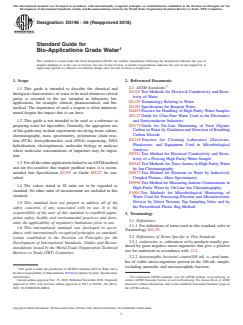
(Guide)Standard Guide for Bio-Applications Grade Water
General Information
- Abstract
SIGNIFICANCE AND USE
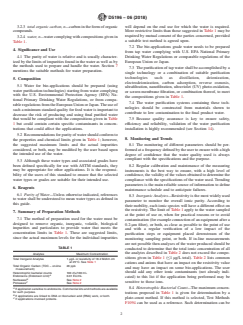
4.1 The purity of water is relative and is usually characterized by the limits of impurities found in the water as well as by the methods used to prepare and handle the water. Section 7 mentions the suitable methods for water preparation.
SCOPE
1.1 This guide is intended to describe the chemical and biological characteristics of water to be used whenever critical purity is essential to the use intended in laboratory bio-applications, for example, clinical, pharmaceutical, and biomedical. The importance of such a reagent is often underestimated despite the impact that it can have.
1.2 This guide is not intended to be used as a reference in preparing water for injectables. Generally, the appropriate use of this guide may include experiments involving tissue culture, chromatography, mass spectrometry, polymerase chain reaction (PCR), deoxyribonucleic acid (DNA) sequencing, DNA hybridization, electrophoresis, molecular biology or analyses where molecular concentrations of impurities may be important.
1.3 For all the other applications linked to an ASTM method and not bio-sensitive that require purified water, it is recommended that Specification D1193 or Guide D5127 be consulted.
1.4 The values stated in SI units are to be regarded as standard. No other units of measurement are included in this standard.
1.5 This standard does not purport to address all of the safety concerns, if any, associated with its use. It is the responsibility of the user of this standard to establish appropriate safety, health, and environmental practices and determine the applicability of regulatory limitations prior to use.
1.6 This international standard was developed in accordance with internationally recognized principles on standardization established in the Decision on Principles for the Development of International Standards, Guides and Recommendations issued by the World Trade Organization Technical Barriers to Trade (TBT) Committee.
- Status
- Published
- Publication Date
- 14-Nov-2018
- Technical Committee
- D19 - Water
- Drafting Committee
- D19.02 - Quality Systems, Specification, and Statistics

Overview
ASTM D5196-06(2018), Standard Guide for Bio-Applications Grade Water, provides comprehensive guidance on the chemical and biological characteristics required for water used in laboratory bio-applications where critical purity is essential. Developed by ASTM International, this standard outlines key requirements for water quality to ensure reliable results in critical scientific and analytical applications, notably in clinical, pharmaceutical, and biomedical settings.
The guide emphasizes that the purity of water must be characterized both by the limits of impurities present and by the methods utilized to prepare and handle the water. Water used for sensitive bio-applications must meet stringent criteria to prevent interference or contamination during experimentation.
Key Topics
Water Quality and Purity Requirements
The standard specifies maximum permitted levels for total inorganic analytes, total organic carbon, heterotrophic bacterial counts, and endotoxins to ensure the water's suitability for sensitive bio-applications.Preparation and Handling
Appropriate water purification technologies, such as distillation, deionization, reverse osmosis, and filtration, are described as necessary for achieving the required purity levels. The use of feed water complying with local or international drinking water regulations is advised.Monitoring and Validation
Continuous monitoring of critical parameters, calibrations of analytical instruments, and regular performance qualifications are essential for maintaining water quality. Trending of parameters is highlighted as a practical approach for preventive maintenance and failure anticipation.Sampling and Storage
The standard underscores meticulous sampling techniques and minimal storage times to prevent contamination. Recommendations are included for the types of containers and cleaning practices to use when handling samples for analysis.Quality Assurance and System Validation
The document details a four-step validation process-design, installation, operational, and performance qualification-to assure ongoing system integrity and compliance with the defined specifications.
Applications
Bio-applications grade water produced according to ASTM D5196-06(2018) is critical in:
Clinical and Biomedical Laboratories:
Used as a reagent or process water to avoid interference from impurities in tests involving tissue culture, electrophoresis, PCR, DNA sequencing, DNA hybridization, and other molecular biology procedures.Pharmaceutical Research and Production:
Essential for analytical methods like chromatography and mass spectrometry, where trace impurities can impact results.Research & Development:
Applicable for any experimental workflow where molecular concentrations of impurities can compromise scientific outcomes.Other Laboratory Uses:
Suitable for environments requiring ultra-pure water but not intended for water used in injectable preparations.
Related Standards
For laboratories and facilities seeking further information or complementary guidelines, consider the following related ASTM standards:
- ASTM D1193 - Specification for Reagent Water
- ASTM D5127 - Guide for Ultra-Pure Water Used in the Electronics and Semiconductor Industries
- ASTM D1125 - Test Methods for Electrical Conductivity and Resistivity of Water
- ASTM D4453 - Practice for Handling of High Purity Water Samples
- ASTM F1094 - Test Methods for Microbiological Monitoring of Water for Electronics Applications
- ASTM D5173, D5391, D5542, D5673, D5996 - Various analytical and quality testing methods
Conclusion
ASTM D5196-06(2018) offers key guidance for the preparation, monitoring, and validation of bio-applications grade water to ensure the integrity of laboratory processes. Compliance with this standard helps laboratories and production facilities maintain the highest quality standards, reduce the risk of contamination, and ensure accurate results in clinical, pharmaceutical, and research environments. Employing such standards greatly contributes to robust laboratory quality management systems and regulatory compliance.
Relations
- Effective Date
- 15-Nov-2018
- Effective Date
- 01-Apr-2024
- Effective Date
- 01-May-2020
- Effective Date
- 15-Apr-2020
- Effective Date
- 01-Apr-2019
- Effective Date
- 15-Oct-2018
- Effective Date
- 01-Feb-2017
- Effective Date
- 15-Feb-2016
- Effective Date
- 15-Feb-2016
- Effective Date
- 01-Jul-2015
- Effective Date
- 01-Jul-2012
- Effective Date
- 15-Jun-2012
- Effective Date
- 01-Jun-2012
- Effective Date
- 01-Feb-2011
- Effective Date
- 01-Aug-2010
Get Certified
Connect with accredited certification bodies for this standard

ECOCERT
Organic and sustainability certification.

Eurofins Food Testing Global
Global leader in food, environment, and pharmaceutical product testing.

Intertek Bangladesh
Intertek certification and testing services in Bangladesh.
Sponsored listings
Frequently Asked Questions
ASTM D5196-06(2018) is a guide published by ASTM International. Its full title is "Standard Guide for Bio-Applications Grade Water". This standard covers: SIGNIFICANCE AND USE 4.1 The purity of water is relative and is usually characterized by the limits of impurities found in the water as well as by the methods used to prepare and handle the water. Section 7 mentions the suitable methods for water preparation. SCOPE 1.1 This guide is intended to describe the chemical and biological characteristics of water to be used whenever critical purity is essential to the use intended in laboratory bio-applications, for example, clinical, pharmaceutical, and biomedical. The importance of such a reagent is often underestimated despite the impact that it can have. 1.2 This guide is not intended to be used as a reference in preparing water for injectables. Generally, the appropriate use of this guide may include experiments involving tissue culture, chromatography, mass spectrometry, polymerase chain reaction (PCR), deoxyribonucleic acid (DNA) sequencing, DNA hybridization, electrophoresis, molecular biology or analyses where molecular concentrations of impurities may be important. 1.3 For all the other applications linked to an ASTM method and not bio-sensitive that require purified water, it is recommended that Specification D1193 or Guide D5127 be consulted. 1.4 The values stated in SI units are to be regarded as standard. No other units of measurement are included in this standard. 1.5 This standard does not purport to address all of the safety concerns, if any, associated with its use. It is the responsibility of the user of this standard to establish appropriate safety, health, and environmental practices and determine the applicability of regulatory limitations prior to use. 1.6 This international standard was developed in accordance with internationally recognized principles on standardization established in the Decision on Principles for the Development of International Standards, Guides and Recommendations issued by the World Trade Organization Technical Barriers to Trade (TBT) Committee.
SIGNIFICANCE AND USE 4.1 The purity of water is relative and is usually characterized by the limits of impurities found in the water as well as by the methods used to prepare and handle the water. Section 7 mentions the suitable methods for water preparation. SCOPE 1.1 This guide is intended to describe the chemical and biological characteristics of water to be used whenever critical purity is essential to the use intended in laboratory bio-applications, for example, clinical, pharmaceutical, and biomedical. The importance of such a reagent is often underestimated despite the impact that it can have. 1.2 This guide is not intended to be used as a reference in preparing water for injectables. Generally, the appropriate use of this guide may include experiments involving tissue culture, chromatography, mass spectrometry, polymerase chain reaction (PCR), deoxyribonucleic acid (DNA) sequencing, DNA hybridization, electrophoresis, molecular biology or analyses where molecular concentrations of impurities may be important. 1.3 For all the other applications linked to an ASTM method and not bio-sensitive that require purified water, it is recommended that Specification D1193 or Guide D5127 be consulted. 1.4 The values stated in SI units are to be regarded as standard. No other units of measurement are included in this standard. 1.5 This standard does not purport to address all of the safety concerns, if any, associated with its use. It is the responsibility of the user of this standard to establish appropriate safety, health, and environmental practices and determine the applicability of regulatory limitations prior to use. 1.6 This international standard was developed in accordance with internationally recognized principles on standardization established in the Decision on Principles for the Development of International Standards, Guides and Recommendations issued by the World Trade Organization Technical Barriers to Trade (TBT) Committee.
ASTM D5196-06(2018) is classified under the following ICS (International Classification for Standards) categories: 71.060.01 - Inorganic chemicals in general. The ICS classification helps identify the subject area and facilitates finding related standards.
ASTM D5196-06(2018) has the following relationships with other standards: It is inter standard links to ASTM D5196-06(2013), ASTM D5245-19(2024), ASTM D1129-13(2020)e2, ASTM F1094-87(2020), ASTM D5245-19, ASTM D5127-13(2018), ASTM D4453-17, ASTM D5996-16, ASTM D4453-16, ASTM D5673-15, ASTM F1094-87(2012), ASTM D5127-12, ASTM D5245-92(2012), ASTM D4453-11, ASTM D5673-10. Understanding these relationships helps ensure you are using the most current and applicable version of the standard.
ASTM D5196-06(2018) is available in PDF format for immediate download after purchase. The document can be added to your cart and obtained through the secure checkout process. Digital delivery ensures instant access to the complete standard document.
Standards Content (Sample)
This international standard was developed in accordance with internationally recognized principles on standardization established in the Decision on Principles for the
Development of International Standards, Guides and Recommendations issued by the World Trade Organization Technical Barriers to Trade (TBT) Committee.
Designation: D5196 − 06 (Reapproved 2018)
Standard Guide for
Bio-Applications Grade Water
This standard is issued under the fixed designation D5196; the number immediately following the designation indicates the year of
original adoption or, in the case of revision, the year of last revision. A number in parentheses indicates the year of last reapproval. A
superscript epsilon (´) indicates an editorial change since the last revision or reapproval.
1. Scope 2. Referenced Documents
2.1 ASTM Standards:
1.1 This guide is intended to describe the chemical and
D1125 Test Methods for Electrical Conductivity and Resis-
biological characteristics of water to be used whenever critical
tivity of Water
purity is essential to the use intended in laboratory bio-
D1129 Terminology Relating to Water
applications, for example, clinical, pharmaceutical, and bio-
D1193 Specification for Reagent Water
medical. The importance of such a reagent is often underesti-
D4453 Practice for Handling of High Purity Water Samples
mated despite the impact that it can have.
D5127 Guide for Ultra-Pure Water Used in the Electronics
1.2 This guide is not intended to be used as a reference in and Semiconductor Industries
D5173 Guide for On-Line Monitoring of Total Organic
preparing water for injectables. Generally, the appropriate use
Carbon in Water by Oxidation and Detection of Resulting
of this guide may include experiments involving tissue culture,
Carbon Dioxide
chromatography, mass spectrometry, polymerase chain reac-
D5245 Practice for Cleaning Laboratory Glassware,
tion (PCR), deoxyribonucleic acid (DNA) sequencing, DNA
Plasticware, and Equipment Used in Microbiological
hybridization, electrophoresis, molecular biology or analyses
Analyses
where molecular concentrations of impurities may be impor-
D5391 Test Method for Electrical Conductivity and Resis-
tant.
tivity of a Flowing High Purity Water Sample
1.3 ForalltheotherapplicationslinkedtoanASTMmethod
D5542 Test Methods for TraceAnions in High Purity Water
and not bio-sensitive that require purified water, it is recom-
by Ion Chromatography
mended that Specification D1193 or Guide D5127 be con-
D5673 Test Method for Elements in Water by Inductively
sulted.
Coupled Plasma—Mass Spectrometry
D5996 Test Method for MeasuringAnionic Contaminants in
1.4 The values stated in SI units are to be regarded as
High-Purity Water by On-Line Ion Chromatography
standard. No other units of measurement are included in this
F1094 Test Methods for Microbiological Monitoring of
standard.
Water Used for Processing Electron and Microelectronic
Devices by Direct Pressure Tap Sampling Valve and by
1.5 This standard does not purport to address all of the
the Presterilized Plastic Bag Method
safety concerns, if any, associated with its use. It is the
responsibility of the user of this standard to establish appro-
3. Terminology
priate safety, health, and environmental practices and deter-
3.1 Definitions:
mine the applicability of regulatory limitations prior to use.
3.1.1 For definitions of terms used in this standard, refer to
1.6 This international standard was developed in accor-
Terminology D1129.
dance with internationally recognized principles on standard-
3.2 Definitions of Terms Specific to This Standard:
ization established in the Decision on Principles for the
3.2.1 endotoxins, n—substances or by-products usually pro-
Development of International Standards, Guides and Recom-
duced by gram negative micro-organisms that give a positive
mendations issued by the World Trade Organization Technical
test for endotoxin in accordance with 13.2.
Barriers to Trade (TBT) Committee.
3.2.2 heterotrophic bacterial counts/100 mL, n—total num-
ber of viable micro-organisms present in the 100-mL sample,
excluding anaerobic and microaerophilic bacteria.
This guide is under the jurisdiction of ASTM Committee D19 on Water and is
thedirectresponsibilityofSubcommitteeD19.02onQualitySystems,Specification,
and Statistics. For referenced ASTM standards, visit the ASTM website, www.astm.org, or
Current edition approved Nov. 15, 2018. Published November 2018. Originally contact ASTM Customer Service at service@astm.org. For Annual Book of ASTM
approved in 1991. Last previous edition approved in 2013 as D5196 – 06 (2013). Standards volume information, refer to the standard’s Document Summary page on
DOI: 10.1520/D5196-06R18. the ASTM website.
Copyright © ASTM International, 100 Barr Harbor Drive, PO Box C700, West Conshohocken, PA 19428-2959. United States
D5196 − 06 (2018)
3.2.3 total organic carbon, n—carbonintheformoforganic will depend on the end use for which the water is required.
compounds. More restrictive limits than those suggested in Table 1 may be
required by mutual consent of the parties concerned, provided
3.2.4 water,n—watercomplyingwithcompositionsgivenin
a suitable test method is agreed upon.
Table 1.
7.2 The bio-applications grade water needs to be prepared
4. Significance and Use
from tap water complying with U.S. EPA National Primary
4.1 The purity of water is relative and is usually character- Drinking Water Regulations or comparable regulations of the
ized by the limits of impurities found in the water as well as by
European Union or Japan.
the methods used to prepare and handle the water. Section 7
7.3 The purification of tap water shall be accomplished by a
mentions the suitable methods for water preparation.
single technology or a combination of suitable purification
technologies such as distillation, deionization,
5. Composition
electrodeionization, carbon adsorption, reverse osmosis,
5.1 Water for bio-applications should be prepared (using
ultrafiltration, nanofiltration, ultraviolet (UV) photo-oxidation,
water purification technologies) starting from water complying
or screen membrane filtration, or combination thereof, to meet
with the U.S. Environmental Protection Agency (EPA) Na-
the compositions given in Table 1.
tional Primary Drinking Water Regulations, or from compa-
7.4 The water purification systems containing these tech-
rableregulationsfromtheEuropeanUnionorJapan.Theuseof
nologies should be constructed from materials shown to
such a minimum standard quality for feed water is important to
contribute to low contamination to the final product water.
decrease the risk of producing and using final purified water
that would be compliant with the compositions given in Table 7.5 Because quality assurance is key to ensure safety,
1 but could contain certain specific contaminants in concen- efficiency and reliability, validation of the water purification
trations that could affect the applications. installation is highly recommended (see Section 14).
5.2 Recommendationsforpurityofwatershouldconformto
8. Monitoring and Trends
the properties and chemical limits given in Table 1; however,
the suggested maximum limits and the actual impurities
8.1 The monitoring of different parameters should be per-
considered, or both, may be modified by the user based upon formed at a frequency defined by the user to ensure with a high
the intended use of the water.
degree of confidence that the water quality used is always
compliant with the specifications and the purpose.
5.3 Although these water types and associated grades have
been defined specifically for use with ASTM standards, they
8.2 Regular calibration and maintenance of the measuring
may be appropriate for other applications. It is the responsi- instruments is the best way to ensure, with a high level of
bility of the users of this standard to ensure that the selected
confidence, the validity of the values obtained to determine the
water types or grades are suitable for their intended use. compliance with the specifications of the water used. Trending
parameters is the main reliable source of information to define
6. Reagents
maintenance schedule and to anticipate failures.
6.1 Purity of Water—Unless otherwise indicated, references
8.3 Inorganic Analytes—Resistivity is the most widely used
to water shall be understood to mean water types as defined in
parameter to monitor the overall ionic purity. According to
this guide.
their mobility, each ionic species will have a different effect on
the resistivity. The limit of Table 1 apply to the water sampled
7. Summary of Preparation Methods
at the point of use or, when for practical reasons or to avoid
7.1 The method of preparation used for the water must be
contamination (for example connection of an equipment after a
designed to remove organic, inorganic, volatile, biological
0.2-µm filter), or both, as close as possible to the point of use
impurities and particulates to provide water that meets the
and with a regular verification of a low impact of the
concentration limits in Table 1. These are suggested limits,
purification steps or equipment placed downstream of the
since the actual maximum levels for the individual impurities
monitoring sampling point, or both. If in-line measurements
are not possible then analyses of the water produced should be
TABLE 1
conducted to determine that the total ionic concentration of all
the analytes described in Table 2 does not exceed the compo-
Analytes Maximum Concentration
sitions given in Table 1 (≤1 µg/L total). Table 2 lists common
Total Inorganic Analytes 1 µg/L or resistivity of 18.2 Mohm.cm
at 25°C. See Note 1
cations and anions that have an impact on the resistivity value
Total Organic Carbon (TOC – on-line 20 ppb
and may have an impact on some bio-applications. The user
measurement)
should add any other ionic contaminants (not already indi-
Heterotrophic bacterial counts 100 cfu/100 mL
A
Endotoxins (Endotoxin Unit) 0.01 EU/mL
cated) to this list if the application being performed may be
B
Nucleases See Note 2
sensitive to those ions.
C
Proteases See Note 2
A
Ifapplicationsensitivetoendotoxins.Commercialkitsandmethodsareavailable 8.4 Heterotrophic Bacterial Count—The maximum concen-
for such purpose.
trations proposed in Table 1 is given for determination by a
B
If applications are linked to DNA or ribonucleic acid (RNA) work, or both.
C plate-count method. If thi
...