

ASTM F3605-23
(Guide)Standard Guide for Additive Manufacturing of Metals - Data - File Structure for In-Process Monitoring of Powder Bed Fusion (PBF)
General Information
- Abstract
SIGNIFICANCE AND USE
5.1 The converted file will be organized in a specific structure to reflect the relationship between the in-process monitoring data with the quality of the printing process.
5.2 This standard file structure will help ensure the data compatibility across various printing systems, analyses, and illustration software. It aims to be self-explaining and easy to use to accommodate data sharing in a large base of users.
5.3 The converted file can be used for the evaluation of printing quality and the detections of defects and anomalies.
SCOPE
1.1 This guide provides standardized procedures and requirements for converting acquired in-process monitoring data into one file representing the printing process of powder bed fusion (PBF) for quality evaluation.
1.2 Many of the operational descriptions included in this guide are intended as general overviews. They may not present the detailed information required.
1.3 This guide covers:
1.3.1 Data registration,
1.3.2 Extraction of in-process data, and
1.3.3 File conversion and visualization.
1.4 This standard does not purport to address all of the safety concerns, if any, associated with its use. It is the responsibility of the user of this standard to establish appropriate safety, health, and environmental practices and determine the applicability of regulatory limitations prior to use.
1.5 This international standard was developed in accordance with internationally recognized principles on standardization established in the Decision on Principles for the Development of International Standards, Guides and Recommendations issued by the World Trade Organization Technical Barriers to Trade (TBT) Committee.
- Status
- Published
- Publication Date
- 31-Jan-2023
- Technical Committee
- F42 - Additive Manufacturing Technologies
- Drafting Committee
- F42.08 - Data
Overview
ASTM F3605-23: Standard Guide for Additive Manufacturing of Metals – Data – File Structure for In-Process Monitoring of Powder Bed Fusion (PBF) provides standardized procedures for converting in-process monitoring data into a unified file structure, specifically for powder bed fusion additive manufacturing systems. This international standard from ASTM supports harmonized data registration, extraction, and conversion, enabling robust quality evaluation and improved data interoperability across various systems and software. By facilitating systematic organization and presentation of monitoring data, the standard plays a critical role in detecting defects and anomalies, supporting process optimization, and enabling data-driven decision-making in metal additive manufacturing.
Key Topics
- Data Registration: Procedures for harmonizing spatial and temporal data from multiple in-process sensors, ensuring alignment and consistency across different data types (e.g., optical, thermal, topographical).
- Data Extraction: Systematic extraction of relevant layer-wise data tailored to user requirements, including specific types or regions of interest within each build cycle. Supports the transformation of time-series data into usable static representations for each layer.
- File Conversion and Structure: Guidance on embedding processed monitoring data into a single, well-structured file. Recommendations on using established file formats (such as XML or AMF per ISO/ASTM 52915:2020) to support cross-compatibility, efficient storage, and easy visualization.
- Visualization: Methods for visualizing processed data using third-party tools (e.g., Tecplot, ParaView), enabling swift and insightful examination of process quality, defect localization, and process trends.
- Data Compatibility and Sharing: Emphasis on creating self-explainable, user-friendly file formats that promote interoperability and data sharing among a broad base of users and software platforms.
Applications
ASTM F3605-23 delivers practical value across multiple facets of powder bed fusion (PBF) additive manufacturing, including:
- Process Quality Evaluation: Standardized file structures make it easier to review the relationship between in-process data and part quality, supporting root-cause analysis and troubleshooting.
- Defect Detection: Unified storage and visualization of multi-sensor data improve the identification of process anomalies, such as temperature deviations or build irregularities.
- Data-Driven Optimization: Researchers and engineers can compare, aggregate, and analyze process monitoring results efficiently, paving the way for process improvements, machine learning applications, and reproducible studies.
- Cross-Platform Compatibility: Adhering to this guide ensures data files are compatible with a variety of analysis and illustration software, benefitting OEMs, service bureaus, and research institutions.
- Collaboration and Traceability: The standardized approach simplifies data sharing within multi-disciplinary teams and regulatory bodies, enhancing traceability in regulated industries such as aerospace and medical device manufacturing.
Related Standards
For comprehensive data management in additive manufacturing, ASTM F3605-23 references and aligns with several foundational standards, including:
- ISO/ASTM 52900:2015 – Standard Terminology for Additive Manufacturing – General Principles – Terminology
- ISO/ASTM 52915:2020 – Specification for Additive Manufacturing File Format (AMF) Version 1.2
- ISO/ASTM 52921:2013 – Standard Terminology for Additive Manufacturing – Coordinate Systems and Test Methodologies
These related standards ensure terminological consistency, reliable file formatting, and coordinated data management practices essential for high-quality, interoperable additive manufacturing workflows.
Keywords: ASTM F3605-23, additive manufacturing, powder bed fusion, in-process monitoring, data file structure, data registration, defect detection, process quality, data extraction, AMF file format, visualization, interoperability, process optimization.
Get Certified
Connect with accredited certification bodies for this standard

BSI Group
BSI (British Standards Institution) is the business standards company that helps organizations make excellence a habit.

DVS-ZERT GmbH
German welding certification society.
CARES (UK Certification Authority for Reinforcing Steels)
UK certification for reinforcing steels and construction.
Sponsored listings
Frequently Asked Questions
ASTM F3605-23 is a guide published by ASTM International. Its full title is "Standard Guide for Additive Manufacturing of Metals - Data - File Structure for In-Process Monitoring of Powder Bed Fusion (PBF)". This standard covers: SIGNIFICANCE AND USE 5.1 The converted file will be organized in a specific structure to reflect the relationship between the in-process monitoring data with the quality of the printing process. 5.2 This standard file structure will help ensure the data compatibility across various printing systems, analyses, and illustration software. It aims to be self-explaining and easy to use to accommodate data sharing in a large base of users. 5.3 The converted file can be used for the evaluation of printing quality and the detections of defects and anomalies. SCOPE 1.1 This guide provides standardized procedures and requirements for converting acquired in-process monitoring data into one file representing the printing process of powder bed fusion (PBF) for quality evaluation. 1.2 Many of the operational descriptions included in this guide are intended as general overviews. They may not present the detailed information required. 1.3 This guide covers: 1.3.1 Data registration, 1.3.2 Extraction of in-process data, and 1.3.3 File conversion and visualization. 1.4 This standard does not purport to address all of the safety concerns, if any, associated with its use. It is the responsibility of the user of this standard to establish appropriate safety, health, and environmental practices and determine the applicability of regulatory limitations prior to use. 1.5 This international standard was developed in accordance with internationally recognized principles on standardization established in the Decision on Principles for the Development of International Standards, Guides and Recommendations issued by the World Trade Organization Technical Barriers to Trade (TBT) Committee.
SIGNIFICANCE AND USE 5.1 The converted file will be organized in a specific structure to reflect the relationship between the in-process monitoring data with the quality of the printing process. 5.2 This standard file structure will help ensure the data compatibility across various printing systems, analyses, and illustration software. It aims to be self-explaining and easy to use to accommodate data sharing in a large base of users. 5.3 The converted file can be used for the evaluation of printing quality and the detections of defects and anomalies. SCOPE 1.1 This guide provides standardized procedures and requirements for converting acquired in-process monitoring data into one file representing the printing process of powder bed fusion (PBF) for quality evaluation. 1.2 Many of the operational descriptions included in this guide are intended as general overviews. They may not present the detailed information required. 1.3 This guide covers: 1.3.1 Data registration, 1.3.2 Extraction of in-process data, and 1.3.3 File conversion and visualization. 1.4 This standard does not purport to address all of the safety concerns, if any, associated with its use. It is the responsibility of the user of this standard to establish appropriate safety, health, and environmental practices and determine the applicability of regulatory limitations prior to use. 1.5 This international standard was developed in accordance with internationally recognized principles on standardization established in the Decision on Principles for the Development of International Standards, Guides and Recommendations issued by the World Trade Organization Technical Barriers to Trade (TBT) Committee.
ASTM F3605-23 is classified under the following ICS (International Classification for Standards) categories: 25.030 - Additive manufacturing; 35.240.50 - IT applications in industry. The ICS classification helps identify the subject area and facilitates finding related standards.
ASTM F3605-23 is available in PDF format for immediate download after purchase. The document can be added to your cart and obtained through the secure checkout process. Digital delivery ensures instant access to the complete standard document.
Standards Content (Sample)
This international standard was developed in accordance with internationally recognized principles on standardization established in the Decision on Principles for the
Development of International Standards, Guides and Recommendations issued by the World Trade Organization Technical Barriers to Trade (TBT) Committee.
Designation: F3605 − 23
Standard Guide for
Additive Manufacturing of Metals — Data — File Structure
for In-Process Monitoring of Powder Bed Fusion (PBF)
This standard is issued under the fixed designation F3605; the number immediately following the designation indicates the year of
original adoption or, in the case of revision, the year of last revision. A number in parentheses indicates the year of last reapproval. A
superscript epsilon (´) indicates an editorial change since the last revision or reapproval.
1. Scope 3. Terminology
1.1 This guide provides standardized procedures and re- 3.1 Definitions—For the purpose of this guide, refer to the
quirements for converting acquired in-process monitoring data terms and definitions in ISO/ASTM 52900:2015 and ISO/
into one file representing the printing process of powder bed ASTM 52915:2020.
fusion (PBF) for quality evaluation.
4. Summary of Guide
1.2 Many of the operational descriptions included in this
guide are intended as general overviews. They may not present 4.1 The raw data could be obtained from various in-process
the detailed information required. monitoring systems. This guide does not involve specific
details of these systems, such as sensors and controllers. It is
1.3 This guide covers:
assumed that the user has completed the system setup and
1.3.1 Data registration,
calibration and can successfully collect the in process moni-
1.3.2 Extraction of in-process data, and
toring data.
1.3.3 File conversion and visualization.
4.2 The user shall provide the details of the data-processing
1.4 This standard does not purport to address all of the
method and choose the information embedded into the final
safety concerns, if any, associated with its use. It is the
converted file to satisfy their special requirements. They shall
responsibility of the user of this standard to establish appro-
be fully aware of the effect of data processing to avoid
priate safety, health, and environmental practices and deter-
extracting misleading information and erroneous interpreta-
mine the applicability of regulatory limitations prior to use.
tion.
1.5 This international standard was developed in accor-
dance with internationally recognized principles on standard-
NOTE 1—Any data processing is recommended to be applied only to a
ization established in the Decision on Principles for the working copy of the data with the raw data preserved.
Development of International Standards, Guides and Recom-
4.3 The focus of this guide is on extracting and demonstrat-
mendations issued by the World Trade Organization Technical
ing the information from the printing process and leaves the
Barriers to Trade (TBT) Committee.
part quality to the user to draw their own conclusion.
2. Referenced Documents
5. Significance and Use
2.1 ISO/ASTM Standards:
5.1 The converted file will be organized in a specific
ISO/ASTM 52900:2015 Standard Terminology for Additive
structure to reflect the relationship between the in-process
Manufacturing — General Principles — Terminology
monitoring data with the quality of the printing process.
ISO/ASTM 52915:2020 Specification for Additive Manu-
5.2 This standard file structure will help ensure the data
facturing File Format (AMF) Version 1.2
compatibility across various printing systems, analyses, and
ISO/ASTM 52921:2013 Standard Terminology for Additive
illustration software. It aims to be self-explaining and easy to
Manufacturing — Coordinate Systems and Test Method-
use to accommodate data sharing in a large base of users.
ologies
5.3 The converted file can be used for the evaluation of
printing quality and the detections of defects and anomalies.
This guide is under the jurisdiction of ASTM Committee F42 on Additive
Manufacturing Technologies and is the direct responsibility of Subcommittee
F42.08 on Data.
6. Data Registration
Current edition approved Feb. 1, 2023. Published March 2023. DOI: 10.1520/
F3605-23.
6.1 This necessary procedure aims to transform different
For referenced ASTM standards, visit the ASTM website, www.astm.org, or
sets of geometrically or temporally related in-process data into
contact ASTM Customer Service at service@astm.org. For Annual Book of ASTM
a single and global coordinate system before converting them
Standards volume information, refer to the standard’s Document Summary page on
the ASTM website. into one file.
Copyright © ASTM International, 100 Barr Harbor Drive, PO Box C700, West Conshohocken, PA 19428-2959. United States
F3605 − 23
6.2 The in-process data include all the information acquired them. Extraction of in-process data is intended to extract data
from the layer-wise raw data captured by monitoring sensors in from the registered layer-wise data based on the user’s special
the powder bed fusion (PBF) process. requirements, for example, data of a certain type or data from
region of interest (ROI).
NOTE 2—The layer-wise raw data refers to all the raw data that are
acquired during the printing process of each layer (or each build cycle).
7.2 Extraction Processes:
NOTE 3—Different sensors generate various layer-wise data types (for
7.2.1 Pre-process the registered data for each layer.
example, temperature sequence at a certain point or line, optical or
7.2.2 Choose the representative layer-wise data at a desig-
infrared image, topography data by three dimensional (3D) camera). The
nated time of each build cycle according to the user’s require-
raw data for each layer are a time series of data (for example, images,
videos). In the PBF process, all data can be processed and transformed
ments (for example, after laser scanning or after powder
into a static (non-temporal) representation for each layer.
coating) and transform the layer-wise registered data into a
6.3 The registration method depends on the data acquisition static (non-temporal) representation for each layer and so the
method. layer number coincides with the z axis.
6.3.1 The in-process data captured by various sensors with
NOTE 6—In the PBF process, the data of each layer (or build cycle)
different characteristics usually have different resolutions,
usually have the same z coordinate calculated by multiplying layer number
sampling frequencies, and so forth. Data registration could be
and height. If the representative layer-wise data is not chosen at a
designated time for each layer (or build cycle), a time series of data (for
based on the characteristic parameters of lower-resolution or
example, images, videos) yield multiple data points at the same x, y, and
higher-resolution sensors. Data interpolation or omission may
z coordinates and the converted 3D file will fail to be read and visualized
be applied to match all the data from different-performance
by the visualization tools.
sensors during registration.
7.2.3 Determine the sampling points and their space coor-
6.3.2 For the synchronously acquired data, the spatial coor-
dinates for the extracted data of each layer.
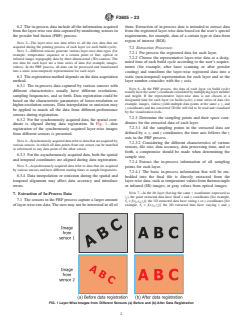
dinate is aligned during data registration. In Fig. 1, data
7.2.3.1 All the sampling points in the extracted data are
registration of the synchronously acquired layer-wise images
defined by x, y, and z coordinates; the time axis follows the z
from different sensors is presented.
axis in the PBF process.
NOTE 4—Synchronously acquired data refer to data that are acquired by
7.2.3.2 Considering the different characteristics of various
various sensors, in which all data points from one sensor can be matched
sensors, file size, data accuracy, data processing time, and so
or referenced to any data point of the other sensor.
forth, a compromise should be made when determining the
6.3.3 For the asynchronously acquired data, both the spatial
sample size.
and temporal coordinates are aligned during data registration.
7.2.4 Extract the in-process information of all sampling
NOTE 5—Asynchronously acquired data refer to data that are acquired
points for each layer.
by various sensors and have different starting times or sample frequencies.
7.2.4.1 The basic in-process information that will be em-
6.3.4 Data interpolation or omission during the spatial and
bedded into the final file is directly extracted from the
temporal alignment may affect data accuracy and introduce layer-wise data, such as temperature values from thermocouple
errors.
or infrared (IR) images, or gray values from optical images.
NOTE 7—In the ith layer (having the same z coordinates expressed as
7. Extraction of In-Process Data
z ), the point extracted data have fixed x and y coordinates [for example,
i
7.1 The sensors in the PBF process capture a larger amount
S = f(x ,y ,z )]; the 1D extracted data have varing x or y coordinates [for
i 0 0 i
of layer-wise raw data. The user may not be interested in all of example, S = f(x,y ,z )]; the 2D extracted data have varying x and y
i 0 i
FIG. 1 Layer-Wise Images from Different Sensors (a) Before and (b) After Data Registration
F3605 − 23
FIG. 2 An Example of Commonly Used File Structure
7,4 8,4
coordinates [for example, S = f(x,y,z )]. netCDF , or FITS file types. Parsers may need to be written to allow
i i
9,4
NOTE 8—It may be hard to directly embed the topography data by 3D visualization tools to view, for example, XDMF.
camera [expressed as z = f(x,y,z )] into the final converted 3D file. NOTE 10—The AMF file format defined in ISO/ASTM 52915:2020 is
i
However, it is possible to transform the 3D topography of each layer into encouraged if possible. Otherwise, XML 1.0 is recommended to be used
one 2D gray or colorful image with the gray or RGB value representing to output and store the data, which is easy to implement since there is a
the topography information (for example, roughness expressed as S = standardized open data interchange format used by any third party
i
f(x,y,z )). Then, all the 2D image data could be easily converted into single software and is also compatible with ISO/ASTM 52915:2020.
i
3D file [expressed as S = f(x,y,z)]. Using this file, the visualization tools NOTE 11—It is recommended to review and follow the FAIR data
can quickly rebuild the 3D topography for each layer. principles (Findability, Accessibility, Interoperability, and Reuse of digital
assets) when storing or sharing data.
7.2.4.2 Special complex processing of the layer-wise regis-
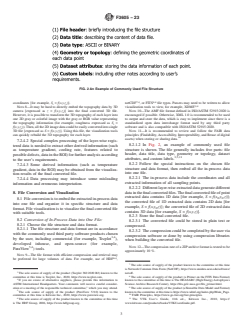
8.2.1.2 In Fig. 2, an example of commonly used file
tered data is needed to extract other derived information (such
structure is shown. The file generally includes five parts: file
as temperature gradient, cooling rate, features related to
header, data title, data type, geometry or topology, dataset
possible defects, data in the ROI) for further analysis according
3,5,11
attributes, and custom labels.
to the user’s requirements.
8.2.2 Follow the special instructions on the chosen file
7.2.4.3 Some derived information (such as temperature
structure and data format, then embed all the
...