

ASTM C1594-23
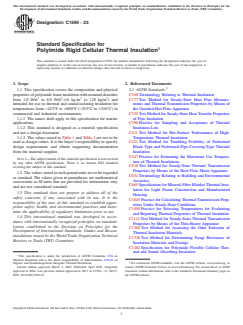
(Specification)Standard Specification for Polyimide Rigid Cellular Thermal Insulation
General Information
- Abstract
ABSTRACT
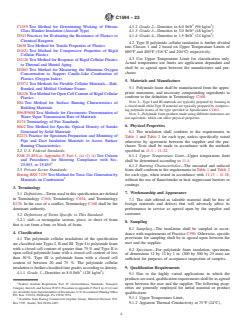
This specification establishes the composition and physical properties of rigid polyimide cellular foams intended for use as thermal and sound-isolating insulation in commercial and industrial environments. The polyimide insulations covered are classified into three types (Types I, II, and III) according to closed cell content, and into four grades (Grades 1, 2, 3, and 4) according to density. Type II insulation is further divided into two classes (Classes 1 and 2) according to upper temperature limits. Materials shall be manufactured from the appropriate monomers and necessary ingredients. Specimens shall be sampled, tested, and conform accordingly to the following physical property requirements: apparent thermal conductivity; water and gas permeability; density; percent closed cell; upper temperature limit; high temperature stability; compressive strength; compressive force deflection; water vapor transmission; steam aging characteristics (tensile strength, dimensional and weight changes), corrosiveness; chemical resistance; vertical burn characteristics (flame application and time, burn length, and dripping); specific optical smoke density for both flaming and non-flaming exposures; toxic smoke generation; surface burning characteristics (flame spread and smoke developed indices); combustion by-products (carbon monoxide, hydrogen fluoride, hydrogen chloride, nitrogen oxides, sulfur dioxide, and hydrogen cyanide); oxygen index, and 14 scale room burn.
SCOPE
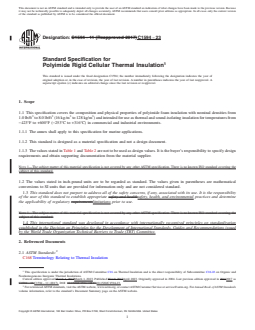
1.1 This specification covers the composition and physical properties of polyimide foam insulation with nominal densities from 1.0 lb/ft3 to 8.0 lb/ft3 (16 kg/m3 to 128 kg/m3) and intended for use as thermal and sound-isolating insulation for temperatures from −423°F to +600°F (−253°C to +316°C) in commercial and industrial environments.
1.1.1 The annex shall apply to this specification for marine applications.
1.1.2 This standard is designed as a material specification and not a design document.
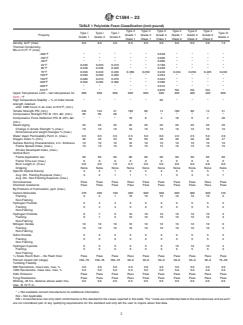
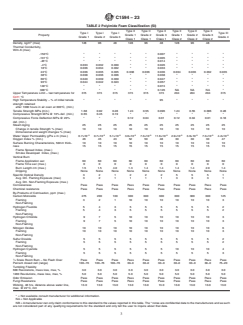
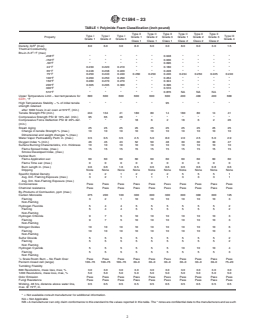
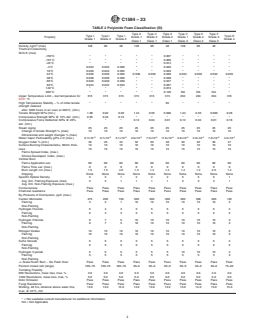
1.1.3 The values stated in Table 1 and Table 2 are not to be used as design values. It is the buyer’s responsibility to specify design requirements and obtain supporting documentation from the material supplier.
* = Not available consult manufacturer for additional information.
NA = Not Applicable
NB = A manufacturer can only claim conformance to this standard to the values reported in this table. The * notes are confidential data to the manufacturers and as such are not considered part of any qualifying requirements for the standard and only tell the user to inquire about that data.
* = Not available consult manufacturer for additional information.
NA = Not Applicable
NB = A manufacturer can only claim conformance to this standard to the values reported in this table. The * notes are confidential data to the manufacturers and as such are not considered part of any qualifying requirements for the standard and only tell the user to inquire about that data.
Note 1: The subject matter of this material specification is not covered by any other ASTM specification. There is no known ISO standard covering the subject of this standard.
1.2 The values stated in inch-pound units are to be regarded as standard. The values given in parentheses are mathematical conversions to SI units that are provided for information only and are not considered standard.
1.3 This standard does not purport to address all of the safety concerns, if any, associated with its use. It is the responsibility of the user of this standard to establish appropriate safety, health, and environmental practices and determine the applicability of regulatory limitations prior to use.
1.4 This international standard was developed in accordance with internationally recognized principles on standardization established in the Decision on Principles for the Development of International Standards, Guides and Recommendations issued by the World Trade Organization Technical B...
- Status
- Published
- Publication Date
- 28-Feb-2023
- Technical Committee
- C16 - Thermal Insulation
- Drafting Committee
- C16.22 - Organic and Nonhomogeneous Inorganic Thermal Insulations
Buy Documents
ASTM C1594-23 - Standard Specification for Polyimide Rigid Cellular Thermal Insulation
REDLINE ASTM C1594-23 - Standard Specification for Polyimide Rigid Cellular Thermal Insulation
Overview
ASTM C1594-23: Standard Specification for Polyimide Rigid Cellular Thermal Insulation defines the composition and essential physical properties of rigid polyimide cellular foam used as thermal and sound-isolating insulation in both commercial and industrial environments. This standard specifies classification by type (closed cell content), grade (density), and class (upper temperature limit), ensuring reliable product selection for a wide range of demanding applications.
Polyimide foam insulation, under this standard, is engineered for use in temperatures from −423°F to +600°F (−253°C to +316°C), offering robust performance spanning stringent thermal and acoustic insulation needs. The specification includes requirements for physical properties such as thermal conductivity, compressive strength, chemical resistance, and fire safety characteristics, making it a comprehensive guide for material selection and quality assurance.
Key Topics
Product Classification
Polyimide foams are categorized by:- Type: Corresponds to closed cell content (Type I - high, Type II - low, Type III - intermediate).
- Grade: Differentiated by nominal density (1.0 to 8.0 lb/ft³ / 16 to 128 kg/m³).
- Class: Relevant to Type II, based on upper temperature performance.
Physical Property Requirements
Essential properties tested include:- Thermal conductivity
- Upper temperature limit and stability
- Compressive and tensile strength
- Water vapor transmission and gas permeability
- Chemical and fungal resistance
- Closed cell percentage
- Fire and smoke behavior (vertical burn, smoke density, combustion by-products)
- Odor and friability
Test Methods and Sampling
- Testing follows referenced ASTM methods for thermal, mechanical, aging, and fire response.
- Sampling and acceptance are conducted in accordance with established ASTM practices.
Certifications and Markings
- Certification is provided upon request, ensuring compliance with specification requirements for each product lot.
- Packaging and labeling must clearly indicate manufacturer details and product information as agreed upon between supplier and purchaser.
Applications
Polyimide rigid cellular insulation according to ASTM C1594-23 is widely used for:
Thermal Insulation
- Industrial storage tanks
- Process piping
- High- and low-temperature plant equipment
- Marine environments and ship insulation (supplementary marine requirements included)
Acoustic Insulation
- HVAC system ducts and enclosures
- Commercial soundproofing panels
Fire and Safety Applications
- Areas requiring fire resistance, low smoke density, and minimal toxic gas generation
- Applications demanding stringent chemical and fungal resistance
Special Environments
- Facilities operating at extreme temperatures, such as cryogenic storage, or requiring resistance to harsh chemicals, such as chemical plants or offshore operations
Related Standards
This specification references numerous related standards covering terminology, test methods, and practices for insulation materials and fire safety:
- ASTM C168: Terminology Relating to Thermal Insulation
- ASTM C335, C518, C177: Methods for measuring thermal transmission and conductivity
- ASTM D1621, D638: Mechanical properties testing for plastics
- ASTM E84, E662: Fire behavior and smoke density testing
- ASTM C1304, C1338: Odor emission and fungal resistance assessments
- ASTM C1482: Specification for Polyimide Flexible Cellular Thermal and Sound Absorbing Insulation
For a full list of referenced standards, consult ASTM C1594-23 and associated documentation.
Practical Benefits
By adhering to ASTM C1594-23, stakeholders ensure:
- Consistent Material Quality: Clear requirements for physical, chemical, and fire-related performance.
- Regulatory Compliance: Meets marine, commercial, and industrial insulation standards, addressing fire safety and environmental resistance.
- Versatile Application: Reliable insulation performance across a wide temperature and environmental range.
ASTM C1594-23 provides critical guidance for manufacturers, specifiers, and installers seeking proven, high-performance polyimide rigid cellular insulation for demanding commercial and industrial projects.
Relations
- Effective Date
- 15-Apr-2024
- Effective Date
- 01-Mar-2024
- Effective Date
- 01-Mar-2024
- Effective Date
- 01-Mar-2024
- Effective Date
- 01-Mar-2024
- Effective Date
- 01-Jan-2024
- Effective Date
- 01-Dec-2023
- Effective Date
- 15-Nov-2023
- Effective Date
- 01-Oct-2023
- Effective Date
- 29-Sep-2023
- Effective Date
- 01-Sep-2023
- Effective Date
- 01-Mar-2020
- Effective Date
- 01-Oct-2019
- Effective Date
- 01-Sep-2019
- Effective Date
- 01-Jul-2019
Buy Documents
ASTM C1594-23 - Standard Specification for Polyimide Rigid Cellular Thermal Insulation
REDLINE ASTM C1594-23 - Standard Specification for Polyimide Rigid Cellular Thermal Insulation
Get Certified
Connect with accredited certification bodies for this standard

DIN CERTCO
DIN Group product certification.
DIBt (Deutsches Institut für Bautechnik)
German Institute for Building Technology.

Aboma Certification B.V.
Specialized in construction, metal, and transport sectors.
Sponsored listings
Frequently Asked Questions
ASTM C1594-23 is a technical specification published by ASTM International. Its full title is "Standard Specification for Polyimide Rigid Cellular Thermal Insulation". This standard covers: ABSTRACT This specification establishes the composition and physical properties of rigid polyimide cellular foams intended for use as thermal and sound-isolating insulation in commercial and industrial environments. The polyimide insulations covered are classified into three types (Types I, II, and III) according to closed cell content, and into four grades (Grades 1, 2, 3, and 4) according to density. Type II insulation is further divided into two classes (Classes 1 and 2) according to upper temperature limits. Materials shall be manufactured from the appropriate monomers and necessary ingredients. Specimens shall be sampled, tested, and conform accordingly to the following physical property requirements: apparent thermal conductivity; water and gas permeability; density; percent closed cell; upper temperature limit; high temperature stability; compressive strength; compressive force deflection; water vapor transmission; steam aging characteristics (tensile strength, dimensional and weight changes), corrosiveness; chemical resistance; vertical burn characteristics (flame application and time, burn length, and dripping); specific optical smoke density for both flaming and non-flaming exposures; toxic smoke generation; surface burning characteristics (flame spread and smoke developed indices); combustion by-products (carbon monoxide, hydrogen fluoride, hydrogen chloride, nitrogen oxides, sulfur dioxide, and hydrogen cyanide); oxygen index, and 14 scale room burn. SCOPE 1.1 This specification covers the composition and physical properties of polyimide foam insulation with nominal densities from 1.0 lb/ft3 to 8.0 lb/ft3 (16 kg/m3 to 128 kg/m3) and intended for use as thermal and sound-isolating insulation for temperatures from −423°F to +600°F (−253°C to +316°C) in commercial and industrial environments. 1.1.1 The annex shall apply to this specification for marine applications. 1.1.2 This standard is designed as a material specification and not a design document. 1.1.3 The values stated in Table 1 and Table 2 are not to be used as design values. It is the buyer’s responsibility to specify design requirements and obtain supporting documentation from the material supplier. * = Not available consult manufacturer for additional information. NA = Not Applicable NB = A manufacturer can only claim conformance to this standard to the values reported in this table. The * notes are confidential data to the manufacturers and as such are not considered part of any qualifying requirements for the standard and only tell the user to inquire about that data. * = Not available consult manufacturer for additional information. NA = Not Applicable NB = A manufacturer can only claim conformance to this standard to the values reported in this table. The * notes are confidential data to the manufacturers and as such are not considered part of any qualifying requirements for the standard and only tell the user to inquire about that data. Note 1: The subject matter of this material specification is not covered by any other ASTM specification. There is no known ISO standard covering the subject of this standard. 1.2 The values stated in inch-pound units are to be regarded as standard. The values given in parentheses are mathematical conversions to SI units that are provided for information only and are not considered standard. 1.3 This standard does not purport to address all of the safety concerns, if any, associated with its use. It is the responsibility of the user of this standard to establish appropriate safety, health, and environmental practices and determine the applicability of regulatory limitations prior to use. 1.4 This international standard was developed in accordance with internationally recognized principles on standardization established in the Decision on Principles for the Development of International Standards, Guides and Recommendations issued by the World Trade Organization Technical B...
ABSTRACT This specification establishes the composition and physical properties of rigid polyimide cellular foams intended for use as thermal and sound-isolating insulation in commercial and industrial environments. The polyimide insulations covered are classified into three types (Types I, II, and III) according to closed cell content, and into four grades (Grades 1, 2, 3, and 4) according to density. Type II insulation is further divided into two classes (Classes 1 and 2) according to upper temperature limits. Materials shall be manufactured from the appropriate monomers and necessary ingredients. Specimens shall be sampled, tested, and conform accordingly to the following physical property requirements: apparent thermal conductivity; water and gas permeability; density; percent closed cell; upper temperature limit; high temperature stability; compressive strength; compressive force deflection; water vapor transmission; steam aging characteristics (tensile strength, dimensional and weight changes), corrosiveness; chemical resistance; vertical burn characteristics (flame application and time, burn length, and dripping); specific optical smoke density for both flaming and non-flaming exposures; toxic smoke generation; surface burning characteristics (flame spread and smoke developed indices); combustion by-products (carbon monoxide, hydrogen fluoride, hydrogen chloride, nitrogen oxides, sulfur dioxide, and hydrogen cyanide); oxygen index, and 14 scale room burn. SCOPE 1.1 This specification covers the composition and physical properties of polyimide foam insulation with nominal densities from 1.0 lb/ft3 to 8.0 lb/ft3 (16 kg/m3 to 128 kg/m3) and intended for use as thermal and sound-isolating insulation for temperatures from −423°F to +600°F (−253°C to +316°C) in commercial and industrial environments. 1.1.1 The annex shall apply to this specification for marine applications. 1.1.2 This standard is designed as a material specification and not a design document. 1.1.3 The values stated in Table 1 and Table 2 are not to be used as design values. It is the buyer’s responsibility to specify design requirements and obtain supporting documentation from the material supplier. * = Not available consult manufacturer for additional information. NA = Not Applicable NB = A manufacturer can only claim conformance to this standard to the values reported in this table. The * notes are confidential data to the manufacturers and as such are not considered part of any qualifying requirements for the standard and only tell the user to inquire about that data. * = Not available consult manufacturer for additional information. NA = Not Applicable NB = A manufacturer can only claim conformance to this standard to the values reported in this table. The * notes are confidential data to the manufacturers and as such are not considered part of any qualifying requirements for the standard and only tell the user to inquire about that data. Note 1: The subject matter of this material specification is not covered by any other ASTM specification. There is no known ISO standard covering the subject of this standard. 1.2 The values stated in inch-pound units are to be regarded as standard. The values given in parentheses are mathematical conversions to SI units that are provided for information only and are not considered standard. 1.3 This standard does not purport to address all of the safety concerns, if any, associated with its use. It is the responsibility of the user of this standard to establish appropriate safety, health, and environmental practices and determine the applicability of regulatory limitations prior to use. 1.4 This international standard was developed in accordance with internationally recognized principles on standardization established in the Decision on Principles for the Development of International Standards, Guides and Recommendations issued by the World Trade Organization Technical B...
ASTM C1594-23 is classified under the following ICS (International Classification for Standards) categories: 83.100 - Cellular materials; 91.120.10 - Thermal insulation of buildings. The ICS classification helps identify the subject area and facilitates finding related standards.
ASTM C1594-23 has the following relationships with other standards: It is inter standard links to ASTM C168-24, ASTM C390-08(2024), ASTM C1482-24e1, ASTM E96/E96M-24, ASTM C1482-24, ASTM E176-24, ASTM E84-23d, ASTM E96/E96M-23, ASTM D2863-23, ASTM D2863-95, ASTM E84-23c, ASTM C421-08(2020), ASTM D2863-19, ASTM C390-08(2019), ASTM E84-19b. Understanding these relationships helps ensure you are using the most current and applicable version of the standard.
ASTM C1594-23 is available in PDF format for immediate download after purchase. The document can be added to your cart and obtained through the secure checkout process. Digital delivery ensures instant access to the complete standard document.
Standards Content (Sample)
This international standard was developed in accordance with internationally recognized principles on standardization established in the Decision on Principles for the
Development of International Standards, Guides and Recommendations issued by the World Trade Organization Technical Barriers to Trade (TBT) Committee.
Designation: C1594 − 23
Standard Specification for
Polyimide Rigid Cellular Thermal Insulation
This standard is issued under the fixed designation C1594; the number immediately following the designation indicates the year of
original adoption or, in the case of revision, the year of last revision. A number in parentheses indicates the year of last reapproval. A
superscript epsilon (´) indicates an editorial change since the last revision or reapproval.
1. Scope 2. Referenced Documents
1.1 This specification covers the composition and physical 2.1 ASTM Standards:
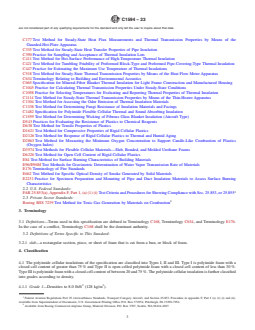
properties of polyimide foam insulation with nominal densities C168 Terminology Relating to Thermal Insulation
3 3 3 3
from 1.0 lb/ft to 8.0 lb/ft (16 kg ⁄m to 128 kg/m ) and C177 Test Method for Steady-State Heat Flux Measure-
intended for use as thermal and sound-isolating insulation for ments and Thermal Transmission Properties by Means of
temperatures from −423°F to +600°F (−253°C to +316°C) in the Guarded-Hot-Plate Apparatus
commercial and industrial environments. C335 Test Method for Steady-State Heat Transfer Properties
1.1.1 The annex shall apply to this specification for marine of Pipe Insulation
applications. C390 Practice for Sampling and Acceptance of Thermal
1.1.2 This standard is designed as a material specification Insulation Lots
and not a design document. C411 Test Method for Hot-Surface Performance of High-
1.1.3 The values stated in Table 1 and Table 2 are not to be Temperature Thermal Insulation
used as design values. It is the buyer’s responsibility to specify C421 Test Method for Tumbling Friability of Preformed
design requirements and obtain supporting documentation Block-Type and Preformed Pipe-Covering-Type Thermal
from the material supplier. Insulation
C447 Practice for Estimating the Maximum Use Tempera-
NOTE 1—The subject matter of this material specification is not covered
ture of Thermal Insulations
by any other ASTM specification. There is no known ISO standard
C518 Test Method for Steady-State Thermal Transmission
covering the subject of this standard.
Properties by Means of the Heat Flow Meter Apparatus
1.2 The values stated in inch-pound units are to be regarded
C634 Terminology Relating to Building and Environmental
as standard. The values given in parentheses are mathematical
Acoustics
conversions to SI units that are provided for information only
C665 Specification for Mineral-Fiber Blanket Thermal Insu-
and are not considered standard.
lation for Light Frame Construction and Manufactured
1.3 This standard does not purport to address all of the
Housing
safety concerns, if any, associated with its use. It is the
C1045 Practice for Calculating Thermal Transmission Prop-
responsibility of the user of this standard to establish appro-
erties Under Steady-State Conditions
priate safety, health, and environmental practices and deter-
C1058 Practice for Selecting Temperatures for Evaluating
mine the applicability of regulatory limitations prior to use.
and Reporting Thermal Properties of Thermal Insulation
1.4 This international standard was developed in accor-
C1114 Test Method for Steady-State Thermal Transmission
dance with internationally recognized principles on standard-
Properties by Means of the Thin-Heater Apparatus
ization established in the Decision on Principles for the
C1304 Test Method for Assessing the Odor Emission of
Development of International Standards, Guides and Recom-
Thermal Insulation Materials
mendations issued by the World Trade Organization Technical
C1338 Test Method for Determining Fungi Resistance of
Barriers to Trade (TBT) Committee.
Insulation Materials and Facings
C1482 Specification for Polyimide Flexible Cellular Ther-
mal and Sound Absorbing Insulation
This specification is under the jurisdiction of ASTM Committee C16 on
Thermal Insulation and is the direct responsibility of Subcommittee C16.22 on
Organic and Nonhomogeneous Inorganic Thermal Insulations. For referenced ASTM standards, visit the ASTM website, www.astm.org, or
Current edition approved March 1, 2023. Published April 2023. Originally contact ASTM Customer Service at service@astm.org. For Annual Book of ASTM
approved in 2004. Last previous edition approved in 2017 as C1594 – 11 (2017). Standards volume information, refer to the standard’s Document Summary page on
DOI: 10.1520/C1594-23. the ASTM website.
Copyright © ASTM International, 100 Barr Harbor Drive, PO Box C700, West Conshohocken, PA 19428-2959. United States
C1594 − 23
TABLE 1 Polyimide Foam Classification (inch pound)
Type II Type II Type II Type II Type II Type II
Type I Type I Type I Type III
Property Grade 1 Grade 2 Grade 3 Grade 1 Grade 2 Grade 3
Grade 1 Grade 2 Grade 3 Grade 4
Class 1 Class 1 Class 1 Class 2 Class 2 Class 2
Density, lb/ft (max) 8.0 6.0 3.0 8.0 6.0 3.0 8.0 6.0 3.0 1.5
Thermal Conductivity,
Btu-in./h-ft -°F (max)
-238°F * * * * * 0.048 * * * *
-150°F * * * * * 0.036 * * * *
-50°F * * * * * 0.096 * * * *
24°F 0.230 0.220 0.210 * * 0.180 * * * *
65°F 0.248 0.238 0.220 * * 0.228 * * * *
75°F 0.250 0.240 0.240 0.260 0.250 0.246 0.234 0.250 0.225 0.240
100°F 0.260 0.250 0.250 * * 0.264 * * * *
150°F 0.280 0.270 0.270 * * 0.324 * * * *
200°F 0.305 0.295 0.300 * * 0.396 * * * *
300°F * * * * * 0.516 * * * *
572°F * * * * * 0.876 NA NA NA *
Upper Temperature Limit – test temperature for 600 600 600 600 600 600 400 400 400 600
C411, °F
High Temperature Stability – % of initial tensile * * * * * 95 * * * *
strength retained
after 1000 hours in air oven at 572°F, (min.)
Tensile Strength PSI (min.) 244 134 41 180 80 14 180 80 14 41
Compressive Strength PSI @ 10% def. (min.) 95 65 28 * * * * * * *
Compressive Force Deflection PSI @ 20% def. * * * 18 6 2 18 6 2 26
(min.)
Steam Aging 25 25 25 25 25 25 25 25 25 25
Change in tensile Strength % (max.) 10 10 10 10 10 10 10 10 10 10
Dimensional and weight changes % (max.)
Water Vapor Permeability Perm in. (max.) 0.5 0.5 3.5 2.5 5.0 8.0 2.0 2.5 5.0 2.9
Oxygen Index % (min.) 46 45 43 52 50 48 30 30 30 47
Surface Burning Characteristics, 2 in. thickness 10 10 10 10 10 10 10 10 10 10
Flame Spread Index, (max.) 15 15 15 15 15 15 15 15 15 15
Smoke Developed Index, (max.)
Vertical Burn
Flame Application sec 60 60 60 60 60 60 60 60 60 60
Flame Time sec (max.) 0 0 0 0 0 0 0 0 0 0
Burn Length in. (max.) 0.6 0.6 1.6 0.5 0.6 0.6 0.6 0.6 0.8 0.6
Dripping None None None None None None None None None None
Specific Optical Density 3 2 1 2 2 2 5 5 5 1
Avg. Dm. Flaming Exposure (max.) 3 2 1 1 1 1 3 3 3 1
Avg. Dm. Non-Flaming Exposure (max.)
Corrosiveness Pass Pass Pass Pass Pass Pass Pass Pass Pass Pass
Chemical resistance Pass Pass Pass Pass Pass Pass Pass Pass Pass Pass
By-Products of Combustion, ppm (max.)
Carbon Monoxide 275 200 100 300 300 300 300 300 300 125
Flaming 3 2 1 10 10 10 10 10 10 3
Non-Flaming
Hydrogen Fluoride 5 4 4 5 5 5 5 5 5 2
Flaming 5 4 4 5 5 5 5 5 5 2
Non-Flaming
Hydrogen Chloride 9 7 5 10 10 10 10 10 10 3
Flaming 9 7 5 10 10 10 10 10 10 3
Non-Flaming
Nitrogen Oxides 10 10 10 10 10 10 10 10 10 6
Flaming 10 10 10 10 10 10 10 10 10 3
Non-Flaming
Sulfur Dioxide 5 5 5 5 5 5 5 5 5 2
Flaming 5 5 5 5 5 5 5 5 5 2
Non Flaming
Hydrogen Cyanide 5 5 5 5 5 5 10 10 10 4
Flaming 5 5 5 5 5 5 5 5 5 3
Non Flaming
⁄4 Scale Room Burn – No Flash Over Pass Pass Pass Pass Pass Pass Pass Pass Pass Pass
Percent closed cell (range) 100–76 100–76 100–76 30–0 30–0 30–0 30–0 30–0 30–0 75–20
Tumbling Friability
600 Revolutions, mass loss, max, % 3.0 3.0 3.0 3.0 3.0 3.0 3.0 3.0 3.0 3.0
1200 Revolutions, mass loss, max, % 5.0 5.0 5.0 5.0 5.0 5.0 5.0 5.0 5.0 5.0
Odor Emission Pass Pass Pass Pass Pass Pass Pass Pass Pass Pass
Fungi Resistance Pass Pass Pass Pass Pass Pass Pass Pass Pass Pass
Wicking, 48 hrs, distance above water line, 0.5 0.5 0.5 0.5 0.5 0.5 0.5 0.5 0.5 0.5
max. @ 72°F, in.
* = Not available consult manufacturer for additional information.
NA = Not Applicable
NB = A manufacturer can only claim conformance to this standard to the values reported in this table. The * notes are confidential data to the manufacturers and as such
are not considered part of any qualifying requirements for the standard and only tell the user to inquire about that data.
C1594 − 23
TABLE 2 Polyimide Foam Classification (SI)
Type II Type II Type II Type II Type II Type II
Type I Type I Type I Type III
Property Grade 1 Grade 2 Grade 3 Grade 1 Grade 2 Grade 3
Grade 1 Grade 2 Grade 3 Grade 4
Class 1 Class 1 Class 1 Class 2 Class 2 Class 2
Density, kg/m (max) 128 96 48 128 96 48 128 96 48
Thermal Conductivity,
W/m-K (max)
-150°C * * * * * 0.007 * * * *
-101°C * * * * * 0.005 * * * *
-46°C * * * * * 0.014 * * * *
-4°C 0.033 0.032 0.030 * * 0.026 * * * *
18°C 0.036 0.034 0.032 * * 0.033 * * * *
24°C 0.036 0.035 0.035 0.038 0.036 0.036 0.034 0.036 0.032 0.035
38°C 0.038 0.036 0.036 * * 0.038 * * * *
66°C 0.040 0.039 0.039 * * 0.047 * * * *
93°C 0.044 0.042 0.043 * * 0.057 * * * *
149°C * * * * * 0.074 * * * *
300°C * * * * * 0.126 NA NA NA *
Upper Temperature Limit – test temperature for 315 315 315 315 315 315 204 204 204 315
C411 °C
High Temperature Stability – % of initial tensile * * * * * 95 * * * *
strength retained
after 1000 hours in air oven at 300°C, (min.)
Tensile Strength MPa (min.) 1.68 0.92 0.28 1.24 0.55 0.096 1.24 0.55 0.096 0.28
Compressive Strength MPa @ 10% def. (min.) 0.65 0.45 0.19 * * * * * * *
Compressive Force Deflection MPa @ 20% * * * 0.12 0.04 0.01 0.12 0.04 0.01 0.18
def. (min.)
Steam Aging 25 25 25 25 25 25 25 25 25 25
Change in tensile Strength % (max) 10 10 10 10 10 10 10 10 10 10
Dimensional and weight changes % (max)
-9 -9 -9 -9 -9 -9 -9 -9 -9 -9
Water Vapor Permeability g/Pa s m (max.) 0.7×10 0.7×10 5.1×10 3.6×10 7.3×10 11.6×10 2.9×10 3.6×10 7.3×10 4.2×10
Oxygen Index % (min.) 46 45 43 52 50 48 30 30 30 47
Surface Burning Characteristics, 50mm thick- 10 10 10 10 10 10 10 10 10 10
ness 15 15 15 15 15 15 15 15 15 15
Flame Spread Index, (max.)
Smoke Developed Index, (max.)
Vertical Burn
Flame Application sec 60 60 60 60 60 60 60 60 60 60
Flame Time sec (max.) 0 0 0 0 0 0 0 0 0 0
Burn Length cm (max.) 1.5 1.5 4.0 1.3 1.4 1.4 1.4 1.4 2.0 1.4
Dripping None None None None None None None None None None
Specific Optical Density 3 2 1 2 2 2 5 5 5 1
Avg. Dm. Flaming Exposure (max) 3 2 1 1 1 1 3 3 3 1
Avg. Dm. Non-Flaming Exposure (max.)
Corrosiveness Pass Pass Pass Pass Pass Pass Pass Pass Pass Pass
Chemical resistance Pass Pass Pass Pass Pass Pass Pass Pass Pass Pass
By-Products of Combustion, ppm (max.)
Carbon Monoxide 275 200 100 300 300 300 300 300 300 125
Flaming 3 2 1 10 10 10 10 10 10 3
Non-Flaming
Hydrogen Fluoride 5 4 3 5 5 5 5 5 5 2
Flaming 5 4 3 5 5 5 5 5 5 2
Non-Flaming
Hydrogen Chloride 9 7 5 10 10 10 10 10 10 3
Flaming 9 7 5 10 10 10 10 10 10 3
Non-Flaming
Nitrogen Oxides 10 10 10 10 10 10 10 10 10 6
Flaming 10 10 10 10 10 10 10 10 10 3
Non-Flaming
Sulfur Dioxide 5 5 5 5 5 5 5 5 5 2
Flaming 5 5 5 5 5 5 5 5 5 2
Non-Flaming
Hydrogen Cyanide 5 5 5 5 5 5 10 10 10 4
Flaming 5 5 5 5 5 5 5 5 5 3
Non-Flaming
⁄4 Scale Room Burn – No Flash Over Pass Pass Pass Pass Pass Pass Pass Pass Pass Pass
Percent closed cell (range) 100–76 100–76 100–76 30–0 30–0 30–0 30–0 30–0 30–0 75–20
Tumbling Friability
600 Revolutions, mass loss, max, % 3.0 3.0 3.0 3.0 3.0 3.0 3.0 3.0 3.0 3.0
1200 Revolutions, mass loss, max, % 5.0 5.0 5.0 5.0 5.0 5.0 5.0 5.0 5.0 5.0
Odor Emission Pass Pass Pass Pass Pass Pass Pass Pass Pass Pass
Fungi Resistance Pass Pass Pass Pass Pass Pass Pass Pass Pass Pass
Wicking, 48 hrs, distance above water line, 13.0 13.0 13.0 13.0 13.0 13.0 13.0 13.0 13.0 13.0
max. @ 22°C, mm
* = Not available consult manufacturer for additional information.
NA = Not Applicable
NB = A manufacturer can only claim conformance to this standard to the values reported in this table. The * notes are confidential data to the manufacturers and as such
are not considered part of any qualifying requirements for the standard and only tell the user to inquire about that data.
C1594 − 23
3 3
C1559 Test Method for Determining Wicking of Fibrous 4.1.2 Grade 2—Densities to 6.0 lb/ft (96 kg/m ).
3 3
Glass Blanket Insulation (Aircraft Type) 4.1.3 Grade 3—Densities to 3.0 lb/ft (48 kg/m )
3 3
D543 Practices for Evaluating the Resistance of Plastics to 4.1.4 Grade 4—Densities to 1.5 lb/ft (24 kg/m )
Chemical Reagents
4.2 Type II polyimide cellular insulation is further divided
D638 Test Method for Tensile Properties of Plastics
into Classes 1 and 2 based on Upper Temperature Limits of
D1621 Test Method for Compressive Properties of Rigid
600°F and 400°F (316°C and 204°C) respectively.
Cellular Plastics
4.3 Use Upper Temperature Limit for classification only.
D2126 Test Method for Response of Rigid Cellular Plastics
Actual temperature use limits are application dependant and
to Thermal and Humid Aging
shall be as agreed upon between the manufacturer and pur-
D2863 Test Method for Measuring the Minimum Oxygen
chaser.
Concentration to Support Candle-Like Combustion of
Plastics (Oxygen Index)
5. Materials and Manufacture
D3574 Test Methods for Flexible Cellular Materials—Slab,
5.1 Polyimide foam shall be manufactured from the appro-
Bonded, and Molded Urethane Foams
priate monomers, and necessary compounding ingredients to
D6226 Test Method for Open Cell Content of Rigid Cellular
conform to the definition in Terminology C168.
Plastics
NOTE 2—Type I and III materials are typically prepared by foaming in
E84 Test Method for Surface Burning Characteristics of
a closed mold while Type II material are typically prepared by compress-
Building Materials
ing polymide foams of the type specified in Specification C1482.
E96/E96M Test Methods for Gravimetric Determination of
NOTE 3—Polyimide foam products made using different monomers are
Water Vapor Transmission Rate of Materials
not equivalent, which can affect physical properties.
E176 Terminology of Fire Standards
6. Physical Properties
E662 Test Method for Specific Optical Density of Smoke
Generated by Solid Materials
6.1 The insulation shall conform to the requirements in
E2231 Practice for Specimen Preparation and Mounting of
Table 1 and Table 2 for each type, unless specifically stated
Pipe and Duct Insulation Materials to Assess Surface
otherwise by agreement between the supplier and the pur-
Burning Characteristics
chaser. Tests shall be made in accordance with the methods
2.2 U.S. Federal Standards:
specified in 11.1 – 11.22.
FAR 25.853(a), Appendix F, Part 1, (a) (1) (i) Test Criteria
6.1.1 Upper Temperature Limit—Upper temperature limit
and Procedures for Showing Compliance with Sec.
shall be determined according to 11.4.
25.853, or 25.855
6.1.2 Burning Characteristics—The uncoated and unfaced
2.3 Private Sector Standards:
foam shall conform to the requirements in Table 1 and Table 2
Boeing BSS 7239 Test Method for Toxic Gas Generation by
for each type, when tested in accordance with 11.13 – 11.18,
Materials on Combustion
without the use of flame/smoke or heat suppressant barriers or
coatings.
3. Terminology
7. Workmanship and Appearance
3.1 Definitions—Terms used in this specification are defined
in Terminology C168, Terminology C634, a
...
This document is not an ASTM standard and is intended only to provide the user of an ASTM standard an indication of what changes have been made to the previous version. Because
it may not be technically possible to adequately depict all changes accurately, ASTM recommends that users consult prior editions as appropriate. In all cases only the current version
of the standard as published by ASTM is to be considered the official document.
Designation: C1594 − 11 (Reapproved 2017) C1594 − 23
Standard Specification for
Polyimide Rigid Cellular Thermal Insulation
This standard is issued under the fixed designation C1594; the number immediately following the designation indicates the year of
original adoption or, in the case of revision, the year of last revision. A number in parentheses indicates the year of last reapproval. A
superscript epsilon (´) indicates an editorial change since the last revision or reapproval.
1. Scope
1.1 This specification covers the composition and physical properties of polyimide foam insulation with nominal densities from
3 3 3 3
1.0 lb/ft to 8.0 lb/ft (16 kg ⁄m to 128 kg/m ) and intended for use as thermal and sound-isolating insulation for temperatures from
−423°F to +600°F (−253°C to +316°C) in commercial and industrial environments.
1.1.1 The annex shall apply to this specification for marine applications.
1.1.2 This standard is designed as a material specification and not a design document.
1.1.3 The values stated in Table 1 and Table 2 are not to be used as design values. It is the buyer’s responsibility to specify design
requirements and obtain supporting documentation from the material supplier.
NOTE 1—The subject matter of this material specification is not covered by any other ASTM specification. There is no known ISO standard covering the
subject of this standard.
1.2 The values stated in inch-pound units are to be regarded as standard. The values given in parentheses are mathematical
conversions to SI units that are provided for information only and are not considered standard.
1.3 This standard does not purport to address all of the safety concerns, if any, associated with its use. It is the responsibility
of the user of this standard to establish appropriate safety and healthsafety, health, and environmental practices and determine
the applicability of regulatory requirementslimitations prior to use.
NOTE 1—The subject matter of this material specification is not covered by any other ASTM specification. There is no known ISO standard covering the
subject of this standard.
1.4 This international standard was developed in accordance with internationally recognized principles on standardization
established in the Decision on Principles for the Development of International Standards, Guides and Recommendations issued
by the World Trade Organization Technical Barriers to Trade (TBT) Committee.
2. Referenced Documents
2.1 ASTM Standards:
C168 Terminology Relating to Thermal Insulation
This specification is under the jurisdiction of ASTM Committee C16 on Thermal Insulation and is the direct responsibility of Subcommittee C16.22 on Organic and
Nonhomogeneous Inorganic Thermal Insulations.
Current edition approved March 1, 2017March 1, 2023. Published March 2017April 2023. Originally approved in 2004. Last previous edition approved in 20112017 as
C1594 – 11.C1594 – 11 (2017). DOI: 10.1520/C1594-11R17.10.1520/C1594-23.
For referenced ASTM standards, visit the ASTM website, www.astm.org, or contact ASTM Customer Service at service@astm.org. For Annual Book of ASTM Standards
volume information, refer to the standard’s Document Summary page on the ASTM website.
Copyright © ASTM International, 100 Barr Harbor Drive, PO Box C700, West Conshohocken, PA 19428-2959. United States
C1594 − 23
TABLE 1 Polyimide Foam Classification (inch pound)
Type II Type II Type II Type II Type II Type II
Type I Type I Type I Type III
Property Grade 1 Grade 2 Grade 3 Grade 1 Grade 2 Grade 3
Grade 1 Grade 2 Grade 3 Grade 4
Class 1 Class 1 Class 1 Class 2 Class 2 Class 2
Density, lb/ft (max) 8.0 6.0 3.0 8.0 6.0 3.0 8.0 6.0 3.0 1.5
Thermal Conductivity,
Btu-in./h-ft -°F (max)
-238°F * * * * * 0.048 * * * *
-150°F * * * * * 0.036 * * * *
-50°F * * * * * 0.096 * * * *
24°F 0.230 0.220 0.210 * * 0.180 * * * *
65°F 0.248 0.238 0.220 * * 0.228 * * * *
75°F 0.250 0.240 0.240 0.260 0.250 0.246 0.234 0.250 0.225 0.240
100°F 0.260 0.250 0.250 * * 0.264 * * * *
150°F 0.280 0.270 0.270 * * 0.324 * * * *
200°F 0.305 0.295 0.300 * * 0.396 * * * *
300°F * * * * * 0.516 * * * *
572°F * * * * * 0.876 NA NA NA *
Upper Temperature Limit – test temperature for 600 600 600 600 600 600 400 400 400 600
C411, °F
High Temperature Stability – % of initial tensile * * * * * 95 * * * *
strength retained
after 1000 hours in air oven at 572°F, (min.)
Tensile Strength PSI (min.) 244 134 41 180 80 14 180 80 14 41
Compressive Strength PSI @ 10% def. (min.) 95 65 28 * * * * * * *
Compressive Force Deflection PSI @ 20% def. * * * 18 6 2 18 6 2 26
(min.)
Steam Aging 25 25 25 25 25 25 25 25 25 25
Change in tensile Strength % (max.) 10 10 10 10 10 10 10 10 10 10
Dimensional and weight changes % (max.)
Water Vapor Permeability Perm in. (max.) 0.5 0.5 3.5 2.5 5.0 8.0 2.0 2.5 5.0 2.9
Oxygen Index % (min.) 46 45 43 52 50 48 30 30 30 47
Surface Burning Characteristics, 2 in. thickness 10 10 10 10 10 10 10 10 10 10
Flame Spread Index, (max.) 15 15 15 15 15 15 15 15 15 15
Smoke Developed Index, (max.)
Vertical Burn
Flame Application sec 60 60 60 60 60 60 60 60 60 60
Flame Time sec (max.) 0 0 0 0 0 0 0 0 0 0
Burn Length in. (max.) 0.6 0.6 1.6 0.5 0.6 0.6 0.6 0.6 0.8 0.6
Dripping None None None None None None None None None None
Specific Optical Density 3 2 1 2 2 2 5 5 5 1
Avg. Dm. Flaming Exposure (max.) 3 2 1 1 1 1 3 3 3 1
Avg. Dm. Non-Flaming Exposure (max.)
Corrosiveness Pass Pass Pass Pass Pass Pass Pass Pass Pass Pass
Chemical resistance Pass Pass Pass Pass Pass Pass Pass Pass Pass Pass
By-Products of Combustion, ppm (max.)
Carbon Monoxide 275 200 100 300 300 300 300 300 300 125
Flaming 3 2 1 10 10 10 10 10 10 3
Non-Flaming
Hydrogen Fluoride 5 4 4 5 5 5 5 5 5 2
Flaming 5 4 4 5 5 5 5 5 5 2
Non-Flaming
Hydrogen Chloride 9 7 5 10 10 10 10 10 10 3
Flaming 9 7 5 10 10 10 10 10 10 3
Non-Flaming
Nitrogen Oxides 10 10 10 10 10 10 10 10 10 6
Flaming 10 10 10 10 10 10 10 10 10 3
Non-Flaming
Sulfur Dioxide 5 5 5 5 5 5 5 5 5 2
Flaming 5 5 5 5 5 5 5 5 5 2
Non Flaming
Hydrogen Cyanide 5 5 5 5 5 5 10 10 10 4
Flaming 5 5 5 5 5 5 5 5 5 3
Non Flaming
⁄4 Scale Room Burn – No Flash Over Pass Pass Pass Pass Pass Pass Pass Pass Pass Pass
Percent closed cell (range) 100–76 100–76 100–76 30–0 30–0 30–0 30–0 30–0 30–0 75–20
Tumbling Friability
600 Revolutions, mass loss, max, % 3.0 3.0 3.0 3.0 3.0 3.0 3.0 3.0 3.0 3.0
1200 Revolutions, mass loss, max, % 5.0 5.0 5.0 5.0 5.0 5.0 5.0 5.0 5.0 5.0
Odor Emission Pass Pass Pass Pass Pass Pass Pass Pass Pass Pass
Fungi Resistance Pass Pass Pass Pass Pass Pass Pass Pass Pass Pass
Wicking, 48 hrs, distance above water line, 0.5 0.5 0.5 0.5 0.5 0.5 0.5 0.5 0.5 0.5
max. @ 72°F, in.
* = Not available consult manufacturer for additional information.
NA = Not Applicable
NB = A manufacturer can only claim conformance to this standard to the values reported in this table. The * notes are confidential data to the manufacturers and as such
C1594 − 23
are not considered part of any qualifying requirements for the standard and only tell the user to inquire about that data.
C177 Test Method for Steady-State Heat Flux Measurements and Thermal Transmission Properties by Means of the
Guarded-Hot-Plate Apparatus
C335 Test Method for Steady-State Heat Transfer Properties of Pipe Insulation
C390 Practice for Sampling and Acceptance of Thermal Insulation Lots
C411 Test Method for Hot-Surface Performance of High-Temperature Thermal Insulation
C421 Test Method for Tumbling Friability of Preformed Block-Type and Preformed Pipe-Covering-Type Thermal Insulation
C447 Practice for Estimating the Maximum Use Temperature of Thermal Insulations
C518 Test Method for Steady-State Thermal Transmission Properties by Means of the Heat Flow Meter Apparatus
C634 Terminology Relating to Building and Environmental Acoustics
C665 Specification for Mineral-Fiber Blanket Thermal Insulation for Light Frame Construction and Manufactured Housing
C1045 Practice for Calculating Thermal Transmission Properties Under Steady-State Conditions
C1058 Practice for Selecting Temperatures for Evaluating and Reporting Thermal Properties of Thermal Insulation
C1114 Test Method for Steady-State Thermal Transmission Properties by Means of the Thin-Heater Apparatus
C1304 Test Method for Assessing the Odor Emission of Thermal Insulation Materials
C1338 Test Method for Determining Fungi Resistance of Insulation Materials and Facings
C1482 Specification for Polyimide Flexible Cellular Thermal and Sound Absorbing Insulation
C1559 Test Method for Determining Wicking of Fibrous Glass Blanket Insulation (Aircraft Type)
D543 Practices for Evaluating the Resistance of Plastics to Chemical Reagents
D638 Test Method for Tensile Properties of Plastics
D1621 Test Method for Compressive Properties of Rigid Cellular Plastics
D2126 Test Method for Response of Rigid Cellular Plastics to Thermal and Humid Aging
D2863 Test Method for Measuring the Minimum Oxygen Concentration to Support Candle-Like Combustion of Plastics
(Oxygen Index)
D3574 Test Methods for Flexible Cellular Materials—Slab, Bonded, and Molded Urethane Foams
D6226 Test Method for Open Cell Content of Rigid Cellular Plastics
E84 Test Method for Surface Burning Characteristics of Building Materials
E96/E96M Test Methods for Gravimetric Determination of Water Vapor Transmission Rate of Materials
E176 Terminology of Fire Standards
E662 Test Method for Specific Optical Density of Smoke Generated by Solid Materials
E2231 Practice for Specimen Preparation and Mounting of Pipe and Duct Insulation Materials to Assess Surface Burning
Characteristics
2.2 U.S. Federal Standards:
FAR 25.853(a), Appendix F, Part 1, (a) (1) (i) Test Criteria and Procedures for Showing Compliance with Sec. 25.853, or 25.855
2.3 Private Sector Standards:
Boeing BSS 7239 Test Method for Toxic Gas Generation by Materials on Combustion
3. Terminology
3.1 Definitions—Terms used in this specification are defined in Terminology C168, Terminology C634, and Terminology E176.
In the case of a conflict, Terminology C168 shall be the dominant authority.
3.2 Definitions of Terms Specific to This Standard:
3.2.1 slab—a rectangular section, piece, or sheet of foam that is cut from a bun, or block of foam.
4. Classification
4.1 The polyimide cellular insulations of the specification are classified into Types I, II and III. Type I is polyimide foam with a
closed cell content of greater than 75 % and Type II is open celled polyimide foam with a closed cell content of less than 30 %.
Type III is polyimide foam with a closed cell content of between 20 and 75 %. The polyimide cellular insulation is further classified
into grades according to density.
3 3
4.1.1 Grade 1—Densities to 8.0 lb/ft (128 kg/m ).
Federal Aviation Regulations Part 25 (Airworthiness Standards, Transport Category Aircraft, and Section 25.853. Procedure in appendix F, Part I (a) (1) (i) and (ii).
Available from Superintendent of Documents, U.S. Government Printing Office P.O. Box 371954, Pittsburgh, PA 15250-7954.
Available from Boeing Commercial Airplane Group, Material Division, P.O. Box 3707, Seattle, WA 98124-2207.
C1594 − 23
TABLE 2 Polyimide Foam Classification (SI)
Type II Type II Type II Type II Type II Type II
Type I Type I Type I Type III
Property Grade 1 Grade 2 Grade 3 Grade 1 Grade 2 Grade 3
Grade 1 Grade 2 Grade 3 Grade 4
Class 1 Class 1 Class 1 Class 2 Class 2 Class 2
Density, kg/m (max) 128 96 48 128 96 48 128 96 48
Thermal Conductivity,
W/m-K (max)
-150°C * * * * * 0.007 * * * *
-101°C * * * * * 0.005 * * * *
-46°C * * * * * 0.014 * * * *
-4°C 0.033 0.032 0.030 * * 0.026 * * * *
18°C 0.036 0.034 0.032 * * 0.033 * * * *
24°C 0.036 0.035 0.035 0.038 0.036 0.036 0.034 0.036 0.032 0.035
38°C 0.038 0.036 0.036 * * 0.038 * * * *
66°C 0.040 0.039 0.039 * * 0.047 * * * *
93°C 0.044 0.042 0.043 * * 0.057 * * * *
149°C * * * * * 0.074 * * * *
300°C * * * * * 0.126 NA NA NA *
Upper Temperature Limit – test temperature for 315 315 315 315 315 315 204 204 204 315
C411 °C
High Temperature Stability – % of initial tensile * * * * * 95 * * * *
strength retained
after 1000 hours in air oven at 300°C, (min.)
Tensile Strength MPa (min.) 1.68 0.92 0.28 1.24 0.55 0.096 1.24 0.55 0.096 0.28
Compressive Strength MPa @ 10% def. (min.) 0.65 0.45 0.19 * * * * * * *
Compressive Force Deflection MPa @ 20% * * * 0.12 0.04 0.01 0.12 0.04 0.01 0.18
def. (min.)
Steam Aging 25 25 25 25 25 25 25 25 25 25
Change in tensile Strength % (max) 10 10 10 10 10 10 10 10 10 10
Dimensional and weight changes % (max)
-9 -9 -9 -9 -9 -9 -9 -9 -9 -9
Water Vapor Permeability g/Pa s m (max.) 0.7×10 0.7×10 5.1×10 3.6×10 7.3×10 11.6×10 2.9×10 3.6×10 7.3×10 4.2×10
Oxygen Index % (min.) 46 45 43 52 50 48 30 30 30 47
Surface Burning Characteristics, 50mm thick- 10 10 10 10 10 10 10 10 10 10
ness 15 15 15 15 15 15 15 15 15 15
Flame Spread Index, (max.)
Smoke Developed Index, (max.)
Vertical Burn
Flame Application sec 60 60 60 60 60 60 60 60 60 60
Flame Time sec (max.) 0 0 0 0 0 0 0 0 0 0
Burn Length cm (max.) 1.5 1.5 4.0 1.3 1.4 1.4 1.4 1.4 2.0 1.4
Dripping None None None None None None None None None None
Specific Optical Density 3 2 1 2 2 2 5 5 5 1
Avg. Dm. Flaming Exposure (max) 3 2 1 1 1 1 3 3 3 1
Avg. Dm. Non-Flaming Exposure (max.)
Corrosiveness Pass Pass Pass Pass Pass Pass Pass Pass Pass Pass
Chemical resistance Pass Pass Pass Pass Pass Pass Pass Pass Pass Pass
By-Products of Combustion, ppm (max.)
Carbon Monoxide 275 200 100 300 300 300 300 300 300 125
Flaming 3 2 1 10 10 10 10 10 10 3
Non-Flaming
Hydrogen Fluoride 5 4 3 5 5 5 5 5 5 2
Flaming 5 4 3 5 5 5 5 5 5 2
Non-Flaming
Hydrogen Chloride 9 7 5 10 10 10 10 10 10 3
Flaming 9 7 5 10 10 10 10 10 10 3
Non-Flaming
Nitrogen Oxides 10 10 10 10 10 10 10 10 10 6
Flaming 10 10 10 10 10 10 10 10 10 3
Non-Flaming
Sulfur Dioxide 5 5 5 5 5 5 5 5 5 2
Flaming 5 5 5 5 5 5 5 5 5 2
Non-Flaming
Hydrogen Cyanide 5 5 5 5 5 5 10 10 10 4
Flaming 5 5 5 5 5 5 5 5 5 3
Non-Flaming
⁄4 Scale Room Burn – No Flash Over Pass Pass Pass Pass Pass Pass Pass Pass Pass Pass
Percent closed cell (range) 100–76 100–76 100–76 30–0 30–0 30–0 30–0 30–0 30–0 75–20
Tumbling Friability
600 Revolutions, mass loss, max, % 3.0 3.0 3.0 3.0 3.0 3.0 3.0 3.0 3.0 3.0
1200 Revolutions, mass loss, max, % 5.0 5.0 5.0 5.0 5.0 5.0 5.0 5.0 5.0 5.0
Odor Emission Pass Pass Pass Pass Pass Pass Pass Pass Pass Pass
Fungi Resistance Pass Pass Pass Pass Pass Pass Pass Pass Pass Pass
Wicking, 48 hrs, distance above water line, 13.0 13.0 13.0 13.0 13.0 13.0 13.0 13.0 13.0 13.0
max. @ 22°C, mm
* = Not available consult manufacturer for additional information.
NA = Not Applicable
C1594 − 23
NB = A manufacturer can only claim conformance to this standard to the values reported in this table. The * notes are confidential data to the manufacturers and as such
are not considered part of any qualifying requirements for the standard and only tell the user to inquire about that data.
3 3
4.1.2 Grade 2—Densities to 6.0 lb/ft (96 kg/m ).
3 3
4.1.3 Grade 3—Densities to 3.0 lb/ft (48 kg/m )
3 3
4.1.4 Grade 4—Densities to 1.5 lb/ft (24 kg/m )
4.2 Type II polyimide cellular insulation is further divided into Classes 1 and 2 based on Upper Temperature Limits of 600°F and
400°F (316°C and 204°C) respectively.
4.3 Use Upper Temperature Limi
...