

ASTM F309-18
(Practice)Standard Practice for Liquid Sampling of Noncryogenic Aerospace Propellants
General Information
- Abstract
ABSTRACT
This practice covers procedures for obtaining a sample of noncryogenic aerospace propellant. Two procedures are covered as follows: procedure 1 (closed system) and procedure 2 (open-end procedure).
SCOPE
1.1 This practice covers procedures for obtaining a sample of noncryogenic aerospace propellant. Two procedures are covered as follows:
Procedure 1—Closed System (Section 6), and
Procedure 2—Open-End Procedure (Section 7).
1.2 This standard does not purport to address all of the safety concerns, if any, associated with its use. It is the responsibility of the user of this standard to establish appropriate safety, health, and environmental practices and determine the applicability of regulatory limitations prior to use. For hazard statements see Sections 4 and 5.
1.3 This international standard was developed in accordance with internationally recognized principles on standardization established in the Decision on Principles for the Development of International Standards, Guides and Recommendations issued by the World Trade Organization Technical Barriers to Trade (TBT) Committee.
- Status
- Published
- Publication Date
- 31-Oct-2018
- Technical Committee
- E21 - Space Simulation and Applications of Space Technology
- Drafting Committee
- E21.05 - Contamination




Overview
ASTM F309-18 - Standard Practice for Liquid Sampling of Noncryogenic Aerospace Propellants defines standardized procedures for obtaining representative liquid samples from noncryogenic aerospace propellant systems. Published by ASTM International, this standard ensures that propellant samples are collected safely and consistently for testing and quality control purposes. Accurate sampling is vital for maintaining the reliability, safety, and quality of aerospace operations involving liquid propellants that are not subject to cryogenic storage requirements.
ASTM F309-18 is designed in accordance with internationally recognized standardization principles, supporting uniform practices across global aerospace organizations.
Key Topics
Sampling Procedures:
The standard details two distinct methods for collecting liquid samples of noncryogenic aerospace propellants:- Closed System Procedure: Utilizes a sealed system to prevent exposure to the environment and maintain sample integrity.
- Open-End Procedure: Involves drawing the sample using an open method, suitable for certain system configurations and operational needs.
Required Equipment:
Essential apparatus includes:- Stainless steel pressure sampling cylinders (1-L capacity, fitted with specific valves)
- Full protective suits for operator safety
- Polyethylene wash bottles with demineralized water for cleaning sample valves
- Miscellaneous fittings and stainless steel buckets for sample collection
Safety and Health Considerations:
Emphasizes strict adherence to safety procedures due to the toxic and potentially corrosive nature of many liquid aerospace propellants. Users must establish appropriate safety, health, and environmental controls, using suitable personal protective equipment and ensuring compatibility of all sampling components.Sample Contamination Avoidance:
Procedures highlight the importance of cleanliness and particulate control, referencing best practices to prevent cross-contamination and ensure representative sampling.
Applications
ASTM F309-18 is widely applicable to:
Quality Assurance:
Ensures accurate and uncontaminated liquid propellant samples for laboratory analysis, aiding in the verification of fuel quality and composition.Operational Safety:
Supports risk mitigation by prescribing processes that limit operator exposure to hazardous propellants and reduce the potential for spills and system contamination.Maintenance and Inspection:
Used during routine maintenance or troubleshooting to collect samples with minimal system disturbance, enhancing efficiency and system reliability.Compliance with International Standards:
Facilitates conformity with global aerospace material handling standards and regulatory frameworks by providing transparent, accepted sampling practices.
This standard is particularly relevant for aerospace manufacturers, satellite operators, propulsion system engineers, and quality assurance laboratories working with noncryogenic propellants.
Related Standards
ASTM F311 - Practice for Processing Aerospace Liquid Samples for Particulate Contamination Analysis Using Membrane Filters:
Provides guidance on preparing aerospace liquid samples (such as those taken per ASTM F309-18) for analysis of particulate contamination, supporting comprehensive fuel quality assessment.General Aerospace Fluids Handling Standards:
Practitioners may consult other ASTM standards or applicable ISO documents addressing handling, storage, and testing of aerospace fluids to ensure end-to-end process quality.
Keywords: aerospace propellants, liquid propellant sampling, noncryogenic fuels, aerospace fluid standards, sampling procedures, ASTM F309-18
For more detailed guidance and official documentation, refer to the ASTM International website and obtain the full standard.
Relations
- Replaces
ASTM F309-04(2018) - Standard Practice for Liquid Sampling of Noncryogenic Aerospace Propellants - Effective Date
- 01-Nov-2018
- Effective Date
- 01-Apr-2020
- Effective Date
- 01-Nov-2013
- Effective Date
- 01-May-2008
- Effective Date
- 10-Apr-1997
- Effective Date
- 01-Jan-1992
Get Certified
Connect with accredited certification bodies for this standard

Element Materials Technology
Materials testing and product certification.

BUREAU VERITAS Certification Germany
Bureau Veritas certification in Germany.

ABS Group Brazil
ABS Group certification services in Brazil.
Sponsored listings
Frequently Asked Questions
ASTM F309-18 is a standard published by ASTM International. Its full title is "Standard Practice for Liquid Sampling of Noncryogenic Aerospace Propellants". This standard covers: ABSTRACT This practice covers procedures for obtaining a sample of noncryogenic aerospace propellant. Two procedures are covered as follows: procedure 1 (closed system) and procedure 2 (open-end procedure). SCOPE 1.1 This practice covers procedures for obtaining a sample of noncryogenic aerospace propellant. Two procedures are covered as follows: Procedure 1—Closed System (Section 6), and Procedure 2—Open-End Procedure (Section 7). 1.2 This standard does not purport to address all of the safety concerns, if any, associated with its use. It is the responsibility of the user of this standard to establish appropriate safety, health, and environmental practices and determine the applicability of regulatory limitations prior to use. For hazard statements see Sections 4 and 5. 1.3 This international standard was developed in accordance with internationally recognized principles on standardization established in the Decision on Principles for the Development of International Standards, Guides and Recommendations issued by the World Trade Organization Technical Barriers to Trade (TBT) Committee.
ABSTRACT This practice covers procedures for obtaining a sample of noncryogenic aerospace propellant. Two procedures are covered as follows: procedure 1 (closed system) and procedure 2 (open-end procedure). SCOPE 1.1 This practice covers procedures for obtaining a sample of noncryogenic aerospace propellant. Two procedures are covered as follows: Procedure 1—Closed System (Section 6), and Procedure 2—Open-End Procedure (Section 7). 1.2 This standard does not purport to address all of the safety concerns, if any, associated with its use. It is the responsibility of the user of this standard to establish appropriate safety, health, and environmental practices and determine the applicability of regulatory limitations prior to use. For hazard statements see Sections 4 and 5. 1.3 This international standard was developed in accordance with internationally recognized principles on standardization established in the Decision on Principles for the Development of International Standards, Guides and Recommendations issued by the World Trade Organization Technical Barriers to Trade (TBT) Committee.
ASTM F309-18 is classified under the following ICS (International Classification for Standards) categories: 49.080 - Aerospace fluid systems and components; 75.160.20 - Liquid fuels. The ICS classification helps identify the subject area and facilitates finding related standards.
ASTM F309-18 has the following relationships with other standards: It is inter standard links to ASTM F309-04(2018), ASTM F311-08(2020), ASTM F311-08(2013), ASTM F311-08, ASTM F311-97(2002), ASTM F311-97. Understanding these relationships helps ensure you are using the most current and applicable version of the standard.
ASTM F309-18 is available in PDF format for immediate download after purchase. The document can be added to your cart and obtained through the secure checkout process. Digital delivery ensures instant access to the complete standard document.
Standards Content (Sample)
This international standard was developed in accordance with internationally recognized principles on standardization established in the Decision on Principles for the
Development of International Standards, Guides and Recommendations issued by the World Trade Organization Technical Barriers to Trade (TBT) Committee.
Designation: F309 − 18
Standard Practice for
Liquid Sampling of Noncryogenic Aerospace Propellants
ThisstandardisissuedunderthefixeddesignationF309;thenumberimmediatelyfollowingthedesignationindicatestheyearoforiginal
adoption or, in the case of revision, the year of last revision.Anumber in parentheses indicates the year of last reapproval.Asuperscript
epsilon (´) indicates an editorial change since the last revision or reapproval.
1. Scope 4.1.1 Caution—Pressure sampling cylinders must be
marked for the liquid being sampled. Cylinders for one
1.1 This practice covers procedures for obtaining a sample
material must not be interchanged with sampling cylinders of
of noncryogenic aerospace propellant. Two procedures are
other materials because of the possibility of incompatibility.
covered as follows:
Procedure 1—Closed System (Section 6), and 4.2 Full Protective Suits.
Procedure 2—Open-End Procedure (Section 7). 4.2.1 Caution—Due to the toxic and corrosive nature of
most propellant fluids and their vapors, extreme care must be
1.2 This standard does not purport to address all of the
exercised in handling. Full protective suits must be worn when
safety concerns, if any, associated with its use. It is the
sampling these fluids.
responsibility of the user of this standard to establish appro-
priate safety, health, and environmental practices and deter-
4.3 Polyethylene Wash Bottle, 1-L capacity, filled with
mine the applicability of regulatory limitations prior to use.
demineralized water, filtered in the manner described in Prac-
For hazard statements see Sections 4 and 5.
tice F311.
1.3 This international standard was developed in accor-
4.4 Stainless Steel Bucket.
dance with internationally recognized principles on standard-
4.5 Miscellaneous Fittings, as needed for sample point
ization established in the Decision on Principles for the
adaption.
Development of International Standards, Guides and Recom-
4.5.1 Caution—Ensure all fittings are compatible with the
mendations issued by the World Trade Organization Technical
propellant being sampled. (This includes but is not limited to
Barriers to Trade (TBT) Committee.
the metals and soft goods, such as o-rings, valves, seals, etc.)
2. Referenced Documents
5. Hazards
2.1 ASTM Standards:
F311 Practice for Processing Aerospace Liquid Samples for
5.1 Care should be taken when handling propellants since
Particulate Contamination Analysis Using Membrane Fil-
most of them are toxic to some degree. Care should also be
ters
taken when sampling fluids from a system under dynamic
conditions.
3. Summary of Practice
PROCEDURE 1—CLOSED SYSTEM
3.1 Samples are withdrawn from the system by (1) a closed
vessel capture, and (2) an open-end vessel (see Fig. 1). Both
6. Procedure
procedures are practical for most liquid aerospace propellants
not excessively corrosive or toxic.
6.1 Samplingcylindersmustbeclean,particulate-controlled
in accordance with system requirements, and have a partial
4. Apparatus
vacuum of 10 % of atmospheric pressure.
4.1 Stainless Steel Pressure Sampling Cylinders, 1-L
6.2 Afterremovingprotectivecaps,connectbothendsofthe
capacity, equipped with stainless steel valves on each end.
sampling cylinder to the system sampling ports, using fittings
as necessary.
This practice is under the jurisdiction of ASTM Committee E21 on Space
6.3 Open both sampling valves and both sampling cylinder
Simulation andApplications of Spac
...
This document is not an ASTM standard and is intended only to provide the user of an ASTM standard an indication of what changes have been made to the previous version. Because
it may not be technically possible to adequately depict all changes accurately, ASTM recommends that users consult prior editions as appropriate. In all cases only the current version
of the standard as published by ASTM is to be considered the official document.
Designation: F309 − 04 (Reapproved 2018) F309 − 18
Standard Practice for
Liquid Sampling of Noncryogenic Aerospace Propellants
This standard is issued under the fixed designation F309; the number immediately following the designation indicates the year of original
adoption or, in the case of revision, the year of last revision. A number in parentheses indicates the year of last reapproval. A superscript
epsilon (´) indicates an editorial change since the last revision or reapproval.
1. Scope
1.1 This practice covers procedures for obtaining a sample of noncryogenic aerospace propellant. Two procedures are covered
as follows:
Procedure 1—Closed System (Section 6), and
Procedure 2—Open-End Procedure (Section 7).
1.2 This standard does not purport to address all of the safety concerns, if any, associated with its use. It is the responsibility
of the user of this standard to establish appropriate safety, health, and environmental practices and determine the applicability of
regulatory limitations prior to use. For hazard statements see Sections 4 and 5.
1.3 This international standard was developed in accordance with internationally recognized principles on standardization
established in the Decision on Principles for the Development of International Standards, Guides and Recommendations issued
by the World Trade Organization Technical Barriers to Trade (TBT) Committee.
2. Referenced Documents
2.1 ASTM Standards:
F311 Practice for Processing Aerospace Liquid Samples for Particulate Contamination Analysis Using Membrane Filters
3. Summary of Practice
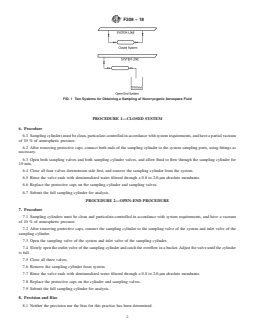
3.1 Samples are withdrawn from the system by (1) a closed vessel capture, and (2) an open-end vessel (see Fig. 1). Both
procedures are practical for most liquid aerospace propellants not excessively corrosive or toxic.
4. Apparatus
4.1 Stainless Steel Pressure Sampling Cylinders, 1-L capacity, equipped with stainless steel valves on each end.
4.1.1 Caution—Pressure sampling cylinders must be marked for the liquid being sampled. Cylinders for one material must not
be interchanged with sampling cylinders of other materials because of the possibility of incompatibility.
4.2 Full Protective Suits.
4.2.1 Caution—Due to the toxic and corrosive nature of most propellentpropellant fluids and their vapors, extreme care must
be exercised in handling. Full protective suits must be worn when sampling these fluids.
4.3 Polyethylene Wash Bottle, 1-L capacity, filled with demineralized water, filtered in the manner described in Practice F311.
4.4 Stainless Steel Bucket.
4.5 Miscellaneous Fittings, as needed for sample point adaption.
4.5.1 Caution—Ensure all fittings are compatible with the propellant being sampled. (This includes but is not limited to the
metals and soft goods, such as o-rings, valves, seals, etc.)
5. Hazards
5.1 Care should be taken when handling propellants since most of them are toxic to some degree. Care should also be taken
when sampling fluids from a system under dynamic conditions.
This practice is under the jurisdiction of ASTM Committee E21 on Space Simulation and Applications of Space Technology and is the direct responsibility of
Subcommittee E21.05 on Contamination.
Current edition approved Sept. 1, 2018Nov. 1, 2018. Published September 2018November 2018. Originally approved in 1966. Last previous edition approved in 20102018
as F309 – 04 (2010).(2018). DOI: 10.1520/F0309-04R18.10.1520/F0309-18.
For referenced ASTM standards, visit the ASTM website, ww
...