

ASTM E3254-23
(Practice)Standard Practice for Use of Color in the Visual Examination and Forensic Comparison of Soil Samples
General Information
- Abstract
SIGNIFICANCE AND USE
4.1 Color is an easily observable characteristic of soils and is integral to the taxonomic classifications of soils (6-8); factors including parent material, hydrology, vegetation, and extent of soil weathering, can affect soil color, making color a valuable diagnostic tool for forensic examination purposes.
4.2 Soil color is sufficiently variable among soils to be used for differentiation of many soils in forensic examinations (9, 10) (see Section 6 for the test method for color determination and comparison criteria) as determined by visual characterization in the Munsell color system.
4.3 Instrumental techniques are suitable for color determination of soil evidence but are not covered within this practice.
4.4 Color determinations of soil samples are also used within soil provenance assessments to provide investigative leads or aid in searches. Interpretation of soil color for soil provenance is case-specific and beyond the scope of this practice, but the methods of color determination (6.5.1 to 6.5.2) and documentation (6.7) described here should be applied to soil color within soil provenance cases.
SCOPE
1.1 This practice covers visual color determination of soil/geologic material within the context of a forensic examination and is intended for use by laboratory personnel.
1.1.1 This practice recommends use of soil color for: the initial screening of soil samples in forensic casework, prioritization of known soil exemplars for detailed analysis, and includes a test method for color determination in the Munsell color system and comparison among samples.
1.2 Units—Units in the Munsell color system are used throughout this document.
1.3 This practice is intended for use by competent forensic science practitioners with the requisite formal education, discipline-specific training (see Practice E2917), and demonstrated proficiency to perform forensic casework.
1.4 This standard does not purport to address all of the safety concerns, if any, associated with its use. It is the responsibility of the user of this standard to establish appropriate safety, health, and environmental practices and determine the applicability of regulatory limitations prior to use.
1.5 This international standard was developed in accordance with internationally recognized principles on standardization established in the Decision on Principles for the Development of International Standards, Guides and Recommendations issued by the World Trade Organization Technical Barriers to Trade (TBT) Committee.
- Status
- Published
- Publication Date
- 30-Apr-2023
- Technical Committee
- E30 - Forensic Sciences
- Drafting Committee
- E30.01 - Criminalistics
Overview
ASTM E3254-23: Standard Practice for Use of Color in the Visual Examination and Forensic Comparison of Soil Samples establishes guidelines for visually determining and comparing the color of soil and geologic materials for forensic purposes. Developed by ASTM International, this standard provides consistent, scientifically recognized methods for laboratory personnel engaged in forensic soil examination. The visual characterization of soil color, primarily using the Munsell color system, is a powerful diagnostic tool to aid forensic investigations by differentiating soil samples based on observable color differences.
Key Topics
- Visual Soil Color Determination: The practice emphasizes the visual assessment and comparison of soil samples using Munsell Soil Color Charts. This standardized approach ensures consistent descriptions and interpretations across forensic laboratories.
- Munsell Color System: All assessments use hue, value, and chroma from the Munsell system, a globally accepted method for quantifying and communicating color in soils.
- Forensic Comparisons: Soil color differences are leveraged for initial screening, exclusionary comparisons, and prioritization of soil exemplars in forensic casework.
- Sample Preparation and Documentation: Procedures include guidelines for sample segregation, documentation of color, and considerations of environmental or handling influences such as moisture, contamination, or alteration.
- Quality and Limitations: The standard addresses variables that can affect soil color perception, such as lighting, moisture content, and the presence of mixtures, and details steps to minimize error and document uncertainties.
- Competence and Training: Proper application requires practitioners to have relevant education and discipline-specific training, as outlined in referenced standards.
Applications
ASTM E3254-23 is essential for:
- Criminal Investigations: Enables forensic scientists to visually compare soil evidence-such as debris from tires, shoes, or clothing-to known soil samples, supporting conclusions about origin or transfer.
- Initial Screening: Facilitates rapid, non-destructive screening of multiple soil samples to focus detailed analysis on the most relevant matches.
- Exclusion and Source Attribution: Supports exclusion of unrelated soil sources and provides evidence to include or exclude potential locations during investigations.
- Soil Provenance Assessments: Though forensic interpretation of provenance is case-specific, the standard’s methods for color determination and documentation are suitable for use within broader provenance studies.
- Documentation in Legal Contexts: Provides the required rigor and documentation to withstand scrutiny in legal proceedings, ensuring that findings are reproducible and scientifically sound.
Related Standards
- ASTM D1535: Practice for Specifying Color by the Munsell System - foundational for using Munsell color charts.
- ASTM E2917: Practice for Forensic Science Practitioner Training, Continuing Education, and Professional Development Programs - required training for practitioners.
- ASTM E3272: Guide for Collection of Soils and Other Geological Evidence for Criminal Forensic Applications - recommendations for collecting soil evidence.
- ASTM E620 and E1492: Practices for Reporting and Documenting Scientific Observations in Forensic Casework.
Practical Value
Adopting ASTM E3254-23 ensures consistency, reliability, and scientific integrity in forensic soil color analysis. By following this standard, laboratories can produce clear, documented, and defensible evidence in criminal and environmental investigations. The standard also promotes harmonization with national and international classification systems, supporting global best practices in forensic geoscience.
Keywords: forensic soil comparison, Munsell color system, soil color examination, forensic laboratory, soil provenance, ASTM E3254-23, forensic science standards, soil color chart, visual soil analysis, forensic evidence.
Relations
- Effective Date
- 01-Feb-2024
- Effective Date
- 01-Sep-2023
- Effective Date
- 15-Feb-2019
- Effective Date
- 01-Nov-2014
- Effective Date
- 01-Jan-2013
- Effective Date
- 15-Jul-2012
- Effective Date
- 01-Feb-2012
- Effective Date
- 01-Jun-2011
- Effective Date
- 01-May-2011
- Effective Date
- 01-Jan-2008
- Effective Date
- 01-Jan-2008
- Effective Date
- 01-Jul-2007
- Effective Date
- 01-Jul-2006
- Effective Date
- 15-Jul-2005
- Effective Date
- 01-Jul-2004
Get Certified
Connect with accredited certification bodies for this standard

DIBt (Deutsches Institut für Bautechnik)
German Institute for Building Technology.
DIN CERTCO
DIN Group product certification.

ECOCERT
Organic and sustainability certification.
Sponsored listings
Frequently Asked Questions
ASTM E3254-23 is a standard published by ASTM International. Its full title is "Standard Practice for Use of Color in the Visual Examination and Forensic Comparison of Soil Samples". This standard covers: SIGNIFICANCE AND USE 4.1 Color is an easily observable characteristic of soils and is integral to the taxonomic classifications of soils (6-8); factors including parent material, hydrology, vegetation, and extent of soil weathering, can affect soil color, making color a valuable diagnostic tool for forensic examination purposes. 4.2 Soil color is sufficiently variable among soils to be used for differentiation of many soils in forensic examinations (9, 10) (see Section 6 for the test method for color determination and comparison criteria) as determined by visual characterization in the Munsell color system. 4.3 Instrumental techniques are suitable for color determination of soil evidence but are not covered within this practice. 4.4 Color determinations of soil samples are also used within soil provenance assessments to provide investigative leads or aid in searches. Interpretation of soil color for soil provenance is case-specific and beyond the scope of this practice, but the methods of color determination (6.5.1 to 6.5.2) and documentation (6.7) described here should be applied to soil color within soil provenance cases. SCOPE 1.1 This practice covers visual color determination of soil/geologic material within the context of a forensic examination and is intended for use by laboratory personnel. 1.1.1 This practice recommends use of soil color for: the initial screening of soil samples in forensic casework, prioritization of known soil exemplars for detailed analysis, and includes a test method for color determination in the Munsell color system and comparison among samples. 1.2 Units—Units in the Munsell color system are used throughout this document. 1.3 This practice is intended for use by competent forensic science practitioners with the requisite formal education, discipline-specific training (see Practice E2917), and demonstrated proficiency to perform forensic casework. 1.4 This standard does not purport to address all of the safety concerns, if any, associated with its use. It is the responsibility of the user of this standard to establish appropriate safety, health, and environmental practices and determine the applicability of regulatory limitations prior to use. 1.5 This international standard was developed in accordance with internationally recognized principles on standardization established in the Decision on Principles for the Development of International Standards, Guides and Recommendations issued by the World Trade Organization Technical Barriers to Trade (TBT) Committee.
SIGNIFICANCE AND USE 4.1 Color is an easily observable characteristic of soils and is integral to the taxonomic classifications of soils (6-8); factors including parent material, hydrology, vegetation, and extent of soil weathering, can affect soil color, making color a valuable diagnostic tool for forensic examination purposes. 4.2 Soil color is sufficiently variable among soils to be used for differentiation of many soils in forensic examinations (9, 10) (see Section 6 for the test method for color determination and comparison criteria) as determined by visual characterization in the Munsell color system. 4.3 Instrumental techniques are suitable for color determination of soil evidence but are not covered within this practice. 4.4 Color determinations of soil samples are also used within soil provenance assessments to provide investigative leads or aid in searches. Interpretation of soil color for soil provenance is case-specific and beyond the scope of this practice, but the methods of color determination (6.5.1 to 6.5.2) and documentation (6.7) described here should be applied to soil color within soil provenance cases. SCOPE 1.1 This practice covers visual color determination of soil/geologic material within the context of a forensic examination and is intended for use by laboratory personnel. 1.1.1 This practice recommends use of soil color for: the initial screening of soil samples in forensic casework, prioritization of known soil exemplars for detailed analysis, and includes a test method for color determination in the Munsell color system and comparison among samples. 1.2 Units—Units in the Munsell color system are used throughout this document. 1.3 This practice is intended for use by competent forensic science practitioners with the requisite formal education, discipline-specific training (see Practice E2917), and demonstrated proficiency to perform forensic casework. 1.4 This standard does not purport to address all of the safety concerns, if any, associated with its use. It is the responsibility of the user of this standard to establish appropriate safety, health, and environmental practices and determine the applicability of regulatory limitations prior to use. 1.5 This international standard was developed in accordance with internationally recognized principles on standardization established in the Decision on Principles for the Development of International Standards, Guides and Recommendations issued by the World Trade Organization Technical Barriers to Trade (TBT) Committee.
ASTM E3254-23 is classified under the following ICS (International Classification for Standards) categories: 07.140 - Forensic science; 71.040.50 - Physicochemical methods of analysis; 91.100.15 - Mineral materials and products. The ICS classification helps identify the subject area and facilitates finding related standards.
ASTM E3254-23 has the following relationships with other standards: It is inter standard links to ASTM E2917-24, ASTM E3272-23, ASTM E2917-19, ASTM D1535-14, ASTM D1535-13, ASTM D1535-12a, ASTM D1535-12, ASTM E1492-11, ASTM E620-11, ASTM D1535-08e1, ASTM D1535-08, ASTM D1535-07, ASTM D1535-06, ASTM E1492-05, ASTM E620-04. Understanding these relationships helps ensure you are using the most current and applicable version of the standard.
ASTM E3254-23 is available in PDF format for immediate download after purchase. The document can be added to your cart and obtained through the secure checkout process. Digital delivery ensures instant access to the complete standard document.
Standards Content (Sample)
This international standard was developed in accordance with internationally recognized principles on standardization established in the Decision on Principles for the
Development of International Standards, Guides and Recommendations issued by the World Trade Organization Technical Barriers to Trade (TBT) Committee.
Designation: E3254 − 23 An American National Standard
Standard Practice for
Use of Color in the Visual Examination and Forensic
Comparison of Soil Samples
This standard is issued under the fixed designation E3254; the number immediately following the designation indicates the year of
original adoption or, in the case of revision, the year of last revision. A number in parentheses indicates the year of last reapproval. A
superscript epsilon (´) indicates an editorial change since the last revision or reapproval.
1. Scope Retrieving Evidence in a Forensic Science Laboratory
E2917 Practice for Forensic Science Practitioner Training,
1.1 This practice covers visual color determination of soil/
Continuing Education, and Professional Development
geologic material within the context of a forensic examination
Programs
and is intended for use by laboratory personnel.
E3272 Guide for Collection of Soils and Other Geological
1.1.1 This practice recommends use of soil color for: the
Evidence for Criminal Forensic Applications
initial screening of soil samples in forensic casework, prioriti-
zation of known soil exemplars for detailed analysis, and
3. Terminology
includes a test method for color determination in the Munsell
3.1 Definitions of Terms Specific to This Standard:
color system and comparison among samples.
3.1.1 aggregate(s) [clump(s)], n—a group of soil particles
1.2 Units—Units in the Munsell color system are used
that cohere to each other more strongly than to other surround-
throughout this document.
ing particles.
1.3 This practice is intended for use by competent forensic
(1)
science practitioners with the requisite formal education,
3.1.1.1 Discussion—Soil aggregates can be natural (a ped)
discipline-specific training (see Practice E2917), and demon-
or formed by human activities (a clod). Often the genesis of
strated proficiency to perform forensic casework.
evidentiary soil aggregates is unknown, so aggregate is often a
preferred term in descriptions of soil evidence.
1.4 This standard does not purport to address all of the
3.1.1.2 Discussion—This use of the term aggregate is dis-
safety concerns, if any, associated with its use. It is the
tinct from this term’s use in construction as the sand or crushed
responsibility of the user of this standard to establish appro-
rock mixed with cement to form mortar, grout, or concrete.
priate safety, health, and environmental practices and deter-
mine the applicability of regulatory limitations prior to use.
3.1.2 color contrast, n—the degree of visual difference that
1.5 This international standard was developed in accor-
is evident between one soil color compared with another in
dance with internationally recognized principles on standard-
close proximity.
ization established in the Decision on Principles for the
(adapted from Ref (2)
Development of International Standards, Guides and Recom-
3.1.2.1 Discussion—Within this practice, color contrast re-
mendations issued by the World Trade Organization Technical
fers to color difference between evidentiary soil samples.
Barriers to Trade (TBT) Committee.
3.1.3 color contrast classes, n—degree of color distinction
(color contrast) between colors within a soil are categorized as
2. Referenced Documents
faint, distinct and prominent.
2.1 ASTM Standards:
(2)
D1535 Practice for Specifying Color by the Munsell System
3.1.3.1 Discussion—Within this practice, these contrast
E620 Practice for Reporting Opinions of Scientific or Tech-
classes are used to describe the degree of color distinction
nical Experts
between two evidentiary soil samples, whereas the United
E1492 Practice for Receiving, Documenting, Storing, and
States Department of Agriculture – National Resource Conser-
vation Service – National Cooperative Soil Survey (NCSS)
uses these contrast classes to describe color distinction within
This practice is under the jurisdiction of ASTM Committee E30 on Forensic
soil horizons. Faint color contrast is evident only on close
Sciences and is the direct responsibility of Subcommittee E30.01 on Criminalistics.
examination. Distinct color contrast is readily seen but con-
Current edition approved May 1, 2023. Published May 2023. DOI: 10.1520/
trasts only moderately with the color to which it is compared.
E3254-23.
For referenced ASTM standards, visit the ASTM website, www.astm.org, or
contact ASTM Customer Service at service@astm.org. For Annual Book of ASTM
Standards volume information, refer to the standard’s Document Summary page on The boldface numbers in parentheses refer to the list of references at the end of
the ASTM website. this standard.
Copyright © ASTM International, 100 Barr Harbor Drive, PO Box C700, West Conshohocken, PA 19428-2959. United States
E3254 − 23
Prominent indicates colors which contrast strongly with the etc; Ref (5). However, in a forensic examination mottling is
color to which it is compared; prominent colors are commonly often used to describe any color contrast within a soil
the most obvious color feature of the section described. The
aggregate, regardless of its origin.
NCSS thresholds between faint and distinct color contrast (2)
3.1.8 Munsell color code, n—Munsell color is recorded as
are adapted as exclusion criteria in forensic comparisons of soil
alpha-numeric Hue Value/Chroma, H V/C (for example, 7.5YR
(see 6.6).
5/4 or 5R 6/4); neutral colors, lacking a hue tone, (chroma = 0)
3.1.4 known soil sample, n—known soil samples are inten-
are designated with a “hue” of N and omit chroma or list it as
tionally collected, typically from crime scene or alternate
zero (N 3/ or N 3/0).
locations, for comparison to a questioned soil sample.
3.1.9 Munsell color system, n—an ordered system to quan-
3.1.4.1 Discussion—Soils are heterogeneous mixtures of
tify and describe color based on the three qualities or attributes:
organic matter and minerals that vary vertically with depth and
hue (H), value (V), and chroma (C) (see Practice D1535 and
horizontally across the landscape. Typically, a greater number
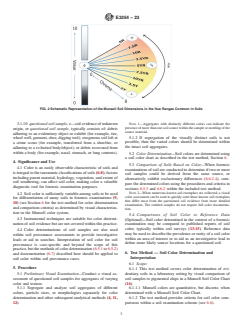
Fig. 2).
of known soil samples are needed than manufactured materials
to represent the range of variation (see Guide E3272). Refer-
3.1.9.1 chroma (C), n—the saturation or brilliance of a
ence sample and control sample are synonyms or sub-types of
color, from 0 (no color) to ~8 (for vividly colored soils) or
known soil samples (3, 4).
higher (for non-soil materials) in the Munsell color system.
3.1.5 matrix color, n—dominant or background color com- (adapted from Ref (5))
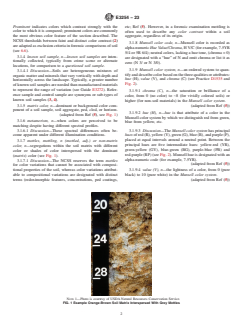
ponent of a soil sample, soil aggregate, ped, clod, or horizon.
3.1.9.2 hue (H), n—hue is that attribute of a color in the
(adapted from Ref (5), see Fig. 1)
Munsell color system by which we distinguish red from green,
3.1.6 metamerism, n—when colors are perceived to be
blue from yellow, etc.
matching despite having different spectral profiles.
3.1.6.1 Discussion—These spectral differences often be- 3.1.9.3 Discussion—The Munsell color system has principal
come apparent under different illumination conditions. hues of red (R), yellow (Y), green (G), blue (B), and purple (P),
placed at equal intervals around a neutral point. Between the
3.1.7 mottles, mottling, n (mottled, adj.) or non-matrix
principal hues are five intermediate hues: yellow-red (YR),
color, n—segregations within the soil matrix with different
green-yellow (GY), blue-green (BG), purple-blue (PB) and
color or shades of color interspersed with the dominant
red-purple (RP) (see Fig. 2). Munsell hue is designated with an
(matrix) color (see Fig. 1).
alpha-numeric code (for example, 7.5YR).
3.1.7.1 Discussion—The NCSS reserves the term mottles
(adapted from Ref (5))
for color variations that cannot be associated with composi-
tional properties of the soil, whereas color variations attribut- 3.1.9.4 value (V), n—the lightness of a color, from 0 (pure
black) to 10 (pure white) in the Munsell color system.
able to compositional variations are designated with distinct
terms (redoximorphic features, concentrations, ped coatings, (adapted from Ref (5))
NOTE 1—Photo is courtesy of USDA Natural Resources Conservation Service.
FIG. 1 Example Orange-Brown Soil Matrix Interspersed With Grey Mottles
E3254 − 23
FIG. 2 Schematic Representation of the Munsell Soil Dimensions in the Hue Ranges Common in Soils
NOTE 1—Aggregates with distinctly different colors can indicate the
3.1.10 questioned soil sample, n—soil evidence of unknown
presence of more than one soil source within the sample or mottling of the
origin, or questioned soil sample, typically consists of: debris
source material.
adhering to an evidentiary object or exhibit (for example, tire,
5.1.2 If segregation of the visually distinct soils is not
wheel well, garment, shoe, digging tool); exogenous soil left at
possible, then the varied colors should be determined within
a crime scene (for example, transferred from a shoe/tire, or
the intact soil aggregates.
adhering to a re-buried body/object); or debris recovered from
within a body (for example, nasal, stomach, or lung contents).
5.2 Color Determination—Soil colors are determined using
a soil color chart as described in the test method, Section 6.
4. Significance and Use
5.3 Comparison of Soils Based on Color—When forensic
4.1 Color is an easily observable characteristic of soils and
examinations of soil are conducted to determine if two or more
is integral to the taxonomic classifications of soils (6-8); factors
soil samples could be derived from the same source, or
including parent material, hydrology, vegetation, and extent of
alternatively exhibit exclusionary differences (6.6.2.4), com-
soil weathering, can affect soil color, making color a valuable
pare the determined colors using the procedures and criteria in
diagnostic tool for forensic examination purposes.
sections 6.5.3 and 6.6.2 within the included test method.
NOTE 2—When numerous known soil exemplars are collected, a visual
4.2 Soil color is sufficiently variable among soils to be used
color assessment can be used to quickly omit those known soil exemplars
for differentiation of many soils in forensic examinations (9,
that differ most from the questioned soil evidence from more detailed
10) (see Section 6 for the test method for color determination
examination. The omitted samples do not require full color documenta-
and comparison criteria) as determined by visual characteriza-
tion.
tion in the Munsell color system.
5.4 Comparisons of Soil Color to Reference Data
4.3 Instrumental techniques are suitable for color determi-
(Optional)—Soil color determined in the context of a forensic
nation of soil evidence but are not covered within this practice.
examination may be compared to published reports of soil
color, typically within soil surveys (13-15). Reference data
4.4 Color determinations of soil samples are also used
may be used to describe the prevalence or rarity of a soil color
within soil provenance assessments to provide investigative
within an area of interest or to aid as an investigative lead to
leads or aid in searches. Interpretation of soil color for soil
define more likely source locations for a questioned soil.
provenance is case-specific and beyond the scope of this
practice, but the methods of color determination (6.5.1 to 6.5.2)
6. Test Method — Soil Color Determination and
and documentation (6.7) described here should be applied to
Interpretation
soil color within soil provenance cases.
6.1 Scope:
5. Procedure
6.1.1 This test method covers color determination of evi-
5.1 Preliminary Visual Examination—Conduct a visual as- dentiary soils in a laboratory setting by visual comparison of
soil samples to pigmented chips in a Munsell Soil Color Chart
sessment of questioned soil samples for aggregates of varying
color and texture. (16).
5.1.1 Segregate and analyze soil aggregates of different 6.1.1.1 Munsell colors are quantitative, but discrete, when
colors, particle sizes, or morphologies separately for color determined with a Munsell Soil Color Chart.
determination and other subsequent analytical methods (4, 11, 6.1.2 The test method provides criteria for soil color com-
12). parisons within a soil examination scheme (see 6.6).
E3254 − 23
6.2 Significance and Use: 6.4.1 Munsell Soil Color Charts—Munsell Soil Color
Charts (X-Rite, 16) consist of pigmented chips of color
6.2.1 Munsell color determinations of soils (see 6.5.1) are
standards, labeled with Munsell color notations, which span a
used as a basis for soil comparisons (see 6.5.3) and as part of
soil examinations for provenance assessments. range of colors common in soils (Note 6 and Note 7).
6.2.2 This test method adapts practices used by soil scien-
NOTE 6—The GLOBE Soil Color Book (21) is a suitable alternative to
tists in field settings to soil color determination within a
the Munsell Soil Color Chart (22, 23), but the color chips are physically
arranged in a different configuration.
forensic laboratory setting (5, 17).
NOTE 7—Soil color books, particularly those used in field settings, often
6.2.3 Soil color differences can provide exclusionary differ-
become contaminated with soil, obscuring the true colors of the pigmented
ences in soil comparisons (9, 10, 12, and 6.6).
chips. Some studies have indicated that the chips in Munsell Soil Color
Charts do not fade or change color over decades (22) while others have
6.3 Interferences and Limitations:
observed fading with use (24).
6.3.1 Moisture—Differences in soil moisture content can
NOTE 8—Pages of specific hues, from 5R to 5Y in increments of 2.5 hue
change Munsell value by as much as 2.0 units and hue by as
units, each have a grid of chips that systematically range in both value
much as 0.75 hue units (0.3 pages in the Munsell Soil Color
(dark to light) and chroma (weak to vivid) (see Fig. 3 and Note 9)
Chart) (17). NOTE 9—The “hue pages” are supplemented by “10G 5GY” (for
glauconitic or other green-hued soils), two “GLEY” pages (for soil colors
6.3.1.1 When determining soil colors for comparison (see
formed under anaerobic conditions), and “WHITE” (e.g., evaporites,
6.5.3), the soils should have similar moisture contents, typi-
carbonate accumulations, albic horizon, and E-horizons).
cally achieved by air drying the samples at room temperature.
6.4.2 Light Source(s):
6.3.1.2 When comparing a soil’s color to reference data
6.4.2.1 A consistent polychromatic light source (common
(5.4), soil evidence should have similar moisture content as the
indoor illumination is suitable).
reference data (moist or dry).
6.4.2.2 (Optional) sunlight simulant, D65 or similar.
NOTE 3—The NCSS (5) recommends determining dry soil color at the
6.4.2.3 (Optional) additional illuminants with different
point where color does not change with additional air-drying. To achieve
spectral ranges (for example, UV source).
a moist soil from an air-dried sample for color determination, add water
drop-wise or with a spray bottle until the color no longer changes, but do
6.5 Procedure:
not add enough water to make the soil surface glisten.
6.5.1 Soil Color Determination—Determine soil color by
6.3.2 Contamination—Contamination of soil evidence with
visual comparison to the pigmented chips of the Munsell Soil
exogenous material (for example, human decomposition
Color Charts.
products, mold, soot/char, rust from sample storage containers)
NOTE 10—Soil color is typically determined early in the examination
can alter the color of the soil.
scheme of soils because this property can be characterized quickly,
6.3.3 Alteration—Soil evidence can be altered from its
non-destructively, and with minimal or no sample modification.
source by a number of factors, including: size fractionation,
NOTE 11—The in-situ determination of the color of soil adhering to an
fire, change in the reduction-oxidation state (18, 19), or
item of evidence, like a garment, requires that the soil completely obscures
the color of the underlying substrate.
exposure to stomach acid, etc. These alterations can impact soil
color.
6.5.1.1 Use of a Single Color Book—Within a case, use a
single soil color book for all color determinations and docu-
NOTE 4—Certain soil types are more susceptible to color alteration
ment the book used.
when removed from the ground. Anaerobic/gley soils and acid sulfate
soils commonly undergo oxidation and acidification upon exposure to the
6.5.1.2 Illumination and Color Assessment—Illuminate the
air. Other soils may have precipitation or alteration of secondary minerals
sample and place the soil color chart atop of it, so that both the
that might cause color changes (20).
sample and standard chips can be viewed simultaneously. View
6.3.4 Soils Problematic for Color Determination:
the sample through the holes (when using the Munsell Soil
6.3.4.1 If the quantity of a questioned soil is so small that
Color Charts) and determine which color chip most closely
the observer cannot determine its color without magnification,
resembles the color of each soil or component of interest (for
visual color determination is unlikely; however, large color
example, matrix, mottles, etc.).
contrast can be observed in side-by-side soil color comparisons
NOTE 12—When comparing soil color to published reference data (see
of small evidentiary soils.
5.4), the illuminant used for color measurement should be similar to the
6.3.4.2 Questioned soil samples consisting of mixtures of
light used to create the reference data (for example, for soils colors from
soils from more than one source are unsuitable for color the NCSS databases determined in field settings (13-15), the illuminant
should be similar to sunlight, D65).
determination unless these soil mixtures can be physically
NOTE 13—The optional use of multiple illuminants, adding and
segregated into its components or if different soil sources can
removing ultraviolet (UV) light in particular, assists in soil color com-
be characterized in-situ.
parisons by permitting documentation of metamerism.
6.3.5 Non-Representative Known Soil Samples—Sparse
6.5.1.3 Optional Sample Treatments—Other sample prepa-
sampling of known soil exemplars submitted for comparison to
rations techniques may be used prior to color determination,
a questioned soil might not represent the full range of colors at
including: disaggregation and subsequent particle size fraction-
the source location.
ation (that is, sieving or sedimentation, 25); heating or low
NOTE 5—Refer to Guide E3272 for recommend
...