

ASTM D4538-21
(Terminology)Standard Terminology Relating to Protective Coating and Lining Work for Power Generation Facilities
General Information
- Abstract
SCOPE
1.1 This terminology covers terms and their definitions relevant to the use of protective coatings in nuclear power plants.
1.2 This international standard was developed in accordance with internationally recognized principles on standardization established in the Decision on Principles for the Development of International Standards, Guides and Recommendations issued by the World Trade Organization Technical Barriers to Trade (TBT) Committee.
- Status
- Published
- Publication Date
- 31-Jan-2021
- Technical Committee
- D33 - Protective Coating and Lining Work for Power Generation Facilities
- Drafting Committee
- D33.92 - Definitions
Buy Documents

ASTM D4538-21 - Standard Terminology Relating to Protective Coating and Lining Work for Power Generation Facilities
REDLINE ASTM D4538-21 - Standard Terminology Relating to Protective Coating and Lining Work for Power Generation Facilities
Overview
ASTM D4538-21: Standard Terminology Relating to Protective Coating and Lining Work for Power Generation Facilities defines critical terms and concepts associated with protective coatings and linings used in nuclear power plants. Developed by ASTM International, this terminology standard provides a consistent language to promote clear communication and regulatory compliance regarding coating practices in the power generation industry.
The document serves as a foundational reference for stakeholders including facility owners, operators, contractors, manufacturers, quality assurance professionals, and regulatory agencies. Standardized terminology ensures consistency in technical documentation, procurement processes, inspection reports, and regulatory submissions.
Key Topics
- Protective Coating and Lining Systems: Terminology defines essential concepts such as coating systems, linings, coating applicators, manufacturers, and service levels. Terms like "acceptable coating or lining system," "safety-related coating system," and "DBA qualified coating system" specify the types and qualification status of coatings in nuclear environments.
- Quality Assurance and Inspection: Extensive definitions cover procedures and roles involved in ensuring coating effectiveness. Terms include quality assurance, inspection, certification, qualifying agents, and inspection agency.
- Design Basis Accident (DBA): The standard defines terminology related to accidents and stress conditions such as "DBA qualified" and "DBA unqualified coating systems." This is important for evaluating how coatings will perform during critical events.
- Coating Application and Defects: Common application processes and potential issues are covered, including blistering, cracking, delamination, mud-cracking, sagging, and crawling. Detection techniques such as holiday testing and use of high-voltage or low-voltage testers are also included.
- Industry Regulations and Standards: The standard incorporates references to regulatory guides (such as USNRC Regulatory Guide 8.8 and 10CFR20.1) and other ASTM documents that support broader compliance efforts.
Applications
ASTM D4538-21 is vital for:
- Nuclear Power Generation: Standardizing terminology for use on-site and in documentation related to nuclear safety, regulatory compliance, routine maintenance, and emergency preparedness.
- Project Specifications and Procurement: Assists in writing clear, unambiguous project requirements for contractors, vendors, and coating manufacturers.
- Quality Management: Supports quality control and inspection teams in documenting and addressing coating system performance and potential non-conformance in nuclear facilities.
- Personnel Training and Certification: Establishes a common language for training programs, qualification, and certification of coating applicators, inspectors, and supervisory staff.
- Regulatory Compliance: Facilitates communication with regulatory authorities, ensuring documentation and reporting align with industry and governmental standards.
Related Standards
Several key ASTM standards referenced in ASTM D4538-21 support comprehensive coating and lining work:
- ASTM D16 – Terminology for Paint, Related Coatings, Materials, and Applications
- ASTM D3843 – Practice for Quality Assurance for Protective Coatings Applied to Nuclear Facilities
- ASTM D3911 – Test Method for Evaluating Coatings in Light-Water Nuclear Power Plants at Simulated Design Basis Accident Conditions
- ASTM D4227/D4228 – Qualification of Coating Applicators for Concrete and Steel Surfaces
- ASTM D4537 – Guide for Establishing Procedures to Qualify and Certify Personnel Performing Coating and Lining Work Inspection in Nuclear Facilities
- ASTM D5144 – Guide for Use of Protective Coating Standards in Nuclear Power Plants
- ASTM D4787 – Practice for Continuity Verification of Linings on Concrete Substrates
Practical Value
By adopting ASTM D4538-21, organizations benefit from:
- Enhanced Communication: Clear, universally accepted terminology minimizes misunderstandings and errors.
- Improved Compliance: Supports alignment with international and regulatory requirements.
- Streamlined Processes: Facilitates efficient training, procurement, inspection, and reporting in nuclear power generation.
Keywords: ASTM D4538-21, protective coating, lining, nuclear power plant, quality assurance, inspection, safety-related coating, power generation facility.
Relations
- Effective Date
- 01-Jan-2024
- Effective Date
- 01-Sep-2018
- Effective Date
- 01-Aug-2018
- Effective Date
- 01-Jul-2016
- Effective Date
- 01-Dec-2014
- Effective Date
- 01-Feb-2013
- Effective Date
- 15-Sep-2012
- Effective Date
- 15-Sep-2012
- Effective Date
- 01-Aug-2012
- Effective Date
- 01-Mar-2012
- Effective Date
- 01-Jun-2011
- Effective Date
- 01-Jan-2011
- Effective Date
- 01-Feb-2010
- Refers
ASTM D5144-08e1 - Standard Guide for Use of Protective Coating Standards in Nuclear Power Plants - Effective Date
- 15-Nov-2008
- Refers
ASTM D5144-08 - Standard Guide for Use of Protective Coating Standards in Nuclear Power Plants - Effective Date
- 15-Nov-2008
Buy Documents
ASTM D4538-21 - Standard Terminology Relating to Protective Coating and Lining Work for Power Generation Facilities
REDLINE ASTM D4538-21 - Standard Terminology Relating to Protective Coating and Lining Work for Power Generation Facilities
Get Certified
Connect with accredited certification bodies for this standard

DNV
DNV is an independent assurance and risk management provider.

Lloyd's Register
Lloyd's Register is a global professional services organisation specialising in engineering and technology.
DNV Energy Systems
Energy and renewable energy certification.
Sponsored listings
Frequently Asked Questions
ASTM D4538-21 is a standard published by ASTM International. Its full title is "Standard Terminology Relating to Protective Coating and Lining Work for Power Generation Facilities". This standard covers: SCOPE 1.1 This terminology covers terms and their definitions relevant to the use of protective coatings in nuclear power plants. 1.2 This international standard was developed in accordance with internationally recognized principles on standardization established in the Decision on Principles for the Development of International Standards, Guides and Recommendations issued by the World Trade Organization Technical Barriers to Trade (TBT) Committee.
SCOPE 1.1 This terminology covers terms and their definitions relevant to the use of protective coatings in nuclear power plants. 1.2 This international standard was developed in accordance with internationally recognized principles on standardization established in the Decision on Principles for the Development of International Standards, Guides and Recommendations issued by the World Trade Organization Technical Barriers to Trade (TBT) Committee.
ASTM D4538-21 is classified under the following ICS (International Classification for Standards) categories: 01.040.27 - Energy and heat transfer engineering (Vocabularies); 27.100 - Power stations in general. The ICS classification helps identify the subject area and facilitates finding related standards.
ASTM D4538-21 has the following relationships with other standards: It is inter standard links to ASTM D16-24, ASTM D4787-13(2018), ASTM D4537-12(2018), ASTM D16-16, ASTM D16-14, ASTM D4787-13, ASTM D4227-05(2012), ASTM D4228-05(2012), ASTM D16-12, ASTM D4537-12, ASTM D16-11a, ASTM D16-11, ASTM D16-10, ASTM D5144-08e1, ASTM D5144-08. Understanding these relationships helps ensure you are using the most current and applicable version of the standard.
ASTM D4538-21 is available in PDF format for immediate download after purchase. The document can be added to your cart and obtained through the secure checkout process. Digital delivery ensures instant access to the complete standard document.
Standards Content (Sample)
This international standard was developed in accordance with internationally recognized principles on standardization established in the Decision on Principles for the
Development of International Standards, Guides and Recommendations issued by the World Trade Organization Technical Barriers to Trade (TBT) Committee.
Designation: D4538 − 21
Standard Terminology Relating to
Protective Coating and Lining Work for Power Generation
Facilities
This standard is issued under the fixed designation D4538; the number immediately following the designation indicates the year of
original adoption or, in the case of revision, the year of last revision. A number in parentheses indicates the year of last reapproval. A
superscript epsilon (´) indicates an editorial change since the last revision or reapproval.
1. Scope D5161 Guide for Specifying Inspection Requirements for
Coating and Lining Work (Metal Substrates) (Withdrawn
1.1 This terminology covers terms and their definitions
2013)
relevant to the use of protective coatings in nuclear power
D5162 Practice for Discontinuity (Holiday) Testing of Non-
plants.
conductive Protective Coating on Metallic Substrates
1.2 This international standard was developed in accor-
D5367 Practice for Evaluating Coatings Applied Over Sur-
dance with internationally recognized principles on standard-
faces Treated With Inhibitors Used to Prevent Flash
ization established in the Decision on Principles for the
Rusting of Steel When Water or Water/Abrasive Blasted
Development of International Standards, Guides and Recom-
D5962 Guide for Maintaining Unqualified Coatings (Paints)
mendations issued by the World Trade Organization Technical
Within Level I Areas of a Nuclear Power Facility (With-
Barriers to Trade (TBT) Committee.
drawn 2008)
D7491 GuideforManagementofNon-ConformingCoatings
2. Referenced Documents
in Coating Service Level IAreas of Nuclear Power Plants
2.1 ASTM Standards:
2.2 Other Documents:
D16 TerminologyforPaint,RelatedCoatings,Materials,and
USNRC Regulatory Guide 8.8 Ensuring Occupational Ra-
Applications
diation Exposure ALARA at Nuclear Power Stations
D1193 Specification for Reagent Water
10CFR20.1 Standards for Protection Against Radiation
D3843 Practice for Quality Assurance for Protective Coat-
ings Applied to Nuclear Facilities
3. Terminology
D3911 Test Method for Evaluating Coatings Used in Light-
acceptable coating or lining system, n—safety-related coat-
Water Nuclear Power Plants at Simulated Design Basis
ing or lining system for which a suitability for application
Accident (DBA) Conditions
review that meets the plant licensing requirements has been
D4227 Practice for Qualification of Coating Applicators for
completed and there is reasonable assurance that, when
Application of Coatings to Concrete Surfaces
properly applied and maintained, the coating or lining will
D4228 Practice for Qualification of Coating Applicators for
not detach under normal or accident conditions. D5144
Application of Coatings to Steel Surfaces
D4537 Guide for Establishing Procedures to Qualify and
ALARA, n—concept of reducing radiation exposure to per-
Certify Personnel Performing Coating and Lining Work
sonnel to levels “as low as reasonably achievable,” as
Inspection in Nuclear Facilities
defined in the USNRC Regulatory Guide 8.8 and
D4787 Practice for Continuity Verification of Liquid or
10CFR20.1(C). D5144
Sheet Linings Applied to Concrete Substrates
blistering, n—the formation of raised areas in the applied
D5144 Guide for Use of Protective Coating Standards in
coating film resulting from local loss of adhesion with
Nuclear Power Plants
subsequent lifting of the film from the underlying surface.
D3911
This terminology is under the jurisdiction of ASTM Committee D33 on
boiling water reactor (BWR), n—reactor in which the water
ProtectiveCoatingandLiningWorkforPowerGenerationFacilitiesandisthedirect
moderator-coolant is boiled directly within the reactor core
responsibility of Subcommittee D33.92 on Definitions.
Current edition approved Feb. 1, 2021. Published February 2021. Originally
approved in 1986. Last previous edition approved in 2015 as D4538 – 15. DOI:
10.1520/D4538-21. The last approved version of this historical standard is referenced on
For referenced ASTM standards, visit the ASTM website, www.astm.org, or www.astm.org.
contact ASTM Customer Service at service@astm.org. For Annual Book of ASTM AvailablefromU.S.GovernmentPrintingOfficeSuperintendentofDocuments,
Standards volume information, refer to the standard’s Document Summary page on 732 N. Capitol St., NW, Mail Stop: SDE, Washington, DC 20401, http://
the ASTM website. www.access.gpo.gov.
Copyright © ASTM International, 100 Barr Harbor Drive, PO Box C700, West Conshohocken, PA 19428-2959. United States
D4538 − 21
and the pressure in the reactor vessel is only slightly greater damp, adj—moist but not visibly wet.
than the steam turbine pressure. D3911
DBA qualified coating system, n—coating system used inside
certification, n—written documentation of qualification.
reactor containment that can be attested to having passed the
required laboratory testing, including irradiation and simu-
checking, n—slight breaks in the film that do not penetrate to
lated design basis accident (DBA), and has adequate quality
the previously applied coating or to the substrate.
documentation to support its use as DBA qualified. D5144
chemical spray, n—solution of chemicals that could be used
DBA unqualified coating system, n—coating system used
during a loss of coolant accident (LOCA) to suppress the
inside reactor containment that cannot be attested to having
incident, to scavenge fission products, and to return the
passed the required laboratory testing, including irradiation
facility to near-ambient conditions. D3911
and simulated DBA or has inadequate quality
coating applicator, n—organization or individual responsible documentation, or both, to support its use as DBAqualified.
for applying a protective or decorative coating. D3843 D5144
coating manufacturer, n—organization responsible for manu-
deionized water, n—water that has been purified of salts by
facturing coating materials. D3843 passing through a cation-exchange resin to replace metal
ions, such as calcium and iron, with the hydrogen ion and
Coating Service Level I,n—termusedtodescribeareasinside
through an anion-exchange resin to remove both the hydro-
the reactor containment where coating failure could ad-
gen ions and the corresponding negative ions.
versely affect the operation of post-accident fluid systems
and, thereby, impair safe shutdown. D5144
delamination, n—separation of one coat or layer from another
coat or layer or from the substrate. D3911
Coating Service Level II, n—term used to describe areas
outside the reactor containment where coating failure could
design basis accident (DBA), n—generic term for any one of
impair, but not prevent, normal operating performance; the
a family of accident conditions that can result from postu-
function of Coating Level II coatings is to provide corrosion
lated events.
protection and decontaminability in those areas outside the
DISCUSSION—These conditions are generally associated with the
rupture of high-energy piping. The more commonly recognized acci-
reactor containment subject to radiation exposure and radio-
dent conditions used to evaluate coating systems for primary contain-
nuclide contamination and Service Level II coatings are not
ment are the loss of coolant accident (LOCA) or main steam line break
safety-related. D5144
(MSLB). D3911
Coating Service Level III, n—term used to describe areas
deviation, n—departure of a characteristic from established
outside the reactor containment where coating failure could
procedures or specified requirements. D3843
adversely affect the safety function of a safety-related
structure, system, or component (SSC). D5144
discontinuity, n—void, crack, thin spot, foreign inclusion, or
contamination in the coating film that significantly lowers
coating system,n—polymericprotectivefilmconsistingofone
the dielectric strength of the coating film (may also be
or more coats, applied in a predetermined order by pre-
identified as a holiday). D4787, D5162
scribed methods. D3843
distilled water, n—water meeting the requirements of Speci-
coating work, n—an all-inclusive term to define all operations
fication D1193, Types II and III. D3911, D5367
requiredtoaccomplishacompletecoatingjob;thetermshall
be construed to include materials, equipment, labor, prepa-
documentation, n—any written or pictorial
...
This document is not an ASTM standard and is intended only to provide the user of an ASTM standard an indication of what changes have been made to the previous version. Because
it may not be technically possible to adequately depict all changes accurately, ASTM recommends that users consult prior editions as appropriate. In all cases only the current version
of the standard as published by ASTM is to be considered the official document.
Designation: D4538 − 15 D4538 − 21
Standard Terminology Relating to
Protective Coating and Lining Work for Power Generation
Facilities
This standard is issued under the fixed designation D4538; the number immediately following the designation indicates the year of
original adoption or, in the case of revision, the year of last revision. A number in parentheses indicates the year of last reapproval. A
superscript epsilon (´) indicates an editorial change since the last revision or reapproval.
1. Scope
1.1 This terminology covers terms and their definitions relevant to the use of protective coatings in nuclear power plants.
1.2 This international standard was developed in accordance with internationally recognized principles on standardization
established in the Decision on Principles for the Development of International Standards, Guides and Recommendations issued
by the World Trade Organization Technical Barriers to Trade (TBT) Committee.
2. Referenced Documents
2.1 ASTM Standards:
D16 Terminology for Paint, Related Coatings, Materials, and Applications
D1193 Specification for Reagent Water
D3843 Practice for Quality Assurance for Protective Coatings Applied to Nuclear Facilities
D3911 Test Method for Evaluating Coatings Used in Light-Water Nuclear Power Plants at Simulated Design Basis Accident
(DBA) Conditions
D4227 Practice for Qualification of Coating Applicators for Application of Coatings to Concrete Surfaces
D4228 Practice for Qualification of Coating Applicators for Application of Coatings to Steel Surfaces
D4537 Guide for Establishing Procedures to Qualify and Certify Personnel Performing Coating and Lining Work Inspection in
Nuclear Facilities
D4787 Practice for Continuity Verification of Liquid or Sheet Linings Applied to Concrete Substrates
D5144 Guide for Use of Protective Coating Standards in Nuclear Power Plants
D5161 Guide for Specifying Inspection Requirements for Coating and Lining Work (Metal Substrates) (Withdrawn 2013)
D5162 Practice for Discontinuity (Holiday) Testing of Nonconductive Protective Coating on Metallic Substrates
D5367 Practice for Evaluating Coatings Applied Over Surfaces Treated With Inhibitors Used to Prevent Flash Rusting of Steel
When Water or Water/Abrasive Blasted
D5962 Guide for Maintaining Unqualified Coatings (Paints) Within Level I Areas of a Nuclear Power Facility (Withdrawn
2008)
D7491 Guide for Management of Non-Conforming Coatings in Coating Service Level I Areas of Nuclear Power Plants
This terminology is under the jurisdiction of ASTM Committee D33 on Protective Coating and Lining Work for Power Generation Facilities and is the direct
responsibility of Subcommittee D33.92 on Definitions.
Current edition approved Dec. 1, 2015Feb. 1, 2021. Published December 2015February 2021. Originally approved in 1986. Last previous edition approved in 20132015
as D4538D4538 – 15. – 13 DOI: 10.1520/D4538-15.10.1520/D4538-21.
For referenced ASTM standards, visit the ASTM website, www.astm.org, or contact ASTM Customer Service at service@astm.org. For Annual Book of ASTM Standards
volume information, refer to the standard’s Document Summary page on the ASTM website.
The last approved version of this historical standard is referenced on www.astm.org.
Copyright © ASTM International, 100 Barr Harbor Drive, PO Box C700, West Conshohocken, PA 19428-2959. United States
D4538 − 21
2.2 Other Documents:
USNRC Regulatory Guide 8.8 Ensuring Occupational Radiation Exposure ALARA at Nuclear Power Stations
10CFR20.1 Standards for Protection Against Radiation
3. Terminology
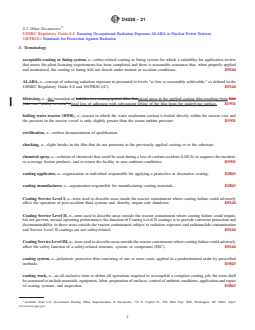
acceptable coating or lining system, n—safety-related coating or lining system for which a suitability for application review
that meets the plant licensing requirements has been completed and there is reasonable assurance that, when properly applied
and maintained, the coating or lining will not detach under normal or accident conditions. D5144
ALARA, n—concept of reducing radiation exposure to personnel to levels “as low as reasonably achievable,” as defined in the
USNRC Regulatory Guide 8.8 and 10CFR20.1(C). D5144
blistering, n—the formation of bubbles in a coating (paint) film. Seeraised areas in the applied coating film resulting from D16
(take out “ability to resist”).local loss of adhesion with subsequent lifting of the film from the underlying surface. D3911
boiling water reactor (BWR), n—reactor in which the water moderator-coolant is boiled directly within the reactor core and
the pressure in the reactor vessel is only slightly greater than the steam turbine pressure. D3911
certification, n—written documentation of qualification.
checking, n—slight breaks in the film that do not penetrate to the previously applied coating or to the substrate.
chemical spray, n—solution of chemicals that could be used during a loss of coolant accident (LOCA) to suppress the incident,
to scavenge fission products, and to return the facility to near-ambient conditions. D3911
coating applicator, n—organization or individual responsible for applying a protective or decorative coating. D3843
coating manufacturer, n—organization responsible for manufacturing coating materials. D3843
Coating Service Level I, n—term used to describe areas inside the reactor containment where coating failure could adversely
affect the operation of post-accident fluid systems and, thereby, impair safe shutdown. D5144
Coating Service Level II, n—term used to describe areas outside the reactor containment where coating failure could impair,
but not prevent, normal operating performance; the function of Coating Level II coatings is to provide corrosion protection and
decontaminability in those areas outside the reactor containment subject to radiation exposure and radionuclide contamination
and Service Level II coatings are not safety-related. D5144
Coating Service Level III, n—term used to describe areas outside the reactor containment where coating failure could adversely
affect the safety function of a safety-related structure, system, or component (SSC). D5144
coating system, n—polymeric protective film consisting of one or more coats, applied in a predetermined order by prescribed
methods. D3843
coating work, n—an all-inclusive term to define all operations required to accomplish a complete coating job; the term shall
be construed to include materials, equipment, labor, preparation of surfaces, control of ambient conditions, application and repair
of coating systems, and inspection. D3843
Available from U.S. Government Printing Office Superintendent of Documents, 732 N. Capitol St., NW, Mail Stop: SDE, Washington, DC 20401, http://
www.access.gpo.gov.
D4538 − 21
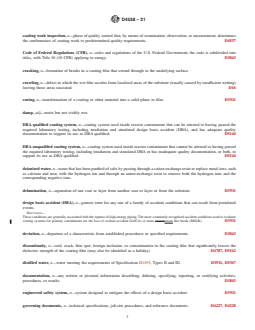
coating work inspection, n—phase of quality control that, by means of examination, observation, or measurement, determines
the conformance of coating work to predetermined quality requirements. D4537
Code of Federal Regulations (CFR), n—rules and regulations of the U.S. Federal Government; the code is subdivided into
titles, with Title 10 (10 CFR) applying to energy. D3843
cracking, n—formation of breaks in a coating film that extend through to the underlying surface.
crawling, n—defect in which the wet film recedes from localized areas of the substrate (usually caused by insufficient wetting)
leaving those areas uncoated. D16
curing, n—transformation of a coating or other material into a solid phase or film. D3911
damp, adj—moist but not visibly wet.
DBA qualified coating system, n—coating system used inside reactor containment that can be attested to having passed the
required laboratory testing, including irradiation and simulated design basis accident (DBA), and has adequate quality
documentation to support its use as DBA qualified. D5144
DBA unqualified coating system, n—coating system used inside reactor containment that cannot be attested to having passed
the required laboratory testing, including irradiation and simulated DBA or has inadequate quality documentation, or both, to
support its use as DBA qualified. D5144
deionized water, n—water that has been purified of salts by passing through a cation-exchange resin to replace metal ions, such
as calcium and iron, with the hydrogen ion and through an anion-exchange resin to remove both the hydrogen ions and the
corresponding negative ions.
delamination, n—separa
...