

ASTM F3460-21
(Test Method)Standard Test Method for Seam Measurement Procedure for Baseballs and Softballs
General Information
- Abstract
SIGNIFICANCE AND USE
4.1 The ball seam height of a baseball or softball is a measurement that can correlate to ball grip and aerodynamic properties.
4.2 This test method is suitable for obtaining data in research and development, quality control, and classifying balls by seam type.
4.3 Sports associations can use seam height standards in specifications for official baseballs and softballs.
4.4 Users of this test method may be testing individual baseballs or softballs or entire production lots of baseballs or softballs. If a single ball or small sample of balls are being measured for individual properties, multiple measurements should be performed on the balls. If a large sample of balls is being measured for the overall seam characteristics of the large sample, then an individual seam height measurement may be recorded for a ball. Thus, number of measurement points (m) on any one ball is at the discretion of the test sponsor of this test method.
SCOPE
1.1 This test method is intended to standardize a method of measuring the seam height of baseballs and softballs.
1.2 This standard is established to provide a single, repeatable, and uniform test method.
1.3 This test method is for a ball that is intended for use in the game of baseball or softball.
1.4 Units—The values stated in inch-pound units are to be regarded as the standard. The values given in parentheses are mathematical conversions to SI units that are provided for information only and are not considered standard.
1.5 This standard does not purport to address all of the safety concerns, if any, associated with its use. It is the responsibility of the user of this standard to establish appropriate safety, health, and environmental practices and determine the applicability of regulatory limitations prior to use.
1.6 This international standard was developed in accordance with internationally recognized principles on standardization established in the Decision on Principles for the Development of International Standards, Guides and Recommendations issued by the World Trade Organization Technical Barriers to Trade (TBT) Committee.
- Status
- Published
- Publication Date
- 14-May-2021
- Technical Committee
- F08 - Sports Equipment, Playing Surfaces, and Facilities
- Drafting Committee
- F08.26 - Baseball and Softball Equipment
Overview
ASTM F3460-21 is the internationally recognized Standard Test Method for Seam Measurement Procedure for Baseballs and Softballs. Developed by ASTM, this standard establishes a repeatable and uniform method for measuring seam height and width on baseballs and softballs. These measurements are crucial as seam dimensions can directly influence a ball’s grip, aerodynamics, and overall performance in the context of gameplay.
The ASTM F3460-21 standard supports research and development, quality control processes, and the official specification of sports equipment as required by sporting associations globally. It ensures that testing results for seam characteristics are consistent, providing reliable data for manufacturers, testing laboratories, and sports governing bodies.
Key Topics
Seam Height Measurement: Standardizes how seam height-the vertical distance from the ball’s panel to the top of the seam-is determined using a dial indicator and three-point cradle. Measurements should be taken at multiple points to ensure accuracy and repeatability.
Seam Width Measurement: Defines the process of measuring the distance across the seam, from the outer edge of a stitching hole to the outer edge on the opposite side. Calipers are used to record these dimensions at several locations around the seam.
Sampling and Testing: The standard accommodates both individual ball testing and batch testing for large production lots. The number of measurement points per ball is at the discretion of the test sponsor to meet the needs of specific quality control or classification programs.
Environmental Controls: Outlines conditioning requirements for test balls, including temperature and humidity controls, to ensure measurement consistency.
Reporting Requirements: Specifies the information to be included in test reports, such as details on testing conditions, equipment, and measurements, to facilitate traceability and reproducibility.
Applications
The ASTM F3460-21 standard delivers practical value across a range of use-cases:
Manufacturers: Employ this test method for quality assurance throughout the production process, verifying that seam heights and widths fall within specified limits for consistent performance.
Sports Associations: Rely on seam height and width data for defining standards and approving official game balls, ensuring every ball meets the required playing specifications.
Testing Laboratories: Use the standardized procedure to provide official testing and certification services for baseballs and softballs seeking compliance with national and international regulations.
Research & Development: Engineers and designers utilize accurate seam measurement data to analyze correlations between seam height, grip, and aerodynamic characteristics of baseballs and softballs during product innovation.
Related Standards
For a comprehensive approach to baseball and softball equipment testing and quality control, the following ASTM standards and international documents may offer additional guidance:
- ASTM F1887 - Test method for measuring the compression-displacement of softballs
- ASTM F910 - Specification for face guards for youth baseball
- ASTM F2166 - Test method for resistance of softballs and baseballs to synthetic material damage
- ISO/IEC 17025 - General requirements for the competence of testing and calibration laboratories
By implementing ASTM F3460-21, organizations reinforce product quality, traceability, and conformity to sports industry requirements, creating confidence among stakeholders from manufacturers to athletes.
Keywords: seam measurement, seam height, seam width, baseball, softball, test method, ASTM F3460-21, quality control, sports equipment standards
Get Certified
Connect with accredited certification bodies for this standard

Control Union Certifications
Global certification for agriculture and sustainability.

Hohenstein Institut
Textile testing and certification.

Bureau Veritas Bangladesh
Bureau Veritas certification services in Bangladesh.
Sponsored listings
Frequently Asked Questions
ASTM F3460-21 is a standard published by ASTM International. Its full title is "Standard Test Method for Seam Measurement Procedure for Baseballs and Softballs". This standard covers: SIGNIFICANCE AND USE 4.1 The ball seam height of a baseball or softball is a measurement that can correlate to ball grip and aerodynamic properties. 4.2 This test method is suitable for obtaining data in research and development, quality control, and classifying balls by seam type. 4.3 Sports associations can use seam height standards in specifications for official baseballs and softballs. 4.4 Users of this test method may be testing individual baseballs or softballs or entire production lots of baseballs or softballs. If a single ball or small sample of balls are being measured for individual properties, multiple measurements should be performed on the balls. If a large sample of balls is being measured for the overall seam characteristics of the large sample, then an individual seam height measurement may be recorded for a ball. Thus, number of measurement points (m) on any one ball is at the discretion of the test sponsor of this test method. SCOPE 1.1 This test method is intended to standardize a method of measuring the seam height of baseballs and softballs. 1.2 This standard is established to provide a single, repeatable, and uniform test method. 1.3 This test method is for a ball that is intended for use in the game of baseball or softball. 1.4 Units—The values stated in inch-pound units are to be regarded as the standard. The values given in parentheses are mathematical conversions to SI units that are provided for information only and are not considered standard. 1.5 This standard does not purport to address all of the safety concerns, if any, associated with its use. It is the responsibility of the user of this standard to establish appropriate safety, health, and environmental practices and determine the applicability of regulatory limitations prior to use. 1.6 This international standard was developed in accordance with internationally recognized principles on standardization established in the Decision on Principles for the Development of International Standards, Guides and Recommendations issued by the World Trade Organization Technical Barriers to Trade (TBT) Committee.
SIGNIFICANCE AND USE 4.1 The ball seam height of a baseball or softball is a measurement that can correlate to ball grip and aerodynamic properties. 4.2 This test method is suitable for obtaining data in research and development, quality control, and classifying balls by seam type. 4.3 Sports associations can use seam height standards in specifications for official baseballs and softballs. 4.4 Users of this test method may be testing individual baseballs or softballs or entire production lots of baseballs or softballs. If a single ball or small sample of balls are being measured for individual properties, multiple measurements should be performed on the balls. If a large sample of balls is being measured for the overall seam characteristics of the large sample, then an individual seam height measurement may be recorded for a ball. Thus, number of measurement points (m) on any one ball is at the discretion of the test sponsor of this test method. SCOPE 1.1 This test method is intended to standardize a method of measuring the seam height of baseballs and softballs. 1.2 This standard is established to provide a single, repeatable, and uniform test method. 1.3 This test method is for a ball that is intended for use in the game of baseball or softball. 1.4 Units—The values stated in inch-pound units are to be regarded as the standard. The values given in parentheses are mathematical conversions to SI units that are provided for information only and are not considered standard. 1.5 This standard does not purport to address all of the safety concerns, if any, associated with its use. It is the responsibility of the user of this standard to establish appropriate safety, health, and environmental practices and determine the applicability of regulatory limitations prior to use. 1.6 This international standard was developed in accordance with internationally recognized principles on standardization established in the Decision on Principles for the Development of International Standards, Guides and Recommendations issued by the World Trade Organization Technical Barriers to Trade (TBT) Committee.
ASTM F3460-21 is classified under the following ICS (International Classification for Standards) categories: 59.060.01 - Textile fibres in general; 97.220.40 - Outdoor and water sports equipment. The ICS classification helps identify the subject area and facilitates finding related standards.
ASTM F3460-21 is available in PDF format for immediate download after purchase. The document can be added to your cart and obtained through the secure checkout process. Digital delivery ensures instant access to the complete standard document.
Standards Content (Sample)
This international standard was developed in accordance with internationally recognized principles on standardization established in the Decision on Principles for the
Development of International Standards, Guides and Recommendations issued by the World Trade Organization Technical Barriers to Trade (TBT) Committee.
Designation: F3460 − 21
Standard Test Method for
Seam Measurement Procedure for Baseballs and Softballs
This standard is issued under the fixed designation F3460; the number immediately following the designation indicates the year of
original adoption or, in the case of revision, the year of last revision. A number in parentheses indicates the year of last reapproval. A
superscript epsilon (´) indicates an editorial change since the last revision or reapproval.
1. Scope single measurement at a single location or the averaging of
multiple measurements at multiple locations on an individual
1.1 This test method is intended to standardize a method of
ball.
measuring the seam height of baseballs and softballs.
2.1.5.1 average seam height (ASH)—average ball seam
1.2 This standard is established to provide a single,
height relative to the region adjacent to the seam.
repeatable, and uniform test method.
2.1.5.2 average ball seam height (ABSH)—average ball
1.3 This test method is for a ball that is intended for use in
seam height relative to the center of the panel.
the game of baseball or softball.
2.1.6 seam region, n—region of the ball which includes the
1.4 Units—The values stated in inch-pound units are to be
seam and stitches and is bound by the lines generated on the
regarded as the standard. The values given in parentheses are
ball by the edge of the holes in the covers that is furthest from
mathematical conversions to SI units that are provided for
the seam and on the outer surface of the ball.
information only and are not considered standard.
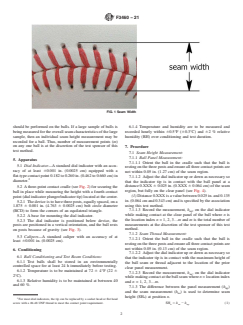
2.1.7 seam width, n—numerical value determined by mea-
1.5 This standard does not purport to address all of the
suringthedistanceacrosstheseamfromtheoutsideedgeofthe
safety concerns, if any, associated with its use. It is the
stitching hole on one side of the seam to the outside edge of the
responsibility of the user of this standard to establish appro-
hole on the other side of the seam (see Fig. 1).
priate safety, health, and environmental practices and deter-
2.1.7.1 Discussion—In cases when the outside edge of the
mine the applicability of regulatory limitations prior to use.
hole is distorted as a result of stretching of the hole, the outside
1.6 This international standard was developed in accor-
edge is defined as the edge between the side wall of the hole
dance with internationally recognized principles on standard-
and the surface of the ball.
ization established in the Decision on Principles for the
2.1.7.2 Discussion—The seam width may consist of a single
Development of International Standards, Guides and Recom-
measurement at a single location or the averaging of multiple
mendations issued by the World Trade Organization Technical
measurements at multiple locations on an individual ball.
Barriers to Trade (TBT) Committee.
3. Summary of Test Method
2. Terminology
3.1 A baseball or softball is placed on a cradle apparatus
2.1 Definitions of Terms Specific to This Standard:
with a dial indicator located on the clear panel and then on the
2.1.1 baseball and softball, n—any ball defined by the rules
seam of the ball. The difference between the height measure-
for the game of baseball or softball.
ments is recorded.
2.1.2 clear panel, n—non-seam region of the ball cover.
4. Significance and Use
2.1.3 panel, n—two larger end regions of the clear panel.
4.1 The ball seam height of a baseball or softball is a
2.1.4 seam, n—line along which two edges of ball covers
measurement that can correlate to ball grip and aerodynamic
are sewn together (stitch line).
properties.
2.1.5 seam height, n—numerical value determined by mea-
4.2 This test method is suitable for obtaining data in
suring the height of the seam of a ball relative to the height of
research and development, quality control, and classifying
the clear panel of the ball.
balls by seam type.
2.1.5.1 Discussion—The seam height may consist of a
4.3 Sports associations can use seam height standards in
specifications for official baseballs and softballs.
This test method is under the jurisdiction of ASTM Committee F08 on Sports
4.4 Users of this test method may be testing individual
Equipment, Playing Surfaces, and Facilities and is the direct responsibility of
baseballs or softballs or entire production lots of baseballs or
Subcommittee F08.26 on Baseball and Softball Equipment.
softballs. If a single ball or small sample of balls are being
Current edition approved May 15, 2021. Published June 2021. DOI: 10.1520/
F3460-21. measured for individual properties, multiple measurements
Copyright © ASTM International, 100 Barr Harbor Drive, PO Box C700, West Conshohocken, PA 19428-2959. United States
F3460 − 21
FIG. 1 Seam Width
should be performed on the balls. If a large sample of balls is 6.1.4 Temperature and humidity are to be measured and
being measured for the overall seam characteristics of the large recorded hourly within 60.5°F (60.3°C) and 62 % relative
sample, then an individual seam height measurement may be humidity (RH) over conditioning and test duration.
recorded for a ball. Thus, number of measurement points (m)
on any one ball is at the discretion of the test sponsor of this 7. Procedure
test method.
7.1 Seam Height Measurement:
7.1.1 Ball Panel Measurement:
5. Apparatus
7.1.1.1 Orient the ball in the cradle such that the ball is
5.1 Dial Indicator—A standard dial indicator with an accu-
resting on the three posts and ensure all three contact points are
racy of at least 60.001 in. (0.0025 cm) equipped with a
not within 0.05 in. (1.27 cm) of the seam region.
flat-type contact point 0.182 to 0.260 in. (0.462 to 0.660 cm) in
7.1.1.2 Adjust the dial indicator up or down as necessary so
diameter.
that the indicator tip is in contact with the ball panel at a
distance 0.XXX 6 0.025 in. (0.XXX 6 0.064 cm) of the seam
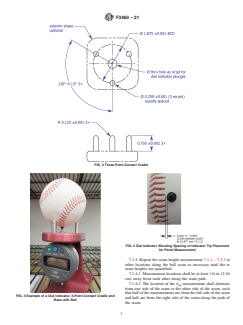
5.2 Athree-point contact cradle (see Fig. 2) for securing the
region, but fully on the clear panel (see Fig. 4).
ball in place while measuring the height with a fourth contact
(1) Distance 0.XXX is a value between 0.025 in. and 0.135
point (dial indicator plunger/indicator tip) located at the center.
in. (0.064 cm and 0.343 cm) and is specified by the association
5.2.1 The device is to have three posts, equally spaced, on a
using this test method.
1.875 6 0.001 in. (4.763 6 0.0025 cm) bolt circle diameter
7.1.1.3 Record the measurement, h , on the dial indicator
(BCD) to form the corners of an equilateral triangle. np
while making contact at the clear panel of the ball where n is
5.2.2 A base for mounting the dial indicator.
the location index n=1,2,3…m and m is the total number of
5.2.3 The dial indicator is positioned below device, the
measurements at the discretion of the test sponsor of this test
posts are positioned in a vertical orientation, and the ball rests
method.
on posts because of gravity (see Fig. 3).
7.1.2 Seam Thread Measurement:
5.3 Calipers—A standard caliper with an accuracy of at
7.1.2.1 Orient the ball in the cradle such that the ball is
least 60.001 in. (0.0025 cm).
resting on the three posts and ensure all three contact points are
not within 0.05 in. (0.13 cm) of the seam region.
6. Conditioning
7.1.2.2 Adjust the dial indicator up or down as necessary so
6.1 Ball Conditioning and Test Room Conditions:
that the indicator tip is in contact with the maximum height of
6.1.1 Test balls shall be stored in an environmentally
the ball seam or thread adjacent to the location of the prior
controlled space for at least 24 h immediately before testing.
clear panel measurement.
6.1.2 Temperature is to be maintained at 72 6 4°F (22 6
7.1.2.3 Record the measurement, h , on the dial indicator
ns
2°C).
while making contact at the ball seam where n = location index
6.1.3 Relative humidity is to be maintained at between 40
and n=1,2,3…m.
and 60 %.
7.1.3 The difference between the panel measurement (h )
np
and the seam measurement (h ) is used to determine seam
ns
height (SH ) at position n.
n
For most dial indicators, the tip can be replaced by a socket head or flat head
screw with a #4-48 UNF thread to meet the contact point requirement. SH 5 h 2 h (1)
n ns np
F3460 − 21
FIG. 2 Three-Point Contact Cradle
FIG. 4 Dial Indicator Showing Spacing of Indicator Tip Placement
for Panel Measurement
7.1.4 Repeat the seam height measurement 7.1.1 – 7.1.3 at
other locations
...