

ASTM E2348-24
(Guide)Standard Guide for Framework for a Consensus-based Environmental Decision-making Process
General Information
- Abstract
SIGNIFICANCE AND USE
5.1 This standard guide is designed to help the owners and regulators of a specific environmental problem to identify and integrate affected stakeholders and establish a process to identify and work through all the key questions and answers essential to a mutually acceptable decision. This standard guide presents a “framework” that is intended to help ensure that all the CBED process components (that is, human health, ecological condition, socio-cultural values and economic well-being) are considered, but is designed to allow the user to interpret which components of the process are applicable and how these components are defined for the specific environmental problem being addressed. It also provides general guidance to help with selecting approaches and methods for specific analyses of each of the major CBED components (that is, human health, ecological condition, socio-cultural values, and economic well-being). The CBED process can be easily coupled with other relevant standards (for example Guides E1739, E1984, E2205, and E2876) and environmental compliance guidance and requirements, for example, Quality of Stakeholder-Based Decisions and Understanding Risk, 40 CRF 1501, 10 CFR 20, and Marine Mammals Protection Act of 1972.
5.2 The CBED process is appropriate in two contexts: (1) when a specific project is proposed; and (2) when there are or may be public concerns about specific health, environmental, cultural, social or economic issues. CERCLA § 128(a) grantees will find the CBED process useful for community engagement activities such as the analysis of brownfields cleanup alternatives.
5.3 Involving affected stakeholders actively in the decision-making process reorients that process from one dominated by regulators and owners to one that includes those who live with the consequences of the decision. This not only increases the successful implementation of decisions, but also can promote greater trust in government, industry and other institutions (See Se...
SCOPE
1.1 This guide presents a framework for a stakeholder-focused Consensus-based Environmental Decision-making (CBED) process, which is a stakeholder-empowered, process to prioritize and select actions to be initiated with the goal of optimizing many types of environmental decisions that may affect a community or communities.
1.2 This guide is intended to describe a highly flexible CBED process, and therefore does not recommend a specific course of action for this activity.
1.3 This guide is intended to assist in implementing a CBED process, which allows assessing the full impact of any project- or issue-related decisions related to human health, ecological, socio-cultural or economic impacts.2
1.3.1 States and Tribes applying for CERCLA §128(a) Brownfields grants may find this guide useful when developing and implementing their meaningful public participation and community engagement programs.
1.4 This guide is not intended to replace existing environmental decision-making or public participation processes. It may be used with other processes or standards that address stakeholder involvement in environmental decision-making.
1.5 Limitations—This standard does not address the specific methods for generating or evaluating technical data related to assessing a particular environmental issues. The user should seek other sources on methods to gather information for completion of models or other analyses that may be used during a CBED process. This standard may not fully address the rights of owners of real property or the potential impact (positive or negative) on the value of real property of a decision made using this process.
1.6 This international standard was developed in accordance with internationally recognized principles on standardization established in the Decision on Principles for the Development of International Standards, Guides and Recommendations issued by the World Trade Organization Technica...
- Status
- Published
- Publication Date
- 31-Jan-2024
- Technical Committee
- E50 - Environmental Assessment, Risk Management and Corrective Action
- Drafting Committee
- E50.05 - Environmental Risk Management
Buy Documents
ASTM E2348-24 - Standard Guide for Framework for a Consensus-based Environmental Decision-making Process
REDLINE ASTM E2348-24 - Standard Guide for Framework for a Consensus-based Environmental Decision-making Process
Overview
ASTM E2348-24: Standard Guide for Framework for a Consensus-based Environmental Decision-making Process establishes a comprehensive, stakeholder-driven process for making environmental decisions. Developed by ASTM International, this guide provides a flexible framework to integrate affected stakeholders and address all relevant human health, ecological, socio-cultural, and economic components. It is especially valuable for communities, regulators, and owners managing environmental issues that could impact various groups. The guide promotes informed consent, transparency, and inclusive participation, leading to decisions that are widely supported and more effectively implemented.
Key Topics
- Stakeholder Integration: Central to this guide is the early and active participation of affected stakeholders throughout the decision-making process. Stakeholders help define problems, clarify questions, and directly participate in developing solutions.
- Consensus-based Approach: The framework fosters agreement among diverse parties by encouraging open dialogue, negotiation, and trade-offs, moving beyond regulator-dominated decisions.
- Flexible Process: The CBED framework is adaptable, allowing users to determine which components-human health, ecological, socio-cultural, and economic-are most relevant for a specific environmental problem.
- Iterative Steps: The process includes identification of stakeholders, information gathering, option generation and impact forecasting, obtaining informed consent, and implementation with ongoing evaluation. This iterative structure accommodates changing conditions and new data.
- Analytical Guidance: While not prescribing specific technical data or methodologies, the guide offers support for selecting appropriate approaches to analyze each major component pertinent to a decision.
Applications
ASTM E2348-24 is applicable in a wide range of environmental contexts, notably:
- Project Proposals: When launching a project with potential environmental impacts, this guide helps ensure that all affected groups are heard and that their concerns are addressed through consensus.
- Public Concerns: In cases where health, environmental, cultural, social, or economic issues arise, the CBED process aids stakeholders and regulators in collaboratively navigating complex issues.
- Community Engagement: Ideal for state and tribal agencies applying for CERCLA §128(a) Brownfields grants, especially during public participation and community consultation phases.
- Policy Integration: The guide is designed to be used in conjunction with existing public participation or environmental decision-making processes, enhancing inclusivity and transparency.
- Comprehensive Analysis: Organizations can consider the full scope of impacts-from human health to economic consequences-when making decisions, promoting balanced and mutually acceptable solutions.
Related Standards
ASTM E2348-24 aligns with and can complement the following standards and regulatory references:
- ASTM E1739: Guide for Risk-Based Corrective Action Applied at Petroleum Release Sites
- ASTM E1984: Guide for Brownfields Redevelopment
- ASTM E2205: Guide for Risk-Based Corrective Action for Protection of Ecological Resources
- ASTM E2876: Guide for Integrating Sustainable Objectives into Cleanup
- ASTM E3356: Guide for Stakeholder Engagement on Environmental Risk Management and Climate
Regulatory References:
- Quality of Stakeholder-Based Decisions and Understanding Risk (40 CFR Part 1501-1506)
- Standards for Protection Against Radiation (10 CFR Part 20)
- Marine Mammal Protection Act of 1972
- Guidance from the US EPA and Department of Interior on collaborative decision-making
Practical Value
By implementing ASTM E2348-24, organizations, regulators, and communities benefit from:
- Greater Trust: Actively involving stakeholders increases public trust in outcomes and institutions.
- Reduced Conflict: Early and ongoing engagement can help avoid litigation and project delays.
- Custom Solutions: The flexible framework can be tailored to local needs and specific environmental issues.
- Improved Outcomes: Consensus-built decisions are more likely to be implemented successfully and deliver lasting benefits.
In short, ASTM E2348-24 is a key resource for any initiative seeking to integrate diverse interests, ensure compliance, and optimize the sustainability and acceptance of environmental decisions.
Relations
- Effective Date
- 01-Feb-2024
- Effective Date
- 01-Feb-2024
- Effective Date
- 01-Feb-2024
- Effective Date
- 01-Feb-2024
- Effective Date
- 01-Feb-2024
- Effective Date
- 01-Feb-2024
- Effective Date
- 01-Feb-2024
- Referred By
ASTM E3350-22 - Standard Guide for Community Resilience Planning for Buildings and Infrastructure - Effective Date
- 01-Feb-2024
Buy Documents
ASTM E2348-24 - Standard Guide for Framework for a Consensus-based Environmental Decision-making Process
REDLINE ASTM E2348-24 - Standard Guide for Framework for a Consensus-based Environmental Decision-making Process
Get Certified
Connect with accredited certification bodies for this standard

BSI Group
BSI (British Standards Institution) is the business standards company that helps organizations make excellence a habit.

Bureau Veritas
Bureau Veritas is a world leader in laboratory testing, inspection and certification services.

DNV
DNV is an independent assurance and risk management provider.
Sponsored listings
Frequently Asked Questions
ASTM E2348-24 is a guide published by ASTM International. Its full title is "Standard Guide for Framework for a Consensus-based Environmental Decision-making Process". This standard covers: SIGNIFICANCE AND USE 5.1 This standard guide is designed to help the owners and regulators of a specific environmental problem to identify and integrate affected stakeholders and establish a process to identify and work through all the key questions and answers essential to a mutually acceptable decision. This standard guide presents a “framework” that is intended to help ensure that all the CBED process components (that is, human health, ecological condition, socio-cultural values and economic well-being) are considered, but is designed to allow the user to interpret which components of the process are applicable and how these components are defined for the specific environmental problem being addressed. It also provides general guidance to help with selecting approaches and methods for specific analyses of each of the major CBED components (that is, human health, ecological condition, socio-cultural values, and economic well-being). The CBED process can be easily coupled with other relevant standards (for example Guides E1739, E1984, E2205, and E2876) and environmental compliance guidance and requirements, for example, Quality of Stakeholder-Based Decisions and Understanding Risk, 40 CRF 1501, 10 CFR 20, and Marine Mammals Protection Act of 1972. 5.2 The CBED process is appropriate in two contexts: (1) when a specific project is proposed; and (2) when there are or may be public concerns about specific health, environmental, cultural, social or economic issues. CERCLA § 128(a) grantees will find the CBED process useful for community engagement activities such as the analysis of brownfields cleanup alternatives. 5.3 Involving affected stakeholders actively in the decision-making process reorients that process from one dominated by regulators and owners to one that includes those who live with the consequences of the decision. This not only increases the successful implementation of decisions, but also can promote greater trust in government, industry and other institutions (See Se... SCOPE 1.1 This guide presents a framework for a stakeholder-focused Consensus-based Environmental Decision-making (CBED) process, which is a stakeholder-empowered, process to prioritize and select actions to be initiated with the goal of optimizing many types of environmental decisions that may affect a community or communities. 1.2 This guide is intended to describe a highly flexible CBED process, and therefore does not recommend a specific course of action for this activity. 1.3 This guide is intended to assist in implementing a CBED process, which allows assessing the full impact of any project- or issue-related decisions related to human health, ecological, socio-cultural or economic impacts.2 1.3.1 States and Tribes applying for CERCLA §128(a) Brownfields grants may find this guide useful when developing and implementing their meaningful public participation and community engagement programs. 1.4 This guide is not intended to replace existing environmental decision-making or public participation processes. It may be used with other processes or standards that address stakeholder involvement in environmental decision-making. 1.5 Limitations—This standard does not address the specific methods for generating or evaluating technical data related to assessing a particular environmental issues. The user should seek other sources on methods to gather information for completion of models or other analyses that may be used during a CBED process. This standard may not fully address the rights of owners of real property or the potential impact (positive or negative) on the value of real property of a decision made using this process. 1.6 This international standard was developed in accordance with internationally recognized principles on standardization established in the Decision on Principles for the Development of International Standards, Guides and Recommendations issued by the World Trade Organization Technica...
SIGNIFICANCE AND USE 5.1 This standard guide is designed to help the owners and regulators of a specific environmental problem to identify and integrate affected stakeholders and establish a process to identify and work through all the key questions and answers essential to a mutually acceptable decision. This standard guide presents a “framework” that is intended to help ensure that all the CBED process components (that is, human health, ecological condition, socio-cultural values and economic well-being) are considered, but is designed to allow the user to interpret which components of the process are applicable and how these components are defined for the specific environmental problem being addressed. It also provides general guidance to help with selecting approaches and methods for specific analyses of each of the major CBED components (that is, human health, ecological condition, socio-cultural values, and economic well-being). The CBED process can be easily coupled with other relevant standards (for example Guides E1739, E1984, E2205, and E2876) and environmental compliance guidance and requirements, for example, Quality of Stakeholder-Based Decisions and Understanding Risk, 40 CRF 1501, 10 CFR 20, and Marine Mammals Protection Act of 1972. 5.2 The CBED process is appropriate in two contexts: (1) when a specific project is proposed; and (2) when there are or may be public concerns about specific health, environmental, cultural, social or economic issues. CERCLA § 128(a) grantees will find the CBED process useful for community engagement activities such as the analysis of brownfields cleanup alternatives. 5.3 Involving affected stakeholders actively in the decision-making process reorients that process from one dominated by regulators and owners to one that includes those who live with the consequences of the decision. This not only increases the successful implementation of decisions, but also can promote greater trust in government, industry and other institutions (See Se... SCOPE 1.1 This guide presents a framework for a stakeholder-focused Consensus-based Environmental Decision-making (CBED) process, which is a stakeholder-empowered, process to prioritize and select actions to be initiated with the goal of optimizing many types of environmental decisions that may affect a community or communities. 1.2 This guide is intended to describe a highly flexible CBED process, and therefore does not recommend a specific course of action for this activity. 1.3 This guide is intended to assist in implementing a CBED process, which allows assessing the full impact of any project- or issue-related decisions related to human health, ecological, socio-cultural or economic impacts.2 1.3.1 States and Tribes applying for CERCLA §128(a) Brownfields grants may find this guide useful when developing and implementing their meaningful public participation and community engagement programs. 1.4 This guide is not intended to replace existing environmental decision-making or public participation processes. It may be used with other processes or standards that address stakeholder involvement in environmental decision-making. 1.5 Limitations—This standard does not address the specific methods for generating or evaluating technical data related to assessing a particular environmental issues. The user should seek other sources on methods to gather information for completion of models or other analyses that may be used during a CBED process. This standard may not fully address the rights of owners of real property or the potential impact (positive or negative) on the value of real property of a decision made using this process. 1.6 This international standard was developed in accordance with internationally recognized principles on standardization established in the Decision on Principles for the Development of International Standards, Guides and Recommendations issued by the World Trade Organization Technica...
ASTM E2348-24 is classified under the following ICS (International Classification for Standards) categories: 13.020.20 - Environmental economics. Sustainability. The ICS classification helps identify the subject area and facilitates finding related standards.
ASTM E2348-24 has the following relationships with other standards: It is inter standard links to ASTM E2348-17, ASTM E2590-23, ASTM E2531-06(2020), ASTM E2876-13(2020), ASTM E2728-19, ASTM E3356-22, ASTM E3377-24, ASTM E3350-22. Understanding these relationships helps ensure you are using the most current and applicable version of the standard.
ASTM E2348-24 is available in PDF format for immediate download after purchase. The document can be added to your cart and obtained through the secure checkout process. Digital delivery ensures instant access to the complete standard document.
Standards Content (Sample)
This international standard was developed in accordance with internationally recognized principles on standardization established in the Decision on Principles for the
Development of International Standards, Guides and Recommendations issued by the World Trade Organization Technical Barriers to Trade (TBT) Committee.
Designation: E2348 − 24
Standard Guide for
Framework for a Consensus-based Environmental Decision-
making Process
This standard is issued under the fixed designation E2348; the number immediately following the designation indicates the year of
original adoption or, in the case of revision, the year of last revision. A number in parentheses indicates the year of last reapproval. A
superscript epsilon (´) indicates an editorial change since the last revision or reapproval.
1. Scope the rights of owners of real property or the potential impact
(positive or negative) on the value of real property of a decision
1.1 This guide presents a framework for a stakeholder-
made using this process.
focused Consensus-based Environmental Decision-making
1.6 This international standard was developed in accor-
(CBED) process, which is a stakeholder-empowered, process
dance with internationally recognized principles on standard-
to prioritize and select actions to be initiated with the goal of
ization established in the Decision on Principles for the
optimizing many types of environmental decisions that may
Development of International Standards, Guides and Recom-
affect a community or communities.
mendations issued by the World Trade Organization Technical
1.2 This guide is intended to describe a highly flexible
Barriers to Trade (TBT) Committee.
CBED process, and therefore does not recommend a specific
course of action for this activity.
2. Referenced Documents
1.3 This guide is intended to assist in implementing a CBED 3
2.1 ASTM Standards:
process, which allows assessing the full impact of any project-
E1739 Guide for Risk-Based Corrective Action Applied at
or issue-related decisions related to human health, ecological, 4
Petroleum Release Sites (Withdrawn 2024)
socio-cultural or economic impacts.
E1984 Guide for Brownfields Redevelopment (Withdrawn
1.3.1 States and Tribes applying for CERCLA §128(a) 4
2012)
Brownfields grants may find this guide useful when developing
E2205 Guide for Risk-Based Corrective Action for Protec-
and implementing their meaningful public participation and
tion of Ecological Resources
community engagement programs.
E2876 Guide for Integrating Sustainable Objectives into
1.4 This guide is not intended to replace existing environ-
Cleanup
mental decision-making or public participation processes. It
E3356 Guide for Stakeholder Engagement on Environmen-
may be used with other processes or standards that address
tal Risk Management and Climate
stakeholder involvement in environmental decision-making.
2.2 Other Documents:
P/CCRARM (The Presidential/Congressional Commission
1.5 Limitations—This standard does not address the specific
on Risk Assessment and Risk Management),
methods for generating or evaluating technical data related to
1997a, Framework for Environmental Health Risk Man-
assessing a particular environmental issues. The user should
agement. Final Report. Volume I.
seek other sources on methods to gather information for
P/CCRARM (The Presidential/Congressional Commission
completion of models or other analyses that may be used
on Risk Assessment and Risk Management), 1997b, Risk
during a CBED process. This standard may not fully address
Assessment and Risk Management in Regulatory
Decision-Making. Volume II.
This guide is under the jurisdiction of ASTM Committee E50 on Environmental
Assessment, Risk Management and Corrective Action and is the direct responsibil-
ity of Subcommittee E50.05 on Environmental Risk Management.
Current edition approved Feb. 1, 2024. Published March 2024. Originally For referenced ASTM standards, visit the ASTM website, www.astm.org, or
approved in 2006. Last previous edition approved in 2017 as E2348–17. DOI: contact ASTM Customer Service at service@astm.org. For Annual Book of ASTM
10.1520/E2348-24. Standards volume information, refer to the standard’s Document Summary page on
The CBED process is not meant to replace other processes, such as the U.S. the ASTM website.
National Environmental Policy Act (NEPA) process. The strength of the CBED The last approved version of this historical standard is referenced on
process is to empower the stakeholders in an organized fashion to focus on specific www.astm.org.
issues that tend to result in litigation and long delays and can be readily used in Available at http://www.riskworld.com/Nreports/nr7me001.htm.
conjunction with NEPA and/or other public participation processes. Available at http://www.riskworld.com/Nreports/nr7me001.htm
Copyright © ASTM International, 100 Barr Harbor Drive, PO Box C700, West Conshohocken, PA 19428-2959. United States
E2348 − 24
Quality of Stakeholder-Based Decisions and Understanding 3.1.8 regulator—a local, regional, state/provincial, Tribal or
Risk federal government agency or person employed to administra-
40CFR, Part 1501-1506, The Quality of Stakeholder-Based tor and enforce compliance with laws and regulations, which
Decisions: Lessons from the Case Study Record, Re- may be either a stakeholder, a decision-maker, or an advisor to
sources for the Future the Stakeholder Committee.
10CFR Part 20, NEPA and Agency Planning; "Standards for
3.1.9 stakeholder committee—the entity empowered to
Protection Against Radiation," Subpart E, "Radiological
make decisions within the CBED process which is composed
Criteria for License Termination.
of representative(s) selected from each group of affected
Section 117(d) of the Marine Mammals Protection Act of
stakeholders.
1972 16 U.S.C. 1386, Section 117
3.1.9.1 Discussion—Members of the Stakeholder Commit-
U.S. Department of Interior. BLM Collaborative Stake-
tee are responsible to act as liaisons with their respective
holder Engagement and Appropriate Dispute Resolution,
stakeholder groups.
2009 (BLM 2009)
US EPA. Better Decisions Through Consultation and
4. Summary of Guide
Collaboration, September 2015 (EPA 2015)
4.1 The Consensus-Based Environmental Decision-making
Process is a stakeholder-empowered, community-specific pro-
3. Terminology
cess established to assess, prioritize and select actions to
3.1 Definitions:
initiate with the goal of optimizing environmental decision-
3.1.1 affected stakeholder, n—any individual, group,
making with respect to human health, ecological, socio-
company, organization, government, tribe or other entity which
cultural, and economic impacts. The Stakeholder Committee
may be directly affected by or has a stake in the outcome of the
may consider issues related to environmental justice, which
specific CBED process.
relates to the fair treatment and meaningful involvement of all
3.1.2 community—a group or groups of individuals who live people, regardless of race, ethnicity, income, national origin or
education level. The CBED process is an iterative process
or work in specific neighborhoods or regions.
comprised of five main steps: (1) affected stakeholder identi-
3.1.3 consensus—a generally accepted agreement among a
fication and formation of the Stakeholder Committee; (see
group of stakeholders.
BLM 2009, EPA 2015, and Section 6.2 of Guide E3356) (2)
3.1.4 consensus-based environmental decision-making
information gathering; (3) forecasting; (4) establishment of
(CBED) framework—a process structure that will facilitate
informed consent; and (5) implementation and evaluation of
empowering affected stakeholders in developing a CBED
initiatives.
process.
4.2 The CBED process facilitates decision-making through
3.1.5 consensus-based environmental decision-making
negotiations among affected stakeholders with fairly consen-
(CBED) process—a stakeholder-empowered process to assess,
sual decision rules. An important part of the process is to
prioritize and select actions to initiate with the goal of
determine and clearly communicate to all participants the rules
optimizing environmental decisions with respect to human
to be followed about transparency, the procedures that will be
health, and ecological, socio-cultural, and economic impacts.
used to reach consensus, and the delineation of the ultimate
3.1.6 informed consent—agreement reached by affected
decision-making authority (see EPA 2015 and Section 6.4 of
stakeholders, which is obtained by a process by which affected
Guide E3356).
stakeholders (1) are involved in a participative process that
4.3 The CBED process allows the impact of any project-
creates common understanding of the issues, concerns and
related or issue-related decision to be assessed. The process
priorities held by all affected stakeholders; (2) assess, prioritize
provides all affected stakeholders with scientific and legal
and select actions to improve the problem situation; and (3)
analyses and decision criteria that are prepared and interpreted
agree to trade-offs to achieve consensus on specific initiatives
by scientific, technical, and legal experts, as well as relevant
related to the CBED process.
qualitative experiential knowledge and values-based decision
3.1.7 interested party—any individual, group, company,
criteria. The Stakeholder Committee decides the relevance and
organization or other entity which is not an “affected stake-
importance of the criteria to the decision under consideration.
holder” but which is interested in the outcome of the particular
4.4 There is no specific path that has to be followed when
CBED process. Interested parties are not empowered with a
initiating and participating in this CBED process. Depending
decision-making role, and may participate on the Stakeholder
on the needs and priorities of the affected stakeholders and the
Committee only as an observer or to provide information at the
legal constraints governing specific environmental decisions,
discretion of the Stakeholder Committee.
different entities may initiate the process, different procedural
rules may be adopted, and different analysis tools may be used
to address each issue or concern (see BLM 2009).
Available at: http://www.rff.org/Documents/RFF-DP-00-56.pdf
Available from DLA Document Services, Building 4/D, 700 Robbins Ave.,
Philadelphia, PA 19111-5094, http://quicksearch.dla.mil. 5. Significance and Use
Available from National Oceanic and Atmospheric Administration (NOAA),
5.1 This standard guide is designed to help the owners and
1401 Constitution Ave., NW, Room 5128, Washington, DC 20230, http://
www.noaa.gov. regulators of a specific environmental problem to identify and
E2348 − 24
integrate affected stakeholders and establish a process to Analysis Table). These groups should be invited to select (a)
identify and work through all the key questions and answers representative(s) to participate on the Stakeholder Committee;
essential to a mutually acceptable decision. This standard guide the most effective representatives are those selected by the
presents a “framework” that is intended to help ensure that all group or organization to be represented. There may be (a)
the CBED process components (that is, human health, ecologi- representative(s) of several organizations within each category
cal condition, socio-cultural values and economic well-being) (for example, there may be two main industries in the area;
are considered, but is designed to allow the user to interpret there may be three government agencies which require repre-
which components of the process are applicable and how these sentation; etc.). Each member of the Stakeholder Committee is
components are defined for the specific environmental problem responsible to act as liaison with their respective stakeholder
being addressed. It also provides general guidance to help with group.
selecting approaches and methods for specific analyses of each
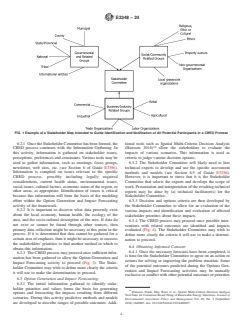
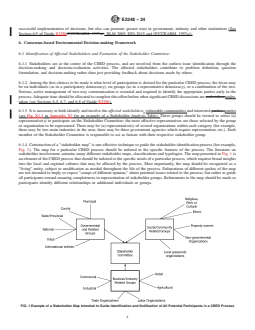
6.1.4 Construction of a “stakeholder map” is one effective
of the major CBED components (that is, human health, technique to guide the stakeholder identification process (for
ecological condition, socio-cultural values, and economic well-
example, Fig. 1). The map for a particular CBED process
being). The CBED process can be easily coupled with other should be tailored to the specific features of the process. The
relevant standards (for example Guides E1739, E1984, E2205,
literature on stakeholder involvement contains many different
and E2876) and environmental compliance guidance and
stakeholder maps, classifications and typologies. The map
requirements, for example, Quality of Stakeholder-Based De-
presented in Fig. 1 is an element of the CBED process that
cisions and Understanding Risk, 40 CRF 1501, 10 CFR 20, and
should be tailored to the specific needs of a particular process,
Marine Mammals Protection Act of 1972.
which requires broad insights into the local and regional
cultures that may be affected by the process. Most importantly,
5.2 The CBED process is appropriate in two contexts: (1)
the map should be recognized as a “living” entity, subjec
...
This document is not an ASTM standard and is intended only to provide the user of an ASTM standard an indication of what changes have been made to the previous version. Because
it may not be technically possible to adequately depict all changes accurately, ASTM recommends that users consult prior editions as appropriate. In all cases only the current version
of the standard as published by ASTM is to be considered the official document.
Designation: E2348 − 17 E2348 − 24
Standard Guide for
Framework for a Consensus-based Environmental Decision-
making Process
This standard is issued under the fixed designation E2348; the number immediately following the designation indicates the year of
original adoption or, in the case of revision, the year of last revision. A number in parentheses indicates the year of last reapproval. A
superscript epsilon (´) indicates an editorial change since the last revision or reapproval.
1. Scope
1.1 This guide presents a framework for a stakeholder-focused Consensus-based Environmental Decision-making (CBED)
process, which is a stakeholder-empowered, process to prioritize and select actions to be initiated with the goal of optimizing many
types of environmental decisions that may affect a community or communities.
1.2 This guide is intended to describe a highly flexible CBED process, and therefore does not recommend a specific course of
action for this activity.
1.3 This guide is intended to assist in implementing a CBED process, which allows assessing the full impact of any project- or
issue-related decisions related to human health, ecological, socio-cultural or economic impacts.
1.3.1 States and Tribes applying for CERCLA §128(a) Brownfields grants may find this guide useful when developing and
implementing their meaningful public participation and community engagement programs.
1.4 This guide is not intended to replace existing environmental decision-making or public participation processes. It may be used
with other processes or standards that address stakeholder involvement in environmental decision-making.
1.5 Limitations—This standard does not address the specific methods for generating or evaluating technical data related to
assessing a particular environmental issues. The user should seek other sources on methods to gather information for completion
of models or other analyses that may be used during a CBED process. This standard may not fully address the rights of owners
of real property or the potential impact (positive or negative) on the value of real property of a decision made using this process.
1.6 This international standard was developed in accordance with internationally recognized principles on standardization
established in the Decision on Principles for the Development of International Standards, Guides and Recommendations issued
by the World Trade Organization Technical Barriers to Trade (TBT) Committee.
This guide is under the jurisdiction of ASTM Committee E50 on Environmental Assessment, Risk Management and Corrective Action and is the direct responsibility
of Subcommittee E50.05 on Environmental Risk Management.
Current edition approved Jan. 1, 2017Feb. 1, 2024. Published January 2017March 2024. Originally approved in 2006. Last previous edition approved in 20102017 as
E2348–06(2010).E2348–17. DOI: 10.1520/E2348-17.10.1520/E2348-24.
The CBED process is not meant to replace other processes, such as the U.S. National Environmental Policy Act (NEPA) process. The strength of the CBED process is
to empower the stakeholders in an organized fashion to focus on specific issues that tend to result in litigation and long delays and can be readily used in conjunction with
NEPA and/or other public participation processes.
Copyright © ASTM International, 100 Barr Harbor Drive, PO Box C700, West Conshohocken, PA 19428-2959. United States
E2348 − 24
2. Referenced Documents
2.1 ASTM Standards:
E1739 Guide for Risk-Based Corrective Action Applied at Petroleum Release Sites (Withdrawn 2024)
E1984 Guide for Brownfields Redevelopment (Withdrawn 2012)
E2205 Guide for Risk-Based Corrective Action for Protection of Ecological Resources
E2876 Guide for Integrating Sustainable Objectives into Cleanup
E3356 Guide for Stakeholder Engagement on Environmental Risk Management and Climate
2.2 Other Documents:
P/CCRARM (The Presidential/Congressional Commission on Risk Assessment and Risk Management), 1997a, Framework for
Environmental Health Risk Management. Final Report. Volume I.
P/CCRARM (The Presidential/Congressional Commission on Risk Assessment and Risk Management), 1997b, Risk Assess-
ment and Risk Management in Regulatory Decision-Making. Volume II.
Quality of Stakeholder-Based Decisions and Understanding Risk
40CFR, Part 1501-1506, The Quality of Stakeholder-Based Decisions: Lessons from the Case Study Record, Resources for the
Future
10CFR Part 20, NEPA and Agency Planning; "Standards for Protection Against Radiation," Subpart E, "Radiological Criteria for
License Termination.
Section 117(d) of the Marine Mammals Protection Act of 1972 16 U.S.C. 1386, Section 117
U.S. Department of Interior. BLM Collaborative Stakeholder Engagement and Appropriate Dispute Resolution, 2009 (BLM
2009)
US EPA. Better Decisions Through Consultation and Collaboration, September 2015 (EPA 2015)
3. Terminology
3.1 Definitions:
3.1.1 affected stakeholder—stakeholder, n—any individual, group, company, organization, government, tribe or other entity which
may be directly affected by or has a stake in the outcome of the specific CBED process.
3.1.2 community—a group or groups of individuals who live or work in specific neighborhoods or regions.
3.1.3 consensus—a generally accepted agreement among a group of stakeholders.
3.1.4 consensus-based environmental decision-making (CBED) framework—a process structure that will facilitate empowering
affected stakeholders in developing a CBED process.
3.1.5 consensus-based environmental decision-making (CBED) process—a stakeholder-empowered process to assess, prioritize
and select actions to initiate with the goal of optimizing environmental decisions with respect to human health, and ecological,
socio-cultural, and economic impacts.
3.1.6 informed consent—agreement reached by affected stakeholders, which is obtained by a process by which affected
stakeholders (1) are involved in a participative process that creates common understanding of the issues, concerns and priorities
held by all affected stakeholders; (2) assess, prioritize and select actions to improve the problem situation; and (3) agree to
trade-offs to achieve consensus on specific initiatives related to the CBED process.
3.1.7 interested party—any individual, group, company, organization or other entity which is not an “affected stakeholder” but
which is interested in the outcome of the particular CBED process. Interested parties are not empowered with a decision-making
role, and may participate on the Stakeholder Committee only as an observer or to provide information at the discretion of the
Stakeholder Committee.
For referenced ASTM standards, visit the ASTM website, www.astm.org, or contact ASTM Customer Service at service@astm.org. For Annual Book of ASTM Standards
volume information, refer to the standard’s Document Summary page on the ASTM website.
The last approved version of this historical standard is referenced on www.astm.org.
Available at http://www.riskworld.com/Nreports/nr7me001.htm.
Available at http://www.riskworld.com/Nreports/nr7me001.htm
Available at: http://www.rff.org/Documents/RFF-DP-00-56.pdf
Available from DLA Document Services, Building 4/D, 700 Robbins Ave., Philadelphia, PA 19111-5094, http://quicksearch.dla.mil.
Available from National Oceanic and Atmospheric Administration (NOAA), 1401 Constitution Ave., NW, Room 5128, Washington, DC 20230, http://www.noaa.gov.
E2348 − 24
3.1.8 regulator—a local, regional, state/provincial state/provincial, Tribal or federal government agency or person employed to
administrator and enforce compliance with laws and regulations, which may be either a stakeholder, a decision-maker, or an
advisor to the Stakeholder Committee.
3.1.9 stakeholder committee—the entity empowered to make decisions within the CBED process which is composed of
representative(s) selected from each group of affected stakeholders. Members of the Stakeholder Committee are responsible to act
as liaisons with their respective stakeholder groups.
3.1.9.1 Discussion—
Members of the Stakeholder Committee are responsible to act as liaisons with their respective stakeholder groups.
4. Summary of Guide
4.1 The Consensus-Based Environmental Decision-making Process is a stakeholder-empowered, community-specific process
established to assess, prioritize and select actions to initiate with the goal of optimizing environmental decision-making with
respect to human health, ecological, socio-cultural, and economic impacts. The Stakeholder Committee may consider issues related
to environmental justice, which relates to the fair treatment and meaningful involvement of all people, regardless of race, ethnicity,
income, national origin or education level. The CBED process is an iterative process comprised of five main steps: (1) affected
stakeholder identification and formation of the Stakeholder Committee; (see BLM 2009, EPA 2015, and Section 6.2 of Guide
E3356) (2) information gathering; (3) forecasting; (4) establishment of informed consent; and (5) implementation and evaluation
of initiatives.
4.2 The CBED process facilitates decision-making through negotiations among affected stakeholders with fairly consensual
decision rules. An important part of the process is to determine and clearly communicate to all participants the rules to be followed
about transparency, the procedures that will be used to reach consensus, and the delineation of the ultimate decision-making
authority.authority (see EPA 2015 and Section 6.4 of Guide E3356).
4.3 The CBED process allows the impact of any project-related or issue-related decision to be assessed. The process provides all
affected stakeholders with scientific and legal analyses and decision criteria that are prepared and interpreted by scientific,
technical, and legal experts, as well as relevant qualitative experiential knowledge and values-based decision criteria. The
Stakeholder Committee decides the relevance and importance of the criteria to the decision under consideration.
4.4 There is no specific path that has to be followed when initiating and participating in this CBED process. Depending on the
needs and priorities of the affected stakeholders and the legal constraints governing specific environmental decisions, different
entities may initiate the process, different procedural rules may be adopted, and different analysis tools may be used to address each
issue or concern.concern (see BLM 2009).
5. Significance and Use
5.1 This standard guide is designed to help the owners and regulators of a specific environmental problem to identify and integrate
affected stakeholders and establish a process to identify and work through all the key questions and answers essential to a mutually
acceptable decision. This standard guide presents a “framework” that is intended to help ensure that all the CBED process
components (that is, human health, ecological condition, socio-cultural values and economic well-being) are considered, but is
designed to allow the user to interpret which components of the process are applicable and how these components are defined for
the specific environmental problem being addressed. It also provides general guidance to help with selecting approaches and
methods for specific analyses of each of the major CBED components (that is, human health, ecological condition, socio-cultural
values, and economic well-being). The CBED process can be easily coupled with other relevant standards (for example Guides
E1739, E1984, E2205, and E2876) and environmental compliance guidance and requirements, for example, Quality of
Stakeholder-Based Decisions and Understanding Risk, 40 CRF 1501, 10 CFR 20, and Marine Mammals Protection Act of 1972.
5.2 The CBED process is appropriate in two contexts: (1) when a specific project is proposed; and (2) when there are or may be
public concerns about specific health, environmental, cultural, social or economic issues. CERCLA § 128(a) grantees will find the
CBED process useful for community engagement activities such as the analysis of brownfields cleanup alternatives.
5.3 Involving affected stakeholders actively in the decision-making process reorients that process from one dominated by
regulators and owners to one that includes those who live with the consequences of the decision. This not only increases the
E2348 − 24
successful implementation of decisions, but also can promote greater trust in government, industry and other institutions (See
Section 6.9 of Guide E3356(P/CCRARM, 1997a)., BLM 2009, EPA 2015 and (P/CCRARM, 1997a)).
6. Consensus-based Environmental Decision-making Framework
6.1 Identification of Affected Stakeholders and Formation of the Stakeholder Committee:
6.1.1 Stakeholders are at the center of the CBED process, and are involved from the earliest issue identification through the
decision-making and de
...