

ASTM D7958/D7958M-17
(Test Method)Standard Test Method for Evaluation of Performance for FRP Composite Bonded to Concrete Substrate using Beam Test
General Information
- Abstract
SIGNIFICANCE AND USE
5.1 This test method serves as a means for uniformly preparing and testing standard specimens suitable for being subject to environmental conditioning and subsequently used to evaluate FRP-bonded-to-concrete system performance, and evaluating and reporting the results.
5.2 This test method is intended for use in the laboratory.
5.3 The comparison of results from this test method conducted on identical specimens subject to different environmental conditioning protocols can be used to evaluate the effects of environmental exposure on the bond performance of FRP systems.
SCOPE
1.1 This test method describes the apparatus and procedure for evaluating the performance of wet lay-up or pultruded Fiber-Reinforced Polymer (FRP) composite systems adhesively bonded to a flat concrete substrate. The test determines the maximum force that an FRP system can bear before detaching from a concrete beam tested in flexure. Failure will occur along the weakest plane within the system composed of the FRP composite, adhesive, and concrete substrate.
1.2 This test method is used for assessment and comparison of FRP systems subject to environmental conditioning. This test method is not intended for job approval or product qualification purposes.
1.3 This test method is intended for use with adhesive-applied FRP systems and is appropriate for use with FRP systems having any fiber orientation or combination of ply orientations comprising the FRP composite, although the test condition only considers forces in the direction parallel to the beam longitudinal axis.
1.4 The values stated in either SI units or inch-pound units are to be regarded separately as standard. The values stated in each system are not exact equivalents; therefore, each system must be used independently of the other. Combining values from the two systems may result in nonconformance with the standard.
1.4.1 Within the text, the inch-pound units are shown in brackets.
1.5 This standard does not purport to address all of the safety concerns, if any, associated with its use. It is the responsibility of the user of this standard to establish appropriate safety, health and environmental practices and determine the applicability of regulatory limitations prior to use.
1.6 This international standard was developed in accordance with internationally recognized principles on standardization established in the Decision on Principles for the Development of International Standards, Guides and Recommendations issued by the World Trade Organization Technical Barriers to Trade (TBT) Committee.
- Status
- Published
- Publication Date
- 31-Jul-2017
- Technical Committee
- D30 - Composite Materials
- Drafting Committee
- D30.10 - Composites for Civil Structures
Overview
ASTM D7958/D7958M-17 is the Standard Test Method for Evaluation of Performance for FRP Composite Bonded to Concrete Substrate using Beam Test. Developed by ASTM International, this standard details a laboratory procedure for assessing the performance of adhesively bonded Fiber-Reinforced Polymer (FRP) composite systems installed on flat concrete substrates. By utilizing a beam test, the method determines the maximum force an FRP system can withstand before detaching from concrete, providing critical data on the bond effectiveness after various environmental exposures. This test is instrumental for research, comparative assessments, and product development within the field of structural strengthening and concrete repair using FRP composites.
Key Topics
- Test Methodology: Establishes a consistent laboratory procedure for preparing specimens, applying FRP systems, and measuring detachment force under flexural loading.
- Environmental Conditioning: Assesses the performance of FRP-composite-to-concrete bonds under different environmental exposures such as temperature, humidity, and chemical exposure.
- Failure Modes: Identifies possible failure mechanisms, including cohesive failure within the FRP, adhesive, or concrete substrate, and documents conditions leading to debonding, rupture, or shear.
- Applicable Materials: Designed for wet lay-up or pultruded FRP systems with any fiber orientation, applied using adhesives to flat concrete surfaces.
- Reporting and Data Analysis: Provides requirements for detailed reporting of specimen conditions, test parameters, failure modes, and statistical analysis, supporting meaningful comparison across different tests and research studies.
- Test Units: Allows results to be recorded in both SI and inch-pound units, but prohibits combining data across measurement systems to preserve conformity.
Applications
This standard is highly relevant in several engineering and construction scenarios, including:
- Structural Upgrading and Repair: Establishes a test protocol to compare the effectiveness of various FRP composite products or bonding methods for retrofitting reinforced concrete structures.
- Research and Development: Facilitates material comparison and product improvement by evaluating performance changes due to environmental influences.
- Quality Assurance in Manufacturing: Useful for verifying batch consistency within R&D programs or assessing individual product behavior under controlled laboratory settings.
- Performance Benchmarking: Provides a defined measure for academics, manufacturers, and engineers to evaluate and document the bond performance of FRP-to-concrete systems when subjected to standard environmental conditioning.
- Guided Specification: Informs specifiers and designers about test-supported performance levels for FRP systems, essential for evidence-based specification in civil engineering projects.
Related Standards
ASTM D7958/D7958M-17 references and aligns with several related ASTM standards, enhancing its relevance and integration within the domain of composite materials and concrete testing. These include:
- ASTM C39/C39M – Test Method for Compressive Strength of Cylindrical Concrete Specimens
- ASTM C78 – Test Method for Flexural Strength of Concrete (Using Simple Beam with Third-Point Loading)
- ASTM C42/C42M – Test Method for Obtaining and Testing Drilled Cores and Sawed Beams of Concrete
- ASTM D3039 – Test Method for Tensile Properties of Polymer Matrix Composite Materials
- ASTM D7565 – Test Method for Determining Tensile Properties of Fiber Reinforced Polymer Matrix Composites Used for Strengthening of Civil Structures
By complying with these and other established ASTM protocols, ASTM D7958/D7958M-17 ensures measurement consistency, facilitates broader research compatibility, and supports international best practices in FRP-concrete bond testing.
Keywords: ASTM D7958, FRP composite, concrete substrate, beam test, bond performance, environmental conditioning, structural strengthening, flexural test, adhesive bonding, composite materials.
Relations
- Refers
ASTM C31/C31M-24a - Standard Practice for Making and Curing Concrete Test Specimens in the Field - Effective Date
- 01-Apr-2024
- Effective Date
- 01-Feb-2024
- Refers
ASTM C31/C31M-24 - Standard Practice for Making and Curing Concrete Test Specimens in the Field - Effective Date
- 01-Jan-2024
- Refers
ASTM C39/C39M-23 - Standard Test Method for Compressive Strength of Cylindrical Concrete Specimens - Effective Date
- 01-Dec-2023
- Effective Date
- 01-Nov-2023
- Effective Date
- 01-Apr-2022
- Effective Date
- 01-Jun-2020
- Effective Date
- 01-May-2020
- Effective Date
- 01-Jan-2020
- Effective Date
- 15-Dec-2019
- Effective Date
- 15-Oct-2019
- Effective Date
- 01-Aug-2019
- Effective Date
- 15-Apr-2019
- Effective Date
- 15-Apr-2019
- Effective Date
- 01-Apr-2019
Get Certified
Connect with accredited certification bodies for this standard

DIN CERTCO
DIN Group product certification.
DIBt (Deutsches Institut für Bautechnik)
German Institute for Building Technology.

Aboma Certification B.V.
Specialized in construction, metal, and transport sectors.
Sponsored listings
Frequently Asked Questions
ASTM D7958/D7958M-17 is a standard published by ASTM International. Its full title is "Standard Test Method for Evaluation of Performance for FRP Composite Bonded to Concrete Substrate using Beam Test". This standard covers: SIGNIFICANCE AND USE 5.1 This test method serves as a means for uniformly preparing and testing standard specimens suitable for being subject to environmental conditioning and subsequently used to evaluate FRP-bonded-to-concrete system performance, and evaluating and reporting the results. 5.2 This test method is intended for use in the laboratory. 5.3 The comparison of results from this test method conducted on identical specimens subject to different environmental conditioning protocols can be used to evaluate the effects of environmental exposure on the bond performance of FRP systems. SCOPE 1.1 This test method describes the apparatus and procedure for evaluating the performance of wet lay-up or pultruded Fiber-Reinforced Polymer (FRP) composite systems adhesively bonded to a flat concrete substrate. The test determines the maximum force that an FRP system can bear before detaching from a concrete beam tested in flexure. Failure will occur along the weakest plane within the system composed of the FRP composite, adhesive, and concrete substrate. 1.2 This test method is used for assessment and comparison of FRP systems subject to environmental conditioning. This test method is not intended for job approval or product qualification purposes. 1.3 This test method is intended for use with adhesive-applied FRP systems and is appropriate for use with FRP systems having any fiber orientation or combination of ply orientations comprising the FRP composite, although the test condition only considers forces in the direction parallel to the beam longitudinal axis. 1.4 The values stated in either SI units or inch-pound units are to be regarded separately as standard. The values stated in each system are not exact equivalents; therefore, each system must be used independently of the other. Combining values from the two systems may result in nonconformance with the standard. 1.4.1 Within the text, the inch-pound units are shown in brackets. 1.5 This standard does not purport to address all of the safety concerns, if any, associated with its use. It is the responsibility of the user of this standard to establish appropriate safety, health and environmental practices and determine the applicability of regulatory limitations prior to use. 1.6 This international standard was developed in accordance with internationally recognized principles on standardization established in the Decision on Principles for the Development of International Standards, Guides and Recommendations issued by the World Trade Organization Technical Barriers to Trade (TBT) Committee.
SIGNIFICANCE AND USE 5.1 This test method serves as a means for uniformly preparing and testing standard specimens suitable for being subject to environmental conditioning and subsequently used to evaluate FRP-bonded-to-concrete system performance, and evaluating and reporting the results. 5.2 This test method is intended for use in the laboratory. 5.3 The comparison of results from this test method conducted on identical specimens subject to different environmental conditioning protocols can be used to evaluate the effects of environmental exposure on the bond performance of FRP systems. SCOPE 1.1 This test method describes the apparatus and procedure for evaluating the performance of wet lay-up or pultruded Fiber-Reinforced Polymer (FRP) composite systems adhesively bonded to a flat concrete substrate. The test determines the maximum force that an FRP system can bear before detaching from a concrete beam tested in flexure. Failure will occur along the weakest plane within the system composed of the FRP composite, adhesive, and concrete substrate. 1.2 This test method is used for assessment and comparison of FRP systems subject to environmental conditioning. This test method is not intended for job approval or product qualification purposes. 1.3 This test method is intended for use with adhesive-applied FRP systems and is appropriate for use with FRP systems having any fiber orientation or combination of ply orientations comprising the FRP composite, although the test condition only considers forces in the direction parallel to the beam longitudinal axis. 1.4 The values stated in either SI units or inch-pound units are to be regarded separately as standard. The values stated in each system are not exact equivalents; therefore, each system must be used independently of the other. Combining values from the two systems may result in nonconformance with the standard. 1.4.1 Within the text, the inch-pound units are shown in brackets. 1.5 This standard does not purport to address all of the safety concerns, if any, associated with its use. It is the responsibility of the user of this standard to establish appropriate safety, health and environmental practices and determine the applicability of regulatory limitations prior to use. 1.6 This international standard was developed in accordance with internationally recognized principles on standardization established in the Decision on Principles for the Development of International Standards, Guides and Recommendations issued by the World Trade Organization Technical Barriers to Trade (TBT) Committee.
ASTM D7958/D7958M-17 is classified under the following ICS (International Classification for Standards) categories: 83.120 - Reinforced plastics; 91.100.30 - Concrete and concrete products. The ICS classification helps identify the subject area and facilitates finding related standards.
ASTM D7958/D7958M-17 has the following relationships with other standards: It is inter standard links to ASTM C31/C31M-24a, ASTM D883-24, ASTM C31/C31M-24, ASTM C39/C39M-23, ASTM D883-23, ASTM E456-13a(2022)e1, ASTM E251-20a, ASTM E251-20, ASTM D883-20, ASTM C125-19a, ASTM D3878-19a, ASTM D883-19c, ASTM D3878-19, ASTM D883-19a, ASTM C150/C150M-19. Understanding these relationships helps ensure you are using the most current and applicable version of the standard.
ASTM D7958/D7958M-17 is available in PDF format for immediate download after purchase. The document can be added to your cart and obtained through the secure checkout process. Digital delivery ensures instant access to the complete standard document.
Standards Content (Sample)
This international standard was developed in accordance with internationally recognized principles on standardization established in the Decision on Principles for the
Development of International Standards, Guides and Recommendations issued by the World Trade Organization Technical Barriers to Trade (TBT) Committee.
Designation: D7958/D7958M − 17
Standard Test Method for
Evaluation of Performance for FRP Composite Bonded to
Concrete Substrate using Beam Test
This standard is issued under the fixed designation D7958/D7958M; the number immediately following the designation indicates the
year of original adoption or, in the case of revision, the year of last revision. A number in parentheses indicates the year of last
reapproval. A superscript epsilon (´) indicates an editorial change since the last revision or reapproval.
1. Scope 1.6 This international standard was developed in accor-
dance with internationally recognized principles on standard-
1.1 This test method describes the apparatus and procedure
ization established in the Decision on Principles for the
for evaluating the performance of wet lay-up or pultruded
Development of International Standards, Guides and Recom-
Fiber-Reinforced Polymer (FRP) composite systems adhe-
mendations issued by the World Trade Organization Technical
sively bonded to a flat concrete substrate. The test determines
Barriers to Trade (TBT) Committee.
the maximum force that an FRP system can bear before
detaching from a concrete beam tested in flexure. Failure will
2. Referenced Documents
occur along the weakest plane within the system composed of
the FRP composite, adhesive, and concrete substrate.
2.1 ASTM Standards:
1.2 This test method is used for assessment and comparison C31/C31M Practice for Making and Curing Concrete Test
of FRP systems subject to environmental conditioning. This
Specimens in the Field
test method is not intended for job approval or product C33/C33M Specification for Concrete Aggregates
qualification purposes.
C39/C39M Test Method for Compressive Strength of Cylin-
drical Concrete Specimens
1.3 This test method is intended for use with adhesive-
C42/C42M Test Method for Obtaining and Testing Drilled
applied FRP systems and is appropriate for use with FRP
Cores and Sawed Beams of Concrete
systems having any fiber orientation or combination of ply
C78 Test Method for Flexural Strength of Concrete (Using
orientations comprising the FRP composite, although the test
Simple Beam with Third-Point Loading)
condition only considers forces in the direction parallel to the
C125 Terminology Relating to Concrete and Concrete Ag-
beam longitudinal axis.
gregates
1.4 The values stated in either SI units or inch-pound units
C150/C150M Specification for Portland Cement
are to be regarded separately as standard. The values stated in
C192/C192M Practice for Making and Curing Concrete Test
each system are not exact equivalents; therefore, each system
Specimens in the Laboratory
must be used independently of the other. Combining values
C511 Specification for Mixing Rooms, Moist Cabinets,
from the two systems may result in nonconformance with the
Moist Rooms, and Water Storage Tanks Used in the
standard.
Testing of Hydraulic Cements and Concretes
1.4.1 Within the text, the inch-pound units are shown in
C617 Practice for Capping Cylindrical Concrete Specimens
brackets.
D883 Terminology Relating to Plastics
1.5 This standard does not purport to address all of the
D3039 Test Method for Tensile Properties of Polymer Ma-
safety concerns, if any, associated with its use. It is the
trix Composite Materials
responsibility of the user of this standard to establish appro-
D3878 Terminology for Composite Materials
priate safety, health and environmental practices and deter-
D7565 Test Method for Determining Tensile Properties of
mine the applicability of regulatory limitations prior to use.
Fiber Reinforced Polymer Matrix Composites Used for
Strengthening of Civil Structures
E4 Practices for Force Verification of Testing Machines
This test method is under the jurisdiction of ASTM Committee D30 on
E6 Terminology Relating to Methods of Mechanical Testing
Composite Materials and is the direct responsibility of Subcommittee D30.10 on
E122 Practice for Calculating Sample Size to Estimate,With
Composites for Civil Structures.
Specified Precision, the Average for a Characteristic of a
Current edition approved Aug. 1, 2017. Published September 2017. DOI:
10.1520/D7958_D7958M-17. Lot or Process
Copyright © ASTM International, 100 Barr Harbor Drive, PO Box C700, West Conshohocken, PA 19428-2959. United States
D7958/D7958M − 17
E251 Test Methods for Performance Characteristics of Me- 3.3.11 h—thickness of FRP (D3039)
tallic Bonded Resistance Strain Gages
3.3.12 K*—FRP tensile stiffness per unit width (D7565)
E456 Terminology Relating to Quality and Statistics
3.3.13 n—number of specimens
3.3.14 P—maximum applied force indicated by testing ma-
3. Terminology
chine
3.1 Terminology D3878 defines terms relating to high-
3.3.15 r—repeatability limit, the value below which the
modulus fibers and their composites. Terminology D883 de-
absolutedifferencebetweentwoindividualtestresultsobtained
fines terms relating to plastics. Terminology E6 defines terms
under repeatability conditions may be expected to occur with a
relatingtomechanicaltesting.TerminologyC125definesterms
probability of approximately 0.95 (95 %)
relating to concrete. Terminology E456 and Practice E122
define terms relating to statistics. In the event of a conflict
3.3.16 r —rate of application of load P, N/min [lbf/min]
P
between terms, Terminology D3878 shall have precedence
3.3.17 S —sample standard deviation
n-1
over the other standards.
3.3.18 S—bonded length of FRP
3.2 Definitions:
3.3.19 w—bonded width of FRP
3.2.1 detach, v—The FRP system pulling off of or breaking
3.3.20 x¯—sample mean
away from the concrete substrate. Detachment may result from
cohesive failure in the FRP laminate, adhesive or substrate
3.3.21 x—measured or derived property
i
concrete or from adhesive failure between any components of
3.3.22 α—ratio of neutral axis depth measured from com-
the FRP system. Detachment corresponds to the peak force
pression face of specimen to overall depth of specimen
carried by the FRP.
3.3.23 β—ratio of axial stiffness of FRP to that of concrete
3.3 Symbols:
specimen
3.3.1 A—lower bound rate coefficient: A = 0.50 MPa/min
3.3.24 ε—strain at debonding recorded from strain gage
[72 psi/min]
4. Summary of Test Method
3.3.2 B—upper bound rate coefficient: A = 0.69 MPa/min
[100 psi/min]
4.1 This test is conducted by loading simply supported
concrete beam specimens having a load located at the center of
3.3.3 C—resultant force of compression block
the beam span to failure. The beams are reinforced on their
3.3.4 b—width of test beam
soffit (tension face) with bonded FRP reinforcement. The
3.3.5 CV—sample coefficient of variation
specimen configuration and testing procedures are similar to
3.3.6 d—overall depth of test beam
those used to determine modulus of rupture of concrete (see
Test Method C78).
3.3.7 E —modulus of elasticity of concrete
c
chord
3.3.8 E —tensile chord modulus of elasticity of FRP
5. Significance and Use
(D3039)
5.1 This test method serves as a means for uniformly
'
3.3.9 f —compressive strength of concrete (C39/C39M)
c
preparing and testing standard specimens suitable for being
3.3.10 F—maximum force in FRP subject to environmental conditioning and subsequently used
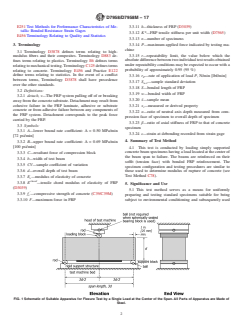
FIG. 1 Schematic of Suitable Apparatus for Flexure Test by a Single Load at the Center of the Span. All Parts of Apparatus are Made of
Steel.
D7958/D7958M − 17
6.5 Concrete Strength and Modulus of Elasticity—Variation
due to aging and/or conditioning affects the concrete strength
and modulus which may affect the assumed distribution of
stress in the cross section which affects Calculation Method 2.
6.6 Calculation Method—It is known that calculation meth-
ods 1 and 2 will yield different results. Method 1 relies on a
measured value of stiffness per unit width obtained from
another specimen usingTest Method D7565 or D3039. Method
2 relies on a number of geometric and material simplifications.
Method 2 is intended for use when direct strain measurements
are not possible. Values calculated using Method 1 are not
comparable to values calculated using Method 2.
7. Apparatus
7.1 The testing machine used shall conform to the require-
ments of the sections on Basis of Verification, Corrections, and
Time Interval Between Verifications of Practices E4. Hand-
operated testing machines having pumps that do not provide a
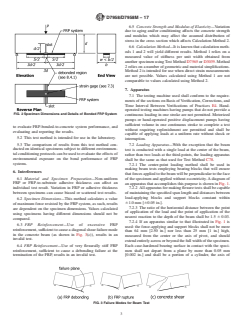
FIG. 2 Specimen Dimensions and Details of Bonded FRP System
continuous loading in one stroke are not permitted. Motorized
pumps or hand-operated positive displacement pumps having
sufficient volume in one continuous stroke to complete a test
to evaluate FRP-bonded-to-concrete system performance, and
without requiring replenishment are permitted and shall be
evaluating and reporting the results.
capable of applying loads at a uniform rate without shock or
5.2 This test method is intended for use in the laboratory.
interruption.
5.3 The comparison of results from this test method con-
7.2 Loading Apparatus—With the exception that the beam
ducted on identical specimens subject to different environmen-
test is conducted with a single load at the center of the beam,
tal conditioning protocols can be used to evaluate the effects of
rather than two loads at the third-points, the loading apparatus
environmental exposure on the bond performance of FRP
shall be the same as that used for Test Method C78.
systems.
7.2.1 The center-point loading method shall be used in
making beam tests employing bearing blocks that will ensure
6. Interferences
thatforcesappliedtothebeamwillbeperpendiculartotheface
6.1 Material and Specimen Preparation—Non-uniform of the specimen and applied without eccentricity.Adiagram of
FRP or FRP-to-substrate adhesive thickness can affect an
an apparatus that accomplishes this purpose is shown in Fig. 1.
individual test result. Variation in FRP or adhesive thickness 7.2.2 All apparatus for making flexure tests shall be capable
between specimens can cause biased or scattered test results.
of maintaining the specified span length and distances between
load-applying blocks and support blocks constant within
6.2 Specimen Dimensions—This method calculates a value
61.0 mm [60.05 in.].
of maximum force resisted by the FRPsystem, as such, results
7.2.3 The ratio of the horizontal distance between the point
are dependent on the specimen dimensions. Values calculated
of application of the load and the point of application of the
using specimens having different dimensions should not be
nearest reaction to the depth of the beam shall be 1.5 6 0.03.
compared.
7.2.4 If an apparatus similar to that illustrated in Fig. 1 is
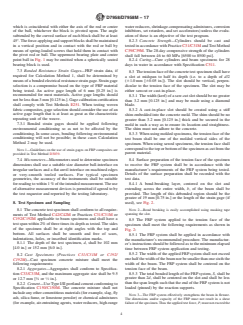
6.3 FRP Reinforcement—Use of excessive FRP
used: the force-applying and support blocks shall not be more
reinforcement,sufficienttocauseadiagonalshearfailuremode
than 64 mm [2.50 in.] nor less than 25 mm [1 in.] high,
in the concrete beam (as shown in Fig. 3(c)), results in an
measured from the center or the axis of pivot, and should
invalid test.
extendentirelyacrossorbeyondthefullwidthofthespecimen.
6.4 FRP Reinforcement—Use of very flexurally stiff FRP Each case-hardened bearing surface in contact with the speci-
reinforcement, sufficient to cause a debonding failure at the men shall not depart from a plane by more than 0.05 mm
termination of the FRP, results in an invalid test. [0.002 in.] and shall be a portion of a cylinder, the axis of
FIG. 3 Failure Modes for Beam Test
D7958/D7958M − 17
which is coincidental with either the axis of the rod or center water reducers, shrinkage-compensating admixtures, corrosion
of the ball, whichever the block is pivoted upon. The angle inhibitors, set retarders, and set accelerators) unless the evalu-
subtended by the curved surface of each block shall be at least ation of these is an objective of the test program.
45°.Theforce-applyingandsupportblocksshallbemaintained 8.2.3 Concrete Strength—Cylinders should be cast and
in a vertical position and in contact with the rod or ball by
tested in accordance with Practice C31/C31M andTest Method
means of spring-loaded screws that hold them in contact with C39/C39M. The 28-day compressive strength of the cylinders
the pivot rod or ball. The uppermost bearing plate and center
shall fall between 46 to 60 MPa [6500 to 8500 psi].
point ball in Fig. 1 may be omitted when a spherically seated 8.2.4 Curing—Cure cylinders and beam specimens for 28
bearing block is used.
days in water in accordance with Specification C511.
7.3 Bonded Resistance Strain Gages—FRP strain data, if
8.3 Thetensionfaceoftheconcretetestspecimenshallhave
required for Calculation Method 1, shall be determined by
a slot at midspan to half its depth (i.e. to a depth of d/2
means of a bonded electrical resistance strain gage. Strain gage
(61.0 mm [60.05 in.]). The slot should be vertical, perpen-
selection is a compromise based on the type of FRP material
dicular to the tension face of the specimen. The slot may be
being tested. An active gage length of 6 mm [0.25 in.] is
either sawcut or cast-in-place.
recommended for most materials. Active gage lengths should
8.3.1 The width (kerf) of a saw-cut slot should be no greater
not be less than 3 mm [0.125 in.]. Gage calibration certification
than 3.2 mm [0.125 in.] and may be made using a diamond
shall comply with Test Methods E251. When testing woven
blade.
fabric composites, gage selection should consider the use of an
8.3.2 A cast-in-place slot should be created using a stiff
active gage length that is at least as great as the characteristic
shim embedded into the concrete mold. The shim should be no
repeating unit of the weave.
greater than 3.2 mm [0.125 in.] thick and be secured in the
7.3.1 Bonded strain gages should be applied following
mold in such a way as to ensure its location and straightness.
environmental conditioning so as not to be affected by the
The shim must not adhere to the concrete.
conditioning. In some cases, bonding following environmental
8.3.3 When using molded specimens, the tension face of the
conditioning will not be possible; in these cases Calculation
test beam shall be one of the molded vertical sides of the
Method 2 may be used.
specimen. When using sawed specimens, the tension face shall
correspondtothetoporbottomofthespecimenascutfromthe
NOTE 1—Guidelines on the use of strain gages on FRP composites are
parent material.
provided in Test Method D3039.
7.4 Micrometers—Micrometers used to determine specimen 8.4 Surface preparation of the tension face of the specimen
to receive the FRP system shall be in accordance with the
dimensions shall use a suitable size diameter ball-interface on
irregular surfaces and a flat anvil interface on machined edges manufacturer’s requirements of the FRP system being tested.
Details of the surface preparation shall be recorded with the
or very-smooth tooled surfaces. For typical specimen
geometries, the accuracy of the instruments shall be suitable test data.
forreadingtowithin1%oftheintendedmeasurement.Theuse 8.4.1 A bond-breaking layer, centered on the slot and
of alternative measurement devices is permitted if agreed to by extending across the entire width, b, of the beam shall be
the test requestor and reported by the testing laboratory. provided. The length of this debonded region should be the
greater of 19 mm [0.75 in.] or the length of the strain gage (if
8. Test Specimen and Sampling used), see Fig. 2.
8.1 The concrete test specimen shall conform to all require-
NOTE 2—Bond breaking is easily accomplished using masking tape
spanning the slot.
ments of Test Method C42/C42M or Practices C31/C31M or
C192/C192M applicable to beam specimens and shall have a
8.5 The FRP system applied to the tension face of the
test span within 2% of three times its depth as tested.The sides
specimen shall meet the following requirements as shown in
of the specimen shall be at right angles with the top and
Fig. 2:
bottom. All surfaces shall be smooth and free of scars,
8.5.1 The FRP system shall be applied in accordance with
indentations, holes, or inscribed identification marks.
the manufacturer’s recommended procedure. The manufactur-
8.1.1 The depth of the test specimen, d, shall be 102 mm
er’s instructions should be followed as to the minimum elapsed
[4.0 in.] or 152 mm [6.0 in.].
time between FRP system application and testing.
8.5.2 The width of the applied FRP system shall not exceed
8.2 Cast Specimens (Practices C31/C31M or C192/
onehalfthewidthofthebeamnorbesmallerthanonesixththe
C192M)—Cast specimen concrete mixture shall meet the
width of the beam. The FRP system shall be centered on the
following requirements:
tension face of the beam.
8.2.1 Aggregates—Aggregates shall conform to Specifica-
8.5.3 The total bonded length of the FRPsystem, S, shall be
tion C33/C33M, and the maximum aggregate size shall be 9.5
3 1
greater than 2d, shall be centered on the slot and shall be less
or 12.7 mm [ ⁄8 or ⁄2 in.].
than the span length such that the end of the FRPsystem is not
8.2.2 Cement—UseTypeI/IIportlandcementconformingto
loaded (pinned) by the reaction supports.
Specification C150/C150M. The concrete mixture shall not
include any other cementitious materials (for example, slag, fly
NOTE 3—The FRP system effectively strengthens the beam in flexure.
ash, silica fume, or limestone powder) or chemical admixtures
The dimensions and/or capacity of the FRP must not result in a shear
(for example, air-entraining agents, water reducers, high-range failureofthespecimen.Thustheappliedtestforce, P,mustnotexceedthe
D7958/D7958M − 17
capacity of the beam to resist shear w
...