

ASTM D6669-19
(Practice)Standard Practice for Selecting and Constructing Exposure Scenarios for Assessment of Exposures to Alkyd and Latex Interior Paints
General Information
- Abstract
SIGNIFICANCE AND USE
5.1 Increasing attention is being paid to human exposure to airborne chemicals from products or materials used indoors, for two reasons:
5.1.1 Individuals spend substantial fractions of their time indoors.
5.1.2 Such exposures can occur repeatedly throughout one’s lifetime.
5.2 The primary objectives of this practice are as follows:
5.2.1 To list the elements that need to be considered in developing a scenario to describe how exposure occurs to chemicals emitted from alkyd or latex interior paints.
5.2.2 To discuss procedures and alternatives for choosing and describing these elements.
5.3 Elements of an exposure scenario, in turn, are used to inform a subsequent step of estimating exposures through monitoring studies or computer modeling exercises.
5.4 Once exposures have been estimated, the results can be used to assess the potential impacts of a specific paint formulation on the health of exposed individuals, or to compare the relative impacts of alternative formulations.
5.5 Estimation of exposures, or comparisons of estimated exposures across alternative paint formulations, can lead to development of environmentally preferable products by minimizing adverse health effects for exposed individuals.
SCOPE
1.1 This practice provides procedures for constructing scenarios for assessment of inhalation exposure to airborne emissions of chemicals released from alkyd or latex paints that are used indoors.
1.2 The indoor environments covered in this practice, in terms of considerations for developing exposure scenarios, are residences and office buildings.
1.3 Elements of the exposure scenarios include the product and chemical(s) to be assessed, the indoor environment where the product is applied, application of the product, chemical emissions during and after product application, and location/activity patterns of individuals who may be exposed to the airborne chemical emissions.
1.4 Steps to be performed after developing exposure scenarios, such as monitoring, modeling and exposure/risk assessment, also are described.
1.5 Units—The values stated in SI units are to be regarded as standard. No other units of measurement are included in this standard.
1.6 This standard does not purport to address all of the safety concerns, if any, associated with its use. It is the responsibility of the user of this standard to establish appropriate safety, health, and environmental practices and determine the applicability of regulatory limitations prior to use.
1.7 This international standard was developed in accordance with internationally recognized principles on standardization established in the Decision on Principles for the Development of International Standards, Guides and Recommendations issued by the World Trade Organization Technical Barriers to Trade (TBT) Committee.
- Status
- Published
- Publication Date
- 14-Mar-2019
- Technical Committee
- D22 - Air Quality
- Drafting Committee
- D22.05 - Indoor Air
Buy Documents
ASTM D6669-19 - Standard Practice for Selecting and Constructing Exposure Scenarios for Assessment of Exposures to Alkyd and Latex Interior Paints
REDLINE ASTM D6669-19 - Standard Practice for Selecting and Constructing Exposure Scenarios for Assessment of Exposures to Alkyd and Latex Interior Paints
Overview
ASTM D6669-19 is the recognized standard practice for selecting and constructing exposure scenarios for the assessment of inhalation exposures to airborne chemicals from alkyd and latex interior paints. Developed by ASTM International, this practice is critical in understanding and evaluating the potential human health impacts associated with indoor use of these common paint types, especially given that individuals spend significant time indoors and may experience repeat exposures over their lifetime.
The standard outlines a systematic approach to scenario development, addressing key factors such as product type, chemical composition, application methods, indoor environment characteristics, chemical emissions, and occupant behavior patterns. These scenarios serve as the foundation for subsequent exposure estimation using monitoring data or computer modeling, ultimately supporting risk assessment and the development of safer, more environmentally friendly paint products.
Key Topics
Exposure Assessment Elements
- Identification of the paint product (alkyd or latex) and chemicals of concern
- Description of the indoor environment (residence or office, room size, air flow)
- Details on application techniques, amount of paint used, and duration
- Chemical emission profiles during and after application
- Patterns of occupant activities and locations affecting exposure
Scenario Construction Procedures
- Selection of representative or conservative values for scenario variables
- Consideration of both short-term (acute) and long-term (chronic) exposure perspectives
- Comparison of scenarios for alternative paint formulations or different exposure settings
Exposure Estimation Methods
- Monitoring indoor air concentrations at relevant locations
- Modeling exposures with validated computer tools using emissions, air flow, and occupancy data
Risk Assessment
- Calculation of potential inhaled dose
- Comparison of exposures to health benchmarks and regulatory guidelines
- Use of exposure results to guide product development and formulation choices
Applications
ASTM D6669-19 is widely used across industries and regulatory contexts for:
- Paint Manufacturers: To evaluate and minimize the health impacts of new and existing alkyd or latex paint formulations, and to support marketing claims about product safety.
- Indoor Air Quality Professionals: To design assessments and mitigation strategies for projects involving interior painting in residential or office environments.
- Health and Safety Risk Assessors: To estimate occupant or worker exposure to volatile organic compounds (VOCs) and other chemicals, informing compliance and protective measures.
- Building Designers and Facility Managers: To select paint products and ventilation strategies that support healthy indoor environments, especially in sensitive settings like schools or hospitals.
- Regulatory Agencies: To inform rulemaking and oversight regarding permissible emissions from architectural coatings.
Key advantages include the ability to compare impacts of alternative paints, optimize ventilation and application practices, and guide development of low-emission products that improve overall indoor air quality.
Related Standards
Several ASTM standards underpin or complement ASTM D6669-19 in the assessment of paint emissions and exposure scenarios:
- ASTM D1005: Measurement of Dry-Film Thickness of Organic Coatings Using Micrometers
- ASTM D1212: Measurement of Wet Film Thickness of Organic Coatings
- ASTM D1356: Terminology Relating to Sampling and Analysis of Atmospheres
- ASTM D5116: Guide for Small-Scale Environmental Chamber Determinations of Organic Emissions from Indoor Materials/Products
- ASTM D6178: Practice for Estimation of Short-term Inhalation Exposure to VOCs
- ASTM D6485: Guide for Risk Characterization of Acute and Irritant Effects from Short-Term VOC Exposure
- ASTM E741: Test Method for Determining Air Change in a Single Zone Using Tracer Gas Dilution
For a robust and compliant exposure assessment, it is recommended to reference these related standards where applicable.
Keywords: indoor air quality, exposure scenario, alkyd paint, latex paint, inhalation exposure, volatile organic compounds, exposure assessment, indoor environmental quality, risk assessment, paint emissions
Relations
- Effective Date
- 15-Mar-2019
- Effective Date
- 01-Sep-2020
- Effective Date
- 01-Jun-2020
- Effective Date
- 01-Jun-2020
- Effective Date
- 15-Mar-2020
- Effective Date
- 01-Nov-2019
- Effective Date
- 15-Apr-2018
- Effective Date
- 01-Nov-2017
- Effective Date
- 15-Oct-2015
- Effective Date
- 01-Jul-2015
- Effective Date
- 01-Dec-2014
- Effective Date
- 15-Oct-2014
- Effective Date
- 01-May-2014
- Effective Date
- 15-Jan-2014
- Effective Date
- 01-Jul-2013
Buy Documents
ASTM D6669-19 - Standard Practice for Selecting and Constructing Exposure Scenarios for Assessment of Exposures to Alkyd and Latex Interior Paints
REDLINE ASTM D6669-19 - Standard Practice for Selecting and Constructing Exposure Scenarios for Assessment of Exposures to Alkyd and Latex Interior Paints
Get Certified
Connect with accredited certification bodies for this standard

IMP NDT d.o.o.
Non-destructive testing services. Radiography, ultrasonic, magnetic particle, penetrant, visual inspection.
Inštitut za kovinske materiale in tehnologije
Institute of Metals and Technology. Materials testing, metallurgical analysis, NDT.
Q Techna d.o.o.
NDT and quality assurance specialist. 30+ years experience. NDT personnel certification per ISO 9712, nuclear and thermal power plant inspections, QA/
Sponsored listings
Frequently Asked Questions
ASTM D6669-19 is a standard published by ASTM International. Its full title is "Standard Practice for Selecting and Constructing Exposure Scenarios for Assessment of Exposures to Alkyd and Latex Interior Paints". This standard covers: SIGNIFICANCE AND USE 5.1 Increasing attention is being paid to human exposure to airborne chemicals from products or materials used indoors, for two reasons: 5.1.1 Individuals spend substantial fractions of their time indoors. 5.1.2 Such exposures can occur repeatedly throughout one’s lifetime. 5.2 The primary objectives of this practice are as follows: 5.2.1 To list the elements that need to be considered in developing a scenario to describe how exposure occurs to chemicals emitted from alkyd or latex interior paints. 5.2.2 To discuss procedures and alternatives for choosing and describing these elements. 5.3 Elements of an exposure scenario, in turn, are used to inform a subsequent step of estimating exposures through monitoring studies or computer modeling exercises. 5.4 Once exposures have been estimated, the results can be used to assess the potential impacts of a specific paint formulation on the health of exposed individuals, or to compare the relative impacts of alternative formulations. 5.5 Estimation of exposures, or comparisons of estimated exposures across alternative paint formulations, can lead to development of environmentally preferable products by minimizing adverse health effects for exposed individuals. SCOPE 1.1 This practice provides procedures for constructing scenarios for assessment of inhalation exposure to airborne emissions of chemicals released from alkyd or latex paints that are used indoors. 1.2 The indoor environments covered in this practice, in terms of considerations for developing exposure scenarios, are residences and office buildings. 1.3 Elements of the exposure scenarios include the product and chemical(s) to be assessed, the indoor environment where the product is applied, application of the product, chemical emissions during and after product application, and location/activity patterns of individuals who may be exposed to the airborne chemical emissions. 1.4 Steps to be performed after developing exposure scenarios, such as monitoring, modeling and exposure/risk assessment, also are described. 1.5 Units—The values stated in SI units are to be regarded as standard. No other units of measurement are included in this standard. 1.6 This standard does not purport to address all of the safety concerns, if any, associated with its use. It is the responsibility of the user of this standard to establish appropriate safety, health, and environmental practices and determine the applicability of regulatory limitations prior to use. 1.7 This international standard was developed in accordance with internationally recognized principles on standardization established in the Decision on Principles for the Development of International Standards, Guides and Recommendations issued by the World Trade Organization Technical Barriers to Trade (TBT) Committee.
SIGNIFICANCE AND USE 5.1 Increasing attention is being paid to human exposure to airborne chemicals from products or materials used indoors, for two reasons: 5.1.1 Individuals spend substantial fractions of their time indoors. 5.1.2 Such exposures can occur repeatedly throughout one’s lifetime. 5.2 The primary objectives of this practice are as follows: 5.2.1 To list the elements that need to be considered in developing a scenario to describe how exposure occurs to chemicals emitted from alkyd or latex interior paints. 5.2.2 To discuss procedures and alternatives for choosing and describing these elements. 5.3 Elements of an exposure scenario, in turn, are used to inform a subsequent step of estimating exposures through monitoring studies or computer modeling exercises. 5.4 Once exposures have been estimated, the results can be used to assess the potential impacts of a specific paint formulation on the health of exposed individuals, or to compare the relative impacts of alternative formulations. 5.5 Estimation of exposures, or comparisons of estimated exposures across alternative paint formulations, can lead to development of environmentally preferable products by minimizing adverse health effects for exposed individuals. SCOPE 1.1 This practice provides procedures for constructing scenarios for assessment of inhalation exposure to airborne emissions of chemicals released from alkyd or latex paints that are used indoors. 1.2 The indoor environments covered in this practice, in terms of considerations for developing exposure scenarios, are residences and office buildings. 1.3 Elements of the exposure scenarios include the product and chemical(s) to be assessed, the indoor environment where the product is applied, application of the product, chemical emissions during and after product application, and location/activity patterns of individuals who may be exposed to the airborne chemical emissions. 1.4 Steps to be performed after developing exposure scenarios, such as monitoring, modeling and exposure/risk assessment, also are described. 1.5 Units—The values stated in SI units are to be regarded as standard. No other units of measurement are included in this standard. 1.6 This standard does not purport to address all of the safety concerns, if any, associated with its use. It is the responsibility of the user of this standard to establish appropriate safety, health, and environmental practices and determine the applicability of regulatory limitations prior to use. 1.7 This international standard was developed in accordance with internationally recognized principles on standardization established in the Decision on Principles for the Development of International Standards, Guides and Recommendations issued by the World Trade Organization Technical Barriers to Trade (TBT) Committee.
ASTM D6669-19 is classified under the following ICS (International Classification for Standards) categories: 19.040 - Environmental testing; 87.040 - Paints and varnishes. The ICS classification helps identify the subject area and facilitates finding related standards.
ASTM D6669-19 has the following relationships with other standards: It is inter standard links to ASTM D6669-12, ASTM D1356-20a, ASTM D1005-95(2020), ASTM D1212-91(2020), ASTM D1356-20, ASTM D6178-19, ASTM D6485-18, ASTM D5116-17, ASTM D1356-15a, ASTM D1356-15, ASTM D1356-14b, ASTM D6178-14, ASTM D1356-14a, ASTM D1356-14, ASTM D1212-91(2013). Understanding these relationships helps ensure you are using the most current and applicable version of the standard.
ASTM D6669-19 is available in PDF format for immediate download after purchase. The document can be added to your cart and obtained through the secure checkout process. Digital delivery ensures instant access to the complete standard document.
Standards Content (Sample)
This international standard was developed in accordance with internationally recognized principles on standardization established in the Decision on Principles for the
Development of International Standards, Guides and Recommendations issued by the World Trade Organization Technical Barriers to Trade (TBT) Committee.
Designation: D6669 − 19
Standard Practice for
Selecting and Constructing Exposure Scenarios for
Assessment of Exposures to Alkyd and Latex Interior
Paints
This standard is issued under the fixed designation D6669; the number immediately following the designation indicates the year of
original adoption or, in the case of revision, the year of last revision. A number in parentheses indicates the year of last reapproval. A
superscript epsilon (´) indicates an editorial change since the last revision or reapproval.
1. Scope 2. Referenced Documents
2.1 ASTM Standards:
1.1 This practice provides procedures for constructing sce-
D1005 Test Method for Measurement of Dry-Film Thick-
narios for assessment of inhalation exposure to airborne
ness of Organic Coatings Using Micrometers
emissions of chemicals released from alkyd or latex paints that
D1212 Test Methods for Measurement of Wet Film Thick-
are used indoors.
ness of Organic Coatings
1.2 The indoor environments covered in this practice, in
D1356 Terminology Relating to Sampling and Analysis of
terms of considerations for developing exposure scenarios, are
Atmospheres
residences and office buildings.
D5116 Guide for Small-Scale Environmental Chamber De-
terminations of Organic Emissions from Indoor Materials/
1.3 Elements of the exposure scenarios include the product
Products
and chemical(s) to be assessed, the indoor environment where
D6178 Practice for Estimation of Short-term Inhalation Ex-
the product is applied, application of the product, chemical
posure to Volatile Organic Chemicals Emitted from Bed-
emissions during and after product application, and location/
ding Sets
activity patterns of individuals who may be exposed to the
D6485 Guide for Risk Characterization ofAcute and Irritant
airborne chemical emissions.
Effects of Short-Term Exposure to Volatile Organic
Chemicals Emitted from Bedding Sets
1.4 Steps to be performed after developing exposure
E741 Test Method for Determining Air Change in a Single
scenarios, such as monitoring, modeling and exposure/risk
Zone by Means of a Tracer Gas Dilution
assessment, also are described.
3. Terminology
1.5 Units—The values stated in SI units are to be regarded
as standard. No other units of measurement are included in this
3.1 Definitions—For definitions of terms used in this
standard.
practice, refer to Terminology D1356.
1.6 This standard does not purport to address all of the 3.2 Definitions of Terms Specific to This Standard:
safety concerns, if any, associated with its use. It is the 3.2.1 emission profile, n—a time-series of emission rates of
responsibility of the user of this standard to establish appro- one or more chemicals.
priate safety, health, and environmental practices and deter-
3.2.2 exposure scenario, n—a description of how and where
mine the applicability of regulatory limitations prior to use.
an estimated exposure occurs, including (1) the location and
emission profile of the product or material that causes
1.7 This international standard was developed in accor-
dance with internationally recognized principles on standard- exposure, (2) the indoor environment where the individual is
exposed to airborne emissions from the product or material,
ization established in the Decision on Principles for the
and (3) the location and activity patterns of the exposed
Development of International Standards, Guides and Recom-
individual.
mendations issued by the World Trade Organization Technical
Barriers to Trade (TBT) Committee.
3.2.3 potential inhaled dose, n—the product of air concen-
tration to which an individual is exposed times breathing rate
times duration of exposure.
This practice is under the jurisdiction ofASTM Committee D22 on Air Quality
and is the direct responsibility of Subcommittee D22.05 on Indoor Air. For referenced ASTM standards, visit the ASTM website, www.astm.org, or
Current edition approved March 15, 2019. Published April 2019. Originally contact ASTM Customer Service at service@astm.org. For Annual Book of ASTM
approved in 2001. Last previous edition approved in 2012 as D6669 – 12. DOI: Standards volume information, refer to the standard’s Document Summary page on
10.1520/D6669-19. the ASTM website.
Copyright © ASTM International, 100 Barr Harbor Drive, PO Box C700, West Conshohocken, PA 19428-2959. United States
D6669 − 19
3.2.4 short-term exposure, n—an exposure of one week or 6. Procedures for Developing Exposure Scenarios
less in duration.
6.1 Describing the Product and Chemical(s):
6.1.1 Chemical emissions can vary according to the type of
4. Summary of Practice
paint and painted substrate. Describe the following:
4.1 This practice documents the items that need to be
6.1.1.1 Alkyd or latex paint.
described when developing an exposure scenario for assess-
6.1.1.2 Flat, gloss, or semi-gloss paint.
ment of exposures to chemicals released indoors from alkyd or
6.1.1.3 Physical properties such as paint density, g/cm .
latex paints. Important considerations are discussed for each
6.1.1.4 Typical applications of the paint, in terms of (1) type
item, along with examples or alternatives where appropriate.
of substrate to which it is applied (for example, gypsum
4.2 Anexposurescenario—adescriptionofhowandwhere wallboardversuswood/trimversusmetal)and(2)typeofroom
(for example, bedroom versus bathroom or kitchen).
an estimated exposure occurs — includes the following ele-
ments for paints used indoors (that is, interior paints): 6.1.1.5 Typical warnings or advice on the paint container
(for example, “Use in a well-ventilated area”).
4.2.1 The product and chemical(s) to be assessed.
4.2.2 The indoor environment where the product is applied, 6.1.2 The pattern and potential impact of chemical emis-
including properties such as volume and airflow rate. sions over time can vary by chemical. Describe the following:
6.1.2.1 Physical/chemical properties of the chemical(s) un-
4.2.3 The amount and rate of product use.
4.2.4 Chemicalemissionsduringandafterpaintapplication. derinvestigation,suchasmolecularweightandvaporpressure.
6.1.2.2 Role of the chemical(s) in the paint (for example,
4.2.5 Locations and breathing rates of an individual, or
individuals, who may be exposed to the airborne chemical solvent).
6.1.2.3 Weight fraction of the chemical(s) in the paint.
emissions.
6.1.2.4 Toxicity information, such as that commonly re-
4.3 Further considerations discussed in this practice include
ported in Safety Data Sheets.
typical versus conservative assumptions, short-term versus
6.1.3 Chemical emissions can be affected by environmental
long-termexposureperspectives,alkydversuslatexpaints,and
factors such as temperature and humidity. These factors are
residential versus office settings.
discussed in 6.2. The pattern of chemical emissions also can
4.4 More than one exposure scenario can be constructed.
depend on factors such as the paint application method, the
The practice also provides a list of elements to be included
amount of paint applied, and the rate of application. These
when comparing multiple scenarios.
factors are discussed in 6.3.
6.2 Describing the Indoor Environment Where the Product
5. Significance and Use
Is Applied:
5.1 Increasing attention is being paid to human exposure to
6.2.1 Describe the size/volume and general configuration of
airborne chemicals from products or materials used indoors,
the environment (for example, a two-story residence consisting
for two reasons:
of eight rooms with a volume of 425 m ). Specific consider-
5.1.1 Individuals spend substantial fractions of their time
ations for residential versus office buildings are discussed
indoors.
under 6.6. Distributions for volumes of U.S. residences are
5.1.2 Such exposures can occur repeatedly throughout one’s
presented in the Exposure Factors Handbook (1).
lifetime.
6.2.2 Describe the indoor-outdoor air change rate (for
5.2 The primary objectives of this practice are as follows:
example, in 1/h or air changes per hour, ACH) and associated
5.2.1 To list the elements that need to be considered in
conditions such as opening of doors/windows and use of
developing a scenario to describe how exposure occurs to
exhaust/circulation fans. Distributions for air change rates of
chemicals emitted from alkyd or latex interior paints.
U.S. residences are presented in the Exposure Factors Hand-
5.2.2 To discuss procedures and alternatives for choosing
book (1). Persily (2) has measured air change rates in a limited
and describing these elements.
set of office buildings.
6.2.3 Discussion—When conducting an actual exposure
5.3 Elements of an exposure scenario, in turn, are used to
assessment, as opposed to constructing an exposure scenario to
inform a subsequent step of estimating exposures through
guide the assessment, it may be preferable to replace assump-
monitoring studies or computer modeling exercises.
tions regarding air change rates with actual measurements,
5.4 Once exposures have been estimated, the results can be
using methods such as those described in Test Method E741.
used to assess the potential impacts of a specific paint
6.2.4 Describe the fraction of the building (or building
formulation on the health of exposed individuals, or to com-
volume) that is being painted. It usually is convenient to
pare the relative impacts of alternative formulations.
conceptualize the building as consisting of two indoor air
5.5 Estimation of exposures, or comparisons of estimated
spaces — a painted space and an unpainted space, with
exposures across alternative paint formulations, can lead to
communicating air flows between the two spaces — as
development of environmentally preferable products by mini-
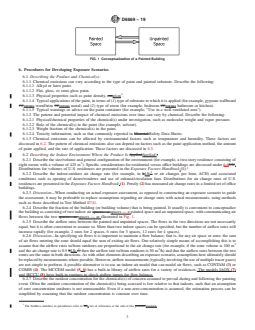
illustrated in Fig. 1.
mizing adverse health effects for exposed individuals.
The boldface numbers in parentheses refer to a list of references at the end of
this standard.
D6669 − 19
6.3.2 Indicate whether the substrate is being painted with
primer only, paint only, or primer plus paint.
6.3.3 Indicate the number of coats of primer/paint being
applied.
6.3.4 Indicate the drying time(s) between successive coats
of primer/paint.
6.3.5 Indicate the total amount of primer/paint being used.
FIG. 1 Conceptualization of a Painted Building
This quantity, commonly expressed in litres, can be indicated
or calculated in any of the following ways:
6.3.5.1 If the actual quantity used is known, then indicate
6.2.5 Describe the airflow rates between the painted and
that quantity.
unpainted spaces. The flows in the two directions are not
6.3.5.2 Ifthepaintedsurfaceareaisknown,thentheamount
necessarilyequal,butitisoftenconvenienttoassumeso.More
applied (A) can be estimated as follows:
than two indoor spaces can be specified, but the number of
A>painted surface area / coverage per coat 3number of coats (1)
~ !
airflow rates will increase rapidly (for example, 2 rates for 2
spaces, 6 rates for 3 spaces, 12 rates for 4 spaces).
2 2
for example, 100 m / 10 m /L 3 2 coats 5 20 L
~ ~ ! !
6.2.6 Discussion—In specifying air flows it is important to
maintain a flow balance; that is, for any air space or zone, the 6.3.5.3 If the wet film thickness in µm is known (see Test
sum of air flows entering the zone should equal the sum of Methods D1005 and D1212), it can be converted to coverage
exiting air flows. One relatively simple means of accomplish- per coat using the following formula:
ing this is to assume that the airflow rates to/from outdoors are
Coverage per coat m ⁄L 5 1000 / wet film thickness µ m (2)
~ ! ~ !
proportional to the air change rate (for example, if the zone
The amount applied can then be calculated as in 6.3.5.2.
volume is 100 m and the air change rate is 0.5 1/h, then the
6.3.5.4 If the volume of the painted space is known and if
airflow rate to/from outdoors is 50 m /h) and that the airflow
walls or ceilings are being painted, then the painted surface
rates between the two zones are the same in both directions.As
area can be estimated from the following relationships given in
with other elements describing an exposure scenario, assump-
the Exposure Factors Handbook (1), Chapter 19, Loading
tions here ultimately should be replaced by measurements
Ratios, for residences:
where possible. However, airflow measurements (typically
2 3
involving the use of multiple tracer gases) are not simple to
Wall area ~m !>volume ~m ! 30.95 (3)
perform. A possible alternative is to use an indoor-air model
2 3
Ceiling area ~m !>volume ~m ! 30.43 (4)
that can model air flows, such as CONTAM (3) or COMIS (4).
TheMCCEMmodel (5, 6)hasabuilt-inlibraryofairflowrates The amount applied can then be calculated as in 6.3.5.2.
6.3.6 Indicate the product application rate (for example,
for a variety of residences. The models IAQX (7) and IECCU
(8) have built-in routines to check airflow inputs for flow L/h). This rate can depend on factors such as application
method (roller, brush, spray) and the number of painters.
balance.
6.2.7 Describe the outdoor concentration for the chemi- Indicate the application method and number of painters along
with the rate.
cals(s) of concern assumed to prevail during and following the
painting event. Often the outdoor concentration of the chemi- 6.3.7 Indicate the total duration of the painting event. The
duration can be calculated by dividing the total amount of
cal(s) being assessed is low relative to that indoors, such that
an assumption of zero concentration outdoors is not unreason- primer or paint, or both used (in L) by the application rate (in
L/h), assuming a constant application rate. The drying time(s)
able. Even if a non-zero-concentration is assumed, the estima-
tion process can be simplified by assuming that the outdoor between successive coats needs to be added to the painting
concentration is constant over time. time to obtain the total duration. In cases where the duration is
6.2.8 Describe the environmental conditions of the indoor relatively long (for example, >8 h), indicate the number of
space where paint is to be applied. Conditions such as painting hours per day and the resultant number of painting
temperatureandrelativehumidityareparticularlyimportant,as days.
these can affect the rate of chemical emissions.
6.4 Describing the Chemical Emissions from the Paint:
6.2.9 Indoor-air concentrations of chemicals released from
6.4.1 General Nature of Emissions Profile. When primer or
paint can be affected by certain types of materials that absorb
paint is applied quickly to a small specimen (as when conduct-
(and sometimes desorb) emitted chemicals. Describe wall,
ing a small-chamber test to characterize emissions), the chemi-
ceiling and floor materials as well as furnishings such as
cal emissions tend to be higher at first and then to decline over
upholstered furniture or draperies. The preferred method for
time. Studies of airborne chemical concentrations in chambers
documenting the presence of such materials is to note their
(9, 10), following instantaneous application of paint to a
loading rates (that is, ratio of surface area to indoor volume, in
substrate such as gypsum wallboard, indicate that the declining
2 3
units of m /m ).
emission rate tends to follow a single-exponential model for
6.3 Describing the Product Application: chemicals released from alkyd paint and a double-exponential
6.3.1 Describe the substrate that is being painted — gypsum model for chemicals released from latex paint.
wallboard, wood, metal, etc. — and indicate whether it ever 6.4.2 Direct Estimation of Emissions Profile. An emission
has been painted before. profile for the chemical(s) of concern released from primer or
D6669 − 19
type of activity and the associated level of physical/mental
exertion, in addition
...
This document is not an ASTM standard and is intended only to provide the user of an ASTM standard an indication of what changes have been made to the previous version. Because
it may not be technically possible to adequately depict all changes accurately, ASTM recommends that users consult prior editions as appropriate. In all cases only the current version
of the standard as published by ASTM is to be considered the official document.
Designation: D6669 − 12 D6669 − 19
Standard Practice for
Selecting and Constructing Exposure Scenarios for
Assessment of Exposures to Alkyd and Latex Interior
Paints
This standard is issued under the fixed designation D6669; the number immediately following the designation indicates the year of
original adoption or, in the case of revision, the year of last revision. A number in parentheses indicates the year of last reapproval. A
superscript epsilon (´) indicates an editorial change since the last revision or reapproval.
1. Scope
1.1 This practice provides procedures for constructing scenarios for assessment of inhalation exposure to airborne emissions of
chemicals released from alkyd or latex paints that are used indoors.
1.2 The indoor environments covered in this practice, in terms of considerations for developing exposure scenarios, are
residences and office buildings.
1.3 Elements of the exposure scenarios include the product and chemical(s) to be assessed, the indoor environment where the
product is applied, application of the product, chemical emissions during and after product application, and location/activity
patterns of individuals who may be exposed to the airborne chemical emissions.
1.4 Steps to be performed after developing exposure scenarios, such as monitoring, modeling and exposure/risk assessment, also
are described.
1.5 Units—The values stated in SI units are to be regarded as standard. No other units of measurement are included in this
standard.
1.6 This standard does not purport to address all of the safety concerns, if any, associated with its use. It is the responsibility
of the user of this standard to establish appropriate safety safety, health, and healthenvironmental practices and determine the
applicability of regulatory limitations prior to use.
1.7 This international standard was developed in accordance with internationally recognized principles on standardization
established in the Decision on Principles for the Development of International Standards, Guides and Recommendations issued
by the World Trade Organization Technical Barriers to Trade (TBT) Committee.
2. Referenced Documents
2.1 ASTM Standards:
D1005 Test Method for Measurement of Dry-Film Thickness of Organic Coatings Using Micrometers
D1212 Test Methods for Measurement of Wet Film Thickness of Organic Coatings
D1356 Terminology Relating to Sampling and Analysis of Atmospheres
D5116 Guide for Small-Scale Environmental Chamber Determinations of Organic Emissions from Indoor Materials/Products
D6178 Practice for Estimation of Short-term Inhalation Exposure to Volatile Organic Chemicals Emitted from Bedding Sets
D6485 Guide for Risk Characterization of Acute and Irritant Effects of Short-Term Exposure to Volatile Organic Chemicals
Emitted from Bedding Sets
E741 Test Method for Determining Air Change in a Single Zone by Means of a Tracer Gas Dilution
3. Terminology
3.1 Definitions—For definitions of terms used in this practice, refer to Terminology D1356.
3.2 Definitions of Terms Specific to This Standard:
3.2.1 emission profile, n—a time-series of emission rates of one or more compounds.chemicals.
This practice is under the jurisdiction of ASTM Committee D22 on Air Quality and is the direct responsibility of Subcommittee D22.05 on Indoor Air.
Current edition approved April 1, 2012March 15, 2019. Published May 2012April 2019. Originally approved in 2001. Last previous edition approved in 20072012 as
ε1
D6669 – 01a (2007)D6669 – 12. . DOI: 10.1520/D6669-12.10.1520/D6669-19.
For referenced ASTM standards, visit the ASTM website, www.astm.org, or contact ASTM Customer Service at service@astm.org. For Annual Book of ASTM Standards
volume information, refer to the standard’sstandard’s Document Summary page on the ASTM website.
Copyright © ASTM International, 100 Barr Harbor Drive, PO Box C700, West Conshohocken, PA 19428-2959. United States
D6669 − 19
3.2.2 exposure scenario, n—a description of how and where an estimated exposure occurs, including (1) the location and
emission profile of the product or material that causes exposure, (2) the indoor environment where the individual is exposed to
airborne emissions from the product or material, and (3) the location and activity patterns of the exposed individual.
3.2.3 potential inhaled dose, n—the product of air concentration to which an individual is exposed times breathing rate times
duration of exposure.
3.2.4 short-term exposure, n—an exposure of one week or less in duration.
4. Summary of Practice
4.1 This practice documents the items that need to be described when developing an exposure scenario for assessment of
exposures to chemicals released indoors from alkyd or latex paints. Important considerations are discussed for each item, along
with examples or alternatives where appropriate.
4.2 An exposure scenario—a scenario — a description of how and where an estimated exposure occurs—includes occurs —
includes the following elements for paints used indoors (that is, interior paints):
4.2.1 The product and chemical(s) to be assessed.
4.2.2 The indoor environment where the product is applied, including properties such as volume and airflow rate.
4.2.3 The amount and rate of product use.
4.2.4 Chemical emissions during and after paint application.
4.2.5 Locations and breathing rates of an individual, or individuals, who may be exposed to the airborne chemical emissions.
4.3 Further considerations discussed in this practice include typical versus conservative assumptions, short-term versus
long-term exposure perspectives, alkyd versus latex paints, and residential versus office settings.
4.4 More than one exposure scenario can be constructed. The practice also provides a list of elements to be included when
comparing multiple scenarios.
5. Significance and Use
5.1 Increasing attention is being paid to human exposure to airborne chemicals from products or materials used indoors, for two
reasons:
5.1.1 Individuals spend substantial fractions of their time indoors.
5.1.2 Such exposures can occur repeatedly throughout one’sone’s lifetime.
5.2 The primary objectives of this practice are as follows:
5.2.1 To list the elements that need to be considered in developing a scenario to describe how exposure occurs to chemicals
emitted from alkyd or latex interior paints.
5.2.2 To discuss procedures and alternatives for choosing and describing these elements.
5.3 Elements of an exposure scenario, in turn, are used to practiceinform a subsequent step of estimating exposures through
monitoring studies or computer modeling exercises.
5.4 Once exposures have been estimated, the results can be used to assess the potential impacts of a specific paint formulation
on the health of exposed individuals, or to compare the relative impacts of alternative formulations.
5.5 Estimation of exposures, or comparisons of estimated exposures across alternative paint formulations, can lead to
development of environmentally preferable products by minimizing adverse health effects for exposed individuals.
D6669 − 19
FIG. 1 Conceptualization of a Painted Building
6. Procedures for Developing Exposure Scenarios
6.1 Describing the Product and Chemical(s):
6.1.1 Chemical emissions can vary according to the type of paint and painted substrate. Describe the following:
6.1.1.1 Alkyd or latex paint.
6.1.1.2 Flat, gloss, or semi-gloss paint.
6.1.1.3 Physical properties such as paint density, cmg/cm .
6.1.1.4 Typical applications of the paint, in terms of (1) type of substrate to which it is applied (for example, gypsum wallboard
vs.versus wood/trim vs.versus metal) and (2) type of room (for example, bedroom vs.versus bathroom or kitchen).
6.1.1.5 Typical warnings or advice on the paint container (for example, “Use in a well-ventilated area”).
6.1.2 The pattern and potential impact of chemical emissions over time can vary by chemical. Describe the following:
6.1.2.1 Physical/chemical properties of the chemical(s) under investigation, such as molecular weight and vapor pressure.
6.1.2.2 Role of the chemical(s) in the paint (for example, solvent).
6.1.2.3 Weight fraction of the chemical(s) in the paint.
6.1.2.4 Toxicity information, such as that commonly reported in Material Safety Data Sheets.
6.1.3 Chemical emissions can be affected by environmental factors such as temperature and humidity. These factors are
discussed in 6.2. The pattern of chemical emissions also can depend on factors such as the paint application method, the amount
of paint applied, and the rate of application. These factors are discussed in 6.3.
6.2 Describing the Indoor Environment Where the Product Is AppliedApplied::
6.2.1 Describe the size/volume and general configuration of the environment (for example, a two-story residence consisting of
eight rooms with a volume of 425 m ). Specific considerations for residential versus office buildings are discussed under 6.66.6.
Distributions for volumes of U.S. residences are presented in the Exposure Factors Handbook (1).
-1
6.2.2 Describe the indoor-outdoor air change rate (for example, in h1/h or air changes per hour, ACH) and associated
conditions such as opening of doors/windows and use of exhaust/circulation fans. Distributions for air change rates of U.S.
residences are presented in the Exposure Factors Handbook (1). Persily (2) has measured air change rates in a limited set of office
buildings.
6.2.3 Discussion—When conducting an actual exposure assessment, as opposed to constructing an exposure scenario to guide
the assessment, it may be preferable to replace assumptions regarding air change rates with actual measurements, using methods
such as those described in Test Method E741.
6.2.4 Describe the fraction of the building (or building volume) that is being painted. It usually is convenient to conceptualize
the building as consisting of two indoor air spaces—a spaces — a painted space and an unpainted space, with communicating air
flows between the two spaces—as spaces — as illustrated in Fig. 1.
6.2.5 Describe the airflow rates between the painted and unpainted spaces. The flows in the two directions are not necessarily
equal, but it is often convenient to assume so. More than two indoor spaces can be specified, but the number of airflow rates will
increase rapidly (for example, 2 rates for 2 spaces, 6 rates for 3 spaces, 12 rates for 4 spaces).
6.2.6 Discussion—In specifying air flows it is important to maintain a flow balance; that is, for any air space or zone, the sum
of air flows entering the zone should equal the sum of exiting air flows. One relatively simple means of accomplishing this is to
assume that the airflow rates to/from outdoors are proportional to the air change rate (for example, if the zone volume is 100 m
-1 3
and the air change rate is 0.5 h1/h, , then the airflow rate to/from outdoors is 50 m /h) and that the airflow rates between the two
zones are the same in both directions. As with other elements describing an exposure scenario, assumptions here ultimately should
be replaced by measurements where possible. However, airflow measurements (typically involving the use of multiple tracer gases)
are not simple to perform. A possible alternative is to use an indoor-air model that can model air flows, such as CONTAM (3) or
COMIS (4). The MCCEM model (5, 6) has a built-in library of airflow rates for a variety of residences. The models IAQX (7)
and IECCU (8) have built-in routines to check airflow inputs for flow balance.
6.2.7 Describe the outdoor concentration for the chemicals(s) of concern assumed to prevail during and following the painting
event. Often the outdoor concentration of the chemical(s) being assessed is low relative to that indoors, such that an assumption
of zero concentration outdoors is not unreasonable. Even if a non-zero-concentration is assumed, the estimation process can be
simplified by assuming that the outdoor concentration is constant over time.
The boldface numbers in parentheses refer to thea list of references at the end of this practice.standard.
D6669 − 19
6.2.8 Describe the environmental conditions of the indoor space where paint is to be applied. Conditions such as temperature
and relative humidity are particularly important, as these can affect the rate of chemical emissions.
6.2.9 Indoor-air concentrations of chemicals released from paint can be affected by certain types of materials that absorb (and
sometimes desorb) emitted chemicals. Describe wall, ceiling and floor materials as well as furnishings such as upholstered
furniture or draperies. The preferred method for documenting the presence of such materials is to note their loading rates (that is,
2 3
ratio of surface area to indoor volume, in units of m /m ).
6.3 Describing the Product Application:
6.3.1 Describe the substrate that is being painted—gypsum painted — gypsum wallboard, wood, metal, etc.—and etc. — and
indicate whether it ever has been painted before.
6.3.2 Indicate whether the substrate is being painted with primer only, paint only, or primer plus paint.
6.3.3 Indicate the number of coats of primer/paint being applied.
6.3.4 Indicate the drying time(s) between successive coats of primer/paint.
6.3.5 Indicate the total amount of primer/paint being used. This quantity, commonly expressed in litres, can be indicated or
calculated in any of the following ways:
6.3.5.1 If the actual quantity used is known, then indicate that quantity.
6.3.5.2 If the painted surface area is known, then the amount applied (A) can be estimated as follows:
2 2
A>painted surface area/~coverage per coat! 3number of coats ~for example, 100 m /~10 m /L! 32 coats 5 20 L!
A>painted surface area / coverage per coat 3number of coats (1)
~ !
2 2
for example, 100 m / 10 m /L 3 2 coats 5 20 L
~ ~ ! !
6.3.5.3 If the wet film thickness in μm is known (see Test Methods D1005 and D1212), it can be converted to coverage per coat
using the following formula:
Coverage per coat ~m /L! 5 1000/wet film thickness ~μm! (2)
Coverage per coat ~m ⁄ L!5 1000 / wet film thickness ~μ m! (2)
The amount applied can then be calculated as in 6.3.5.2.
6.3.5.4 If the volume of the painted space is known and if walls or ceilings are being painted, then the painted surface area can
be estimated from the following relationships given in the Exposure Factors Handbook (1)), Chapter 19, Loading Ratios, for
residences:
2 3
Wall area m >volume m 30.95 (3)
~ ! ~ !
2 3
Ceiling area m >volume m 30.43
~ ! ~ !
2 3
Wall area ~m !>volume ~m !30.95 (3)
2 3
Ceiling area ~m !>volume ~m !30.43 (4)
The amount applied can then be calculated as in 6.3.5.2.
6.3.6 Indicate the product application rate (for example, L/h). This rate can depend on factors such as application method (roller,
brush, spray) and the number of painters. Indicate the application method and number of painters along with the rate.
6.3.7 Indicate the total duration of the painting event. The duration can be calculated by dividing the total amount of primer or
paint, or both used (in L) by the application rate (in L/h), assuming a constant application rate. The drying time(s) between
successive coats needs to be added to the painting time to obtain the total duration. In cases where the duration is relatively long
(for example, > 8 >8 h), indicate the number of painting hours per day and the resultant number of painting days.
6.4 Describing the Chemical Emissions from the Paint:
6.4.1 General Nature of Emissions Profile. When primer or paint is applied quickly to a small specimen (as when conducting
a small-chamber test to characterize emissions), the chemical emissions tend to be higher at first and then to decline over time.
Studies of airborne chemical concentrations in chambers (69, 710), following instantaneous application of paint to a substrate such
as gypsum wallboard, indicate that the declining emission rate tends to follow a single-exponential model for chemicals released
from alkyd paint and a double-exponential model for chemicals released from latex paint.
6.4.2 Direct Estimation of Emissions Profile. An emission profile for the chemical(s) of concern released from primer or paint
can be estimated using a small-chamber facility (see Guide D5116) by (1) applying the primer/paint to the substrate of interest and
determining the mass applied through before/after weight differentials, (2) inserting the painted substrate in the chamber
immediately after applying the paint and then measuring the airborne chemical concentrations over time, and (3) using non-linear
regression to fit a single- or double-exponential emission model to the concentration data.
6.4.3 Indirect Estimation of Emission Profile. Studies have been conducted to investigate the dependence of an emissio
...