

ASTM D1250-19e1
(Guide)Standard Guide for the Use of the Joint API and ASTM Adjunct for Temperature and Pressure Volume Correction Factors for Generalized Crude Oils, Refined Products, and Lubricating Oils: API MPMS Chapter 11.1
General Information
- Abstract
SIGNIFICANCE AND USE
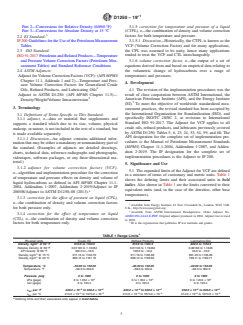
5.1 The expanded limits of the Adjunct for VCF are defined in a mixture of terms of customary and metric units. Table 1 shows the defining limits and their associated units in bold italics. Also shown in Table 1 are the limits converted to their equivalent units (and, in the case of the densities, other base temperatures).
5.2 Note that only the precision levels of the defining values shown in Table 1 are correct. The other values showing converted units have been rounded to the significant digits shown; as rounded values, they may numerically fall just outside of the actual limits established by the defining values.
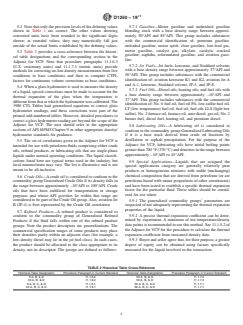
5.3 Table 2 provides a cross-reference between the historical table designations and the corresponding section in the Adjunct for VCF. Note that procedure paragraphs 11.1.6.3 (U.S. customary units) and 11.1.7.3 (metric units) provide methods for correcting on-line density measurements from live conditions to base conditions and then to compute CTPL factors for continuous volume corrections to base conditions.
5.4 When a glass hydrometer is used to measure the density of a liquid, special corrections must be made to account for the thermal expansion of the glass when the temperature is different from that at which the hydrometer was calibrated. The 1980 CTL Tables had generalized equations to correct glass hydrometer readings, and these corrections were part of the printed odd-numbered tables. However, detailed procedures to correct a glass hydrometer reading are beyond the scope of the Adjunct for VCF. The user should refer to the appropriate sections of API MPMS Chapter 9 or other appropriate density/hydrometer standards for guidance.
5.5 The set of correlations given in the Adjunct for VCF is intended for use with petroleum fluids comprising either crude oils, refined products, or lubricating oils that are single-phase liquids under normal operating conditions. The liquid classifications listed here are typical terms used in the industry, ...
SCOPE
1.1 This guide provides information related to the algorithm and implementation procedure but does not contain the full set of algorithms. The algorithms, instructions, procedures, and examples are located in the associated supplementary adjuncts. The Adjunct for Volume Correction Factors (VCF) for temperature and pressure volume correction factors for generalized crude oils, refined products, and lubricating oils provides the algorithm and implementation procedure for the correction of temperature and pressure effects on density and volume of liquid hydrocarbons. Natural gas liquids (NGLs) and liquefied petroleum gases (LPGs) are excluded from consideration in this standard but may be found in API MPMS Chapter 11.2.4/GPA 8217 Temperature Correction for NGL and LPG. As this Adjunct for VCF will be applied to a variety of applications, the output parameters of CTL, Fp, CPL, and CTPL may be used as specified in other standards.
1.2 Including the pressure correction in the Adjunct for VCF represents an important change from the “temperature only” correction factors given in the 1980 Petroleum Measurement Tables. However, if the pressure is one atmosphere (the standard pressure), then there is no pressure correction and the standard/adjunct(s) will give CTL values consistent with the 1980 Petroleum Measurement Tables.
1.3 The Adjunct for VCF covers general procedures for the conversion of input data to generate CTL, Fp, CPL, and CTPL values at the user-specified base temperature and pressure (Tb, Pb). Two sets of procedures are included for computing volume correction factor: one set for data expressed in customary units (temperature in °F, pressure in psig); the other for the metric system of units (temperature in °C, pressure in kPa or bar).
Note 1: In contrast to the 1980 Petroleum Measurement Tables, the metric procedures require the procedure for customary units be used first to compute density at 60 °F. This va...
- Status
- Published
- Publication Date
- 30-Apr-2019
- Technical Committee
- D02 - Petroleum Products, Liquid Fuels, and Lubricants
- Drafting Committee
- D02.02 - Hydrocarbon Measurement for Custody Transfer (Joint ASTM-API)
Overview
ASTM D1250-19e1 is the Standard Guide for the Use of the Joint API and ASTM Adjunct for Temperature and Pressure Volume Correction Factors (VCF) for Generalized Crude Oils, Refined Products, and Lubricating Oils, aligning with API MPMS Chapter 11.1. Developed by ASTM International, this guide provides essential information on algorithm and implementation procedures for correcting the temperature and pressure effects on density and volume of liquid hydrocarbons during measurement. The standard is globally recognized and supports accurate, standardized measurement practices in the petroleum and lubricants industries. It applies to both customary (U.S. customary units) and metric measurement systems.
Key Topics
- Volume Correction Factors (VCF): Methods for determining the adjustment needed for the effects of temperature and pressure on petroleum fluids such as crude oils, refined products, and lubricating oils.
- Commodity Group Coverage: Procedures are specified for three main commodity groups:
- Crude Oil
- Refined Products (e.g., gasoline, jet fuels, diesel)
- Lubricating Oils
- Corrections for Measurement Devices: Guidance for handling measurement uncertainties, including procedures for glass hydrometer readings and thermal expansion corrections.
- Customary and Metric Units: Separate implementation for temperature in °F and °C, and pressure in psig, kPa, or bar.
- Historical Reference: Cross-references provided between previous table-based systems and the current algorithmic approach.
- Precision and Accuracy: Details on the limits, units, and significance of rounding and precision, ensuring conformance with international measurement standards.
Applications
The ASTM D1250-19e1 standard guide is widely used across industries for:
- Custody Transfer: Ensuring equitable and precise volume corrections for crude oils and petroleum products during commercial transactions.
- Terminal Operations: Consistent adjustment of liquid hydrocarbon measurements to standard base conditions (typically 15 °C, 20 °C, or 60 °F and standard pressure).
- Refinery Processes: Calculation of base volumes for refined products and lubricating oils to optimize blending, shipping, and inventory management.
- Quality Control: Standardized methods for volume correction help reduce disputes and facilitate compliance with regulatory requirements for petroleum product measurements.
- Equipment Calibration: Provides guidance for adjusting density readings from glass hydrometers and other measurement equipment to account for thermal expansion and ensure reliable results.
- Special Applications: Includes procedures for substances with known thermal expansion coefficients, enabling precise measurement adjustments for specialized products.
Related Standards
Ensuring compatibility and alignment with global measurement practices, ASTM D1250-19e1 references and relates to several key standards, including:
- API MPMS Chapter 11.1 – Temperature and Pressure Volume Correction Factors for Generalized Crude Oils, Refined Products, and Lubricating Oils
- API MPMS Chapter 9 – Density Determination (all sections)
- API MPMS Chapter 11.2.1 and 11.2.1M – Compressibility Factors for Hydrocarbons
- API MPMS Chapter 11.2.4/GPA 8217 – Temperature Correction for NGL and LPG (for products not covered by D1250-19e1)
- API MPMS Chapter 11.3.3 and 11.3.4 – Miscellaneous Hydrocarbon Properties for Ethanol and Blends
- API MPMS Chapter 11.5 – Density/Weight/Volume Intraconversion
- ISO 91:2017 – Petroleum and Related Products – Temperature and Pressure Volume Correction Factors (Petroleum Measurement Tables)
By leveraging ASTM D1250-19e1 and its referenced adjuncts, stakeholders can achieve internationally recognized methods for correcting and standardizing volume measurements, improving consistency and fairness in the petroleum sector.
Relations
- Effective Date
- 01-May-2019
- Effective Date
- 01-May-2019
- Effective Date
- 01-May-2019
- Effective Date
- 01-May-2019
- Referred By
ASTM D1160-18 - Standard Test Method for Distillation of Petroleum Products at Reduced Pressure - Effective Date
- 01-May-2019
- Effective Date
- 01-May-2019
- Effective Date
- 01-May-2019
- Referred By
ASTM D483-04(2018) - Standard Test Method for Unsulfonated Residue of Petroleum Plant Spray Oils - Effective Date
- 01-May-2019
- Effective Date
- 01-May-2019
- Effective Date
- 01-May-2019
- Effective Date
- 01-May-2019
- Effective Date
- 01-May-2019
- Effective Date
- 01-May-2019
- Effective Date
- 01-May-2019
- Referred By
ASTM D6448-16(2022) - Standard Specification for Industrial Burner Fuels from Used Lubricating Oils - Effective Date
- 01-May-2019
Get Certified
Connect with accredited certification bodies for this standard

Element Materials Technology
Materials testing and product certification.

ABS Group Brazil
ABS Group certification services in Brazil.

ABS Quality Evaluations Inc.
American Bureau of Shipping quality certification.
Sponsored listings
Frequently Asked Questions
ASTM D1250-19e1 is a guide published by ASTM International. Its full title is "Standard Guide for the Use of the Joint API and ASTM Adjunct for Temperature and Pressure Volume Correction Factors for Generalized Crude Oils, Refined Products, and Lubricating Oils: API MPMS Chapter 11.1". This standard covers: SIGNIFICANCE AND USE 5.1 The expanded limits of the Adjunct for VCF are defined in a mixture of terms of customary and metric units. Table 1 shows the defining limits and their associated units in bold italics. Also shown in Table 1 are the limits converted to their equivalent units (and, in the case of the densities, other base temperatures). 5.2 Note that only the precision levels of the defining values shown in Table 1 are correct. The other values showing converted units have been rounded to the significant digits shown; as rounded values, they may numerically fall just outside of the actual limits established by the defining values. 5.3 Table 2 provides a cross-reference between the historical table designations and the corresponding section in the Adjunct for VCF. Note that procedure paragraphs 11.1.6.3 (U.S. customary units) and 11.1.7.3 (metric units) provide methods for correcting on-line density measurements from live conditions to base conditions and then to compute CTPL factors for continuous volume corrections to base conditions. 5.4 When a glass hydrometer is used to measure the density of a liquid, special corrections must be made to account for the thermal expansion of the glass when the temperature is different from that at which the hydrometer was calibrated. The 1980 CTL Tables had generalized equations to correct glass hydrometer readings, and these corrections were part of the printed odd-numbered tables. However, detailed procedures to correct a glass hydrometer reading are beyond the scope of the Adjunct for VCF. The user should refer to the appropriate sections of API MPMS Chapter 9 or other appropriate density/hydrometer standards for guidance. 5.5 The set of correlations given in the Adjunct for VCF is intended for use with petroleum fluids comprising either crude oils, refined products, or lubricating oils that are single-phase liquids under normal operating conditions. The liquid classifications listed here are typical terms used in the industry, ... SCOPE 1.1 This guide provides information related to the algorithm and implementation procedure but does not contain the full set of algorithms. The algorithms, instructions, procedures, and examples are located in the associated supplementary adjuncts. The Adjunct for Volume Correction Factors (VCF) for temperature and pressure volume correction factors for generalized crude oils, refined products, and lubricating oils provides the algorithm and implementation procedure for the correction of temperature and pressure effects on density and volume of liquid hydrocarbons. Natural gas liquids (NGLs) and liquefied petroleum gases (LPGs) are excluded from consideration in this standard but may be found in API MPMS Chapter 11.2.4/GPA 8217 Temperature Correction for NGL and LPG. As this Adjunct for VCF will be applied to a variety of applications, the output parameters of CTL, Fp, CPL, and CTPL may be used as specified in other standards. 1.2 Including the pressure correction in the Adjunct for VCF represents an important change from the “temperature only” correction factors given in the 1980 Petroleum Measurement Tables. However, if the pressure is one atmosphere (the standard pressure), then there is no pressure correction and the standard/adjunct(s) will give CTL values consistent with the 1980 Petroleum Measurement Tables. 1.3 The Adjunct for VCF covers general procedures for the conversion of input data to generate CTL, Fp, CPL, and CTPL values at the user-specified base temperature and pressure (Tb, Pb). Two sets of procedures are included for computing volume correction factor: one set for data expressed in customary units (temperature in °F, pressure in psig); the other for the metric system of units (temperature in °C, pressure in kPa or bar). Note 1: In contrast to the 1980 Petroleum Measurement Tables, the metric procedures require the procedure for customary units be used first to compute density at 60 °F. This va...
SIGNIFICANCE AND USE 5.1 The expanded limits of the Adjunct for VCF are defined in a mixture of terms of customary and metric units. Table 1 shows the defining limits and their associated units in bold italics. Also shown in Table 1 are the limits converted to their equivalent units (and, in the case of the densities, other base temperatures). 5.2 Note that only the precision levels of the defining values shown in Table 1 are correct. The other values showing converted units have been rounded to the significant digits shown; as rounded values, they may numerically fall just outside of the actual limits established by the defining values. 5.3 Table 2 provides a cross-reference between the historical table designations and the corresponding section in the Adjunct for VCF. Note that procedure paragraphs 11.1.6.3 (U.S. customary units) and 11.1.7.3 (metric units) provide methods for correcting on-line density measurements from live conditions to base conditions and then to compute CTPL factors for continuous volume corrections to base conditions. 5.4 When a glass hydrometer is used to measure the density of a liquid, special corrections must be made to account for the thermal expansion of the glass when the temperature is different from that at which the hydrometer was calibrated. The 1980 CTL Tables had generalized equations to correct glass hydrometer readings, and these corrections were part of the printed odd-numbered tables. However, detailed procedures to correct a glass hydrometer reading are beyond the scope of the Adjunct for VCF. The user should refer to the appropriate sections of API MPMS Chapter 9 or other appropriate density/hydrometer standards for guidance. 5.5 The set of correlations given in the Adjunct for VCF is intended for use with petroleum fluids comprising either crude oils, refined products, or lubricating oils that are single-phase liquids under normal operating conditions. The liquid classifications listed here are typical terms used in the industry, ... SCOPE 1.1 This guide provides information related to the algorithm and implementation procedure but does not contain the full set of algorithms. The algorithms, instructions, procedures, and examples are located in the associated supplementary adjuncts. The Adjunct for Volume Correction Factors (VCF) for temperature and pressure volume correction factors for generalized crude oils, refined products, and lubricating oils provides the algorithm and implementation procedure for the correction of temperature and pressure effects on density and volume of liquid hydrocarbons. Natural gas liquids (NGLs) and liquefied petroleum gases (LPGs) are excluded from consideration in this standard but may be found in API MPMS Chapter 11.2.4/GPA 8217 Temperature Correction for NGL and LPG. As this Adjunct for VCF will be applied to a variety of applications, the output parameters of CTL, Fp, CPL, and CTPL may be used as specified in other standards. 1.2 Including the pressure correction in the Adjunct for VCF represents an important change from the “temperature only” correction factors given in the 1980 Petroleum Measurement Tables. However, if the pressure is one atmosphere (the standard pressure), then there is no pressure correction and the standard/adjunct(s) will give CTL values consistent with the 1980 Petroleum Measurement Tables. 1.3 The Adjunct for VCF covers general procedures for the conversion of input data to generate CTL, Fp, CPL, and CTPL values at the user-specified base temperature and pressure (Tb, Pb). Two sets of procedures are included for computing volume correction factor: one set for data expressed in customary units (temperature in °F, pressure in psig); the other for the metric system of units (temperature in °C, pressure in kPa or bar). Note 1: In contrast to the 1980 Petroleum Measurement Tables, the metric procedures require the procedure for customary units be used first to compute density at 60 °F. This va...
ASTM D1250-19e1 is classified under the following ICS (International Classification for Standards) categories: 75.080 - Petroleum products in general; 75.100 - Lubricants, industrial oils and related products. The ICS classification helps identify the subject area and facilitates finding related standards.
ASTM D1250-19e1 has the following relationships with other standards: It is inter standard links to ASTM D1250-19, ASTM D1903-08(2017), ASTM D287-22, ASTM D3227-23, ASTM D1160-18, ASTM D1481-17, ASTM D1369-19, ASTM D483-04(2018), ASTM D7777-13(2018)e1, ASTM D3827-92(2020), ASTM E2995-15a(2020), ASTM D117-22, ASTM D6822-12b(2017)e1, ASTM D5002-22, ASTM D6448-16(2022). Understanding these relationships helps ensure you are using the most current and applicable version of the standard.
ASTM D1250-19e1 is available in PDF format for immediate download after purchase. The document can be added to your cart and obtained through the secure checkout process. Digital delivery ensures instant access to the complete standard document.
Standards Content (Sample)
This international standard was developed in accordance with internationally recognized principles on standardization established in the Decision on Principles for the
Development of International Standards, Guides and Recommendations issued by the World Trade Organization Technical Barriers to Trade (TBT) Committee.
´1
Designation:D1250 −19
Designation: 200/19
Standard Guide for the
Use of the Joint API and ASTM Adjunct for Temperature and
Pressure Volume Correction Factors for Generalized Crude
Oils, Refined Products, and Lubricating Oils: API MPMS
Chapter 11.1
This standard is issued under the fixed designation D1250; the number immediately following the designation indicates the year of
original adoption or, in the case of revision, the year of last revision. A number in parentheses indicates the year of last reapproval. A
superscript epsilon (´) indicates an editorial change since the last revision or reapproval.
This standard has been approved for use by agencies of the U.S. Department of Defense.
ε NOTE—Editorially updated adjunct information in May 2020.
INTRODUCTION
This guide, ASTM D1250, provides information related to the algorithm and implementation
procedure for the correction of temperature and pressure effects on density and volume of liquid
hydrocarbons as outlined in API MPMS Chapter 11.1, Physical Properties Data—Temperature and
Pressure Volume Correction Factors for Generalized Crude Oils, Refined Products, and Lubricating
Oils. The algorithms and implementation procedure are published in an adjunct (supplementary)
product called the Adjunct for Volume Correction Factors (VCF).
ASTM D1250 is not theAPI standard and all instructions, procedures, and examples for calculating
volume correction factors for generalized crude oils, refined products, and lubrication oils are found
in the standard, API MPMS Chapter 11.1-2004, Addendum 1{2007, and Addendum 2{2019.
The volume correction factors, in their basic form, are the output of a set of equations derived from,
and based on, empirical data relating to the volumetric change of hydrocarbons over a range of
temperatures and pressures. Prior to 2004, the factors were listed in tabular format called ASTM
D1250, Petroleum Measurement Tables and published as anAPI Standard Chapter 11.1/Adjunct to IP
200/Adjunct to ASTM D1250. However, the current standard, API MPMS Chapter 11.1{2004,
Addendum 1{2007, and Addendum 2{2019 replaced the previous printed tables.
This current Adjunct for VCF establishes a set of implementation procedures for crude oils, liquid
refined products, and lubricating oils, by which volume measurements taken at any temperature and
pressure (within the range of the standard) can be corrected to an equivalent volume at base/standard
conditions, normally 15 °C, 60 °F, or 20 °C, by use of a volume correction factor (VCF). TheAdjunct
for VCF also provides methods for making conversions to alternate conditions from base condition
and to alternate base temperatures. Densities can be corrected by using the inverse of the VCF.
USAGE GUIDELINES
The current Adjunct for VCF is effective upon the date of publication and supersedes the previous
edition of the standard/adjunct(s). Once the current year version of the standard(s) and adjunct are
implemented in a particular application, the previous versions should no longer be used in that
application. However, the use of the standard(s) and adjunct remains voluntary, and the decision on
when to utilize a standard is an issue that is subject to the negotiations between the parties involved
in the transaction.
Copyright © ASTM International, 100 Barr Harbor Drive, PO Box C700, West Conshohocken, PA 19428-2959. United States
´1
D1250−19
2019 UPDATE
Some minor modifications to the API MPMS Chapter 11.1-2004/Adjunct to IP 200/04/Adjunct to
ASTM D1250–04Addendum 1-2007 have been issued asAddendum 2-2019. These modifications to
the adjunct necessitated a realignment with ASTM Standard Guide D1250, hence a –19 version has
been approved and published.
This guide is under the jurisdiction ofASTM Committee D02 on Petroleum Products, Liquid Fuels, and Lubricants and theAPI Committee on Petroleum Measurement,
and is the direct responsibility of Subcommittee D02.02 /COMQ the joint ASTM-API Committee on Hydrocarbon Measurement for Custody Transfer (Joint ASTM-API).
This guide has been approved by the sponsoring committees and was accepted by the Cooperating Societies in accordance with established procedures.
Current edition approved May 1, 2019. Published September 2019. Originally approved in 1952, replacing former D206 and D1090. Last previous edition approved in
ɛ1
2013 as D1250 – 08 (2013) . DOI: 10.1520/D1250-19E01.
1. Scope MPMS Chapter 11.3.3, Miscellaneous Hydrocarbon
Properties—Denatured Ethanol Density and Volume Correc-
1.1 This guide provides information related to the algorithm
rd
tion Factors, 3 edition. Procedures for determining Volume
and implementation procedure but does not contain the full set
Correction Factors (VCF) for Gasoline and Denatured Ethanol
of algorithms. The algorithms, instructions, procedures, and
Blends can be found in API MPMS Chapter 11.3.4, Miscella-
examples are located in the associated supplementary adjuncts.
neous Hydrocarbon Properties—Denatured Ethanol and Gaso-
The Adjunct for Volume Correction Factors (VCF) for tem-
line Component Blend Densities and Volume Correction
peratureandpressurevolumecorrectionfactorsforgeneralized
st
Factors, 1 edition.
crude oils, refined products, and lubricating oils provides the
1.5 The values stated in either SI units or inch{pound units
algorithm and implementation procedure for the correction of
are to be regarded separately as standard. The values stated in
temperature and pressure effects on density and volume of
each system are not necessarily exact equivalents; therefore, to
liquid hydrocarbons. Natural gas liquids (NGLs) and liquefied
ensure conformance with the standard, each system shall be
petroleum gases (LPGs) are excluded from consideration in
used independently of the other, and values from the two
this standard but may be found in API MPMS Chapter
systems shall not be combined.
11.2.4/GPA 8217 Temperature Correction for NGL and LPG.
As this Adjunct for VCF will be applied to a variety of
1.6 This international standard was developed in accor-
applications, the output parameters of CTL, F , CPL, and
dance with internationally recognized principles on standard-
p
CTPL may be used as specified in other standards.
ization established in the Decision on Principles for the
Development of International Standards, Guides and Recom-
1.2 IncludingthepressurecorrectionintheAdjunctforVCF
mendations issued by the World Trade Organization Technical
represents an important change from the “temperature only”
Barriers to Trade (TBT) Committee.
correction factors given in the 1980 Petroleum Measurement
Tables. However, if the pressure is one atmosphere (the
2. Referenced Documents
standard pressure), then there is no pressure correction and the
standard/adjunct(s) will give CTL values consistent with the
2.1 API Standards:
1980 Petroleum Measurement Tables. API Manual of Petroleum Measurement Standards(MPMS):
Chapter 9 Density Determination (all sections)
1.3 The Adjunct for VCF covers general procedures for the
Chapter 11.1-2004 Temperature and Pressure Volume Cor-
conversion of input data to generate CTL, F , CPL, and CTPL
p
rection Factors for Generalized Crude Oils, Refined
values at the user-specified base temperature and pressure (T ,
b
Products, and Lubricating Oils (including Addendum
P ).Twosetsofproceduresareincludedforcomputingvolume
b
1-2007 and Addendum 2-2019)
correction factor: one set for data expressed in customary units
Chapter 11.2.1 Compressibility Factors for Hydrocarbons:
(temperature in °F, pressure in psig); the other for the metric
0–90° API Gravity Range
system of units (temperature in °C, pressure in kPa or bar).
Chapter 11.2.1M Compressibility Factors for Hydrocarbons:
NOTE 1—In contrast to the 1980 Petroleum Measurement Tables, the
638–1074 Kilograms per Cubic Meter Range
metric procedures require the procedure for customary units be used first
Chapter 11.2.4 Temperature Correction for NGL and LPG
tocomputedensityat60 °F.Thisvalueisthenfurthercorrectedtogivethe
Chapter 11.3.3 Miscellaneous Hydrocarbon Properties—
metric output. The metric procedures now incorporate the base tempera-
Denatured Ethanol Density and Volume Correction Fac-
ture of 20 °C in addition to 15 °C.
tors
1.4 The procedures in the Adjunct for VCF recognize three
Chapter 11.3.4 Miscellaneous Hydrocarbon Properties—
distinct commodity groups: crude oil, refined products, and
Denatured Ethanol and Gasoline Component Blend Den-
lubricating oils. A procedure is also provided for determining
sities and Volume Correction Factors
volume correction for special applications where the general-
Chapter 11.5 Density/Weight/Volume Intraconversion
ized commodity groups’ parameters may not adequately rep-
Part 1—Conversions of API Gravity at 60 °F
resent the thermal expansion properties of the liquid and a
precise thermal expansion coefficient has been determined by
experiment. Procedures for determining Volume Correction
Available from American Petroleum Institute (API), 200 Massachusetts Ave.
Factors (VCF) for Denatured Ethanol can be found in API NW, Washington, DC 20001, http://www.api.org.
´1
D1250−19
Part 2—Conversions for Relative Density (60/60 °F) 3.1.5 correction for temperature and pressure of a liquid
Part 3—Conversions for Absolute Density at 15 °C (CTPL), n—the combination of density and volume correction
factors for both temperature and pressure.
2.2 EI Standard:
3.1.5.1 Discussion—Historically, the CTPL is known as the
IP200 GuidelinesfortheUseofthePetroleumMeasurement
VCF (Volume Correction Factor) and for many applications,
Tables
the CPL was assumed to be unity, hence many applications
2.3 ISO Standard:
tended to treat the VCF and CTL interchangeably.
ISO 91:2017 Petroleum and Related Products—Temperature
and Pressure Volume Correction Factors (Petroleum Mea-
3.1.6 volume correction factor, n—the output of a set of
surement Tables) and Standard Reference Conditions
equations derived from and based on empirical data relating to
2.4 ASTM Adjuncts: the volumetric change of hydrocarbons over a range of
Adjunct forVolume Correction Factors (VCF): (API MPMS temperatures and pressures.
Chapter 11.1, Addenda 1 and 2)—Temperature and Pres-
4. Development
sure Volume Correction Factors for Generalized Crude
4.1 The revision of the implementation procedures was the
Oils, Refined Products, and Lubricating Oils
result of close cooperation between ASTM International, the
Adjunct to ASTM D1250: (API MPMS Chapter 11.5)—
American Petroleum Institute (API), and the Energy Institute
Density/Weight/Volume Intraconversion
(EI). To meet the objective of worldwide standardized mea-
3. Terminology
surement practices, the revised standard has been accepted by
the International Organization for Standardization (ISO), and
3.1 Definitions of T
...