

ASTM D1369-19
(Practice)Standard Practice for Quantities of Materials for Asphalt-Aggregate Surface Treatments
General Information
- Abstract
SIGNIFICANCE AND USE
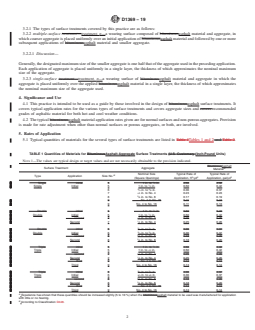
4.1 This practice is intended to be used as a guide by those involved in the design of asphalt surface treatments. It covers typical application rates for the various types of surface treatments and covers aggregate sizes and recommended grades of asphaltic material for both hot and cool weather conditions.
4.2 The typical asphalt material application rates given are for normal surfaces and non-porous aggregates. Provision is made for rate adjustment when other than normal surfaces or porous aggregates, or both, are involved.
SCOPE
1.1 This practice covers the rates of application of asphalt materials and aggregates and types and grades of asphalt materials for single and multiple asphalt surface treatments as applied to suitably prepared pavements or bases.
1.2 The text of this standard references notes and footnotes that provide explanatory material. These notes and footnotes (excluding those in tables and figures) shall not be considered as requirements of the standard.
1.3 The values stated in either SI units or inch-pound units are to be regarded separately as standard. The values stated in each system may not be exact equivalents; therefore, each system shall be used independently of the other. Combining values from the two systems may result in nonconformance with the standard.
1.4 This standard does not purport to address all of the safety concerns, if any, associated with its use. It is the responsibility of the user of this standard to establish appropriate safety, health, and environmental practices and determine the applicability of regulatory limitations prior to use.
1.5 This international standard was developed in accordance with internationally recognized principles on standardization established in the Decision on Principles for the Development of International Standards, Guides and Recommendations issued by the World Trade Organization Technical Barriers to Trade (TBT) Committee.
- Status
- Published
- Publication Date
- 31-Oct-2019
- Technical Committee
- D04 - Road and Paving Materials
- Drafting Committee
- D04.24 - Asphalt Surface Treatments
Buy Documents

ASTM D1369-19 - Standard Practice for Quantities of Materials for Asphalt-Aggregate Surface Treatments
REDLINE ASTM D1369-19 - Standard Practice for Quantities of Materials for Asphalt-Aggregate Surface Treatments
Overview
ASTM D1369-19, Standard Practice for Quantities of Materials for Asphalt-Aggregate Surface Treatments, provides a comprehensive framework for determining the correct quantities of asphalt materials and aggregates in single or multiple surface treatments. Developed by ASTM, this standard serves as a practical guide for engineers, contractors, and specifiers engaged in the design and implementation of asphalt surface treatments. By addressing typical application rates, recommended grades, and aggregate sizes, ASTM D1369-19 ensures efficient pavement maintenance and surface improvement for a wide range of roadway and base preparation scenarios.
Key Topics
- Application Rates: This standard specifies typical application rates for both asphaltic material and aggregate, adjusted for surface type (normal or porous) and aggregate characteristics.
- Surface Treatments: Guidance is provided for single-surface and multiple-surface treatments, including the selection of aggregate size and layer thickness.
- Material Grading: ASTM D1369-19 includes recommendations for the types and grades of asphaltic material suitable for both hot and cool weather conditions.
- Measurement Methods: The practice outlines calculation methods and conversion tables for quantifying materials in both SI and inch-pound units to ensure international applicability.
- Rate Adjustments: Provisions are made for adjusting application rates based on surface and aggregate properties, with recommendations for increases or decreases relative to standard conditions.
Applications
ASTM D1369-19 plays a critical role in the design and construction of asphalt-aggregate surface treatments for pavements and roadways. Its principal applications include:
- New pavement construction: Ensuring optimal layer thickness and aggregate coverage for durability and performance.
- Pavement maintenance and rehabilitation: Providing material estimates for resurfacing or restoring existing roads with surface treatments tailored to prevailing climatic and surface conditions.
- Municipal and highway projects: Enabling consistent application of materials across multiple projects, ensuring compliance with recognized international standards.
- Flexible design adaptation: Adjustment of material quantities to suit a variety of pavement and aggregate types, leading to cost-effective and high-quality surface treatments.
By following the recommended application rates, material grades, and adjustment guidelines in ASTM D1369-19, stakeholders can extend pavement life, minimize maintenance costs, and achieve uniform, long-lasting results.
Related Standards
ASTM D1369-19 references a number of related ASTM standards and specifications to provide a holistic approach to asphalt surface treatment design and implementation:
- ASTM D8: Terminology Relating to Materials for Roads and Pavements
- ASTM D448: Classification for Sizes of Aggregate for Road and Bridge Construction
- ASTM D946/D946M: Specification for Penetration-Graded Asphalt Binder for Use in Pavement Construction
- ASTM D977: Specification for Emulsified Asphalt
- ASTM D1139/D1139M: Specification for Aggregate for Single or Multiple Bituminous Surface Treatments
- ASTM D2027/D2027M & D2028/D2028M: Specifications for Cutback Asphalt (Medium-Curing and Rapid-Curing Types)
- ASTM D2397/D2397M: Specification for Cationic Emulsified Asphalt
- ASTM C29/C29M: Test Method for Bulk Density (“Unit Weight”) and Voids in Aggregate
For a complete and compliant surface treatment project, users should consult these related documents in conjunction with ASTM D1369-19, ensuring the right materials and procedures are used for each unique construction and maintenance scenario.
Keywords: ASTM D1369-19, asphalt-aggregate surface treatments, application rates, aggregate size, asphaltic material grades, pavement maintenance, road construction standards.
Relations
- Effective Date
- 01-Nov-2019
- Refers
ASTM C29/C29M-23 - Standard Test Method for Bulk Density (“Unit Weight”) and Voids in Aggregate - Effective Date
- 01-Oct-2023
- Effective Date
- 01-May-2020
- Effective Date
- 01-Dec-2019
- Effective Date
- 01-Nov-2019
- Effective Date
- 01-Nov-2019
- Effective Date
- 01-Nov-2019
- Effective Date
- 01-Aug-2019
- Effective Date
- 01-May-2019
- Effective Date
- 01-May-2019
- Effective Date
- 01-May-2019
- Effective Date
- 15-Dec-2018
- Effective Date
- 15-Aug-2018
- Effective Date
- 01-Jul-2018
- Effective Date
- 01-Feb-2018
Buy Documents
ASTM D1369-19 - Standard Practice for Quantities of Materials for Asphalt-Aggregate Surface Treatments
REDLINE ASTM D1369-19 - Standard Practice for Quantities of Materials for Asphalt-Aggregate Surface Treatments
Get Certified
Connect with accredited certification bodies for this standard

DIBt (Deutsches Institut für Bautechnik)
German Institute for Building Technology.
DIN CERTCO
DIN Group product certification.
Zavod za gradbeništvo Slovenije (ZAG) - Inšpekcija
ZAG inspection body for construction products, structures, and materials.
Sponsored listings
Frequently Asked Questions
ASTM D1369-19 is a standard published by ASTM International. Its full title is "Standard Practice for Quantities of Materials for Asphalt-Aggregate Surface Treatments". This standard covers: SIGNIFICANCE AND USE 4.1 This practice is intended to be used as a guide by those involved in the design of asphalt surface treatments. It covers typical application rates for the various types of surface treatments and covers aggregate sizes and recommended grades of asphaltic material for both hot and cool weather conditions. 4.2 The typical asphalt material application rates given are for normal surfaces and non-porous aggregates. Provision is made for rate adjustment when other than normal surfaces or porous aggregates, or both, are involved. SCOPE 1.1 This practice covers the rates of application of asphalt materials and aggregates and types and grades of asphalt materials for single and multiple asphalt surface treatments as applied to suitably prepared pavements or bases. 1.2 The text of this standard references notes and footnotes that provide explanatory material. These notes and footnotes (excluding those in tables and figures) shall not be considered as requirements of the standard. 1.3 The values stated in either SI units or inch-pound units are to be regarded separately as standard. The values stated in each system may not be exact equivalents; therefore, each system shall be used independently of the other. Combining values from the two systems may result in nonconformance with the standard. 1.4 This standard does not purport to address all of the safety concerns, if any, associated with its use. It is the responsibility of the user of this standard to establish appropriate safety, health, and environmental practices and determine the applicability of regulatory limitations prior to use. 1.5 This international standard was developed in accordance with internationally recognized principles on standardization established in the Decision on Principles for the Development of International Standards, Guides and Recommendations issued by the World Trade Organization Technical Barriers to Trade (TBT) Committee.
SIGNIFICANCE AND USE 4.1 This practice is intended to be used as a guide by those involved in the design of asphalt surface treatments. It covers typical application rates for the various types of surface treatments and covers aggregate sizes and recommended grades of asphaltic material for both hot and cool weather conditions. 4.2 The typical asphalt material application rates given are for normal surfaces and non-porous aggregates. Provision is made for rate adjustment when other than normal surfaces or porous aggregates, or both, are involved. SCOPE 1.1 This practice covers the rates of application of asphalt materials and aggregates and types and grades of asphalt materials for single and multiple asphalt surface treatments as applied to suitably prepared pavements or bases. 1.2 The text of this standard references notes and footnotes that provide explanatory material. These notes and footnotes (excluding those in tables and figures) shall not be considered as requirements of the standard. 1.3 The values stated in either SI units or inch-pound units are to be regarded separately as standard. The values stated in each system may not be exact equivalents; therefore, each system shall be used independently of the other. Combining values from the two systems may result in nonconformance with the standard. 1.4 This standard does not purport to address all of the safety concerns, if any, associated with its use. It is the responsibility of the user of this standard to establish appropriate safety, health, and environmental practices and determine the applicability of regulatory limitations prior to use. 1.5 This international standard was developed in accordance with internationally recognized principles on standardization established in the Decision on Principles for the Development of International Standards, Guides and Recommendations issued by the World Trade Organization Technical Barriers to Trade (TBT) Committee.
ASTM D1369-19 is classified under the following ICS (International Classification for Standards) categories: 91.100.50 - Binders. Sealing materials; 93.080.20 - Road construction materials. The ICS classification helps identify the subject area and facilitates finding related standards.
ASTM D1369-19 has the following relationships with other standards: It is inter standard links to ASTM D1369-84(2012), ASTM C29/C29M-23, ASTM D946/D946M-20, ASTM D2027/D2027M-19, ASTM D977-19ae1, ASTM D977-19a, ASTM D2397/D2397M-19a, ASTM D8-19, ASTM D977-19, ASTM D2397/D2397M-19, ASTM D1250-19e1, ASTM D8-18c, ASTM D8-18b, ASTM D8-18a, ASTM D8-18. Understanding these relationships helps ensure you are using the most current and applicable version of the standard.
ASTM D1369-19 is available in PDF format for immediate download after purchase. The document can be added to your cart and obtained through the secure checkout process. Digital delivery ensures instant access to the complete standard document.
Standards Content (Sample)
This international standard was developed in accordance with internationally recognized principles on standardization established in the Decision on Principles for the
Development of International Standards, Guides and Recommendations issued by the World Trade Organization Technical Barriers to Trade (TBT) Committee.
Designation: D1369 − 19
Standard Practice for
Quantities of Materials for Asphalt-Aggregate Surface
Treatments
This standard is issued under the fixed designation D1369; the number immediately following the designation indicates the year of
original adoption or, in the case of revision, the year of last revision. A number in parentheses indicates the year of last reapproval. A
superscript epsilon (´) indicates an editorial change since the last revision or reapproval.
This standard has been approved for use by agencies of the U.S. Department of Defense.
1. Scope and Voids in Aggregate
D8 Terminology Relating to Materials for Roads and Pave-
1.1 This practice covers the rates of application of asphalt
ments
materials and aggregates and types and grades of asphalt
D448 Classification for Sizes of Aggregate for Road and
materials for single and multiple asphalt surface treatments as
Bridge Construction
applied to suitably prepared pavements or bases.
D946/D946M Specification for Penetration-Graded Asphalt
1.2 The text of this standard references notes and footnotes
Binder for Use in Pavement Construction
that provide explanatory material. These notes and footnotes
D977 Specification for Emulsified Asphalt
(excluding those in tables and figures) shall not be considered
D1139/D1139M Specification for Aggregate for Single or
as requirements of the standard.
Multiple Bituminous Surface Treatments
1.3 The values stated in either SI units or inch-pound units D1250 Guide for the Use of the Joint API and ASTM
Adjunct for Temperature and Pressure Volume Correction
are to be regarded separately as standard. The values stated in
each system may not be exact equivalents; therefore, each Factors for Generalized Crude Oils, Refined Products, and
Lubricating Oils: API MPMS Chapter 11.1
system shall be used independently of the other. Combining
values from the two systems may result in nonconformance D2027/D2027M Specification for Cutback Asphalt
(Medium-Curing Type)
with the standard.
D2028/D2028M Specification for Cutback Asphalt (Rapid-
1.4 This standard does not purport to address all of the
Curing Type)
safety concerns, if any, associated with its use. It is the
D2397/D2397M Specification for Cationic Emulsified As-
responsibility of the user of this standard to establish appro-
phalt
priate safety, health, and environmental practices and deter-
mine the applicability of regulatory limitations prior to use.
3. Terminology
1.5 This international standard was developed in accor-
3.1 For definitions of other terms used in this standard, refer
dance with internationally recognized principles on standard-
to Terminology D8.
ization established in the Decision on Principles for the
Development of International Standards, Guides and Recom-
3.2 Definitions of Terms Specific to This Standard:
mendations issued by the World Trade Organization Technical
3.2.1 The types of surface treatments covered by this
Barriers to Trade (TBT) Committee.
practice are as follows:
3.2.2 multiple-surface treatment, n—awearingsurfacecom-
2. Referenced Documents
posed of asphalt material and aggregate, in which coarser
aggregate is placed uniformly over an initial application of
2.1 ASTM Standards:
asphalt material and followed by one or more subsequent
C29/C29M Test Method for Bulk Density (“Unit Weight”)
applications of asphalt material and smaller aggregate.
3.2.2.1 Discussion—Generally, the designated maximum
1 size of the smaller aggregate is one half that of the aggregate
This practice is under the jurisdiction of ASTM Committee D04 on Road and
Paving Materials and is the direct responsibility of Subcommittee D04.24 on used in the preceding application. Each application of aggre-
Asphalt Surface Treatments.
gate is placed uniformly in a single layer, the thickness of
Current edition approved Nov. 1, 2019. Published November 2019. Originally
which approximates the nominal maximum size of the aggre-
approved in 1955. Last previous edition approved in 2012 as D1369 – 84 (2012).
gate.
DOI: 10.1520/D1369-19.
For referenced ASTM standards, visit the ASTM website, www.astm.org, or
3.2.3 single-surface treatment, n—a wearing surface of
contact ASTM Customer Service at service@astm.org. For Annual Book of ASTM
asphalt material and aggregate in which the aggregate is placed
Standards volume information, refer to the standard’s Document Summary page on
the ASTM website. uniformly over the applied asphalt material in a single layer,
Copyright © ASTM International, 100 Barr Harbor Drive, PO Box C700, West Conshohocken, PA 19428-2959. United States
D1369 − 19
the thickness of which approximates the nominal maximum material absorbed. The quantity of asphalt material should be
size of the aggregate used. decreased when treating an existing surface that is rich in
asphalt, in order to compensate for such excess. Quantities of
4. Significance and Use
asphalt materials shown are for volumes of the material at
15.6 °C (60.0 °F). For application at elevated temperatures,
4.1 This practice is intended to be used as a guide by those
involved in the design of asphalt surface treatments. It covers these quantities should be adjusted to provide the desired
volume at 15.6 °C (60.0 °F).
typical application rates for the various types of surface
treatments and covers aggregate sizes and recommended
5.4 The typical rates of application shown in Tables 1 and 2
grades of asphaltic material for both hot and cool weather
may be adjusted for variations in the gradation of the aggregate
conditions.
from the coarse to the fine limit of the specification. The
quantities of asphalt material and aggregate should be in-
4.2 The typical asphalt material application rates given are
for normal surfaces and non-porous aggregates. Provision is creased when the gradation of the aggregate approaches the
coarse limit of the specification. Likewise, the quantities
made for rate adjustment when other than normal surfaces or
porous aggregates, or both, are involved. should be decreased when the aggregate approaches the fine
limit of the specification. The amount of such increase or
5. Rates of Application
decrease should not be more than 20 % of the quantity given.
5.1 Typical quantities of materials for the several types of
5.5 The types and grades of asphalt materials recommended
surface treatments are listed in Tables 1 and 2.
for use with the various aggregate sizes are listed in Table 5.
5.2 The quantities of the various gradations are normally
6. Reference Specifications
sufficient to provide a uniform cover over the area specified.
6.1 The specifications for aggregates are covered in Speci-
Thequantitiesofaggregateareshownbyvolumemeasurement
in order to minimize the effect of variations due to specific fication D1139/D1139M.
gravity, particle shape, surface texture, and porosity. For job
6.2 The specifications for asphalt materials are covered by
control, the quantity of aggregate by volume may be converted
the following ASTM specifications: Specifications D946/
to a weight figure by determining the loose unit weight of the
D946M, D2027/D2027M, D2028/D2028M, D977, and D2397/
aggregate and calculating or using Tables 3 and 4 to determine
D2397M.
the pounds per square yard or kilograms per square metre.
7. Measurement of Material
...
This document is not an ASTM standard and is intended only to provide the user of an ASTM standard an indication of what changes have been made to the previous version. Because
it may not be technically possible to adequately depict all changes accurately, ASTM recommends that users consult prior editions as appropriate. In all cases only the current version
of the standard as published by ASTM is to be considered the official document.
Designation: D1369 − 84 (Reapproved 2012) D1369 − 19
Standard Practice for
Quantities of Materials for BituminousAsphalt-Aggregate
Surface Treatments
This standard is issued under the fixed designation D1369; the number immediately following the designation indicates the year of
original adoption or, in the case of revision, the year of last revision. A number in parentheses indicates the year of last reapproval. A
superscript epsilon (´) indicates an editorial change since the last revision or reapproval.
This standard has been approved for use by agencies of the U.S. Department of Defense.
1. Scope
1.1 This practice covers the rates of application of bituminousasphalt materials and aggregates and types and grades of
bituminousasphalt materials for single and multiple bituminousasphalt surface treatments as applied to suitably prepared
pavements or bases.
1.2 The text of this standard references notes and footnotes that provide explanatory material. These notes and footnotes
(excluding those in tables and figures) shall not be considered as requirements of the standard.
1.3 The values stated in either SI units or inch-pound units are to be regarded separately as standard. The values stated in each
system may not be exact equivalents; therefore, each system shall be used independently of the other. Combining values from the
two systems may result in nonconformance with the standard.
1.4 This standard does not purport to address all of the safety concerns, if any, associated with its use. It is the responsibility
of the user of this standard to establish appropriate safety safety, health, and healthenvironmental practices and determine the
applicability of regulatory limitations prior to use.
1.5 This international standard was developed in accordance with internationally recognized principles on standardization
established in the Decision on Principles for the Development of International Standards, Guides and Recommendations issued
by the World Trade Organization Technical Barriers to Trade (TBT) Committee.
2. Referenced Documents
2.1 ASTM Standards:
C29/C29M Test Method for Bulk Density (“Unit Weight”) and Voids in Aggregate
D8 Terminology Relating to Materials for Roads and Pavements
D448 Classification for Sizes of Aggregate for Road and Bridge Construction
D490 Specification for Road Tar
D633 Volume Correction Table for Road Tar
D946D946/D946M Specification for Penetration-Graded Asphalt Binder for Use in Pavement Construction
D977 Specification for Emulsified Asphalt
D1139D1139/D1139M Specification for Aggregate for Single or Multiple Bituminous Surface Treatments
D1250 Guide for the Use of the Joint API and ASTM Adjunct for Temperature and Pressure Volume Correction Factors for
Generalized Crude Oils, Refined Products, and Lubricating Oils: API MPMS Chapter 11.1
D2027D2027/D2027M Specification for Cutback Asphalt (Medium-Curing Type)
D2028D2028/D2028M Specification for Cutback Asphalt (Rapid-Curing Type)
D2397D2397/D2397M Specification for Cationic Emulsified Asphalt
3. Terminology
3.1 For definitions of other terms used in this standard, refer to Terminology D8.
3.2 Definitions:Definitions of Terms Specific to This Standard:
This practice is under the jurisdiction of ASTM Committee D04 on Road and Paving Materials and is the direct responsibility of Subcommittee D04.24 on
BituminousAsphalt Surface Treatments.
Current edition approved June 1, 2012Nov. 1, 2019. Published September 2012November 2019. Originally approved in 1955. Last previous edition approved in 20062012
as D1369 – 84 (2006).(2012). DOI: 10.1520/D1369-84R12.10.1520/D1369-19.
For referenced ASTM standards, visit the ASTM website, www.astm.org, or contact ASTM Customer Service at service@astm.org. For Annual Book of ASTM Standards
volume information, refer to the standard’s Document Summary page on the ASTM website.
Copyright © ASTM International, 100 Barr Harbor Drive, PO Box C700, West Conshohocken, PA 19428-2959. United States
D1369 − 19
3.2.1 The types of surface treatments covered by this practice are as follows:
3.2.2 multiple-surface treatment—treatment, n—a wearing surface composed of bituminousasphalt material and aggregate, in
which coarser aggregate is placed uniformly over an initial application of bituminousasphalt material and followed by one or more
subsequent applications of bituminousasphalt material and smaller aggregate.
3.2.2.1 Discussion—
Generally, the designated maximum size of the smaller aggregate is one half that of the aggregate used in the preceding application.
Each application of aggregate is placed uniformly in a single layer, the thickness of which approximates the nominal maximum
size of the aggregate.
3.2.3 single-surface treatment—treatment, n—a wearing surface of bituminousasphalt material and aggregate in which the
aggregate is placed uniformly over the applied bituminousasphalt material in a single layer, the thickness of which approximates
the nominal maximum size of the aggregate used.
4. Significance and Use
4.1 This practice is intended to be used as a guide by those involved in the design of bituminousasphalt surface treatments. It
covers typical application rates for the various types of surface treatments and covers aggregate sizes and covers recommended
grades of asphaltic material for both hot and cool weather conditions.
4.2 The typical bituminousasphalt material application rates given are for normal surfaces and non-porous aggregates. Provision
is made for rate adjustment when other than normal surfaces or porous aggregates, or both, are involved.
5. Rates of Application
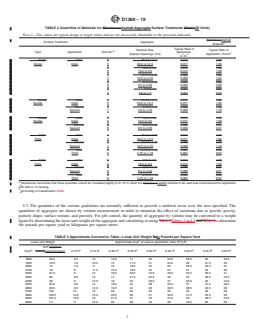
5.1 Typical quantities of materials for the several types of surface treatments are listed in Table 1Tables 1 and 2 and Table 2.
TABLE 1 Quantities of Materials for BituminousAsphalt-Aggregate Surface Treatments (U.S. Customary (Inch-Pound Units)
NOTE 1—The values are typical design or target values and are not necessarily obtainable to the precision indicated.
BituminousAsphalt
Surface Treatment Aggregate
A
Material
Nominal Size Typical Rate of Typical Rate of
B
Type Application Size No.
3 2 2
(Square Openings) Application, ft /yd Application, gal/yd
Single initial 5 1 in. to ⁄2 in. 0.50 0.42
Single Initial 5 1 in. to ⁄2 in. 0.50 0.42
3 3
6 ⁄4 in. to ⁄8 in. 0.36 0.37
7 ⁄2 in. to No. 4 0.23 0.23
8 ⁄8 in. to No. 8 0.17 0.19
9 No. 4 to No. 16 0.11 0.13
9 No. 4 to No. 16 0.11 0.13
Double initial 5 1 in. to ⁄2 in. 0.50 0.42
Double Initial 5 1 in. to ⁄2 in. 0.50 0.42
second 7 ⁄2 in. to No. 4 0.25 0.26
Second 7 ⁄2 in. to No. 4 0.25 0.26
3 3
Double initial 6 ⁄4 in. to ⁄8 in. 0.36 0.37
3 3
Double Initial 6 ⁄4 in. to ⁄8 in. 0.36 0.37
second 8 ⁄8 in. to No. 8 0.18 0.20
Second 8 ⁄8 in. to No. 8 0.18 0.20
Triple initial 5 1 in. to ⁄2 in. 0.50 0.42
Triple Initial 5 1 in. to ⁄2 in. 0.50 0.42
second 7 ⁄2 in. to No. 4 0.25 0.26
Second 7 ⁄2 in. to No. 4 0.25 0.26
third 9 No. 4 to No. 16 0.13 0.14
Third 9 No. 4 to No. 16 0.13 0.14
3 3
Triple initial 6 ⁄4 in. to ⁄8 in. 0.36 0.37
3 3
Triple Initial 6 ⁄4 in. to ⁄8 in. 0.36 0.37
second 8 ⁄8 in. to No. 8 0.18 0.20
Second 8 ⁄8 in. to No. 8 0.18 0.20
third 9 No. 4 to No. 16 0.13 0.14
Third 9 No. 4 to No. 16 0.13 0.14
A
Experience has shown that these quantities should be increased slightly (5 to 10 %) when the bituminousasphalt material to be used was manufactured for application
with little or no heating.
B
According to Classification D448.
D1369 − 19
TABLE 2 Quantities of Materials for BituminousAsphalt-Aggregate Surface Treatments (Metric(SI Units)
NOTE 1—The values are typical design or target values and are not necessarily obtainable to the precision indicated.
BituminousAsphalt
Surface Treatment Aggregate
A
Material
Typical Rate of
Nominal Size Typical Rate of
B
Type Application Size No. Application,
(Square Openings, mm) Application, litre/m
3 2
m /m
Single initial 5 25.0 to 12.5 0.017 1.90
Single Initial 5 25.0 to 12.5 0.017 1.90
6 19.0 to 9.5 0.012 1.68
6 19.0 to 9.5 0.012 1.68
7 12.5 to 4.75 0.008 1.04
7 12.5 to 4.75 0.008 1.04
8 9.5 to 2.36 0.006 0.86
8 9.5 to 2.36 0.006 0.86
9 4.8 to 1.2 0.004 0.59
9 4.8 to 1.2 0.004 0.59
Double initial 5 25.0 to 12.5 0.017 1.90
Double Initial 5 25.0 to 12.5 0.017 1.90
second 7 2.5 to 4.75 0.008 1.18
Second 7 2.5 to 4.75 0.008 1.18
Double initial 6 19.0 to 9.5 0.012 1.68
Double Initial 6 19.0 to 9.5 0.012 1.68
second 8 9.5 to 2.36 0.006 0.91
Second 8 9.5 to 2.36 0.006 0.91
Triple initial 5 25.0 to 12.5 0.017 1.90
Triple Initial 5 25.0 to 12.5 0.017 1.90
second 7 12.5 to 4.75 0.008 1.18
Second 7 12.5 to 4.75 0.008 1.18
third 9 4.75 to 1.18 0.004 0.63
Third 9 4.75 to 1.18 0.004 0.63
Triple initial 6 19.0 to 9.5 0.012 1.68
Triple
...