

ASTM D1160-18
(Test Method)Standard Test Method for Distillation of Petroleum Products at Reduced Pressure
General Information
- Abstract
SIGNIFICANCE AND USE
5.1 This test method is used for the determination of the distillation characteristics of petroleum products, biodiesel, and fractions that may decompose if distilled at atmospheric pressure. This boiling range, obtained at conditions designed to obtain approximately one theoretical plate fractionation, can be used in engineering calculations to design distillation equipment, to prepare appropriate blends for industrial purposes, to determine compliance with regulatory rules, to determine the suitability of the product as feed to a refining process, or for a host of other purposes.
5.2 The boiling range is directly related to viscosity, vapor pressure, heating value, average molecular weight, and many other chemical, physical, and mechanical properties. Any of these properties can be the determining factor in the suitability of the product in its intended application.
5.3 Petroleum product specifications often include distillation limits based on data by this test method.
5.4 Many engineering design correlations have been developed on data by this test method. These correlative methods are used extensively in current engineering practice.
SCOPE
1.1 This test method covers the determination, at reduced pressures, of the range of boiling points for petroleum products and biodiesel that can be partially or completely vaporized at a maximum liquid temperature of 400 °C. Both a manual method and an automatic method are specified.
1.2 In cases of dispute, the referee test method is the manual test method at a mutually agreed upon pressure.
1.3 The values stated in SI units are to be regarded as standard. The values given in parentheses after SI units are provided for information only and are not considered standard.
1.4 This standard does not purport to address all of the safety concerns, if any, associated with its use. It is the responsibility of the user of this standard to establish appropriate safety, health, and environmental practices and determine the applicability of regulatory limitations prior to use. For specific warning statements, see 6.1.4, 6.1.8.1, 10.11, and A3.2.1.
1.5 This international standard was developed in accordance with internationally recognized principles on standardization established in the Decision on Principles for the Development of International Standards, Guides and Recommendations issued by the World Trade Organization Technical Barriers to Trade (TBT) Committee.
- Status
- Published
- Publication Date
- 30-Jun-2018
- Technical Committee
- D02 - Petroleum Products, Liquid Fuels, and Lubricants
- Drafting Committee
- D02.08 - Volatility
Buy Documents
ASTM D1160-18 - Standard Test Method for Distillation of Petroleum Products at Reduced Pressure
REDLINE ASTM D1160-18 - Standard Test Method for Distillation of Petroleum Products at Reduced Pressure
Overview
ASTM D1160-18, issued by ASTM International, specifies the Standard Test Method for Distillation of Petroleum Products at Reduced Pressure. This method is essential for determining the distillation characteristics-such as boiling range-of petroleum products, biodiesel, and related fractions that may decompose at atmospheric pressure. The standard lays out procedures for both manual and automatic methods to achieve accurate distillation results under reduced pressures, typically with a maximum liquid temperature up to 400 °C.
This standard is widely recognized as critical in the petroleum, refining, and biodiesel industries for product specification, equipment design, regulatory compliance, and quality control. The boiling range data obtained is directly linked to other key properties such as viscosity, vapor pressure, heating value, and molecular weight.
Key Topics
- Reduced Pressure Distillation: Describes a process where petroleum products and biodiesel are distilled at pressures ranging from 0.13 kPa to 6.7 kPa. This technique is vital for products prone to thermal decomposition at standard pressures.
- Boiling Range Determination: Provides a method to determine initial boiling point (IBP), final boiling point (FBP), and develop a distillation curve. These data are essential for understanding product volatility and thermal stability.
- Manual and Automatic Methods: Both approaches are included, with the manual method serving as the referee in case of discrepancies.
- Precision and Reproducibility: The standard emphasizes the importance of repeatability and reproducibility of results, ensuring confidence in the data used for engineering and regulatory purposes.
- Safety and Regulatory Considerations: Users must establish proper safety, health, and environmental controls. The test method also aligns with international standardization principles under the WTO TBT agreement.
Applications
ASTM D1160-18 plays a pivotal role across multiple sectors:
- Engineering Design: Data derived from this method informs the design and optimization of distillation towers and petroleum processing equipment.
- Product Specification: Frequently used to determine compliance with contractual specifications and regulatory requirements for petroleum products and biodiesel.
- Quality Control: Refineries, laboratories, and biodiesel plants utilize this test to verify the suitability of raw materials and end products.
- Feedstock Suitability: Helps processors determine if a petroleum fraction or biodiesel is appropriate as a feed to further refining or chemical processing.
- Blend Preparation: Essential for developing blends of fuels and lubricants tailored to specific industrial or automotive needs.
- Research & Development: Supports the advancement of new fuel formulations, biodiesel blends, and refining technologies.
Related Standards
- ASTM D613: Test Method for Cetane Number of Diesel Fuel Oil
- ASTM D1193: Specification for Reagent Water
- ASTM D1250: Guide for Use of Petroleum Measurement Tables
- ASTM D1298: Test Method for Density, Relative Density, or API Gravity by Hydrometer
- ASTM D4052: Test Method for Density and API Gravity of Liquids by Digital Density Meter
- ASTM D4057: Practice for Manual Sampling of Petroleum and Petroleum Products
- ASTM D4177: Practice for Automatic Sampling of Petroleum and Petroleum Products
- ASTM D6300: Practice for Determination of Precision and Bias in Test Methods
Each of these related ASTM standards supports the implementation and verification of the procedures outlined in D1160, contributing to the overall quality and reliability of petroleum testing and analysis.
Keywords: ASTM D1160, reduced pressure distillation, petroleum distillation, biodiesel analysis, boiling range, vacuum distillation, petroleum product specifications, refinery testing, fuel quality control.
Relations
- Effective Date
- 01-Mar-2024
- Effective Date
- 01-Feb-2024
- Effective Date
- 01-Dec-2023
- Effective Date
- 01-Dec-2019
- Effective Date
- 01-May-2019
- Effective Date
- 01-Dec-2017
- Effective Date
- 01-May-2017
- Effective Date
- 01-Mar-2017
- Effective Date
- 01-Oct-2016
- Effective Date
- 01-Jun-2016
- Effective Date
- 01-Apr-2016
- Effective Date
- 01-Jun-2015
- Effective Date
- 01-Apr-2015
- Effective Date
- 01-Jun-2014
- Effective Date
- 01-Jun-2014
Buy Documents
ASTM D1160-18 - Standard Test Method for Distillation of Petroleum Products at Reduced Pressure
REDLINE ASTM D1160-18 - Standard Test Method for Distillation of Petroleum Products at Reduced Pressure
Get Certified
Connect with accredited certification bodies for this standard

Element Materials Technology
Materials testing and product certification.

ABS Group Brazil
ABS Group certification services in Brazil.

ABS Quality Evaluations Inc.
American Bureau of Shipping quality certification.
Sponsored listings
Frequently Asked Questions
ASTM D1160-18 is a standard published by ASTM International. Its full title is "Standard Test Method for Distillation of Petroleum Products at Reduced Pressure". This standard covers: SIGNIFICANCE AND USE 5.1 This test method is used for the determination of the distillation characteristics of petroleum products, biodiesel, and fractions that may decompose if distilled at atmospheric pressure. This boiling range, obtained at conditions designed to obtain approximately one theoretical plate fractionation, can be used in engineering calculations to design distillation equipment, to prepare appropriate blends for industrial purposes, to determine compliance with regulatory rules, to determine the suitability of the product as feed to a refining process, or for a host of other purposes. 5.2 The boiling range is directly related to viscosity, vapor pressure, heating value, average molecular weight, and many other chemical, physical, and mechanical properties. Any of these properties can be the determining factor in the suitability of the product in its intended application. 5.3 Petroleum product specifications often include distillation limits based on data by this test method. 5.4 Many engineering design correlations have been developed on data by this test method. These correlative methods are used extensively in current engineering practice. SCOPE 1.1 This test method covers the determination, at reduced pressures, of the range of boiling points for petroleum products and biodiesel that can be partially or completely vaporized at a maximum liquid temperature of 400 °C. Both a manual method and an automatic method are specified. 1.2 In cases of dispute, the referee test method is the manual test method at a mutually agreed upon pressure. 1.3 The values stated in SI units are to be regarded as standard. The values given in parentheses after SI units are provided for information only and are not considered standard. 1.4 This standard does not purport to address all of the safety concerns, if any, associated with its use. It is the responsibility of the user of this standard to establish appropriate safety, health, and environmental practices and determine the applicability of regulatory limitations prior to use. For specific warning statements, see 6.1.4, 6.1.8.1, 10.11, and A3.2.1. 1.5 This international standard was developed in accordance with internationally recognized principles on standardization established in the Decision on Principles for the Development of International Standards, Guides and Recommendations issued by the World Trade Organization Technical Barriers to Trade (TBT) Committee.
SIGNIFICANCE AND USE 5.1 This test method is used for the determination of the distillation characteristics of petroleum products, biodiesel, and fractions that may decompose if distilled at atmospheric pressure. This boiling range, obtained at conditions designed to obtain approximately one theoretical plate fractionation, can be used in engineering calculations to design distillation equipment, to prepare appropriate blends for industrial purposes, to determine compliance with regulatory rules, to determine the suitability of the product as feed to a refining process, or for a host of other purposes. 5.2 The boiling range is directly related to viscosity, vapor pressure, heating value, average molecular weight, and many other chemical, physical, and mechanical properties. Any of these properties can be the determining factor in the suitability of the product in its intended application. 5.3 Petroleum product specifications often include distillation limits based on data by this test method. 5.4 Many engineering design correlations have been developed on data by this test method. These correlative methods are used extensively in current engineering practice. SCOPE 1.1 This test method covers the determination, at reduced pressures, of the range of boiling points for petroleum products and biodiesel that can be partially or completely vaporized at a maximum liquid temperature of 400 °C. Both a manual method and an automatic method are specified. 1.2 In cases of dispute, the referee test method is the manual test method at a mutually agreed upon pressure. 1.3 The values stated in SI units are to be regarded as standard. The values given in parentheses after SI units are provided for information only and are not considered standard. 1.4 This standard does not purport to address all of the safety concerns, if any, associated with its use. It is the responsibility of the user of this standard to establish appropriate safety, health, and environmental practices and determine the applicability of regulatory limitations prior to use. For specific warning statements, see 6.1.4, 6.1.8.1, 10.11, and A3.2.1. 1.5 This international standard was developed in accordance with internationally recognized principles on standardization established in the Decision on Principles for the Development of International Standards, Guides and Recommendations issued by the World Trade Organization Technical Barriers to Trade (TBT) Committee.
ASTM D1160-18 is classified under the following ICS (International Classification for Standards) categories: 75.080 - Petroleum products in general. The ICS classification helps identify the subject area and facilitates finding related standards.
ASTM D1160-18 has the following relationships with other standards: It is inter standard links to ASTM D6300-24, ASTM D613-24, ASTM D6300-23a, ASTM D6300-19a, ASTM D1250-19e1, ASTM D613-17c, ASTM D613-17a, ASTM D613-17, ASTM D613-16a, ASTM D613-16, ASTM D6300-16, ASTM D6300-15, ASTM D613-15a, ASTM D6300-14ae1, ASTM D6300-14a. Understanding these relationships helps ensure you are using the most current and applicable version of the standard.
ASTM D1160-18 is available in PDF format for immediate download after purchase. The document can be added to your cart and obtained through the secure checkout process. Digital delivery ensures instant access to the complete standard document.
Standards Content (Sample)
This international standard was developed in accordance with internationally recognized principles on standardization established in the Decision on Principles for the
Development of International Standards, Guides and Recommendations issued by the World Trade Organization Technical Barriers to Trade (TBT) Committee.
Designation: D1160 − 18
Standard Test Method for
Distillation of Petroleum Products at Reduced Pressure
This standard is issued under the fixed designation D1160; the number immediately following the designation indicates the year of
original adoption or, in the case of revision, the year of last revision.Anumber in parentheses indicates the year of last reapproval.A
superscript epsilon (´) indicates an editorial change since the last revision or reapproval.
This standard has been approved for use by agencies of the U.S. Department of Defense.
1. Scope* ucts by Hydrometer Method
D4052Test Method for Density, Relative Density, and API
1.1 This test method covers the determination, at reduced
Gravity of Liquids by Digital Density Meter
pressures,oftherangeofboilingpointsforpetroleumproducts
D4057Practice for Manual Sampling of Petroleum and
andbiodieselthatcanbepartiallyorcompletelyvaporizedata
Petroleum Products
maximumliquidtemperatureof400°C.Bothamanualmethod
D4177Practice for Automatic Sampling of Petroleum and
and an automatic method are specified.
Petroleum Products
1.2 Incasesofdispute,therefereetestmethodisthemanual
D6300Practice for Determination of Precision and Bias
test method at a mutually agreed upon pressure.
Data for Use in Test Methods for Petroleum Products and
1.3 The values stated in SI units are to be regarded as
Lubricants
standard. The values given in parentheses after SI units are
providedforinformationonlyandarenotconsideredstandard.
3. Terminology
1.4 This standard does not purport to address all of the
3.1 Definitions of Terms Specific to This Standard:
safety concerns, if any, associated with its use. It is the
3.1.1 atmospheric equivalent temperature (AET), n—the
responsibility of the user of this standard to establish appro-
temperature converted from the measured vapor temperature
priate safety, health, and environmental practices and deter-
using EqA7.1. TheAET is the expected distillate temperature
mine the applicability of regulatory limitations prior to use.
if the distillation was performed at atmospheric pressure and
For specific warning statements, see 6.1.4, 6.1.8.1, 10.11, and
there was no thermal decomposition.
A3.2.1.
1.5 This international standard was developed in accor-
3.1.2 end point (EP) or final boiling point (FBP), n—the
dance with internationally recognized principles on standard-
maximum vapor temperature reached during the test.
ization established in the Decision on Principles for the
3.1.3 initial boiling point (IBP), n—the vapor temperature
Development of International Standards, Guides and Recom-
mendations issued by the World Trade Organization Technical that is measured at the instant the first drop of condensate falls
Barriers to Trade (TBT) Committee. from the lower end of the condenser section drip tip.
3.1.3.1 Discussion—Whenachainisattachedtothedriptip
2. Referenced Documents
the first drop will form and run down the chain. In automatic
2.1 ASTM Standards:
apparatus, the first drop detection device shall be located as
D613Test Method for Cetane Number of Diesel Fuel Oil
near to the lower end of the drip tip as practical.
D1193Specification for Reagent Water
3.1.4 spillover point, n—the highest point of the lower
D1250Guide for Use of the Petroleum MeasurementTables
internal junction of the distillation column and the condensing
D1298Test Method for Density, Relative Density, or API
section of the vacuum-jacketed column assembly.
Gravity of Crude Petroleum and Liquid Petroleum Prod-
4. Summary of Test Method
This test method is under the jurisdiction of ASTM Committee D02 on
Petroleum Products, Liquid Fuels, and Lubricants and is the direct responsibility of
4.1 The sample is distilled at an accurately controlled
Subcommittee D02.08 on Volatility.
pressure between 0.13kPa and 6.7kPa (1mm and 50 mm Hg)
Current edition approved July 1, 2018. Published August 2018. Originally
under conditions that are designed to provide approximately
approved in 1951. Last previous edition approved in 2015 as D1160–15. DOI:
10.1520/D1160-18.
one theoretical plate fractionation. Data are obtained from
For referenced ASTM standards, visit the ASTM website, www.astm.org, or
which the initial boiling point, the final boiling point, and a
contact ASTM Customer Service at service@astm.org. For Annual Book of ASTM
distillation curve relating volume percent distilled and atmo-
Standards volume information, refer to the standard’s Document Summary page on
the ASTM website. spheric equivalent boiling point temperature can be prepared.
*A Summary of Changes section appears at the end of this standard
Copyright © ASTM International, 100 Barr Harbor Drive, PO Box C700, West Conshohocken, PA 19428-2959. United States
D1160 − 18
5. Significance and Use efficient use of the apparatus and ease of its operation. Both
manual and automatic versions of the apparatus must conform
5.1 This test method is used for the determination of the
to the following requirements.Additional requirements for the
distillationcharacteristicsofpetroleumproducts,biodiesel,and
automatic apparatus can be found in Annex A9.
fractions that may decompose if distilled at atmospheric
pressure.Thisboilingrange,obtainedatconditionsdesignedto 6.1.1 Distillation Flask, of 500mL capacity, made of boro-
obtainapproximatelyonetheoreticalplatefractionation,canbe silicate glass or of quartz conforming to the dimensions given
used in engineering calculations to design distillation
in Fig. 2 or Fig. 3, and having a heating mantle with insulating
equipment, to prepare appropriate blends for industrial
top. These dimensions can vary slightly by manufacturer, and
purposes, to determine compliance with regulatory rules, to
are not considered critical dimensions, with the exception of
determine the suitability of the product as feed to a refining
the position of the end of the temperature sensing probe, and
process, or for a host of other purposes.
the inner diameter of the connection to the distillation column
not being less than the inner diameter of the distillation
5.2 The boiling range is directly related to viscosity, vapor
pressure, heating value, average molecular weight, and many column. The use of the thermowell can be replaced by an
other chemical, physical, and mechanical properties. Any of
encased temperature probe and the second side neck is present
these properties can be the determining factor in the suitability
on commercially available flasks used in this test method.
of the product in its intended application.
5.3 Petroleum product specifications often include distilla- 6.1.2 Vacuum-Jacketed Column Assembly, of borosilicate
tion limits based on data by this test method.
glass, consisting of a distilling head and an associated con-
denser section as illustrated in the lettered drawing, Fig. 4 and
5.4 Many engineering design correlations have been devel-
Table 1. The head shall be enclosed in a completely silvered
opedondatabythistestmethod.Thesecorrelativemethodsare
glass vacuum jacket with a permanent vacuum of less than
used extensively in current engineering practice.
−5 −7
10 Pa (10 mm Hg) (Note 1). The attached condenser
6. Apparatus
section shall be enclosed in water jackets as illustrated and
haveanadapteratthetopforconnectiontothevacuumsource.
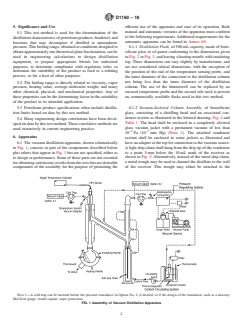
6.1 The vacuum distillation apparatus, shown schematically
Alightdrip-chainshallhangfromthedriptipofthecondenser
in Fig. 1, consists in part of the components described below
to a point 5mm below the 10mL mark of the receiver as
plus others that appear in Fig. 1 but are not specified, either as
to design or performance. Some of these parts are not essential shown in Fig. 5.Alternatively, instead of the metal drip-chain,
forobtainingsatisfactoryresultsfromthetestsbutaredesirable a metal trough may be used to channel the distillate to the wall
components of the assembly for the purpose of promoting the of the receiver. This trough may either be attached to the
NOTE 1—Acold trap can be inserted before the pressure transducer in Option No. 2, if desired, or if the design of the transducer, such as a mercury
McCleod gauge, would require vapor protection.
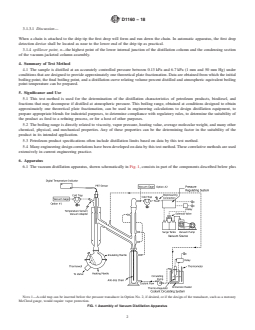
FIG. 1 Assembly of Vacuum Distillation Apparatus
D1160 − 18
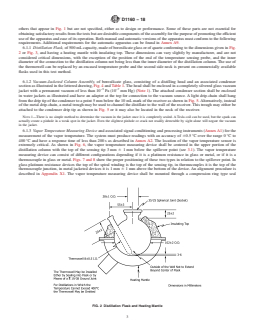
FIG. 2 Distillation Flask and Heating Mantle
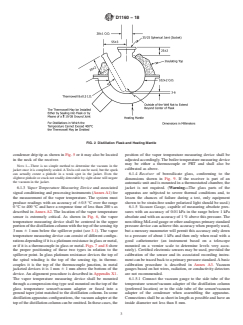
condenser drip tip as shown in Fig. 5 or it may also be located position of the vapor temperature measuring device shall be
in the neck of the receiver. adjustedaccordingly.Theboilertemperaturemeasuringdevice
may be either a thermocouple or PRT and shall also be
NOTE 1—There is no simple method to determine the vacuum in the
calibrated as above.
jacket once it is completely sealed.ATesla coil can be used, but the spark
6.1.4 Receiver of borosilicate glass, conforming to the
can actually create a pinhole in a weak spot in the jacket. Even the
slightest pinhole or crack not readily detectable by sight alone will negate
dimensions shown in Fig. 9. If the receiver is part of an
the vacuum in the jacket.
automatic unit and is mounted in a thermostatted chamber, the
6.1.3 Vapor Temperature Measuring Device and associated jacket is not required. (Warning—The glass parts of the
signalconditioningandprocessinginstruments(AnnexA1)for apparatus are subjected to severe thermal conditions and, to
the measurement of the vapor temperature. The system must lessen the chances of failure during a test, only equipment
produce readings with an accuracy of 60.5°C over the range shown to be strain-free under polarized light should be used.)
0°C to 400°C and have a response time of less than 200s as 6.1.5 Vacuum Gauge, capable of measuring absolute pres-
described in AnnexA2. The location of the vapor temperature sures with an accuracy of 0.01kPa in the range below 1kPa
sensor is extremely critical. As shown in Fig. 6, the vapor absolute and with an accuracy of 1% above this pressure. The
temperature measuring device shall be centered in the upper non-tiltingMcLeodgaugeorotheranalogousprimarystandard
portionofthedistillationcolumnwiththetopofthesensingtip pressure device can achieve this accuracy when properly used,
3mm 6 1mm below the spillover point (see 3.1). The vapor but a mercury manometer will permit this accuracy only down
temperature measuring device can consist of different configu- to a pressure of about 1kPa and then only when read with a
rationsdependingifitisaplatinumresistanceinglassormetal, good cathetometer (an instrument based on a telescope
or if it is a thermocouple in glass or metal. Figs. 7 and 8 show mounted on a vernier scale to determine levels very accu-
the proper positioning of these two types in relation to the rately). Certified electronic sensors may be used, provided the
spillover point. In glass platinum resistance devices the top of calibration of the sensor and its associated recording instru-
the spiral winding is the top of the sensing tip, in thermo- mentcanbetracedbacktoaprimarypressurestandard.Abasic
couples it is the top of the thermocouple junction, in metal calibration procedure is described in Annex A3. Vacuum
jacketed devices it is 1mm 6 1mm above the bottom of the gauges based on hot wires, radiation, or conductivity detectors
device.An alignment procedure is described in Appendix X1. are not recommended.
The vapor temperature measuring device shall be mounted 6.1.5.1 Connect the vacuum gauge to the side tube of the
throughacompressionringtypesealmountedonthetopofthe temperature sensor/vacuum adapter of the distillation column
glass temperature sensor/vacuum adapter or fused into a (preferred location) or to the side tube of the sensor/vacuum
ground taper joint matched to the distillation column. In some adapter of the condenser when assembling the apparatus.
distillation apparatus configurations, the vacuum adapter at the Connections shall be as short in length as possible and have an
topofthedistillationcolumncanbeomitted.Inthesecases,the inside diameter not less than 8 mm.
D1160 − 18
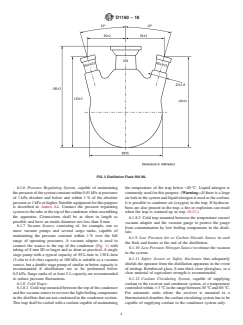
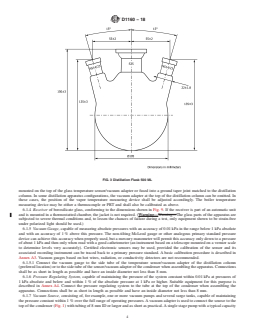
FIG. 3 Distillation Flask 500 ML
6.1.6 Pressure Regulating System, capable of maintaining the temperature of the trap below−40°C. Liquid nitrogen is
thepressureofthesystemconstantwithin0.01kPaatpressures commonlyusedforthispurpose.(Warning—Ifthereisalarge
of 1kPa absolute and below and within 1% of the absolute airleakinthesystemandliquidnitrogenisusedasthecoolant,
pressureat1kPaorhigher.Suitableequipmentforthispurpose it is possible to condense air (oxygen) in the trap. If hydrocar-
is described in Annex A4. Connect the pressure regulating bons are also present in the trap, a fire or explosion can result
systemtothetubeatthetopofthecondenserwhenassembling
when the trap is warmed up in step 10.12.)
the apparatus. Connections shall be as short in length as
6.1.8.2 Cold trap mounted between the temperature sensor/
possible and have an inside diameter not less than 8mm.
vacuum adapter and the vacuum gauge to protect the gauge
6.1.7 Vacuum Source, consisting of, for example, one or
from contamination by low boiling components in the distil-
more vacuum pumps and several surge tanks, capable of
late.
maintaining the pressure constant within 1% over the full
6.1.9 Low Pressure Air or Carbon Dioxide Source to cool
range of operating pressures. A vacuum adapter is used to
the flask and heater at the end of the distillation.
connect the source to the top of the condenser (Fig. 1) with
6.1.10 Low Pressure Nitrogen Source to release the vacuum
tubing of 8mm ID or larger and as short as practical.Asingle
in the system.
stage pump with a typical capacity of 85L⁄min to 130L⁄min
6.1.11 Safety Screen or Safety Enclosure that adequately
(3cfm to 4.6cfm) capacity at 100kPa is suitable as a vacuum
shields the operator from the distillation apparatus in the event
source,butadoublestagepumpofsimilarorbettercapacityis
of mishap. Reinforced glass, 6 mm thick clear plexiglass, or a
recommended if distillations are to be performed below
clear material of equivalent strength is recommended.
0.5kPa. Surge tanks of at least 5Lcapacity are recommended
to reduce pressure fluctuations. 6.1.12 Coolant Circulating System, capable of supplying
6.1.8 Cold Traps: coolant to the receiver and condenser system, at a temperature
6.1.8.1 Coldtrapmountedbetweenthetopofthecondenser controlledwithin 63°Cintherangebetween30°Cand80°C.
andthevacuumsourcetorecoverthelightboilingcomponents For automatic units where the receiver is mounted in a
inthedistillatethatarenotcondensedinthecondensersection. thermostattedchamber,thecoolantcirculatingsystemhastobe
Thistrapshallbecooledwithacoolantcapableofmaintaining capable of supplying coolant to the condenser system only.
D1160 − 18
FIG. 4 Vacuum-Jacketed Column
7. Reagents and Materials 7.5 Toluene—Technical grade.
7.1 n-Tetradecane—Reagent grade conforming to the speci-
7.6 Cyclohexane—Technical grade.
fications of the Committee on Analytical Reagents of the
American Chemical Society.
8. Sample and Sampling Requirements
7.2 ASTM Cetane Reference Fuel (n-Hexadecane), con-
8.1 Sampling shall be done in accordance with Practices
forming to the specification in Test Method D613.
D4057 or D4177. It is assumed that a 4L to 8L sample,
7.3 SiliconeGrease—Highvacuumsiliconegreasespecially
representativeofashipmentorofaplantoperation,isreceived
manufactured for the use in high vacuum applications.
by the laboratory and that this sample is to be used for a series
of tests and analyses. An aliquot portion slightly in excess of
7.4 Silicone Oil, certified by the manufacturer to be appli-
200mL will be required for this test method.
cable for prolonged use at temperatures above 350°C.
8.2 The aliquot used for this test shall be moisture-free. If
thereisevidenceofmoisture(dropsonthevesselwall,aliquid
Reagent Chemicals, American Chemical Society Specifications, American
Chemical Society, Washington, DC. For Suggestions on the testing of reagents not
layer on the bottom of the container, etc.) use the procedure
listed by the American Chemical Society, see Annual Standards for Laboratory
given in Annex A6, paragraph A6.1, to dehydrate a sufficient
Chemicals, BDH Ltd., Poole, Dorset, U.K., and the United States Pharmacopeia
quantity of sample to provide the 200mL charge to the
and National Formulary, U.S. Pharmacopeial Convention, Inc. (USPC), Rockville,
MD. distillation flask.
D1160 − 18
TABLE 1 Vacuum-Jacketed Column Assembly Dimensions
NOTE 1—These dimensions are for guidance for verifying the appropriate construction of the assembly. The actual dimensions used by glassmakers
varytosomeextent,andthedimensionstheyusetoconstructtheassemblyarenoteasilyobtainedaftertheassemblyisfusedtogether.Thosedimensions
noted as critical shall be adhered to within the tolerance listed. The dimensions listed in this chart have been gathered from users of the various
manufactured manual and automatic apparatus who participated in the interlaboratory program to produce the precision for this test method.
NOTE 2—Important—Further study will progress to produce a set of dimensions which will be more restrictive in range of dimension, since it is
believed that the current wide variance in dimensions has resulted in precision for this test method to be significantly high. The target dimensions for
this assembly and other components of the apparatus are expected to be available within the next year, with implementation expected to occur after five
years of initial revised test method publication date.
A
Component Critical Dimensions Notes
A no 265±10 .
B yes 99 ± 4 Spillover point
C yes 85 ± 3 Internal measurement difficult, used by manufacturer for assembly. Dimension is where
center of angled inner tube intersects with the inner wall of the vertical column
D (OD) no 64.5 ± 2 . . .
B
E no 14/23 or 19/38 Tapered ground joint – female
B
F no 35/25 Spherical ground joint – male
G no 35 ± 10 This area to be covered by the insulating top of the heating mantle
H (ID) yes 24.7 ± 1.2 Use of 28 mm OD tubing achieves this dimension
I no 2 − 12 Window allows observation of boil-up rate and column cleanliness, but also allows detri-
mental heat loss
J no 60±20 .
K no 12±7 .
L (OD) no 8 Minimum, cooling medium connections
M yes 230 ± 13 This dimension determines condensed vapor run down time and affects temperature/
recovery results
N (OD) no 38 ± 2 . . .
O yes 140 ± 20 This dimension affects vapor condensing efficiency which influences temperature/
recovery results
P (ID) yes 18.7 ± 1.1 Use of 22 mm OD tubing achieves this dimension
Q yes 60 ± 2° . . .
R no not applicable Connection to vacuum system; any suitable means is allowed
S no not applicable Extension above condensing section; must maintain minimum or greater internal diam-
eter of condensing section
T (ID) yes 18.7 ± 1.1 Use of 22 mm OD tubing achieves this dimension
U yes 140 ± 5 This dimension affects vapor condensing efficiency which influences temperature/
recovery results
V no not applicable Extensions on the upper and lower portions of the condensing section vary by manufac-
turer and have no influence on the test
W no 12±7 .
X yes 50 ± 8 . . .
Y yes 30 ± 7 Distance to end of drip tip
A
All dimensions are in millimetres.
B
Ground glass joints from different sources may have one of a number of diameter to length ratios. For purposes of this test method, any are suitable, and in some
instances, the diameter itself is not critical. However, it is critical that the male and female parts of each joint are from the same series to avoid recession or protuberance.
D4052, and by using either the mathematical subroutines or
tables of Guide D1250, or a combination thereof.
8.4 If the sample is not to be tested immediately upon
receipt, store at ambient temperature or below. If the sample is
received in a plastic container, it shall be transferred to a
container made out of glass or of metal prior to storage.
8.5 The sample shall be completely liquid before charging.
If crystals are visible, the sample shall be heated to a
temperature that permits the crystals to dissolve. The sample
mustthenbestirredvigorouslyfor5minto15min,depending
on the sample size, viscosity, and other factors, to ensure
uniformity. If solids are still visible above 70°C, these par-
ticles are probably inorganic in nature and not part of the
distillable portion of the sample. Remove most of these solids
FIG. 5 Detail of Drip-Chain or Trough Attachment to Condenser
by filtering or decanting the sample.
8.5.1 There are several substances, such as visbroken resi-
duesandhighmeltingpointwaxes,thatwillnotbecompletely
8.3 Determine the density of the oil sample at the tempera-
fluid at 70°C. These solids and semi-solids should not be
ture of the receiver by means of a hydrometer by Practice
D1298, by means of a digital density meter by Test Method removed since they are part of the hydrocarbon feed.
D1160 − 18
NOTE 1—Dimensions are in millimetres.
FIG. 6 Location of Temperature Sensor
FIG. 7 Platinum Resistance Temperature Measuring Device
D1160 − 18
FIG. 8 Thermocouple Temperature Measuring Device
9. Preparation, Calibration, and Quantification of
Apparatus
9.1 Calibrate the temperature sensors and associated signal
conditioning and processing device as a unit in accordance
with Annex A1.
9.2 Checktheoperationofthepressureregulatingsystemas
described in Annex A4.
9.3 Clean and dry the glass parts and relubricate the joints.
Silicone high-vacuum grease can be used but no more than is
necessary to give a uniform film on the ground glass surfaces.
An excess of grease can cause leaks and can contribute to
foaming at startup.
9.4 Assembletheemptyapparatusandconductaleaktestas
described in A3.3.2.
9.5 Check the total apparatus using either of the two
reagents described in 7.1 and 7.2 and in accordance with
Annex A5.
NOTE 1—Jacket is not required for automatic units when receiver is
10. Procedure
placed in thermostatted chamber. If jacket is used, connections should not
interfere with reading of graduations.
10.1 Determine when the temperature sensor was last cali-
FIG. 9 Receiver
brated. Recalibrate according to Annex A1 if more time has
elapsed than that specified in Annex A1.
D1160 − 18
10.2 Set the temperature of the condenser coolant to at least temperaturereadingandthetotalvolumerecoveredatthetime
30°Cbelowthelowestvaportemperaturetobeobservedinthe the distillation is discontinued. When a product is tested for
test.
conformity with a given specification, record all requested
observations, whether or not they are listed above.
NOTE 2—A suitable coolant temperature for distillation of many
materials is 60°C.
NOTE 6—The maximum vapor temperature will result either from
10.3 From the density of the sample determine the weight, complete distillation of the oil or from the onset of cracking.
to the nearest 0.1g, equivalent to 200mLof the sample at the
10.10 If a sudden increase in pressure is observed, coupled
temperature of the receiver. Weigh this quantity of oil into the
with the formation of white vapors and a drop in the vapor
distillation flask.
temperature, the material being distilled is showing significant
10.4 Lubricate the spherical joints of the distillation appa- cracking. Discontinue the distillation immediately and record
ratus with a suitable grease (Note 3). Make certain that the
thefactontherunsheet.Ifnecessary,rerunthedistillationwith
surfaces of the joints are clean before applying the grease, and
a fresh sample at lower operating pressure.
use only the minimum quantity required. Connect the flask to
10.11 Lower the flask heater 5cm to 10cm and cool the
the lower spherical joint of the distilling head, place the heater
flask and heater with a gentle stream of air or, preferably, with
undertheflask,putthetopmantleinplaceandconnecttherest
astreamofcarbondioxide(Note7).Repressurethecontentsof
of the apparatus using spring clamps to secure the joints.
the still with dry nitrogen (Warning—Repressuring the con-
NOTE 3—Silicone high-vacuum grease has been used for this purpose.
tents of the still with air while it contains hot oil vapors can
An excess of this lubricant applied to the flask joint can cause the sample
result in fire or explosion.) if it is necessary to dismantle the
to foam during distillation.
apparatus before it has cooled below 200°C. Carbon dioxide
10.5 Place a few drops of silicone oil in the bottom of the
can also be used for repressuring, provided liquid nitrogen
thermowelloftheflaskandinsertthetemperaturesensortothe
traps are not in use. (Warning—In addition to other
bottom.The sensor can be secured with a wad of glass wool at
precautions,itisrecommendedtodiscontinuethedistillationat
the top of the thermowell.
a maximum vapor temperature of 350°C. Operating the
10.6 Start the vacuum pump and observe the flask contents distillation flask at temperatures above 350°C for prolonged
for signs of foaming. If the sample foams, allow the pressure periods at pressures below 1kPa may also result in thermal
ontheapparatustoincreaseslightlyuntilthefoamingsubsides. deformationoftheflask.Inthiscase,discardtheflaskafteruse.
Apply gentle heat to assist the removal of dissolved gas. For Alternatively, use a quartz flask.)
general directions for suppression of excessive foaming of the
NOTE7—Agentlestreamofcarbondioxideispreferredtocooltheflask
sample, see A6.2.
to prevent fire in the event the flask cracks during the test or during the
cooling cycle.
10.7 Evacuate the apparatus until the pressure reaches the
level prescribed for the distillation (Note 4). Failure to reach
10.12 Bringthetemperatureofthecoldtrapmountedbefore
the distillation pressure, or the presence of a steady increase in
the vacuum source back to ambient temperature. Recover,
pressure in the apparatus with the pump blocked off, is
measure, and record the volume of the light products collected
evidence of significant leakage into the system. Bring the
in the trap.
system to atmospheric condition using a nitrogen bleed and
10.13 Remove the receiver, empty it, and place it back into
relubricate all joints. If this does not result in a vacuum-tight
the instrument for the cleaning cycle, or use a separate, empty
system, examine other parts of the system for leaks.
receiver. Remove the flask and replace with a flask filled with
NOTE 4—The most commonly prescribed pressure is 1.3kPa (10mm
a cleaning solvent (Note 8). Run a distillation at atmospheric
Hg). For heavy products with a substantial fraction boiling above 500°C,
pressure to clean the unit. At the end of this cleaning run,
an operating pressure of 0.13kPa (1mm Hg) or 0.26kPa (2mm Hg) is
generally specified.
remove the flask and receiver and blow a gentle stream of air
or nitrogen to dry the unit.
10.8 After the desired pressure level has been attained, turn
on the heater and apply heat as rapidly as possible to the flask,
NOTE 8—Toluene or cyclohexane can be used as cleaning solvent.
without causing undue foaming of the sample. As soon as
vapororrefluxingliquidappearsattheneckoftheflask,adjust
11. Calculations and Report
therateofheatingsothatthedistillateisrecoveredatauniform
11.1 Convert the recorded vapor temperature readings to
rate of 6mL⁄min to 8mL⁄min (Note 5).
Atmospheric Equivalent Temperatures (AET) using the equa-
NOTE 5—It is extremely difficult to achieve the desired rate at the very
tions in Annex A7.
beginningofthedistillation,butthisrateshouldbeattainableafterthefirst
10% of the distillate has been recovered.
11.2 Report the AET to the nearest degree Celsius corre-
sponding to the volumetric percentages of liquid recovered in
10.9 Recordthevaportemperature,time,andthepressureat
each of the following volume percentage fractions of the the receiver. Report also the identity of the sample, the density
(measured in 8.3), the amount of liquid distillate recovered in
charge collected in the receiver: IBP, 5, 10, 20, 30, 40, 50, 60,
70, 80, 90, 95, and at the end point. If the liquid temperature the receiver, in the cold trap before the vacuum source, any
reaches 400°C, or if the vapor reaches a maximum tempera- unusual occurrence such as foaming or burping, together with
ture before the end point is observed, record the vapor the measures that were taken to correct the problem.
D1160 − 18
12. Precision and Bias 12.1.3 In Table 2, the rate of change in degrees Celsius
(AET) per percentage of liquid volume recovered is shown as
12.1 Precision—The precision of this test method was
C/V%.At any point between the 10% and the 90% point this
generated from data obtained in a 1983 cooperative interlabo-
value is assumed to be equal to the average value of C/V%of
ratory program with nine laboratories participating and eight
thetwodatapointsthatbracketthepointinquestion.Innocase
samples being run. In this program, one laboratory used an
shallthespanofthesetwopointsbemorethan20%recovered.
automaticvacuumdistillationanalyzerandtheresultsobtained
Anexceptionisthe5%pointwherethespanshallbenotmore
with this equipment have been included in the data used to
than 10%. See Annex A8 for an example.
generate this precision statement. The precision of this test
method is as follows:
12.2 The precision data in Table 2 have been computed
12.1.1 Repeatability—The difference between two test
from the following equations, which can be used to calculate
results, in degrees Celsius, obtained by the same operator with
precision data for C/V% values not listed.
the same apparatus under constant operating conditions on
12.2.1 Repeatability (r) can be calculated using the follow-
identical test materials would, in the long run, in the normal
ing equation:
and correct operation of this test method, exceed the values
indicated in Table 2 in only 1 case in 20. r 5 M eexp a1bln 1.8 S /1.8 (1)
@ $ ~ !%#
12.1.2 Reproducibility—The difference between two single
where:
and independent results in degrees Celsius, obtained by differ-
r = repeatability, °C (AET),
ent operators working in different laboratories on identical test
e = base of natural logarithmic function, ap-
material would, in the long run, in the normal and correct
proximately 2.718281828,
operation of this test method, exceed the values indicated in
a, b, and M = constants from 12.5.1, and
Table 2 in only 1 case in 20.
S = rate of temperature change (°C, AET) per
volume percent recovered.
Supporting data have been filed atASTM International Headquarters and may
12.2.2 Reproducibility (R) can be calculated using the
beobtainedbyrequestingResearchReportRR:D02-1206.ContactASTMCustomer
following equation:
Service at service@astm.org.
TABLE 2 Precision
NOTE 1—The body of this table is in degrees Celsius atmospheric equivalent temperature.
Criteria Repeatability Reproducibility
Pressure
0.13 kPa (1 mm Hg) 1.3 kPa (10 mm Hg) 0.13 kPa (1 mm Hg) 1.3 kPa (10 mm Hg)
IBP 17 15 56 49
FBP 3.3 7.1 31 27
Volume
5 %–50 % 60 %–90 % 5 %–50 % 60 %–90 % 5 %–50 % 60 %–90 % 5 %–50 % 60 %–90 %
Recovered
C/V %
0.5 2.4 2.5 1.9 2.0 6.5 3.9 7.0 5.4
1.0 2.9 3.0 2.4 2.5 10 6.0 9.3 7.2
1.5 3.2 3.3 2.8 2.9 13 7.8 11 8.5
2.0 3.4 3.5 3.1 3.2 16 9.4 12 9.6
2.5 3.6 3.7 3.3 3.5 18 11 14 11
3.0 3.8 3.9 3.6 3.7 21 12 15 11
3.5 3.9 4.0 3.8 3.9 23 13 16 12
4.0 4.0 4.2 3.9 4.1 25 15 16 13
4.5 4.1 4.3 4.1 4.3 27 16 17 13
5.0 4.2 4.4 4.3 4.4 29 17 18 14
5.5 4.3 4.5 4.4 4.6 30 18 19 15
6.0 4.4 4.6 4.5 4.7 32 19 19 15
6.5 4.5 4.7 4.7 4.8 34 20 20 16
7.0 4.6 4.8 4.8 5.0 35 23 21 16
7.5 4.7 4.8 4.9 5.1 37 22 21 16
8.0 4.8 4.9 5.0 5.2 38 23 22 17
8.5 4.8 5.0 5.1 5.3 40 24 22 17
9.0 4.9 5.1 5.2 5.4 41 25 23 18
9.5 5.0 5.1 5.3 5.5 43 25 23 18
10.0 5.0 5.2 5.4 5.6 44 26 24 19
10.5 5.1 5.2 5.5 5.7 46 27 24 19
11.0 5.1 5.3 5.6 5.8 47 28 25 19
11.5 5.2 5.4 5.7 5.9 48 29 25 20
12.0 5.2 5.4 5.8 6.0 50 30 26 20
12.5 5.3 5.5 5.9 6.1 51 30 26 20
13.0 5.3 5.5 6.0 6.2 52 31 27 21
13.5 5.4 5.6 6.0 5.3 54 32 27 21
14.0 5.4 5.6 6.1 6.3 55 33 27 21
14.5 5.5 5.7 6.2 6.4 56 33 28 22
15.0 5.5 5.7 6.3 6.5 57 34 28 22
D1160 − 18
TABLE 3 Precision (Biodiesel) 1.3 kPa (10 mm Hg)
R 5 M' eexp a'1b'ln 1.8 S /1.8 (2)
@ $ ~ !%#
Biodiesel Precision 5% to 60 % to
w
...
This document is not an ASTM standard and is intended only to provide the user of an ASTM standard an indication of what changes have been made to the previous version. Because
it may not be technically possible to adequately depict all changes accurately, ASTM recommends that users consult prior editions as appropriate. In all cases only the current version
of the standard as published by ASTM is to be considered the official document.
Designation: D1160 − 15 D1160 − 18
Standard Test Method for
Distillation of Petroleum Products at Reduced Pressure
This standard is issued under the fixed designation D1160; the number immediately following the designation indicates the year of
original adoption or, in the case of revision, the year of last revision. A number in parentheses indicates the year of last reapproval. A
superscript epsilon (´) indicates an editorial change since the last revision or reapproval.
This standard has been approved for use by agencies of the U.S. Department of Defense.
1. Scope*
1.1 This test method covers the determination, at reduced pressures, of the range of boiling points for petroleum products and
biodiesel that can be partially or completely vaporized at a maximum liquid temperature of 400 °C. Both a manual method and
an automatic method are specified.
1.2 In cases of dispute, the referee test method is the manual test method at a mutually agreed upon pressure.
1.3 The values stated in SI units are to be regarded as the standard. The values given in parentheses are for information only.after
SI units are provided for information only and are not considered standard.
1.4 This standard does not purport to address all of the safety concerns, if any, associated with its use. It is the responsibility
of the user of this standard to establish appropriate safety safety, health, and healthenvironmental practices and determine the
applicability of regulatory limitations prior to use. For specific warning statements, see 6.1.4, 6.1.8.1, 10.11, and A3.2.1.
1.5 This international standard was developed in accordance with internationally recognized principles on standardization
established in the Decision on Principles for the Development of International Standards, Guides and Recommendations issued
by the World Trade Organization Technical Barriers to Trade (TBT) Committee.
2. Referenced Documents
2.1 ASTM Standards:
D613 Test Method for Cetane Number of Diesel Fuel Oil
D1193 Specification for Reagent Water
D1250 Guide for Use of the Petroleum Measurement Tables
D1298 Test Method for Density, Relative Density, or API Gravity of Crude Petroleum and Liquid Petroleum Products by
Hydrometer Method
D4052 Test Method for Density, Relative Density, and API Gravity of Liquids by Digital Density Meter
D4057 Practice for Manual Sampling of Petroleum and Petroleum Products
D4177 Practice for Automatic Sampling of Petroleum and Petroleum Products
D6300 Practice for Determination of Precision and Bias Data for Use in Test Methods for Petroleum Products and Lubricants
3. Terminology
3.1 Definitions of Terms Specific to This Standard:
3.1.1 atmospheric equivalent temperature (AET), n—the temperature converted from the measured vapor temperature using Eq
A7.1. The AET is the expected distillate temperature if the distillation was performed at atmospheric pressure and there was no
thermal decomposition.
3.1.2 end point (EP) or final boiling point (FBP),n—the maximum vapor temperature reached during the test.
3.1.3 initial boiling point (IBP), n—the vapor temperature that is measured at the instant the first drop of condensate falls from
the lower end of the condenser section drip tip.
This test method is under the jurisdiction of ASTM Committee D02 on Petroleum Products, Liquid Fuels, and Lubricants and is the direct responsibility of Subcommittee
D02.08 on Volatility.
Current edition approved Feb. 1, 2015July 1, 2018. Published February 2015August 2018. Originally approved in 1951. Last previous edition approved in 20132015 as
D1160 – 13.D1160 – 15. DOI: 10.1520/D1160-15.10.1520/D1160-18.
For referenced ASTM standards, visit the ASTM website, www.astm.org, or contact ASTM Customer Service at service@astm.org. For Annual Book of ASTM Standards
volume information, refer to the standard’s Document Summary page on the ASTM website.
*A Summary of Changes section appears at the end of this standard
Copyright © ASTM International, 100 Barr Harbor Drive, PO Box C700, West Conshohocken, PA 19428-2959. United States
D1160 − 18
3.1.3.1 Discussion—
When a chain is attached to the drip tip the first drop will form and run down the chain. In automatic apparatus, the first drop
detection device shall be located as near to the lower end of the drip tip as practical.
3.1.4 spillover point, n—the highest point of the lower internal junction of the distillation column and the condensing section
of the vacuum-jacketed column assembly.
4. Summary of Test Method
4.1 The sample is distilled at an accurately controlled pressure between 0.13 kPa and 6.7 kPa (1 mm and 50 mm Hg) under
conditions that are designed to provide approximately one theoretical plate fractionation. Data are obtained from which the initial
boiling point, the final boiling point, and a distillation curve relating volume percent distilled and atmospheric equivalent boiling
point temperature can be prepared.
5. Significance and Use
5.1 This test method is used for the determination of the distillation characteristics of petroleum products, biodiesel, and
fractions that may decompose if distilled at atmospheric pressure. This boiling range, obtained at conditions designed to obtain
approximately one theoretical plate fractionation, can be used in engineering calculations to design distillation equipment, to
prepare appropriate blends for industrial purposes, to determine compliance with regulatory rules, to determine the suitability of
the product as feed to a refining process, or for a host of other purposes.
5.2 The boiling range is directly related to viscosity, vapor pressure, heating value, average molecular weight, and many other
chemical, physical, and mechanical properties. Any of these properties can be the determining factor in the suitability of the
product in its intended application.
5.3 Petroleum product specifications often include distillation limits based on data by this test method.
5.4 Many engineering design correlations have been developed on data by this test method. These correlative methods are used
extensively in current engineering practice.
6. Apparatus
6.1 The vacuum distillation apparatus, shown schematically in Fig. 1, consists in part of the components described below plus
NOTE 1—A cold trap can be inserted before the pressure transducer in Option No. 2, if desired, or if the design of the transducer, such as a mercury
McCleod gauge, would require vapor protection.
FIG. 1 Assembly of Vacuum Distillation Apparatus
D1160 − 18
others that appear in Fig. 1 but are not specified, either as to design or performance. Some of these parts are not essential for
obtaining satisfactory results from the tests but are desirable components of the assembly for the purpose of promoting the efficient
use of the apparatus and ease of its operation. Both manual and automatic versions of the apparatus must conform to the following
requirements. Additional requirements for the automatic apparatus can be found in Annex A9.
6.1.1 Distillation Flask, of 500 mL capacity, made of borosilicate glass or of quartz conforming to the dimensions given in Fig.
2 or Fig. 3, and having a heating mantle with insulating top. These dimensions can vary slightly by manufacturer, and are not
considered critical dimensions, with the exception of the position of the end of the temperature sensing probe, and the inner
diameter of the connection to the distillation column not being less than the inner diameter of the distillation column. The use of
the thermowell can be replaced by an encased temperature probe and the second side neck is present on commercially available
flasks used in this test method.
6.1.2 Vacuum-Jacketed Column Assembly, of borosilicate glass, consisting of a distilling head and an associated condenser
section as illustrated in the lettered drawing, Fig. 4 and Table 1. The head shall be enclosed in a completely silvered glass vacuum
−5 −7
jacket with a permanent vacuum of less than 10 Pa (10 mm Hg) (Note 1). The attached condenser section shall be enclosed
in water jackets as illustrated and have an adapter at the top for connection to the vacuum source. A light drip-chain shall hang
from the drip tip of the condenser to a point 5 mm below the 10 mL mark of the receiver as shown in Fig. 5. Alternatively, instead
of the metal drip-chain, a metal trough may be used to channel the distillate to the wall of the receiver. This trough may either be
attached to the condenser drip tip as shown in Fig. 5 or it may also be located in the neck of the receiver.
NOTE 1—There is no simple method to determine the vacuum in the jacket once it is completely sealed. A Tesla coil can be used, but the spark can
actually create a pinhole in a weak spot in the jacket. Even the slightest pinhole or crack not readily detectable by sight alone will negate the vacuum
in the jacket.
6.1.3 Vapor Temperature Measuring Device and associated signal conditioning and processing instruments (Annex A1) for the
measurement of the vapor temperature. The system must produce readings with an accuracy of 60.5 °C over the range 0 °C to
400 °C and have a response time of less than 200 s as described in Annex A2. The location of the vapor temperature sensor is
extremely critical. As shown in Fig. 6, the vapor temperature measuring device shall be centered in the upper portion of the
distillation column with the top of the sensing tip 3 mm 6 1 mm below the spillover point (see 3.1). The vapor temperature
measuring device can consist of different configurations depending if it is a platinum resistance in glass or metal, or if it is a
thermocouple in glass or metal. Figs. 7 and 8 show the proper positioning of these two types in relation to the spillover point. In
glass platinum resistance devices the top of the spiral winding is the top of the sensing tip, in thermocouples it is the top of the
thermocouple junction, in metal jacketed devices it is 1 mm 6 1 mm above the bottom of the device. An alignment procedure is
described in Appendix X1. The vapor temperature measuring device shall be mounted through a compression ring type seal
FIG. 2 Distillation Flask and Heating Mantle
D1160 − 18
FIG. 3 Distillation Flask 500 ML
mounted on the top of the glass temperature sensor/vacuum adapter or fused into a ground taper joint matched to the distillation
column. In some distillation apparatus configurations, the vacuum adapter at the top of the distillation column can be omitted. In
these cases, the position of the vapor temperature measuring device shall be adjusted accordingly. The boiler temperature
measuring device may be either a thermocouple or PRT and shall also be calibrated as above.
6.1.4 Receiver of borosilicate glass, conforming to the dimensions shown in Fig. 9. If the receiver is part of an automatic unit
and is mounted in a thermostatted chamber, the jacket is not required. (Warning—Warning—The glass parts of the apparatus are
subjected to severe thermal conditions and, to lessen the chances of failure during a test, only equipment shown to be strain-free
under polarized light should be used.)
6.1.5 Vacuum Gauge, capable of measuring absolute pressures with an accuracy of 0.01 kPa in the range below 1 kPa absolute
and with an accuracy of 1 % above this pressure. The non-tilting McLeod gauge or other analogous primary standard pressure
device can achieve this accuracy when properly used, but a mercury manometer will permit this accuracy only down to a pressure
of about 1 kPa and then only when read with a good cathetometer (an instrument based on a telescope mounted on a vernier scale
to determine levels very accurately). Certified electronic sensors may be used, provided the calibration of the sensor and its
associated recording instrument can be traced back to a primary pressure standard. A basic calibration procedure is described in
Annex A3. Vacuum gauges based on hot wires, radiation, or conductivity detectors are not recommended.
6.1.5.1 Connect the vacuum gauge to the side tube of the temperature sensor/vacuum adapter of the distillation column
(preferred location) or to the side tube of the sensor/vacuum adapter of the condenser when assembling the apparatus. Connections
shall be as short in length as possible and have an inside diameter not less than 8 mm.
6.1.6 Pressure Regulating System, capable of maintaining the pressure of the system constant within 0.01 kPa at pressures of
1 kPa absolute and below and within 1 % of the absolute pressure at 1 kPa or higher. Suitable equipment for this purpose is
described in Annex A4. Connect the pressure regulating system to the tube at the top of the condenser when assembling the
apparatus. Connections shall be as short in length as possible and have an inside diameter not less than 8 mm.
6.1.7 Vacuum Source, consisting of, for example, one or more vacuum pumps and several surge tanks, capable of maintaining
the pressure constant within 1 % over the full range of operating pressures. A vacuum adapter is used to connect the source to the
top of the condenser (Fig. 1) with tubing of 8 mm ID or larger and as short as practical. A single stage pump with a typical capacity
D1160 − 18
FIG. 4 Vacuum-Jacketed Column
of 85 L ⁄min to 130 L ⁄min (3 cfm to 4.6 cfm) capacity at 100 kPa is suitable as a vacuum source, but a double stage pump of similar
or better capacity is recommended if distillations are to be performed below 0.5 kPa. Surge tanks of at least 5 L capacity are
recommended to reduce pressure fluctuations.
6.1.8 Cold Traps:
6.1.8.1 Cold trap mounted between the top of the condenser and the vacuum source to recover the light boiling components in
the distillate that are not condensed in the condenser section. This trap shall be cooled with a coolant capable of maintaining the
temperature of the trap below −40 °C. Liquid nitrogen is commonly used for this purpose. (Warning—Warning—If there is a large
air leak in the system and liquid nitrogen is used as the coolant, it is possible to condense air (oxygen) in the trap. If hydrocarbons
are also present in the trap, a fire or explosion can result when the trap is warmed up in step 10.12.)
6.1.8.2 Cold trap mounted between the temperature sensor/vacuum adapter and the vacuum gauge to protect the gauge from
contamination by low boiling components in the distillate.
6.1.9 Low Pressure Air or Carbon Dioxide Source to cool the flask and heater at the end of the distillation.
6.1.10 Low Pressure Nitrogen Source to release the vacuum in the system.
6.1.11 Safety Screen or Safety Enclosure that adequately shields the operator from the distillation apparatus in the event of
mishap. Reinforced glass, 6 mm thick clear plexiglass, or a clear material of equivalent strength is recommended.
6.1.12 Coolant Circulating System, capable of supplying coolant to the receiver and condenser system, at a temperature
controlled within 63 °C in the range between 30 °C and 80 °C. For automatic units where the receiver is mounted in a
thermostatted chamber, the coolant circulating system has to be capable of supplying coolant to the condenser system only.
D1160 − 18
TABLE 1 Vacuum-Jacketed Column Assembly Dimensions
NOTE 1—These dimensions are for guidance for verifying the appropriate construction of the assembly. The actual dimensions used by glassmakers
vary to some extent, and the dimensions they use to construct the assembly are not easily obtained after the assembly is fused together. Those dimensions
noted as critical shall be adhered to within the tolerance listed. The dimensions listed in this chart have been gathered from users of the various
manufactured manual and automatic apparatus who participated in the interlaboratory program to produce the precision for this test method.
NOTE 2—Important—Further study will progress to produce a set of dimensions which will be more restrictive in range of dimension, since it is
believed that the current wide variance in dimensions has resulted in precision for this test method to be significantly high. The target dimensions for
this assembly and other components of the apparatus are expected to be available within the next year, with implementation expected to occur after five
years of initial revised test method publication date.
A
Component Critical Dimensions Notes
A no 265 ± 10 . . .
B yes 99 ± 4 Spillover point
C yes 85 ± 3 Internal measurement difficult, used by manufacturer for assembly. Dimension is where
center of angled inner tube intersects with the inner wall of the vertical column
D (OD) no 64.5 ± 2 . . .
B
E no 14/23 or 19/38 Tapered ground joint – female
B
F no 35/25 Spherical ground joint – male
G no 35 ± 10 This area to be covered by the insulating top of the heating mantle
H (ID) yes 24.7 ± 1.2 Use of 28 mm OD tubing achieves this dimension
I no 2 − 12 Window allows observation of boil-up rate and column cleanliness, but also allows detri-
mental heat loss
J no 60 ± 20 . . .
K no 12 ± 7 . . .
L (OD) no 8 Minimum, cooling medium connections
M yes 230 ± 13 This dimension determines condensed vapor run down time and affects temperature/
recovery results
N (OD) no 38 ± 2 . . .
O yes 140 ± 20 This dimension affects vapor condensing efficiency which influences temperature/
recovery results
P (ID) yes 18.7 ± 1.1 Use of 22 mm OD tubing achieves this dimension
Q yes 60 ± 2° . . .
R no not applicable Connection to vacuum system; any suitable means is allowed
S no not applicable Extension above condensing section; must maintain minimum or greater internal diam-
eter of condensing section
T (ID) yes 18.7 ± 1.1 Use of 22 mm OD tubing achieves this dimension
U yes 140 ± 5 This dimension affects vapor condensing efficiency which influences temperature/
recovery results
V no not applicable Extensions on the upper and lower portions of the condensing section vary by manufac-
turer and have no influence on the test
W no 12 ± 7 . . .
X yes 50 ± 8 . . .
Y yes 30 ± 7 Distance to end of drip tip
A
All dimensions are in millimetres.
B
Ground glass joints from different sources may have one of a number of diameter to length ratios. For purposes of this test method, any are suitable, and in some
instances, the diameter itself is not critical. However, it is critical that the male and female parts of each joint are from the same series to avoid recession or protuberance.
FIG. 5 Detail of Drip-Chain or Trough Attachment to Condenser
D1160 − 18
NOTE 1—Dimensions are in millimetres.
FIG. 6 Location of Temperature Sensor
FIG. 7 Platinum Resistance Temperature Measuring Device
D1160 − 18
FIG. 8 Thermocouple Temperature Measuring Device
NOTE 1—Jacket is not required for automatic units when receiver is placed in thermostatted chamber. If jacket is used, connections should not interfere
with reading of graduations.
FIG. 9 Receiver
D1160 − 18
7. Reagents and Materials
7.1 n-Tetradecane—Reagent grade conforming to the specifications of the Committee on Analytical Reagents of the American
Chemical Society.
7.2 ASTM Cetane Reference Fuel (n-Hexadecane), conforming to the specification in Test Method D613.
7.3 Silicone Grease—High vacuum silicone grease specially manufactured for the use in high vacuum applications.
7.4 Silicone Oil, certified by the manufacturer to be applicable for prolonged use at temperatures above 350 °C.
7.5 Toluene—Technical grade.
7.6 Cyclohexane—Technical grade.
8. Sample and Sampling Requirements
8.1 Sampling shall be done in accordance with Practices D4057 or D4177. It is assumed that a 4 L to 8 L sample, representative
of a shipment or of a plant operation, is received by the laboratory and that this sample is to be used for a series of tests and
analyses. An aliquot portion slightly in excess of 200 mL will be required for this test method.
8.2 The aliquot used for this test shall be moisture-free. If there is evidence of moisture (drops on the vessel wall, a liquid layer
on the bottom of the container, etc.) use the procedure given in Annex A6, paragraph A6.1, to dehydrate a sufficient quantity of
sample to provide the 200 mL charge to the distillation flask.
8.3 Determine the density of the oil sample at the temperature of the receiver by means of a hydrometer by Practice D1298,
by means of a digital density meter by Test Method D4052, and by using either the mathematical subroutines or tables of Guide
D1250, or a combination thereof.
8.4 If the sample is not to be tested immediately upon receipt, store at ambient temperature or below. If the sample is received
in a plastic container, it shall be transferred to a container made out of glass or of metal prior to storage.
8.5 The sample shall be completely liquid before charging. If crystals are visible, the sample shall be heated to a temperature
that permits the crystals to dissolve. The sample must then be stirred vigorously for 5 min to 15 min, depending on the sample size,
viscosity, and other factors, to ensure uniformity. If solids are still visible above 70 °C, these particles are probably inorganic in
nature and not part of the distillable portion of the sample. Remove most of these solids by filtering or decanting the sample.
8.5.1 There are several substances, such as visbroken residues and high melting point waxes, that will not be completely fluid
at 70 °C. These solids and semi-solids should not be removed since they are part of the hydrocarbon feed.
9. Preparation, Calibration, and Quantification of Apparatus
9.1 Calibrate the temperature sensors and associated signal conditioning and processing device as a unit in accordance with
Annex A1.
9.2 Check the operation of the pressure regulating system as described in Annex A4.
9.3 Clean and dry the glass parts and relubricate the joints. Silicone high-vacuum grease can be used but no more than is
necessary to give a uniform film on the ground glass surfaces. An excess of grease can cause leaks and can contribute to foaming
at startup.
9.4 Assemble the empty apparatus and conduct a leak test as described in A3.3.2.
9.5 Check the total apparatus using either of the two reagents described in 7.1 and 7.2 and in accordance with Annex A5.
10. Procedure
10.1 Determine when the temperature sensor was last calibrated. Recalibrate according to Annex A1 if more time has elapsed
than that specified in Annex A1.
10.2 Set the temperature of the condenser coolant to at least 30 °C below the lowest vapor temperature to be observed in the
test.
NOTE 2—A suitable coolant temperature for distillation of many materials is 60 °C.
10.3 From the density of the sample determine the weight, to the nearest 0.1 g, equivalent to 200 mL of the sample at the
temperature of the receiver. Weigh this quantity of oil into the distillation flask.
10.4 Lubricate the spherical joints of the distillation apparatus with a suitable grease (Note 3). Make certain that the surfaces
of the joints are clean before applying the grease, and use only the minimum quantity required. Connect the flask to the lower
Reagent Chemicals, American Chemical Society Specifications, American Chemical Society, Washington, DC. For Suggestions on the testing of reagents not listed by
the American Chemical Society, see Annual Standards for Laboratory Chemicals, BDH Ltd., Poole, Dorset, U.K., and the United States Pharmacopeia and National
Formulary, U.S. Pharmacopeial Convention, Inc. (USPC), Rockville, MD.
D1160 − 18
spherical joint of the distilling head, place the heater under the flask, put the top mantle in place and connect the rest of the
apparatus using spring clamps to secure the joints.
NOTE 3—Silicone high-vacuum grease has been used for this purpose. An excess of this lubricant applied to the flask joint can cause the sample to
foam during distillation.
10.5 Place a few drops of silicone oil in the bottom of the thermowell of the flask and insert the temperature sensor to the
bottom. The sensor can be secured with a wad of glass wool at the top of the thermowell.
10.6 Start the vacuum pump and observe the flask contents for signs of foaming. If the sample foams, allow the pressure on
the apparatus to increase slightly until the foaming subsides. Apply gentle heat to assist the removal of dissolved gas. For general
directions for suppression of excessive foaming of the sample, see A6.2.
10.7 Evacuate the apparatus until the pressure reaches the level prescribed for the distillation (Note 4). Failure to reach the
distillation pressure, or the presence of a steady increase in pressure in the apparatus with the pump blocked off, is evidence of
significant leakage into the system. Bring the system to atmospheric condition using a nitrogen bleed and relubricate all joints. If
this does not result in a vacuum-tight system, examine other parts of the system for leaks.
NOTE 4—The most commonly prescribed pressure is 1.3 kPa (10 mm Hg). For heavy products with a substantial fraction boiling above 500 °C, an
operating pressure of 0.13 kPa (1 mm Hg) or 0.26 kPa (2 mm Hg) is generally specified.
10.8 After the desired pressure level has been attained, turn on the heater and apply heat as rapidly as possible to the flask,
without causing undue foaming of the sample. As soon as vapor or refluxing liquid appears at the neck of the flask, adjust the rate
of heating so that the distillate is recovered at a uniform rate of 6 mL ⁄min to 8 mL ⁄min (Note 5).
NOTE 5—It is extremely difficult to achieve the desired rate at the very beginning of the distillation, but this rate should be attainable after the first
10 % of the distillate has been recovered.
10.9 Record the vapor temperature, time, and the pressure at each of the following volume percentage fractions of the charge
collected in the receiver: IBP, 5, 10, 20, 30, 40, 50, 60, 70, 80, 90, 95, and at the end point. If the liquid temperature reaches 400 °C,
or if the vapor reaches a maximum temperature before the end point is observed, record the vapor temperature reading and the total
volume recovered at the time the distillation is discontinued. When a product is tested for conformity with a given specification,
record all requested observations, whether or not they are listed above.
NOTE 6—The maximum vapor temperature will result either from complete distillation of the oil or from the onset of cracking.
10.10 If a sudden increase in pressure is observed, coupled with the formation of white vapors and a drop in the vapor
temperature, the material being distilled is showing significant cracking. Discontinue the distillation immediately and record the
fact on the run sheet. If necessary, rerun the distillation with a fresh sample at lower operating pressure.
10.11 Lower the flask heater 5 cm to 10 cm and cool the flask and heater with a gentle stream of air or, preferably, with a stream
of carbon dioxide (Note 7). Repressure the contents of the still with dry nitrogen (Warning—Warning—Repressuring the contents
of the still with air while it contains hot oil vapors can result in fire or explosion.) if it is necessary to dismantle the apparatus before
it has cooled below 200 °C. Carbon dioxide can also be used for repressuring, provided liquid nitrogen traps are not in use.
(Warning—Warning—In addition to other precautions, it is recommended to discontinue the distillation at a maximum vapor
temperature of 350 °C. Operating the distillation flask at temperatures above 350 °C for prolonged periods at pressures below 1 kPa
may also result in thermal deformation of the flask. In this case, discard the flask after use. Alternatively, use a quartz flask.)
NOTE 7—A gentle stream of carbon dioxide is preferred to cool the flask to prevent fire in the event the flask cracks during the test or during the cooling
cycle.
10.12 Bring the temperature of the cold trap mounted before the vacuum source back to ambient temperature. Recover, measure,
and record the volume of the light products collected in the trap.
10.13 Remove the receiver, empty it, and place it back into the instrument for the cleaning cycle, or use a separate, empty
receiver. Remove the flask and replace with a flask filled with a cleaning solvent (Note 8). Run a distillation at atmospheric pressure
to clean the unit. At the end of this cleaning run, remove the flask and receiver and blow a gentle stream of air or nitrogen to dry
the unit.
NOTE 8—Toluene or cyclohexane can be used as cleaning solvent.
11. Calculations and Report
11.1 Convert the recorded vapor temperature readings to Atmospheric Equivalent Temperatures (AET) using the equations in
Annex A7.
11.2 Report the AET to the nearest degree Celsius corresponding to the volumetric percentages of liquid recovered in the
receiver. Report also the identity of the sample, the density (measured in 8.3), the total amount of liquid distillate recovered in the
receiver and receiver, in the cold trap before the vacuum source, any unusual occurrence such as foaming or burping, together with
the measures that were taken to correct the problem.
D1160 − 18
12. Precision and Bias
12.1 Precision—The precision of this test method was generated from data obtained in a 1983 cooperative interlaboratory
program with nine laboratories participating and eight samples being run. In this program, one laboratory used an automatic
vacuum distillation analyzer and the results obtained with this equipment have been included in the data used to generate this
precision statement. The precision of this test method is as follows:
12.1.1 Repeatability—The difference between two test results, in degrees Celsius, obtained by the same operator with the same
apparatus under constant operating conditions on identical test materials would, in the long run, in the normal and correct operation
of this test method, exceed the values indicated in Table 2 in only 1 case in 20.
12.1.2 Reproducibility—The difference between two single and independent results in degrees Celsius, obtained by different
operators working in different laboratories on identical test material would, in the long run, in the normal and correct operation
of this test method, exceed the values indicated in Table 2 in only 1 case in 20.
12.1.3 In Table 2, the rate of change in degrees Celsius (AET) per percentage of liquid volume recovered is shown as C/V %.
At any point between the 10 % and the 90 % point this value is assumed to be equal to the average value of C/V % of the two data
points that bracket the point in question. In no case shall the span of these two points be more than 20 % recovered. An exception
is the 5 % point where the span shall be not more than 10 %. See Annex A8 for an example.
12.2 The precision data in Table 2 have been computed from the following equations, which can be used to calculate precision
data for C/V % values not listed.
12.2.1 Repeatability (r) can be calculated using the following equation:
r 5 M@eexp$a1bln~1.8 S!%#/1.8 (1)
TABLE 2 Precision
NOTE 1—The body of this table is in degrees Celsius atmospheric equivalent temperature.
Criteria Repeatability Reproducibility
Pressure
0.13 kPa (1 mm Hg) 1.3 kPa (10 mm Hg) 0.13 kPa (1 mm Hg) 1.3 kPa (10 mm Hg)
IBP 17 15 56 49
FBP 3.3 7.1 31 27
Volume
5 %–50 % 60 %–90 % 5 %–50 % 60 %–90 % 5 %–50 % 60 %–90 % 5 %–50 % 60 %–90 %
Recovered
C/V %
0.5 2.4 2.5 1.9 2.0 6.5 3.9 7.0 5.4
1.0 2.9 3.0 2.4 2.5 10 6.0 9.3 7.2
1.5 3.2 3.3 2.8 2.9 13 7.8 11 8.5
2.0 3.4 3.5 3.1 3.2 16 9.4 12 9.6
2.5 3.6 3.7 3.3 3.5 18 11 14 11
3.0 3.8 3.9 3.6 3.7 21 12 15 11
3.5 3.9 4.0 3.8 3.9 23 13 16 12
4.0 4.0 4.2 3.9 4.1 25 15 16 13
4.5 4.1 4.3 4.1 4.3 27 16 17 13
5.0 4.2 4.4 4.3 4.4 29 17 18 14
5.5 4.3 4.5 4.4 4.6 30 18 19 15
6.0 4.4 4.6 4.5 4.7 32 19 19 15
6.5 4.5 4.7 4.7 4.8 34 20 20 16
7.0 4.6 4.8 4.8 5.0 35 23 21 16
7.5 4.7 4.8 4.9 5.1 37 22 21 16
8.0 4.8 4.9 5.0 5.2 38 23 22 17
8.5 4.8 5.0 5.1 5.3 40 24 22 17
9.0 4.9 5.1 5.2 5.4 41 25 23 18
9.5 5.0 5.1 5.3 5.5 43 25 23 18
10.0 5.0 5.2 5.4 5.6 44 26 24 19
10.5 5.1 5.2 5.5 5.7 46 27 24 19
11.0 5.1 5.3 5.6 5.8 47 28 25 19
11.5 5.2 5.4 5.7 5.9 48 29 25 20
12.0 5.2 5.4 5.8 6.0 50 30 26 20
12.5 5.3 5.5 5.9 6.1 51 30 26 20
13.0 5.3 5.5 6.0 6.2 52 31 27 21
13.5 5.4 5.6 6.0 5.3 54 32 27 21
14.0 5.4 5.6 6.1 6.3 55 33 27 21
14.5 5.5 5.7 6.2 6.4 56 33 28 22
15.0 5.5 5.7 6.3 6.5 57 34 28 22
Supporting data have been filed at ASTM International Headquarters and may be obtained by requesting Research Report RR:D02-1206. Contact ASTM Customer
Service at service@astm.org.
D1160 − 18
where:
r = repeatability, °C (AET),
e = base of natural logarithmic function, approximately 2.718281828,
a, b, and M = constants from 12.5.1, and
S = rate of temperature change (°C, AET) per volume percent recovered.
12.2.2 Reproducibility (R) can be calculated using the following equation:
R 5 M'@eexp a'1b'ln 1.8 S #/1.8 (2)
$ ~ !%
where:
R = reproducibility, °C (AET),
a', b', and M' = constants from 12.5.2, and
S = rate of temperature change (°C, AET) per volume percent recovered.
12.2.3 See Annex A8 for an example.
12.3 To calculate precision data for pressures between 0.13 kPa and 1.3 kPa (1 mm and 10 mm Hg), use constants calculated
by linear interpolation from data given in 12.5.1 and 12.5.2.
12.4 Bias—Since there is no accepted reference material suitable for determining the bias for the procedure in this test method,
no statement is being made.
12.5 Constants for Calculating: See Table 2.
12.5.1 Constants for calculating repeatability (r):
Volume Recovered
IBP 5 %–50 % 60 %–95 % FBP
At 0.13 kPa (1 mm a 2.372 0.439 0.439 0.718
Hg)
b 0 0.241 0.241 0
M 2.9 2.9 3.0 2.9
At 1.3 kPa (10 mm a 2.246 0.240 0.240 1.521
Hg)
b 0 0.350 0.350 0
M 2.8 2.8 2.9 2.8
12.5.2 Constants for calculating reproducibility (R):
Volume Recovered
IBP 5 %–50 % 60 %–95 % FBP
At 0.13 kPa (1 mm a' 3.512 1.338 0.815 2.931
Hg)
b' 0 0.639 0.639 0
M' 3.0 3.3 3.3 3.0
At 1.3 kPa (10 mm a' 3.424 1.415 1.190 2.815
Hg)
b' 0 0.409 0.409 0
M' 2.9 3.2 3.1 2.9
12.6 Precision (Biodiesel) —The precision of this test method when applied to biodiesel (FAME) as determined by the
statistical examination of the interlaboratory test results is as follows:
12.6.1 Repeatability—The difference between successive test results, obtained by the same operator using the same apparatus
under constant operating conditions on identical test material, would in the long run, in the normal and correct operation of this
test method, exceed the values in Table 3 only in one case in twenty.
12.6.2 Reproducibility—The difference between two single and independent test results, obtained by different operators working
in different laboratories on identical test material, would in the long run, in normal and correct operation of this test method, exceed
the values in Table 3 only in one case in twenty.
NOTE 9—The degrees of freedom associated with the reproducibility estimate from this interlaboratory study for D1160 Biodiesel Precision for IBP
TABLE 3 Precision (Biodiesel) 1.3 kPa (10 mm Hg)
Biodiesel Precision 5 % to 60 % to
(°C) IBP 50 % 95 % FBP Range
Recovered Recovered
Repeatability (r) 39 2.1 2.1 24 274 – 400
Reproducibility (R) 89 5.55 4.64 68 274 – 400
Supporting data have been filed at ASTM International Headquarters and may be obtained by requesting Research Report RR:D02-1766. Contact ASTM Customer
Service at service@astm.org.
D1160 − 18
are 22. Since the minimum requirement of 30 (in accordance with Practice D6300) is not met, users are cautioned that the actual reproducibility may
be significantly different than these estimates.
NOTE 10—The degrees of freedom associated with the reproducibility estimate from this interlaboratory study for D1160 Biodiesel Precision for 55 %
to 50 % are 18. Since the minimum requirement of 30 (in accordance with Practice D6300) is not met, users are cautioned that the actual reproducibility
may be significantly different than these estimates.
NOTE 11—The degrees of freedom associated with the reproducibility estimate from this interlaboratory study for D1160 Biodiesel Precision for
6060 % to 95 % are 25. Since the minimum requirement of 30 (in accordance with Practice D6300) is not met, users are cautioned that the actual
reproducibility may be significantly different than these estimates.
NOTE 12—The degrees of freedom associated with the reproducibility estimate from this interlaboratory study for D1160 Biodiesel Precision for FBP
are 14. Practice D6300 does not recommend publishing precision estimates with degrees of freedom less than 15 as the reliability of such estimates is
highly questionable.
12.6.3 The precision statements were derived from a 2012 interlaboratory cooperative test program. A total of nine
participating laboratories using various D1160 automated, automatic, or manual apparatus analyzed blind replicates of eleven
sample sets comprised of eight specification grade biodiesel (derived from soy, canola, tallow, and yellow grease), two mixed
blends of biodiesel (soy and tallow), and a mustard oil. The distillation range was from 274274 °C to 400°C.400 °C. Information
on the type of samples and their average boiling points are in the research report.
12.7 Bias (Biodiesel)—Since there is no accepted reference material suitable for determining the bias for the procedure in this
test method, bias has not been determined.
13. Keywords
13.1 atmospheric equivalent temperature (AET); boiling range; distillation; vacuum distillation
ANNEXES
(Mandatory Information)
A1. PRACTICE FOR CALIBRATION OF TEMPERATURE SENSORS
A1.1 Principle—This section of the annex deals with the basic calibration of the vapor temperature sensor against primary
temperature standards as recommended by the National Institute for Science and Technology (NIST) in order to avoid the problems
associated with the use of secondary temperature references. It can also be used for the calibration of other temperature sensors.
A1.2 Sensors should be calibrated over the full range of temperatures at the time of first use and whenever the sensor or its
associated instrument is repaired or serviced. Sensors used in vapor temperature service should be checked monthly at one or more
temperatures.
A1.3 Calibrate the sensors with their associated instruments by recording the temperatures of the freezing points of water and of
the selected pure metals and metal blends listed in A1.6.
A1.4 Apparatus—A suitable apparatus is shown in Fig. A1.1. For the freezing point of water, a Dewar flask filled with at least
50 % crushed ice in water may be substituted.
A1.5 Procedure:
A1.5.1 For sensors that are mounted loosely in a thermowell, place enough silicone oil or other inert liquid in the bottom of the
well so as to make good physical contact between the sensor and the tip of the well. Those sensors that are fused into good contact
with the tip of the well may be calibrated as is.
A1.5.2 Place about 0.3 mL of silicone oil in the bottom of the thermowell of the melting point bath and insert the sensors to be
calibrated. The oil must cover the tips.
A1.5.3 Heat the melting point bath to a temperature 5 °C to 10 °C above the melting point of the metal inside and hold at this
temperature for 5 min to ensure that all the metal inside is melted.
D1160 − 18
FIG. A1.1 Melting Point Bath for Temperature Standards
A1.5.4 Discontinue heat to the melting point bath and observe and record the cooling curve. A paper strip chart recorder is
recommended. When the cooling curve shows a plateau of constant temperature for at least 1 min, the temperature of the recorded
plateau is accepted as the calibration temperature.
A1.5.5 Apply a correction to be added to the reading, if necessary, to give the correct temperature. A chart may be drawn of
correction versus temperature for interpolation. In the case of automated instruments, the correction must be built into the record
and must be adjustable.
A1.5.6 If the freezing plateau is too short, it can be increased by applying some heat during the cooling cycle. Be aware of the
possibility that the metal bath can become contaminated or too oxidized. In this case, replace the metal.
A1.6 Reagents and Materials:
A1.6.1 Distilled Water—Reagent grade as defined by Type III of Specification D1193, freezing point 0.0 °C.
A1.6.2 Metals Blend of Sn 50 wt %, Pb 32 wt %, Cd 18 wt %—Freezing point 145.0 °C.
A1.6.3 Sn—100 %, freezing point 231.9 °C.
A1.6.4 Pb—100 %, freezing point 327.4 °C.
D1160 − 18
A2. PRACTICE FOR DETERMINATION OF TEMPERATURE RESPONSE TIME
A2.1 Scope—This practice is for the determination of the temperature response time based on the rate of cooling of the sensor
under prescribed conditions.
A2.2 Significance and Use—This practice is performed to ensure that the sensor is able to respond sufficiently rapidly to changes
in temperature that no significant error due to lag is introduced in a rapidly rising temperature curve.
A2.2.1 The importance of this test is greatest under the lowest pressure conditions when the heat content of the vapors is minimal.
A2.3 Procedure:
A2.3.1 Arrange a 1 L beaker of water on a hot plate with a glass thermowell supported vertically in the water. Maintain the
temperature of the water at 90 °C 6 5 °C.
A2.3.2 Connect the sensor to a suitable instrument preferably having a digital readout with a readability to 0.1 °C. Alternatively,
connect the sensor to a strip chart recorder of suitable range that will allow interpolation to 0.1 °C. Set the chart speed to at least
30 cm ⁄h for ease of reading.
A2.3.3 Insert the sensor into a hole in the center of one side of a cardboard cube box of about 30 cm in each dimension. The sensor
should be held in place by friction fit of the joint in the hole. Record the temperature in the box when it becomes stable.
A2.3.4 Remove the sensor and insert it into the thermowell in the beaker of water. After the sensor has reached a temperature of
80 °C, remove it and immediately insert it into the hole in the box.
A2.3.5 Observe with a stopwatch, or record on the stripchart, the time interval required by the sensor to cool from 30°C above
to 5°C above the temperature recorded in A2.3.3.
A2.3.6 A time interval in excess of 200 s is not acceptable.
A3. PRACTICE FOR CALIBRATION OF VACUUM GAUGES
A3.1 Principle—The calibration of vacuum sensors is based upon the use of a primary pressure gauge, such as the non-tilting
McLeod gauge or other analogous primary standard pressure device.
NOTE A3.1—The general principles of construction of McLeod gauges are well-established. The dimensions and tolerances of a gauge that, when properly
employed, fulfills the requirements of 6.1.5 for the pressure range from 0.1 kPa to 5 kPa are: capillary length of 200 mm 6 5 mm, capillary diameter of
2.7 mm (known to 0.002 mm), bulk volume + capillary volume, 10.5 mL 6 0.5 mL (known to 0.05 mL). This gauge is best used by adjusting the mercury
level in the system pressure arm to a point opposite the closed end of the capillary tube. The system pressure is calculated by means of the following
equation:
P 5 Kbh / V 2 bh (A3.1)
~ !
where:
K = 133.32. This is a dimensioned conversion factor to convert mm to N/m ,
P = system pressure, Pa,
b = volume of capillary per unit of length expressed as mL/mm,
h = length of capillary left unfilled by mercury, mm, and
V = combined volume of bulb and capillary, mL.
D1160 − 18
This equation includes the correction term required when the Hg) is the determination of the length of capillary left unfilled
system pressure is an appreciable fraction of the length of the with mercury with an accuracy of 0.2 mm. At pressures from
capillary left unfilled with mercury. A requirement for the
0.2 kPa to 2 kPa (1.5 mm to 15 mm Hg), a precision in this
successful operation of this gauge to measure system pressures
measurement of 0.5 mm is sufficient.
in the range from 100 Pa to 200 Pa (0.75 mm Hg to 1.5 mm
A3.2 Apparatus—A suitable
...