

ASTM D5291-21
(Test Method)Standard Test Methods for Instrumental Determination of Carbon, Hydrogen, and Nitrogen in Petroleum Products and Lubricants
General Information
- Abstract
SIGNIFICANCE AND USE
5.1 This is the first ASTM standard covering the simultaneous determination of carbon, hydrogen, and nitrogen in petroleum products and lubricants.
5.2 Carbon, hydrogen, and particularly nitrogen analyses are useful in determining the complex nature of sample types covered by this test method. The CHN results can be used to estimate the processing and refining potentials and yields in the petrochemical industry.
5.3 The concentration of nitrogen is a measure of the presence of nitrogen containing additives. Knowledge of its concentration can be used to predict performance. Some petroleum products also contain naturally occurring nitrogen. Knowledge of hydrogen content in samples is helpful in addressing their performance characteristics. Hydrogen to carbon ratio is useful to assess the performance of upgrading processes.
SCOPE
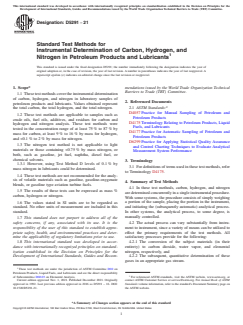
1.1 These test methods cover the instrumental determination of carbon, hydrogen, and nitrogen in laboratory samples of petroleum products and lubricants. Values obtained represent the total carbon, the total hydrogen, and the total nitrogen.
1.2 These test methods are applicable to samples such as crude oils, fuel oils, additives, and residues for carbon and hydrogen and nitrogen analysis. These test methods were tested in the concentration range of at least 75 % to 87 % by mass for carbon, at least 9 % to 16 % by mass for hydrogen, and
1.3 The nitrogen test method is not applicable to light materials or those containing
1.3.1 However, using Test Method D levels of 0.1 % by mass nitrogen in lubricants could be determined.
1.4 These test methods are not recommended for the analysis of volatile materials such as gasoline, gasoline-oxygenate blends, or gasoline type aviation turbine fuels.
1.5 The results of these tests can be expressed as mass % carbon, hydrogen or nitrogen.
1.6 The values stated in SI units are to be regarded as standard. No other units of measurement are included in this standard.
1.7 This standard does not purport to address all of the safety concerns, if any, associated with its use. It is the responsibility of the user of this standard to establish appropriate safety, health, and environmental practices and determine the applicability of regulatory limitations prior to use.
1.8 This international standard was developed in accordance with internationally recognized principles on standardization established in the Decision on Principles for the Development of International Standards, Guides and Recommendations issued by the World Trade Organization Technical Barriers to Trade (TBT) Committee.
- Status
- Published
- Publication Date
- 31-Oct-2021
- Technical Committee
- D02 - Petroleum Products, Liquid Fuels, and Lubricants
- Drafting Committee
- D02.03 - Elemental Analysis
Buy Documents
ASTM D5291-21 - Standard Test Methods for Instrumental Determination of Carbon, Hydrogen, and Nitrogen in Petroleum Products and Lubricants
REDLINE ASTM D5291-21 - Standard Test Methods for Instrumental Determination of Carbon, Hydrogen, and Nitrogen in Petroleum Products and Lubricants
Overview
ASTM D5291-21: Standard Test Methods for Instrumental Determination of Carbon, Hydrogen, and Nitrogen in Petroleum Products and Lubricants specifies procedures for the simultaneous determination of total carbon, hydrogen, and nitrogen in petroleum products and lubricants using instrumental analysis. This standard provides consistent and reliable measurement practices for laboratories and quality control environments, supporting the petrochemical and lubricants industries in evaluating product composition and performance potential.
Key Topics
- Simultaneous Elemental Analysis: This ASTM standard is the first to address the concurrent determination of carbon (C), hydrogen (H), and nitrogen (N) in petroleum samples. The results are used to assess the chemical structure and complexity of various petroleum products, crude oils, fuel oils, additives, and residues.
- Sample Types and Applicability: The methods are applicable to laboratory samples within specified concentration ranges (carbon: 75-87% by mass, hydrogen: 9-16% by mass, nitrogen: 0.1-2% by mass), excluding highly volatile materials like gasoline.
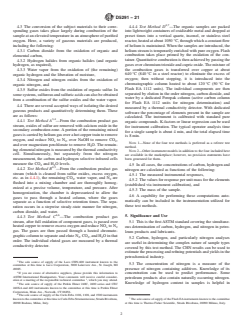
- Instrumentation: Multiple instrumental methods are permitted, requiring complete combustion of the sample and quantitative detection of resultant gases. Procedures account for automation or manual control, and several calibration standards are referenced.
- Data and Units: Results are reported as mass percent using SI units, ensuring international consistency.
Applications
- Petrochemical Processing: CHN analysis is essential in estimating processing and refining potentials, yields, and the suitability of feedstocks. Understanding hydrogen-to-carbon ratios assists in evaluating upgrading processes.
- Lubricants and Additives: Nitrogen analysis helps identify nitrogen-containing additives, which can influence lubricant performance and stability. Determining hydrogen content relates to performance characteristics in engine and industrial lubricants.
- Quality Assurance: Consistent methodology for elemental analysis supports statistical quality control, laboratory accreditation, and compliance with regulatory and industry requirements.
- Research and Product Development: Accurate elemental composition informs new formulation development, process optimization, and comparative studies for alternative fuels, renewable feedstocks, and advanced lubricants.
Related Standards
- ASTM D4057 - Practice for Manual Sampling of Petroleum and Petroleum Products: Used for sampling guidance prior to analysis.
- ASTM D4177 - Practice for Automatic Sampling of Petroleum and Petroleum Products: Useful for process and continuous sampling.
- ASTM D6299 - Practice for Applying Statistical Quality Assurance and Control Charting Techniques: Supports monitoring of instrument and analytical method performance.
- ASTM D4175 - Terminology Relating to Petroleum Products, Liquid Fuels, and Lubricants: Provides definitions for terms relevant to this and related standards.
Practical Value
ASTM D5291-21 delivers a robust, internationally recognized framework for quantifying the elemental content of petroleum products and lubricants. Its use ensures:
- Accurate and repeatable results between laboratories and manufacturing sites
- Support for product qualification, process optimization, and troubleshooting
- Consistency in global trade and regulatory compliance for the petroleum and lubricants sectors
- Improved understanding of additives and processing impacts on product quality
Keywords: carbon content analysis, hydrogen content testing, nitrogen determination, CHN analysis, ASTM D5291, petroleum product testing, lubricant analysis, elemental analysis instrument, quality control in petrochemicals, standard test methods.
Relations
- Refers
ASTM D4175-23a - Standard Terminology Relating to Petroleum Products, Liquid Fuels, and Lubricants - Effective Date
- 15-Dec-2023
- Effective Date
- 01-Dec-2023
- Refers
ASTM D4175-23e1 - Standard Terminology Relating to Petroleum Products, Liquid Fuels, and Lubricants - Effective Date
- 01-Jul-2023
- Effective Date
- 15-Dec-2017
- Effective Date
- 15-Nov-2017
- Effective Date
- 01-Jan-2017
- Effective Date
- 01-Oct-2013
- Refers
ASTM D4057-06(2011) - Standard Practice for Manual Sampling of Petroleum and Petroleum Products - Effective Date
- 01-Jun-2011
- Effective Date
- 01-Mar-2010
- Effective Date
- 01-Mar-2010
- Effective Date
- 01-Nov-2009
- Effective Date
- 15-Oct-2008
- Effective Date
- 01-Nov-2007
- Effective Date
- 01-Nov-2007
- Effective Date
- 10-Jun-2002
Buy Documents
ASTM D5291-21 - Standard Test Methods for Instrumental Determination of Carbon, Hydrogen, and Nitrogen in Petroleum Products and Lubricants
REDLINE ASTM D5291-21 - Standard Test Methods for Instrumental Determination of Carbon, Hydrogen, and Nitrogen in Petroleum Products and Lubricants
Get Certified
Connect with accredited certification bodies for this standard

Element Materials Technology
Materials testing and product certification.

ABS Group Brazil
ABS Group certification services in Brazil.

ABS Quality Evaluations Inc.
American Bureau of Shipping quality certification.
Sponsored listings
Frequently Asked Questions
ASTM D5291-21 is a standard published by ASTM International. Its full title is "Standard Test Methods for Instrumental Determination of Carbon, Hydrogen, and Nitrogen in Petroleum Products and Lubricants". This standard covers: SIGNIFICANCE AND USE 5.1 This is the first ASTM standard covering the simultaneous determination of carbon, hydrogen, and nitrogen in petroleum products and lubricants. 5.2 Carbon, hydrogen, and particularly nitrogen analyses are useful in determining the complex nature of sample types covered by this test method. The CHN results can be used to estimate the processing and refining potentials and yields in the petrochemical industry. 5.3 The concentration of nitrogen is a measure of the presence of nitrogen containing additives. Knowledge of its concentration can be used to predict performance. Some petroleum products also contain naturally occurring nitrogen. Knowledge of hydrogen content in samples is helpful in addressing their performance characteristics. Hydrogen to carbon ratio is useful to assess the performance of upgrading processes. SCOPE 1.1 These test methods cover the instrumental determination of carbon, hydrogen, and nitrogen in laboratory samples of petroleum products and lubricants. Values obtained represent the total carbon, the total hydrogen, and the total nitrogen. 1.2 These test methods are applicable to samples such as crude oils, fuel oils, additives, and residues for carbon and hydrogen and nitrogen analysis. These test methods were tested in the concentration range of at least 75 % to 87 % by mass for carbon, at least 9 % to 16 % by mass for hydrogen, and 1.3 The nitrogen test method is not applicable to light materials or those containing 1.3.1 However, using Test Method D levels of 0.1 % by mass nitrogen in lubricants could be determined. 1.4 These test methods are not recommended for the analysis of volatile materials such as gasoline, gasoline-oxygenate blends, or gasoline type aviation turbine fuels. 1.5 The results of these tests can be expressed as mass % carbon, hydrogen or nitrogen. 1.6 The values stated in SI units are to be regarded as standard. No other units of measurement are included in this standard. 1.7 This standard does not purport to address all of the safety concerns, if any, associated with its use. It is the responsibility of the user of this standard to establish appropriate safety, health, and environmental practices and determine the applicability of regulatory limitations prior to use. 1.8 This international standard was developed in accordance with internationally recognized principles on standardization established in the Decision on Principles for the Development of International Standards, Guides and Recommendations issued by the World Trade Organization Technical Barriers to Trade (TBT) Committee.
SIGNIFICANCE AND USE 5.1 This is the first ASTM standard covering the simultaneous determination of carbon, hydrogen, and nitrogen in petroleum products and lubricants. 5.2 Carbon, hydrogen, and particularly nitrogen analyses are useful in determining the complex nature of sample types covered by this test method. The CHN results can be used to estimate the processing and refining potentials and yields in the petrochemical industry. 5.3 The concentration of nitrogen is a measure of the presence of nitrogen containing additives. Knowledge of its concentration can be used to predict performance. Some petroleum products also contain naturally occurring nitrogen. Knowledge of hydrogen content in samples is helpful in addressing their performance characteristics. Hydrogen to carbon ratio is useful to assess the performance of upgrading processes. SCOPE 1.1 These test methods cover the instrumental determination of carbon, hydrogen, and nitrogen in laboratory samples of petroleum products and lubricants. Values obtained represent the total carbon, the total hydrogen, and the total nitrogen. 1.2 These test methods are applicable to samples such as crude oils, fuel oils, additives, and residues for carbon and hydrogen and nitrogen analysis. These test methods were tested in the concentration range of at least 75 % to 87 % by mass for carbon, at least 9 % to 16 % by mass for hydrogen, and 1.3 The nitrogen test method is not applicable to light materials or those containing 1.3.1 However, using Test Method D levels of 0.1 % by mass nitrogen in lubricants could be determined. 1.4 These test methods are not recommended for the analysis of volatile materials such as gasoline, gasoline-oxygenate blends, or gasoline type aviation turbine fuels. 1.5 The results of these tests can be expressed as mass % carbon, hydrogen or nitrogen. 1.6 The values stated in SI units are to be regarded as standard. No other units of measurement are included in this standard. 1.7 This standard does not purport to address all of the safety concerns, if any, associated with its use. It is the responsibility of the user of this standard to establish appropriate safety, health, and environmental practices and determine the applicability of regulatory limitations prior to use. 1.8 This international standard was developed in accordance with internationally recognized principles on standardization established in the Decision on Principles for the Development of International Standards, Guides and Recommendations issued by the World Trade Organization Technical Barriers to Trade (TBT) Committee.
ASTM D5291-21 is classified under the following ICS (International Classification for Standards) categories: 75.080 - Petroleum products in general; 75.100 - Lubricants, industrial oils and related products. The ICS classification helps identify the subject area and facilitates finding related standards.
ASTM D5291-21 has the following relationships with other standards: It is inter standard links to ASTM D4175-23a, ASTM D6299-23a, ASTM D4175-23e1, ASTM D6299-17b, ASTM D6299-17a, ASTM D6299-17, ASTM D6299-13e1, ASTM D4057-06(2011), ASTM D6299-10, ASTM D6299-10e2, ASTM D6299-09, ASTM D6299-08, ASTM D6299-07e1, ASTM D6299-07, ASTM D6299-02e1. Understanding these relationships helps ensure you are using the most current and applicable version of the standard.
ASTM D5291-21 is available in PDF format for immediate download after purchase. The document can be added to your cart and obtained through the secure checkout process. Digital delivery ensures instant access to the complete standard document.
Standards Content (Sample)
This international standard was developed in accordance with internationally recognized principles on standardization established in the Decision on Principles for the
Development of International Standards, Guides and Recommendations issued by the World Trade Organization Technical Barriers to Trade (TBT) Committee.
Designation: D5291 − 21
Standard Test Methods for
Instrumental Determination of Carbon, Hydrogen, and
Nitrogen in Petroleum Products and Lubricants
This standard is issued under the fixed designation D5291; the number immediately following the designation indicates the year of
original adoption or, in the case of revision, the year of last revision. A number in parentheses indicates the year of last reapproval. A
superscript epsilon (´) indicates an editorial change since the last revision or reapproval.
1. Scope* mendations issued by the World Trade Organization Technical
Barriers to Trade (TBT) Committee.
1.1 Thesetestmethodscovertheinstrumentaldetermination
of carbon, hydrogen, and nitrogen in laboratory samples of
2. Referenced Documents
petroleum products and lubricants. Values obtained represent
the total carbon, the total hydrogen, and the total nitrogen. 2.1 ASTM Standards:
D4057 Practice for Manual Sampling of Petroleum and
1.2 These test methods are applicable to samples such as
Petroleum Products
crude oils, fuel oils, additives, and residues for carbon and
D4175 Terminology Relating to Petroleum Products, Liquid
hydrogen and nitrogen analysis. These test methods were
Fuels, and Lubricants
tested in the concentration range of at least 75 % to 87 % by
D4177 Practice for Automatic Sampling of Petroleum and
mass for carbon, at least 9 % to 16 % by mass for hydrogen,
Petroleum Products
and <0.1 % to 2 % by mass for nitrogen.
D6299 Practice for Applying Statistical Quality Assurance
1.3 The nitrogen test method is not applicable to light
and Control Charting Techniques to Evaluate Analytical
materials or those containing <0.75 % by mass nitrogen, or
Measurement System Performance
both, such as gasoline, jet fuel, naphtha, diesel fuel, or
chemical solvents.
3. Terminology
1.3.1 However, using Test Method D levels of 0.1 % by
3.1 For definitions of terms used in these test methods, refer
mass nitrogen in lubricants could be determined.
to Terminology D4175.
1.4 These test methods are not recommended for the analy-
sis of volatile materials such as gasoline, gasoline-oxygenate
4. Summary of Test Methods
blends, or gasoline type aviation turbine fuels.
4.1 In these test methods, carbon, hydrogen, and nitrogen
1.5 The results of these tests can be expressed as mass %
aredeterminedconcurrentlyinasingleinstrumentalprocedure.
carbon, hydrogen or nitrogen.
With some systems, the procedure consists of simply weighing
a portion of the sample, placing the portion in the instrument,
1.6 The values stated in SI units are to be regarded as
and initiating the (subsequently automatic) analytical process.
standard. No other units of measurement are included in this
In other systems, the analytical process, to some degree, is
standard.
manually controlled.
1.7 This standard does not purport to address all of the
safety concerns, if any, associated with its use. It is the 4.2 The actual process can vary substantially from instru-
responsibility of the user of this standard to establish appro- ment to instrument, since a variety of means can be utilized to
priate safety, health, and environmental practices and deter- effect the primary requirements of the test methods. All
mine the applicability of regulatory limitations prior to use. satisfactory processes provide for the following:
1.8 This international standard was developed in accor- 4.2.1 The conversion of the subject materials (in their
dance with internationally recognized principles on standard- entirety) to carbon dioxide, water vapor, and elemental
ization established in the Decision on Principles for the nitrogen, respectively, and
Development of International Standards, Guides and Recom- 4.2.2 The subsequent, quantitative determination of these
gases in an appropriate gas stream.
These test methods are under the jurisdiction of ASTM Committee D02 on
Petroleum Products, Liquid Fuels, and Lubricants and are the direct responsibility
of Subcommittee D02.03 on Elemental Analysis. For referenced ASTM standards, visit the ASTM website, www.astm.org, or
Current edition approved Nov. 1, 2021. Published December 2021. Originally contact ASTM Customer Service at service@astm.org. For Annual Book of ASTM
approved in 1992. Last previous edition approved in 2016 as D5291 – 16. DOI: Standards volume information, refer to the standard’s Document Summary page on
10.1520/D5291-21. the ASTM website.
*A Summary of Changes section appears at the end of this standard
Copyright © ASTM International, 100 Barr Harbor Drive, PO Box C700, West Conshohocken, PA 19428-2959. United States
D5291 − 21
4,7
4.3 The conversion of the subject materials to their corre- 4.4.4 Test Method D —The organic samples are packed
sponding gases takes place largely during combustion of the into lightweight containers of oxidizable metal and dropped at
sample at an elevated temperature in an atmosphere of purified preset times into a vertical quartz, inconel, or stainless steel
oxygen. Here, a variety of gaseous materials are produced, reactor,heatedatabout1050 °C,throughwhichaconstantflow
including the following: of helium is maintained. When the samples are introduced, the
4.3.1 Carbon dioxide from the oxidation of organic and helium stream is temporarily enriched with pure oxygen. Flash
combustion takes place primed by the oxidation of the con-
elemental carbon,
tainer. Quantitative combustion is then achieved by passing the
4.3.2 Hydrogen halides from organic halides (and organic
gasesoverchromiumtrioxideandcupricoxide.Themixtureof
hydrogen, as required),
the combustion gases is transferred over copper at about
4.3.3 Water vapor from the oxidation of (the remaining)
640 °C (840 °C in a steel reactor) to eliminate the excess of
organic hydrogen and the liberation of moisture,
oxygen; then without stopping, it is introduced into the
4.3.4 Nitrogen and nitrogen oxides from the oxidation of
chromatographic column heated to about 120 °C (50 °C for
organic nitrogen, and
Flash EA 1112 units). The individual components are then
4.3.5 Sulfur oxides from the oxidation of organic sulfur. In
separated by elution in the order nitrogen, carbon dioxide, and
somesystems,sulfurousandsulfuricacidscanalsobeobtained
water by a dedicated Poropak column (active carbon column
from a combination of the sulfur oxides and the water vapor.
for Flash EA 1112 units for nitrogen determination) and
4.4 There are several accepted ways of isolating the desired
measured by a thermal conductivity detector. With dedicated
gaseous products and quantitatively determining them. These
software the percentage of elements present in the sample are
are as follows:
calculated. The instrument is calibrated with standard pure
3,4
4.4.1 Test Method A —From the combustion product gas
organic compounds. K-factors or linear regression can be used
stream, oxides of sulfur are removed with calcium oxide in the
for instrument calibration. The typical operator analysis time
secondary combustion zone.Aportion of the remaining mixed
for a single sample is about 4 min, and the total elapsed time
gasesiscarriedbyheliumgasoverahotcoppertraintoremove
is 8 min.
oxygen, and reduce NO to N , over NaOH to remove CO ,
x 2 2
NOTE 1—None of the four test methods is preferred as a referee test
and over magnesium perchlorate to remove H O. The remain-
method.
ingelementalnitrogenismeasuredbythethermalconductivity
NOTE 2—Other instrument models in addition to the four included here
cell. Simultaneously, but separately from the nitrogen
are available in the marketplace; however, no precision statements have
measurement, the carbon and hydrogen selective infrared cells been generated for them.
measure the CO and H O levels.
2 2
4.5 In all cases, the concentrations of carbon, hydrogen and
4,5
4.4.2 Test Method B —From the combustion product gas
nitrogen are calculated as functions of the following:
stream (which is cleaned from sulfur oxides, excess oxygen,
4.5.1 The measured instrumental responses,
etc. as in 4.4.1), the remaining CO , water vapor, and N are
2 2
4.5.2 The values for response per unit mass for the elements
flushed into a mixing chamber and are thoroughly homog-
(established via instrument calibration), and
enized at a precise volume, temperature, and pressure. After
4.5.3 The mass of the sample.
homogenization, the chamber is depressurized to allow the
4.6 A capability for performing these computations auto-
gases to pass through a heated column, where the gases
matically can be included in the instrumentation utilized for
separate as a function of selective retention times. The sepa-
these test methods.
ration occurs in a stepwise steady-state manner for nitrogen,
carbon dioxide, and water.
4,6
5. Significance and Use
4.4.3 Test Method C —The combustion product gas
stream, after full oxidation of component gases, is passed over
5.1 This is the firstASTM standard covering the simultane-
heated copper to remove excess oxygen and reduce NO to N ous determination of carbon, hydrogen, and nitrogen in petro-
x 2
gas. The gases are then passed through a heated chromato-
leum products and lubricants.
graphic column to separate and elute N ,CO , and H O in that
2 2 2
5.2 Carbon, hydrogen, and particularly nitrogen analyses
order. The individual eluted gases are measured by a thermal
are useful in determining the complex nature of sample types
conductivity detector.
covered by this test method. The CHN results can be used to
estimatetheprocessingandrefiningpotentialsandyieldsinthe
petrochemical industry.
The sole source of supply of the Leco CHN-600 instrument known to the
5.3 The concentration of nitrogen is a measure of the
committee at this time is Leco Corporation, 3000 Lakeview Ave., St. Joseph, MI
presence of nitrogen containing additives. Knowledge of its
49085.
If you are aware of alternative suppliers, please provide this information to
concentration can be used to predict performance. Some
ASTM International Headquarters. Your comments will receive careful consider-
petroleum products also contain naturally occurring nitrogen.
ation at a meeting of the responsible technical committee , which you may attend.
5 Knowledge of hydrogen content in samples is helpful in
The sole source of supply of the Perkin Elmer 240C, 2400 series and CEC
240XA and 440 instruments known to the committee at this time is Perkin Elmer
Corporation, Main Ave., Norwalk, CT 06856.
The sole source of supply of the Carlo Erba 1106, 1108, and 1500 instruments
knowntothecommitteeatthistimeisCarloErbaStrumentazione,StradaRivoltana, The sole source of supply of the Flash EAinstruments known to the committee
20090 Rodano, Milan, Italy. at this time is Thermo Fisher Scientific, Strada Rivoltana, 20090 Milano, Italy.
D5291 − 21
A,B
TABLE 1 Calibration Standards for CHN Instrumental Analysis
addressing their performance characteristics. Hydrogen to
Molecular Carbon, Hydrogen Nitrogen
carbon ratio is useful to assess the performance of upgrading
Compound
Formula Mass% Mass % Mass %
processes.
Acetanilide C H NO 71.09 6.71 10.36
8 9
Atropine C H NO 70.56 8.01 4.84
17 23 3
6. Apparatus Benzoic acid C H O 68.84 4.95 . . .
7 6 2
Cyclohexanone- C H N O 51.79 5.07 20.14
12 14 4 4
6.1 Sinceavarietyofinstrumentalcomponentsandconfigu-
2,4-dinitrophenylhydrazone
Cystine C H N O S 29.99 5.03 11.66
rations can be satisfactorily utilized for these test methods, no
6 12 2 4 2
Diphenyl C H 93.46 6.54 . .
12 10
specifications are given here with respect to overall system
EDTA C H N O 41.10 5.52 9.59
10 16 2 8
design.
Imidazol C H N 52.92 5.92 41.15
3 4 2
Nicotinic acid C H NO 58.53 4.09 11.38
6 5 2
6.2 Functionally,however,thefollowingarespecifiedforall
Stearic acid C H O 75.99 12.76 . .
18 36 2
instruments:
Succinamide C H N O 41.37 6.94 24.13
4 8 2 2
Sucrose C H O 42.10 6.48 . .
6.2.1 The conditions for combustion of the sample must be 12 22 11
Sulphanilamide C H N O S 41.84 4.68 16.27
6 8 2 2
such that (for the full range of applicable samples) the subject
Triethanol amine C H NO 48.30 10.13 9.39
6 15 3
components are completely converted to carbon dioxide, water
A
The Merck Index, 10th Edition, Merck and Company, Inc., Rahway, New Jersey,
vapor(exceptforhydrogenassociatedwithvolatilehalidesand
1983.
B
Many of these compounds can be obtained from commercial chemical manu-
sulfur oxides), and nitrogen or nitrogen oxides. Generally,
facturers. See 7.1 for the purity of these reagents.
instrumental conditions that affect complete combustion in-
clude availability of the oxidant, temperature, and time.
6.2.2 Representative aliquots of the combustion gases must
then be treated:
6.2.2.1 To liberate (as water vapor) hydrogen present as 6.3.11 Reduction Tubes.
hydrogen halides and sulfur oxyacids, and
6.4 Analytical Balance, capable of weighing to the nearest
6.2.2.2 To reduce (to the element) nitrogen present as
0.00001 g.
nitrogen oxides.
6.5 Syringes or Pipettes, to transfer the test specimens to
6.2.3 The water vapor and nitrogen so obtained must be
capsules.
included with the materials originally present in these aliquots.
6.2.4 Additional treatment of the aliquots (prior to detec-
7. Reagents
tion) depends on the detection scheme utilized for the instru-
ment (see Note 3). 7.1 Purity of Reagents—Reagent grade chemicals shall be
used in all tests. Unless otherwise indicated, it is intended that
NOTE 3—These additional treatments can be provided by the instru-
all reagents shall conform to the specifications of the Commit-
mental components utilized to satisfy 6.2.2.
tee onAnalytical Reagents of theAmerican Chemical Society,
6.2.5 The detection system (in its full scope) must deter-
where such specifications are available. Other grades may be
minetheanalyticalgasesindividuallyandwithoutinterference.
used, provided it is first ascertained that the reagent is of
Additionally, for each analyte, either:
sufficiently high purity to permit its use without lessening the
6.2.5.1 The detectors must provide linear responses with
accuracy of the determination.
respect to concentration over the full range of possible con-
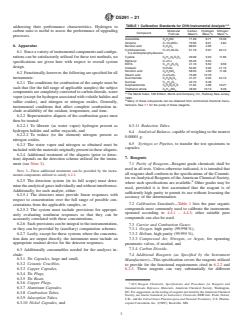
7.2 Calibration Standards—Table 1 lists the pure organic
centrations from the applicable samples, or
compounds most commonly used to calibrate the instruments
6.2.5.2 The system must include provisions for appropri-
operated according to 4.4.1 – 4.4.3; other suitable pure
ately evaluating nonlinear responses so that they can be
compounds can also be used.
accurately correlated with these concentrations.
6.2.6 Suchprovisionscanbeintegraltotheinstrumentation,
7.3 Carrier and Combustion Gases:
or they can be provided by (auxiliary) computation schemes.
7.3.1 Oxygen, high purity (99.998 %),
6.2.7 Lastly, except for those systems where the concentra-
7.3.2 Helium, high purity (99.995 %),
tion data are output directly, the instrument must include an
7.3.3 Compressed Air, Nitrogen, or Argon, for operating
appropriate readout device for the detector responses.
pneumatic valves, if needed, and
7.3.4 Carbon Dioxide.
6.3 Additionally consumables needed for the analyses in-
clude:
7.4 Additional Reagents (as Specified by the Instrument
6.3.1 Tin Capsules, large and small,
Manufacturer)—This specification covers the reagents utilized
6.3.2 Ceramic Crucibles,
to provide for the functional requirements cited in 6.2.2 and
6.3.3 Copper Capsules,
6.2.3. These reagents can vary substantially for different
6.3.4 Tin Plugs,
6.3.5 Tin Boats,
6.3.6 Copper Plugs,
ACS Reagent Chemicals, Specifications and Procedures for Reagents and
Standard-Grade Reference Materials, American Chemical Society, Washington,
6.3.7 Aluminum Capsules,
DC. For suggestions on the testing of reagents not listed by theAmerican Chemical
6.3.8 Combustion Tubes,
Society, see Analar Standards for Laboratory Chemicals, BDH Ltd., Poole, Dorset,
6.3.9 Adsorption Tubes,
U.K., and the United States Pharmacopeia and National Formulary, U.S. Pharma-
6.3.10 Nickel Capsules, and copeial Convention, Inc. (USPC), Rockville, MD.
D5291 − 21
instruments. Consequently, these reagents shall be those rec- 8.2.1 Preparation—Warm viscous samples until they are
ommended by the manufacturer. Specifically, these reagents fluid, and shake for 5 s.
will be for:
8.2.2 Transfer—Use any convenient, clean syringe or pipet
3,4
7.4.1 Test Method A : to transfer test specimens to the capsules as described in
7.4.1.1 Sodium Hydroxide Coated Silica,
Section 10.
7.4.1.2 Quartz Wool,
7.4.1.3 Magnesium Perchlorate,
9. Preparation of Apparatus
7.4.1.4 Copper Turnings,
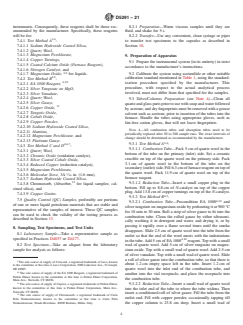
9.1 Prepare the instrumental system (in its entirety) in strict
7.4.1.5 Coated Calcium Oxide (Furnace Reagent),
accordance to the manufacturer’s instructions.
7.4.1.6 Nitrogen Catalyst, and
4,9
9.2 Calibrate the system using acetanilide or other suitable
7.4.1.7 Magnesium Oxide, for liquids.
4,5
calibration standard mentioned in Table 1, using the standard-
7.4.2 Test Method B :
4,10
ization procedure specified by the manufacturer. This
7.4.2.1 EA 1000 Reagent,
procedure, with respect to the actual analytical process
7.4.2.2 Silver Tungstate on MgO,
involved, must not differ from that specified for the samples.
7.4.2.3 Silver Vanadate,
7.4.2.4 Quartz Wool,
9.3 Tubes/Columns Preparation (see Note 4)—Clean all
7.4.2.5 Silver Gauze,
quartzandglasspartspriortousewithsoapandwaterfollowed
7.4.2.6 Copper Oxide,
byacetone,anddryfingerprintsmustberemovedwithagrease
7.4.2.7 Tungstic Oxide,
solvent such as acetone, prior to insertion of the tubes into the
7.4.2.8 Cobalt Oxide,
furnace. Handle the tubes using appropriate gloves, such as
7.4.2.9 Copper Powder,
lint-free cotton gloves, that will not leave fingerprints.
7.4.2.10 Sodium Hydroxide Coated Silica,
NOTE 4—All combustion tubes and absorption tubes need to be
7.4.2.11 Alumina,
periodically replaced after 50 to 300 sample runs. The exact intervals of
7.4.2.12 Magnesium Perchlorate, and
change should be determined as recommended by the manufacturer.
7.4.2.13 Platinum Gauze.
3,4
4,6,7 9.3.1 Test Method A :
7.4.3 Test Method C and D :
9.3.1.1 Combustion Tube—Pack 5 cm of quartz wool in the
7.4.3.1 Quartz Wool,
bottom of the tube on the primary (inlet) side. Set a ceramic
7.4.3.2 Chromic Oxide (oxidation catalyst),
crucible on top of the quartz wool on the primary side. Pack
7.4.3.3 Silver Coated Cobalt Oxide,
3.1 cm of quartz wool in the bottom of the tube on the
7.4.3.4 Reduced Copper (reduction catalyst),
secondary(outlet)side.Fill6.3 cmoffurnacereagentontopof
7.4.3.5 Magnesium Perchlorate,
the quartz wool. Pack 11.9 cm of quartz wool on top of the
7.4.3.6 Molecular Sieve, 3A ⁄16 in. (1.6 mm),
furnace reagent.
7.4.3.7 Sodium Hydroxide Coated Silica,
9.3.1.2 Reduction Tube—Insert a small copper plug in the
7.4.3.8 Chromosorb, (Absorber, for liquid samples; cal-
bottom. Fill up to 8.8 cm of N-catalyst on top of the copper
cined silica), and
plug.Add 13.8 cm of copper turnings on top of the N-catalyst.
7.4.3.9 Copper Grain
...
This document is not an ASTM standard and is intended only to provide the user of an ASTM standard an indication of what changes have been made to the previous version. Because
it may not be technically possible to adequately depict all changes accurately, ASTM recommends that users consult prior editions as appropriate. In all cases only the current version
of the standard as published by ASTM is to be considered the official document.
Designation: D5291 − 16 D5291 − 21
Standard Test Methods for
Instrumental Determination of Carbon, Hydrogen, and
Nitrogen in Petroleum Products and Lubricants
This standard is issued under the fixed designation D5291; the number immediately following the designation indicates the year of
original adoption or, in the case of revision, the year of last revision. A number in parentheses indicates the year of last reapproval. A
superscript epsilon (´) indicates an editorial change since the last revision or reapproval.
1. Scope*
1.1 These test methods cover the instrumental determination of carbon, hydrogen, and nitrogen in laboratory samples of petroleum
products and lubricants. Values obtained represent the total carbon, the total hydrogen, and the total nitrogen.
1.2 These test methods are applicable to samples such as crude oils, fuel oils, additives, and residues for carbon and hydrogen and
nitrogen analysis. These test methods were tested in the concentration range of at least 75 mass % to 87 mass % 75 % to 87 %
by mass for carbon, at least 9 mass % to 16 mass % 9 % to 16 % by mass for hydrogen, and <0.1 mass % to 2 mass % <0.1 %
to 2 % by mass for nitrogen.
1.3 The nitrogen test method is not applicable to light materials or those containing <0.75 <0.75 % by mass % nitrogen, or both,
such as gasoline, jet fuel, naphtha, diesel fuel, or chemical solvents.
1.3.1 However, using Test Method D levels of 0.1 0.1 % by mass % nitrogen in lubricants could be determined.
1.4 These test methods are not recommended for the analysis of volatile materials such as gasoline, gasoline-oxygenate blends,
or gasoline type aviation turbine fuels.
1.5 The results of these tests can be expressed as mass % carbon, hydrogen or nitrogen.
1.6 The values stated in SI units are to be regarded as standard. No other units of measurement are included in this standard.
1.7 This standard does not purport to address all of the safety concerns, if any, associated with its use. It is the responsibility
of the user of this standard to establish appropriate safety safety, health, and healthenvironmental practices and determine the
applicability of regulatory limitations prior to use.
1.8 This international standard was developed in accordance with internationally recognized principles on standardization
established in the Decision on Principles for the Development of International Standards, Guides and Recommendations issued
by the World Trade Organization Technical Barriers to Trade (TBT) Committee.
These test methods are under the jurisdiction of ASTM Committee D02 on Petroleum Products, Liquid Fuels, and Lubricants and are the direct responsibility of
Subcommittee D02.03 on Elemental Analysis.
Current edition approved Oct. 1, 2016Nov. 1, 2021. Published October 2016December 2021. Originally approved in 1992. Last previous edition approved in 20152016
as D5291 – 10 (2015). 16. DOI: 10.1520/D5291-16. 10.1520/D5291-21.
*A Summary of Changes section appears at the end of this standard
Copyright © ASTM International, 100 Barr Harbor Drive, PO Box C700, West Conshohocken, PA 19428-2959. United States
D5291 − 21
2. Referenced Documents
2.1 ASTM Standards:
D4057 Practice for Manual Sampling of Petroleum and Petroleum Products
D4175 Terminology Relating to Petroleum Products, Liquid Fuels, and Lubricants
D4177 Practice for Automatic Sampling of Petroleum and Petroleum Products
D6299 Practice for Applying Statistical Quality Assurance and Control Charting Techniques to Evaluate Analytical Measure-
ment System Performance
3. Terminology
3.1 For definitions of terms used in these test methods, refer to Terminology D4175.
4. Summary of Test Methods
4.1 In these test methods, carbon, hydrogen, and nitrogen are determined concurrently in a single instrumental procedure. With
some systems, the procedure consists of simply weighing a portion of the sample, placing the portion in the instrument, and
initiating the (subsequently automatic) analytical process. In other systems, the analytical process, to some degree, is manually
controlled.
4.2 The actual process can vary substantially from instrument to instrument, since a variety of means can be utilized to effect the
primary requirements of the test methods. All satisfactory processes provide for the following:
4.2.1 The conversion of the subject materials (in their entirety) to carbon dioxide, water vapor, and elemental nitrogen,
respectively, and
4.2.2 The subsequent, quantitative determination of these gases in an appropriate gas stream.
4.3 The conversion of the subject materials to their corresponding gases takes place largely during combustion of the sample at
an elevated temperature in an atmosphere of purified oxygen. Here, a variety of gaseous materials are produced, including the
following:
4.3.1 Carbon dioxide from the oxidation of organic and elemental carbon,
4.3.2 Hydrogen halides from organic halides (and organic hydrogen, as required),
4.3.3 Water vapor from the oxidation of (the remaining) organic hydrogen and the liberation of moisture,
4.3.4 Nitrogen and nitrogen oxides from the oxidation of organic nitrogen, and
4.3.5 Sulfur oxides from the oxidation of organic sulfur. In some systems, sulfurous and sulfuric acids can also be obtained from
a combination of the sulfur oxides and the water vapor.
4.4 There are several accepted ways of isolating the desired gaseous products and quantitatively determining them. These are as
follows:
3,4
4.4.1 Test Method A —From the combustion product gas stream, oxides of sulfur are removed with calcium oxide in the
secondary combustion zone. A portion of the remaining mixed gases is carried by helium gas over a hot copper train to remove
oxygen, and reduce NO to N , over NaOH to remove CO , and over magnesium perchlorate to remove H O. The remaining
x 2 2 2
elemental nitrogen is measured by the thermal conductivity cell. Simultaneously, but separately from the nitrogen measurement,
the carbon and hydrogen selective infrared cells measure the CO and H O levels.
2 2
For referenced ASTM standards, visit the ASTM website, www.astm.org, or contact ASTM Customer Service at service@astm.org. For Annual Book of ASTM Standards
volume information, refer to the standard’s Document Summary page on the ASTM website.
The sole source of supply of the Leco CHN-600 instrument known to the committee at this time is Leco Corporation, 3000 Lakeview Ave., St. Joseph, MI 49085.
If you are aware of alternative suppliers, please provide this information to ASTM International Headquarters. Your comments will receive careful consideration at a
meeting of the responsible technical committee , which you may attend.
D5291 − 21
4,5
4.4.2 Test Method B —From the combustion product gas stream (which is cleaned from sulfur oxides, excess oxygen, etc. as in
3.4.14.4.1), the remaining CO , water vapor, and N are flushed into a mixing chamber and are thoroughly homogenized at a
2 2
precise volume, temperature, and pressure. After homogenization, the chamber is depressurized to allow the gases to pass through
a heated column, where the gases separate as a function of selective retention times. The separation occurs in a stepwise
steady-state manner for nitrogen, carbon dioxide, and water.
4,6
4.4.3 Test Method C —The combustion product gas stream, after full oxidation of component gases, is passed over heated copper
to remove excess oxygen and reduce NO to N gas. The gases are then passed through a heated chromatographic column to
x 2
separate and elute N , CO , and H O in that order. The individual eluted gases are measured by a thermal conductivity detector.
2 2 2
4,7
4.4.4 Test Method D —The organic samples are packed into lightweight containers of oxidizable metal and dropped at preset
times into a vertical quartz, inconel, or stainless steel reactor, heated at about 1050 °C, through which a constant flow of helium
is maintained. When the samples are introduced, the helium stream is temporarily enriched with pure oxygen. Flash combustion
takes place primed by the oxidation of the container. Quantitative combustion is then achieved by passing the gases over chromium
trioxide and cupric oxide. The mixture of the combustion gases is transferred over copper at about 640 °C (840 °C in a steel
reactor) to eliminate the excess of oxygen; then without stopping, it is introduced into the chromatographic column heated to about
120 °C (50 °C for Flash EA 1112 units). The individual components are then separated by elution in the order nitrogen, carbon
dioxide, and water by a dedicated Poropak column (active carbon column for Flash EA 1112 units for nitrogen determination) and
measured by a thermal conductivity detector. With dedicated software the percentage of elements present in the sample are
calculated. The instrument is calibrated with standard pure organic compounds. K-factors or linear regression can be used for
instrument calibration. The typical operator analysis time for a single sample is about 4 min, and the total elapsed time is 8 min.
NOTE 1—None of the four test methods is preferred as a referee test method.
NOTE 2—Other instrument models in addition to the four included here are available in the marketplace; however, no precision statements have been
generated for them.
4.5 In all cases, the concentrations of carbon, hydrogen and nitrogen are calculated as functions of the following:
4.5.1 The measured instrumental responses,
4.5.2 The values for response per unit mass for the elements (established via instrument calibration), and
4.5.3 The mass of the sample.
4.6 A capability for performing these computations automatically can be included in the instrumentation utilized for these test
methods.
5. Significance and Use
5.1 This is the first ASTM standard covering the simultaneous determination of carbon, hydrogen, and nitrogen in petroleum
products and lubricants.
5.2 Carbon, hydrogen, and particularly nitrogen analyses are useful in determining the complex nature of sample types covered
by this test method. The CHN results can be used to estimate the processing and refining potentials and yields in the petrochemical
industry.
5.3 The concentration of nitrogen is a measure of the presence of nitrogen containing additives. Knowledge of its concentration
can be used to predict performance. Some petroleum products also contain naturally occurring nitrogen. Knowledge of hydrogen
content in samples is helpful in addressing their performance characteristics. Hydrogen to carbon ratio is useful to assess the
performance of upgrading processes.
The sole source of supply of the Perkin Elmer 240C, 2400 series and CEC 240XA and 440 instruments known to the committee at this time is Perkin Elmer Corporation,
Main Ave., Norwalk, CT 06856.
The sole source of supply of the Carlo Erba 1106, 1108, and 1500 instruments known to the committee at this time is Carlo Erba Strumentazione, Strada Rivoltana, 20090
Rodano, Milan, Italy.
The sole source of supply of the Flash EA instruments known to the committee at this time is Thermo Fisher Scientific, Strada Rivoltana, 20090 Milano, Italy.
D5291 − 21
6. Apparatus
6.1 Since a variety of instrumental components and configurations can be satisfactorily utilized for these test methods, no
specifications are given here with respect to overall system design.
6.2 Functionally, however, the following are specified for all instruments:
6.2.1 The conditions for combustion of the sample must be such that (for the full range of applicable samples) the subject
components are completely converted to carbon dioxide, water vapor (except for hydrogen associated with volatile halides and
sulfur oxides), and nitrogen or nitrogen oxides. Generally, instrumental conditions that affect complete combustion include
availability of the oxidant, temperature, and time.
6.2.2 Representative aliquots of the combustion gases must then be treated:
6.2.2.1 To liberate (as water vapor) hydrogen present as hydrogen halides and sulfur oxyacids, and
6.2.2.2 To reduce (to the element) nitrogen present as nitrogen oxides.
6.2.3 The water vapor and nitrogen so obtained must be included with the materials originally present in these aliquots.
6.2.4 Additional treatment of the aliquots (prior to detection) depends on the detection scheme utilized for the instrument (see Note
23).
NOTE 3—These additional treatments can be provided by the instrumental components utilized to satisfy 5.2.26.2.2.
6.2.5 The detection system (in its full scope) must determine the analytical gases individually and without interference.
Additionally, for each analyte, either:
6.2.5.1 The detectors must provide linear responses with respect to concentration over the full range of possible concentrations
from the applicable samples, or
6.2.5.2 The system must include provisions for appropriately evaluating nonlinear responses so that they can be accurately
correlated with these concentrations.
6.2.6 Such provisions can be integral to the instrumentation, or they can be provided by (auxiliary) computation schemes.
6.2.7 Lastly, except for those systems where the concentration data are output directly, the instrument must include an appropriate
readout device for the detector responses.
6.3 Additionally consumables needed for the analyses include:
6.3.1 Tin Capsules, large and small,
6.3.2 Ceramic Crucibles,
6.3.3 Copper Capsules,
6.3.4 Tin Plugs,
6.3.5 Tin Boats,
6.3.6 Copper Plugs,
6.3.7 Aluminum Capsules,
6.3.8 Combustion Tubes,
D5291 − 21
A,B
TABLE 1 Calibration Standards for CHN Instrumental Analysis
Molecular Carbon, Hydrogen Nitrogen
Compound
Formula Mass% Mass % Mass %
Acetanilide C H NO 71.09 6.71 10.36
8 9
Atropine C H NO 70.56 8.01 4.84
17 23 3
Benzoic acid C H O 68.84 4.95 . . .
7 6 2
Cyclohexanone- C H N O 51.79 5.07 20.14
12 14 4 4
2,4-dinitrophenylhydrazone
Cystine C H N O S 29.99 5.03 11.66
6 12 2 4 2
Diphenyl C H 93.46 6.54 . .
12 10
EDTA C H N O 41.10 5.52 9.59
10 16 2 8
Imidazol C H N 52.92 5.92 41.15
3 4 2
Nicotinic acid C H NO 58.53 4.09 11.38
6 5 2
Stearic acid C H O 75.99 12.76 . .
18 36 2
Succinamide C H N O 41.37 6.94 24.13
4 8 2 2
Sucrose C H O 42.10 6.48 . .
12 22 11
Sulphanilamide C H N O S 41.84 4.68 16.27
6 8 2 2
Triethanol amine C H NO 48.30 10.13 9.39
6 15 3
A
The Merck Index, 10th Edition, Merck and Company, Inc., Rahway, New Jersey,
1983.
B
Many of these compounds can be obtained from commercial chemical manu-
facturers. See 6.17.1 for the purity of these reagents.
6.3.9 Adsorption Tubes,
6.3.10 Nickel Capsules, and
6.3.11 Reduction Tubes.
6.4 Analytical Balance, capable of weighing to the nearest 0.00001 g.
6.5 Syringes or Pipettes, to transfer the test specimens to capsules.
7. Reagents
7.1 Purity of Reagents—Reagent grade chemicals shall be used in all tests. Unless otherwise indicated, it is intended that all
reagents shall conform to the specifications of the Committee on Analytical Reagents of the American Chemical Society, where
such specifications are available. Other grades may be used, provided it is first ascertained that the reagent is of sufficiently high
purity to permit its use without lessening the accuracy of the determination.
7.2 Calibration Standards—Table 1 lists the pure organic compounds most commonly used to calibrate the instruments operated
according to 3.4.14.4.1 – 3.4.34.4.3; other suitable pure compounds can also be used.
7.3 Carrier and Combustion Gases:
7.3.1 Oxygen, high purity (99.998 %),
7.3.2 Helium, high purity (99.995 %),
7.3.3 Compressed Air, Nitrogen,or Argon, for operating pneumatic valves, if needed, and
7.3.4 Carbon Dioxide.
Reagent Chemicals, American Chemical Society Specifications,ACS Reagent Chemicals, Specifications and Procedures for Reagents and Standard-Grade Reference
Materials, American Chemical Society, Washington, DC. For Suggestionssuggestions on the testing of reagents not listed by the American Chemical Society, see
AnnualAnalar Standards for Laboratory Chemicals, BDH Ltd., Poole, Dorset, U.K., and the United States Pharmacopeia and National Formulary, U.S. Pharmacopeial
Convention, Inc. (USPC), Rockville, MD.
D5291 − 21
7.4 Additional Reagents (as Specified by the Instrument Manufacturer)—This specification covers the reagents utilized to provide
for the functional requirements cited in 5.2.26.2.2 and 5.2.36.2.3. These reagents can vary substantially for different instruments.
Consequently, these reagents shall be those recommended by the manufacturer. Specifically, these reagents will be for:
3,4
7.4.1 Test Method A :
7.4.1.1 Sodium Hydroxide Coated Silica, Sodium Hydroxide Coated Silica,
7.4.1.2 Quartz Wool, Quartz Wool,
7.4.1.3 Magnesium Perchlorate, Magnesium Perchlorate,
7.4.1.4 Copper Turnings, Copper Turnings,
7.4.1.5 Coated Calcium Oxide (Furnace Reagent), Coated Calcium Oxide (Furnace Reagent),
7.4.1.6 Nitrogen Catalyst, and
4,9
7.4.1.7 Magnesium Oxide, for liquids.
4,5
7.4.2 Test Method B :
4,10
7.4.2.1 EA 1000 Reagent,
7.4.2.2 Silver Tungstate on MgO, Silver Tungstate on MgO,
7.4.2.3 Silver Vanadate, Silver Vanadate,
7.4.2.4 Quartz Wool, Quartz Wool,
7.4.2.5 Silver Gauze, Silver Gauze,
7.4.2.6 Copper Oxide,
7.4.2.7 Tungstic Oxide, Tungstic Oxide,
7.4.2.8 Cobalt Oxide, Cobalt Oxide,
7.4.2.9 Copper Powder, Copper Powder,
7.4.2.10 Sodium Hydroxide Coated Silica, Sodium Hydroxide Coated Silica,
7.4.2.11 Alumina, Alumina,
7.4.2.12 Magnesium Perchlorate, and
7.4.2.13 Platinum Gauze. Platinum Gauze.
4,6,7
7.4.3 Test Method C and D :
7.4.3.1 Quartz Wool, Quartz Wool,
The sole source of supply of Com-aid, a registered trademark of Leco, known to the committee at this time is Leco Corporation, 3000 Lakeview Ave., St Joseph, MI
49085.
The sole source of supply of the EA 1000 Reagent, a registered trademark of Perkin Elmer, known to the committee at this time is Perkin Elmer Corporation, Main
Ave., Norwalk, CT 06856.
The sole source of supply of Cuprox, a registered trademark of Perkin Elmer, known to the committee at this time is Perkin Elmer Corporation, Main Ave., Norwalk,
CT 06856.
D5291 − 21
7.4.3.2 Chromic Oxide (oxidation catalyst),
7.4.3.3 Silver Coated Cobalt Oxide, Silver Coated Cobalt Oxide,
7.4.3.4 Reduced Copper (reduction catalyst),
7.4.3.5 Magnesium Perchlorate, Magnesium Perchlorate,
7.4.3.6 Molecular Sieve, 3A ⁄16 in. (1.6 mm),
7.4.3.7 Sodium Hydroxide Coated Silica, Sodium Hydroxide Coated Silica,
7.4.3.8 Chromosorb, (Absorber, for liquid samples; calcined silica), and
7.4.3.9 Copper Grains. Copper Grains.
7.5 Quality Control (QC) Samples, preferably are portions of one or more liquid petroleum materials that are stable and
representative of the samples of interest. These QC samples can be used to check the validity of the testing process as described
in Section 1213.
8. Sampling, Test Specimens, and Test Units
8.1 Laboratory Sample—Take a representative sample as specified in Practices D4057 or D4177.
8.2 Test Specimen—Take an aliquot from the laboratory sample for analysis as follows:
8.2.1 Preparation—Warm viscous samples until they are fluid, and shake for 5 s.
8.2.2 Transfer—Use any convenient, clean syringe or pipet to transfer test specimens to the capsules as described in Section 910.
9. Preparation of Apparatus
9.1 Prepare the instrumental system (in its entirety) in strict accordance to the manufacturer’s instructions.
9.2 Calibrate the system using acetanilide or other suitable calibration standard mentioned in Table 1, using the standar
...