

ASTM E3032-22
(Guide)Standard Guide for Climate Resiliency Planning and Strategy
General Information
- Abstract
SIGNIFICANCE AND USE
4.1 The Use of this Standard Guide—This guide addresses issues related solely to adaptation strategies and development of a plan to address extreme weather and related physical changes. This guide does not include specific guidance on risk assessment, however references are provided in Appendix X3. The matrix approach does reflect general risks for certain regions of the country, based upon the frequency of extreme weather and/or conditions such as fires, floods, storms, drought, and extreme temperatures. Adaptation strategies and planning may consist of a wide variety of actions by an individual, community, or organization to prepare for, or respond to, the impacts of extreme weather.
4.1.1 This guide does not address causes of extreme weather.
4.1.2 This guide addresses adjustment strategies and planning that a group of people or ecosystems make to limit negative effects of extreme weather. It also addresses taking advantage of opportunities that long term extreme weather patterns may present.
4.2 Example Users:
4.2.1 Small businesses or enterprises;
4.2.2 Service industries;
4.2.3 Federal, state or municipal facilities and regulators, including departments of health and fire departments;
4.2.4 Financial and insurance institutions;
4.2.5 Public works staff, including water system, stormwater system, wastewater system, solid waste, and other utilities (electrical, telephone, gas, et al) and other waste managers, including liquid and solid waste haulers, treatment, recycling, disposal and transfer;
4.2.6 Consultants, auditors, state, municipal and private inspectors and compliance assistance personnel;
4.2.7 Educational facilities;
4.2.8 Property, buildings and grounds management, including landscaping;
4.2.9 Non-regulatory government agencies, such as the military;
4.2.10 Wildlife management entities including government, tribal and NGOs.
4.3 This guide is a first step in crafting simplified goals for managing and communic...
SCOPE
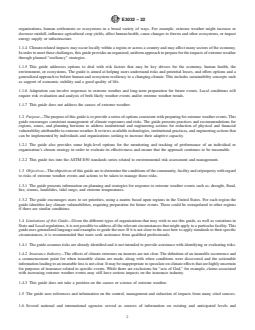
1.1 Overview—For the purposes of this guide, ‘resiliency’ refers to efforts by entities, organizations, or individuals to prepare for or adjust to future extreme weather and related physical conditions. The primary purpose is to reduce negative economic impacts associated with extreme weather.
1.1.1 This guide presents a generalized, systematic approach to voluntary assessment and risk management of extreme climate related events and conditions. It helps the user structure their understanding of the climate related vulnerabilities and consequences they seek to manage. It helps the user identify adaptive actions of both an institutional (legal), as well as engineering (physical) nature. Options for analysis provide a priority ranking system to address the “worst first” risks of a municipality, local area or facility, addressing practicality and cost-benefit. Users may approach this analysis having initially undertaken a risk assessment to determine what they are seeking to manage, or use the guide to help determine the likely areas of greatest need.
1.1.2 These climate adaptations or adjustments may be either protective (that is, guarding against negative impacts of extreme weather), or opportunistic (that is, taking advantage of any beneficial effects of extreme weather).
1.1.3 This guide addresses adaptation strategies and planning in response to various impacts that may occur to individuals, organizations, human settlements or ecosystems in a broad variety of ways. For example, extreme weather might increase or decrease rainfall, influence agricultural crop yields, affect human health, cause changes to forests and other ecosystems, or impact energy supply or infrastructure.
1.1.4 Climate-related impacts may occur locally within a region or across a country and may affect many sectors of the economy. In order to meet these challenges, this guide provides an organized, uniform approach to prepare for the impa...
- Status
- Published
- Publication Date
- 14-Jul-2022
- Technical Committee
- E50 - Environmental Assessment, Risk Management and Corrective Action
- Drafting Committee
- E50.07 - Climate and Community
Overview
ASTM E3032-22: Standard Guide for Climate Resiliency Planning and Strategy offers a comprehensive, systematic approach for organizations and communities to plan adaptation strategies addressing extreme weather and related physical changes. Developed by ASTM, this standard guide focuses on adaptive planning to reduce the negative economic and environmental impacts caused by events such as fires, floods, storms, drought, and extreme temperatures. The document supports voluntary climate risk management, helping users understand vulnerabilities, assess potential consequences, and identify effective protective and opportunistic responses.
Key Topics
- Climate Resiliency Framework: Outlines a structured process for climate adaptation planning, enabling users to categorize and prioritize climate risks and responses.
- Adaptation Strategy Options: Details protective and opportunistic adaptation methods, allowing entities to mitigate risks or harness beneficial effects of long-term weather trends.
- Regional and Sector-Based Planning: Uses a matrix approach reflecting general risks by region, with adaptation priorities based on local climate vulnerabilities.
- Practical Actions: Covers a spectrum of actions including engineering changes, contingency planning, resource allocation, community and stakeholder engagement, and emergency preparedness.
- Stakeholder Guidance: Addresses adaptation planning for a wide range of users: small businesses, service industries, government agencies (at all levels), financial and insurance sectors, utilities, public works, educational and healthcare facilities, property managers, and wildlife management organizations.
- Priority Ranking System: Provides a methodology to address the most significant risks first, improving practicality and cost-benefit in resilience planning efforts.
- Integration with Existing Systems: Encourages the inclusion of climate adaptation in Environmental Management Systems and Disaster Response Plans.
Applications
For Organizations and Communities
- Business Continuity Planning: Integrates climate resiliency measures to maintain or quickly resume operations during and after extreme weather.
- Municipal and Infrastructure Management: Helps local governments and utilities prepare infrastructure-such as water, stormwater, and energy systems-to withstand climate-related threats.
- Insurance and Financial Services: Supports assessment and communication of climate-related risks, informing underwriting, investment, and loan decisions.
- Public Health and Safety: Guides emergency services and health agencies in adapting response protocols to increased risks from extreme weather.
- Education and Risk Communication: Assists educational facilities and community organizations in developing protocols and raising awareness about climate vulnerabilities.
Example Adaptation Strategies
- Constructing green roofs or firebreaks
- Upgrading building insulation and emergency power systems
- Implementing integrated water management or flood protection barriers
- Developing contingency and evacuation plans
- Collaboration among stakeholders for cross-boundary climate response
Related Standards
ASTM E3032-22 is closely connected with other standards on environmental risk management and climate adaptation, including:
ASTM Standards:
- E2114 – Sustainability Terminology for Buildings
- E2432 – Principles of Sustainability Relative to Buildings
- E2718 – Guide for Climate Change Financial Disclosures
- E2725 – Assessment and Management of Greenhouse Gases
- E3136 – Climate Resiliency in Water Resources
- E3249 – Remedial Action Resiliency to Climate Impacts
- E3312 – Wildfire Impact Mitigation for Water Utilities
ISO Standards:
- ISO 14001:2015 – Environmental Management Systems
- ISO 31000:2018 – Risk Management Guidelines
- ISO 14064-1 & -3 – Greenhouse Gas Quantification and Verification
- ISO 14063:2020 – Environmental Communication
Other References:
- AS 5334-2013 (Australia) – Risk-Based Climate Change Adaptation for Settlements and Infrastructure
Practical Value
By leveraging the guidance of ASTM E3032-22, users can:
- Anticipate and effectively manage climate risks
- Reduce long-term operational and financial vulnerability
- Align adaptation planning with best practices and regulatory expectations
- Foster resilience at the organization, community, and ecosystem levels
Adopting a standardized approach to climate resiliency ensures more robust, consistent, and actionable planning for extreme weather challenges-providing essential value in today's changing climate.
Relations
- Effective Date
- 01-Feb-2019
- Effective Date
- 01-May-2017
- Refers
ASTM E2114-17 - Standard Terminology for Sustainability Relative to the Performance of Buildings - Effective Date
- 01-Feb-2017
- Effective Date
- 01-Aug-2011
- Effective Date
- 01-Nov-2010
- Effective Date
- 15-Mar-2010
- Refers
ASTM E2114-08 - Standard Terminology for Sustainability Relative to the Performance of Buildings - Effective Date
- 01-Nov-2008
- Refers
ASTM E2114-06a - Standard Terminology for Sustainability Relative to the Performance of Buildings - Effective Date
- 01-Dec-2006
- Refers
ASTM E2114-06 - Standard Terminology for Sustainability Relative to the Performance of Buildings - Effective Date
- 15-Feb-2006
- Effective Date
- 15-Aug-2005
- Refers
ASTM E2114-05a - Standard Terminology for Sustainability Relative to the Performance of Buildings - Effective Date
- 01-Jun-2005
- Refers
ASTM E2114-05 - Standard Terminology for Sustainability Relative to the Performance of Buildings - Effective Date
- 01-Feb-2005
- Refers
ASTM E2114-04 - Standard Terminology for Sustainability Relative to the Performance of Buildings - Effective Date
- 01-Dec-2004
- Refers
ASTM E2114-00a - Standard Terminology for Sustainability Relative to the Performance of Buildings - Effective Date
- 10-Feb-2001
- Refers
ASTM E2114-01 - Standard Terminology for Sustainability Relative to the Performance of Buildings - Effective Date
- 10-Feb-2001
Get Certified
Connect with accredited certification bodies for this standard

BSI Group
BSI (British Standards Institution) is the business standards company that helps organizations make excellence a habit.

Bureau Veritas
Bureau Veritas is a world leader in laboratory testing, inspection and certification services.

DNV
DNV is an independent assurance and risk management provider.
Sponsored listings
Frequently Asked Questions
ASTM E3032-22 is a guide published by ASTM International. Its full title is "Standard Guide for Climate Resiliency Planning and Strategy". This standard covers: SIGNIFICANCE AND USE 4.1 The Use of this Standard Guide—This guide addresses issues related solely to adaptation strategies and development of a plan to address extreme weather and related physical changes. This guide does not include specific guidance on risk assessment, however references are provided in Appendix X3. The matrix approach does reflect general risks for certain regions of the country, based upon the frequency of extreme weather and/or conditions such as fires, floods, storms, drought, and extreme temperatures. Adaptation strategies and planning may consist of a wide variety of actions by an individual, community, or organization to prepare for, or respond to, the impacts of extreme weather. 4.1.1 This guide does not address causes of extreme weather. 4.1.2 This guide addresses adjustment strategies and planning that a group of people or ecosystems make to limit negative effects of extreme weather. It also addresses taking advantage of opportunities that long term extreme weather patterns may present. 4.2 Example Users: 4.2.1 Small businesses or enterprises; 4.2.2 Service industries; 4.2.3 Federal, state or municipal facilities and regulators, including departments of health and fire departments; 4.2.4 Financial and insurance institutions; 4.2.5 Public works staff, including water system, stormwater system, wastewater system, solid waste, and other utilities (electrical, telephone, gas, et al) and other waste managers, including liquid and solid waste haulers, treatment, recycling, disposal and transfer; 4.2.6 Consultants, auditors, state, municipal and private inspectors and compliance assistance personnel; 4.2.7 Educational facilities; 4.2.8 Property, buildings and grounds management, including landscaping; 4.2.9 Non-regulatory government agencies, such as the military; 4.2.10 Wildlife management entities including government, tribal and NGOs. 4.3 This guide is a first step in crafting simplified goals for managing and communic... SCOPE 1.1 Overview—For the purposes of this guide, ‘resiliency’ refers to efforts by entities, organizations, or individuals to prepare for or adjust to future extreme weather and related physical conditions. The primary purpose is to reduce negative economic impacts associated with extreme weather. 1.1.1 This guide presents a generalized, systematic approach to voluntary assessment and risk management of extreme climate related events and conditions. It helps the user structure their understanding of the climate related vulnerabilities and consequences they seek to manage. It helps the user identify adaptive actions of both an institutional (legal), as well as engineering (physical) nature. Options for analysis provide a priority ranking system to address the “worst first” risks of a municipality, local area or facility, addressing practicality and cost-benefit. Users may approach this analysis having initially undertaken a risk assessment to determine what they are seeking to manage, or use the guide to help determine the likely areas of greatest need. 1.1.2 These climate adaptations or adjustments may be either protective (that is, guarding against negative impacts of extreme weather), or opportunistic (that is, taking advantage of any beneficial effects of extreme weather). 1.1.3 This guide addresses adaptation strategies and planning in response to various impacts that may occur to individuals, organizations, human settlements or ecosystems in a broad variety of ways. For example, extreme weather might increase or decrease rainfall, influence agricultural crop yields, affect human health, cause changes to forests and other ecosystems, or impact energy supply or infrastructure. 1.1.4 Climate-related impacts may occur locally within a region or across a country and may affect many sectors of the economy. In order to meet these challenges, this guide provides an organized, uniform approach to prepare for the impa...
SIGNIFICANCE AND USE 4.1 The Use of this Standard Guide—This guide addresses issues related solely to adaptation strategies and development of a plan to address extreme weather and related physical changes. This guide does not include specific guidance on risk assessment, however references are provided in Appendix X3. The matrix approach does reflect general risks for certain regions of the country, based upon the frequency of extreme weather and/or conditions such as fires, floods, storms, drought, and extreme temperatures. Adaptation strategies and planning may consist of a wide variety of actions by an individual, community, or organization to prepare for, or respond to, the impacts of extreme weather. 4.1.1 This guide does not address causes of extreme weather. 4.1.2 This guide addresses adjustment strategies and planning that a group of people or ecosystems make to limit negative effects of extreme weather. It also addresses taking advantage of opportunities that long term extreme weather patterns may present. 4.2 Example Users: 4.2.1 Small businesses or enterprises; 4.2.2 Service industries; 4.2.3 Federal, state or municipal facilities and regulators, including departments of health and fire departments; 4.2.4 Financial and insurance institutions; 4.2.5 Public works staff, including water system, stormwater system, wastewater system, solid waste, and other utilities (electrical, telephone, gas, et al) and other waste managers, including liquid and solid waste haulers, treatment, recycling, disposal and transfer; 4.2.6 Consultants, auditors, state, municipal and private inspectors and compliance assistance personnel; 4.2.7 Educational facilities; 4.2.8 Property, buildings and grounds management, including landscaping; 4.2.9 Non-regulatory government agencies, such as the military; 4.2.10 Wildlife management entities including government, tribal and NGOs. 4.3 This guide is a first step in crafting simplified goals for managing and communic... SCOPE 1.1 Overview—For the purposes of this guide, ‘resiliency’ refers to efforts by entities, organizations, or individuals to prepare for or adjust to future extreme weather and related physical conditions. The primary purpose is to reduce negative economic impacts associated with extreme weather. 1.1.1 This guide presents a generalized, systematic approach to voluntary assessment and risk management of extreme climate related events and conditions. It helps the user structure their understanding of the climate related vulnerabilities and consequences they seek to manage. It helps the user identify adaptive actions of both an institutional (legal), as well as engineering (physical) nature. Options for analysis provide a priority ranking system to address the “worst first” risks of a municipality, local area or facility, addressing practicality and cost-benefit. Users may approach this analysis having initially undertaken a risk assessment to determine what they are seeking to manage, or use the guide to help determine the likely areas of greatest need. 1.1.2 These climate adaptations or adjustments may be either protective (that is, guarding against negative impacts of extreme weather), or opportunistic (that is, taking advantage of any beneficial effects of extreme weather). 1.1.3 This guide addresses adaptation strategies and planning in response to various impacts that may occur to individuals, organizations, human settlements or ecosystems in a broad variety of ways. For example, extreme weather might increase or decrease rainfall, influence agricultural crop yields, affect human health, cause changes to forests and other ecosystems, or impact energy supply or infrastructure. 1.1.4 Climate-related impacts may occur locally within a region or across a country and may affect many sectors of the economy. In order to meet these challenges, this guide provides an organized, uniform approach to prepare for the impa...
ASTM E3032-22 is classified under the following ICS (International Classification for Standards) categories: 07.060 - Geology. Meteorology. Hydrology; 13.020.01 - Environment and environmental protection in general. The ICS classification helps identify the subject area and facilitates finding related standards.
ASTM E3032-22 has the following relationships with other standards: It is inter standard links to ASTM E2725-19, ASTM E2432-17, ASTM E2114-17, ASTM E2432-11, ASTM E2725-10, ASTM E2718-10, ASTM E2114-08, ASTM E2114-06a, ASTM E2114-06, ASTM E2432-05, ASTM E2114-05a, ASTM E2114-05, ASTM E2114-04, ASTM E2114-00a, ASTM E2114-01. Understanding these relationships helps ensure you are using the most current and applicable version of the standard.
ASTM E3032-22 is available in PDF format for immediate download after purchase. The document can be added to your cart and obtained through the secure checkout process. Digital delivery ensures instant access to the complete standard document.
Standards Content (Sample)
This international standard was developed in accordance with internationally recognized principles on standardization established in the Decision on Principles for the
Development of International Standards, Guides and Recommendations issued by the World Trade Organization Technical Barriers to Trade (TBT) Committee.
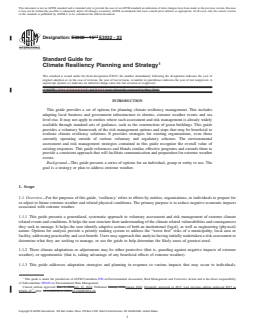
Designation: E3032 − 22
Standard Guide for
Climate Resiliency Planning and Strategy
This standard is issued under the fixed designation E3032; the number immediately following the designation indicates the year of
original adoption or, in the case of revision, the year of last revision. A number in parentheses indicates the year of last reapproval. A
superscript epsilon (´) indicates an editorial change since the last revision or reapproval.
INTRODUCTION
This guide provides a set of options for planning climate resiliency management. This includes
adapting local business and government infrastructure to chronic, extreme weather events and sea
level rise. It may not apply to entities where such assessment and risk management is already widely
available through standard sets of guidance, such as the construction of green buildings. This guide
provides a voluntary framework of the risk management options and steps that may be beneficial to
evaluate climate resiliency solutions. It provides strategies for existing organizations, even those
currently operating outside of various voluntary and regulatory schemes. The environmental
assessment and risk management strategies contained in this guide recognize the overall value of
existing responses. This guide references and blends similar, effective programs and extends them to
provide a consistent approach that will facilitate communication and preparation for extreme weather
events.
Background—This guide presents a series of options for an individual, group or entity to use. The
goal is a strategy or plan to address extreme weather.
1. Scope extreme weather), or opportunistic (that is, taking advantage of
any beneficial effects of extreme weather).
1.1 Overview—For the purposes of this guide, ‘resiliency’
1.1.3 This guide addresses adaptation strategies and plan-
refers to efforts by entities, organizations, or individuals to
ning in response to various impacts that may occur to
prepare for or adjust to future extreme weather and related
individuals, organizations, human settlements or ecosystems in
physical conditions. The primary purpose is to reduce negative
a broad variety of ways. For example, extreme weather might
economic impacts associated with extreme weather.
increase or decrease rainfall, influence agricultural crop yields,
1.1.1 This guide presents a generalized, systematic ap-
affect human health, cause changes to forests and other
proach to voluntary assessment and risk management of
ecosystems, or impact energy supply or infrastructure.
extreme climate related events and conditions. It helps the user
1.1.4 Climate-related impacts may occur locally within a
structure their understanding of the climate related vulnerabili-
region or across a country and may affect many sectors of the
ties and consequences they seek to manage. It helps the user
economy.Inordertomeetthesechallenges,thisguideprovides
identifyadaptiveactionsofbothaninstitutional(legal),aswell
an organized, uniform approach to prepare for the impacts of
as engineering (physical) nature. Options for analysis provide
extreme weather through planned “resiliency” strategies.
a priority ranking system to address the “worst first” risks of a
1.1.5 This guide addresses options to deal with risk factors
municipality, local area or facility, addressing practicality and
that may be key drivers for the economy, human health, the
cost-benefit. Users may approach this analysis having initially
environment, or ecosystems. The guide is aimed at helping
undertaken a risk assessment to determine what they are
users understand risks and potential losses, and offers options
seeking to manage, or use the guide to help determine the
and a generalized approach to bolster human and ecosystem
likely areas of greatest need.
resiliency to a changing climate. This includes sustainability
1.1.2 These climate adaptations or adjustments may be
concepts such as support of economic stability and a good
either protective (that is, guarding against negative impacts of
quality of life.
1.1.6 Adaptation can involve responses to extreme weather
1 and long-term preparation for future events. Local conditions
ThisguideisunderthejurisdictionofASTMCommitteeE50onEnvironmental
Assessment, Risk Management and CorrectiveAction and is the direct responsibil-
will require risk evaluation and analysis of both likely weather
ity of Subcommittee E50.07 on Climate and Community.
events and/or extreme weather trends.
Current edition approved July 15, 2022. Published August 2022. Originally
ɛ1
1.1.7 This guide does not address the causes of extreme
approved in 2015. Last previous edition approved 2015 as E3032–15 . DOI:
10.1520/E3032–22 weather.
Copyright © ASTM International, 100 Barr Harbor Drive, PO Box C700, West Conshohocken, PA 19428-2959. United States
E3032 − 22
1.2 Purpose—The purpose of this guide is to provide a 1.6 Several national and international agencies served as
series of options consistent with preparing for extreme weather sources of information on existing and anticipated levels and
events. This guide encourages consistent management of managementofclimaterisksincluding:theAustralianMinistry
climate exposures and risks. The guide presents practices and of Environment; the Federal Emergency ManagementAgency;
recommendations for regions, zones, and planning horizons to the National Oceanographic and Atmospheric Administration;
address institutional and engineering actions for reduction of the Securities and Exchange Commission; the U.S. Army
physical and financial vulnerability attributable to extreme Corps of Engineers; the U.S. Department of Agriculture; the
weather. It reviews available technologies, institutional U.S.DepartmentofEnergy;theU.S.EnvironmentalProtection
practices, and engineering actions that can be implemented by Agency; and, the U.S. Department of Defense.
individualsandorganizationsseekingtoincreasetheiradaptive
1.7 This guide relies on current regulatory information
capacity.
about risks from various state agencies, including the Califor-
1.2.1 The guide also provides some high-level options for
nia Air Resources Board, the Massachusetts and Connecticut
the monitoring and tracking of performance of an individual or
DepartmentsofEnvironmentalProtection,theWesternClimate
organization’s chosen strategy in order to evaluate its effec-
Initiative, and other published high-level strategies and guid-
tiveness and ensure that the approach continues to be reason-
ance. For example, the National Academy of Sciences guid-
able.
ance and the Climate and Risk section of the Envision rating
1.2.2 This guide ties into the ASTM E50 standards series
system published by the Institute of Sustainable Infrastructure.
related to environmental risk assessment and management.
1.8 This standard does not purport to address all of the
1.3 Objectives—The objectives of this guide are to deter-
safety concerns, if any, associated with its use. It is the
mine the conditions of the community, facility and or/property
responsibility of the user of this standard to establish appro-
withregardtorisksofextremeweathereventsandactionstobe
priate safety, health, and environmental practices and deter-
taken to manage those risks.
mine the applicability of regulatory limitations prior to use.
1.3.1 The guide presents information on planning and strat-
1.9 This international standard was developed in accor-
egies for response to extreme weather events such as: drought,
dance with internationally recognized principles on standard-
flood, fire, storms, landslides, tidal surge, and extreme tem-
ization established in the Decision on Principles for the
peratures.
Development of International Standards, Guides and Recom-
1.3.2 The guide encourages users to set priorities, using a
mendations issued by the World Trade Organization Technical
matrixbaseduponregionsintheUnitedStates.Foreachregion
Barriers to Trade (TBT) Committee.
the guide identifies key climate vulnerabilities, requiring
preparation for future events. These could be extrapolated to
2. Referenced Documents
other regions if there are similar conditions.
2.1 ASTM Standards:
1.4 Limitations of this Guide—Given the different types of
E2114 Terminology for Sustainability Relative to the Perfor-
organizations that may wish to use this guide, as well as
mance of Buildings
variations in State and Local regulations, it is not possible to
E2432 Guide for General Principles of Sustainability Rela-
address all the relevant circumstances that might apply to a
tive to Buildings
particular facility. This guide uses generalized language and
E2718 GuideforFinancialDisclosuresAttributedtoClimate
examples to guide the user. If it is not clear to the user how to
Change
apply standards to their specific circumstances, it is recom-
E2725 Guide for Basic Assessment and Management of
mended that users seek assistance from qualified professionals.
Greenhouse Gases
1.4.1 The guide assumes risks are already identified and is
E3136 Guide for Climate Resiliency in Water Resources
not intended to provide assistance with identifying or evaluat-
E3249 Guide for Remedial Action Resiliency to Climate
ing risks.
Impacts
1.4.2 Insurance Industry—The effects of climate extremes
E3312 Guide for Mitigation of Wildfire Impact to Source
on insurers are not clear. The definition of an insurable
Water Protection Areas and Risk to Water Utilities
occurrence and a commencement point for when insurable
claims are made, along with when conditions were discovered
2.2 ISO Standards:
and the actionable information leading to an insurable loss is
ISO 14001:2015 Environmental management—systems —
not clear. It may be inappropriate to speculate on climate
Requirements with guidance for use
effects that are highly uncertain for purposes of insurance
ISO 14063:2020 Environmental management — Environ-
related to specific events. While there are exclusions for “acts
mental communication — Guidelines and examples
of God,” for example, claims associated with increasing
extreme weather events may still have serious impacts on the
insurance industry.
For referenced ASTM standards, visit the ASTM website, www.astm.org, or
1.4.3 This guide does not take a position on the causes or
contact ASTM Customer Service at service@astm.org. For Annual Book of ASTM
science of extreme weather.
Standards volume information, refer to the standard’s Document Summary page on
the ASTM website.
1.5 The guide uses references and information on the
Available from International Organization for Standardization (ISO), ISO
control, management and reduction of impacts from many
Central Secretariat, BIBC II, Chemin de Blandonnet 8, CP 401, 1214 Vernier,
cited sources. Geneva, Switzerland, http://www.iso.org.
E3032 − 22
ISO 14064-1:2018 Greenhouse gases — Part 1: Specifica- sity; temperature; precipitation patterns; or wind patterns,
tion with guidance at the organization level for quantifi- among others, that occur over several decades or longer.
cation and reporting of greenhouse gas emissions and
3.1.9 fire risk, n—various rating systems to determine how
removals
likely a fire is, given weather and wind conditions. The
ISO 14064-3:2020 Greenhouse gases — Part 3: Specifica-
National Fire Protection Association has a rating system
tion with guidance for the verification and validation of
3.1.10 flood risk, n—variousratingsystemstodeterminethe
greenhouse gas statements
flood zone associated with flooding and water damage. Rating
ISO 31000:2018 Risk management — Guidelines
system terminology includes various flood zones as defined by
ISO Guide 73:2009 Risk management – Vocabulary
FEMAandStateagenciesforrainfallandtidalevents.Thiscan
ISO Draft Standard on Asset Management: Overview, Prin-
include the 5, 10, 25, 50,100 and 500 year events). The
ciples and Terminology (56/1358/DC)
100-Year flood level and floodplain are the typical standard to
2.3 Standards Australia:
define severe flood levels and flood extent. The 100 year event
AS 5334-2013 Climate change adaptation for settlements
risk is also defined as a one-in-100 or 1% likelihood of
and infrastructure – A risk based approach
occurring in any given year.
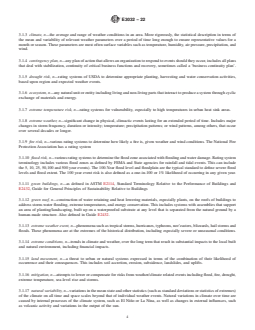
3.1.11 green buildings, n—as defined in ASTM E2114,
3. Terminology
Standard Terminology Relative to the Performance of Build-
3.1 Definitions:
ings and E2432, Guide for General Principles of Sustainability
3.1.1 adaptation, n—risk treatment and mitigation actions
Relative to Buildings
undertaken to reduce the adverse consequences of extreme
3.1.12 green roof, n—construction of water retaining and
weather, as well as to harness any beneficial opportunities.
heat lowering materials, especially plants, on the roofs of
Adjustment or preparation of natural or human systems to a
buildings to address storm-water flooding, extreme
new or changing environment which moderates harm or
temperatures, and energy conservation. This includes systems
exploits beneficial opportunities.
with assemblies that support an area of planting/landscaping,
3.1.2 adaptive capacity, n—the ability of a system to adjust
built up on a waterproofed substrate at any level that is
to extreme weather (including climate variability and ex-
separated from the natural ground by a human-made structure.
tremes) to moderate potential damages, to take advantage of
Also defined in Guide E2432.
opportunities, or to cope with the consequences. Response to
3.1.13 extreme weather event, n—phenomena such as tropi-
and attenuation of potential damages, to take advantage of
cal storms, hurricanes, typhoons, nor’easters, blizzards, hail
opportunities, or to cope with the consequences.
storms and floods. These phenomena are at the extremes of the
3.1.3 climate, n—the average and range of weather condi-
historical distribution, including especially severe or unsea-
tions in an area. More rigorously, the statistical description in
sonal conditions.
terms of the mean and variability of relevant weather param-
3.1.14 extreme conditions, n—trendsinclimateandweather,
etersoveraperiodoftimelongenoughtoensurerepresentative
over the long term that result in substantial impacts to the local
values for a month or season. These parameters are most often
built and natural environment, including financial impacts.
surface variables such as temperature, humidity, air pressure,
precipitation, and wind.
3.1.15 land movement, n—a threat to urban or natural
systems expressed in terms of the combination of their likeli-
3.1.4 contingency plan, n—any plan of action that allows an
hood of occurrence and their consequences. This includes soil
organization to respond to events should they occur, includes
accretion, erosion, subsidence, landslides, and uplifts.
all plans that deal with stabilization, continuity of critical
business functions and recovery, sometimes called a ‘business
3.1.16 mitigation, n—attempts to lower or compensate for
continuity plan’.
risks from weather/climate related events including flood, fire,
drought, extreme temperature, sea-level rise and storms.
3.1.5 drought risk, n—rating systems of USDAto determine
appropriate planting, harvesting and water conservation
3.1.17 natural variability, n—variations in the mean state
activities, based upon region and expected weather events.
and other statistics (such as standard deviations or statistics of
extremes) of the climate on all time and space scales beyond
3.1.6 ecosystem, n—any natural unit or entity including
that of individual weather events. Natural variations in climate
living and non-living parts that interact to produce a system
over time are caused by internal processes of the climate
through cyclic exchange of materials and energy.
system, such as El Niño or La Nina, as well as changes in
3.1.7 extreme temperature risk, n—rating systems for
external influences, such as volcanic activity and variations in
vulnerability,especiallytohightemperaturesinurbanheatsink
the output of the sun.
areas.
3.1.18 relative sea level rise, n—the increase in ocean water
3.1.8 extreme weather, n—significant change in physical,
levelsataspecificlocation,takingintoaccountbothglobaland
climactic events lasting for an extended period of time.
local factors, such as glacial ice melt (from land and in sea,
Includes major changes in storm frequency, duration or inten-
with land melt having greater relative impact), local
subsidence, thermal expansion, and/or continental uplift or
subduction Measured with respect to a specified vertical datum
Standards Australia Level 10, The Exchange Centre 20 Bridge Street, Sydney
GPO Box 476 Sydney NSW 2001. http://www.standards.org.au/ relativetotheland,whichmayalsobechangingelevationover
E3032 − 22
time. Can include evaluation of flood risk to coastal areas, what you expect (for example, cold winters) and ’weather’ is
generally associated with flood insurance ratings and maps. what you get (for example, a blizzard).]
3.1.19 resilience, n—adaptive capacity of an organization in
4. Significance and Use
a complex and changing environment. A capability to
4.1 The Use of this Standard Guide—This guide addresses
anticipate, prepare for, respond to, and recover from significant
issues related solely to adaptation strategies and development
multi-hazard threats with minimum damage to social well-
of a plan to address extreme weather and related physical
being, the economy, and the environment.
changes. This guide does not include specific guidance on risk
3.1.20 scenarios, n—a plausible and often simplified de-
assessment, however references are provided in Appendix X3.
scription of how the future may develop based on a coherent
The matrix approach does reflect general risks for certain
and internally consistent set of assumptions about driving
regions of the country, based upon the frequency of extreme
forces and key relationships.
weather and/or conditions such as fires, floods, storms,
drought, and extreme temperatures. Adaptation strategies and
3.1.21 sensitivity, n—the degree to which a system is
planning may consist of a wide variety of actions by an
affected, either adversely or beneficially, by climate variability
individual, community, or organization to prepare for, or
or change. The effect may be direct (for example, a change in
respond to, the impacts of extreme weather.
crop yield in response to a change in the mean, range or
4.1.1 This guide does not address causes of extreme
variability of temperature) or indirect (for example, damages
weather.
caused by an increase in the frequency of coastal flooding due
4.1.2 This guide addresses adjustment strategies and plan-
to sea level rise).
ning that a group of people or ecosystems make to limit
3.1.22 storm risk, n—rating systems for the likelihood of
negative effects of extreme weather. It also addresses taking
impacts from rainfall, snow, hail or wind from rainfall events,
advantage of opportunities that long term extreme weather
hurricanes and tropical storms, Nor’easters, tornadoes, bliz-
patterns may present.
zards and other types of storms. Can include surges or
4.2 Example Users:
abnormal rise in sea level accompanying a hurricane, tropical
4.2.1 Small businesses or enterprises;
storm, or other intense storm, whose height is the difference
4.2.2 Service industries;
between the observed level of the sea surface and the level that
4.2.3 Federal, state or municipal facilities and regulators,
would have occurred in the absence of the storm or hurricane.
including departments of health and fire departments;
3.1.23 subsiding/subsidence, n—the downward settling of
4.2.4 Financial and insurance institutions;
soil layers and/or rock in the Earth’s crust relative to its
4.2.5 Public works staff, including water system, stormwa-
surroundings.
ter system, wastewater system, solid waste, and other utilities
3.1.24 thermal expansion, n—the increase in volume (and (electrical, telephone, gas, et al) and other waste managers,
including liquid and solid waste haulers, treatment, recycling,
decrease in density) that results from warming water. A
warming of the ocean leads to an expansion of the ocean disposal and transfer;
4.2.6 Consultants, auditors, state, municipal and private
volume, which leads to an increase in sea level.
inspectors and compliance assistance personnel;
3.1.25 tidal effects, n—rising seas, extreme water levels,
4.2.7 Educational facilities;
storm surges, rising sea levels, and frequent tidal events, from
4.2.8 Property, buildings and grounds management, includ-
hurricanes, tropical storms, typhoons, and Nor’Easters
ing landscaping;
3.1.26 vulnerability, n—the degree to which a system is
4.2.9 Non-regulatory government agencies, such as the
susceptible to, or unable to cope with, adverse effects of
military;
extreme weather, including climate variability and extremes. 4.2.10 Wildlife management entities including government,
Vulnerabilityisafunctionofthecharacter,magnitude,andrate
tribal and NGOs.
of climate variation to which a system is exposed; its sensitiv-
4.3 This guide is a first step in crafting simplified goals for
ity; and its adaptive capacity.
managing and communicating risks. The framework describes
3.1.27 weather, n—atmospheric condition at any given time a process by which the user may categorize current climate
or place. It is measured in terms of such parameters as wind, risks and a priority approach to manage those risks. The
temperature, humidity, atmospheric pressure, cloudiness, and technique classifies common responses for both mitigation and
precipitation. In most places, weather can change from hour- adaptation. The guide groups responses and examples into
to-hour, day-to-day, and season-to-season. Climate in a narrow regions based on experience in responding to risks. The
sense is usually defined as the "average weather", or more regional classifications found in this guide reflect the general
rigorously, as the statistical description in terms of the mean structures of State, Federal and local response programs.These
and variability of relevant quantities over a period of time authorities generally classify groups of similar responses
ranging from months to thousands or millions of years. These according to the timely availability and cost effectiveness of
quantitiesaremostoftensurfacevariablessuchastemperature, responses (see ISO 14063:2020).
precipitation, and wind. Climate in a wider sense is the state, 4.3.1 Adaptation strategies and planning may include ac-
including a statistical description, of the climate system. [A tions by individuals and communities, for example, from
simple way of remembering the difference is that climate is reduced tree clearing for an individual lot, to a farmer planting
E3032 − 22
more drought-resistant crops, or to a municipality protecting 4.4.3 Assessingrisksfromfutureweatherrelatedeventsand
riparian and floodplain standards and buffers or ensuring that extreme conditions. A compendium of applicable risk assess-
new coastal infrastructure can accommodate future sea level ment tools that users may find useful are in Appendix X1.
rise. However, building resilience across communities will
4.4.4 Risk management, underwriting; loss control and
require action at all levels; individual, business, town, county,
history; premiums and claims;
state, and federal.
4.4.5 Liability assessment and qualifications for loans;
4.3.2 Some municipalities, for example Boston, Miami
4.4.6 Standardization, consistency and certification of facil-
Beach, and Baltimore, corporate entities, and organizations
ity specific evaluations;
have already begun taking action toward defining adaptation
4.4.7 Educating employees, clients and customers;
strategies and planning for extreme weather.
4.4.8 Generating multi media and cross medium informa-
4.3.3 In an increasingly interdependent world, negative
tion;
effects of extreme weather on one population or economic
4.4.9 Evaluating vendors;
sector may have repercussions around the world. These effects
4.4.10 Reducing costs and preventing pollution.
have repercussions on populations and settlements in neigh-
boring areas, within countries, or across the globe. They 4.5 Users may consider various benefits of assessment and
response.
include economic disruption to productivity and the supply-
chain, impacts to energy production and cascading impacts to
4.5.1 This guide is a basic primer on climate impacts and
users. may serve to introduce the subject for organizations unfamiliar
4.3.4 Many ecosystems will also be affected by extreme with the principles.
weather challenges and opportunities. Some species may be
4.5.2 Some government agencies, fiduciaries and business
able to migrate or change their behavior to accommodate
organizations publish strategies for climate resiliency. The
changes in the weather. Other species may decline or become
public has systematic ability to access or estimate information
extinct. Some species may increase in numbers. Managers of
on individual businesses. Therefore, businesses need guidance
natural resources may anticipate some of the impacts of
on how to assess the nature and potential risks of climate risks,
extreme weather on ecosystems. This offers one avenue in
andaprogrammaticapproachforreducingoreliminatingthose
beginning to develop management programs that may help
risks through protection, accommodation, retreat, and other
ecosystems adapt.
proactive management systems.
4.3.5 There are limits to the ability of human systems to
4.5.3 Reduced operation, insurance and maintenance costs
adapt. For example, the relocation of cities and various
may be realized through a tiered evaluation of weather related
communities or infrastructure may not be feasible in many
response opportunities.
locations, especially in a short period of time. Implementation
4.5.4 Responses may be streamlined and simplified so that
timeframes could take 20, 50 and 100 years or longer.
all levels in an organization may participate.
4.3.6 Those communities or sections of communities that
4.5.5 Some enterprises may be more competitive in the
are most vulnerable, such as locations where the poor,
marketplacewithimprovedclimate-relatedresponseprograms.
disengaged, elderly or those in ill health live, are at greatest
4.5.6 Setting priorities can allow planning and evaluation of
risk.Extremeweathermayexacerbateexistingissues.Address-
new adaptation and response requirements.
ing underlying issues that make communities or systems
4.5.7 Different stakeholders, such as industries or
vulnerable will increase their resilience and support adaptation
governments, will have different interests and responsibilities
efforts.
for taking action. For example, retreat and relocation of
4.3.7 The user should consider the most effective scale of
populations will fall under the government scope rather than
adaptation, for example, site, town, catchment, watershed,
industry.
City, State, or regional level. The scale will impact the relative
4.6 Institutional Risks—Some of the risks posed by weather
direct and indirect costs and benefits of a solution. The guide
related events include damage to residences, businesses, infra-
may help users understand the most effective scale of adapta-
structure and agriculture from fires, floods, drought, extreme
tion and the appropriate level of action.
temperature, storms, hail, winds, tidal surge and sea level rise.
4.4 This guide defines good commercial and customary
Early, voluntary actions, including the use of this guide, may
practice in the U.S. for conducting baseline assessment and
also help organizations prepare for and reduce the impacts of
reasonable mitigation/adaptation strategic options on a volun-
future government regulations. Some of the possible govern-
tary basis. The following principles apply to this priority
ment programs that may be used to address climate are
system:
described below.
4.4.1 Ability to set specific goals for activities. This in-
4.6.1 Flood Insurance Maps;
cludesadoptingacontingencyplanforprotectionfromweather
4.6.2 Water conservation requirements;
related events using engineering changes while maintaining
4.6.3 Fire codes;
current operations. This includes “flood-proofing” “fire-
4.6.4 Emergency response;
proofing,” back-up energy generation, vegetation management
4.6.5 Zoning regulations;
around power lines and other measures to cope with extreme
4.6.6 Building codes;
weather.
4.4.2 Marketing environmental awareness and sensitivity; 4.6.7 Wetlands and stream buffer regulations;
E3032 − 22
4.6.8 Stormwater standards and regulations for floodplains include adoption of regional priorities for adaptation. Strate-
and floodways, planning, development requirements, and in- gies for preparedness for a weather event may be different than
frastructure design (MS4, flood control systems, floodplains reactions to post-extreme weather events.
and floodways);
5.3 Extreme weather may pose a risk or threat to businesses
4.6.9 Public Works Projects;
andproperties.Forexample,variationsinairtemperaturesover
4.6.10 Hazard Mitigation Planning.
landmassesoroceantemperaturescoulddirectlyandindirectly
4.7 Managing Risk Uncertainty:
affect ecosystems, humans, and the economy. In some areas,
4.7.1 It appears that weather extremes will continue to
there could be regional increases in the form of more pro-
present risks and uncertainty as to the effects they will have in
nounced heat waves and heavy precipitation events, which
different regions. The ability to predict future weather related
exceed the levels expected from standard variability.
risks has improved, but efforts to understand the complete
5.4 Extreme weather might yield economic damages in the
impact of those risks on society and analyze mitigation and
form of flood and storm damage, crop losses, wildfire losses,
adaptation strategies are still relatively immature.
supply chain disruptions and critical infrastructure outages.
4.7.2 The tiered analysis in this guide will help support
This guide addresses adaptation strategies and plans, taking a
decision-making, studying regional impacts, and communicat-
measured approach to promote effective risk management
ing with wider group of stakeholders in the face of uncertainty.
strategies.
4.7.3 Theinsuranceindustryhasalwaysplayedaroleinrisk
management by insuring weather related risks, promoting
5.5 This guide does not address the uncertainty of unpre-
stronger building codes, and better land-use decision-making. dictableandsevereweatherevents.Thisguidedoesnotaddress
connections between impacts of rising temperatures and ex-
5. Risk Management
treme events or the probability of the rate of increase of these
events. However, this guide does discuss options for address-
5.1 This guide establishes a framework of common, climate
ing vulnerabilities to the impacts of extreme weather and
risk management strategies in the United States. The same
natural catastrophes.
planning principles could be applied in other countries, de-
pending upon priorities associated with climate risks. This
5.6 Procedure for Planning A Strategy—A plan of adapta-
general guide will allow the user to evaluate the category of
tion to extreme weather should educate groups, businesses and
risk from extreme weather related issues. Responses would
individuals to reduce risks, and build safety restraints into their
then be evaluated for timeliness and availability in order to
activities, increasing resiliency. The development of a strategy,
continually reduce the risks.
and application of this guide, may be approached from a
5.2 This guide outlines adaptation strategies and planning starting point of having determined the priority risks that need
steps that may be taken to prepare for, and respond to, the to be addressed (for example, through a risk assessment).
impacts of extreme weather. The guide addresses a series of Alternatively, if a risk assessment has not been undertaken, the
adaptation and planning options for managing environmental approach outlined in Fig. 1 may be applied starting with
and human risks associated with extreme weather. The guide identifying the relevant region (that is geography). For ex-
addressespotentialwaystoapproachmanagingrisks.Thismay ample there are eight regions shown in Fig. 2.
FIG. 1 Procedure for Adaptation Planning Strategy Development
E3032 − 22
FIG. 2 National Climate Assessment Regions (National Climate Assessment, 2014)
5.6.1 If the regional approach is followed, the user first 5.6.3 Priority areas of concern may also be based on
decides on the appropriate regions for planning, selecting from previous, climate related, catastrophic events. The areas of
one of eight regions of the United States. Certain areas of
NewYork,LongIslandandNewJerseyimpactedbyHurricane
Canada adjacent to the Northeast, the Midwest, the Great
Sandy are examples.
Plains or the Northwest may benefit from this regional orga-
5.6.4 Categories of actions include adaptation, protection
nization of the guide. Certain areas of Mexico adjacent to the
and retreat and are shown in Table 2.
Southwest or Great Plains may also benefit from guide use.
5.7 Building a strategy or plan of adaptation to extreme
5.6.2 The priority areas of concern are shown in Table 1,
based upon the selected region. There may be other priority weather educates groups, businesses and individuals to reduce
areas, based upon local conditions and state by state priorities. risks, and build safety restraints into their activities, increasing
Flash floods from rivers and streams are examples of local
resiliency. Broad examples of strategy or plan elements
conditions requiring priority planning, in addition to regional
include, but are not limited to:
priorities.
TABLE 1 Example Regional Climate Adaptation Priorities
NOTE 1—Table 1 provides a regional overview of adaptation priorities. The lack of a ‘*’ does not indicate that other climate risks will not occur in
a region. In addition, specific risks and adaptation priorities may differ within a region, at the local or site specific scale.
Storms
Land Movement
Extreme (wind straight line
Subsidence Sea Rise and
Region Temperature Drought Fire Flood and tornadic and
(uplifts and Tidal Effects
(hot or cold) snow hail, sleet
landslides)
and ice)
1 Northeast * * * *
2 Southeast and
*** *
Caribbean
3 Midwest * * * *
4GreatPlains *****
5 Southwest * * * *
6 Northwest * * * *
7 Alaska * ***
8 Hawaii ***
E3032 − 22
TABLE 2 Category of Responses to Example Climate Events
Adaptation Risk Category 1: Accommodation Category 2: Protection Category 3: Retreat/Relocate
Category
Extreme Temperature Build green roofs, conserve water, and add Add insulation and energy efficient Move residences and buildings
plantings and landscape to increase shade windows to buildings Provide into more temperate areas;
and oxygen. emergency generators for including underground zones for
temperature control centers to geothermal temperature control.
address extremes.
Drought Conservation. Plant alternative crops or Integrated water resource programs Move crops, livestock and resi-
drought resistant crops. Underground water for stormwater and “wastewater”. dences from risk areas. Provide
storage. Recycle of existing water supplies. Reservoirs. Aquifer recharge and un- for technology that uses less wa-
(See Guide E3312.) derground water storage. Water re- ter or hydroponic growth with re-
taining soil amendments. Provide cycled water.
emergency water supplies. (See
Guide E3136.)
Fire Construct firebreaks, and fire-fighting sta- Fire resistant coatings; Stronger Move residences out of high risk
tions. Water storage in potential fire areas. regulations and oversight in areas of areas. Realign development to
Low occupancy development. Controlled concern (man-made fires). Water provide for fire line and reduced
burns. Strategic logging to thin out forests storage in potential fire areas. (See spread. Redesign structure to in-
near residential areas. Guide E3312.) clude fire protective natural infra-
structure (soil external covering).
Flood Free-board buildings. Sumps and tunnels to Build seawalls barrier islands and Remove, relocate or raze vulner-
move water away from buildings. Pumping dunes. Provide run-off structures to able buildings and infrastructure.
stations and infrastructure control manage flooding and provide water Replace and restore floodplains,
measures, including bridges, culverts, storm storage, retention and detention. wetlands and natural channels.
water systems; and run-off controls using Redesign development to retreat
natural systems. from flood zones and sea impact
areas. Use natural designs to re-
duce inward flow of waters.
Storms include Emergency Response and shelter plans. Upgrade building codes for windows, Include development plans with
straight-line and tor- Upgrade buildings, including windows, doors, roofs, insulation and other cooperative energy provisions;
nadic winds, hail and doors, roofs, insulation and other building building features. Address energy Design or redesign occupied ar-
ice features. Provide supportive energy sys- issues with backup structures. eas to address main impacts from
tems. Address ice and wind damage issues. storms.
Land Movement in- Upgrade building and community designs to Build retaining structures and run-off Move residences out of high risk
cludes subsidence address structural and emergency issues structures to reduce erosional areas. areas. Provide for free board ar-
(increase strength of buildings and escape Provide for green space to eas if slope failure occurs.
routes). strengthen slope stability.
Sea Rise and Tidal Free-board buildings away from main im- Build seawalls, retaining structures, Remove relocate or raze occupied
Effects pact tidal zones. Sumps and water tunnels levees and protective sea/flood walls. structures from high risk areas.
to move water away from buildings. Pump- Provide run-off and storage struc- Provide natural run-off storage
ing stations and infrastructure control tures. Address beach erosional is- and protective structures in de-
measures, along with riparian zones to ad- sues through restoration of barrier signs. Redesign development to
dress impacts. islands and dunes. Repair, upgrade retreat from tidal erosional zones
and maintain locks and other struc- and tidal impact areas. Use natu-
tures to control surge for navigation ral designs to reduce inward flow
channels and ports. of waters and sea impacts.
5.7.1 Putting in place a group to understand, coordinate and 14001:2015andISO31000:2018).Planupdatesshouldinclude
reduce disaster risk based on participation of multiple parties, training for those responsible for response to extreme weather
including local alliances.
events.
5.7.2 For businesses, climate adaptation goals in employee
5.7.8 Planning to maintain critical evacuation and supply
jobdescriptions,especiallyinkeygeographiesinanenterprise,
routes, access (for police, fire, medical, and other emergency
or in operations and supply chain.
responders), and infrastructure (water, sewer, stormwater,
5.7.3 Establishingacross-functionclimateadaptationwork-
communications, hospitals, shelters, power with backup
ing group with connections to local or regional organizations.
generators, airports, rail lines, et al) that reduce risk, adjusted
5.7.4 Setting a budget and providing the necessary re-
where needed to cope with extreme weather.
sources for proactive adaptation.
5.7.9 Assessment of the safety of nearby facilities that
5.7.5 Collaborating with neighboring businesses and supply
support disaster response efforts (for example, schools and
chain partners on climate adaptation planning and execution.
health facilities) and upgrading the plan as necessary.
5.7.6 All parties understand their role regarding adaptation
5.7.10 Definitions for realistic, risk-compliant building
that requires disaster risk reduction and preparedness.
guidance and land-use planning.
5.7.7 Making up-to-date information and plans readily
5.7.11 Education programs and training on disaster risk
available. Plans and strategies to cope with extreme weather
could be integrated into an existing Environmental Manage- reduction at facilities that support disaster response efforts (for
example, schools and local communities).
mentSystemorDisasterResponsePlan(seeGuideE3249,ISO
E3032 − 22
5.7.12 Protecting specific ecosystems and natural buffers to tions away from coastlines and other flood hazard areas. The
mitigate floods, storm surges and other hazards to which planning horizon includes actions that may be available,
participant(s) are vulnerable. through research and development programs, rezoning and
5.7.13 Periodic updates and refinements of the plan and relocation programs, as well as wetland replication and species
effective risk-reduction practices. replacement in a ten- to thirty-year timeframe.
5.7.14 Installing early warning systems and emergency
5.10 Regional Approach to Climate Resiliency—The essen-
management capacities in your group and hold regular public
tial principles of this guide are: Environmental assessment by
preparedness drills.
objective; Priority planning; Measuring effectiveness of adap-
5.7.15 Post disaster needs assessment of survivors to guide
tation measures. This guide groups climate adaptation mea-
reconstruction, with support from community organizations.
sures in a matrix for eight regions shown in Fig. 2 and Table 1
Design and help implement responses, including rebuilding
and three general categories: accommodation, protection and
homes and livelihoods.
retreat shown in Table 2.
5.7.16 Reassessment procedures in plans to determine is-
5.10.1 These figures and tables can be adjusted to reflect the
sues or problems which require evaluation of current processes
regions in the National Climate Assessment and their high-
and revisions to ensure better adaptive strategies in the future.
lighted challenges. Refer to U.S. Global Change Research
This is an iterative process for continual improvement.
Program National Climate Assessment, 2014.
5.8 Financial and Schedule Considerations—Users should
5.10.2 Regional climate adaptation priorities and classifica-
evaluate and compare life cycle (capital, operation, and main-
tions may be informed by statistical analysis of historical
tenance) costs and benefits of the different actions to mitigate
insurance claims for types of damage to various regions and
categories of risk management. This includes the time of
resources.
implementation and planning horizon. Users may pursue one
5.10.3 Federal and State programs for assistance in climate
or more categories of management risks simultaneously.
adaptation implementation may base funding priorities upon
5.8.1 The user should identify the priority planning areas,
previous catastrophic events related to extreme weather. For
based upon the overall region. Fig. 2 shows general regions of
example, communities in New Jersey may base adaptation
the country. Table 1 shows some priority planning subjects,
priorities after hurricane Sandy on storms, flooding and sea-
based upon region.
level rise.
5.8.2 An initial risk assessment of the community or spe-
cific area will determine the highest vulnerabilities to climate
6. Planning and Identification of Actions
related events.Then the user should also identify conventional,
6.1 The overall process first involves selecting climate
short-term, measures recommended for the region, including
adaptation planning areas, based upon the region of the
emergency response plans for initial response to events.
country. Sample areas are shown in Table 1.
5.8.3 The National Climate Assessment Report (see U.S.
6.2 Based on either the risk identification or regional
Global Change Reserch Program National Climate
process, develop a list of potential actions that may improve
Assessment, 2014) addresses seven sectors: human health;
climate resilience. Examples within the three categories of
water, energy; transportation; agriculture, forests and ecosys-
response include:
tems.Theusermaysetprioritiesforadaptationinthelocalarea
according to the most important or urgent sectors.
6.3 Category 1 Accommodation—See Table 2.
6.3.1 Extreme Temperature—Adapt all buildings and struc-
5.9 Management Categories:
tures with green roofs and temperature resistant insulation.
5.9.1 Category
...
This document is not an ASTM standard and is intended only to provide the user of an ASTM standard an indication of what changes have been made to the previous version. Because
it may not be technically possible to adequately depict all changes accurately, ASTM recommends that users consult prior editions as appropriate. In all cases only the current version
of the standard as published by ASTM is to be considered the official document.
´1
Designation: E3032 − 15 E3032 − 22
Standard Guide for
Climate Resiliency Planning and Strategy
This standard is issued under the fixed designation E3032; the number immediately following the designation indicates the year of
original adoption or, in the case of revision, the year of last revision. A number in parentheses indicates the year of last reapproval. A
superscript epsilon (´) indicates an editorial change since the last revision or reapproval.
ε NOTE—5.9.1, 6.3.4.4, 6.3.4.5, and X4.2.1 were editorially corrected in May 2016.
INTRODUCTION
This guide provides a set of options for planning climate resiliency management. This includes
adapting local business and government infrastructure to chronic, extreme weather events and sea
level rise. It may not apply to entities where such assessment and risk management is already widely
available through standard sets of guidance, such as the construction of green buildings. This guide
provides a voluntary framework of the risk management options and steps that may be beneficial to
evaluate climate resiliency solutions. It provides strategies for existing organizations, even those
currently operating outside of various voluntary and regulatory schemes. The environmental
assessment and risk management strategies contained in this guide recognize the overall value of
existing responses. This guide references and blends similar, effective programs and extends them to
provide a consistent approach that will facilitate communication and preparation for extreme weather
events.
Background—This guide presents a series of options for an individual, group or entity to use. The
goal is a strategy or plan to address extreme weather.
1. Scope
1.1 Overview—For the purposes of this guide, ‘resiliency’ refers to efforts by entities, organizations, or individuals to prepare for
or adjust to future extreme weather and related physical conditions. The primary purpose is to reduce negative economic impacts
associated with extreme weather.
1.1.1 This guide presents a generalized, systematic approach to voluntary assessment and risk management of extreme climate
related events and conditions. It helps the user structure their understanding of the climate related vulnerabilities and consequences
they seek to manage. It helps the user identify adaptive actions of both an institutional (legal), as well as engineering (physical)
nature. Options for analysis provide a priority ranking system to address the “worst first” risks of a municipality, local area or
facility, addressing practicality and cost-benefit. Users may approach this analysis having initially undertaken a risk assessment to
determine what they are seeking to manage, or use the guide to help determine the likely areas of greatest need.
1.1.2 These climate adaptations or adjustments may be either protective (that is, guarding against negative impacts of extreme
weather), or opportunistic (that is, taking advantage of any beneficial effects of extreme weather).
1.1.3 This guide addresses adaptation strategies and planning in response to various impacts that may occur to individuals,
This guide is under the jurisdiction of ASTM Committee E50 on Environmental Assessment, Risk Management and Corrective Action and is the direct responsibility
of Subcommittee E50.05 on Environmental Risk Management.
Current edition approved Dec. 1, 2015July 15, 2022. Published January 2016August 2022. Originally approved in 2015. Last previous edition approved 2015 as
ɛ1
E3032–15 . DOI: 10.1520/E3032–15E0110.1520/E3032–22
Copyright © ASTM International, 100 Barr Harbor Drive, PO Box C700, West Conshohocken, PA 19428-2959. United States
E3032 − 22
organizations, human settlements or ecosystems in a broad variety of ways. For example, extreme weather might increase or
decrease rainfall, influence agricultural crop yields, affect human health, cause changes to forests and other ecosystems, or impact
energy supply or infrastructure.
1.1.4 Climate-related impacts may occur locally within a region or across a country and may affect many sectors of the economy.
In order to meet these challenges, this guide provides an organized, uniform approach to prepare for the impacts of extreme weather
through planned “resiliency” strategies.
1.1.5 This guide addresses options to deal with risk factors that may be key drivers for the economy, human health, the
environment, or ecosystems. The guide is aimed at helping users understand risks and potential losses, and offers options and a
generalized approach to bolster human and ecosystem resiliency to a changing climate. This includes sustainability concepts such
as support of economic stability and a good quality of life.
1.1.6 Adaptation can involve responses to extreme weather and long-term preparation for future events. Local conditions will
require risk evaluation and analysis of both likely weather events and/or extreme weather trends.
1.1.7 This guide does not address the causes of extreme weather.
1.2 Purpose—The purpose of this guide is to provide a series of options consistent with preparing for extreme weather events. This
guide encourages consistent management of climate exposures and risks. The guide presents practices and recommendations for
regions, zones, and planning horizons to address institutional and engineering actions for reduction of physical and financial
vulnerability attributable to extreme weather. It reviews available technologies, institutional practices, and engineering actions that
can be implemented by individuals and organizations seeking to increase their adaptive capacity.
1.2.1 The guide also provides some high-level options for the monitoring and tracking of performance of an individual or
organization’s chosen strategy in order to evaluate its effectiveness and ensure that the approach continues to be reasonable.
1.2.2 This guide ties into the ASTM E50 standards series related to environmental risk assessment and management.
1.3 Objectives—The objectives of this guide are to determine the conditions of the community, facility and or/property with regard
to risks of extreme weather events and actions to be taken to manage those risks.
1.3.1 The guide presents information on planning and strategies for response to extreme weather events such as: drought, flood,
fire, storms, landslides, tidal surge, and extreme temperatures.
1.3.2 The guide encourages users to set priorities, using a matrix based upon regions in the United States. For each region the
guide identifies key climate vulnerabilities, requiring preparation for future events. These could be extrapolated to other regions
if there are similar conditions.
1.4 Limitations of this Guide—Given the different types of organizations that may wish to use this guide, as well as variations in
State and Local regulations, it is not possible to address all the relevant circumstances that might apply to a particular facility. This
guide uses generalized language and examples to guide the user. If it is not clear to the user how to apply standards to their specific
circumstances, it is recommended that users seek assistance from qualified professionals.
1.4.1 The guide assumes risks are already identified and is not intended to provide assistance with identifying or evaluating risks.
1.4.2 Insurance Industry—The effects of climate extremes on insurers are not clear. The definition of an insurable occurrence and
a commencement point for when insurable claims are made, along with when conditions were discovered and the actionable
information leading to an insurable loss is not clear. It may be inappropriate to speculate on climate effects that are highly uncertain
for purposes of insurance related to specific events. While there are exclusions for “acts of God,” for example, claims associated
with increasing extreme weather events may still have serious impacts on the insurance industry.
1.4.3 This guide does not take a position on the causes or science of extreme weather.
1.5 The guide uses references and information on the control, management and reduction of impacts from many cited sources.
1.6 Several national and international agencies served as sources of information on existing and anticipated levels and
E3032 − 22
management of climate risks including: the Australian Ministry of Environment; the Federal Emergency Management Agency; the
National Oceanographic and Atmospheric Administration; the Securities and Exchange Commission; the U.S. Army Corps of
Engineers; the U.S. Department of Agriculture; the U.S. Department of Energy; the U.S. Environmental Protection Agency; and,
the U.S. Department of Defense.
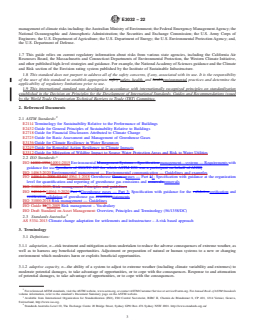
1.7 This guide relies on current regulatory information about risks from various state agencies, including the California Air
Resources Board, the Massachusetts and Connecticut Departments of Environmental Protection, the Western Climate Initiative,
and other published high-level strategies and guidance. For example, the National Academy of Sciences guidance and the Climate
and Risk section of the Envision rating system published by the Institute of Sustainable Infrastructure.
1.8 This standard does not purport to address all of the safety concerns, if any, associated with its use. It is the responsibility
of the user of this standard to establish appropriate safety safety, health, and healthenvironmental practices and determine the
applicability of regulatory limitations prior to use.
1.9 This international standard was developed in accordance with internationally recognized principles on standardization
established in the Decision on Principles for the Development of International Standards, Guides and Recommendations issued
by the World Trade Organization Technical Barriers to Trade (TBT) Committee.
2. Referenced Documents
2.1 ASTM Standards:
E2114 Terminology for Sustainability Relative to the Performance of Buildings
E2432 Guide for General Principles of Sustainability Relative to Buildings
E2718 Guide for Financial Disclosures Attributed to Climate Change
E2725 Guide for Basic Assessment and Management of Greenhouse Gases
E3136 Guide for Climate Resiliency in Water Resources
E3249 Guide for Remedial Action Resiliency to Climate Impacts
E3312 Guide for Mitigation of Wildfire Impact to Source Water Protection Areas and Risk to Water Utilities
2.2 ISO Standards:
ISO 14001:199614001:2015 Environmental Management Systems – Specification management—systems — Requirements with
guidance for use [products of ISO/TC 207 for which ASTM E50 was a participant on behalf of ANSI]
ISO 14063:2020 Environmental management — Environmental communication — Guidelines and examples
ISO 14064-1: 2006-03-0114064-1:2018 Greenhouse Gases –gases — Part 11: Specification with guidance at the organization
level for quantification and reporting of greenhouse gas emissions and removals.removals
ISO 31000:2009, Risk management Principles and guidelines
ISO 14064-3:14064-3:2020 Part 3Greenhouse gases — Part 3: Specification with guidance for the validationverification and
verificationvalidation of greenhouse gas assertionsstatements
ISO 31000:2018 Risk management — Guidelines
ISO Guide 7373:2009 Risk management – Vocabulary
ISO Draft Standard on Asset Management: Overview, Principles and Terminology (56/1358/DC)
2.3 Standards Australia:
AS 5334-2013 Climate change adaptation for settlements and infrastructure – A risk based approach
3. Terminology
3.1 Definitions:
3.1.1 adaptation, n—risk treatment and mitigation actions undertaken to reduce the adverse consequences of extreme weather, as
well as to harness any beneficial opportunities. Adjustment or preparation of natural or human systems to a new or changing
environment which moderates harm or exploits beneficial opportunities.
3.1.2 adaptive capacity, n—the ability of a system to adjust to extreme weather (including climate variability and extremes) to
moderate potential damages, to take advantage of opportunities, or to cope with the consequences. Response to and attenuation
of potential damages, to take advantage of opportunities, or to cope with the consequences.
For referenced ASTM standards, visit the ASTM website, www.astm.org, or contact ASTM Customer Service at service@astm.org. For Annual Book of ASTM Standards
volume information, refer to the standard’s Document Summary page on the ASTM website.
Available from International Organization for Standardization (ISO), ISO Central Secretariat, BIBC II, Chemin de Blandonnet 8, CP 401, 1214 Vernier, Geneva,
Switzerland, http://www.iso.org.
Standards Australia Level 10, The Exchange Centre 20 Bridge Street, Sydney GPO Box 476 Sydney NSW 2001. http://www.standards.org.au/
E3032 − 22
3.1.3 climate, n—the average and range of weather conditions in an area. More rigorously, the statistical description in terms of
the mean and variability of relevant weather parameters over a period of time long enough to ensure representative values for a
month or season. These parameters are most often surface variables such as temperature, humidity, air pressure, precipitation, and
wind.
3.1.4 contingency plan, n—any plan of action that allows an organization to respond to events should they occur, includes all plans
that deal with stabilization, continuity of critical business functions and recovery, sometimes called a ‘business continuity plan’.
3.1.5 drought risk, n—rating systems of USDA to determine appropriate planting, harvesting and water conservation activities,
based upon region and expected weather events.
3.1.6 ecosystem, n—any natural unit or entity including living and non-living parts that interact to produce a system through cyclic
exchange of materials and energy.
3.1.7 extreme temperature risk, n—rating systems for vulnerability, especially to high temperatures in urban heat sink areas.
3.1.8 extreme weather, n—significant change in physical, climactic events lasting for an extended period of time. Includes major
changes in storm frequency, duration or intensity; temperature; precipitation patterns; or wind patterns, among others, that occur
over several decades or longer.
3.1.9 fire risk, n—various rating systems to determine how likely a fire is, given weather and wind conditions. The National Fire
Protection Association has a rating system
3.1.10 flood risk, n—various rating systems to determine the flood zone associated with flooding and water damage. Rating system
terminology includes various flood zones as defined by FEMA and State agencies for rainfall and tidal events. This can include
the 5, 10, 25, 50,100 and 500 year events). The 100-Year flood level and floodplain are the typical standard to define severe flood
levels and flood extent. The 100 year event risk is also defined as a one-in-100 or 1% likelihood of occurring in any given year.
3.1.11 green buildings, n—as defined in ASTM E2114, Standard Terminology Relative to the Performance of Buildings and
E2432, Guide for General Principles of Sustainability Relative to Buildings
3.1.12 green roof, n—construction of water retaining and heat lowering materials, especially plants, on the roofs of buildings to
address storm-water flooding, extreme temperatures, and energy conservation. This includes systems with assemblies that support
an area of planting/landscaping, built up on a waterproofed substrate at any level that is separated from the natural ground by a
human-made structure. Also defined in Guide E2432.
3.1.13 extreme weather event, n—phenomena such as tropical storms, hurricanes, typhoons, nor’easters, blizzards, hail storms and
floods. These phenomena are at the extremes of the historical distribution, including especially severe or unseasonal conditions.
3.1.14 extreme conditions, n—trends in climate and weather, over the long term that result in substantial impacts to the local built
and natural environment, including financial impacts.
3.1.15 land movement, n—a threat to urban or natural systems expressed in terms of the combination of their likelihood of
occurrence and their consequences. This includes soil accretion, erosion, subsidence, landslides, and uplifts.
3.1.16 mitigation, n—attempts to lower or compensate for risks from weather/climate related events including flood, fire, drought,
extreme temperature, sea-level rise and storms.
3.1.17 natural variability, n—variations in the mean state and other statistics (such as standard deviations or statistics of extremes)
of the climate on all time and space scales beyond that of individual weather events. Natural variations in climate over time are
caused by internal processes of the climate system, such as El Niño or La Nina, as well as changes in external influences, such
as volcanic activity and variations in the output of the sun.
E3032 − 22
3.1.18 relative sea level rise, n—the increase in ocean water levels at a specific location, taking into account both global and local
factors, such as glacial ice melt (from land and in sea, with land melt having greater relative impact), local subsidence, thermal
expansion, and/or continental uplift or subduction Measured with respect to a specified vertical datum relative to the land, which
may also be changing elevation over time. Can include evaluation of flood risk to coastal areas, generally associated with flood
insurance ratings and maps.
3.1.19 resilience, n—adaptive capacity of an organization in a complex and changing environment. A capability to anticipate,
prepare for, respond to, and recover from significant multi-hazard threats with minimum damage to social well-being, the economy,
and the environment.
3.1.20 scenarios, n—a plausible and often simplified description of how the future may develop based on a coherent and internally
consistent set of assumptions about driving forces and key relationships.
3.1.21 sensitivity, n—the degree to which a system is affected, either adversely or beneficially, by climate variability or change.
The effect may be direct (for example, a change in crop yield in response to a change in the mean, range or variability of
temperature) or indirect (for example, damages caused by an increase in the frequency of coastal flooding due to sea level rise).
3.1.22 storm risk, n—rating systems for the likelihood of impacts from rainfall, snow, hail or wind from rainfall events, hurricanes
and tropical storms, Nor’easters, tornadoes, blizzards and other types of storms. Can include surges or abnormal rise in sea level
accompanying a hurricane, tropical storm, or other intense storm, whose height is the difference between the observed level of the
sea surface and the level that would have occurred in the absence of the storm or hurricane.
3.1.23 subsiding/subsidence, n—the downward settling of soil layers and/or rock in the Earth’s crust relative to its surroundings.
3.1.24 thermal expansion, n—the increase in volume (and decrease in density) that results from warming water. A warming of the
ocean leads to an expansion of the ocean volume, which leads to an increase in sea level.
3.1.25 tidal effects, n—rising seas, extreme water levels, storm surges, rising sea levels, and frequent tidal events, from hurricanes,
tropical storms, typhoons, and Nor’Easters
3.1.26 vulnerability, n—the degree to which a system is susceptible to, or unable to cope with, adverse effects of extreme weather,
including climate variability and extremes. Vulnerability is a function of the character, magnitude, and rate of climate variation to
which a system is exposed; its sensitivity; and its adaptive capacity.
3.1.27 weather, n—atmospheric condition at any given time or place. It is measured in terms of such parameters as wind,
temperature, humidity, atmospheric pressure, cloudiness, and precipitation. In most places, weather can change from hour-to-hour,
day-to-day, and season-to-season. Climate in a narrow sense is usually defined as the "average weather", or more rigorously, as
the statistical description in terms of the mean and variability of relevant quantities over a period of time ranging from months to
thousands or millions of years. These quantities are most often surface variables such as temperature, precipitation, and wind.
Climate in a wider sense is the state, including a statistical description, of the climate system. [A simple way of remembering the
difference is that climate is what you expect (for example, cold winters) and ’weather’ is what you get (for example, a blizzard).]
4. Significance and Use
4.1 The Use of this Standard Guide—This guide addresses issues related solely to adaptation strategies and development of a plan
to address extreme weather and related physical changes. This guide does not include specific guidance on risk assessment,
however references are provided in Appendix X3. The matrix approach does reflect general risks for certain regions of the country,
based upon the frequency of extreme weather and/or conditions such as fires, floods, storms, drought, and extreme temperatures.
Adaptation strategies and planning may consist of a wide variety of actions by an individual, community, or organization to prepare
for, or respond to, the impacts of extreme weather.
4.1.1 This guide does not address causes of extreme weather.
4.1.2 This guide addresses adjustment strategies and planning that a group of people or ecosystems make to limit negative effects
of extreme weather. It also addresses taking advantage of opportunities that long term extreme weather patterns may present.
E3032 − 22
4.2 Example Users:
4.2.1 Small businesses or enterprises;
4.2.2 Service industries;
4.2.3 Federal, state or municipal facilities and regulators, including departments of health and fire departments;
4.2.4 Financial and insurance institutions;
4.2.5 Public works staff, including water system, stormwater system, wastewater system, solid waste, and other utilities (electrical,
telephone, gas, et al) and other waste managers, including liquid and solid waste haulers, treatment, recycling, disposal and
transfer;
4.2.6 Consultants, auditors, state, municipal and private inspectors and compliance assistance personnel;
4.2.7 Educational facilities;
4.2.8 Property, buildings and grounds management, including landscaping;
4.2.9 Non-regulatory government agencies, such as the military;
4.2.10 Wildlife management entities including government, tribal and NGOs.
4.3 This guide is a first step in crafting simplified goals for managing and communicating risks. The framework describes a process
by which the user may categorize current climate risks and a priority approach to manage those risks. The technique classifies
common responses for both mitigation and adaptation. The guide groups responses and examples into regions based on experience
in responding to risks. The regional classifications found in this guide reflect the general structures of State, Federal and local
response programs. These authorities generally classify groups of similar responses according to the timely availability and cost
effectiveness of responses.responses (see ISO 14063:2020).
4.3.1 Adaptation strategies and planning may include actions by individuals and communities, for example, from reduced tree
clearing for an individual lot, to a farmer planting more drought-resistant crops, or to a municipality protecting riparian and
floodplain standards and buffers or ensuring that new coastal infrastructure can accommodate future sea level rise. However,
building resilience across communities will require action at all levels; individual, business, town, county, state, and federal.
4.3.2 Some municipalities, for example Boston, Miami Beach, and Baltimore, corporate entities, and organizations have already
begun taking action toward defining adaptation strategies and planning for extreme weather.
4.3.3 In an increasingly interdependent world, negative effects of extreme weather on one population or economic sector may have
repercussions around the world. These effects have repercussions on populations and settlements in neighboring areas, within
countries, or across the globe. They include economic disruption to productivity and the supply-chain, impacts to energy
production and cascading impacts to users.
4.3.4 Many ecosystems will also be affected by extreme weather challenges and opportunities. Some species may be able to
migrate or change their behavior to accommodate changes in the weather. Other species may decline or become extinct. Some
species may increase in numbers. Managers of natural resources may anticipate some of the impacts of extreme weather on
ecosystems. This offers one avenue in beginning to develop management programs that may help ecosystems adapt.
4.3.5 There are limits to the ability of human systems to adapt. For example, the relocation of cities and various communities or
infrastructure may not be feasible in many locations, especially in a short period of time. Implementation timeframes could take
20, 50 and 100 years or longer.
4.3.6 Those communities or sections of communities that are most vulnerable, such as locations where the poor, disengaged,
elderly or those in ill health live, are at greatest risk. Extreme weather may exacerbate existing issues. Addressing underlying issues
that make communities or systems vulnerable will increase their resilience and support adaptation efforts.
E3032 − 22
4.3.7 The user should consider the most effective scale of adaptation, for example, site, town, catchment, watershed, City, State,
or regional level. The scale will impact the relative direct and indirect costs and benefits of a solution. The guide may help users
understand the most effective scale of adaptation and the appropriate level of action.
4.4 This guide defines good commercial and customary practice in the U.S. for conducting baseline assessment and reasonable
mitigation/adaptation strategic options on a voluntary basis. The following principles apply to this priority system:
4.4.1 Ability to set specific goals for activities. This includes adopting a contingency plan for protection from weather related
events using engineering changes while maintaining current operations. This includes “flood-proofing” “fire-proofing,” back-up
energy generation, vegetation management around power lines and other measures to cope with extreme weather.
4.4.2 Marketing environmental awareness and sensitivity;
4.4.3 Assessing risks from future weather related events and extreme conditions. A compendium of applicable risk assessment
tools that users may find useful are in Appendix X1.
4.4.4 Risk management, underwriting; loss control and history; premiums and claims;
4.4.5 Liability assessment and qualifications for loans;
4.4.6 Standardization, consistency and certification of facility specific evaluations;
4.4.7 Educating employees, clients and customers;
4.4.8 Generating multi media and cross medium information;
4.4.9 Evaluating vendors;
4.4.10 Reducing costs and preventing pollution.
4.5 Users may consider various benefits of assessment and response.
4.5.1 This guide is a basic primer on climate impacts and may serve to introduce the subject for organizations unfamiliar with the
principles.
4.5.2 Some government agencies, fiduciaries and business organizations publish strategies for climate resiliency. The public has
systematic ability to access or estimate information on individual businesses. Therefore, businesses need guidance on how to assess
the nature and potential risks of climate risks, and a programmatic approach for reducing or eliminating those risks through
protection, accommodation, retreat, and other proactive management systems.
4.5.3 Reduced operation, insurance and maintenance costs may be realized through a tiered evaluation of weather related response
opportunities.
4.5.4 Responses may be streamlined and simplified so that all levels in an organization may participate.
4.5.5 Some enterprises may be more competitive in the marketplace with improved climate-related response programs.
4.5.6 Setting priorities can allow planning and evaluation of new adaptation and response requirements.
4.5.7 Different stakeholders, such as industries or governments, will have different interests and responsibilities for taking action.
For example, retreat and relocation of populations will fall under the government scope rather than industry.
4.6 Institutional Risks—Some of the risks posed by weather related events include damage to residences, businesses, infrastructure
and agriculture from fires, floods, drought, extreme temperature, storms, hail, winds, tidal surge and sea level rise. Early, voluntary
actions, including the use of this guide, may also help organizations prepare for and reduce the impacts of future government
regulations. Some of the possible government programs that may be used to address climate are described below.
E3032 − 22
4.6.1 Flood Insurance Maps;
4.6.2 Water conservation requirements;
4.6.3 Fire codes;
4.6.4 Emergency response;
4.6.5 Zoning regulations;
4.6.6 Building codes;
4.6.7 Wetlands and stream buffer regulations;
4.6.8 Stormwater standards and regulations for floodplains and floodways, planning, development requirements, and infrastructure
design (MS4, flood control systems, floodplains and floodways);
4.6.9 Public Works Projects;
4.6.10 Hazard Mitigation Planning.
4.7 Managing Risk Uncertainty:
4.7.1 It appears that weather extremes will continue to present risks and uncertainty as to the effects they will have in different
regions. The ability to predict future weather related risks has improved, but efforts to understand the complete impact of those
risks on society and analyze mitigation and adaptation strategies are still relatively immature.
4.7.2 The tiered analysis in this guide will help support decision-making, studying regional impacts, and communicating with
wider group of stakeholders in the face of uncertainty.
4.7.3 The insurance industry has always played a role in risk management by insuring weather related risks, promoting stronger
building codes, and better land-use decision-making.
5. Risk Management
5.1 This guide establishes a framework of common, climate risk management strategies in the United States. The same planning
principles could be applied in other countries, depending upon priorities associated with climate risks. This general guide will allow
the user to evaluate the category of risk from extreme weather related issues. Responses would then be evaluated for timeliness
and availability in order to continually reduce the risks.
5.2 This guide outlines adaptation strategies and planning steps that may be taken to prepare for, and respond to, the impacts of
extreme weather. The guide addresses a series of adaptation and planning options for managing environmental and human risks
associated with extreme weather. The guide addresses potential ways to approach managing risks. This may include adoption of
regional priorities for adaptation. Strategies for preparedness for a weather event may be different than reactions to post-extreme
weather events.
5.3 Extreme weather may pose a risk or threat to businesses and properties. For example, variations in air temperatures over land
masses or ocean temperatures could directly and indirectly affect ecosystems, humans, and the economy. In some areas, there could
be regional increases in the form of more pronounced heat waves and heavy precipitation events, which exceed the levels expected
from standard variability.
5.4 Extreme weather might yield economic damages in the form of flood and storm damage, crop losses, wildfire losses, supply
chain disruptions and critical infrastructure outages. This guide addresses adaptation strategies and plans, taking a measured
approach to promote effective risk management strategies.
5.5 This guide does not address the uncertainty of unpredictable and severe weather events. This guide does not address
E3032 − 22
connections between impacts of rising temperatures and extreme events or the probability of the rate of increase of these events.
However, this guide does discuss options for addressing vulnerabilities to the impacts of extreme weather and natural catastrophes.
5.6 Procedure for Planning A Strategy—A plan of adaptation to extreme weather should educate groups, businesses and
individuals to reduce risks, and build safety restraints into their activities, increasing resiliency. The development of a strategy, and
application of this guide, may be approached from a starting point of having determined the priority risks that need to be addressed
(for example, through a risk assessment). Alternatively, if a risk assessment has not been undertaken, the approach outlined in Fig.
1 may be applied starting with identifying the relevant region (that is geography). For example there are eight regions shown in
Fig. 2.
5.6.1 If the regional approach is followed, the user first decides on the appropriate regions for planning, selecting from one of eight
regions of the United States. Certain areas of Canada adjacent to the Northeast, the Midwest, the Great Plains or the Northwest
may benefit from this regional organization of the guide. Certain areas of Mexico adjacent to the Southwest or Great Plains may
also benefit from guide use.
5.6.2 The priority areas of concern are shown in Table 1, based upon the selected region. There may be other priority areas, based
upon local conditions and state by state priorities. Flash floods from rivers and streams are examples of local conditions requiring
priority planning, in addition to regional priorities.
5.6.3 Priority areas of concern may also be based on previous, climate related, catastrophic events. The areas of New York, Long
Island and New Jersey impacted by Hurricane Sandy are examples.
5.6.4 Categories of actions include adaptation, protection and retreat and are shown in Table 2.
5.7 Building a strategy or plan of adaptation to extreme weather educates groups, businesses and individuals to reduce risks, and
build safety restraints into their activities, increasing resiliency. Broad examples of strategy or plan elements include, but are not
limited to:
5.7.1 Putting in place a group to understand, coordinate and reduce disaster risk based on participation of multiple parties,
including local alliances.
5.7.2 For businesses, climate adaptation goals in employee job descriptions, especially in key geographies in an enterprise, or in
operations and supply chain.
5.7.3 Establishing a cross-function climate adaptation working group with connections to local or regional organizations.
FIG. 1 Procedure for Adaptation Planning Strategy Development
E3032 − 22
FIG. 2 National Climate Assessment Regions (National Climate Assessment, 2014)
TABLE 1 Example Regional Climate Adaptation Priorities
NOTE 1—Table 1 provides a regional overview of adaptation priorities. The lack of a ‘*’ does not indicate that other climate risks will not occur in
a region. In addition, specific risks and adaptation priorities may differ within a region, at the local or site specific scale.
Storms
Land Movement
Extreme (wind straight line
Subsidence Sea Rise and
Region Temperature Drought Fire Flood and tornadic and
(uplifts and Tidal Effects
(hot or cold) snow hail, sleet
landslides)
and ice)
1 Northeast * * * *
2 Southeast and
* * * *
Caribbean
3 Midwest * * * *
4 Great Plains * * * * *
5 Southwest * * * *
6 Northwest * * * *
7 Alaska * * * *
8 Hawaii * * *
5.7.4 Setting a budget and providing the necessary resources for proactive adaptation.
5.7.5 Collaborating with neighboring businesses and supply chain partners on climate adaptation planning and execution.
5.7.6 All parties understand their role regarding adaptation that requires disaster risk reduction and preparedness.
5.7.7 Making up-to-date information and plans readily available. Plans and strategies to cope with extreme weather could be
integrated into an existing Environmental Management System or Disaster Response Plan. Plan (see Guide E3249, ISO
14001:2015 and ISO 31000:2018). Plan updates should include training for those responsible for response to extreme weather
events.
5.7.8 Planning to maintain critical evacuation and supply routes, access (for police, fire, medical, and other emergency
responders), and infrastructure (water, sewer, stormwater, communications, hospitals, shelters, power with backup generators,
airports, rail lines, et al) that reduce risk, adjusted where needed to cope with extreme weather.
5.7.9 Assessment of the safety of nearby facilities that support disaster response efforts (for example, schools and health facilities)
and upgrading the plan as necessary.
E3032 − 22
TABLE 2 Category of Responses to Example Climate Events
Adaptation Risk Category 1: Accommodation Category 2: Protection Category 3: Retreat/Relocate
Category
Extreme Temperature Build green roofs, conserve water, and add Add insulation and energy efficient Move residences and buildings
plantings and landscape to increase shade windows to buildings Provide into more temperate areas;
and oxygen. emergency generators for including underground zones for
temperature control centers to geothermal temperature control.
address extremes.
Drought Conservation. Plant alternative crops or Integrated water resource programs Move crops, livestock and resi-
drought resistant crops. Underground water for stormwater and “wastewater”. dences from risk areas. Provide
storage. Recycle of existing water supplies. Reservoirs. Aquifer recharge and un- for technology that uses less wa-
(See Guide E3312.) derground water storage. Water re- ter or hydroponic growth with re-
taining soil amendments. Provide cycled water.
emergency water supplies. (See
Guide E3136.)
Fire Construct firebreaks, and fire-fighting sta- Fire resistant coatings; Stronger Move residences out of high risk
tions. Water storage in potential fire areas. regulations and oversight in areas of areas. Realign development to
Low occupancy development. Controlled concern (man-made fires). Water provide for fire line and reduced
burns. Strategic logging to thin out forests storage in potential fire areas. (See spread. Redesign structure to in-
near residential areas. Guide E3312.) clude fire protective natural infra-
structure (soil external covering).
Flood Free-board buildings. Sumps and tunnels to Build seawalls barrier islands and Remove, relocate or raze vulner-
move water away from buildings. Pumping dunes. Provide run-off structures to able buildings and infrastructure.
stations and infrastructure control manage flooding and provide water Replace and restore floodplains,
measures, including bridges, culverts, storm storage, retention and detention. wetlands and natural channels.
water systems; and run-off controls using Redesign development to retreat
natural systems. from flood zones and sea impact
areas. Use natural designs to re-
duce inward flow of waters.
Storms include Emergency Response and shelter plans. Upgrade building codes for windows, Include development plans with
straight-line and tor- Upgrade buildings, including windows, doors, roofs, insulation and other cooperative energy provisions;
nadic winds, hail and doors, roofs, insulation and other building building features. Address energy Design or redesign occupied ar-
ice features. Provide supportive energy sys- issues with backup structures. eas to address main impacts from
tems. Address ice and wind damage issues. storms.
Land Movement in- Upgrade building and community designs to Build retaining structures and run-off Move residences out of high risk
cludes subsidence address structural and emergency issues structures to reduce erosional areas. areas. Provide for free board ar-
(increase strength of buildings and escape Provide for green space to eas if slope failure occurs.
routes). strengthen slope stability.
Sea Rise and Tidal Free-board buildings away from main im- Build seawalls, retaining structures, Remove relocate or raze occupied
Effects pact tidal zones. Sumps and water tunnels levees and protective sea/flood walls. structures from high risk areas.
to move water away from buildings. Pump- Provide run-off and storage struc- Provide natural run-off storage
ing stations and infrastructure control tures. Address beach erosional is- and protective structures in de-
measures, along with riparian zones to ad- sues through restoration of barrier signs. Redesign development to
dress impacts. islands and dunes. Repair, upgrade retreat from tidal erosional zones
and maintain locks and other struc- and tidal impact areas. Use natu-
tures to control surge for navigation ral designs to reduce inward flow
channels and ports. of waters and sea impacts.
5.7.10 Definitions for realistic, risk-compliant building guidance and land-use planning.
5.7.11 Education programs and training on disaster risk reduction at facilities that support disaster response efforts (for example,
schools and local communities).
5.7.12 Protecting specific ecosystems and natural buffers to mitigate floods, storm surges and other hazards to which participant(s)
are vulnerable.
5.7.13 Periodic updates and refinements of the plan and effective risk-reduction practices.
5.7.14 Installing early warning systems and emergency management capacities in your group and hold regular public preparedness
drills.
5.7.15 Post disaster needs assessment of survivors to guide reconstruction, with support from community organizations. Design
and help implement responses, including rebuilding homes and livelihoods.
5.7.16 Reassessment procedures in plans to determine issues or problems which require evaluation of current processes and
revisions to ensure better adaptive strategies in the future. This is an iterative process for continual improvement.
5.8 Financial and Schedule Considerations—Users should evaluate and compare life cycle (capital, operation, and maintenance)
E3032 − 22
costs and benefits of the different actions to mitigate categories of risk management. This includes the time of implementation and
planning horizon. Users may pursue one or more categories of management risks simultaneously.
5.8.1 The user should identify the priority planning areas, based upon the overall region. Fig. 2 shows general regions of the
country. Table 1 shows some priority planning subjects, based upon region.
5.8.2 An initial risk assessment of the community or specific area will determine the highest vulnerabilities to climate related
events. Then the user should also identify conventional, short-term, measures recommended for the region, including emergency
response plans for initial response to events.
5.8.3 The National Climate Assessment Report (see U.S. Global Change Reserch Program National Climate Assessment, 2014)
addresses seven sectors: human health; water, energy; transportation; agriculture, forests and ecosystems. The user may set
priorities for adaptation in the local area according to the most important or urgent sectors.
5.9 Management Categories:
5.9.1 Category 1 responses address weather-related risk reduction through the development and use of accommodation or
alternative engineering. This means adapting the built environment through structural modifications and agricultural practices such
as forestation or construction of green roofs, “free-boarding” of structures and equipment above new flood levels, or water storage.
The planning horizon generally includes actions that can be taken within a two-year timeframe.
5.9.2 Category 2 protective responses that prevent damage from extreme weather related events, such as fire-resistant coatings,
creation of wetlands and structural barriers to protect structures from damage. These actions may prevent business risk impacts
by providing immediate cost savings and lowering a facility’s risk profile relative to the potential damage. The planning horizon
includes actions that the user can take within a ten-year time-frame.
5.9.3 Category 3 responses address long-term preparation for the most extreme weather relat
...