

ASTM A499-15(2020)
(Specification)Standard Specification for Steel Bars and Shapes, Carbon Rolled from “T” Rails
General Information
- Abstract
ABSTRACT
This specification covers the standard for carbon steel bars and shapes rolled from standard rail steel. The material shall be hot wrought from section “T” rails and shall be produced by hot forming slit railroad rail parts to yield straight lengths. One tension test and one hardness test shall be performed from each lot to determine the mechanical properties and shall conform to the requirement in tensile strength, elongation, Brinell hardness, and Rockwell B hardness.
SCOPE
1.1 This specification covers carbon steel bars and shapes produced from standard rail steel. These bars are furnished in the as-wrought condition intended for structural use, or bar and shape uses, where high tensile properties are applicable. These materials are available in four strength levels as Grade 50, Grade 60, Grade 70, and Grade 80.
1.2 The values stated in inch-pound units are to be regarded as standard. The values given in parentheses are mathematical conversions to SI units that are provided for information only and are not considered standard.
1.3 This international standard was developed in accordance with internationally recognized principles on standardization established in the Decision on Principles for the Development of International Standards, Guides and Recommendations issued by the World Trade Organization Technical Barriers to Trade (TBT) Committee.
- Status
- Published
- Publication Date
- 31-Aug-2020
- Technical Committee
- A01 - Steel, Stainless Steel and Related Alloys
- Drafting Committee
- A01.15 - Bars

Overview
ASTM A499-15(2020) is the internationally recognized standard specification for carbon steel bars and shapes rolled from “T” rails. Developed by ASTM International, this standard details the requirements for hot-wrought carbon steel bars and shapes manufactured by hot forming slit sections of standard rail steel, primarily intended for structural and high-strength bar applications. The material covered by this standard is supplied in the as-wrought condition and comes in four designated strength grades: Grade 50, Grade 60, Grade 70, and Grade 80.
Key Topics
Scope and Coverage
- Carbon steel bars and shapes produced from standard “T” rail steel.
- Available in a variety of cross-sections: rounds, squares, flats, angles, tees, channels, hexagons, octagons, ovals, diamonds, I-beams, U-bars, and channeled flats.
- Supplied in specified cut lengths or ranges of random lengths.
Grades and Mechanical Properties
- Four strength levels: Grade 50, 60, 70, and 80.
- Mechanical test requirements include minimum tensile strength, yield point, elongation, Brinell hardness, and Rockwell B hardness.
- One tension test or one hardness test per lot is standard.
Sizes and Tolerances
- Detailed permissible variations for dimensions, straightness, and cross-sectional geometry.
- Dimensional tolerances are agreed upon per section and size between manufacturer and purchaser.
Testing and Certification
- Materials must conform to mechanical property requirements via standardized testing.
- Manufacturer’s certification and test report are provided upon request.
Ordering and Identification
- Orders should specify quantity, grade, dimensions, cross-section, and end use.
- Must reference ASTM designation and issue date.
Applications
ASTM A499 steel bars and shapes have numerous practical applications in construction, transportation, and manufacturing, where high-strength carbon steel is essential:
Structural Applications
- Utilized in infrastructure and building frameworks requiring strong, durable materials.
- Suitable as structural support members in bridges, buildings, and other civil engineering projects.
Bar and Shape Uses
- Fabrication of custom supports, braces, and reinforcement parts in industrial settings.
- Used in machinery, equipment manufacturing, and agricultural implements where high tensile strength is critical.
Rail Recycling
- Especially valuable for repurposing rail steel, providing a sustainable solution for high-strength steel production.
Related Standards
For users and engineers working with carbon steel bars and related products, the following ASTM standards provide additional guidance:
- ASTM A1 - Specification for Carbon Steel Tee Rails
(reference for chemical composition of “T” rails) - ASTM A29/A29M - General Requirements for Steel Bars, Carbon and Alloy, Hot-Wrought
(covers general requirements applicable to steel bars) - ASTM A370 - Test Methods and Definitions for Mechanical Testing of Steel Products
(mandatory methods for mechanical property tests)
Practical Value
Adherence to ASTM A499-15(2020) ensures consistency and reliability in the production of steel bars and shapes from recycled rail steel, allowing manufacturers and end users to achieve efficient, cost-effective, and sustainable solutions for high-stress steel applications. This standard is recognized by the U.S. Department of Defense and aligns with international trade principles, supporting both domestic and global infrastructure needs.
Keywords: ASTM A499, steel bars, carbon steel shapes, rail steel, structural steel, tensile strength, ASTM standard, recycled rail, high-strength steel, mechanical properties, construction steel, bar shapes.
Relations
- Effective Date
- 01-Sep-2020
- Effective Date
- 01-Mar-2024
- Effective Date
- 01-Jul-2019
- Effective Date
- 01-Mar-2018
- Refers
ASTM A370-17a - Standard Test Methods and Definitions for Mechanical Testing of Steel Products - Effective Date
- 15-Nov-2017
- Effective Date
- 01-Jan-2017
- Effective Date
- 01-Nov-2015
- Effective Date
- 01-Nov-2015
- Effective Date
- 15-May-2014
- Effective Date
- 15-Nov-2013
- Refers
ASTM A370-12a - Standard Test Methods and Definitions for Mechanical Testing of Steel Products - Effective Date
- 15-Oct-2012
- Effective Date
- 01-May-2012
- Effective Date
- 01-May-2012
- Effective Date
- 15-Mar-2012
- Refers
ASTM A370-11a - Standard Test Methods and Definitions for Mechanical Testing of Steel Products - Effective Date
- 15-Nov-2011
Get Certified
Connect with accredited certification bodies for this standard

Element Materials Technology
Materials testing and product certification.

Inštitut za kovinske materiale in tehnologije
Institute of Metals and Technology. Materials testing, metallurgical analysis, NDT.
Sponsored listings
Frequently Asked Questions
ASTM A499-15(2020) is a technical specification published by ASTM International. Its full title is "Standard Specification for Steel Bars and Shapes, Carbon Rolled from “T” Rails". This standard covers: ABSTRACT This specification covers the standard for carbon steel bars and shapes rolled from standard rail steel. The material shall be hot wrought from section “T” rails and shall be produced by hot forming slit railroad rail parts to yield straight lengths. One tension test and one hardness test shall be performed from each lot to determine the mechanical properties and shall conform to the requirement in tensile strength, elongation, Brinell hardness, and Rockwell B hardness. SCOPE 1.1 This specification covers carbon steel bars and shapes produced from standard rail steel. These bars are furnished in the as-wrought condition intended for structural use, or bar and shape uses, where high tensile properties are applicable. These materials are available in four strength levels as Grade 50, Grade 60, Grade 70, and Grade 80. 1.2 The values stated in inch-pound units are to be regarded as standard. The values given in parentheses are mathematical conversions to SI units that are provided for information only and are not considered standard. 1.3 This international standard was developed in accordance with internationally recognized principles on standardization established in the Decision on Principles for the Development of International Standards, Guides and Recommendations issued by the World Trade Organization Technical Barriers to Trade (TBT) Committee.
ABSTRACT This specification covers the standard for carbon steel bars and shapes rolled from standard rail steel. The material shall be hot wrought from section “T” rails and shall be produced by hot forming slit railroad rail parts to yield straight lengths. One tension test and one hardness test shall be performed from each lot to determine the mechanical properties and shall conform to the requirement in tensile strength, elongation, Brinell hardness, and Rockwell B hardness. SCOPE 1.1 This specification covers carbon steel bars and shapes produced from standard rail steel. These bars are furnished in the as-wrought condition intended for structural use, or bar and shape uses, where high tensile properties are applicable. These materials are available in four strength levels as Grade 50, Grade 60, Grade 70, and Grade 80. 1.2 The values stated in inch-pound units are to be regarded as standard. The values given in parentheses are mathematical conversions to SI units that are provided for information only and are not considered standard. 1.3 This international standard was developed in accordance with internationally recognized principles on standardization established in the Decision on Principles for the Development of International Standards, Guides and Recommendations issued by the World Trade Organization Technical Barriers to Trade (TBT) Committee.
ASTM A499-15(2020) is classified under the following ICS (International Classification for Standards) categories: 77.140.60 - Steel bars and rods; 77.140.70 - Steel profiles. The ICS classification helps identify the subject area and facilitates finding related standards.
ASTM A499-15(2020) has the following relationships with other standards: It is inter standard links to ASTM A499-15, ASTM A370-24, ASTM A370-19, ASTM A1-00(2018), ASTM A370-17a, ASTM A370-17, ASTM A29/A29M-15, ASTM A370-15, ASTM A370-14, ASTM A370-13, ASTM A370-12a, ASTM A29/A29M-12, ASTM A29/A29M-12e1, ASTM A370-12, ASTM A370-11a. Understanding these relationships helps ensure you are using the most current and applicable version of the standard.
ASTM A499-15(2020) is available in PDF format for immediate download after purchase. The document can be added to your cart and obtained through the secure checkout process. Digital delivery ensures instant access to the complete standard document.
Standards Content (Sample)
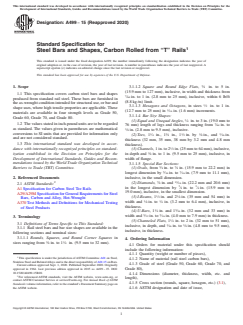
This international standard was developed in accordance with internationally recognized principles on standardization established in the Decision on Principles for the
Development of International Standards, Guides and Recommendations issued by the World Trade Organization Technical Barriers to Trade (TBT) Committee.
Designation:A499 −15 (Reapproved 2020)
Standard Specification for
Steel Bars and Shapes, Carbon Rolled from “T” Rails
This standard is issued under the fixed designation A499; the number immediately following the designation indicates the year of
original adoption or, in the case of revision, the year of last revision.Anumber in parentheses indicates the year of last reapproval.A
superscript epsilon (´) indicates an editorial change since the last revision or reapproval.
This standard has been approved for use by agencies of the U.S. Department of Defense.
1. Scope 3.1.1.2 Square and Round Edge Flats, ⁄8 in. to 5 in.
(15.9mm to 127 mm), inclusive, in width and thickness from
1.1 This specification covers carbon steel bars and shapes
⁄64in. to 1 in. (2.8 mm to 25 mm), inclusive, within 6 lb/ft
produced from standard rail steel. These bars are furnished in
(8.8kg⁄m) limit.
theas-wroughtconditionintendedforstructuraluse,orbarand
3.1.1.3 Hexagons and Octagons, in sizes ⁄2 in. to 1 in.
shape uses, where high tensile properties are applicable.These
(12.7 mm to 25 mm) in ⁄16 in. (1.6 mm) increments.
materials are available in four strength levels as Grade 50,
3.1.1.4 Bar Size Shapes:
Grade 60, Grade 70, and Grade 80.
(1) Equal and Unequal Angles, ⁄4 in. to 3 in. (19.0 mm to
1.2 The values stated in inch-pound units are to be regarded
76 mm) length of legs and thickness ranging from ⁄64in. to
as standard. The values given in parentheses are mathematical
⁄8in. (2.8 mm to 9.5 mm), inclusive.
conversions to SI units that are provided for information only
1 3 1 1 3
(2) Tees, 1 ⁄4 in., 1 ⁄8 in., 1 ⁄2in. by ⁄8in., and ⁄16in.
and are not considered standard.
thickness (32 mm, 35 mm, 38 mm by 3.2 mm and 4.8 mm
1.3 This international standard was developed in accor-
thickness).
dance with internationally recognized principles on standard- (3) Channels, 1 in. to 2 ⁄2in. (25 mm to 64 mm), inclusive,
ization established in the Decision on Principles for the
in depth and ⁄8in. to 1 in. (9.5 mm to 25 mm), inclusive, in
Development of International Standards, Guides and Recom- width of flange.
mendations issued by the World Trade Organization Technical
3.1.1.5 Special Bar Sections:
5 7
Barriers to Trade (TBT) Committee. (1) Ovals, from ⁄8in. to ⁄8in. (15.9 mm to 22.2 mm) in
5 7
longest dimension by ⁄16in. to ⁄16in. (7.9 mm to 11.1 mm),
2. Referenced Documents
inclusive, in the small dimension.
7 13
(2) Diamonds, ⁄8in. and ⁄16 in. (22.2 mm and 20.6 mm)
2.1 ASTM Standards:
5 3
in the longest dimension by ⁄8in. to ⁄4in. (15.9 mm to
A1Specification for Carbon Steel Tee Rails
19.0mm), inclusive, in the smallest dimension.
A29/A29MSpecificationforGeneralRequirementsforSteel
1 1
(3) I-Beams,1 ⁄2in. and 2 ⁄8in. (35 mm and 54 mm) in
Bars, Carbon and Alloy, Hot-Wrought
1 1
width and ⁄8in. to ⁄4 in. (3.2 mm to 6.4 mm), inclusive, in
A370Test Methods and Definitions for Mechanical Testing
thickness.
of Steel Products
1 5
(4) U-Bars,1 ⁄4in. and 1 ⁄16in. (32 mm and 33 mm) in
5 5
width and ⁄32in. to ⁄16in. (4.0 mm to 7.9 mm) in thickness.
3. Terminology
(5) Channeled Flats,1 ⁄4 in. to 2 in. (32 mm to 51 mm),
3.1 Definitions of Terms Specific to This Standard:
3 3
inclusive, in depth, and ⁄16in. to ⁄8in. (4.8 mm to 9.5 mm),
3.1.1 Rail steel bars and bar size shapes are available in the
inclusive, in thickness.
following sections and nominal sizes:
3.1.1.1 Rounds, Squares, and Round Corner Squares in
4. Ordering Information
3 1
sizes ranging from ⁄8in. to 1 ⁄4 in. (9.5 mm to 32 mm).
4.1 Orders for material under this specification should
include the following information:
4.1.1 Quantity (weight or number of pieces),
This specification is under the jurisdiction ofASTM Committee A01 on Steel,
4.1.2 Name of material (rail steel carbon bars),
StainlessSteelandRelatedAlloysandisthedirectresponsibilityofA01.15onBars.
4.1.3 Grade of steel (Grade 50, Grade 60, Grade 70, and
Current edition approved Sept. 1, 2020. Published September 2020. Originally
Grade 80),
approved in 1964. Last previous edition approved in 2015 as A499–15. DOI:
10.1520/A0499-15R20.
4.1.4 Dimensions (diameter, thickness, width, etc. and
For referenced ASTM standards, visit the ASTM website, www.astm.org, or
length),
contact ASTM Customer Service at service@astm.org. For Annual Book of ASTM
4.1.5 Cross section (rounds, square, hexagon, etc.) (3.1),
Standards volume information, refer to the standard’s Document Summary page on
the ASTM website. 4.1.6 ASTM designation and date of issue,
Copyright © ASTM International, 100 Barr Harbor Drive, PO Box C700, West Conshohocken, PA 19428-2959. United States
A499−15 (2020)
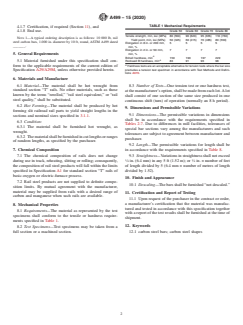
TABLE 1 Mechanical Requirements
4.1.7 Certification, if required (Section 11), and
4.1.8 End use. Grade 50 Grade 60 Grade 70 Grade 80
Tensile strength, min, ksi (MPa) 80 (550) 90 (620) 95 (655) 110 (760)
NOTE 1—A typical ordering description is as follows: 10 000 lb, rail
Yield point, min, ksi (MPa) 50 (345) 60 (415) 70 (485) 80 (550)
steel carbon bars, 1.000 in. diameter by 10 ft, round, ASTM A499 dated
Elongation in 8 in. or 200 mm,55 5 5
_______.
min, %
Elongation in 2 in. or 50 mm,77 7 7
min, %
5. General Requirements
A
Brinell hardness, min 159 190 197 229
A
5.1 Material furnished under this specification shall con- Rockwell B hardness, min 83 91 93 98
A
form to the applicable requirements of the current edition of
Hardness tests are an acceptable alternative for tension tests where the bar size
precludes a tension test specimen in accordance with Test Methods and Defini-
Specification A29/A29M, unless otherwise provided herein.
tions A370.
6. Materials and Manufacture
6.1 Material—The material shall be hot wrought from
8.3 Number of Tests—One tension test or one hardness test,
standard section “T” rails. No other materials, such as those
atthemanufacturer’soption,shallbemadefromeachlot.Alot
known by the terms “rerolled,” “rail steel equivalent,” or “rail
shall consist of one section of the same size produced in one
steel quality,” shall be substituted.
continuous shift (turn) of operation (normally an 8 h period).
6.2 Hot Forming—The material shall be produced by hot
9. Dimensions and Permissible Variations
forming slit railroad rail parts to yield straight lengths in the
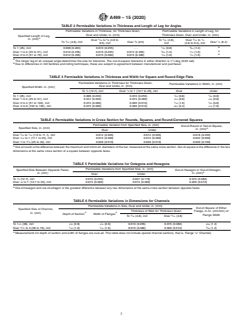
9.1 Dimensions—The permissible variations in dimensions
sections and nominal sizes specified in 3.1.1.
shall be in accordance with the requirements specified in
6.3 Condition:
Tables 2-7. Due to differences in mill facilities, tolerances of
6.3.1 The material shall be furnished hot wrought, as
special bar sections vary among the manufacturers and such
wrought.
tolerances are subject to agreement between manufacturer and
6.3.2 Thematerialshallbefurnishedincutlengthsorranges
purchaser.
of random lengths, as specified by the purchaser.
9.2 Length—The permissible variations for length shall be
7. Chemical Composition in accordance with the requirements specified in Table 8.
7.1 The chemical composition of rails does not change 9.3 Straightness—Variationsinstraightnessshallnotexceed
1 1
during use in track, reheating, slitting or rolling; consequently, ⁄4in. (6.4 mm) in any 5 ft (1.52 m); or ⁄4in.× number of feet
the composition of rail steel products will fall within the limits of length divided by 5 (6.4 mm × number of metres of length
specified in Specification A1 for standard section “T” rails of divided by 1.52).
basic-oxygen or el
...