

ASTM D5972-23
(Test Method)Standard Test Method for Freezing Point of Aviation Fuels (Automatic Phase Transition Method)
General Information
- Abstract
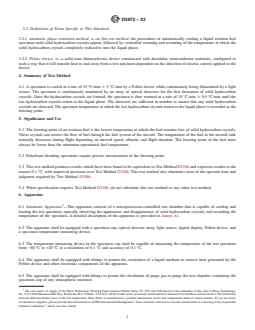
SIGNIFICANCE AND USE
5.1 The freezing point of an aviation fuel is the lowest temperature at which the fuel remains free of solid hydrocarbon crystals. These crystals can restrict the flow of fuel through the fuel system of the aircraft. The temperature of the fuel in the aircraft tank normally decreases during flight depending on aircraft speed, altitude, and flight duration. The freezing point of the fuel must always be lower than the minimum operational fuel temperature.
5.2 Petroleum blending operations require precise measurement of the freezing point.
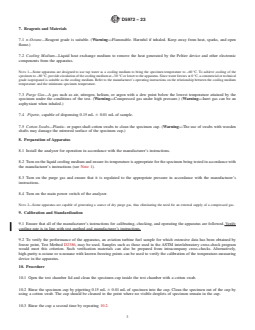
5.3 This test method produces results which have been found to be equivalent to Test Method D2386 and expresses results to the nearest 0.1 °C, with improved precision over Test Method D2386. This test method also eliminates most of the operator time and judgment required by Test Method D2386.
5.4 When specification requires Test Method D2386, do not substitute this test method or any other test method.
SCOPE
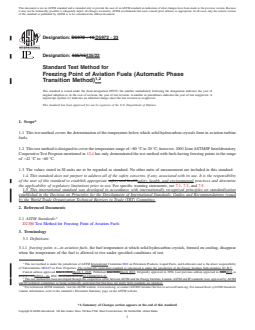
1.1 This test method covers the determination of the temperature below which solid hydrocarbon crystals form in aviation turbine fuels.
1.2 This test method is designed to cover the temperature range of −80 °C to 20 °C; however, 2003 Joint ASTM/IP Interlaboratory Cooperative Test Program mentioned in 12.4 has only demonstrated the test method with fuels having freezing points in the range of −42 °C to −60 °C.
1.3 The values stated in SI units are to be regarded as standard. No other units of measurement are included in this standard.
1.4 This standard does not purport to address all of the safety concerns, if any, associated with its use. It is the responsibility of the user of this standard to establish appropriate safety, health, and environmental practices and determine the applicability of regulatory limitations prior to use. For specific warning statements, see 7.1, 7.3, and 7.5.
1.5 This international standard was developed in accordance with internationally recognized principles on standardization established in the Decision on Principles for the Development of International Standards, Guides and Recommendations issued by the World Trade Organization Technical Barriers to Trade (TBT) Committee.
- Status
- Published
- Publication Date
- 28-Feb-2023
- Technical Committee
- D02 - Petroleum Products, Liquid Fuels, and Lubricants
- Drafting Committee
- D02.07 - Flow Properties
Buy Documents
ASTM D5972-23 - Standard Test Method for Freezing Point of Aviation Fuels (Automatic Phase Transition Method)<rangeref></rangeref >
REDLINE ASTM D5972-23 - Standard Test Method for Freezing Point of Aviation Fuels (Automatic Phase Transition Method)<rangeref></rangeref >
Overview
ASTM D5972-23: Standard Test Method for Freezing Point of Aviation Fuels (Automatic Phase Transition Method) establishes a precise, automated process for determining the freezing point of aviation turbine fuels. The freezing point signifies the lowest temperature at which a fuel remains free of solid hydrocarbon crystals-a critical quality parameter for aviation fuels, as the presence of crystals can restrict the flow through an aircraft’s fuel system during flight.
This method utilizes an automatic phase transition technique, which offers improved precision and reduced operator involvement compared to traditional manual methods. ASTM D5972-23 is particularly valuable to both fuel manufacturers and quality assurance laboratories ensuring compliance with stringent aviation fuel specifications.
Key Topics
- Freezing Point Definition: The lowest temperature at which aviation fuels remain crystal-free, ensuring unobstructed flow during aircraft operation.
- Automatic Phase Transition Method: Utilizes a microprocessor-controlled chamber and Peltier cooling device for automated detection and measurement.
- Operational Temperature Range: Designed to cover −80 °C to +20 °C, but commonly demonstrated for fuels in the −42 °C to −60 °C range.
- Precision and Accuracy: Delivers results to the nearest 0.1 °C, offering better repeatability and reduced operator influence compared to manual methods.
- Critical Safety Parameter: Freezing point testing is essential for safe fuel performance, as in-flight temperatures can drop near fuel freezing points.
- Procedural Efficiency: Automation minimizes operator judgment and handling, streamlining laboratory workflows.
Applications
ASTM D5972-23 is widely applied in the aviation fuel industry to:
- Quality Control in Fuel Production: Ensuring that aviation turbine fuels meet freezing point requirements, which is critical for safety in commercial and military aviation operations.
- Fuel Blending Operations: Refiners and blenders use precise freezing point determination for optimizing fuel formulations and ensuring batch-to-batch consistency.
- Regulatory and Specification Compliance: Laboratories rely on automated, reproducible measurements to comply with national and international aviation fuel standards.
- Research and Development: Provides a scientific basis for investigating the cold flow properties of new or alternative aviation fuels.
- Operational Readiness Checks: Airlines and fuel suppliers use this test method to confirm that purchased fuels are suitable for anticipated operational environments.
Related Standards
For comprehensive fuel testing and standardization, the following standards are closely related:
- ASTM D2386 - Standard Test Method for Freezing Point of Aviation Fuels (Manual Method): The traditional method for freezing point determination. ASTM D5972-23 provides equivalent results with higher precision and automation, but substitution is not permitted when D2386 is specifically required by specifications.
- ASTM D1655 - Specification for Aviation Turbine Fuels: Establishes requirements for aviation fuel properties, including freezing point.
- Energy Institute IP 435 - Freezing Point of Aviation Fuel: Technically equivalent to ASTM D5972-23.
- Other ASTM Petroleum Standards - Cover additional quality and performance parameters for aviation and jet fuels.
Practical Value
Adopting ASTM D5972-23 brings significant advantages:
- Enhanced Safety: Confirms that aviation fuel freezing points are well below operational minimums, mitigating risks of fuel line blockage.
- Laboratory Efficiency: Automates a critical quality control process, reducing costs and the potential for human error.
- Consistency and Precision: Offers reliable, repeatable results necessary for regulatory compliance and operational integrity in the aviation sector.
- Adaptability: Supports a broad range of fuel types and operational conditions, reinforcing its utility in diverse aviation environments.
Keywords: ASTM D5972-23, aviation fuel freezing point, automatic phase transition, aviation turbine fuel testing, jet fuel quality, Peltier device, solid hydrocarbon crystals, aviation safety, fuel compliance, laboratory automation.
Relations
- Effective Date
- 01-Jun-2015
- Effective Date
- 01-Jan-2006
- Effective Date
- 01-Jul-2005
- Effective Date
- 10-May-2003
- Effective Date
- 10-Aug-2001
- Effective Date
- 10-Aug-2001
Buy Documents
ASTM D5972-23 - Standard Test Method for Freezing Point of Aviation Fuels (Automatic Phase Transition Method)<rangeref></rangeref >
REDLINE ASTM D5972-23 - Standard Test Method for Freezing Point of Aviation Fuels (Automatic Phase Transition Method)<rangeref></rangeref >
Get Certified
Connect with accredited certification bodies for this standard

Element Materials Technology
Materials testing and product certification.

BUREAU VERITAS Certification Germany
Bureau Veritas certification in Germany.

ABS Group Brazil
ABS Group certification services in Brazil.
Sponsored listings
Frequently Asked Questions
ASTM D5972-23 is a standard published by ASTM International. Its full title is "Standard Test Method for Freezing Point of Aviation Fuels (Automatic Phase Transition Method)<rangeref></rangeref >". This standard covers: SIGNIFICANCE AND USE 5.1 The freezing point of an aviation fuel is the lowest temperature at which the fuel remains free of solid hydrocarbon crystals. These crystals can restrict the flow of fuel through the fuel system of the aircraft. The temperature of the fuel in the aircraft tank normally decreases during flight depending on aircraft speed, altitude, and flight duration. The freezing point of the fuel must always be lower than the minimum operational fuel temperature. 5.2 Petroleum blending operations require precise measurement of the freezing point. 5.3 This test method produces results which have been found to be equivalent to Test Method D2386 and expresses results to the nearest 0.1 °C, with improved precision over Test Method D2386. This test method also eliminates most of the operator time and judgment required by Test Method D2386. 5.4 When specification requires Test Method D2386, do not substitute this test method or any other test method. SCOPE 1.1 This test method covers the determination of the temperature below which solid hydrocarbon crystals form in aviation turbine fuels. 1.2 This test method is designed to cover the temperature range of −80 °C to 20 °C; however, 2003 Joint ASTM/IP Interlaboratory Cooperative Test Program mentioned in 12.4 has only demonstrated the test method with fuels having freezing points in the range of −42 °C to −60 °C. 1.3 The values stated in SI units are to be regarded as standard. No other units of measurement are included in this standard. 1.4 This standard does not purport to address all of the safety concerns, if any, associated with its use. It is the responsibility of the user of this standard to establish appropriate safety, health, and environmental practices and determine the applicability of regulatory limitations prior to use. For specific warning statements, see 7.1, 7.3, and 7.5. 1.5 This international standard was developed in accordance with internationally recognized principles on standardization established in the Decision on Principles for the Development of International Standards, Guides and Recommendations issued by the World Trade Organization Technical Barriers to Trade (TBT) Committee.
SIGNIFICANCE AND USE 5.1 The freezing point of an aviation fuel is the lowest temperature at which the fuel remains free of solid hydrocarbon crystals. These crystals can restrict the flow of fuel through the fuel system of the aircraft. The temperature of the fuel in the aircraft tank normally decreases during flight depending on aircraft speed, altitude, and flight duration. The freezing point of the fuel must always be lower than the minimum operational fuel temperature. 5.2 Petroleum blending operations require precise measurement of the freezing point. 5.3 This test method produces results which have been found to be equivalent to Test Method D2386 and expresses results to the nearest 0.1 °C, with improved precision over Test Method D2386. This test method also eliminates most of the operator time and judgment required by Test Method D2386. 5.4 When specification requires Test Method D2386, do not substitute this test method or any other test method. SCOPE 1.1 This test method covers the determination of the temperature below which solid hydrocarbon crystals form in aviation turbine fuels. 1.2 This test method is designed to cover the temperature range of −80 °C to 20 °C; however, 2003 Joint ASTM/IP Interlaboratory Cooperative Test Program mentioned in 12.4 has only demonstrated the test method with fuels having freezing points in the range of −42 °C to −60 °C. 1.3 The values stated in SI units are to be regarded as standard. No other units of measurement are included in this standard. 1.4 This standard does not purport to address all of the safety concerns, if any, associated with its use. It is the responsibility of the user of this standard to establish appropriate safety, health, and environmental practices and determine the applicability of regulatory limitations prior to use. For specific warning statements, see 7.1, 7.3, and 7.5. 1.5 This international standard was developed in accordance with internationally recognized principles on standardization established in the Decision on Principles for the Development of International Standards, Guides and Recommendations issued by the World Trade Organization Technical Barriers to Trade (TBT) Committee.
ASTM D5972-23 is classified under the following ICS (International Classification for Standards) categories: 49.025.99 - Other materials; 75.160.20 - Liquid fuels. The ICS classification helps identify the subject area and facilitates finding related standards.
ASTM D5972-23 has the following relationships with other standards: It is inter standard links to ASTM D2386-15, ASTM D2386-06, ASTM D2386-05, ASTM D2386-03, ASTM D2386-01, ASTM D2386-97. Understanding these relationships helps ensure you are using the most current and applicable version of the standard.
ASTM D5972-23 is available in PDF format for immediate download after purchase. The document can be added to your cart and obtained through the secure checkout process. Digital delivery ensures instant access to the complete standard document.
Standards Content (Sample)
This international standard was developed in accordance with internationally recognized principles on standardization established in the Decision on Principles for the
Development of International Standards, Guides and Recommendations issued by the World Trade Organization Technical Barriers to Trade (TBT) Committee.
Designation: D5972 − 23
Designation: 435/22
Standard Test Method for
Freezing Point of Aviation Fuels (Automatic Phase
1,2
Transition Method)
This standard is issued under the fixed designation D5972; the number immediately following the designation indicates the year of
original adoption or, in the case of revision, the year of last revision. A number in parentheses indicates the year of last reapproval. A
superscript epsilon (´) indicates an editorial change since the last revision or reapproval.
This standard has been approved for use by agencies of the U.S. Department of Defense.
1. Scope* 2. Referenced Documents
2.1 ASTM Standards:
1.1 This test method covers the determination of the tem-
perature below which solid hydrocarbon crystals form in D2386 Test Method for Freezing Point of Aviation Fuels
aviation turbine fuels.
3. Terminology
1.2 This test method is designed to cover the temperature
3.1 Definitions:
range of −80 °C to 20 °C; however, 2003 Joint ASTM/IP
3.1.1 freezing point, n—in aviation fuels, the fuel tempera-
Interlaboratory Cooperative Test Program mentioned in 12.4
ture at which solid hydrocarbon crystals, formed on cooling,
has only demonstrated the test method with fuels having
disappear when the temperature of the fuel is allowed to rise
freezing points in the range of −42 °C to −60 °C.
under specified conditions of test.
1.3 The values stated in SI units are to be regarded as
3.2 Definitions of Terms Specific to This Standard:
standard. No other units of measurement are included in this
3.2.1 automatic phase transition method, n—in this test
standard.
method, the procedures of automatically cooling a liquid
1.4 This standard does not purport to address all of the
aviation fuel specimen until solid hydrocarbon crystals appear,
safety concerns, if any, associated with its use. It is the
followed by controlled warming and recording of the tempera-
responsibility of the user of this standard to establish appro-
ture at which the solid hydrocarbon crystals completely redis-
priate safety, health, and environmental practices and deter-
solve into the liquid phase.
mine the applicability of regulatory limitations prior to use.
3.2.2 Peltier device, n—a solid-state thermoelectric device
For specific warning statements, see 7.1, 7.3, and 7.5.
constructed with dissimilar semiconductor materials, config-
1.5 This international standard was developed in accor-
ured in such a way that it will transfer heat to and away from
dance with internationally recognized principles on standard-
a test specimen dependent on the direction of electric current
ization established in the Decision on Principles for the
applied to the device.
Development of International Standards, Guides and Recom-
mendations issued by the World Trade Organization Technical
4. Summary of Test Method
Barriers to Trade (TBT) Committee.
4.1 A specimen is cooled at a rate of 15 °C ⁄min 6 5 °C ⁄min
by a Peltier device while continuously being illuminated by a
light source. The specimen is continuously monitored by an
This test method is under the jurisdiction of ASTM International Committee
array of optical detectors for the first formation of solid
D02 on Petroleum Products, Liquid Fuels, and Lubricants and is the direct
hydrocarbon crystals. Once the hydrocarbon crystals are
responsibility of Subcommittee D02.07 on Flow Properties. The technically
equivalent standard as referenced is under the jurisdiction of the Energy Institute
formed, the specimen is then warmed at a rate of 10 °C ⁄min 6
Subcommittee SC-B-7.
0.5 °C ⁄min until the last hydrocarbon crystals return to the
Current edition approved March 1, 2023. Published March 2023. Originally
approved in 1996. Last previous edition approved in 2016 as D5972 – 16. DOI:
10.1520/D5972-23.
2 3
This test method has been developed through the cooperative effort between For referenced ASTM standards, visit the ASTM website, www.astm.org, or
ASTM and the Energy Institute, London. ASTM and IP standards were approved by contact ASTM Customer Service at service@astm.org. For Annual Book of ASTM
ASTM and EI technical committees as being technically equivalent but that does not Standards volume information, refer to the standard’s Document Summary page on
imply both standards are identical. the ASTM website.
*A Summary of Changes section appears at the end of this standard
Copyright © ASTM International, 100 Barr Harbor Drive, PO Box C700, West Conshohocken, PA 19428-2959. United States
D5972 − 23
liquid phase. The detectors are sufficient in number to ensure 7. Reagents and Materials
that any solid hydrocarbon crystals are detected. The specimen
7.1 n-Octane—Reagent grade is suitable. (Warning—
temperature at which the last hydrocarbon crystals return to the
Flammable. Harmful if inhaled. Keep away from heat, sparks,
liquid phase is recorded as the freezing point.
and open flame.)
7.2 Cooling Medium—Liquid heat exchange medium to
5. Significance and Use
remove the heat generated by the Peltier device and other
5.1 The freezing point of an aviation fuel is the lowest
electronic components from the apparatus.
temperature at which the fuel remains free of solid hydrocar-
NOTE 1—Some apparatus are designed to use tap water as a cooling
bon crystals. These crystals can restrict the flow of fuel through
medium to bring the specimen temperature to −60 °C. To achieve cooling
the fuel system of the aircraft. The temperature of the fuel in
of the specimen to −80 °C, provide circulation of the cooling medium at
the aircraft tank normally decreases during flight depending on
−30 °C or lower to the apparatus. Since water freezes at 0 °C, a
aircraft speed, altitude, and flight duration. The freezing point
commercial or technical grade isopropanol is suitable as the cooling
of the fuel must always be lower than the minimum operational medium. Refer to the manufacturer’s operating instructions on the
relationship between the cooling medium temperature and the minimum
fuel temperature.
specimen temperature.
5.2 Petroleum blending operations require precise measure-
7.3 Purge Gas—A gas such as air, nitrogen, helium, or
ment of the freezing point.
argon with a dew point below the lowest temperature attained
5.3 This test method produces results which have been
by the specimen under the conditions of the test. (Warning—
found to be equivalent to Test Method D2386 and expresses
Compressed gas under high pressure.) (Warning—Inert gas
results to the nearest 0.1 °C, with improved precision over Test
can be an asphyxiant when inhaled.)
Method D2386. This test method also eliminates most of the
7.4 Pipette, capable of dispensing 0.15 mL 6 0.01 mL of
operator time and judgment required by Test Method D2386.
sample.
5.4 When specification requires Test Method D2386, do not
7.5 Cotton Swabs—Plastic- or paper-shaft cotton swabs to
substitute this test method or any other test method.
clean the specimen cup. (Warning—The use of swabs with
wooden shafts may damage the mirrored surface of the
6. Apparatus
specimen cup.)
6.1 Automatic Apparatus —This apparatus consists of a
microprocessor-controlled test chamber that is capable of
8. Preparation of Apparatus
cooling and heating the test specimen, optically observing the
8.1 Install the analyzer for operation in accordance with the
appearance and disappearance of solid hydrocarbon crystals,
manufacturer’s instructions.
and recording the temperature of the specimen. A detailed
description of the apparatus is provided in Annex A1.
8.2 Turn on the liquid cooling medium and ensure its
temperature is appropriate for the specimen being tested in
6.2 The apparatus shall be equipped with a specimen cup,
accordance with the manufacturer’s instructions (see Note 1).
optical detector array, light source, digital display, Peltier
device, and a specimen temperature measuring device.
8.3 Turn on the purge gas and ensure that it is regulated to
the appropriate pressure in accordance with the manufacturer’s
6.3 The temperature measuring device in the specimen cup
instructions.
shall be capable of measuring the temperature of the test
specimen from −80 °C to +20 °C at a resolution of 0.1 °C and
8.4 Turn on the main power switch of the analyzer.
accuracy of 0.1 °C.
NOTE 2—Some apparatus are capable of generating a source of dry
6.4 The apparatus shall be equipped with fittings to permit
purge gas, thus eliminating the need for an external supply of a
the circulation of a liquid medium to remove heat generated by compressed gas.
the Peltier device and other electronic components of the
9. Calibration and Standardization
apparatus.
6.5 The apparatus shall be equipped with fittings to permit
9.1 Ensure that all of the manufacturer’s instructions for
the circulation of purge gas to purge the test chamber contain- calibrating, checking, and operating the apparatus are fol-
ing the specimen cup of any atmospheric moisture.
lowed. Verify cooling rate is in line with test method and
manufacturer’s instructions.
9.2 To verify the performance of the apparatus, an aviation
The sole source of supply of the Phase Technology Freezing Point Analyzer
turbine fuel sample for which extensive data has been obtained
Model Series 70, 70V, and 70X known to the committee at this time is Phase
by freeze point, Test Method D2386, may be used. Samples
Technology, No. 135-11960 Hammersmith Way, Richmond, B.C. Canada, V7A
such as those used in the ASTM interlaboratory cross-check
5C9. All the model series previously mentioned have identical test chambers and
program would meet this criterion. Such verification materials
electronics. The distinction between different model series is the low temperature
limit. Refer to manufacturer’s product information on the low-temperature limit of
can also be prepared from intracompany cross-checks.
various models. If you are aware of alternative suppliers, please provide this
Alternatively, high-purity n-octane or n-nonane with known
information to ASTM International Headquarters. Your comments will receive
freezing points can be used to verify the calibration of the
careful consideration at a meeting of the responsible technical committee, which
you may attend. temperature-measuring device in the apparatus.
D5972 − 23
10. Procedure 12.1.1 Reproducibility—The difference between two single
and independent results obtained by different operators work-
10.1 Open the test chamber lid and clean the specimen cup
ing in different laboratories on identical test material would, in
inside the test chamber with a cotton swab.
the long run, in the norm
...
This document is not an ASTM standard and is intended only to provide the user of an ASTM standard an indication of what changes have been made to the previous version. Because
it may not be technically possible to adequately depict all changes accurately, ASTM recommends that users consult prior editions as appropriate. In all cases only the current version
of the standard as published by ASTM is to be considered the official document.
Designation: D5972 − 16 D5972 − 23
Designation: 435/15435/22
Standard Test Method for
Freezing Point of Aviation Fuels (Automatic Phase
1,2
Transition Method)
This standard is issued under the fixed designation D5972; the number immediately following the designation indicates the year of
original adoption or, in the case of revision, the year of last revision. A number in parentheses indicates the year of last reapproval. A
superscript epsilon (´) indicates an editorial change since the last revision or reapproval.
This standard has been approved for use by agencies of the U.S. Department of Defense.
1. Scope*
1.1 This test method covers the determination of the temperature below which solid hydrocarbon crystals form in aviation turbine
fuels.
1.2 This test method is designed to cover the temperature range of −80 °C to 20 °C; however, 2003 Joint ASTM/IP Interlaboratory
Cooperative Test Program mentioned in 12.4 has only demonstrated the test method with fuels having freezing points in the range
of −42 °C to −60 °C.
1.3 The values stated in SI units are to be regarded as standard. No other units of measurement are included in this standard.
1.4 This standard does not purport to address all of the safety concerns, if any, associated with its use. It is the responsibility
of the user of this standard to establish appropriate safety and healthsafety, health, and environmental practices and determine
the applicability of regulatory limitations prior to use. For specific warning statements, see 7.1, 7.3, and 7.5.
1.5 This international standard was developed in accordance with internationally recognized principles on standardization
established in the Decision on Principles for the Development of International Standards, Guides and Recommendations issued
by the World Trade Organization Technical Barriers to Trade (TBT) Committee.
2. Referenced Documents
2.1 ASTM Standards:
D2386 Test Method for Freezing Point of Aviation Fuels
3. Terminology
3.1 Definitions:
3.1.1 freezing point, n—in aviation fuels, the fuel temperature at which solid hydrocarbon crystals, formed on cooling, disappear
when the temperature of the fuel is allowed to rise under specified conditions of test.
This test method is under the jurisdiction of ASTM International Committee D02 on Petroleum Products, Liquid Fuels, and Lubricants and is the direct responsibility
of Subcommittee D02.07 on Flow Properties. The technically equivalent standard as referenced is under the jurisdiction of the Energy Institute Subcommittee SC-B-7.
Current edition approved June 1, 2016March 1, 2023. Published June 2016March 2023. Originally approved in 1996. Last previous edition approved in 20152016 as
D5972 – 15.D5972 – 16. DOI: 10.1520/D5972-16.10.1520/D5972-23.
This test method has been developed through the cooperative effort between ASTM and the Energy Institute, London. ASTM and IP standards were approved by ASTM
and EI technical committees as being technically equivalent but that does not imply both standards are identical.
For referenced ASTM standards, visit the ASTM website, www.astm.org, or contact ASTM Customer Service at service@astm.org. For Annual Book of ASTM Standards
volume information, refer to the standard’s Document Summary page on the ASTM website.
*A Summary of Changes section appears at the end of this standard
Copyright © ASTM International, 100 Barr Harbor Drive, PO Box C700, West Conshohocken, PA 19428-2959. United States
D5972 − 23
3.2 Definitions of Terms Specific to This Standard:
3.2.1 automatic phase transition method, n—in this test method, the procedures of automatically cooling a liquid aviation fuel
specimen until solid hydrocarbon crystals appear, followed by controlled warming and recording of the temperature at which the
solid hydrocarbon crystals completely redissolve into the liquid phase.
3.2.2 Peltier device, n—a solid-state thermoelectric device constructed with dissimilar semiconductor materials, configured in
such a way that it will transfer heat to and away from a test specimen dependent on the direction of electric current applied to the
device.
4. Summary of Test Method
4.1 A specimen is cooled at a rate of 15 °C ⁄min 6 5 °C ⁄min by a Peltier device while continuously being illuminated by a light
source. The specimen is continuously monitored by an array of optical detectors for the first formation of solid hydrocarbon
crystals. Once the hydrocarbon crystals are formed, the specimen is then warmed at a rate of 10 °C ⁄min 6 0.5 °C ⁄min until the
last hydrocarbon crystals return to the liquid phase. The detectors are sufficient in number to ensure that any solid hydrocarbon
crystals are detected. The specimen temperature at which the last hydrocarbon crystals return to the liquid phase is recorded as the
freezing point.
5. Significance and Use
5.1 The freezing point of an aviation fuel is the lowest temperature at which the fuel remains free of solid hydrocarbon crystals.
These crystals can restrict the flow of fuel through the fuel system of the aircraft. The temperature of the fuel in the aircraft tank
normally decreases during flight depending on aircraft speed, altitude, and flight duration. The freezing point of the fuel must
always be lower than the minimum operational fuel temperature.
5.2 Petroleum blending operations require precise measurement of the freezing point.
5.3 This test method produces results which have been found to be equivalent to Test Method D2386 and expresses results to the
nearest 0.1 °C, with improved precision over Test Method D2386. This test method also eliminates most of the operator time and
judgment required by Test Method D2386.
5.4 When specification requires Test Method D2386, do not substitute this test method or any other test method.
6. Apparatus
6.1 Automatic Apparatus —This apparatus consists of a microprocessor-controlled test chamber that is capable of cooling and
heating the test specimen, optically observing the appearance and disappearance of solid hydrocarbon crystals, and recording the
temperature of the specimen. A detailed description of the apparatus is provided in Annex A1.
6.2 The apparatus shall be equipped with a specimen cup, optical detector array, light source, digital display, Peltier device, and
a specimen temperature measuring device.
6.3 The temperature measuring device in the specimen cup shall be capable of measuring the temperature of the test specimen
from −80 °C to +20 °C at a resolution of 0.1 °C and accuracy of 0.1 °C.
6.4 The apparatus shall be equipped with fittings to permit the circulation of a liquid medium to remove heat generated by the
Peltier device and other electronic components of the apparatus.
6.5 The apparatus shall be equipped with fittings to permit the circulation of purge gas to purge the test chamber containing the
specimen cup of any atmospheric moisture.
The sole source of supply of the Phase Technology Freezing Point Analyzer Model Series 70, 70V, and 70X known to the committee at this time is Phase Technology,
No. 135-11960 Hammersmith Way, Richmond, B.C. Canada, V7A 5C9. All the model series previously mentioned have identical test chambers and electronics. The distinction
between different model series is the low temperature limit. Refer to manufacturer’s product information on the low-temperature limit of various models. If you are aware
of alternative suppliers, please provide this information to ASTM International Headquarters. Your comments will receive careful consideration at a meeting of the responsible
technical committee, which you may attend.
D5972 − 23
7. Reagents and Materials
7.1 n-Octane—Reagent grade is suitable. (Warning—Flammable. Harmful if inhaled. Keep away from heat, sparks, and open
flame.)
7.2 Cooling Medium—Liquid heat exchange medium to remove the heat generated by the Peltier device and other electronic
components from the apparatus.
NOTE 1—Some apparatus are designed to use tap water as a cooling medium to bring the specimen temperature to −60 °C. To achieve cooling of the
specimen to −80 °C, provide circulation of the cooling medium at −30 °C or lower to the apparatus. Since water freezes at 0 °C, a commercial or technical
grade isopropanol is suitable as the cooling medium. Refer to the manufacturer’s operating instructions on the relationship between the cooling medium
temperature and the minimum specimen temperature.
7.3 Purge Gas—A gas such as air, nitrogen, helium, or argon with a dew point below the lowest temperature attained by the
specimen under the conditions of the test. (Warning—Compressed gas under high pressure.) (Warning—Inert gas can be an
asphyxiant when inhaled.)
7.4 Pipette, capable of dispensing 0.15 mL 6 0.01 mL of sample.
7.5 Cotton Swabs—Plastic- or paper-shaft cotton swabs to clean the specimen cup. (Warning—The use of swabs with wooden
shafts may damage the mirrored surface of the specimen cup.)
8. Preparation of Apparatus
8.1 Install the analyzer for operation in accordance with the manufacturer’s instructions.
8.2 Turn on the liquid cooling medium and ensure its temperature is appropriate for the specimen being tested in accordance with
the manufacturer’s instructions (see Note 1).
8.3 Turn on the purge gas and ensure that it is regulated to the appropriate pressure in accordance with the manufacturer’s
instructions.
8.4 Turn on the main power switch of the analyzer.
NOTE 2—Some apparatus are capable of generating a source of dry purge gas, thus eliminating the need for an external supply of a compressed gas.
9. Calibration and Standardization
9.1 Ensure that all of the manufacturer’s instructions for calibrating, checking, and operating the apparatus are followed. Verify
cooling rate is in line with test method and manufacturer’s instructions.
9.2 To verify the performance of the apparatus, an aviation turbine fuel sample for which extensive data has been obtained by
freeze point, Test Method D2386, may be used. Samples such as those used in the ASTM interlaboratory cross-check program
would meet this criterion. Such verification materials can also be prepared from intracompany cross-checks. Alternatively,
high-purity n-octane or n-nonane with known freezing points can be used to verify the calibration of the temperature-measuring
device in the apparatus.
10. Procedure
10.1 Open the test chamber lid and clean the specimen cup inside the test chamber with a cotton swab.
10.2 Rinse the specimen cup by pipetting 0.15 mL 6 0.01 mL of specimen into the cup. Clean the specimen out of the cup by
using a cotton swab. The cup should be cleaned to the point where no visible droplets of specimen remain in the cup.
10.3 Rinse the cup a second time by repeating 10.2.
...