

ASTM D7857-16
(Test Method)Standard Test Method for Evaluating the Flexural Properties and Internal Bond Strength of Fire-Retarded Mat-Formed Wood Structural Composite Panels Exposed to Elevated Temperatures
General Information
- Abstract
SIGNIFICANCE AND USE
5.1 The properties evaluated by this test method are intended to provide comparative information on the effects of fire-retardant chemical formulations and environmental conditions on the flexural properties and IB strength of FRSC panels.
5.2 This practice uses a controlled elevated-temperature environment to produce temperature-induced losses in the mechanical properties of FRSC panels and untreated panels.
5.3 Prediction of performance in natural environments has not been directly correlated with the results of this test method.
5.4 The reproducibility of results in elevated-temperature exposure is highly dependent on the type of specimens tested and the evaluation criteria selected, as well as the control of the operating variables. In any testing program, sufficient replicates shall be included to establish the variability of the results. Variability is often observed when similar specimens are tested in different chambers even though the testing conditions are nominally similar and within the ranges specified in this test method.
SCOPE
1.1 This test method is designed as a laboratory screening test. It is intended to establish an understanding of the respective contributions of the many wood material, fire-retardant, resin and processing variables, and their interactions, upon the mechanical properties of fire-retarded mat-formed wood structural composite (FRSC) panels as they affect flexural and internal bond (IB) performance and as they are often affected later during exposure to high temperature and humidity. Once the critical material and processing variables have been identified through these small-specimen laboratory screening tests, additional testing and evaluation shall be required to determine the effect of the treatment on the panel structural properties and the effect of exposure to high temperature on the properties of commercially produced FRSC panels. In this test method, treated structural composite panels are exposed to a temperature of 77°C (170°F) and at least 50% relative humidity.
1.2 The purpose of the preliminary laboratory-based test method is to compare the flexural properties and IB strength of FRSC panels relative to untreated structural composite panels with otherwise identical manufacturing parameters. The results of tests conducted in accordance with this test method provide a reference point for estimating strength temperature relationships for preliminary purposes. They establish a starting point for subsequent full-scale testing of commercially produced FRSC panels.
1.3 This test method does not cover testing and evaluation requirements necessary for product certification and qualification or the establishment of design value adjustment factors for FRSC panels.
Note 1: One potentially confounding limitation of this preliminary screening test method is that it may be conducted with laboratory panels that may not necessarily represent commercial quality panels. A final qualification program should likely be conducted using commercial quality panels and the scope of the review should include evaluation of the effects of the treatment and elevated temperature exposure on all relevant mechanical properties of the commercially produced panel.
1.4 This test method is not intended for use with structural plywood.
1.5 The values stated in SI units are to be regarded as standard. The values given in parentheses are mathematical conversions to inch-pound units that are provided for information only and are not considered standard.
1.6 This standard does not purport to address all of the safety concerns, if any, associated with its use. It is the responsibility of the user of this standard to establish appropriate safety and health practices and determine the applicability of regulatory limitations prior to use.
- Status
- Published
- Publication Date
- 29-Feb-2016
- Technical Committee
- D07 - Wood
- Drafting Committee
- D07.07 - Fire Performance of Wood
Overview
ASTM D7857-16: Standard Test Method for Evaluating the Flexural Properties and Internal Bond Strength of Fire-Retarded Mat-Formed Wood Structural Composite Panels Exposed to Elevated Temperatures defines a laboratory screening procedure to assess how fire-retardant chemical treatments and environmental exposure, particularly at elevated temperatures and humidity, influence the mechanical properties of wood structural composite (FRSC) panels. This standard is widely referenced in wood products industries to compare flexural strength and internal bond (IB) performance between treated and untreated FRSC panels, serving as a preliminary tool prior to comprehensive full-scale product testing.
Key Topics
- Fire-Retarded Composite Panels: The method focuses on mat-formed wood composite panels treated with fire retardants, excluding traditional structural plywood.
- Mechanical Property Evaluation: It measures flexural properties (such as modulus of rupture, modulus of elasticity, bending stiffness, and maximum load) and internal bond strength after exposure to controlled high temperature and humidity.
- Comparative Testing: Treated panels are directly compared to untreated panels, using laboratory conditions that replicate elevated environmental temperatures (77°C or 170°F) and relative humidity (≥50%).
- Screening and Variability: The purpose is to screen for critical material and process variables that affect panel performance. The methodology acknowledges inherent variability due to specimen selection, chamber differences, and operational controls.
- Statistical Analysis: The standard emphasizes the use of replicates to identify result variability, and requires calculation of statistical values such as mean, median, standard deviation, and coefficient of variation for the tested properties.
Applications
- Product Development and Research: ASTM D7857-16 provides manufacturers and researchers with a standardized procedure for assessing how fire-retardant treatments and processing variables impact the strength and durability of FRSC panels exposed to extreme conditions. The results inform material selection and treatment design during R&D phases.
- Preliminary Screening for Commercial Products: Prior to engaging in large-scale commercial production, this test method helps determine if proposed panel formulations maintain structural performance after fire-retardant treatment and environmental exposure. However, it does not replace the need for full-scale certification or testing for code compliance.
- Estimating Strength-Temperature Relationships: By comparing treated and untreated specimens, this standard allows for initial estimation of how FRSC panels may perform under heat stress, providing valuable data for further product qualification steps.
- Quality Assurance: Although not intended for final certification, the method aids in identifying inadequate formulations or treatments early in the process, supporting quality control and product consistency.
Related Standards
- ASTM D1037: Test Methods for Evaluating Properties of Wood-Base Fiber and Particle Panel Materials
- ASTM D3043: Test Methods for Structural Panels in Flexure
- ASTM D5516: Test Method for Evaluating Flexural Properties of Fire-Retardant Treated Softwood Plywood Exposed to Elevated Temperatures
- ASTM E84: Test Method for Surface Burning Characteristics of Building Materials
- ASTM E2768: Extended Duration Surface Burning Characteristics of Building Materials
- AWPA U1: Specification for Fire Retardants from the American Wood Protection Association
- NFPA 703: Standard for Fire Retardant–Treated Wood and Fire Retardant Coatings for Building Materials
- PS 2: U.S. Performance Standard for Structural-Use Panels
Summary
ASTM D7857-16 is an essential reference for industries and researchers involved with fire-retarded mat-formed structural wood composites. While it offers significant insights into how fire-retardant chemical formulations and environmental stress impact the flexural and internal bond performance of FRSC panels, it is primarily intended for laboratory screening and comparative purposes. For product certification and code compliance, additional extensive testing using commercial-scale panels and broader criteria is required. This standard plays a crucial role in supporting the development, research, and preliminary assessment of fire-protected structural composite panels in the building materials industry.
Relations
- Effective Date
- 01-Jan-2024
- Effective Date
- 01-Dec-2023
- Effective Date
- 01-Sep-2023
- Effective Date
- 01-Jul-2019
- Effective Date
- 15-Apr-2019
- Effective Date
- 01-Mar-2019
- Effective Date
- 15-Dec-2018
- Effective Date
- 01-Oct-2018
- Effective Date
- 01-Aug-2018
- Effective Date
- 01-Jul-2018
- Effective Date
- 01-Jun-2018
- Effective Date
- 01-Mar-2018
- Effective Date
- 01-Mar-2018
- Effective Date
- 15-Nov-2017
- Effective Date
- 01-Nov-2017
Get Certified
Connect with accredited certification bodies for this standard

Gozdarski inštitut Slovenije
Slovenian Forestry Institute. Forest management certification support, timber testing.
Sponsored listings
Frequently Asked Questions
ASTM D7857-16 is a standard published by ASTM International. Its full title is "Standard Test Method for Evaluating the Flexural Properties and Internal Bond Strength of Fire-Retarded Mat-Formed Wood Structural Composite Panels Exposed to Elevated Temperatures". This standard covers: SIGNIFICANCE AND USE 5.1 The properties evaluated by this test method are intended to provide comparative information on the effects of fire-retardant chemical formulations and environmental conditions on the flexural properties and IB strength of FRSC panels. 5.2 This practice uses a controlled elevated-temperature environment to produce temperature-induced losses in the mechanical properties of FRSC panels and untreated panels. 5.3 Prediction of performance in natural environments has not been directly correlated with the results of this test method. 5.4 The reproducibility of results in elevated-temperature exposure is highly dependent on the type of specimens tested and the evaluation criteria selected, as well as the control of the operating variables. In any testing program, sufficient replicates shall be included to establish the variability of the results. Variability is often observed when similar specimens are tested in different chambers even though the testing conditions are nominally similar and within the ranges specified in this test method. SCOPE 1.1 This test method is designed as a laboratory screening test. It is intended to establish an understanding of the respective contributions of the many wood material, fire-retardant, resin and processing variables, and their interactions, upon the mechanical properties of fire-retarded mat-formed wood structural composite (FRSC) panels as they affect flexural and internal bond (IB) performance and as they are often affected later during exposure to high temperature and humidity. Once the critical material and processing variables have been identified through these small-specimen laboratory screening tests, additional testing and evaluation shall be required to determine the effect of the treatment on the panel structural properties and the effect of exposure to high temperature on the properties of commercially produced FRSC panels. In this test method, treated structural composite panels are exposed to a temperature of 77°C (170°F) and at least 50% relative humidity. 1.2 The purpose of the preliminary laboratory-based test method is to compare the flexural properties and IB strength of FRSC panels relative to untreated structural composite panels with otherwise identical manufacturing parameters. The results of tests conducted in accordance with this test method provide a reference point for estimating strength temperature relationships for preliminary purposes. They establish a starting point for subsequent full-scale testing of commercially produced FRSC panels. 1.3 This test method does not cover testing and evaluation requirements necessary for product certification and qualification or the establishment of design value adjustment factors for FRSC panels. Note 1: One potentially confounding limitation of this preliminary screening test method is that it may be conducted with laboratory panels that may not necessarily represent commercial quality panels. A final qualification program should likely be conducted using commercial quality panels and the scope of the review should include evaluation of the effects of the treatment and elevated temperature exposure on all relevant mechanical properties of the commercially produced panel. 1.4 This test method is not intended for use with structural plywood. 1.5 The values stated in SI units are to be regarded as standard. The values given in parentheses are mathematical conversions to inch-pound units that are provided for information only and are not considered standard. 1.6 This standard does not purport to address all of the safety concerns, if any, associated with its use. It is the responsibility of the user of this standard to establish appropriate safety and health practices and determine the applicability of regulatory limitations prior to use.
SIGNIFICANCE AND USE 5.1 The properties evaluated by this test method are intended to provide comparative information on the effects of fire-retardant chemical formulations and environmental conditions on the flexural properties and IB strength of FRSC panels. 5.2 This practice uses a controlled elevated-temperature environment to produce temperature-induced losses in the mechanical properties of FRSC panels and untreated panels. 5.3 Prediction of performance in natural environments has not been directly correlated with the results of this test method. 5.4 The reproducibility of results in elevated-temperature exposure is highly dependent on the type of specimens tested and the evaluation criteria selected, as well as the control of the operating variables. In any testing program, sufficient replicates shall be included to establish the variability of the results. Variability is often observed when similar specimens are tested in different chambers even though the testing conditions are nominally similar and within the ranges specified in this test method. SCOPE 1.1 This test method is designed as a laboratory screening test. It is intended to establish an understanding of the respective contributions of the many wood material, fire-retardant, resin and processing variables, and their interactions, upon the mechanical properties of fire-retarded mat-formed wood structural composite (FRSC) panels as they affect flexural and internal bond (IB) performance and as they are often affected later during exposure to high temperature and humidity. Once the critical material and processing variables have been identified through these small-specimen laboratory screening tests, additional testing and evaluation shall be required to determine the effect of the treatment on the panel structural properties and the effect of exposure to high temperature on the properties of commercially produced FRSC panels. In this test method, treated structural composite panels are exposed to a temperature of 77°C (170°F) and at least 50% relative humidity. 1.2 The purpose of the preliminary laboratory-based test method is to compare the flexural properties and IB strength of FRSC panels relative to untreated structural composite panels with otherwise identical manufacturing parameters. The results of tests conducted in accordance with this test method provide a reference point for estimating strength temperature relationships for preliminary purposes. They establish a starting point for subsequent full-scale testing of commercially produced FRSC panels. 1.3 This test method does not cover testing and evaluation requirements necessary for product certification and qualification or the establishment of design value adjustment factors for FRSC panels. Note 1: One potentially confounding limitation of this preliminary screening test method is that it may be conducted with laboratory panels that may not necessarily represent commercial quality panels. A final qualification program should likely be conducted using commercial quality panels and the scope of the review should include evaluation of the effects of the treatment and elevated temperature exposure on all relevant mechanical properties of the commercially produced panel. 1.4 This test method is not intended for use with structural plywood. 1.5 The values stated in SI units are to be regarded as standard. The values given in parentheses are mathematical conversions to inch-pound units that are provided for information only and are not considered standard. 1.6 This standard does not purport to address all of the safety concerns, if any, associated with its use. It is the responsibility of the user of this standard to establish appropriate safety and health practices and determine the applicability of regulatory limitations prior to use.
ASTM D7857-16 is classified under the following ICS (International Classification for Standards) categories: 79.060.99 - Other wood-based panels. The ICS classification helps identify the subject area and facilitates finding related standards.
ASTM D7857-16 has the following relationships with other standards: It is inter standard links to ASTM E176-24, ASTM E84-23d, ASTM E84-23c, ASTM E84-19b, ASTM E84-19a, ASTM E84-19, ASTM E176-18a, ASTM E84-18b, ASTM E2768-11(2018), ASTM E84-18a, ASTM D5516-18, ASTM E84-18, ASTM E176-18, ASTM D3043-17, ASTM E84-17a. Understanding these relationships helps ensure you are using the most current and applicable version of the standard.
ASTM D7857-16 is available in PDF format for immediate download after purchase. The document can be added to your cart and obtained through the secure checkout process. Digital delivery ensures instant access to the complete standard document.
Standards Content (Sample)
This international standard was developed in accordance with internationally recognized principles on standardization established in the Decision on Principles for the
Development of International Standards, Guides and Recommendations issued by the World Trade Organization Technical Barriers to Trade (TBT) Committee.
Designation: D7857 − 16
Standard Test Method for
Evaluating the Flexural Properties and Internal Bond
Strength of Fire-Retarded Mat-Formed Wood Structural
Composite Panels Exposed to Elevated Temperatures
This standard is issued under the fixed designation D7857; the number immediately following the designation indicates the year of
original adoption or, in the case of revision, the year of last revision. A number in parentheses indicates the year of last reapproval. A
superscript epsilon (´) indicates an editorial change since the last revision or reapproval.
qualitypanelsandthescopeofthereviewshouldincludeevaluationofthe
1. Scope
effects of the treatment and elevated temperature exposure on all relevant
1.1 This test method is designed as a laboratory screening
mechanical properties of the commercially produced panel.
test. It is intended to establish an understanding of the
1.4 This test method is not intended for use with structural
respective contributions of the many wood material, fire-
plywood.
retardant, resin and processing variables, and their interactions,
1.5 The values stated in SI units are to be regarded as
upon the mechanical properties of fire-retarded mat-formed
standard. The values given in parentheses are mathematical
wood structural composite (FRSC) panels as they affect
conversions to inch-pound units that are provided for informa-
flexural and internal bond (IB) performance and as they are
tion only and are not considered standard.
often affected later during exposure to high temperature and
humidity. Once the critical material and processing variables
1.6 This standard does not purport to address all of the
have been identified through these small-specimen laboratory
safety concerns, if any, associated with its use. It is the
screening tests, additional testing and evaluation shall be
responsibility of the user of this standard to establish appro-
required to determine the effect of the treatment on the panel
priate safety and health practices and determine the applica-
structural properties and the effect of exposure to high tem-
bility of regulatory limitations prior to use.
perature on the properties of commercially produced FRSC
2. Referenced Documents
panels. In this test method, treated structural composite panels
are exposed to a temperature of 77°C (170°F) and at least 50%
2.1 ASTM Standards:
relative humidity.
D9 Terminology Relating to Wood and Wood-Based Prod-
ucts
1.2 The purpose of the preliminary laboratory-based test
D198 Test Methods of Static Tests of Lumber in Structural
method is to compare the flexural properties and IB strength of
Sizes
FRSC panels relative to untreated structural composite panels
D1037 Test Methods for Evaluating Properties of Wood-
with otherwise identical manufacturing parameters.The results
Base Fiber and Particle Panel Materials
of tests conducted in accordance with this test method provide
D1165 Nomenclature of Commercial Hardwoods and Soft-
a reference point for estimating strength temperature relation-
woods
ships for preliminary purposes. They establish a starting point
D2395 TestMethodsforDensityandSpecificGravity(Rela-
for subsequent full-scale testing of commercially produced
tive Density) of Wood and Wood-Based Materials
FRSC panels.
D2915 Practice for Sampling and Data-Analysis for Struc-
1.3 This test method does not cover testing and evaluation
tural Wood and Wood-Based Products
requirements necessary for product certification and qualifica-
D3043 Test Methods for Structural Panels in Flexure
tion or the establishment of design value adjustment factors for
D5516 TestMethodforEvaluatingtheFlexuralPropertiesof
FRSC panels.
Fire-Retardant Treated Softwood Plywood Exposed to
NOTE 1—One potentially confounding limitation of this preliminary
Elevated Temperatures
screening test method is that it may be conducted with laboratory panels
D6305 Practice for Calculating Bending Strength Design
that may not necessarily represent commercial quality panels. A final
qualification program should likely be conducted using commercial
Adjustment Factors for Fire-Retardant-Treated Plywood
Roof Sheathing
This test method is under the jurisdiction of ASTM Committee D07 on Wood
and is the direct responsibility of Subcommittee D07.07 on Fire Performance of For referenced ASTM standards, visit the ASTM website, www.astm.org, or
Wood. contact ASTM Customer Service at service@astm.org. For Annual Book of ASTM
Current edition approved March 1, 2016. Published April 2016. DOI: 10.1520/ Standards volume information, refer to the standard’s Document Summary page on
D7857-16. the ASTM website.
Copyright © ASTM International, 100 Barr Harbor Drive, PO Box C700, West Conshohocken, PA 19428-2959. United States
D7857 − 16
E84 Test Method for Surface Burning Characteristics of 5.2 This practice uses a controlled elevated-temperature
Building Materials environment to produce temperature-induced losses in the
E176 Terminology of Fire Standards mechanical properties of FRSC panels and untreated panels.
E2768 Test Method for Extended Duration Surface Burning
5.3 Prediction of performance in natural environments has
CharacteristicsofBuildingMaterials(30minTunnelTest)
not been directly correlated with the results of this test method.
2.2 Other Standards:
5.4 The reproducibility of results in elevated-temperature
AWPA U-1 Commodity Specification H: Fire Retardants
exposure is highly dependent on the type of specimens tested
NFPA 703 Standard for Fire Retardant Impregnated Wood
andtheevaluationcriteriaselected,aswellasthecontrolofthe
and Fire Retardant Coatings for Building Materials
operating variables. In any testing program, sufficient repli-
PS 2 U.S. Performance Standard for Structural-Use Panels
cates shall be included to establish the variability of the results.
3. Terminology Variability is often observed when similar specimens are tested
in different chambers even though the testing conditions are
3.1 Definitions—Definitions used in this test method are in
nominally similar and within the ranges specified in this test
accordance with Terminologies D9 and E176 and Nomencla-
method.
ture D1165.
3.1.1 Structural Composite Panels: wood composite panels
6. Test Specimens
of various sizes and thicknesses manufactured using flakes,
6.1 Material Selection:
strands, wafers or particles derived from wood or similar
6.1.1 Source panels for this test shall be selected from
bio-based resources assembled together with thermoset resins
laboratory panels manufactured on a hot press large enough to
and other complementary materials, such as waxes or chemical
provide flexural specimens having a span-to-depth ratio not
additives in a hot-press intended for load-bearing applications
less than 48:1 after allowances for both sufficient edge trim-
as building materials.
ming to remove panel edges and ensuring the D3043 required
4. Summary of Test Method
overhang beyond the flexural test supports. The nominal panel
11 3
thickness shall be between 9 mm ( ⁄32 in.) and 19 mm ( ⁄4 in.).
4.1 Thepurposeofthistestmethodistodeterminetheeffect
of fire-retarded chemical treatment on flexural properties and
NOTE2—Theinitialexperimentsthatprovidethescientificbasisforthis
IB strength of FRSC panels and to evaluate the effect of
method used specimens cut from larger mat-formed structural composites
exposure to elevated temperatures on these properties. and evaluated at approximately a 70:1 span-to-depth ratio. (1, 2, 3).
NOTE 3—If larger panels and hot presses are used, more test specimens
4.2 Specimens of both the FRSC panel and an untreated
can be expected. If smaller panels and presses are used fewer specimens
panel manufactured with otherwise identical parameters are
can be obtained. In all cases experience suggests that at least 25-mm
should be trimmed from all four panel edges prior to cutting any test
preconditioned to constant moisture content under conditions
specimens.
sufficient to produce moisture content of 10 62%inthe
untreated specimens. 6.1.2 Both treated and matched untreated panels shall be
manufactured from a single batch of matched wood materials.
4.3 After preconditioning (see section 6.4), 203-mm (8-in)
Other than the fire-retardant treatment, both sets of panels shall
wide specimens of treated and untreated treated structural
be manufactured using the same manufacturing parameters
compositepanelsareexposedto77°C(170°F)temperatureand
including, but not limited to, thickness, density, resin content,
relativehumidityequaltoorgreaterthan50%forvarioustime
wax content, and press schedule.
periods.
NOTE 4—For the resulting data to have maximum utility, it is recom-
4.4 After the elevated-temperature exposure, the specimens
mended that both materials and process conditions be selected to closely
are subjected to post-exposure conditioning under the same
parallel those used in manufacturing commercial panels.
temperature and relative humidity used for preconditioning.
6.1.3 Each panel shall be free of manufacturing defects,
4.5 After post-exposure conditioning (see section 7.2), flex-
such as abnormally large surface voids, internal blows, or
ure and internal bond tests are conducted on exposed speci-
visible damage. Orientation, size, and shape, of surface flakes,
mens. Flexural properties considered include maximum
strands or fibers shall be uniform and representative of normal
moment, bending stiffness, and work to maximum load.
commercial production. Ensure that enough materials are
produced or obtained because it is required that all materials in
5. Significance and Use
this study be obtained from a single batch of structural
5.1 The properties evaluated by this test method are in-
composite panels.
tended to provide comparative information on the effects of
NOTE 5—Depending on the initial size of panels used, users should
fire-retardant chemical formulations and environmental condi-
ensure that a number of additional untreated and FRSC source panels are
tionsontheflexuralpropertiesandIBstrengthofFRSCpanels.
available because potential culling of small 200-mm (8-in) wide speci-
mens may require additional FRSC panels.
Available from American Wood Protection Association (AWPA), P.O. Box
6.2 Treatment:
361784, Birmingham, AL 35236-1784, http://www.awpa.com.
Available from National Fire Protection Association (NFPA), 1 Batterymarch
Park, Quincy, MA 02169-7471, http://www.nfpa.org.
5 6
Available for National Institute for Standards and Technology (NIST), 100 The boldface numbers in parentheses refer to the list of references at the end of
Bureau Drive, Stop 1070, Gaithersburg, MD 20899 http://www.nist.gov. this standard.
D7857 − 16
6.2.1 The fire-retardant treatment shall be impregnated into 6.3.3 Each test specimen shall be at least 200-mm (8-in)
the panel and shall provide a flame-spread index of 25 or less wide and long enough to meet the span-to-depth requirements
when tested in accordance with Test Method E2768 or when (6.1.1). Each test specimen shall be labeled to identify the
testedinaccordancewithASTME84foranextendedperiodof original panel and location of the specimen within that panel.
30 min, and also show no evidence of significant progression Care should be taken to avoid assigning more than one
of combustion. Additionally the flame front shall not progress specimen from each panel to any experimental group. Care
more than 3.2 m (10.5 ft) beyond the centerline of the burners shall also be taken to ensure assignment of equal numbers of
at any time during the test. specimenscutfromcenterandcutfromneareranoriginaledge
6.2.1.1 Materials listed as fire-retardant-treated wood are for each group of 20 experimental specimens.
deemed to comply with the provisions of 6.2.1. When alterna-
NOTE6—Theinitialexperimentsthatprovidethescientificbasisforthis
tive performance criteria for the treatment are being evaluated,
method used specimens cut from larger FRSC panels and evaluated
the test report on specimens of that treatment shall state clearly
specimens from 102-mm (4-in) to 305-mm (12-in) wide and found that
the alternative criteria and that the fire-retardant treatment
specimens of at least 200-mm (8-in) wide provide stable coefficient of
variation for both flexural stiffness and strength (
Fig. 1). The above width
retention was limited to that required for those alternative
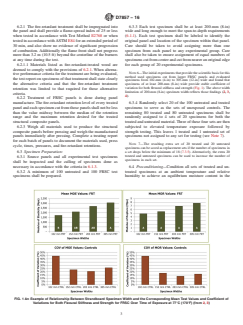
limitation of 200-mm (8-in) specimen width reflects those findings (2, 3,
criteria.
4).
6.2.2 Treatment of FRSC panels is done during panel
manufacture. The fire-retardant retention level of every treated 6.3.4 Randomly select 20 of the 100 untreated and treated
panelandeachspecimencutfromthosepanelsshallnotbeless specimens to serve as the sets of unexposed controls. The
than the value midway between the median of the retention remaining 80 treated and 80 untreated specimens shall be
range and the maximum retention desired for the treated randomly assigned to 4 sets of 20 specimens for both the
structural composite panels. treated and untreated material.Three of these four sets are then
6.2.3 Weigh all materials used to produce the structural subjected to elevated temperature exposure followed by
composite panels before pressing and weigh the manufactured strength testing. This leaves 1 treated and 1 untreated set of
panels immediately after pressing. Complete a treating report specimens not assigned to any set for testing (see Note 7).
for each batch of panels to document the materials used, press
NOTE 7—The resulting extra set of 20 treated and 20 untreated
cycle, times, pressures, and fire-retardant retentions.
specimens can be saved as replacement sets if the number of specimens in
a set drops below the minimum of 18 (7.3.5). Alternatively, the extra 20
6.3 Specimen Preparation:
treated and untreated specimens can be used to increase the number of
6.3.1 Source panels and all experimental test specimens
specimens in each set.
shall be inspected and the culling of specimens done as
necessary in accordance with the criteria in 6.1.3. 6.4 Preconditioning—Condition all sets of treated and un-
6.3.2 A minimum of 100 untreated and 100 FRSC test treated specimens at an ambient temperature and relative
specimens shall be prepared. humidity to achieve an equilibrium moisture content in the
FIG. 1 An Example of Relationship Between Strandboard Specimen Width and the Corresponding Mean Test Values and Coefficient of
Variations for Both Flexural Stiffness and Strength for FRSC Over Time of Exposure at 77°C (170°F) (from 2, 3)
D7857 − 16
untreated specimens of 10 6 2 %. Specimens are considered to 7.3.4 If a defect, as defined in 6.1.3, is observed at the
be at equi
...