

ASTM D5516-18
(Test Method)Standard Test Method for Evaluating the Flexural Properties of Fire-Retardant Treated Softwood Plywood Exposed to Elevated Temperatures
General Information
- Abstract
SIGNIFICANCE AND USE
5.1 The flexural properties evaluated by this test method are intended to provide any one or all of the following:
5.1.1 Data on the comparative effects of fire-retardant chemical formulations and environmental conditions on the flexural properties of plywood.
5.1.2 Data for use in developing modification factors for the allowable design properties of treated plywood when exposed to elevated temperatures and humidities.
5.1.3 Data comparing variables, such as other plywood species and dimensions.
5.2 Results obtained from tests conducted and analyzed in accordance with the procedures of this test method are suitable for use with other information to establish recommended roof sheathing spans for fire-retardant treated plywood.
Note 1: Temperatures lower than the test temperature specified in this test method and the cumulative effects of the elevated temperatures and humidity exposures expected to be encountered in service should be taken into account when recommended roof sheathing spans are established.
Note 2: Practice D6305 can be used to extend the laboratory strength data obtained by this test method to design value recommendations. The test data determined by this test method are used to develop adjustment factors for fire-retardant treatments to apply to untreated plywood design values. The test data are used in conjunction with climate models and other factors.
SCOPE
1.1 This test method is designed to determine the effect of exposure to high temperatures and humidities on the flexure properties of fire-retardant treated softwood plywood. In this test method, plywood is exposed to a temperature of 77°C (170°F).
1.2 The purpose of the test method is to compare the flexural properties of fire-retardant treated plywood relative to untreated plywood. The results of tests conducted in accordance with this test method provide a reference point for estimating strength temperature relationships. This test method is intended to provide an accelerated test at elevated temperatures and controlled humidities of plywood sheathing treated with the same chemical formulation(s) and processing conditions as plywood used commercially.
1.3 The values stated in SI units are to be regarded as standard. The values given in parentheses are mathematical conversions to inch-pound units that are provided for information only and are not considered standard.
1.4 This standard does not purport to address all of the safety concerns, if any, associated with its use. It is the responsibility of the user of this standard to establish appropriate safety, health, and environmental practices and determine the applicability of regulatory limitations prior to use.
1.5 This international standard was developed in accordance with internationally recognized principles on standardization established in the Decision on Principles for the Development of International Standards, Guides and Recommendations issued by the World Trade Organization Technical Barriers to Trade (TBT) Committee.
- Status
- Published
- Publication Date
- 31-May-2018
- Technical Committee
- D07 - Wood
- Drafting Committee
- D07.07 - Fire Performance of Wood
Buy Documents
ASTM D5516-18 - Standard Test Method for Evaluating the Flexural Properties of Fire-Retardant Treated Softwood Plywood Exposed to Elevated Temperatures
REDLINE ASTM D5516-18 - Standard Test Method for Evaluating the Flexural Properties of Fire-Retardant Treated Softwood Plywood Exposed to Elevated Temperatures
Overview
ASTM D5516-18 is the internationally recognized standard test method for evaluating the flexural properties of fire-retardant treated softwood plywood when exposed to elevated temperatures and humidities. Developed by ASTM Committee D07 on Wood, this method is vital for understanding the effects of fire-retardant treatments and environmental conditions on the mechanical performance of plywood, particularly in roofing and structural applications subjected to harsh conditions.
This standard provides procedures for comparing the strength and durability of fire-retardant treated plywood to untreated plywood, supporting informed decisions in design, specification, and code compliance.
Key Topics
- Fire-Retardant Treatment Effects: Assesses how various fire-retardant chemical formulations impact the flexural behavior of plywood.
- Elevated Temperature & Humidity Exposure: Evaluates plywood performance at 77°C (170°F) and high humidity, simulating demanding service environments.
- Comparative Data: Generates reference data for modification factors, aiding in the adjustment of allowable design values for treated vs. untreated plywood.
- Species & Dimensions: Accommodates testing different plywood species and sizes, supporting broad applicability.
- Accelerated Laboratory Testing: Utilizes controlled conditions to deliver timely, reliable results, providing a proxy for long-term field exposure.
- Strength Property Measurement: Involves calculating maximum moment, bending stiffness, and work to maximum load as key flexural properties.
Applications
This standard is critical for multiple sectors and practical scenarios:
- Roof Sheathing Design: Assists in establishing recommended spans for fire-retardant treated plywood in roofing, especially where exposure to heat and moisture are concerns.
- Building Code Compliance: Supports compliance with national and international codes relating to fire performance and material selection for safe construction.
- Product Development: Guides manufacturers in testing new fire-retardant treatments and processing methods, ensuring product reliability and safety.
- Quality Assurance: Enables industry professionals, including architects and engineers, to specify plywood products based on validated performance data under simulated "worst-case" conditions.
- Comparative Analysis: Provides a consistent methodology for comparing various plywood products and treatments, supporting best-in-class material selection.
By delivering robust data on flexural performance after exposure to harsh conditions, ASTM D5516-18 helps prevent failures such as strength loss and brittleness, which can lead to roof sheathing degradation and potential safety risks.
Related Standards
Several other standards complement and are referenced by ASTM D5516-18:
- ASTM D3043 - Test Methods for Structural Panels in Flexure
- ASTM D6305 - Practice for Calculating Bending Strength Design Adjustment Factors for Fire-Retardant-Treated Plywood Roof Sheathing
- ASTM E84 - Test Method for Surface Burning Characteristics of Building Materials
- ASTM E2768 - Extended Duration Surface Burning Characteristics of Building Materials
- AWPA C-27 & AWPA U1 - Standards for fire retardant treatments and specification for treated wood
- NFPA 703 - Standard for Fire Retardant Impregnated Wood and Fire Retardant Coatings for Building Materials
- PS 1 & PS 2 - U.S. Product Standards for Structural Plywood and Wood-Based Structural Use Panels
Together, these documents provide a comprehensive framework for assessing, specifying, and using fire-retardant treated plywood, ensuring structural integrity and fire safety in construction projects.
Keywords: ASTM D5516-18, fire-retardant treated plywood, flexural properties, elevated temperature, roof sheathing, structural plywood, building code compliance, fire safety, mechanical performance, testing standards.
Relations
- Effective Date
- 01-Jun-2018
- Effective Date
- 01-Jan-2024
- Effective Date
- 01-Dec-2023
- Effective Date
- 01-Sep-2023
- Effective Date
- 01-Jul-2019
- Effective Date
- 15-Apr-2019
- Effective Date
- 01-Mar-2019
- Effective Date
- 15-Dec-2018
- Effective Date
- 01-Oct-2018
- Effective Date
- 01-Aug-2018
- Effective Date
- 01-Jul-2018
- Effective Date
- 01-Mar-2018
- Effective Date
- 01-Mar-2018
- Effective Date
- 15-Nov-2017
- Effective Date
- 01-Nov-2017
Buy Documents
ASTM D5516-18 - Standard Test Method for Evaluating the Flexural Properties of Fire-Retardant Treated Softwood Plywood Exposed to Elevated Temperatures
REDLINE ASTM D5516-18 - Standard Test Method for Evaluating the Flexural Properties of Fire-Retardant Treated Softwood Plywood Exposed to Elevated Temperatures
Get Certified
Connect with accredited certification bodies for this standard

Gozdarski inštitut Slovenije
Slovenian Forestry Institute. Forest management certification support, timber testing.
Sponsored listings
Frequently Asked Questions
ASTM D5516-18 is a standard published by ASTM International. Its full title is "Standard Test Method for Evaluating the Flexural Properties of Fire-Retardant Treated Softwood Plywood Exposed to Elevated Temperatures". This standard covers: SIGNIFICANCE AND USE 5.1 The flexural properties evaluated by this test method are intended to provide any one or all of the following: 5.1.1 Data on the comparative effects of fire-retardant chemical formulations and environmental conditions on the flexural properties of plywood. 5.1.2 Data for use in developing modification factors for the allowable design properties of treated plywood when exposed to elevated temperatures and humidities. 5.1.3 Data comparing variables, such as other plywood species and dimensions. 5.2 Results obtained from tests conducted and analyzed in accordance with the procedures of this test method are suitable for use with other information to establish recommended roof sheathing spans for fire-retardant treated plywood. Note 1: Temperatures lower than the test temperature specified in this test method and the cumulative effects of the elevated temperatures and humidity exposures expected to be encountered in service should be taken into account when recommended roof sheathing spans are established. Note 2: Practice D6305 can be used to extend the laboratory strength data obtained by this test method to design value recommendations. The test data determined by this test method are used to develop adjustment factors for fire-retardant treatments to apply to untreated plywood design values. The test data are used in conjunction with climate models and other factors. SCOPE 1.1 This test method is designed to determine the effect of exposure to high temperatures and humidities on the flexure properties of fire-retardant treated softwood plywood. In this test method, plywood is exposed to a temperature of 77°C (170°F). 1.2 The purpose of the test method is to compare the flexural properties of fire-retardant treated plywood relative to untreated plywood. The results of tests conducted in accordance with this test method provide a reference point for estimating strength temperature relationships. This test method is intended to provide an accelerated test at elevated temperatures and controlled humidities of plywood sheathing treated with the same chemical formulation(s) and processing conditions as plywood used commercially. 1.3 The values stated in SI units are to be regarded as standard. The values given in parentheses are mathematical conversions to inch-pound units that are provided for information only and are not considered standard. 1.4 This standard does not purport to address all of the safety concerns, if any, associated with its use. It is the responsibility of the user of this standard to establish appropriate safety, health, and environmental practices and determine the applicability of regulatory limitations prior to use. 1.5 This international standard was developed in accordance with internationally recognized principles on standardization established in the Decision on Principles for the Development of International Standards, Guides and Recommendations issued by the World Trade Organization Technical Barriers to Trade (TBT) Committee.
SIGNIFICANCE AND USE 5.1 The flexural properties evaluated by this test method are intended to provide any one or all of the following: 5.1.1 Data on the comparative effects of fire-retardant chemical formulations and environmental conditions on the flexural properties of plywood. 5.1.2 Data for use in developing modification factors for the allowable design properties of treated plywood when exposed to elevated temperatures and humidities. 5.1.3 Data comparing variables, such as other plywood species and dimensions. 5.2 Results obtained from tests conducted and analyzed in accordance with the procedures of this test method are suitable for use with other information to establish recommended roof sheathing spans for fire-retardant treated plywood. Note 1: Temperatures lower than the test temperature specified in this test method and the cumulative effects of the elevated temperatures and humidity exposures expected to be encountered in service should be taken into account when recommended roof sheathing spans are established. Note 2: Practice D6305 can be used to extend the laboratory strength data obtained by this test method to design value recommendations. The test data determined by this test method are used to develop adjustment factors for fire-retardant treatments to apply to untreated plywood design values. The test data are used in conjunction with climate models and other factors. SCOPE 1.1 This test method is designed to determine the effect of exposure to high temperatures and humidities on the flexure properties of fire-retardant treated softwood plywood. In this test method, plywood is exposed to a temperature of 77°C (170°F). 1.2 The purpose of the test method is to compare the flexural properties of fire-retardant treated plywood relative to untreated plywood. The results of tests conducted in accordance with this test method provide a reference point for estimating strength temperature relationships. This test method is intended to provide an accelerated test at elevated temperatures and controlled humidities of plywood sheathing treated with the same chemical formulation(s) and processing conditions as plywood used commercially. 1.3 The values stated in SI units are to be regarded as standard. The values given in parentheses are mathematical conversions to inch-pound units that are provided for information only and are not considered standard. 1.4 This standard does not purport to address all of the safety concerns, if any, associated with its use. It is the responsibility of the user of this standard to establish appropriate safety, health, and environmental practices and determine the applicability of regulatory limitations prior to use. 1.5 This international standard was developed in accordance with internationally recognized principles on standardization established in the Decision on Principles for the Development of International Standards, Guides and Recommendations issued by the World Trade Organization Technical Barriers to Trade (TBT) Committee.
ASTM D5516-18 is classified under the following ICS (International Classification for Standards) categories: 79.060.20 - Fibre and particle boards. The ICS classification helps identify the subject area and facilitates finding related standards.
ASTM D5516-18 has the following relationships with other standards: It is inter standard links to ASTM D5516-17, ASTM E176-24, ASTM E84-23d, ASTM E84-23c, ASTM E84-19b, ASTM E84-19a, ASTM E84-19, ASTM E176-18a, ASTM E84-18b, ASTM E2768-11(2018), ASTM E84-18a, ASTM E84-18, ASTM E176-18, ASTM D3043-17, ASTM E84-17a. Understanding these relationships helps ensure you are using the most current and applicable version of the standard.
ASTM D5516-18 is available in PDF format for immediate download after purchase. The document can be added to your cart and obtained through the secure checkout process. Digital delivery ensures instant access to the complete standard document.
Standards Content (Sample)
This international standard was developed in accordance with internationally recognized principles on standardization established in the Decision on Principles for the
Development of International Standards, Guides and Recommendations issued by the World Trade Organization Technical Barriers to Trade (TBT) Committee.
Designation: D5516 − 18
Standard Test Method for
Evaluating the Flexural Properties of Fire-Retardant Treated
Softwood Plywood Exposed to Elevated Temperatures
This standard is issued under the fixed designation D5516; the number immediately following the designation indicates the year of
original adoption or, in the case of revision, the year of last revision. A number in parentheses indicates the year of last reapproval. A
superscript epsilon (´) indicates an editorial change since the last revision or reapproval.
1. Scope mendations issued by the World Trade Organization Technical
Barriers to Trade (TBT) Committee.
1.1 This test method is designed to determine the effect of
exposure to high temperatures and humidities on the flexure
2. Referenced Documents
properties of fire-retardant treated softwood plywood. In this
2.1 ASTM Standards:
test method, plywood is exposed to a temperature of 77°C
D9 Terminology Relating to Wood and Wood-Based Prod-
(170°F).
ucts
1.2 The purpose of the test method is to compare the
D1165 Nomenclature of Commercial Hardwoods and Soft-
flexural properties of fire-retardant treated plywood relative to
woods
untreated plywood. The results of tests conducted in accor-
D2915 Practice for Sampling and Data-Analysis for Struc-
dance with this test method provide a reference point for
tural Wood and Wood-Based Products
estimating strength temperature relationships.This test method
D3043 Test Methods for Structural Panels in Flexure
is intended to provide an accelerated test at elevated tempera-
D4933 Guide for Moisture Conditioning of Wood and
tures and controlled humidities of plywood sheathing treated
Wood-Based Materials
with the same chemical formulation(s) and processing condi-
D6305 Practice for Calculating Bending Strength Design
tions as plywood used commercially.
Adjustment Factors for Fire-Retardant-Treated Plywood
Roof Sheathing
1.3 The values stated in SI units are to be regarded as
E84 Test Method for Surface Burning Characteristics of
standard. The values given in parentheses are mathematical
Building Materials
conversions to inch-pound units that are provided for informa-
E176 Terminology of Fire Standards
tion only and are not considered standard.
E2768 Test Method for Extended Duration Surface Burning
1.4 This standard does not purport to address all of the
CharacteristicsofBuildingMaterials(30minTunnelTest)
safety concerns, if any, associated with its use. It is the
2.2 Other Standards:
responsibility of the user of this standard to establish appro-
AWPA C-27 Plywood-Fire Retardant Treatment by Pressure
priate safety, health, and environmental practices and deter-
Processes
mine the applicability of regulatory limitations prior to use.
AWPA U1 Use Category System: User Specification for
1.5 This international standard was developed in accor-
Treated Wood
dance with internationally recognized principles on standard-
NFPA 703 Standard for Fire Retardant Impregnated Wood
ization established in the Decision on Principles for the
and Fire Retardant Coatings for Building Materials
Development of International Standards, Guides and Recom-
For referenced ASTM standards, visit the ASTM website, www.astm.org, or
contact ASTM Customer Service at service@astm.org. For Annual Book of ASTM
This test method is under the jurisdiction of ASTM Committee D07 on Wood Standards volume information, refer to the standard’s Document Summary page on
and is the direct responsibility of Subcommittee D07.07 on Fire Performance of the ASTM website.
Wood. Available from American Wood Protection Association (AWPA), P.O. Box
Current edition approved June 1, 2018. Published August 2018. Originally 361784, Birmingham, AL 35236-1784, http://www.awpa.com.
approved in 1991 as ES 20 – 91. Last previous edition approved in 2017 as Available from National Fire Protection Association (NFPA), 1 Batterymarch
D5516 – 17. DOI: 10.1520/D5516-18. Park, Quincy, MA 02169-7471, http://www.nfpa.org.
Copyright © ASTM International, 100 Barr Harbor Drive, PO Box C700, West Conshohocken, PA 19428-2959. United States
D5516 − 18
test data determined by this test method are used to develop adjustment
Voluntary Product Standard PS1 Structural Plywood
factors for fire-retardant treatments to apply to untreated plywood design
Voluntary Product Standard PS2 Performance Standard for
values. The test data are used in conjunction with climate models and
Wood-Based Structural Use Panels
other factors.
3. Terminology
6. Test Specimens
3.1 Definitions—Definitions used in this test method are in
6.1 Material Selection:
accordance with Terminologies D9 and E176 and Nomencla-
6.1.1 Source panels for this test shall be selected from grade
ture D1165.
marked PS 1 or PS 2 commercially available 3, 4, or 5 ply
3.2 Definitions of Terms Specific to This Standard:
panels of a single thickness, grade, construction, and bond
3.2.1 depth of beam—that dimension of the beam which is
durability. The nominal panel thickness shall be between 12
15 5
perpendicular to the span and parallel to the direction in which
mm ( ⁄32 in.) and 16 mm ( ⁄8 in.).
the load is applied.
NOTE 3—Southern Pine (as defined in PS 1) is suggested as the test
3.2.2 span—the total distance between the centerline of
material because it requires higher fire-retardant chemical retentions to
supports providing the reactions on which a beam is supported obtain the same flame spread rating compared to other softwood plywood
species. Because the bending strength of treated plywood correlates to the
to accommodate a transverse load.
chemical retention levels, Southern Pine plywood is believed to represent
3.2.3 span-depth ratio—the numerical ratio of span divided
a worst case scenario for the same chemical formulation and treating/
by beam depth. redrying procedures. Thus, evaluation of other species of plywood by
testing of that species, rather than by application of southern pine test
4. Summary of Test Method results, are considered to be indicative of that species only.
6.1.2 Select source panels that provide bending strength
4.1 After preconditioning (see 6.5), matched specimens of
specimens after cutting with clear essentially straight-grained
treatedanduntreatedplywoodwillbeexposedto77°C(170°F)
faces free of scoring or other manufacturing defects. The inner
temperature and relative humidity equal to or greater than
plies shall be essentially free of voids, core gaps, and core laps
50 %.
(see 7.3.4.2). Panels shall have generally uniform grain orien-
4.2 Flexural strength tests are conducted on exposed speci-
tationandpercentlatewoodalongandacrossthepanelfaces.A
mens removed after various time periods. Flexural strength
minimum of six sheets of plywood meeting this description is
results shall include maximum moment, bending stiffness, and
required.Alternate 0.61 m (2 ft) long sections to be treated and
work to maximum load.Adjust the test results to 50 % relative
adjacent untreated 0.61 m (2 ft) sections (see Fig. 1) shall have
humidity using Practice D6305 procedures (see X1.1.)
visually similar wood quality.
4.3 The purpose of this test method is to determine the ratio
6.1.2.1 Specimens shall be inspected and the culling of
of the treated mean to the untreated mean for the plywood and
specimens done as necessary in accordance with the criteria in
plot the accelerated exposure strength data against exposure
7.3.4.
time.
NOTE 4—A minimum of six sheets of plywood is required but culling
of specimens could require more sheets.
5. Significance and Use
6.1.3 Thespecimencuttingpatternandnumberingsequence
5.1 The flexural properties evaluated by this test method are
is shown in Fig. 1. Each panel of plywood is to be labeled with
intended to provide any one or all of the following:
a number from 1 to 6. Cut each sheet crosswise to provide 0.61
5.1.1 Data on the comparative effects of fire-retardant
by 1.22 m (2 by 4-ft) sections. Each section is labeled with the
chemical formulations and environmental conditions on the
sheet number and letterA, B, C, or D. TheAand C sections of
flexural properties of plywood.
5.1.2 Data for use in developing modification factors for the
allowable design properties of treated plywood when exposed
to elevated temperatures and humidities.
5.1.3 Data comparing variables, such as other plywood
species and dimensions.
5.2 Results obtained from tests conducted and analyzed in
accordance with the procedures of this test method are suitable
for use with other information to establish recommended roof
sheathing spans for fire-retardant treated plywood.
NOTE 1—Temperatures lower than the test temperature specified in this
test method and the cumulative effects of the elevated temperatures and
humidity exposures expected to be encountered in service should be taken
into account when recommended roof sheathing spans are established.
NOTE 2—Practice D6305can be used to extend the laboratory strength
data obtained by this test method to design value recommendations. The
Available from the U.S. Department of Commerce, 1401 Constitution Ave.,
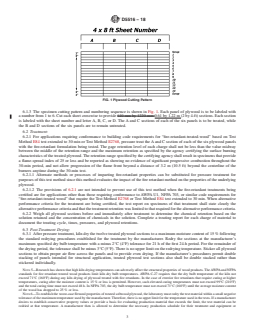
NW Washington, DC 20230, http://ts.nist.gov/Standards/Conformity/vps.cfm. FIG. 1 Plywood Cutting Pattern
D5516 − 18
adverselyaffectthestructuralpropertiesofwoodproducts.TheAWPAand
each of the six panels is to be treated, while the B and D
NFPAstandardsforfireretardanttreatedwoodproductslimitkilndrybulb
sections of the six panels are to remain untreated.
temperatures. AWPA C-27 requires that the dry bulb temperature of the
6.2 Treatment: kiln not exceed 71°C (160°F) during any kiln drying of plywood treated
with fire retardants. In the case of exterior fire retardants that require
6.2.1 For applications requiring conformance to building
curing at higher temperatures, curing after the moisture content is 15 % or
code requirements for “fire-retardant-treated-wood” based on
less is permitted. However, such elevated curing temperatures must not
Test Method E84 test extended to 30 min or Test Method
exceed 99°C (210°F) and the total curing time must not exceed 48 h. In
E2768, pressure treat the A and C section of each of the six NFPA 703, the dry bulb temperature must not exceed 71°C (160°F) until
the average moisture content of the wood has dropped to 25 % or less.
plywood panels with the fire-retardant formulation being
NOTE 6—To establish the worst-case flexural properties of treated
tested.The gage retention level of each charge shall not be less
softwood plywood, the laboratory must redry the test material within a
than the value midway between the middle of the retention
small negative tolerance of the maximum temperature used by the
range and the maximum retention as specified by the agency
manufacturer. Therefore, there is no upper limit for the temperature used
in the tests. If a manufacturer desires to establish conservative property
certifying the surface burning characteristics of the treated
values or provide a basis for evaluating production material that exceeds
plywood. The retention range specified by the certifying
the limit, the test material can be redried at that temperature. A
agency shall result in specimens that provide a flame-spread
manufacturer then is allowed to determine the necessary production
index of 25 or less and be reported as showing no evidence of
schedule for their treatment and equipment or conditions. Thus, a stepped
significant progressive combustion throughout the 30-min
schedule (for example, 10 h at 54°C (130°F), 10 h at 60°C (140°F), 10 h
at 71°C (160°F), etc.) is allowed by the standard, provided the maximum
period, and not allow progression of the flame front beyond a
temperature tolerance requirement is met. These provisions provide for
distance of 3.2 m (10.5 ft) beyond the centerline of the burners
air-drying production material provided the redry conditions for the test
anytime during the 30-min test.
materials are within the tolerance of the maximum temperature specified
6.2.1.1 Alternate methods or processes of imparting fire-
by the manufacturer.
retardant properties can be substituted for pressure treatment
6.3.2 Monitor the moisture content of the plywood sections
forpurposesofthistestmethodsincethismethodevaluatesthe
during the drying cycle by individually weighing the sections.
impact of the fire retardant method on the properties of the
Reduce as much as possible damage or warp during the drying
underlying plywood.
process by adequately supporting the sections. Keep a well-
6.2.1.2 The provisions of 6.2.1 are not intended to prevent
documentedkilnchargereportandkilnrecorderchartdetailing
use of this test method when the fire-retardant treatments being
the drying cycle and parameters.
certified are for applications other than those requiring confor-
6.4 Specimen Preparation:
mance to AWPA U1, NFPA 703, or similar code requirements
6.4.1 After drying, cut the treated and untreated 0.61 by
for “fire-retardant-treated wood” that require the Test Method
1.22-m (2 by 4-ft) sections into nominal 0.076 by 0.61-m (3 by
E2768 or Test Method E84 test extended to 30 min. When
24-in.) test specimens as shown on Fig. 1. Alternatively,
alternative performance criteria for the treatment are being
specimen sizes in accordance with Test Methods D3043, Test
certified, the test report on specimens of that treatment shall
Method A shall be used instead of this size. Number these
state clearly the alternative performance criteria and that the
specimens consecutively from 1 to 14, creating 168 treated and
treatment retention was limited to that required for the alter-
168 untreated specimens. Randomly select 20 of the 168
native performance criteria.
untreated and treated specimens as unexposed controls. The
6.2.2 Weigh all plywood sections before and immediately
remaining 148 treated and 148 untreated specimens shall be
after treatment to determine the chemical retention based on
randomly assigned to 7 sets of 20 specimens for both the
the solution retained and the concentration of chemicals in the
treated and untreated material.These are subjected to exposure
solution. Complete a treating report for each charge of material
followed by strength testing. This results in 8 treated and 8
to document the treating cycle, times, pressures, and plywood
untreated specimens not assigned to any set for testing (see
retentions.
Note 7).
6.3 Post-Treatment Drying:
NOTE 7—The 168 treated and 168 untreated specimens (6.4.1) are 48
6.3.1 After pressure treatment, kiln dry the twelve treated
more specimens than are needed to be tested. The resulting two extra sets
plywood sections to a maximum moisture content of 15 %
of 20 can be saved as replacement sets if the number of specimens in a set
following the standard redrying procedures established for the drops below the minimum of 18 (7.3.4). Alternatively, the extra 48
specimens can be used to increase the number of specimens in each set.A
treatment by the manufacturer. Redry the sections at the
samplesizeof28allowsonetoestimatea75 %confidenceintervalforthe
manufacturer’s maximum specified dry bulb temperature with
5 % nonparametric tolerance limit (see Practice D2915).
a minus 2°C (4°F) tolerance for 21 h of the first 24-h period.
6.4.1.1 Alternatively, the variation in the mean response can
For the remainder of the drying period, the tolerance shall be
bereducedbyablockedspecimenselectionwhereeachtreated
minus 3°C (5°F). There is no upper limit on the redrying
specimen is end-matched to an untreated specimen from the
temperature. Sticker all plywood sections to obtain proper air
same original panel. If blocking is used and a specimen is
flow across the panels and to provide even drying. If the
eliminated either before or after testing, then its mate shall also
manufacturer’s procedures permit double stacking of panels
be eliminated (1).
intended for structural application, treated plywood test sec-
tions also shall be double stacked rather than stickered indi-
vidually.
The boldface numbers in parentheses refer to a list of references at the end of
NOTE 5—Research has shown that high kiln drying temperatures can this standard.
D5516 − 18
6.5 Preconditioning—Equilibrate all sets of treated and 7.3.1 Test untreated and treated specimens for in flexure
untreated specimens at an ambient temperature and relative using the procedures specified in Test Methods D3043, Test
humidity to achieve an equilibrium moisture content in the Method A (see also Ref (2)).
untreated specimens of 10 6 2 % (see Table X1.3 in Guide
7.3.2 For the nominal 0.076 by 0.61 m (3 by 24 in.)
D4933). Specimens are considered to be at equilibrium mois-
specimens, deviations from Test Methods D3043, Test Method
ture content when a constant weight has been achieved. A
A are required as follows:
constantweightisassumedwhentwoconsecutiveweighingsat
7.3.2.1 Test span of 0.56 m (22 in.).
a 24-h interval differ by no more than 60.2 %.
7.3.2.2 Rotational end plates and lateral rotation of end
supports are optional. However, the end supports shall be
7. Procedure
rounded if rot
...
This document is not an ASTM standard and is intended only to provide the user of an ASTM standard an indication of what changes have been made to the previous version. Because
it may not be technically possible to adequately depict all changes accurately, ASTM recommends that users consult prior editions as appropriate. In all cases only the current version
of the standard as published by ASTM is to be considered the official document.
Designation: D5516 − 17 D5516 − 18
Standard Test Method for
Evaluating the Flexural Properties of Fire-Retardant Treated
Softwood Plywood Exposed to Elevated Temperatures
This standard is issued under the fixed designation D5516; the number immediately following the designation indicates the year of
original adoption or, in the case of revision, the year of last revision. A number in parentheses indicates the year of last reapproval. A
superscript epsilon (´) indicates an editorial change since the last revision or reapproval.
1. Scope
1.1 This test method is designed to determine the effect of exposure to high temperatures and humidities on the flexure
properties of fire-retardant treated softwood plywood. In this test method, plywood is exposed to a temperature of 77°C (170°F).
1.2 The purpose of the test method is to compare the flexural properties of fire-retardant treated plywood relative to untreated
plywood. The results of tests conducted in accordance with this test method provide a reference point for estimating strength
temperature relationships. This test method is intended to provide an accelerated test at elevated temperatures and controlled
humidities of plywood sheathing treated with the same chemical formulation(s) and processing conditions as plywood used
commercially.
1.3 The values stated in SI units are to be regarded as standard. The values given in parentheses are mathematical conversions
to inch-pound units that are provided for information only and are not considered standard.
1.4 This standard does not purport to address all of the safety concerns, if any, associated with its use. It is the responsibility
of the user of this standard to establish appropriate safety safety, health, and healthenvironmental practices and determine the
applicability of regulatory limitations prior to use.
1.5 This international standard was developed in accordance with internationally recognized principles on standardization
established in the Decision on Principles for the Development of International Standards, Guides and Recommendations issued
by the World Trade Organization Technical Barriers to Trade (TBT) Committee.
2. Referenced Documents
2.1 ASTM Standards:
D9 Terminology Relating to Wood and Wood-Based Products
D1165 Nomenclature of Commercial Hardwoods and Softwoods
D2915 Practice for Sampling and Data-Analysis for Structural Wood and Wood-Based Products
D3043 Test Methods for Structural Panels in Flexure
D4933 Guide for Moisture Conditioning of Wood and Wood-Based Materials
D6305 Practice for Calculating Bending Strength Design Adjustment Factors for Fire-Retardant-Treated Plywood Roof
Sheathing
E84 Test Method for Surface Burning Characteristics of Building Materials
E176 Terminology of Fire Standards
E2768 Test Method for Extended Duration Surface Burning Characteristics of Building Materials (30 min Tunnel Test)
2.2 Other Standards:
AWPA C-27 Plywood-Fire Retardant Treatment by Pressure Processes
AWPA U1 Use Category System: User Specification for Treated Wood
NFPA 703 Standard for Fire Retardant Impregnated Wood and Fire Retardant Coatings for Building Materials
This test method is under the jurisdiction of ASTM Committee D07 on Wood and is the direct responsibility of Subcommittee D07.07 on Fire Performance of Wood.
Current edition approved April 15, 2017June 1, 2018. Published June 2017August 2018. Originally approved in 1991 as ES 20 – 91. Last previous edition approved in
20092017 as D5516 – 09.D5516 – 17. DOI: 10.1520/D5516-17.10.1520/D5516-18.
For referenced ASTM standards, visit the ASTM website, www.astm.org, or contact ASTM Customer Service at service@astm.org. For Annual Book of ASTM Standards
volume information, refer to the standard’s Document Summary page on the ASTM website.
Available from American Wood Protection Association (AWPA), P.O. Box 361784, Birmingham, AL 35236-1784, http://www.awpa.com.
Available from National Fire Protection Association (NFPA), 1 Batterymarch Park, Quincy, MA 02169-7471, http://www.nfpa.org.
Copyright © ASTM International, 100 Barr Harbor Drive, PO Box C700, West Conshohocken, PA 19428-2959. United States
D5516 − 18
PS 1Voluntary Product Standard U.S. Product Standard for PS1 Structural Plywood
PS 2Voluntary Product Standard U.S. ProductPS2 Performance Standard for Wood-Based Structural Use Panels
3. Terminology
3.1 Definitions—Definitions used in this test method are in accordance with Terminologies D9 and E176 and Nomenclature
D1165.
3.2 Definitions of Terms Specific to This Standard:
3.2.1 depth of beam—that dimension of the beam which is perpendicular to the span and parallel to the direction in which the
load is applied.
3.2.2 span—the total distance between the centerline of supports providing the reactions on which a beam is supported to
accommodate a transverse load.
3.2.3 span-depth ratio—the numerical ratio of span divided by beam depth.
4. Summary of Test Method
4.1 After preconditioning (see 6.5), matched specimens of treated and untreated plywood will be exposed to 77°C (170°F)
temperature and relative humidity equal to or greater than 50 %.
4.2 Flexural strength tests are conducted on exposed specimens removed after various time periods. Flexural strength results
shall include maximum moment, bending stiffness, and work to maximum load. Adjust the test results to 50 % relative humidity
using Practice D6305 procedures (see X1.1.)
4.3 The purpose of this test method is to determine the ratio of the treated mean to the untreated mean for the plywood and plot
the accelerated exposure strength data against exposure time.
5. Significance and Use
5.1 The flexural properties evaluated by this test method are intended to provide any one or all of the following:
5.1.1 Data on the comparative effects of fire-retardant chemical formulations and environmental conditions on the flexural
properties of plywood.
5.1.2 Data for use in developing modification factors for the allowable design properties of treated plywood when exposed to
elevated temperatures and humidities.
5.1.3 Data comparing variables, such as other plywood species and dimensions.
5.2 Results obtained from tests conducted and analyzed in accordance with the procedures of this test method may be used are
suitable for use with other information to establish recommended roof sheathing spans for fire-retardant treated plywood.
NOTE 1—Temperatures lower than the test temperature specified in this test method and the cumulative effects of the elevated temperatures and
humidity exposures expected to be encountered in service should be taken into account when recommended roof sheathing spans are established.
NOTE 2—Practice D6305can be used to extend the laboratory strength data obtained by this test method to design value recommendations. The test
data determined by this test method are used to develop adjustment factors for fire-retardant treatments to apply to untreated plywood design values. The
test data are used in conjunction with climate models and other factors.
6. Test Specimens
6.1 Material Selection:
6.1.1 Source panels for this test shall be selected from grade marked PS 1 or PS 2 commercially available 3, 4, or 5 ply panels
of a single thickness, grade, construction, and bond durability. The nominal panel thickness shall be between 12 mm ( ⁄32 in.) and
16 mm ( ⁄8 in.).
NOTE 3—Southern Pine (as defined in PS 1) is suggested as the test material because it requires higher fire-retardant chemical retentions to obtain the
same flame spread rating compared to other softwood plywood species. Because the bending strength of treated plywood correlates to the chemical
retention levels, Southern Pine plywood is believed to represent a worst case scenario for the same chemical formulation and treating/redrying procedures.
Thus, evaluation of other species of plywood by testing of that species, rather than by application of southern pine test results, are considered to be
indicative of that species only.
6.1.2 Select source panels that provide bending strength specimens after cutting with clear essentially straight-grained faces free
of scoring or other manufacturing defects. The inner plies shall be essentially free of voids, core gaps, and core laps (see 7.3.4.2).
Panels shall have generally uniform grain orientation and percent latewood along and across the panel faces. A minimum of six
sheets of plywood meeting this description is required. Alternate 610 mm0.61 m (2 ft) long sections to be treated and adjacent
untreated 610 mm0.61 m (2 ft) sections (see Fig. 1) shall have visually similar wood quality.
6.1.2.1 Specimens shall be inspected and the culling of specimens done as necessary in accordance with the criteria in 7.3.4.
NOTE 4—A minimum of six sheets of plywood is required but culling of specimens maycould require more sheets.
Available from the U.S. Department of Commerce, 1401 Constitution Ave., NW Washington, DC 20230, http://ts.nist.gov/Standards/Conformity/vps.cfm.
D5516 − 18
FIG. 1 Plywood Cutting Pattern
6.1.3 The specimen cutting pattern and numbering sequence is shown in Fig. 1. Each panel of plywood is to be labeled with
a number from 1 to 6. Cut each sheet crosswise to provide 610 mm by 1220-mm 0.61 by 1.22 m (2 by 4-ft) sections. Each section
is labeled with the sheet number and letter A, B, C, or D. The A and C sections of each of the six panels is to be treated, while
the B and D sections of the six panels are to remain untreated.
6.2 Treatment:
6.2.1 For applications requiring conformance to building code requirements for “fire-retardant-treated-wood” based on Test
Method E84 test extended to 30 min or Test Method E2768, pressure treat the A and C section of each of the six plywood panels
with the fire-retardant formulation being tested. The gage retention level of each charge shall not be less than the value midway
between the middle of the retention range and the maximum retention as specified by the agency certifying the surface burning
characteristics of the treated plywood. The retention range specified by the certifying agency shall result in specimens that provide
a flame-spread index of 25 or less and be reported as showing no evidence of significant progressive combustion throughout the
30-min period, and not allow progression of the flame front beyond a distance of 3.2 m (10.5 ft) beyond the centerline of the
burners anytime during the 30-min test.
6.2.1.1 Alternate methods or processes of imparting fire-retardant properties can be substituted for pressure treatment for
purposes of this test method since this method evaluates the impact of the fire retardant method on the properties of the underlying
plywood.
6.2.1.2 The provisions of 6.2.1 are not intended to prevent use of this test method when the fire-retardant treatments being
certified are for applications other than those requiring conformance to AWPA U1, NFPA 703, or similar code requirements for
“fire-retardant-treated wood” that require the Test Method E2768 or Test Method E84 test extended to 30 min. When alternative
performance criteria for the treatment are being certified, the test report on specimens of that treatment shall state clearly the
alternative performance criteria and that the treatment retention was limited to that required for the alternative performance criteria.
6.2.2 Weigh all plywood sections before and immediately after treatment to determine the chemical retention based on the
solution retained and the concentration of chemicals in the solution. Complete a treating report for each charge of material to
document the treating cycle, times, pressures, and plywood retentions.
6.3 Post-Treatment Drying:
6.3.1 After pressure treatment, kiln dry the twelve treated plywood sections to a maximum moisture content of 15 % following
the standard redrying procedures established for the treatment by the manufacturer. Redry the sections at the manufacturer’s
maximum specified dry bulb temperature with a minus 2°C (4°F) tolerance for 21 h of the first 24-h period. For the remainder of
the drying period, the tolerance shall be minus 3°C (5°F). There is no upper limit on the redrying temperature. Sticker all plywood
sections to obtain proper air flow across the panels and to provide even drying. If the manufacturer’s procedures permit double
stacking of panels intended for structural application, treated plywood test sections also shall be double stacked rather than
stickered individually.
NOTE 5—Research has shown that high kiln drying temperatures can adversely affect the structural properties of wood products. The AWPA and NFPA
standards for fire retardant treated wood products limit kiln dry bulb temperatures. AWPA C-27 requires that the dry bulb temperature of the kiln not
exceed 71°C (160°F) during any kiln drying of plywood treated with fire retardants. In the case of exterior fire retardants that require curing at higher
temperatures, curing after the moisture content is 15 % or less is permitted. However, such elevated curing temperatures must not exceed 99°C (210°F)
and the total curing time must not exceed 48 h. In NFPA 703, the dry bulb temperature must not exceed 71°C (160°F) until the average moisture content
of the wood has dropped to 25 % or less.
NOTE 6—To establish the worst-case flexural properties of treated softwood plywood, the laboratory must redry the test material within a small negative
tolerance of the maximum temperature used by the manufacturer. Therefore, there is no upper limit for the temperature used in the tests. If a manufacturer
desires to establish conservative property values or provide a basis for evaluating production material that exceeds the limit, the test material can be
redried at that temperature. A manufacturer then is allowed to determine the necessary production schedule for their treatment and equipment or
D5516 − 18
conditions. Thus, a stepped schedule (for example, 10 h at 54°C (130°F), 10 h at 60°C (140°F), 10 h at 71°C (160°F), etc.) is allowed by the standard,
provided the maximum temperature tolerance requirement is met. These provisions provide for air-drying production material provided the redry
conditions for the test materials are within the tolerance of the maximum temperature specified by the manufacturer.
6.3.2 Monitor the moisture content of the plywood sections during the drying cycle by individually weighing the sections.
Reduce as much as possible damage or warp during the drying process by adequately supporting the sections. Keep a
well-documented kiln charge report and kiln recorder chart detailing the drying cycle and parameters.
6.4 Specimen Preparation:
6.4.1 After drying, cut the treated and untreated 6100.61 by 1220-mm1.22-m (2 by 4-ft) sections into nominal 750.076 by
610-mm0.61-m (3 by 24-in.) test specimens as shown on Fig. 1. Alternatively, specimen sizes in accordance with Test Methods
D3043, Test Method A shall be used instead of this size. Number these specimens consecutively from 1 to 14, creating 168 treated
and 168 untreated specimens. Randomly select 20 of the 168 untreated and treated specimens as unexposed controls. The
remaining 148 treated and 148 untreated specimens shall be randomly assigned to 7 sets of 20 specimens for both the treated and
untreated material. These are subjected to exposure followed by strength testing. This results in 8 treated and 8 untreated specimens
not assigned to any set for testing (see Note 7).
NOTE 7—The 168 treated and 168 untreated specimens (6.4.1) are 48 more specimens than are needed to be tested. The resulting two extra sets of 20
can be saved as replacement sets if the number of specimens in a set drops below the minimum of 18 (7.3.4). Alternatively, the extra 48 specimens can
be used to increase the number of specimens in each set. A sample size of 28 allows one to estimate a 75 % confidence interval for the 5 % nonparametric
tolerance limit (see Practice D2915).
6.4.1.1 Alternatively, the variation in the mean response can be reduced by a blocked specimen selection where each treated
specimen is end-matched to an untreated specimen from the same original panel. If blocking is used and a specimen is eliminated
either before or after testing, then its mate shall also be eliminated (1).
6.5 Preconditioning—Equilibrate all sets of treated and untreated specimens at an ambient temperature and relative humidity
to achieve an equilibrium moisture content in the untreated specimens of 10 6 2 % (see Table X1.3 in Guide D4933). Specimens
are considered to be at equilibrium moisture content when a constant weight has been achieved. A constant weight is assumed when
two consecutive weighings at a 24-h interval differ by no more than 60.2 %.
7. Procedure
7.1 Specimen Exposure:
7.1.1 After preconditioning, test the unexposed controls (see 6.4.1) as described in 7.3 for initial, unexposed flexural properties.
7.1.2 Expose all the remaining treated and untreated specimen sets in a chamber controlled to 77 6 1°C (170 6 2°F) and a
minimum of 50 % relative humidity. The control of the relative humidity in the chamber shall be 64 % and average 61 % around
the set point.
7.1.3 The first set of 20 untreated and 20 treated specimens shall be s
...