


ASTM E1432-19
(Practice)Standard Practice for Defining and Calculating Individual and Group Sensory Thresholds from Forced-Choice Data Sets of Intermediate Size
Standard Practice for Defining and Calculating Individual and Group Sensory Thresholds from Forced-Choice Data Sets of<brk/> Intermediate Size
SIGNIFICANCE AND USE
6.1 Sensory thresholds are used to determine the potential of substances at low concentrations to impart odor, taste, skinfeel, etc. to some form of matter.
6.2 Thresholds are used, for example, in setting limits in air pollution, in noise abatement, in water treatment, and in food systems.
6.3 Thresholds are used to characterize and compare the sensitivity of individuals or groups to given stimuli, for example, in medicine, ethnic studies, and the study of animal species.
SCOPE
1.1 The definitions and procedures of this practice apply to the calculation of individual thresholds for any stimulus in any medium, from data sets of intermediate size, that is, consisting of more than 20 to 40 3-AFC presentations per individual. A group threshold may be calculated using 5 to 15 individual thresholds.
1.2 This standard does not purport to address all of the safety concerns, if any, associated with its use. It is the responsibility of the user of this standard to establish appropriate safety, health, and environmental practices and determine the applicability of regulatory limitations prior to use.
1.3 This international standard was developed in accordance with internationally recognized principles on standardization established in the Decision on Principles for the Development of International Standards, Guides and Recommendations issued by the World Trade Organization Technical Barriers to Trade (TBT) Committee.
General Information
- Status
- Published
- Publication Date
- 31-Jul-2019
- Technical Committee
- E18 - Sensory Evaluation
- Drafting Committee
- E18.04 - Test Methods
Relations
- Effective Date
- 01-Aug-2019
- Effective Date
- 15-Aug-2019
- Effective Date
- 01-Aug-2011
- Effective Date
- 01-Aug-2011
- Effective Date
- 01-Aug-2009
- Effective Date
- 01-Oct-2007
- Effective Date
- 01-Apr-2004
- Effective Date
- 10-Oct-2000
- Effective Date
- 10-Oct-2000
- Effective Date
- 10-Sep-1997
Overview
ASTM E1432-19: Standard Practice for Defining and Calculating Individual and Group Sensory Thresholds from Forced-Choice Data Sets of Intermediate Size provides internationally recognized procedures for calculating sensory thresholds-such as odor, taste, or skinfeel-from intermediate-sized forced-choice data sets. Sensory thresholds are critical for determining the minimum concentration of a substance that can be detected, and their measurement is essential in diverse fields including environmental monitoring, food and beverage industries, and public health.
This practice is designed for use with data sets where each individual undergoes more than 20 to 40 three-alternative forced-choice (3-AFC) presentations. It provides methods for accurately estimating both individual and group thresholds using statistical models and graphical analysis.
Key Topics
- Sensory Thresholds: The minimum concentration of a stimulus (odor, taste, etc.) that is detectable by an individual or group, typically defined as the concentration at which there is a 50% probability of detection above chance.
- 3-Alternative Forced-Choice (3-AFC) Method: A widely used sensory evaluation procedure where participants identify the sample containing the test stimulus from three presented options.
- Data Set Requirements: Suitable for data sets with greater than 20 to 40 forced-choice presentations per individual, providing robust results that are more reliable than small-panel alternatives.
- Individual vs. Group Thresholds: Procedures for calculating thresholds for single assessors, as well as methods for determining group thresholds from multiple individual results.
- Statistical Analysis and Reporting: Utilizes graphic and regression methods for threshold calculation, requiring clear reporting of methodology, individual/group results, and relevant statistics (mean, median, standard deviation).
- Panel Design: Guidance on panel size (typically 5–15 assessors) and considerations around training, panel selection, and data validity.
Applications
The procedures established in ASTM E1432-19 are applicable across a range of sensory evaluation contexts, including:
- Air Quality and Odor Control: Setting regulatory limits and monitoring pollution by determining the odor threshold of environmental contaminants.
- Water Treatment: Assessing taste and odor thresholds for chemicals in drinking or process water.
- Food and Beverage Testing: Defining flavor thresholds and comparing the impact of ingredients or contaminants.
- Medical and Sensory Research: Studying group or individual sensitivity to stimuli, including olfactory or gustatory disorders in clinical settings.
- Noise and Chemical Sensitivity Evaluation: Adapting forced-choice threshold methods to evaluate sensitivity to other environmental stimuli like noise or tactile sensations.
- Population-Based Assessments: Determining the distribution of sensory thresholds in specific populations, supporting public health standards and product safety.
Related Standards
For comprehensive sensory evaluation solutions, ASTM E1432-19 should be used in conjunction with reference methods and related international standards:
- ASTM E679: Practice for Determination of Odor and Taste Thresholds by a Forced-Choice Ascending Concentration Series Method of Limits-suitable for smaller data sets.
- ASTM E122: Practice for Calculating Sample Size to Estimate, With Specified Precision, the Average for a Characteristic of a Lot or Process.
- EN 13725: Air Quality-Determination of Odour Concentration Using Dynamic Dilution Olfactometry.
- ISO 13301: Sensory Analysis-Methodology for Measuring Odour, Flavour, and Taste Detection Thresholds by 3-AFC Procedure.
Practical Benefits
- Improved Sensory Analysis Consistency: By standardizing threshold calculations, laboratories achieve repeatable, comparable results.
- Support for Regulatory Compliance: Documents reliable methods for demonstrating adherence to air, water, and food safety standards.
- Population Sensitivity Studies: Enables robust comparisons and the development of products or regulations tailored to diverse population needs.
- Enhanced Data Interpretation: Provides detailed guidelines for statistical treatment, helping users report clear and actionable findings.
Keywords: sensory thresholds, forced-choice, 3-AFC, sensory evaluation, odor detection, taste threshold, group threshold, environmental monitoring, ASTM E1432, air pollution, water quality, sensory panel testing, food safety.
Buy Documents
ASTM E1432-19 - Standard Practice for Defining and Calculating Individual and Group Sensory Thresholds from Forced-Choice Data Sets of<brk/> Intermediate Size
REDLINE ASTM E1432-19 - Standard Practice for Defining and Calculating Individual and Group Sensory Thresholds from Forced-Choice Data Sets of<brk/> Intermediate Size
Get Certified
Connect with accredited certification bodies for this standard

BSI Group
BSI (British Standards Institution) is the business standards company that helps organizations make excellence a habit.

NYCE
Mexican standards and certification body.
Sponsored listings
Frequently Asked Questions
ASTM E1432-19 is a standard published by ASTM International. Its full title is "Standard Practice for Defining and Calculating Individual and Group Sensory Thresholds from Forced-Choice Data Sets of<brk/> Intermediate Size". This standard covers: SIGNIFICANCE AND USE 6.1 Sensory thresholds are used to determine the potential of substances at low concentrations to impart odor, taste, skinfeel, etc. to some form of matter. 6.2 Thresholds are used, for example, in setting limits in air pollution, in noise abatement, in water treatment, and in food systems. 6.3 Thresholds are used to characterize and compare the sensitivity of individuals or groups to given stimuli, for example, in medicine, ethnic studies, and the study of animal species. SCOPE 1.1 The definitions and procedures of this practice apply to the calculation of individual thresholds for any stimulus in any medium, from data sets of intermediate size, that is, consisting of more than 20 to 40 3-AFC presentations per individual. A group threshold may be calculated using 5 to 15 individual thresholds. 1.2 This standard does not purport to address all of the safety concerns, if any, associated with its use. It is the responsibility of the user of this standard to establish appropriate safety, health, and environmental practices and determine the applicability of regulatory limitations prior to use. 1.3 This international standard was developed in accordance with internationally recognized principles on standardization established in the Decision on Principles for the Development of International Standards, Guides and Recommendations issued by the World Trade Organization Technical Barriers to Trade (TBT) Committee.
SIGNIFICANCE AND USE 6.1 Sensory thresholds are used to determine the potential of substances at low concentrations to impart odor, taste, skinfeel, etc. to some form of matter. 6.2 Thresholds are used, for example, in setting limits in air pollution, in noise abatement, in water treatment, and in food systems. 6.3 Thresholds are used to characterize and compare the sensitivity of individuals or groups to given stimuli, for example, in medicine, ethnic studies, and the study of animal species. SCOPE 1.1 The definitions and procedures of this practice apply to the calculation of individual thresholds for any stimulus in any medium, from data sets of intermediate size, that is, consisting of more than 20 to 40 3-AFC presentations per individual. A group threshold may be calculated using 5 to 15 individual thresholds. 1.2 This standard does not purport to address all of the safety concerns, if any, associated with its use. It is the responsibility of the user of this standard to establish appropriate safety, health, and environmental practices and determine the applicability of regulatory limitations prior to use. 1.3 This international standard was developed in accordance with internationally recognized principles on standardization established in the Decision on Principles for the Development of International Standards, Guides and Recommendations issued by the World Trade Organization Technical Barriers to Trade (TBT) Committee.
ASTM E1432-19 is classified under the following ICS (International Classification for Standards) categories: 35.240.30 - IT applications in information, documentation and publishing. The ICS classification helps identify the subject area and facilitates finding related standards.
ASTM E1432-19 has the following relationships with other standards: It is inter standard links to ASTM E1432-04(2011), ASTM E679-19, ASTM E679-04(2011), ASTM E122-09e1, ASTM E122-09, ASTM E122-07, ASTM E679-04, ASTM E122-99, ASTM E122-00, ASTM E679-91(1997). Understanding these relationships helps ensure you are using the most current and applicable version of the standard.
ASTM E1432-19 is available in PDF format for immediate download after purchase. The document can be added to your cart and obtained through the secure checkout process. Digital delivery ensures instant access to the complete standard document.
Standards Content (Sample)
This international standard was developed in accordance with internationally recognized principles on standardization established in the Decision on Principles for the
Development of International Standards, Guides and Recommendations issued by the World Trade Organization Technical Barriers to Trade (TBT) Committee.
Designation:E1432 −19
Standard Practice for
Defining and Calculating Individual and Group Sensory
Thresholds from Forced-Choice Data Sets of
Intermediate Size
This standard is issued under the fixed designation E1432; the number immediately following the designation indicates the year of
original adoption or, in the case of revision, the year of last revision.Anumber in parentheses indicates the year of last reapproval.A
superscript epsilon (´) indicates an editorial change since the last revision or reapproval.
INTRODUCTION
The purpose of this practice is to determine individual sensory thresholds for odor, taste, and other
modalities and, when appropriate, calculate group thresholds. The practice takes as its starting point
anysensorythresholddatasetofmorethan100presentations,collectedbyaforced-choiceprocedure.
TheusualprocedureistheThree-AlternativeForced-Choice(3-AFC)(seeISO13301),asexemplified
byDynamicTriangleOlfactometry.Asimilarpractice,PracticeE679,utilizeslimited-sizedatasetsof
50 to 100 3-AFC presentations, and is suitable as a rapid method to approximate group thresholds.
Collection of the data is not a part of this practice. The data are assumed to be valid; for example,
itisassumedthatthestimulusisdefinedproperly,thateachsubjecthasbeenfullytrainedtorecognize
thestimulusanddidindeedperceiveitwhenitwaspresentabovehisorhermomentarythreshold,and
that the quality of dilution medium did not vary.
It is recognized that precise threshold values for a given substance do not exist in the same sense
that values of vapor pressure exist. An assessor’s ability to detect a stimulus varies as a result of
random variations in factors such as alertness, attention, fatigue, events at the molecular level, health
status, etc., the effects of which can usually be described in terms of a probability function. At low
concentrations of an odorant or tastant, the probability of detection by a given individual is typically
0.0 and at high concentrations it is 1.0, and there is a range of concentrations in which the probability
of detection is between these limits. By definition, the threshold is the concentration for which the
probabilityofdetectionofthestimulusis0.5(thatis,50%abovechance,byagivenindividual,under
the conditions of the test).
Thresholds may be determined (1) for an individual (or for individuals one by one), and (2) for a
group (panel). While the determination of an individual threshold is a definable task, careful
consideration of the composition of the group is necessary to ensure the determined threshold
represents the group of interest.
Thereisalargedegreeofrandomerrorassociatedwithestimatingtheprobabilityofdetectionfrom
less than approximately 500 3-AFC presentations. The reliability of the results can be increased
greatly by enlarging the panel and by replicating the tests.
1. Scope medium, from data sets of intermediate size, that is, consisting
of more than 20 to 40 3-AFC presentations per individual. A
1.1 The definitions and procedures of this practice apply to
group threshold may be calculated using 5 to 15 individual
the calculation of individual thresholds for any stimulus in any
thresholds.
1.2 This standard does not purport to address all of the
This practice is under the jurisdiction of ASTM Committee E18 on Sensory
Evaluation and is the direct responsibility of Subcommittee E18.04 on Fundamen-
safety concerns, if any, associated with its use. It is the
tals of Sensory.
responsibility of the user of this standard to establish appro-
Current edition approved Aug. 1, 2019. Published September 2019. Originally
priate safety, health, and environmental practices and deter-
approved in 1991. Last previous edition approved in 2011 as E1432–04 (Reap-
proved 2011). DOI: 10.1520/E1432-19. mine the applicability of regulatory limitations prior to use.
Copyright © ASTM International, 100 Barr Harbor Drive, PO Box C700, West Conshohocken, PA 19428-2959. United States
E1432−19
1.3 This international standard was developed in accor- 4.1.1 model—an abstract or concrete analogy, usually
dance with internationally recognized principles on standard- mathematical, which represents in a useful way the functional
ization established in the Decision on Principles for the elements of a system or process. In short, the experimenter’s
Development of International Standards, Guides and Recom- theory of what is guiding the results observed.
mendations issued by the World Trade Organization Technical
4.1.2 statistical model—amodelassumingthattheprincipal
Barriers to Trade (TBT) Committee.
factor causing the results to deviate from the true value is a
randomerrorprocess.Thiscanusuallybedescribedintermsof
2. Principles
a probability function, for example, a bell-shaped curve,
2.1 The 3-AFC procedure is one of the set of n-AFC
symmetricalorskewed.Errorsarebinomiallydistributedinthe
procedures, any of which could be used, in principle, for the
3-AFC test procedure.
measurement of sensory thresholds, as could other discrimina-
4.1.3 threshold, detection—the intensity of the stimulus that
tion tests.
has a probability of 0.5 of being detected under the conditions
2.2 For calculation of the threshold of one individual, this
of the test. The probability of detection at any intensity is not
practice requires data sets taken at five or more concentration
a fixed attribute of the observer, but rather a value which
scalesteps,typicallysixorsevensteps,witheachstepdiffering
assumesthatsensitivityvariesasaresultofrandomfluctuation
from the previous step by a factor usually between 2 and 4,
infactorssuchasalertness,attention,fatigue,andeventsatthe
typically 3.0. The practice presupposes that the range of
molecular level, the effects of which can be modeled by a
concentrations has been selected by pretesting, in order to
probability function.
ensure that the individual’s threshold falls neither outside nor
near the ends of the range, but well within it. At each
4.1.4 individual threshold—a threshold based on a series of
concentration step, the individual must be tested several times,
judgments by a single assessor.
typically five or more times.
4.1.5 group threshold—the average, median, geometric
2.3 Individualthresholds,asdeterminedin2.2,maybeused
mean or other agreed measure (or an experimentally deter-
for calculation of a group (or panel) threshold. The size and
mined measure) of central tendency of the individual thresh-
composition of the panel (usually 5 to 15 members, preferably
olds of the members of a group (panel). The meaning and
more) is determined according to the purpose for which the
significance of the term depends on what the group is selected
threshold is required and the limitations of the testing situation
to represent (see 7.2.2).
(see 7.2).
4.1.6 scale step factor—for a scale of dilutions presented to
2.4 Pooling of the data sets from panel members to produce
a panel, the factor by which each step differs from adjacent
asinglestepcalculationofthepanelthresholdisnotpermitted.
steps.
3. Referenced Documents
4.1.7 dilution factor—the following applies to flow olfacto-
metry:IfF representstheflowofodorlessgaswhichservesto
3.1 ASTM Standards: 1
dilutetheflowofodorant,F ,thedilutionfactor,Z,isgivenby:
E122PracticeforCalculatingSampleSizetoEstimate,With 2
Specified Precision, the Average for a Characteristic of a
F 1F
1 2
Z 5 (1)
Lot or Process
F
E679Practice for Determination of Odor and Taste Thresh-
where Z is dimensionless. F and F may be expressed,
1 2
olds By a Forced-ChoiceAscending Concentration Series
both in units of mass, or (preferably) both in units of vol-
Method of Limits
3 ume; the report should state which. The term Z represents
3.2 CEN Standard:
the dilution factor to threshold. Alternate terminology in use
EN13725AirQuality—DeterminationofOdourConcentra-
is as follows: dilution-to-threshold ratio (D/T or D-T); odor
tion Using Dynamic Dilution Olfactometry
unit (OU); and effective dose (ED).
3.3 ISO Standard:
ISO 13301 Sensory Analysis—Methodology—General
5. Summary of Practice
guidance for Measuring Odour, Flavour, and Taste Detec-
tion Thresholds by a Three Alternative Forced Choice
5.1 From a data set according to 2.2, calculate the threshold
(3-AFC) Procedure
foroneindividualgraphicallyorbylinearregressionaccording
to5.2,orbyusingamodelfittingcomputerprogramaccording
4. Terminology
to 5.3.
4.1 Definitions of Terms Specific to This Standard:
5.2 Obtain the threshold in 5.1 by first calculating the
proportion correct above chance for each concentration step.
For referenced ASTM standards, visit the ASTM website, www.astm.org, or
This is accomplished by deducting, from the proportion of
contact ASTM Customer Service at service@astm.org. For Annual Book of ASTM
correct choices, the proportion that would have been selected
Standards volume information, refer to the standard’s Document Summary page on
the ASTM website.
by chance in the absence of the stimulus (see 8.1.2). Then, for
Available from British Standards Institution (BSI), 389 Chiswick High Rd.,
each individual calculate that concentration which has a
London W4 4AL, U.K., http://www.bsigroup.com.
probability of 0.5 of being detected under the conditions of the
Available fromAmerican National Standards Institute (ANSI), 25 W. 43rd St.,
4th Floor, New York, NY 10036, http://www.ansi.org. test. This is the individual threshold.
E1432−19
5.3 Alternatively obtain the threshold in 5.1 directly from (2)That the sample drawn be truly random, that is, that
theproportionofcorrectchoicesbynon-linearregressionusing every member of the population has a known chance of being
a computer program, as described in 8.2.2. selected, and
(3)That knowledge of the degree of variation occurring
5.4 Alwaysreporttheindividualthresholdsoftheassessors.
withinthepopulationexistsorcanbeacquiredinthecourseof
Depending on the purpose for which a threshold is required
formulating the plan of sampling.
(see 7.2), and on the distribution found, a group threshold may
7.2.2.1 In practice, the cost and availability of assessor
be calculated as the arithmetic or geometric mean, the median,
places serious limitations on the degree to which population
oranothermeasureofcentraltendency,oritmaybeconcluded
factors affecting thresholds, for example, age groups, gender,
that no group threshold can be calculated (see 7.4).
ethnicorigin,wellversusill,smokerversusnonsmoker,trained
versuscasualobservers,etc.,canbecovered.Theexperimenter
6. Significance and Use
is typically limited to panels of 5 to 15, with each receiving 20
6.1 Sensorythresholdsareusedtodeterminethepotentialof
to 40 3-AFC presentations, for a total of 100 to 600 presenta-
substancesatlowconcentrationstoimpartodor,taste,skinfeel,
tions. If the resulting thresholds are to have validity for the
etc. to some form of matter.
population, the experimenter should include the following
steps:
6.2 Thresholds are used, for example, in setting limits in air
(1)Calculate and tabulate the thresholds for each indi-
pollution, in noise abatement, in water treatment, and in food
vidual;
systems.
(2)Repeat the test for those individuals (outliers) falling
6.3 Thresholds are used to characterize and compare the
well beyond the range of the rest of the panel;
sensitivity of individuals or groups to given stimuli, for
(3)For any individuals whose threshold at first did not fall
example, in medicine, ethnic studies, and the study of animal
well within the range of samples presented to them, adjust the
species.
range and repeat the test; and
(4) If needed to obtain a desired level of precision, repeat
7. Panel Size and Composition Versus Purpose of Test
the test series with a second or third panel sampled from the
7.1 Panel Size and Composition—Panel variables should be
same population of interest.
chosen as a function of the purpose for which the resulting 7.2.2.2 Thresholds vary with age, and one approach to a
threshold is needed. The important panel variables are as
generalizable population value is to adjust thresholds obtained
follows: at various ages to an estimate for healthy 20-year-olds, using
7.1.1 Number of tests per assessor, Amoore’s finding (2) that between the ages of 20 and 65, odor
threshold concentrations double for approximately each 22
7.1.2 Number of assessors,
years of age.
7.1.3 Selection of assessors to represent a given population,
7.2.3 The Distribution of Thresholds in the Population is
and
Required, for example, to determine what proportion of the
7.1.4 Degree of training.
population is affected by a given level of a pollutant, or,
7.2 PurposeofTest—Itisusefultodistinguishthefollowing
conversely, to determine which concentrations of a pollutant
three categories:
will affect a given percent of a population. The requirements
7.2.1 Comparing an Individual’s Threshold With a Litera-
for testing are the same as in 7.2.2, except that it is even more
ture Value—The test may be conducted, for example, to
important to cover the range well, for example, to repeat the
diagnose anosmia or ageusia, or to study sensitivity to pain,
tests for those individuals whose thresholds fall in thinly
noise, or odor. This is the simplest category requiring a
populated parts of the panel range. Consideration should be
minimum of 20 to 40 3-AFC presentations to the individual in
given to increasing the number of presentations per concentra-
question (see 2.2). A number of training sessions may be
tionfrom5-7to7-10forsuchpanelmembers.Iftheindividual
required to establish the range of concentrations that will be
thresholds are plotted as in Fig. 1, any sector requiring study
used and to make certain that the individual is fully familiar
will be apparent from the graph.
withthestimulustobedetectedaswellasthemechanicsofthe
7.3 Trained Versus Casual Assessors—Thresholds should
test.
normally be determined for assessors trained by repeated
7.2.2 A Population Threshold is Required, for example, the
exposure to detect the stimulus in question whenever it is
odor threshold of a population exposed to a given pollutant,
...
This document is not an ASTM standard and is intended only to provide the user of an ASTM standard an indication of what changes have been made to the previous version. Because
it may not be technically possible to adequately depict all changes accurately, ASTM recommends that users consult prior editions as appropriate. In all cases only the current version
of the standard as published by ASTM is to be considered the official document.
Designation: E1432 − 04 (Reapproved 2011) E1432 − 19
Standard Practice for
Defining and Calculating Individual and Group Sensory
Thresholds from Forced-Choice Data Sets of
Intermediate Size
This standard is issued under the fixed designation E1432; the number immediately following the designation indicates the year of
original adoption or, in the case of revision, the year of last revision. A number in parentheses indicates the year of last reapproval. A
superscript epsilon (´) indicates an editorial change since the last revision or reapproval.
INTRODUCTION
The purpose of this practice is to determine individual sensory thresholds for odor, taste, and other
modalities and, when appropriate, calculate group thresholds. The practice takes as its starting point
any sensory threshold data set of more than 100 presentations, collected by a forced-choice procedure.
The usual procedure is the Three-Alternative Forced-Choice (3-AFC) (see ISO 13301), as exemplified
by Dynamic Triangle Olfactometry. A similar practice, Practice E679, utilizes limited-size data sets of
50 to 100 3-AFC presentations, and is suitable as a rapid method to approximate group thresholds.
Collection of the data is not a part of this practice. The data are assumed to be valid; for example,
it is assumed that the stimulus is defined properly, that each subject has been fully trained to recognize
the stimulus and did indeed perceive it when it was present above his or her momentary threshold, and
that the quality of dilution medium did not vary.
It is recognized that precise threshold values for a given substance do not exist in the same sense
that values of vapor pressure exist. A panelist’sAn assessor’s ability to detect a stimulus varies as a
result of random variations in factors such as alertness, attention, fatigue, events at the molecular level,
health status, etc., the effects of which can usually be described in terms of a probability function. At
low concentrations of an odorant or tastant, the probability of detection by a given individual is
typically 0.0 and at high concentrations it is 1.0, and there is a range of concentrations in which the
probability of detection is between these limits. By definition, the threshold is the concentration for
which the probability of detection of the stimulus is 0.5 (that is, 50 % above chance, by a given
individual, under the conditions of the test).
Thresholds may be determined (1) for an individual (or for individuals one by one), and (2) for a
group (panel). While the determination of an individual threshold is a definable task, careful
consideration of the composition of the group is necessary to ensure the determined threshold
represents the group of interest.
There is a large degree of random error associated with estimating the probability of detection from
less than approximately 500 3-AFC presentations. The reliability of the results can be increased
greatly by enlarging the panel and by replicating the tests.
1. Scope
1.1 The definitions and procedures of this practice apply to the calculation of individual thresholds for any stimulus in any
medium, from data sets of intermediate size, that is, consisting of more than 20 to 40 3-AFC presentations per individual. A group
threshold may be calculated using 5 to 15 individual thresholds.
1.2 This standard does not purport to address all of the safety concerns, if any, associated with its use. It is the responsibility
of the user of this standard to establish appropriate safety safety, health, and healthenvironmental practices and determine the
applicability of regulatory limitations prior to use.
This practice is under the jurisdiction of ASTM Committee E18 on Sensory Evaluation and is the direct responsibility of Subcommittee E18.04 on Fundamentals of
Sensory.
Current edition approved Aug. 1, 2011Aug. 1, 2019. Published August 2011September 2019. Originally approved in 1991. Last previous edition approved in 20042011
as E1432E1432 – 04–04 . DOI: 10.1520/E1432-04R11. (Reapproved 2011) . DOI: 10.1520/E1432-19.
Copyright © ASTM International, 100 Barr Harbor Drive, PO Box C700, West Conshohocken, PA 19428-2959. United States
E1432 − 19
1.3 This international standard was developed in accordance with internationally recognized principles on standardization
established in the Decision on Principles for the Development of International Standards, Guides and Recommendations issued
by the World Trade Organization Technical Barriers to Trade (TBT) Committee.
2. Principles
2.1 The 3-AFC procedure is one of the set of n-AFC procedures, any of which could be used, in principle, for the measurement
of sensory thresholds, as could the duo-trio, the triangular, and the two-out-of-five procedures.other discrimination tests.
2.2 For calculation of the threshold of one individual, this practice requires data sets taken at five or more concentration scale
steps, typically six or seven steps, with each step differing from the previous step by a factor usually between 2 and 4, typically
3.0. The practice presupposes that the range of concentrations has been selected by pretesting, in order to ensure that the
individual’s threshold falls neither outside nor near the ends of the range, but well within it. At each concentration step, the
individual must be tested several times, typically five or more times.
2.3 Individual thresholds, as determined in 2.2, may be used for calculation of a group (or panel) threshold. The size and
composition of the panel (usually 5 to 15 members, preferably more) is determined according to the purpose for which the
threshold is required and the limitations of the testing situation (see 7.2).
2.4 Pooling of the data sets from panel members to produce a single step calculation of the panel threshold is not permitted.
3. Referenced Documents
3.1 ASTM Standards:
E122 Practice for Calculating Sample Size to Estimate, With Specified Precision, the Average for a Characteristic of a Lot or
Process
E679 Practice for Determination of Odor and Taste Thresholds By a Forced-Choice Ascending Concentration Series Method of
Limits
3.2 CEN Standard:
EN 13725 Air Quality—Determination of Odour Concentration Using Dynamic Dilution Olfactometry
3.3 ISO Standard:
ISO 13301 Sensory Analysis—Methodology—General guidance for Measuring Odour, Flavour, and Taste Detection Thresholds
by a Three Alternative Forced Choice (3-AFC) Procedure
4. Terminology
4.1 Definitions of Terms Specific to This Standard:
4.1.1 Three-Alternative Forced-Choice (3-AFC) test procedure—a test presentation used in many threshold tests. For example,
in odor testing by Dynamic Triangle Olfactometry, the panelist is presented with three gas streams, only one of which contains the
diluted odorant, while the other two contain odorless carrier gas. The panelist must indicate the one containing the added substance.
(The 3-AFC procedure is different from the classical Triangle test, in which either one or two of the three samples may contain
the added substance.)
4.1.1 model—an abstract or concrete analogy, usually mathematical, which represents in a useful way the functional elements
of a system or process. In short, the experimenter’s theory of what is guiding the results observed.
4.1.2 statistical model—a model assuming that the principal factor causing the results to deviate from the true value is a random
error process. This can usually be described in terms of a probability function, for example, a bell-shaped curve, symmetrical or
skewed. Errors are binomially distributed in the 3-AFC test procedure.
4.1.3 threshold, detection—the intensity of the stimulus that has a probability of 0.5 of being detected under the conditions of
the test. The probability of detection at any intensity is not a fixed attribute of the observer, but rather a value which assumes that
sensitivity varies as a result of random fluctuation in factors such as alertness, attention, fatigue, and events at the molecular level,
the effects of which can be modeled by a probability function.
4.1.4 individual threshold—a threshold based on a series of judgments by a single panelist.assessor.
4.1.5 group threshold—the average, median, geometric mean or other agreed measure (or an experimentally determined
measure) of central tendency of the individual thresholds of the members of a group (panel). The meaning and significance of the
term depends on what the group is selected to represent (see 7.2.2).
4.1.6 scale step factor—for a scale of dilutions presented to a panel, the factor by which each step differs from adjacent steps.
For referenced ASTM standards, visit the ASTM website, www.astm.org, or contact ASTM Customer Service at service@astm.org. For Annual Book of ASTM Standards
volume information, refer to the standard’s Document Summary page on the ASTM website.
Available from British Standards Institution (BSI), 389 Chiswick High Rd., London W4 4AL, U.K., http://www.bsigroup.com.
Available from American National Standards Institute (ANSI), 25 W. 43rd St., 4th Floor, New York, NY 10036, http://www.ansi.org.
E1432 − 19
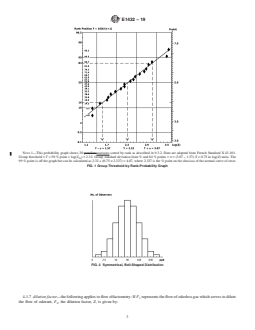
NOTE 1—This probability graph shows 20 panelistsassessors sorted by rank as described in 9.3.2. Data are adapted from French Standard X 43-101.
Group threshold = T = 50 % point = log(Z ) = 2.32. Group standard deviation from % and 84 % points = σ = (3.07 − 1.57) ⁄2 = 0.75 in log(Z) units. The
99 % point is off the graph but can be calculated as 2.32 + (0.75 × 2.327) = 4.07, where 2.327 is the % point on the abscissa of the normal curve of error.
FIG. 1 Group Threshold by Rank-Probability Graph
FIG. 2 Symmetrical, Bell-Shaped Distribution
4.1.7 dilution factor—the following applies to flow olfactometry: If F represents the flow of odorless gas which serves to dilute
the flow of odorant, F , the dilution factor, Z, is given by:
E1432 − 19
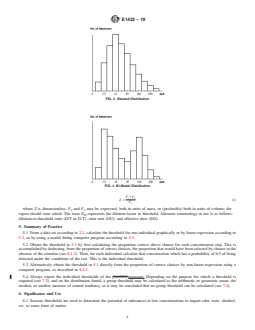
FIG. 3 Skewed Distribution
FIG. 4 Bi-Modal Distribution
F 1F
1 2
Z 5 (1)
F
where Z is dimensionless. F and F may be expressed, both in units of mass, or (preferably) both in units of volume; the
1 2
report should state which. The term Z represents the dilution factor to threshold. Alternate terminology in use is as follows:
dilution-to-threshold ratio (D/T or D-T); odor unit (OU); and effective dose (ED).
5. Summary of Practice
5.1 From a data set according to 2.2, calculate the threshold for one individual graphically or by linear regression according to
5.2, or by using a model fitting computer program according to 5.3.
5.2 Obtain the threshold in 5.1 by first calculating the proportion correct above chance for each concentration step. This is
accomplished by deducting, from the proportion of correct choices, the proportion that would have been selected by chance in the
absence of the stimulus (see 8.1.2). Then, for each individual calculate that concentration which has a probability of 0.5 of being
detected under the conditions of the test. This is the individual threshold.
5.3 Alternatively obtain the threshold in 5.1 directly from the proportion of correct choices by non-linear regression using a
computer program, as described in 8.2.2.
5.4 Always report the individual thresholds of the panelists.assessors. Depending on the purpose for which a threshold is
required (see 7.2), and on the distribution found, a group threshold may be calculated as the arithmetic or geometric mean, the
median, or another measure of central tendency, or it may be concluded that no group threshold can be calculated (see 7.4).
6. Significance and Use
6.1 Sensory thresholds are used to determine the potential of substances at low concentrations to impart odor, taste, skinfeel,
etc. to some form of matter.
E1432 − 19
NOTE 1—The results (using Probits and linear regression) are as follows:
Panelist No. 1 2 3 4 5 6
Assessor No. 1 2 3 4 5 6
Threshold, ppb 381 166 226 97 47 12
Group standard deviation (six panelists), σ = 0.539 in log (ppb) units.
Group standard deviation (six assessors), σ = 0.539 in log (ppb) units.
FIG. 5 Graphic Estimation of Approximate Thresholds for the Six PanelistsAssessors in 7.3
E1432 − 19
** PURPOSE: Fit logistic models P = (1/3 + EXP[K])/(1 + EXP[K]),
** where:
** K = B(T - LOG[X]),
** P = proportion of correct identifications,
** B = slope,
** X = concentration (ppb) of Substance X in purified water, and
** T = threshold value in log(ppb).
*;
PROC NLIN METHOD=GAUSS DATA=INPUT;
BY ASSESSOR;
PARMS B = -4 T = 2;
K = B*(T-LOG10(X));
E = EXP(K);
N = (1/3+E);
D = D = (1+E);
MODEL P=N/D;
TITLE2 ‘Logistic Regression Models’;
RUN;
OUTPUT FOR ASSESSOR 4:
Dependent Variable P
Method: Gauss-Newton
Iterative Phase
Sum of
Iter B T Squares
0 -4.0000 2.0000 0.0258
1 -5.8644 1.9598 0.0107
2 -6.3222 1.9568 0.0104
3 -6.2451 1.9537 0.0104
4 -6.2933 1.9541 0.0104
5 -6.2769 1.9538 0.0104
6 -6.2841 1.9539 0.0104
7 -6.2813 1.9539 0.0104
8 -6.2824 1.9539 0.0104
9 -6.2821 1.9539 0.0104
10 -6.2821 1.9539 0.0104
NOTE: Convergence criterion met.
Approx
Sum of Mean F
Source DF Squares Square Value Pr > F
Model 2 2.3508 1.1754 340.37 0.0003
Error 3 0.0104
Uncorrected Total 5 2.3611
Approx Std
Parameter Estimate error 95 % Confidence Limits
B -6.2821 1.6732 -11.6068 -0.9574
T 1.9539 0.0471 1.8039 2.1038
NOTE 1—The PROC NLIN fits nonlinear regression models by least squares. Following the regression expression, the operator selects one of four
iterative methods (here, DUD)GAUSS) and must specify an approximate value for the parameters B (the slope, here = −4)here = -4) and T (the threshold,
here = 2). The NLIN procedure first prints out the starting values for B and T, then proceeds stepwise (here, ten steps) until the residual sum of squares
no longer decreases (“convergence criterion met”). The threshold (here, TT = log(ppb) = 1.954) = log(ppb) = 1.954) is found as the last value in the T
column. The results for the six panelistsassessors are as follows:
Panelist 1 2 3 4 5 6
Method DUD DUD DUD DUD DUD MARQUARDT
Log (ppb) 2.518 2.249 2.368 1.954 1.806 0.892
Threshold, ppb 330 178 249 90 64 7.8
Group standard deviation (six panelists),σ = 0.59 in log(ppb) units.
Assessor 1 2 3 4 5 6
Log (ppb) 2.519 2.249 2.356 1.954 1.807 0.904
Threshold, ppb 330 178 227 90 64 8
Group standard deviation (six assessors), σ = 0.58 in log (ppb) units.
FIG. 6 Output from SAS NLIN Program (6) with Details for PanelistAssessor No. 4
E1432 − 19
6.2 Thresholds are used, for example, in setting limits in air pollution, in noise abatement, in water treatment, and in food
systems.
6.3 Thresholds are used to characterize and compare the sensitivity of individuals or groups to given stimuli, for example, in
medicine, ethnic studies, and the study of animal species.
7. Panel Size and Composition Versus Purpose of Test
7.1 Panel Size and Composition—Panel variables should be chosen as a function of the purpose for which the resulting threshold
is needed. The important panel variables are as follows:
7.1.1 Number of tests per panelist,assessor,
7.1.2 Number of panelists,assessors,
7.1.3 Selection of panelistsassessors to represent a given population, and
7.1.4 Degree of training.
7.2 Purpose of Test—It is useful to distinguish the following three categories:
7.2.1 Comparing an Individual’s Threshold With a Literature Value—The test may be conducted, for example, to diagnose
anosmia or ageusia, or to study sensitivity to pain, noise, or odor. This is the simplest category requiring a minimum of 20 to 40
3-AFC presentations to the individual in question (see 2.2). A number of training sessions may be required to establish the range
of concentrations that will be used and to make certain that the individual is fully familiar with the stimulus to be detected as well
as the mechanics of the test.
7.2.2 A Population Threshold is Required, for example, the odor threshold of a population exposed to a given pollutant, or the
flavor threshold of consumer
...
Questions, Comments and Discussion
Ask us and Technical Secretary will try to provide an answer. You can facilitate discussion about the standard in here.
Loading comments...