

ASTM D5485-21
(Test Method)Standard Test Method for Determining Corrosive Effect of Combustion Products Using the Cone Corrosimeter
General Information
- Abstract
SIGNIFICANCE AND USE
5.1 The metal loss from corrosion is directly related to the increase in electrical resistance of the target due to the decrease in conductive cross-sectional area.
5.2 The relationship between resistance increase of metallic targets used in this test method and the amount of metal loss as reported by a uniform loss in thickness has not been determined.
5.3 This test method is used to determine the corrosive effect of combustion products from burning electrical insulations or coverings or their constituent materials or components. Corrosion is determined by the reduction of thickness of the metal on standardized targets, as measured by electrical resistance. These targets are not necessarily representative of the intended end use.
5.4 This test method is intended for use in electrical insulations or coverings material and product evaluations, for additional data to assist in design of electrical insulations or coverings products, or for development and research of electrical insulations or coverings products.
5.5 A value of the initial test heat flux is selected to be relevant to the fire scenario being investigated (up to 100 kW/m2). Additional information for testing is given in A1.2.3.
SCOPE
1.1 This fire-test-response standard measures the corrosive effect by loss of metal from the combustion products of materials, components, or products.
1.2 This test method provides corrosion results of product and material specimens limited to a maximum size of 100 by 100 mm in area and 50 mm thick.
1.3 Additional information regarding the targets, the test conditions, and test limitations is provided in Annex A1.
1.4 The results of this test method have not been investigated with respect to correlation to actual fires.
1.5 An ISO standard exists, as developed by ISO TC 61 (Plastics), subcommittee 4 (on burning behavior), which is technically very similar to this test method and is designated ISO 11907-4.
1.6 The values stated in SI units are to be regarded as standard. No other units of measurement are included in this standard. (See IEEE/ASTM SI10.)
1.7 This standard measures and describes the response of materials, products, or assemblies to heat and flame under controlled conditions, but does not by itself incorporate all factors required for fire hazard or fire risk assessment of the materials, products, or assemblies under actual fire conditions.
1.8 Fire testing is inherently hazardous. Adequate safeguards for personnel and property shall be employed in conducting these tests.
1.9 This standard does not purport to address all of the safety concerns, if any, associated with its use. It is the responsibility of the user of this standard to establish appropriate safety, health, and environmental practices and determine the applicability of regulatory limitations prior to use. For specific hazard statements, see Section 7.
1.10 This international standard was developed in accordance with internationally recognized principles on standardization established in the Decision on Principles for the Development of International Standards, Guides and Recommendations issued by the World Trade Organization Technical Barriers to Trade (TBT) Committee.
- Status
- Published
- Publication Date
- 28-Feb-2021
- Technical Committee
- D09 - Electrical and Electronic Insulating Materials
- Drafting Committee
- D09.17 - Fire and Thermal Properties
Buy Documents
ASTM D5485-21 - Standard Test Method for Determining Corrosive Effect of Combustion Products Using the Cone Corrosimeter
REDLINE ASTM D5485-21 - Standard Test Method for Determining Corrosive Effect of Combustion Products Using the Cone Corrosimeter
Overview
ASTM D5485-21 is a standard test method developed by ASTM International for determining the corrosive effect of combustion products using the cone corrosimeter. This fire-test-response standard measures metal loss from corrosion as a result of exposure to combustion products released when electrical insulation materials, coverings, or their components burn. The test quantifies corrosion by detecting changes in electrical resistance of standardized metallic targets, providing valuable data for the evaluation and selection of materials with respect to their performance in fire situations.
This method is widely used in the development, research, and compliance evaluation of electrical insulation materials and products. Comprehensive in its approach, ASTM D5485-21 is recognized internationally, and it complements technically similar standards such as ISO 11907-4.
Key Topics
- Corrosive Effect Assessment: Evaluates the corrosivity of combustion effluents from burned materials by measuring the decrease in metallic thickness (corrosion-by-metal-loss) on standardized targets.
- Cone Corrosimeter Utilization: Test specimens are burned under controlled radiant heat, and the resulting combustion products are channeled through an exposure chamber containing pre-calibrated corrosion targets.
- Electrical Resistance Measurement: The principal measurement technique is the increase in electrical resistance of the metal target, directly relating to the extent of corrosion.
- Material Scope: Applicable to flat plaques, components, or small product samples (up to 100 x 100 mm, 50 mm thick).
- Controlled Test Conditions: The test uses specific heat flux values (up to 100 kW/m²) relevant to realistic fire scenarios. Results are recorded after exposure and after a 24-hour post-test period under controlled humidity and temperature conditions.
- Safety Guidelines: Highlights the inherent hazards of fire testing and requires adequate lab safety practices in accordance with OSHA standards.
Applications
ASTM D5485-21 is primarily applied in:
- Material Qualification: Provides critical data for material suppliers and manufacturers regarding the comparative corrosivity of insulation products under fire conditions.
- Product Development: Assists R&D teams in designing new electrical insulation and covering materials with enhanced fire resistance and reduced tendency to induce corrosion under combustion.
- Regulatory Compliance: Supports efforts to meet industry safety standards and fire performance regulations, especially in sectors such as electrical, electronics, and telecommunications.
- Fire Safety Evaluation: Offers empirical data that can be referenced in broader fire risk or hazard assessments, though results should be used alongside other tests when evaluating overall fire protection strategies.
- Quality Assurance: Enables repeatable evaluation to ensure consistency across material batches or production lots.
Related Standards
Professionals using ASTM D5485-21 may also reference these standards for a more comprehensive understanding and compliance:
- ASTM D6113: Fire-test-response characteristics of insulating materials in cables using a cone calorimeter.
- ASTM E1354: Heat and smoke release rates for materials and products using an oxygen consumption calorimeter.
- ISO 11907-4: Plastics-Smoke Generation-Determination of the Corrosivity of Fire Effluents. Technically similar to ASTM D5485-21.
- ISO 13943: Fire safety vocabulary.
- IEEE/ASTM SI10: Standard for use of the International System of Units (SI).
- OSHA 1910.1450: Occupational exposure to hazardous chemicals in laboratories.
- IEC 60695-4: Fire hazard testing for electrotechnical products.
Adhering to ASTM D5485-21 ensures a scientifically sound and internationally recognized approach to assessing the corrosive impacts of combustion products on metallic components, critical for fire safety and material selection in electrical applications.
Relations
- Effective Date
- 01-Mar-2024
- Effective Date
- 01-Jan-2024
- Effective Date
- 15-Dec-2018
- Effective Date
- 01-Mar-2018
- Effective Date
- 01-May-2016
- Effective Date
- 01-Feb-2016
- Effective Date
- 01-Nov-2015
- Effective Date
- 01-Aug-2015
- Effective Date
- 01-Aug-2015
- Effective Date
- 01-Aug-2015
- Effective Date
- 15-May-2015
- Effective Date
- 01-Feb-2015
- Effective Date
- 01-Nov-2014
- Effective Date
- 01-Oct-2014
- Effective Date
- 15-Aug-2014
Buy Documents
ASTM D5485-21 - Standard Test Method for Determining Corrosive Effect of Combustion Products Using the Cone Corrosimeter
REDLINE ASTM D5485-21 - Standard Test Method for Determining Corrosive Effect of Combustion Products Using the Cone Corrosimeter
Get Certified
Connect with accredited certification bodies for this standard

CIS Institut d.o.o.
Personal Protective Equipment (PPE) certification body. Notified Body NB-2890 for EU Regulation 2016/425 PPE.

Kiwa BDA Testing
Building and construction product certification.
Kmetijski inštitut Slovenije
Agricultural Institute of Slovenia. Soil testing, plant health, agricultural product analysis.
Sponsored listings
Frequently Asked Questions
ASTM D5485-21 is a standard published by ASTM International. Its full title is "Standard Test Method for Determining Corrosive Effect of Combustion Products Using the Cone Corrosimeter". This standard covers: SIGNIFICANCE AND USE 5.1 The metal loss from corrosion is directly related to the increase in electrical resistance of the target due to the decrease in conductive cross-sectional area. 5.2 The relationship between resistance increase of metallic targets used in this test method and the amount of metal loss as reported by a uniform loss in thickness has not been determined. 5.3 This test method is used to determine the corrosive effect of combustion products from burning electrical insulations or coverings or their constituent materials or components. Corrosion is determined by the reduction of thickness of the metal on standardized targets, as measured by electrical resistance. These targets are not necessarily representative of the intended end use. 5.4 This test method is intended for use in electrical insulations or coverings material and product evaluations, for additional data to assist in design of electrical insulations or coverings products, or for development and research of electrical insulations or coverings products. 5.5 A value of the initial test heat flux is selected to be relevant to the fire scenario being investigated (up to 100 kW/m2). Additional information for testing is given in A1.2.3. SCOPE 1.1 This fire-test-response standard measures the corrosive effect by loss of metal from the combustion products of materials, components, or products. 1.2 This test method provides corrosion results of product and material specimens limited to a maximum size of 100 by 100 mm in area and 50 mm thick. 1.3 Additional information regarding the targets, the test conditions, and test limitations is provided in Annex A1. 1.4 The results of this test method have not been investigated with respect to correlation to actual fires. 1.5 An ISO standard exists, as developed by ISO TC 61 (Plastics), subcommittee 4 (on burning behavior), which is technically very similar to this test method and is designated ISO 11907-4. 1.6 The values stated in SI units are to be regarded as standard. No other units of measurement are included in this standard. (See IEEE/ASTM SI10.) 1.7 This standard measures and describes the response of materials, products, or assemblies to heat and flame under controlled conditions, but does not by itself incorporate all factors required for fire hazard or fire risk assessment of the materials, products, or assemblies under actual fire conditions. 1.8 Fire testing is inherently hazardous. Adequate safeguards for personnel and property shall be employed in conducting these tests. 1.9 This standard does not purport to address all of the safety concerns, if any, associated with its use. It is the responsibility of the user of this standard to establish appropriate safety, health, and environmental practices and determine the applicability of regulatory limitations prior to use. For specific hazard statements, see Section 7. 1.10 This international standard was developed in accordance with internationally recognized principles on standardization established in the Decision on Principles for the Development of International Standards, Guides and Recommendations issued by the World Trade Organization Technical Barriers to Trade (TBT) Committee.
SIGNIFICANCE AND USE 5.1 The metal loss from corrosion is directly related to the increase in electrical resistance of the target due to the decrease in conductive cross-sectional area. 5.2 The relationship between resistance increase of metallic targets used in this test method and the amount of metal loss as reported by a uniform loss in thickness has not been determined. 5.3 This test method is used to determine the corrosive effect of combustion products from burning electrical insulations or coverings or their constituent materials or components. Corrosion is determined by the reduction of thickness of the metal on standardized targets, as measured by electrical resistance. These targets are not necessarily representative of the intended end use. 5.4 This test method is intended for use in electrical insulations or coverings material and product evaluations, for additional data to assist in design of electrical insulations or coverings products, or for development and research of electrical insulations or coverings products. 5.5 A value of the initial test heat flux is selected to be relevant to the fire scenario being investigated (up to 100 kW/m2). Additional information for testing is given in A1.2.3. SCOPE 1.1 This fire-test-response standard measures the corrosive effect by loss of metal from the combustion products of materials, components, or products. 1.2 This test method provides corrosion results of product and material specimens limited to a maximum size of 100 by 100 mm in area and 50 mm thick. 1.3 Additional information regarding the targets, the test conditions, and test limitations is provided in Annex A1. 1.4 The results of this test method have not been investigated with respect to correlation to actual fires. 1.5 An ISO standard exists, as developed by ISO TC 61 (Plastics), subcommittee 4 (on burning behavior), which is technically very similar to this test method and is designated ISO 11907-4. 1.6 The values stated in SI units are to be regarded as standard. No other units of measurement are included in this standard. (See IEEE/ASTM SI10.) 1.7 This standard measures and describes the response of materials, products, or assemblies to heat and flame under controlled conditions, but does not by itself incorporate all factors required for fire hazard or fire risk assessment of the materials, products, or assemblies under actual fire conditions. 1.8 Fire testing is inherently hazardous. Adequate safeguards for personnel and property shall be employed in conducting these tests. 1.9 This standard does not purport to address all of the safety concerns, if any, associated with its use. It is the responsibility of the user of this standard to establish appropriate safety, health, and environmental practices and determine the applicability of regulatory limitations prior to use. For specific hazard statements, see Section 7. 1.10 This international standard was developed in accordance with internationally recognized principles on standardization established in the Decision on Principles for the Development of International Standards, Guides and Recommendations issued by the World Trade Organization Technical Barriers to Trade (TBT) Committee.
ASTM D5485-21 is classified under the following ICS (International Classification for Standards) categories: 13.040.40 - Stationary source emissions. The ICS classification helps identify the subject area and facilitates finding related standards.
ASTM D5485-21 has the following relationships with other standards: It is inter standard links to ASTM D1711-24, ASTM E176-24, ASTM E176-18a, ASTM E176-18, ASTM E1354-16a, ASTM E1354-16, ASTM D1711-15, ASTM E1354-15a, ASTM E176-15ae1, ASTM E176-15a, ASTM E1354-15, ASTM E176-15, ASTM D1711-14a, ASTM E176-14c, ASTM E176-14b. Understanding these relationships helps ensure you are using the most current and applicable version of the standard.
ASTM D5485-21 is available in PDF format for immediate download after purchase. The document can be added to your cart and obtained through the secure checkout process. Digital delivery ensures instant access to the complete standard document.
Standards Content (Sample)
This international standard was developed in accordance with internationally recognized principles on standardization established in the Decision on Principles for the
Development of International Standards, Guides and Recommendations issued by the World Trade Organization Technical Barriers to Trade (TBT) Committee.
Designation: D5485 − 21
Standard Test Method for
Determining Corrosive Effect of Combustion Products Using
the Cone Corrosimeter
This standard is issued under the fixed designation D5485; the number immediately following the designation indicates the year of
original adoption or, in the case of revision, the year of last revision.Anumber in parentheses indicates the year of last reapproval.A
superscript epsilon (´) indicates an editorial change since the last revision or reapproval.
1. Scope 1.10 This international standard was developed in accor-
dance with internationally recognized principles on standard-
1.1 This fire-test-response standard measures the corrosive
ization established in the Decision on Principles for the
effect by loss of metal from the combustion products of
Development of International Standards, Guides and Recom-
materials, components, or products.
mendations issued by the World Trade Organization Technical
1.2 This test method provides corrosion results of product
Barriers to Trade (TBT) Committee.
and material specimens limited to a maximum size of 100 by
100 mm in area and 50 mm thick.
2. Referenced Documents
1.3 Additional information regarding the targets, the test
2.1 ASTM Standards:
conditions, and test limitations is provided in Annex A1. D618Practice for Conditioning Plastics for Testing
D1711Terminology Relating to Electrical Insulation
1.4 The results of this test method have not been investi-
D6113Test Method for Using a Cone Calorimeter to Deter-
gated with respect to correlation to actual fires.
mineFire-Test-ResponseCharacteristicsofInsulatingMa-
1.5 An ISO standard exists, as developed by ISO TC 61
terials Contained in Electrical or Optical Fiber Cables
(Plastics), subcommittee 4 (on burning behavior), which is
E176Terminology of Fire Standards
technically very similar to this test method and is designated
E603Guide for Room Fire Experiments
ISO 11907-4.
E906/E906MTest Method for Heat and Visible Smoke
Release Rates for Materials and Products Using a Ther-
1.6 The values stated in SI units are to be regarded as
mopile Method
standard. No other units of measurement are included in this
E1354Test Method for Heat and Visible Smoke Release
standard. (See IEEE/ASTM SI10.)
Rates for Materials and Products Using an Oxygen Con-
1.7 This standard measures and describes the response of
sumption Calorimeter
materials, products, or assemblies to heat and flame under
IEEE/ASTM SI-10Standard for Use of the International
controlled conditions, but does not by itself incorporate all
System of Units (SI): The Modern Metric System
factors required for fire hazard or fire risk assessment of the
2.2 ISO Standards:
materials, products, or assemblies under actual fire conditions.
ISO 11907-4Plastics—Smoke Generation—Determination
1.8 Fire testing is inherently hazardous. Adequate safe-
of the Corrosivity of Fire Effluents—Part 4: Dynamic
guards for personnel and property shall be employed in
Decomposition Method Using a Conical Radiant Heater
conducting these tests.
ISO 13943Fire safety — Vocabulary
1.9 This standard does not purport to address all of the
2.3 Other Documents:
safety concerns, if any, associated with its use. It is the
OSHA 191.1450Occupational Exposure to Hazard Chemi-
responsibility of the user of this standard to establish appro- cals in Laboratories
priate safety, health, and environmental practices and deter-
IEC 60695-4Fire hazard testing - Part 4: Terminology
mine the applicability of regulatory limitations prior to use.
For specific hazard statements, see Section 7.
For referenced ASTM standards, visit the ASTM website, www.astm.org, or
contact ASTM Customer Service at service@astm.org. For Annual Book of ASTM
Standards volume information, refer to the standard’s Document Summary page on
This test method is under the jurisdiction of ASTM Committee D09 on the ASTM website.
Electrical and Electronic Insulating Materials and is the direct responsibility of Available from International Organization for Standardization (ISO), ISO
Subcommittee D09.17 on Fire and Thermal Properties. Central Secretariat, Chemin de Blandonnet 8, CP 401, 1214 Vernier, Geneva,
Current edition approved March 1, 2021. Published May 2021. Originally Switzerland, https://www.iso.org.
approved in 1994. Last previous edition approved in 2016 as D5485–16. DOI: Available from Occupational Safety and Health Administration (OSHA), 200
10.1520/D5485-21. Constitution Ave., NW, Washington, DC 20210, http://www.osha.gov.
Copyright © ASTM International, 100 Barr Harbor Drive, PO Box C700, West Conshohocken, PA 19428-2959. United States
D5485 − 21
concerning fire tests for electrotechnical products 3.3.7 m—specimen mass, g
3.3.8 m—final specimen mass, g
3. Terminology f
3.3.9 m—initial specimen mass, g
3.1 Definitions: i
3.1.1 For definitions of terms used in this test method and
3.3.10 m —average 70% of the total mass loss, g
associated with fire issues use Terminology E176, ISO 13943,
3.3.11 t —sampling time, s
d
and IEC 60695-4. Where differences exist in definitions, those
contained in Terminology E176 shall be used. Use Terminol- 3.3.12 T —temperature of the gas in the exposure chamber,
e
ogyD1711fordefinitionsoftermsusedinthistestmethodand
°C
associated with electrical insulation materials.
3.3.13 V—volumetric sampling rate of combustion
3.2 Definitions of Terms Specific to This Standard:
products, m /s
3.2.1 cone corrosimeter, n—equipment used to determine
corrosion in this test method.
4. Summary of Test Method
3.2.2 corrosion-by-metal-loss, n—loss of metal of a target
4.1 In this test method, a specimen is subjected to radiant
expressed as reduction of thickness of the target metal.
heat. A spark igniter is used to ignite the combustible vapors.
3.2.3 exposure chamber, n—enclosure in which a target is
The products of decomposition or combustion are channeled
exposed to combustion products.
through a funnel.Aportion of the products continuously flows
3.2.4 heat flux, n—heat transfer to a surface per unit area,
throughanexposurechamberwhichholdsthecorrosiontargets
per unit time (see also initial test heat flux).
until the specimen has lost an average 70% of the total
3.2.4.1 Discussion—The heat flux from an energy source,
combustible mass or for a period of 60 min, whichever is less.
such as a radiant heater, can be measured at the initiation of a
The corrosion of the target is determined by exposure of the
test (such as Test Method E1354 or E906/E906M) and then
target to combustion products for 1 h, followed by 24-h
reportedastheinitialtestheatflux,withtheunderstandingthat
exposureofthetargettoacontrolledhumidityandtemperature
the burning of the test specimen can generate additional heat
environment in a separate chamber. The increase in electrical
flux to the specimen surface. The heat flux can also be
resistance of each target is monitored, and the reduction in
measured at any time during a fire test, for example as
thickness of the metal on the target is calculated from the
described in Guide E603, on any surface, and with measure-
increase in electrical resistance. This reduction in thickness is
ment devices responding to radiative and convective fluxes.
referred to as corrosion-by-metal-loss.
2 2 2
Typical units are kW/m , W/cm , or BTU/(sft ).
4.2 Thistestmethodinvolvestheuseofaconecorrosimeter
3.2.5 initial test heat flux, n—the heat flux set on the test
as described in Section 7 and shown in Fig. 1.
apparatus at the initiation of the test (see also heat flux).
4.3 Alternate equipment found suitable for this test method
3.2.5.1 Discussion—The initial test heat flux is the heat flux
is the cone calorimeter (see Test Method E1354), with the
value commonly used when describing or setting test condi-
addition of the gas sampling system described in this test
tions.
method.
3.2.6 sustained flaming, n—existence of flame on or over
the surface of the test specimen for periods of4sor more.
5. Significance and Use
3.2.6.1 Discussion—Flaming ignition of less than4sis
identified as transitory flaming or flashing.
5.1 The metal loss from corrosion is directly related to the
increaseinelectricalresistanceofthetargetduetothedecrease
3.2.7 target, n—detector of known electrical resistance
in conductive cross-sectional area.
which can lose metal through a process of corrosion when it is
exposed to combustion products.
5.2 The relationship between resistance increase of metallic
3.3 Symbols: targetsusedinthistestmethodandtheamountofmetallossas
3.3.1 A —initial corrosion instrument reading reported by a uniform loss in thickness has not been deter-
mined.
3.3.2 A —corrosion instrument reading at the end of 1-h
exposure to combustion products
5.3 This test method is used to determine the corrosive
3.3.3 A —corrosion instrument reading at the end of 24 h effect of combustion products from burning electrical insula-
in the environmental chamber tionsorcoveringsortheirconstituentmaterialsorcomponents.
Corrosion is determined by the reduction of thickness of the
3.3.4 C—corrosion of a target, nm
metal on standardized targets, as measured by electrical resis-
3.3.5 C —corrosion at the end of 1-h exposure to combus-
tance. These targets are not necessarily representative of the
tion products, nm
intended end use.
3.3.6 C —corrosionattheendof24hintheenvironmental
5.4 This test method is intended for use in electrical
chamber, nm
insulations or coverings material and product evaluations, for
additional data to assist in design of electrical insulations or
Available from International Electrotechnical Commission (IEC), 3, rue de
coverings products, or for development and research of elec-
Varembé, 1st floor, P.O. Box 131, CH-1211, Geneva 20, Switzerland, https://
www.iec.ch. trical insulations or coverings products.
D5485 − 21
FIG. 1 Cone Corrosimeter
5.5 A value of the initial test heat flux is selected to be 7.1.2 The dimensions of the cone corrosimeter specimen
relevant to the fire scenario being investigated (up to holder and additional equipment used in collection of gas
100kW⁄m ). Additional information for testing is given in samplesaregiveninFigs.1-11andalsostatedinthefollowing
A1.2.3.
description.
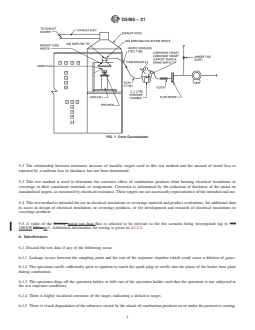
7.1.3 The cone corrosimeter consists of the following main
6. Interferences
components: conical-shaped radiant electric heater, tempera-
6.1 Discard the test data if any of the following occur: ture controller, load cell, electric ignition spark plug, heat-flux
6.1.1 Leakage occurs between the sampling point and the gauge, exhaust system, specimen holder, and the gas sampling
exit of the exposure chamber which could cause a dilution of system. Other essential elements needed to measure corrosion
gases.
are a corrosion target and a device to measure corrosion (see
6.1.2 The specimen swells sufficiently prior to ignition to 7.9).Ageneral view of the cone corrosimeter is shown in Fig.
touch the spark plug or swells into the plane of the heater base
1.
plate during combustion.
7.2 Conical Heater:
6.1.3 The specimen drips off the specimen holder or falls
7.2.1 The active element of the heater consists of an
out of the specimen holder such that the specimen is not
electrical heater rod, rated at 5000 W at 240 V, tightly wound
subjected to the test exposure conditions.
into the shape of a truncated cone (Fig. 2). The heater is
6.1.4 There is highly localized corrosion of the target,
encased on the outside with a double-wall stainless steel cone,
indicating a defective target.
and packed with a refractory fiber material of approximately
6.1.5 There is visual degradation of the reference circuit by
100-kg/m density.
the attack of combustion products on or under the protective
coating. 7.2.2 The heater is capable of producing heat flux on the
surface of the specimen of up to 100 kW/m with a uniformity
7. Apparatus
of 62% within the central 50 by 50 mm area of the specimen.
7.2.3 The heat flux from the heater is held at a preset level
7.1 General:
by means of a temperature controller and three Type K
7.1.1 This test method uses the cone corrosimeter described
in 7.1.3. Alternatively, the cone calorimeter test equipment is stainless-steel-sheathed thermocouples having an outside di-
ameter of 1.5 to 1.6 mm with an unexposed hot junction.
acceptable provided that it is equipped with a gas sampling
system as described in 7.8. If the cone calorimeter is used to Alternatively, either 3 mm outside diameter sheathed thermo-
couples with an exposed hot junction, or 1 mm outside
assess the fire properties of insulating materials contained in
electrical or optical fiber cables, the test shall be conducted in diameter sheathed thermocouples with an unexposed hot junc-
tion are suitable. They are symmetrically disposed and in
accordance with Test Method D6113, which was developed
specifically for that purpose. contactwith,butnotweldedto,theheaterelement(seeFig.2).
D5485 − 21
FIG. 2 Cross-section View Through Heater
FIG. 3 Exhaust System
The thermocouples are of equal length and wired in parallel to safety feature such that in the event of an open circuit in the
the temperature controller. thermocouple line, it will cause the temperature to fall to near
the bottom of its range.
7.3 Temperature Controller:
7.3.3 The temperature controller uses a zero-crossing-type
7.3.1 Thetemperaturecontrollerfortheheateristoholdthe
thyristor unit.
element temperature steady to within 62 °C. A suitable
7.3.4 Theheatertemperatureismonitoredbyameterwitha
temperature controller system is a “3-term” controller
resolution of 2 °C.
(proportional, integral, and derivative) with a thyristor unit
capable of switching currents up to 25 A at 240 V. 7.4 Exhaust System:
7.3.2 Thecontrollerhasatemperatureinputrangefrom0to 7.4.1 Theexhaust-gassystemconsistsofahigh-temperature
1000 °C, a set scale with a resolution of 2 °C, and automatic centrifugal exhaust blower, a hood, intake and exhaust ducts
cold junction compensation. The controller is equipped with a for the fan, and an orifice plate flowmeter (Fig. 3).
D5485 − 21
by 54 mm height (62 mm). The optional grid (Fig. 7)is
constructed from 1 mm nominal stainless steel and has
dimensionsof109by109mm(62mm).Theoptionalgridhas
2 mm ribs and the openings in the center are 20 by 20 mm
(61mm).
7.6.3 The distance between the bottom surface of the cone
heaterandthetopofthespecimenshallbeadjustedtobe25 6
1mm(Fig. 2), except as indicated in 7.6.3.1.
7.6.3.1 Thedistancebetweenthebottomsurfaceofthecone
heater and the top of the specimen shall be adjusted to 60 mm
in the case of those dimensionally unstable materials that have
thepotentialtointumesceordeformtosuchanextentthatthey
are likely to make physical contact with either (a) the spark
plug before ignition, or (b) the underside of the cone heater
after ignition.
7.6.3.2 If a test is conducted in accordance with the speci-
men mounting in 7.6.3.1 (a 60 mm distance), the heat flux
calibration shall be performed with the heat flux meter posi-
tioned 60 mm below the cone heater base plate.
7.6.3.3 If a test has been conducted with a distance of
FIG. 4 Exploded View of Load Cell and Cone Radiant Heater
25mmandthetypeofphysicalcontactdescribedin7.6.3.1has
occurred, that test shall be deemed invalid and the distance
7.4.2 The flow rate is determined by measuring the differ-
shall be adjusted to 60 mm for future tests.
ential pressure across a sharp-edged orifice (57 mm inside
7.6.4 Intumescent materials. The testing technique to be
diameter) in the exhaust stack, at least 350 mm downstream
used when testing intumescing specimens in the horizontal
from the fan.
orientation shall be documented in the test report. Options
7.4.3 In other details, the geometry of the exhaust system is
include those shown in 7.6.4.1 – 7.6.4.4.
not critical. Where necessary, small deviations from the rec-
7.6.4.1 Use a retainer frame or edge frame (Fig. 6). The
ommended dimensions given in Fig. 3 are allowed. For
edge frame is used to reduce unrepresentative edge burning of
example,itispermissiblefortheinnerdiameteroftheductand
specimens. The edge frame is constructed from 1.9 mm
the orifice plate to be slightly different (tolerance: 62 mm).
nominal stainless steel with outside dimensions of 111 by 111
The location of the fan in Fig. 3 shall be between 900 and
by 54 mm height (62 mm).
1200mm downstream of the hood. Flow through the fan
7.6.4.2 Use a wire grid (Fig. 7). The wire grid is used for
ensures adequate mixing, which is essential to the test.
retaining specimens prone to delamination and is suitable for
7.5 Load Cell—The general arrangement of the load cell
several types of intumescent specimens. The grid is con-
with the conical heater is shown in Fig. 4. Use a load cell with structedfrom1mmnominalstainlesssteelandhasdimensions
an accuracy of 0.1 g, a measuring range of at least 500 g, and
of 109 by 109 mm (62 mm). The grid has 2 mm ribs and the
a mechanical tare adjustment range of 3.5 kg. openings in the center are 20 by 20 mm (61 mm).
7.6.4.3 Use a separation distance between the cone base
7.6 Specimen Holder and Mounting:
plate and the upper specimen surface of 60 mm instead of
7.6.1 Two specimen holders are described, one in 7.6.2 –
25mm. This technique is suitable for those dimensionally
7.6.4 and one in 7.6.5.
unstable materials that have the potential to intumesce or
7.6.2 The first specimen holder is shown in Fig. 5. The
deform to such an extent that they are likely to make physical
bottom is constructed from 2.4 mm nominal stainless steel and
contact with either (a) the spark plug before ignition or (b) the
has outside dimensions of 106 by 106 by 25 mm height
underside of the cone heater after ignition.
(62mm).
7.6.4.4 Use a special mounting procedure suitable for the
7.6.2.1 An open stainless steel square, 59 mm in inside
specimen to be tested.
dimensions, shall be spot welded to the underside of the
7.6.5 The second specimen holder is shown in Fig. 8.
horizontal specimen holder to facilitate the centering of the
specimen under the cone heater. The leading edge of the open 7.6.5.1 The second specimen holder consists of the bottom,
square underneath the specimen holder, which is the one the edge frame, retaining pins, and wire grid as shown in Fig.
oppositethehandle,isoptional.Theopensquareonthebottom 8.Thebottomisconstructedfrom2mmnominalstainlesssteel
of the specimen holder shall be designed to seat with the and has outside dimensions of 111 by 111 by 24 mm height
sample mount assembly located at the top of the load cell, (62mm).Thegridisconstructedfrom1mmnominalstainless
ensuring that the specimen holder is centered with respect to steelandhasdimensionsof109by109mm(62mm).Thegrid
the cone heater. has 1 mm ribs and the openings in the center are 19 by 19 mm
7.6.2.2 Optionally, use an edge frame and a grid. The (61 mm). The edge frame is constructed from 2 mm nominal
optional edge frame (Fig. 6) is constructed from 1.9 mm stainlesssteelwithoutsidedimensionsof116by116by56mm
nominal stainless steel with outside dimensions of 111 by 111 height (62 mm). The frame has an 8 mm lip on the top to
D5485 − 21
NOTE 1—All dimensions are in millimetres.
NOTE 2—“*” Indicates a critical dimension.
FIG. 5 First Specimen Holder
provide an opening of 100 by 100 mm on the top. There are 7.8 Gas Sampling System:
two3mm(60.5 mm) diameter by 130 mm (63 mm) long
7.8.1 The gas sampling system consists of a conical funnel,
retaining pins to lock the test specimen in the edge frame.
stainless steel tubing, electric heating tape, silicone rubber
7.6.5.2 The distance between the bottom of the radiant
tubing, filter, flowmeter, exposure chamber, target support
heater and the top of the edge frame is adjusted to 25 61mm
stand, and pump.The general arrangement of the gas sampling
by using a sliding height adjustment (Fig. 2).
system is shown in Fig. 1.
7.6.6 The bottom of the specimen holder in 7.6.2 – 7.6.4 or
7.8.2 Funnel—The funnel is a truncated cone constructed
the one in 7.6.5 shall be lined with a layer of a low-density
3 from stainless steel having a larger diameter of 173 6 5 mm,
(nominal density 65 kg/m ) refractory fiber blanket with a
a smaller diameter of 60 6 5 mm, and a height of 97 6 5 mm.
thickness of at least 13 mm.
It stands on 57 6 5 mm legs projecting from the larger
7.7 Ignition Circuit:
diameter end. The funnel is shown in Fig. 9.
7.7.1 External ignitor is a spark plug powered from a 10kV
7.8.3 Rigid Tubing—A 6.3 mm (0.25-in.) outside diameter
transformer. The spark plug has a gap of 3 mm. The trans-
by 675 6 75 mm long stainless steel tube draws a gas sample
former is of a type specifically designed for spark-ignition use.
from the combustion stream. One end of the tube is bent with
The transformer has an isolated (ungrounded) secondary to
the open end of the tube facing away from the specimen
minimize interference with the data-transmission lines. The
surface. The end of the tube is 255 6 10 mm from the
electrode length and location of the spark plug is such that the
spark gap is located 13 mm above the center of the specimen. specimen surface. The other end of the rigid tube is connected
D5485 − 21
NOTE 1—All dimensions are in millimetres.
NOTE 2—* Indicates a critical dimension.
FIG. 6 Optional Edge Frame
D5485 − 21
NOTE 1—All dimensions are in millimetres.
FIG. 7 Optional Grid
to flexible tubing. The arrangement of the rigid tube with the polycarbonate material 3 mm thick. The bottom component is
funnel is shown in Fig. 9.
formed to the dimensions as shown from a single sheet of
7.8.4 ElectricHeatingTape—Electricheatingtapeisusedto material. Each of the bottom horizontal flanges, vertical legs,
maintain a minimum temperature of the rigid tubing.
and the horizontal ledge (refer to the front view of Fig. 11) are
7.8.5 Flexible Tubing—The flexible tubing consists of
formed by heating the polycarbonate material and bending the
6.3mm inside diameter by 255 6 10 mm long silicone rubber
sheetintothegeometryasshown.Thesmokebaffleiscuttothe
tube. The flexible tubing is used to connect the rigid tubing to
dimensions shown and glued to the bottom with an adhesive.
the exposu
...
This document is not an ASTM standard and is intended only to provide the user of an ASTM standard an indication of what changes have been made to the previous version. Because
it may not be technically possible to adequately depict all changes accurately, ASTM recommends that users consult prior editions as appropriate. In all cases only the current version
of the standard as published by ASTM is to be considered the official document.
Designation: D5485 − 16 D5485 − 21
Standard Test Method for
Determining the Corrosive Effect of Combustion Products
Using the Cone Corrosimeter
This standard is issued under the fixed designation D5485; the number immediately following the designation indicates the year of
original adoption or, in the case of revision, the year of last revision. A number in parentheses indicates the year of last reapproval. A
superscript epsilon (´) indicates an editorial change since the last revision or reapproval.
1. Scope*Scope
1.1 This fire-test-response standard measures the corrosive effect by loss of metal from the combustion products of materials,
components, or products.
1.2 This test method provides corrosion results of product and material specimens limited to a maximum size of 100 by 100 mm
in area and 50 mm thick.
1.3 Additional information regarding the targets, the test conditions, and test limitations is provided in Annex A1the annex.
1.4 The results of this test method have not been investigated with respect to correlation to actual fires.
1.5 An ISO standard exists, as developed by ISO TC 61 (Plastics), subcommittee 4 (on burning behavior), which is technically
very similar to this test method and is designated ISO 11907-4.
1.6 The values stated in SI units are to be regarded as standard. No other units of measurement are included in this standard. (See
IEEE/ASTM SI10).)
1.7 This standard measures and describes the response of materials, products, or assemblies to heat and flame under controlled
conditions, but does not by itself incorporate all factors required for fire hazard or fire risk assessment of the materials, products,
or assemblies under actual fire conditions.
1.8 Fire testing is inherently hazardous. Adequate safeguards for personnel and property shall be employed in conducting these
tests.
1.9 This standard does not purport to address all of the safety concerns, if any, associated with its use. It is the responsibility
of the user of this standard to establish appropriate safety safety, health, and healthenvironmental practices and determine the
applicability of regulatory limitations prior to use. For specific hazard statements, see Section 7.
1.10 This international standard was developed in accordance with internationally recognized principles on standardization
established in the Decision on Principles for the Development of International Standards, Guides and Recommendations issued
by the World Trade Organization Technical Barriers to Trade (TBT) Committee.
This test method is under the jurisdiction of ASTM Committee D09 on Electrical and Electronic Insulating Materials and is the direct responsibility of Subcommittee
D09.17 on Fire and Thermal Properties.
Current edition approved Nov. 1, 2016March 1, 2021. Published November 2016May 2021. Originally approved in 1994. Last previous edition approved in 20112016 as
D5485 – 11.D5485 – 16. DOI: 10.1520/D5485-16.10.1520/D5485-21.
*A Summary of Changes section appears at the end of this standard
Copyright © ASTM International, 100 Barr Harbor Drive, PO Box C700, West Conshohocken, PA 19428-2959. United States
D5485 − 21
2. Referenced Documents
2.1 ASTM Standards:
D618 Practice for Conditioning Plastics for Testing
D1711 Terminology Relating to Electrical Insulation
D6113 Test Method for Using a Cone Calorimeter to Determine Fire-Test-Response Characteristics of Insulating Materials
Contained in Electrical or Optical Fiber Cables
E176 Terminology of Fire Standards
E603 Guide for Room Fire Experiments
E906/E906M Test Method for Heat and Visible Smoke Release Rates for Materials and Products Using a Thermopile Method
E1354 Test Method for Heat and Visible Smoke Release Rates for Materials and Products Using an Oxygen Consumption
Calorimeter
IEEE/ASTM SI-10 Standard for Use of the International System of Units (SI): The Modern Metric System
2.2 ISO StandardsStandards:
ISO 11907-4 Plastics—Smoke Generation—Determination of the Corrosivity of Fire Effluents—Part 4: Dynamic Decomposi-
tion Method Using a Conical Radiant Heater
ISO 13943 Fire safety — Vocabulary
2.3 Other Document:Documents:
OSHA 191.1450 Occupational Exposure to Hazard Chemicals in Laboratories
IEC 60695-4 Fire hazard testing - Part 4: Terminology concerning fire tests for electrotechnical products
3. Terminology
3.1 Definitions:
3.1.1 For definitions of terms used in this test method, refer to Terminologies method and associated with fire issues use
Terminology E176, ISO 13943, and IEC 60695-4. Where differences exist in definitions, those contained in Terminology E176 and
shall be used. Use Terminology D1711. for definitions of terms used in this test method and associated with electrical insulation
materials.
3.2 Definitions of Terms Specific to This Standard:
3.2.1 cone corrosimeter, n—equipment used to determine corrosion in this test method.
3.2.2 corrosion-by-metal-loss, n—loss of metal of a target expressed as reduction of thickness of the target metal.
3.2.3 exposure chamber, n—enclosure in which a target is exposed to combustion products.
3.2.4 heatingheat flux, n—incident power per unit area that is imposed externally fromheat transfer to a surface per unit area, per
unit time (see also the heater on the initial test heat fluxspecimen. ).
3.2.4.1 Discussion—
The specimen, once ignited, is heat flux from an energy source, such as a radiant heater, can be measured at the initiation of a test
(such as Test Method E1354 or E906/E906Malso heated by its own flame.) and then reported as the initial test heat flux, with the
understanding that the burning of the test specimen can generate additional heat flux to the specimen surface. The heat flux can
also be measured at any time during a fire test, for example as described in Guide E603, on any surface, and with measurement
2 2 2
devices responding to radiative and convective fluxes. Typical units are kW/m , W/cm , or BTU/(s ft ).
3.2.5 initial test heat flux, n—the heat flux set on the test apparatus at the initiation of the test (see also heat flux).
3.2.5.1 Discussion—
The initial test heat flux is the heat flux value commonly used when describing or setting test conditions.
3.2.6 sustained flaming, n—existence of flame on or over the surface of the test specimen for periods of 4 s or more.
For referenced ASTM standards, visit the ASTM website, www.astm.org, or contact ASTM Customer Service at service@astm.org. For Annual Book of ASTM Standards
volume information, refer to the standard’s Document Summary page on the ASTM website.
Available from International Organization for Standardization (ISO), 1, ch. de la Voie-Creuse, Case postale 56, CH-1211, Geneva 20, Switzerland, http://www.iso.ch.ISO
Central Secretariat, Chemin de Blandonnet 8, CP 401, 1214 Vernier, Geneva, Switzerland, https://www.iso.org.
Available from Occupational Safety and Health Administration (OSHA)/U.S. Departmnet of Labor, (OSHA), 200 Constitution Ave., NW, Washington, DC 20210,
http://www.osha.gov.
Available from International Electrotechnical Commission (IEC), 3, rue de Varembé, 1st floor, P.O. Box 131, CH-1211, Geneva 20, Switzerland, https://www.iec.ch.
D5485 − 21
3.2.6.1 Discussion—
Flaming ignition of less than 4 s is identified as transitory flaming or flashing.
3.2.7 target, n—detector of known electrical resistance which can lose metal through a process of corrosion when it is exposed
to combustion products.
3.3 Symbols Specific to This Standard: Symbols:
3.3.1 A —initial corrosion instrument reading.reading
3.3.2 A —corrosion instrument reading at the end of 1-h exposure to combustion products.products
3.3.3 A —corrosion instrument reading at the end of 24 h in the environmental chamber.chamber
3.3.4 C—corrosion of a target, nm.nm
3.3.5 C —corrosion at the end of 1-h exposure to combustion products, nm.nm
3.3.6 C —corrosion at the end of 24 h in the environmental chamber, nm.nm
3.3.7 m—specimen mass, g.g
3.3.8 m —final specimen mass, g.g
f
3.3.9 m —initial specimen mass, g.g
i
3.3.10 m —average 70 % of the total mass loss, g.g
3.3.11 t —sampling time, s.s
d
3.3.12 T —temperature of the gas in the exposure chamber, °C.°C
e
3.3.13 V—volumetric sampling rate of combustion products, m /s./s
4. Summary of Test Method
4.1 In this test method, a specimen is subjected to radiant heat. A spark igniter is used to ignite the combustible vapors. The
products of decomposition or combustion are channeled through a funnel. A portion of the products continuously flows through
an exposure chamber which holds the corrosion targets until the specimen has lost an average 70 % of the total combustible mass
or for a period of 60 min, whichever is less. The corrosion of the target is determined by exposure of the target to combustion
products for 1 h, followed by 24-h exposure of the target to a controlled humidity and temperature environment in a separate
chamber. The increase in electrical resistance of each target is monitored, and the reduction in thickness of the metal on the target
is calculated from the increase in electrical resistance. This reduction in thickness is referred to as corrosion-by-metal-loss.
4.2 This test method involves the use of a cone corrosimeter as described in Section 7 and shown in Fig. 1.
4.3 Alternate equipment found suitable for this test method is the cone calorimeter (see Test Method E1354), with the addition
of the gas sampling system described in this test method.
5. Significance and Use
5.1 The metal loss from corrosion is directly related to the increase in electrical resistance of the target due to the decrease in
conductive cross-sectional area.
D5485 − 21
FIG. 1 Cone Corrosimeter
5.2 The relationship between resistance increase of metallic targets used in this test method and the amount of metal loss as
reported by a uniform loss in thickness has not been determined.
5.3 This test method is used to determine the corrosive effect of combustion products from burning electrical insulations or
coverings or their constituent materials or components. Corrosion is determined by the reduction of thickness of the metal on
standardized targets, as measured by electrical resistance. These targets are not necessarily representative of the intended end use.
5.4 This test method is intended for use in electrical insulations or coverings material and product evaluations, for additional data
to assist in design of electrical insulations or coverings products, or for development and research of electrical insulations or
coverings products.
5.5 A value of the heating initial test heat flux is selected to be relevant to the fire scenario being investigated (up to 100
100 kW kW/m⁄m ). Additional information for testing is given in A1.2.3.
6. Interferences
6.1 Discard the test data if any of the following occur:
6.1.1 Leakage occurs between the sampling point and the exit of the exposure chamber which could cause a dilution of gases.
6.1.2 The specimen swells sufficiently prior to ignition to touch the spark plug or swells into the plane of the heater base plate
during combustion.
6.1.3 The specimen drips off the specimen holder or falls out of the specimen holder such that the specimen is not subjected to
the test exposure conditions.
6.1.4 There is highly localized corrosion of the target, indicating a defective target.
6.1.5 There is visual degradation of the reference circuit by the attack of combustion products on or under the protective coating.
D5485 − 21
7. Apparatus
7.1 General:
7.1.1 This test method uses the cone corrosimeter described in 7.1.3. Alternatively, the cone calorimeter test equipment is
acceptable provided that it is equipped with a gas sampling system as described in 7.8. If the cone calorimeter is used to assess
the fire properties of insulating materials contained in electrical or optical fiber cables, the test shall be conducted in accordance
with Test Method D6113, which was developed specifically for that purpose.
7.1.2 The dimensions of the cone corrosimeter specimen holder and additional equipment used in collection of gas samples are
given in Figs. 1-11 and also stated in the following description.
7.1.3 The cone corrosimeter consists of the following main components: conical-shaped radiant electric heater;heater, temperature
controller;controller, load cell;cell, electric ignition spark plug;plug, heat-flux gage;gauge, exhaust system;system, specimen
holder;holder, and the gas sampling system. Other essential elements needed to measure corrosion are a corrosion target and a
device to measure corrosion (see 7.9). A general view of the cone corrosimeter is shown in Fig. 1.
7.2 Conical Heater:
7.2.1 The active element of the heater consists of an electrical heater rod, rated at 5000 W at 240 V, tightly wound into the shape
of a truncated cone (Fig. 2). The heater is encased on the outside with a double-wall stainless steel cone, and packed with a
refractory fiber material of approximately 100-kg/m density.
7.2.2 The heater is capable of producing heatingheat flux on the surface of the specimen of up to 100 kW/m with a uniformity
of 62 % within the central 50 by 50-mm 50 mm area of the specimen.
7.2.3 The heatingheat flux from the heater is held at a preset level by means of a temperature controller and three Type K
stainless-steel-sheathed thermocouples having an outside diameter of 1.5 to 1.6 mm with an unexposed hot junction. Alternatively,
either 3-mm 3 mm outside diameter sheathed thermocouples with an exposed hot junction, or 1-mm 1 mm outside diameter
sheathed thermocouples with an unexposed hot junction are suitable. They are symmetrically disposed and in contact with, but not
welded to, the heater element (see Fig. 2). The thermocouples are of equal length and wired in parallel to the temperature controller.
7.3 Temperature Controller:
7.3.1 The temperature controller for the heater is to hold the element temperature steady to within 62°C. 62 °C. A suitable
temperature controller system is a “3-term” controller (proportional, integral, and derivative) with a thyristor unit capable of
switching currents up to 25 A at 240 V.
FIG. 2 Cross-SectionCross-section View Through the Heater
D5485 − 21
FIG. 3 Exhaust System
FIG. 4 Exploded View of Load Cell and Cone Radiant Heater
7.3.2 The controller has a temperature input range from 0 to 1000°C; 1000 °C, a set scale with a resolution of 2°C; 2 °C, and
automatic cold junction compensation. The controller is equipped with a safety feature such that in the event of an open circuit
in the thermocouple line, it will cause the temperature to fall to near the bottom of its range.
7.3.3 The temperature controller uses a zero-crossing-type thyristor unit.
7.3.4 The heater temperature is monitored by a meter with a resolution of 2°C.2 °C.
7.4 Exhaust System:
D5485 − 21
NOTE 1—All dimensions are in millimetres.
NOTE 2—*“*” Indicates a critical dimension.
FIG. 5 First Specimen Holder
7.4.1 The exhaust-gas system consists of a high-temperature centrifugal exhaust blower, a hood, intake and exhaust ducts for the
fan, and an orifice plate flowmeter (Fig. 3).
7.4.2 The flow rate is determined by measuring the differential pressure across a sharp-edged orifice (57-mm (57 mm inside
diameter) in the exhaust stack, at least 350 mm downstream from the fan.
7.4.3 In other details, the geometry of the exhaust system is not critical. Where necessary, small deviations from the recommended
dimensions given in Fig. 3 are allowed. For example, it is permissible for the inner diameter of the duct and the orifice plate to
be slightly different (tolerance: 62 mm). The location of the fan in Fig. 3 shall be between 900 and 1200 mm 1200 mm
downstream of the hood. Flow through the fan ensures adequate mixing, which is essential to the test.
7.5 Load Cell—The general arrangement of the load cell with the conical heater is shown in Fig. 4. Use a load cell with an
accuracy of 0.1 g, a measuring range of at least 500 g, and a mechanical tare adjustment range of 3.5 kg.
7.6 Specimen Holder and Mounting:
7.6.1 Two specimen holders are described, one in 7.6.2 – 7.6.4 and one in 7.6.5.
D5485 − 21
NOTE 1—All dimensions are in millimetres.
NOTE 2—* Indicates a critical dimension.
FIG. 6 Optional Edge Frame
D5485 − 21
NOTE 1—All dimensions are in millimetres.
FIG. 7 Optional Grid
7.6.2 The first specimen holder is shown in Fig. 5. The bottom is constructed from 2.4-mm 2.4 mm nominal stainless steel and
has outside dimensions of 106 by 106 by 25-mm height (62 mm).25 mm height (62 mm).
7.6.2.1 An open stainless steel square, 59 mm in inside dimensions, shall be spot welded to the underside of the horizontal
specimen holder to facilitate the centering of the specimen under the cone heater. The leading edge of the open square underneath
the specimen holder, which is the one opposite the handle, is optional. The open square on the bottom of the specimen holder shall
be designed to seat with the sample mount assembly located at the top of the load cell, ensuring that the specimen holder is centered
with respect to the cone heater.
7.6.2.2 Optionally, use an edge frame and a grid. The optional edge frame (Fig. 6) is constructed from 1.9-mm 1.9 mm nominal
stainless steel with outside dimensions of 111 by 111 by 54-mm 54 mm height (62 mm). The optional grid (Fig. 7) is constructed
from 1-mm 1 mm nominal stainless steel and has dimensions of 109 by 109 mm (62 mm). The optional grid has 2-mm 2 mm
ribs and the openings in the center are 20 by 20 mm (61 mm).(61 mm).
7.6.3 The distance between the bottom surface of the cone heater and the top of the specimen shall be adjusted to be 25 6 1 mm
(Fig. 2), except as indicated in 7.6.3.1.
D5485 − 21
FIG. 8 Second Specimen Holder
7.6.3.1 The distance between the bottom surface of the cone heater and the top of the specimen shall be adjusted to 60 mm in the
case of those dimensionally unstable materials that have the potential to intumesce or deform to such an extent that they are likely
to make physical contact with either (a) the spark plug before ignition, or (b) the underside of the cone heater after ignition.
7.6.3.2 If a test is conducted in accordance with the specimen mounting in 7.6.3.1 (a 60 mm distance), the heat flux calibration
shall be performed with the heat flux meter positioned 60 mm below the cone heater base plate.
7.6.3.3 If a test has been conducted with a distance of 25 mm 25 mm and the type of physical contact described in 7.6.3.1 has
occurred, that test shall be deemed invalid and the distance shall be adjusted to 60 mm for future tests.
7.6.4 Intumescent materials. The testing technique to be used when testing intumescing specimens in the horizontal orientation
shall be documented in the test report. Options include those shown in 7.6.4.1 – 7.6.4.4.
7.6.4.1 Use a retainer frame or edge frame (Fig. 6). The edge frame is used to reduce unrepresentative edge burning of specimens.
The edge frame is constructed from 1.9-mm 1.9 mm nominal stainless steel with outside dimensions of 111 by 111 by 54-mm 54
mm height (62 mm).
7.6.4.2 Use a wire grid (Fig. 7). The wire grid is used for retaining specimens prone to delamination and is suitable for several
types of intumescent specimens. The grid is constructed from 1-mm 1 mm nominal stainless steel and has dimensions of 109 by
109 mm (62 mm). The grid has 2-mm 2 mm ribs and the openings in the center are 20 by 20 mm (61 mm).
D5485 − 21
FIG. 9 Gas Sampling Collection Device
FIG. 10 11.2-L L Exposure Chamber
D5485 − 21
FIG. 11 Corrosion Target Support Stand and Smoke Baffle
7.6.4.3 Use a separation distance between the cone base plate and the upper specimen surface of 60 mm instead of 25 mm. 25 mm.
This technique is suitable for those dimensionally unstable materials that have the potential to intumesce or deform to such an
extent that they are likely to make physical contact with either (a) the spark plug before ignition or (b) the underside of the cone
heater after ignition.
7.6.4.4 Use a special mounting procedure suitable for the specimen to be tested.
7.6.5 The second specimen holder is shown in Fig. 8.
7.6.5.1 The second specimen holder consists of the bottom, the edge frame, retaining pins, and wire grid as shown in Fig. 8. The
bottom is constructed from 2-mm 2 mm nominal stainless steel and has outside dimensions of 111 by 111 by 24-mm 24 mm height
(62 mm). The grid is constructed from 1-mm 1 mm nominal stainless steel and has dimensions of 109 by 109 mm (62 mm). The
grid has 1-mm 1 mm ribs and the openings in the center are 19 by 19 mm (61 mm). The edge frame is constructed from 2-mm
2 mm nominal stainless steel with outside dimensions of 116 by 116 by 56-mm 56 mm height (62 mm). The frame has an 8-mm
8 mm lip on the top to provide an opening of 100 by 100 mm on the top. There are two 3-mm 3 mm (60.5 mm) diameter by
130-mm 130 mm (63 mm) long retaining pins to lock the test specimen in the edge frame.
7.6.5.2 The distance between the bottom of the radiant heater and the top of the edge frame is adjusted to 25 6 1 mm by using
a sliding height adjustment (Fig. 2).
7.6.6 The bottom of the specimen holder in 7.6.2 – 7.6.4 or the one in 7.6.5 shall be lined with a layer of a low-density (nominal
density 65 kg/m ) refractory fiber blanket with a thickness of at least 13 mm.
7.7 Ignition Circuit:
7.7.1 External ignitor is a spark plug powered from a 10-kV10 kV transformer. The spark plug has a gap of 3 mm. The transformer
is of a type specifically designed for spark-ignition use. The transformer has an isolated (ungrounded) secondary to minimize
interference with the data-transmission lines. The electrode length and location of the spark plug is such that the spark gap is
located 13 mm above the center of the specimen.
7.8 Gas Sampling System:
D5485 − 21
7.8.1 The gas sampling system consists of a conical funnel, stainless steel tubing, electric heating tape, silicone rubber tubing,
filter, flowmeter, exposure chamber, target support stand, and pump. The general arrangement of the gas sampling system is shown
in Fig. 1.
7.8.2 Funnel—The funnel is a truncated cone constructed from stainless steel having a larger diameter of 173 6 5 mm, a smaller
diameter of 60 6 5 mm, and a height of 97 6 5 mm. It stands on 57 6 5-mm 5 mm legs projecting from the larger diameter end.
The funnel is shown in Fig. 9.
7.8.3 Rigid Tubing—A 6.3-mm 6.3 mm (0.25-in.) outside diameter by 675 6 75-mm 75 mm long stainless steel tube draws a gas
sample from the combustion stream. One end of the tube is bent with the open end of the tube facing away from the specimen
surface. The end of the tube is 255 6 10 mm from the specimen surface. The other end of the rigid tube is connected to flexible
tubing. The arrangement of the rigid tube with the funnel is shown in Fig. 9.
7.8.4 Electric Heating Tape—Electric heating tape is used to maintain a minimum temperature of the rigid tubing.
7.8.5 Flexible Tubing—The flexible tubing consists of 6.3-mm6.3 mm inside diameter by 255 6 10-mm 10 mm long silicone
rubber tube. The flexible tubing is used to connect the rigid tubing to the exposure chamber.
7.8.6 Exposure Chamber—The exposure chamber consists of a 0.0112 6 0.0005-m0.0005 m polycarbonate chamber, a corrosion
probe support stand, and smoke baffle. The chamber has an O-ring seal
...