

ASTM E1583-21a
(Practice)Standard Practice for Evaluating Laboratories Engaged in Determination of Lead in Paint, Dust, Airborne Particulates, and Soil Taken From and Around Buildings and Related Structures
General Information
- Abstract
SIGNIFICANCE AND USE
4.1 This practice provides the basic criteria to be used by accreditation bodies and others in evaluating the qualifications of laboratories engaged in the testing of lead in paint, or settled dust, or airborne particulates, or soil, or combination thereof, taken from and around buildings and related structures. The criteria in this practice shall be supplemented by additional specific criteria and requirements, when appropriate; for example, when necessary to be in accordance with federal, state, or local government regulations.
4.2 The accreditation is for organizations and not individuals.
4.3 The practice is intended to provide objective information on the capabilities needed by laboratories to determine lead in paint, dust, airborne particulates, and soil taken from and around buildings and related structures. It is not intended to be used to compare one laboratory with another.
4.4 This practice is also intended for use by laboratories in the development and implementation of their management systems and for use to request or perform an evaluation of in-house facilities in accordance with this practice.
SCOPE
1.1 This practice covers the qualifications, including minimum requirements for personnel and equipment, duties, responsibilities, and services of laboratories engaged in the determination of lead in paint, or settled dust, or airborne particulates, or soil, or any combination thereof, taken from and around buildings and related structures.
1.2 This practice has been developed consistent with Guides E548 and E994, to supplement ISO/IEC 17025.
1.3 This practice contains notes that are explanatory and are not part of the mandatory requirements of the practice.
1.4 This standard does not purport to address all of the safety concerns, if any, associated with its use. It is the responsibility of the user of this standard to establish appropriate safety, health, and environmental practices and determine the applicability of regulatory limitations prior to use.
1.5 This international standard was developed in accordance with internationally recognized principles on standardization established in the Decision on Principles for the Development of International Standards, Guides and Recommendations issued by the World Trade Organization Technical Barriers to Trade (TBT) Committee.
- Status
- Published
- Publication Date
- 31-Oct-2021
- Technical Committee
- D22 - Air Quality
- Drafting Committee
- D22.12 - Sampling and Analysis of Lead for Exposure and Risk Assessment
Buy Documents
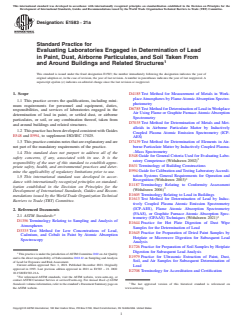
ASTM E1583-21a - Standard Practice for Evaluating Laboratories Engaged in Determination of Lead in Paint, Dust, Airborne Particulates, and Soil Taken From and Around Buildings and Related Structures
REDLINE ASTM E1583-21a - Standard Practice for Evaluating Laboratories Engaged in Determination of Lead in Paint, Dust, Airborne Particulates, and Soil Taken From and Around Buildings and Related Structures
Overview
ASTM E1583-21a is an international standard practice developed by ASTM for evaluating laboratories that determine lead content in paint, settled dust, airborne particulates, and soil taken from and around buildings and related structures. This standard is essential for accreditation bodies and organizations seeking to ensure that laboratories comply with quality and competency requirements for accurate lead analysis. It provides guidance for assessing personnel qualifications, laboratory facilities, management systems, and operational procedures, supporting both compliance and the protection of public health.
Key Topics
- Laboratory Accreditation and Evaluation: Provides the basic criteria for accreditation bodies and other authorities to objectively evaluate laboratory capabilities concerning lead analysis in environmental samples (paint, dust, air, soil).
- Personnel and Organizational Requirements: Outlines minimum personnel qualifications, including education, training, and technical experience, as well as requirements for technical and quality managers.
- Quality Assurance Programs: Establishes the necessity for documented quality assurance (QA) programs within a laboratory’s management system, including document control, sample management, data validation, and corrective actions.
- Equipment and Facility Requirements: Describes the need for adequate and properly maintained equipment and facilities to support reliable lead determination.
- Test Methods and Calibration: Emphasizes the use of validated test methods and the need for regular calibration and verification of analytical instruments, with reference to standards such as ISO/IEC 17025.
- Sample Handling and Recordkeeping: Sets forth documented procedures for sample identification, handling, storage, and comprehensive record retention.
- Reporting Procedures: Details requirements for clear, traceable laboratory reports including information on the test sample, applied methods, results, and uncertainties.
Applications
ASTM E1583-21a supports a range of practical applications relevant to environmental safety and regulatory compliance:
- Laboratory Accreditation: Used by accreditation bodies to assess and accredit laboratories involved in lead analysis, ensuring competence and reliability.
- Environmental Health Assessments: Facilitates lead monitoring in environments such as residences, schools, workplace facilities, and construction sites to mitigate exposure risks.
- Regulatory Compliance: Aids laboratories in meeting federal, state, and local regulatory requirements for lead testing in environmental samples.
- Management System Development: Assists labs in establishing or improving management systems, quality manuals, and operational protocols for lead testing.
- Internal and External Audits: Provides a framework for laboratories to conduct self-assessments or request external evaluations to verify ongoing compliance and improve processes.
- Consultation and Third-party Testing: Ensures that organizations outsourcing lead testing have confidence in the capabilities and practices of contracted laboratories.
Related Standards
ASTM E1583-21a incorporates references to several key standards and authoritative guides:
- ASTM D3335, D4185, D6785: Test methods for trace metals in paint and workplace atmospheres.
- ISO/IEC 17025: General requirements for testing and calibration laboratory competence.
- ISO/IEC 17011: Conformity assessment requirements for accreditation bodies.
- ISO 9000: Quality management systems - fundamentals and vocabulary.
- EPA SW-846, EPA 600/R-93/200: US Environmental Protection Agency test methods for evaluating solid waste and field analysis of lead.
- NIOSH NMAM: National Institute for Occupational Safety and Health’s Manual of Analytical Methods relevant to lead analysis.
- AOAC Official Methods: Widely recognized procedures for chemical analysis in environmental media.
By adhering to ASTM E1583-21a, laboratories can demonstrate their technical proficiency in lead detection, support public safety initiatives, and operate in alignment with both national and international expectations for laboratory practice and accreditation.
Keywords: laboratory accreditation, lead analysis, paint, dust, airborne particulates, soil, ASTM E1583, quality assurance, environmental testing, building safety, regulatory compliance
Relations
- Effective Date
- 01-Nov-2023
- Effective Date
- 01-Nov-2023
- Effective Date
- 01-Sep-2023
- Effective Date
- 01-Sep-2020
- Effective Date
- 15-Mar-2020
- Effective Date
- 01-Feb-2020
- Effective Date
- 01-Apr-2019
- Effective Date
- 01-Jan-2019
- Effective Date
- 15-Dec-2018
- Effective Date
- 01-Oct-2018
- Effective Date
- 01-Sep-2018
- Effective Date
- 01-Apr-2018
- Effective Date
- 01-Mar-2017
- Effective Date
- 15-Feb-2017
- Effective Date
- 01-Oct-2016
Buy Documents
ASTM E1583-21a - Standard Practice for Evaluating Laboratories Engaged in Determination of Lead in Paint, Dust, Airborne Particulates, and Soil Taken From and Around Buildings and Related Structures
REDLINE ASTM E1583-21a - Standard Practice for Evaluating Laboratories Engaged in Determination of Lead in Paint, Dust, Airborne Particulates, and Soil Taken From and Around Buildings and Related Structures
Get Certified
Connect with accredited certification bodies for this standard

CIS Institut d.o.o.
Personal Protective Equipment (PPE) certification body. Notified Body NB-2890 for EU Regulation 2016/425 PPE.

Kiwa BDA Testing
Building and construction product certification.
Kmetijski inštitut Slovenije
Agricultural Institute of Slovenia. Soil testing, plant health, agricultural product analysis.
Sponsored listings
Frequently Asked Questions
ASTM E1583-21a is a standard published by ASTM International. Its full title is "Standard Practice for Evaluating Laboratories Engaged in Determination of Lead in Paint, Dust, Airborne Particulates, and Soil Taken From and Around Buildings and Related Structures". This standard covers: SIGNIFICANCE AND USE 4.1 This practice provides the basic criteria to be used by accreditation bodies and others in evaluating the qualifications of laboratories engaged in the testing of lead in paint, or settled dust, or airborne particulates, or soil, or combination thereof, taken from and around buildings and related structures. The criteria in this practice shall be supplemented by additional specific criteria and requirements, when appropriate; for example, when necessary to be in accordance with federal, state, or local government regulations. 4.2 The accreditation is for organizations and not individuals. 4.3 The practice is intended to provide objective information on the capabilities needed by laboratories to determine lead in paint, dust, airborne particulates, and soil taken from and around buildings and related structures. It is not intended to be used to compare one laboratory with another. 4.4 This practice is also intended for use by laboratories in the development and implementation of their management systems and for use to request or perform an evaluation of in-house facilities in accordance with this practice. SCOPE 1.1 This practice covers the qualifications, including minimum requirements for personnel and equipment, duties, responsibilities, and services of laboratories engaged in the determination of lead in paint, or settled dust, or airborne particulates, or soil, or any combination thereof, taken from and around buildings and related structures. 1.2 This practice has been developed consistent with Guides E548 and E994, to supplement ISO/IEC 17025. 1.3 This practice contains notes that are explanatory and are not part of the mandatory requirements of the practice. 1.4 This standard does not purport to address all of the safety concerns, if any, associated with its use. It is the responsibility of the user of this standard to establish appropriate safety, health, and environmental practices and determine the applicability of regulatory limitations prior to use. 1.5 This international standard was developed in accordance with internationally recognized principles on standardization established in the Decision on Principles for the Development of International Standards, Guides and Recommendations issued by the World Trade Organization Technical Barriers to Trade (TBT) Committee.
SIGNIFICANCE AND USE 4.1 This practice provides the basic criteria to be used by accreditation bodies and others in evaluating the qualifications of laboratories engaged in the testing of lead in paint, or settled dust, or airborne particulates, or soil, or combination thereof, taken from and around buildings and related structures. The criteria in this practice shall be supplemented by additional specific criteria and requirements, when appropriate; for example, when necessary to be in accordance with federal, state, or local government regulations. 4.2 The accreditation is for organizations and not individuals. 4.3 The practice is intended to provide objective information on the capabilities needed by laboratories to determine lead in paint, dust, airborne particulates, and soil taken from and around buildings and related structures. It is not intended to be used to compare one laboratory with another. 4.4 This practice is also intended for use by laboratories in the development and implementation of their management systems and for use to request or perform an evaluation of in-house facilities in accordance with this practice. SCOPE 1.1 This practice covers the qualifications, including minimum requirements for personnel and equipment, duties, responsibilities, and services of laboratories engaged in the determination of lead in paint, or settled dust, or airborne particulates, or soil, or any combination thereof, taken from and around buildings and related structures. 1.2 This practice has been developed consistent with Guides E548 and E994, to supplement ISO/IEC 17025. 1.3 This practice contains notes that are explanatory and are not part of the mandatory requirements of the practice. 1.4 This standard does not purport to address all of the safety concerns, if any, associated with its use. It is the responsibility of the user of this standard to establish appropriate safety, health, and environmental practices and determine the applicability of regulatory limitations prior to use. 1.5 This international standard was developed in accordance with internationally recognized principles on standardization established in the Decision on Principles for the Development of International Standards, Guides and Recommendations issued by the World Trade Organization Technical Barriers to Trade (TBT) Committee.
ASTM E1583-21a is classified under the following ICS (International Classification for Standards) categories: 13.040.40 - Stationary source emissions. The ICS classification helps identify the subject area and facilitates finding related standards.
ASTM E1583-21a has the following relationships with other standards: It is inter standard links to ASTM E2708-23, ASTM E3193-23, ASTM D4185-23, ASTM D1356-20a, ASTM D1356-20, ASTM D3335-85a(2020), ASTM E3203-19, ASTM E3193-19, ASTM E1605-18b, ASTM E1605-18a, ASTM E1605-18, ASTM E2708-18, ASTM D4185-17, ASTM E2708-17, ASTM E1644-04(2016)e1. Understanding these relationships helps ensure you are using the most current and applicable version of the standard.
ASTM E1583-21a is available in PDF format for immediate download after purchase. The document can be added to your cart and obtained through the secure checkout process. Digital delivery ensures instant access to the complete standard document.
Standards Content (Sample)
This international standard was developed in accordance with internationally recognized principles on standardization established in the Decision on Principles for the
Development of International Standards, Guides and Recommendations issued by the World Trade Organization Technical Barriers to Trade (TBT) Committee.
Designation: E1583 − 21a
Standard Practice for
Evaluating Laboratories Engaged in Determination of Lead
in Paint, Dust, Airborne Particulates, and Soil Taken From
and Around Buildings and Related Structures
This standard is issued under the fixed designation E1583; the number immediately following the designation indicates the year of
original adoption or, in the case of revision, the year of last revision. A number in parentheses indicates the year of last reapproval. A
superscript epsilon (´) indicates an editorial change since the last revision or reapproval.
1. Scope D4185 Test Method for Measurement of Metals in Work-
placeAtmospheres by FlameAtomicAbsorption Spectro-
1.1 This practice covers the qualifications, including mini-
photometry
mum requirements for personnel and equipment, duties,
D6785 Test Method for Determination of Lead inWorkplace
responsibilities, and services of laboratories engaged in the
Air Using Flame or Graphite Furnace Atomic Absorption
determination of lead in paint, or settled dust, or airborne
Spectrometry
particulates, or soil, or any combination thereof, taken from
D7035 Test Method for Determination of Metals and Met-
and around buildings and related structures.
alloids in Airborne Particulate Matter by Inductively
1.2 ThispracticehasbeendevelopedconsistentwithGuides
Coupled Plasma Atomic Emission Spectrometry (ICP-
E548 and E994, to supplement ISO/IEC 17025.
AES)
1.3 This practice contains notes that are explanatory and are D7439 Test Method for Determination of Elements in Air-
borne Particulate Matter by Inductively Coupled Plasma-
not part of the mandatory requirements of the practice.
–Mass Spectrometry
1.4 This standard does not purport to address all of the
E548 Guide for General Criteria Used for Evaluating Labo-
safety concerns, if any, associated with its use. It is the
ratory Competence (Withdrawn 2002)
responsibility of the user of this standard to establish appro-
E631 Terminology of Building Constructions
priate safety, health, and environmental practices and deter-
E994 Guide for Calibration and Testing LaboratoryAccredi-
mine the applicability of regulatory limitations prior to use.
tation Systems General Requirements for Operation and
1.5 This international standard was developed in accor-
Recognition (Withdrawn 2003)
dance with internationally recognized principles on standard-
E1187 Terminology Relating to Conformity Assessment
ization established in the Decision on Principles for the
(Withdrawn 2006)
Development of International Standards, Guides and Recom-
E1605 Terminology Relating to Lead in Buildings
mendations issued by the World Trade Organization Technical
E1613 Test Method for Determination of Lead by Induc-
Barriers to Trade (TBT) Committee.
tively Coupled Plasma Atomic Emission Spectrometry
(ICP-AES), Flame Atomic Absorption Spectrometry
2. Referenced Documents
(FAAS), or Graphite Furnace Atomic Absorption Spec-
2.1 ASTM Standards:
trometry (GFAAS) Techniques (Withdrawn 2021)
D1356 Terminology Relating to Sampling and Analysis of
E1644 Practice for Hot Plate Digestion of Dust Wipe
Atmospheres
Samples for the Determination of Lead
D3335 Test Method for Low Concentrations of Lead,
E1645 Practice for Preparation of Dried Paint Samples by
Cadmium, and Cobalt in Paint by Atomic Absorption
Hotplate or Microwave Digestion for Subsequent Lead
Spectroscopy
Analysis
E1726 Practice for Preparation of Soil Samples by Hotplate
Digestion for Subsequent Lead Analysis
This practice is under the jurisdiction ofASTM Committee D22 on Air Quality
E1979 Practice for Ultrasonic Extraction of Paint, Dust,
and is the direct responsibility of Subcommittee D22.12 on Sampling and Analysis
of Lead for Exposure and Risk Assessment. Soil, and Air Samples for Subsequent Determination of
Current edition approved Nov. 1, 2021. Published December 2021. Originally
Lead
approved in 1993. Last previous edition approved in 2021 as E1583 – 21. DOI:
E2708 Terminology for Accreditation and Certification
10.1520/E1583-21A.
For referenced ASTM standards, visit the ASTM website, www.astm.org, or
contact ASTM Customer Service at service@astm.org. For Annual Book of ASTM
Standards volume information, refer to the standard’s Document Summary page on The last approved version of this historical standard is referenced on
the ASTM website. www.astm.org.
Copyright © ASTM International, 100 Barr Harbor Drive, PO Box C700, West Conshohocken, PA 19428-2959. United States
E1583 − 21a
E2913/E2913M Practice for Hotplate Digestion of Lead Terminology E1187, or Terminology E1605, or Terminology
from Composited Wipe Samples E2708.
E2914/E2914M Practice for Ultrasonic Extraction of Lead 3.1.1 accreditation body—authoritative body that performs
from Composited Wipe Samples accreditation. (ISO/IEC 17011)
E3193 Test Method for Measurement of Lead (Pb) in Dust 3.1.1.1 Discussion—For example, an accreditation body
by Wipe, Paint, and Soil by Flame Atomic Absorption may be an organization that has demonstrated competency to
Spectrophotometry (FAAS) ISO/IEC17011andsuccessfullycompletedthepeerevaluation
E3203 Test Method for Determination of Lead in Dried process through the International Laboratory Accreditation
Paint, Soil, and Wipe Samples by Inductively Coupled Cooperation (ILAC) recognition process or through an ILAC
Plasma-Optical Emission Spectroscopy (ICP-OES) regional cooperation such as the Inter-American Accreditation
Cooperation (IACC) or Asia Pacific Laboratory Accreditation
2.2 ISO Standards:
Cooperation (APLAC), or both.
ISO 8518 Workplace air — Determination of particulate
lead and lead compounds — Flame or electrothermal 3.1.2 management system—set of interrelated or interacting
atomic absorption spectrometric method
elements of an organization to establish policies and
ISO 9000 Quality management systems — Fundamentals objectives, and processes to achieve those objectives. (ISO
and vocabulary 9000)
ISO 15202-2 Workplace air — Determination of metals and
4. Significance and Use
metalloids in airborne particulate matter by inductively
coupled plasma atomic emission spectrometry — Part 2:
4.1 This practice provides the basic criteria to be used by
Sample preparation
accreditation bodies and others in evaluating the qualifications
ISO 15202-3 Workplace air — Determination of metals and
of laboratories engaged in the testing of lead in paint, or settled
metalloids in airborne particulate matter by inductively
dust, or airborne particulates, or soil, or combination thereof,
coupled plasma atomic emission spectrometry — Part 3:
taken from and around buildings and related structures. The
Analysis
criteria in this practice shall be supplemented by additional
ISO/IEC 17011 Conformity assessment — General require-
specific criteria and requirements, when appropriate; for
ments for accreditation bodies accrediting conformity
example, when necessary to be in accordance with federal,
assessment bodies
state, or local government regulations.
ISO/IEC 17025 General requirements for the competence of
4.2 The accreditation is for organizations and not individu-
testing and calibration laboratories
als.
ISO 30011 Workplace air — Determination of metals and
4.3 The practice is intended to provide objective informa-
metalloids in airborne particulate matter by inductively
tion on the capabilities needed by laboratories to determine
coupled plasma mass spectrometry
lead in paint, dust, airborne particulates, and soil taken from
2.3 EPA Documents:
and around buildings and related structures. It is not intended
EPA SW-846 Test Methods for Evaluating Solid Waste:
5 to be used to compare one laboratory with another.
Physical/Chemical Methods
EPA 600/R-93/200 Standard Operating Procedure for the 4.4 This practice is also intended for use by laboratories in
the development and implementation of their management
Field Analysis of Lead in Paint, Bulk Dust, and Soil by
systems and for use to request or perform an evaluation of
Ultrasonic,AcidDigestionandColorimetricMeasurement
in-house facilities in accordance with this practice.
2.4 Other Documents:
NIOSH Manual of Analytical Methods (NMAM), 5th Edi-
5. Organization
tion
5.1 The laboratory shall be legally identifiable. The labora-
AOAC Official Methods ofAnalysis ofAOAC International,
tory shall be organized and shall operate in such a way that its
19th Edition (2012)
facilities meet the requirements of this practice.
3. Terminology
5.2 The laboratory shall meet the following requirements:
5.2.1 Have an organizational structure, including a quality
3.1 Definitions—For definitions of terms used in this
assurance program within its management system, that enables
practice,refertoTerminologyD1356,orTerminologyE631,or
it to maintain the capability to satisfactorily perform tests for
the determination of lead in paint, dust, airborne particulates,
4 and soil taken from and around buildings and related struc-
Available from International Organization for Standardization (ISO), ISO
Central Secretariat, Chemin de Blandonnet 8, CP 401, 1214 Vernier, Geneva,
tures;
Switzerland, https://www.iso.org.
5.2.2 Beabletodemonstrate,onrequestfromthepersonsor
Available from United States Environmental ProtectionAgency (EPA) / Office
organizations evaluating the laboratory’s competence, that the
of Resource Conservation and Recovery, 1200 Pennsylvania Ave., NW (5305P),
laboratory is capable of performing the tests for which the
Washington DC 20460, https://www.epa.gov/hw-sw846.
AvailablefromNationalInstituteforOccupationalSafetyandHealth(NIOSH),
laboratory is being evaluated;
Patriots Plaza 1, 395 E Street, SW, Suite 9200, Washington, DC 20201, https://
5.2.3 Be organized so that staff members are not subject to
www.cdc.gov/niosh/nmam.
undue pressure or inducement that might influence their
Available from AOAC International, 2275 Research Blvd., Suite 300,
Rockville, MD 20850-3250, http://www.aoac.org. judgment or the results of their work;
E1583 − 21a
5.2.4 Be organized in such a way that confidence in its entries to hard-copy laboratory records shall be made using
independence of judgment and integrity is maintained at all indelible ink, and that no correction fluid may be used on
times; hard-copy original laboratory data records.
5.2.5 Be organized in such a way that each staff member is
6.3 The laboratory shall arrange for audits of its activities at
aware of both the extent and limitations of their responsibility;
appropriate intervals to verify that its operations continue to
5.2.6 Have a technical manager (however named) who is an
comply with the requirements of the quality management
employee of the laboratory, has overall responsibility for the
system.Suchauditsshallbeperformedbytrainedandqualified
technical operations of the laboratory, and has demonstrated
staff who are, wherever possible, independent of the activity to
competence in lead analyses through education or professional
be audited. Where the audit findings cast doubt on the
experience, or both, in order to be able to design and
correctness or validity of the laboratory’s calibration or test
implement the management system and enable that individual
results, the laboratory shall take immediate corrective action
to identify the occurrence of departures from the implemented
andshallimmediatelynotify,inwriting,anyclientwhosework
management system or test procedures, and to initiate actions
may have been affected.
to prevent or minimize departures; and
5.2.7 Have a quality manager (however named) who has
6.4 The management system adopted to satisfy the require-
responsibility for the quality assurance program within the
ments of this practice shall be reviewed by laboratory manage-
management system and its implementation, and who shall be
ment periodically and whenever significant changes occur to
free of any conflict of interest and have direct access to the top
ensure its continuing suitability and effectiveness, and to
management of the laboratory.
introduce any necessary changes or improvements.
NOTE 1—In the case of a laboratory with only one employee (the
6.5 All audit and review findings and any corrective actions
technical manager), the position of quality manager may be contracted
that arise from them shall be documented.The quality manager
out.
shall ensure that these actions are discharged within the
agreed-upon time scale.
6. Quality Assurance Program
6.1 The laboratory shall operate under an internal quality
6.6 The laboratory shall normally perform the lead testing
assurance program within the management system appropriate
thatitcontractstoundertake.Ifthelaboratorysubcontractsany
to the determination of lead taken from paint, dust, airborne
part of the testing, the work shall be placed with another
particulates, and soil taken from and around buildings and
l
...
This document is not an ASTM standard and is intended only to provide the user of an ASTM standard an indication of what changes have been made to the previous version. Because
it may not be technically possible to adequately depict all changes accurately, ASTM recommends that users consult prior editions as appropriate. In all cases only the current version
of the standard as published by ASTM is to be considered the official document.
Designation: E1583 − 21 E1583 − 21a
Standard Practice for
Evaluating Laboratories Engaged in Determination of Lead
in Paint, Dust, Airborne Particulates, and Soil Taken From
and Around Buildings and Related Structures
This standard is issued under the fixed designation E1583; the number immediately following the designation indicates the year of
original adoption or, in the case of revision, the year of last revision. A number in parentheses indicates the year of last reapproval. A
superscript epsilon (´) indicates an editorial change since the last revision or reapproval.
1. Scope
1.1 This practice covers the qualifications, including minimum requirements for personnel and equipment, duties, responsibilities,
and services of laboratories engaged in the determination of lead in paint, or settled dust, or airborne particulates, or soil, or any
combination thereof, taken from and around buildings and related structures.
1.2 This practice has been developed consistent with Guides E548 and E994, to supplement ISO/IEC 17025.
1.3 This practice contains notes that are explanatory and are not part of the mandatory requirements of the practice.
1.4 This standard does not purport to address all of the safety concerns, if any, associated with its use. It is the responsibility
of the user of this standard to establish appropriate safety, health, and environmental practices and determine the applicability of
regulatory limitations prior to use.
1.5 This international standard was developed in accordance with internationally recognized principles on standardization
established in the Decision on Principles for the Development of International Standards, Guides and Recommendations issued
by the World Trade Organization Technical Barriers to Trade (TBT) Committee.
2. Referenced Documents
2.1 ASTM Standards:
D1356 Terminology Relating to Sampling and Analysis of Atmospheres
D3335 Test Method for Low Concentrations of Lead, Cadmium, and Cobalt in Paint by Atomic Absorption Spectroscopy
D4185 Test Method for Measurement of Metals in Workplace Atmospheres by Flame Atomic Absorption Spectrophotometry
D6785 Test Method for Determination of Lead in Workplace Air Using Flame or Graphite Furnace Atomic Absorption
Spectrometry
D7035 Test Method for Determination of Metals and Metalloids in Airborne Particulate Matter by Inductively Coupled Plasma
Atomic Emission Spectrometry (ICP-AES)
D7439 Test Method for Determination of Elements in Airborne Particulate Matter by Inductively Coupled Plasma–Mass
Spectrometry
E548 Guide for General Criteria Used for Evaluating Laboratory Competence (Withdrawn 2002)
This practice is under the jurisdiction of ASTM Committee D22 on Air Quality and is the direct responsibility of Subcommittee D22.12 on Sampling and Analysis of
Lead for Exposure and Risk Assessment.
Current edition approved Sept. 1, 2021Nov. 1, 2021. Published October 2021December 2021. Originally approved in 1993. Last previous edition approved in 20172021
as E1583 – 17.21. DOI: 10.1520/E1583-21.10.1520/E1583-21A.
For referenced ASTM standards, visit the ASTM website, www.astm.org, or contact ASTM Customer Service at service@astm.org. For Annual Book of ASTM Standards
volume information, refer to the standard’s Document Summary page on the ASTM website.
The last approved version of this historical standard is referenced on www.astm.org.
Copyright © ASTM International, 100 Barr Harbor Drive, PO Box C700, West Conshohocken, PA 19428-2959. United States
E1583 − 21a
E631 Terminology of Building Constructions
E994 Guide for Calibration and Testing Laboratory Accreditation Systems General Requirements for Operation and Recognition
(Withdrawn 2003)
E1187 Terminology Relating to Conformity Assessment (Withdrawn 2006)
E1605 Terminology Relating to Lead in Buildings
E1613 Test Method for Determination of Lead by Inductively Coupled Plasma Atomic Emission Spectrometry (ICP-AES),
Flame Atomic Absorption Spectrometry (FAAS), or Graphite Furnace Atomic Absorption Spectrometry (GFAAS) Techniques
(Withdrawn 2021)
E1644 Practice for Hot Plate Digestion of Dust Wipe Samples for the Determination of Lead
E1645 Practice for Preparation of Dried Paint Samples by Hotplate or Microwave Digestion for Subsequent Lead Analysis
E1726 Practice for Preparation of Soil Samples by Hotplate Digestion for Subsequent Lead Analysis
E1979 Practice for Ultrasonic Extraction of Paint, Dust, Soil, and Air Samples for Subsequent Determination of Lead
E2708 Terminology for Accreditation and Certification
E2913/E2913M Practice for Hotplate Digestion of Lead from Composited Wipe Samples
E2914/E2914M Practice for Ultrasonic Extraction of Lead from Composited Wipe Samples
E3193 Test Method for Measurement of Lead (Pb) in Dust by Wipe, Paint, and Soil by Flame Atomic Absorption
Spectrophotometry (FAAS)
E3203 Test Method for Determination of Lead in Dried Paint, Soil, and Wipe Samples by Inductively Coupled Plasma-Optical
Emission Spectroscopy (ICP-OES)
2.2 ISO Standards:
ISO 8518 Workplace air — Determination of particulate lead and lead compounds — Flame or electrothermal atomic absorption
spectrometric method
ISO 9000 Quality management systems — Fundamentals and vocabulary
ISO 15202-2 Workplace air — Determination of metals and metalloids in airborne particulate matter by inductively coupled
plasma atomic emission spectrometry — Part 2: Sample preparation
ISO 15202-3 Workplace air — Determination of metals and metalloids in airborne particulate matter by inductively coupled
plasma atomic emission spectrometry — Part 3: Analysis
ISO/IEC 17011 Conformity assessment — General requirements for accreditation bodies accrediting conformity assessment
bodies
ISO/IEC 17025 General requirements for the competence of testing and calibration laboratories
ISO 30011 Workplace air — Determination of metals and metalloids in airborne particulate matter by inductively coupled
plasma mass spectrometry
2.3 EPA Documents:
EPA SW-846 Test Methods for Evaluating Solid Waste: Physical/Chemical Methods
EPA 600/R-93/200 Standard Operating Procedure for the Field Analysis of Lead in Paint, Bulk Dust, and Soil by Ultrasonic,
Acid Digestion and Colorimetric Measurement
2.4 Other Documents:
NIOSH Manual of Analytical Methods (NMAM), 5th Edition
AOAC Official Methods of Analysis of AOAC International, 19th Edition (2012)
3. Terminology
3.1 Definitions—For definitions of terms used in this practice, refer to Terminology D1356, or Terminology E631, or
Terminology E1187, or Terminology E1605, or Terminology E2708.
3.1.1 accreditation body—authoritative body that performs accreditation. (ISO/IEC 17011)
3.1.1.1 Discussion—
For example, an accreditation body may be an organization that has demonstrated competency to ISO/IEC 17011 and successfully
completed the peer evaluation process through the International Laboratory Accreditation Cooperation (ILAC) recognition process
or through an ILAC regional cooperation such as the Inter-American Accreditation Cooperation (IACC) or Asia Pacific Laboratory
Accreditation Cooperation (APLAC), or both.
Available from International Organization for Standardization (ISO), ISO Central Secretariat, Chemin de Blandonnet 8, CP 401, 1214 Vernier, Geneva, Switzerland,
https://www.iso.org.
Available from United States Environmental Protection Agency (EPA) / Office of Resource Conservation and Recovery, 1200 Pennsylvania Ave., NW (5305P),
Washington DC 20460, https://www.epa.gov/hw-sw846.
Available from National Institute for Occupational Safety and Health (NIOSH), Patriots Plaza 1, 395 E Street, SW, Suite 9200, Washington, DC 20201,
https://www.cdc.gov/niosh/nmam.
Available from AOAC International, 2275 Research Blvd., Suite 300, Rockville, MD 20850-3250, http://www.aoac.org.
E1583 − 21a
3.1.2 management system—set of interrelated or interacting elements of an organization to establish policies and objectives, and
processes to achieve those objectives. (ISO 9000)
4. Significance and Use
4.1 This practice provides the basic criteria to be used by accreditation bodies and others in evaluating the qualifications of
laboratories engaged in the testing of lead in paint, or settled dust, or airborne particulates, or soil, or combination thereof, taken
from and around buildings and related structures. The criteria in this practice shall be supplemented by additional specific criteria
and requirements, when appropriate; for example, when necessary to be in accordance with federal, state, or local government
regulations.
4.2 The accreditation is for organizations and not individuals.
4.3 The practice is intended to provide objective information on the capabilities needed by laboratories to determine lead in paint,
dust, airborne particulates, and soil taken from and around buildings and related structures. It is not intended to be used to compare
one laboratory with another.
4.4 This practice is also intended for use by laboratories in the development and implementation of their management systems and
for use to request or perform an evaluation of in-house facilities in accordance with this practice.
5. Organization
5.1 The laboratory shall be legally identifiable. The laboratory shall be organized and shall operate in such a way that its facilities
meet the requirements of this practice.
5.2 The laboratory shall meet the following requirements:
5.2.1 Have an organizational structure, including a quality assurance program within its management system, that enables it to
maintain the capability to satisfactorily perform tests for the determination of lead in paint, dust, airborne particulates, and soil
taken from and around buildings and related structures;
5.2.2 Be able to demonstrate, on request from the persons or organizations evaluating the laboratory’s competence, that the
laboratory is capable of performing the tests for which the laboratory is being evaluated;
5.2.3 Be organized so that staff members are not subject to undue pressure or inducement that might influence their judgment or
the results of their work;
5.2.4 Be organized in such a way that confidence in its independence of judgment and integrity is maintained at all times;
5.2.5 Be organized in such a way that each staff member is aware of both the extent and limitations of their responsibility;
5.2.6 Have a technical manager (however named) who is an employee of the laboratory, has overall responsibility for the technical
operations of the laboratory, and has demonstrated competence in lead analyses through education or professional experience, or
both, in order to be able to design and implement the management system and enable that individual to identify the occurrence
of departures from the implemented management system or test procedures, and to initiate actions to prevent or minimize
departures; and
5.2.7 Have a quality manager (however named) who has responsibility for the quality assurance program within the management
system and its implementation, and who shall be free of any conflict of interest and have direct access to the top management of
the laboratory.
NOTE 1—In the case of a laboratory with only one employee (the technical manager), the position of quality manager may be contracted out.
6. Quality Assurance Program
6.1 The laboratory shall operate under an internal quality assurance program within the management system appropriate to the
E1583 − 21a
determination of lead taken from paint, dust, airborne particulates, and soil taken from and around buildings and related structures.
The quality assurance program shall be designed to ensure the required degree of precision and accuracy (or bias) of the
laboratory’s work and should include key elements of document control, sample control, data validation, and corrective/
preventative action. The quality assurance program shall be documented in a quality manual (however titled) that shall be available
for use by laboratory staff.
NOTE 2—The quality manual may consist of more than one document.
6.2 The quality manual shall contain information regarding the following:
6.2.1 The organizational structure of the laboratory which may be portrayed by organizational charts;
6.2.2 The operational and functional duties and services pertaining to quality so that concerned persons will know the extent and
limitations of their responsibility;
6.2.3 General quality procedures, including staff training;
6.2.4 Specific quality procedures for each test, as appropriate;
6.2.5 Proficiency testing, use of reference materials for the determination of lead, and analytical quality control;
6.2.6 Arrangement for feedback and for documentation of corrective action whenever testing discrepancies are detected;
6.2.7 Procedures for dealing with technical complaints;
6.2.8 Arrangements for permitting departures from documented policies or standard test procedures; and
6.2.9 Procedures for corre
...