

ASTM D6830-02(2022)
(Test Method)Standard Test Method for Characterizing the Pressure Drop and Filtration Performance of Cleanable Filter Media
General Information
- Abstract
SIGNIFICANCE AND USE
5.1 This test method determines the comparative performance of filter media. The results can be used for design, manufacturing, construction and selection of filter media.
5.2 Results obtained by this test method should not be used to predict absolute performance on full scale fabric filter (baghouse) facilities, however these results will be useful in selection of proper filter media and identification of recommended operating parameters for these full scale fabric filter facilities.
5.3 Dust types vary greatly; therefore, the results obtained using the standard dust should not be extrapolated to other dust types.
SCOPE
1.1 This test method characterizes the operational performance of cleanable filter media under specified laboratory conditions.
1.2 This test method determines the airflow resistance, drag, cleaning requirements, and particulate filtration performance of pulse cleaned filter media.
1.3 This test method determines the comparative performance of cleanable filter media.
1.4 The results obtained from this test method are useful in the design, construction, and selection of filter media.
1.5 The results obtained by this test method should not be used to predict absolute performance of full scale fabric filter (baghouse) facilities, however these results will be useful in selection of proper filter media and identification of recommended operating parameters for these full scale fabric filter facilities.
1.6 The values stated in SI units are to be regarded as standard. The values given in parentheses are mathematical conversions to inch-pound units that are provided for information only and are not considered standard.
1.7 This standard does not purport to address all of the safety concerns, if any, associated with its use. It is the responsibility of the user of this standard to establish appropriate safety, health, and environmental practices and determine the applicability of regulatory limitations prior to use.
1.8 This international standard was developed in accordance with internationally recognized principles on standardization established in the Decision on Principles for the Development of International Standards, Guides and Recommendations issued by the World Trade Organization Technical Barriers to Trade (TBT) Committee.
- Status
- Published
- Publication Date
- 31-Aug-2022
- Technical Committee
- D22 - Air Quality
- Drafting Committee
- D22.03 - Ambient Atmospheres and Source Emissions
Overview
ASTM D6830-02(2022), titled Standard Test Method for Characterizing the Pressure Drop and Filtration Performance of Cleanable Filter Media, establishes a laboratory methodology for evaluating the operational performance of cleanable filter media under controlled conditions. Issued by ASTM International, this standard is crucial for comparing filter media types, particularly those intended for baghouse and industrial applications. The results enable manufacturers, engineers, and facility managers to make informed decisions regarding the design, construction, and selection of filter media, optimizing the air filtration process in various industrial environments dealing with particulate removal.
Key Topics
- Airflow Resistance and Pressure Drop
- Measures the resistance encountered by air passing through filter media, providing data on pressure drop (ΔP) before and after cleaning.
- Pulse Cleaning Requirements
- Assesses the filter's cleaning efficiency using compressed air pulses, indicating the cleaning frequency and effectiveness.
- Particulate Filtration Performance
- Evaluates how well the filter media captures particulate matter, including total particulate mass and optional PM 2.5 emissions.
- Comparative Performance Analysis
- Provides a uniform laboratory protocol to compare different cleanable media under identical simulated conditions.
- Operational Parameters
- Defines critical parameters such as filtration velocity (gas-to-cloth ratio), dust feeding rates, temperature, and humidity control for test validity.
- Result Reporting
- Outlines mandatory recording of operational and performance data, including pressure drops, cycle times, mass gains, and filtration cycles.
Applications
ASTM D6830-02(2022) has significant practical value for a broad range of industries and professionals seeking to optimize air filtration and dust collection systems:
- Filter Media Selection
- Assists in selecting suitable cleanable filter media for baghouse filter installations by providing standardized comparison data.
- System Design and Engineering
- Informs the design and construction of air filtration systems where cleanable media are required, ensuring that operational requirements are met.
- Quality Control and Manufacturing
- Supports filter media manufacturers in benchmarking and quality assurance, confirming that products meet industry performance standards.
- Research and Product Development
- Facilitates innovation in filtration technologies by offering a robust test method for evaluating new materials under controlled conditions.
- Environmental Compliance
- Helps identify operating parameters that contribute to effective particulate emissions control within regulatory guidelines.
Note: While highly useful for comparative evaluation and media selection, test results should not be extrapolated to predict absolute field performance of full-scale baghouse facilities, nor used for applications involving non-standard dust types.
Related Standards
For a comprehensive approach to filtration media performance assessment and terminology, consider the following related standards:
- ASTM D123 - Terminology Relating to Textiles
- ASTM D737 - Test Method for Air Permeability of Textile Fabrics
- ASTM D1356 - Terminology Relating to Sampling and Analysis of Atmospheres
- ASTM E832 - Specification for Laboratory Filter Papers
- VDI 3926, Part 2 - Testing of Filter Media for Cleanable Filters Under Operational Conditions (German Standard)
- Generic Verification Protocol for Baghouse Filtration Products - U.S. EPA/RTI
Keywords
- Filter media performance
- Pressure drop
- Cleanable filter media
- Pulse cleaning
- Baghouse filters
- Filtration efficiency
- Air filtration standards
- Particulate emission testing
- ASTM D6830
- Industrial dust collection
By adhering to ASTM D6830-02(2022), stakeholders ensure that cleanable filter media are tested using internationally recognized methods, supporting effective and reliable air quality management in industrial settings.
Relations
- Effective Date
- 01-Sep-2020
- Effective Date
- 15-Mar-2020
- Effective Date
- 01-Jul-2019
- Effective Date
- 01-Mar-2017
- Effective Date
- 01-Jul-2016
- Effective Date
- 15-Oct-2015
- Effective Date
- 15-Sep-2015
- Effective Date
- 01-Sep-2015
- Effective Date
- 01-Jul-2015
- Effective Date
- 01-Apr-2015
- Effective Date
- 01-Dec-2014
- Effective Date
- 01-May-2014
- Effective Date
- 15-Jan-2014
- Effective Date
- 15-Jun-2013
- Effective Date
- 15-Jun-2013
Get Certified
Connect with accredited certification bodies for this standard

CIS Institut d.o.o.
Personal Protective Equipment (PPE) certification body. Notified Body NB-2890 for EU Regulation 2016/425 PPE.

Kiwa BDA Testing
Building and construction product certification.
Kmetijski inštitut Slovenije
Agricultural Institute of Slovenia. Soil testing, plant health, agricultural product analysis.
Sponsored listings
Frequently Asked Questions
ASTM D6830-02(2022) is a standard published by ASTM International. Its full title is "Standard Test Method for Characterizing the Pressure Drop and Filtration Performance of Cleanable Filter Media". This standard covers: SIGNIFICANCE AND USE 5.1 This test method determines the comparative performance of filter media. The results can be used for design, manufacturing, construction and selection of filter media. 5.2 Results obtained by this test method should not be used to predict absolute performance on full scale fabric filter (baghouse) facilities, however these results will be useful in selection of proper filter media and identification of recommended operating parameters for these full scale fabric filter facilities. 5.3 Dust types vary greatly; therefore, the results obtained using the standard dust should not be extrapolated to other dust types. SCOPE 1.1 This test method characterizes the operational performance of cleanable filter media under specified laboratory conditions. 1.2 This test method determines the airflow resistance, drag, cleaning requirements, and particulate filtration performance of pulse cleaned filter media. 1.3 This test method determines the comparative performance of cleanable filter media. 1.4 The results obtained from this test method are useful in the design, construction, and selection of filter media. 1.5 The results obtained by this test method should not be used to predict absolute performance of full scale fabric filter (baghouse) facilities, however these results will be useful in selection of proper filter media and identification of recommended operating parameters for these full scale fabric filter facilities. 1.6 The values stated in SI units are to be regarded as standard. The values given in parentheses are mathematical conversions to inch-pound units that are provided for information only and are not considered standard. 1.7 This standard does not purport to address all of the safety concerns, if any, associated with its use. It is the responsibility of the user of this standard to establish appropriate safety, health, and environmental practices and determine the applicability of regulatory limitations prior to use. 1.8 This international standard was developed in accordance with internationally recognized principles on standardization established in the Decision on Principles for the Development of International Standards, Guides and Recommendations issued by the World Trade Organization Technical Barriers to Trade (TBT) Committee.
SIGNIFICANCE AND USE 5.1 This test method determines the comparative performance of filter media. The results can be used for design, manufacturing, construction and selection of filter media. 5.2 Results obtained by this test method should not be used to predict absolute performance on full scale fabric filter (baghouse) facilities, however these results will be useful in selection of proper filter media and identification of recommended operating parameters for these full scale fabric filter facilities. 5.3 Dust types vary greatly; therefore, the results obtained using the standard dust should not be extrapolated to other dust types. SCOPE 1.1 This test method characterizes the operational performance of cleanable filter media under specified laboratory conditions. 1.2 This test method determines the airflow resistance, drag, cleaning requirements, and particulate filtration performance of pulse cleaned filter media. 1.3 This test method determines the comparative performance of cleanable filter media. 1.4 The results obtained from this test method are useful in the design, construction, and selection of filter media. 1.5 The results obtained by this test method should not be used to predict absolute performance of full scale fabric filter (baghouse) facilities, however these results will be useful in selection of proper filter media and identification of recommended operating parameters for these full scale fabric filter facilities. 1.6 The values stated in SI units are to be regarded as standard. The values given in parentheses are mathematical conversions to inch-pound units that are provided for information only and are not considered standard. 1.7 This standard does not purport to address all of the safety concerns, if any, associated with its use. It is the responsibility of the user of this standard to establish appropriate safety, health, and environmental practices and determine the applicability of regulatory limitations prior to use. 1.8 This international standard was developed in accordance with internationally recognized principles on standardization established in the Decision on Principles for the Development of International Standards, Guides and Recommendations issued by the World Trade Organization Technical Barriers to Trade (TBT) Committee.
ASTM D6830-02(2022) is classified under the following ICS (International Classification for Standards) categories: 13.040.40 - Stationary source emissions. The ICS classification helps identify the subject area and facilitates finding related standards.
ASTM D6830-02(2022) has the following relationships with other standards: It is inter standard links to ASTM D1356-20a, ASTM D1356-20, ASTM E832-81(2019), ASTM D123-17, ASTM D737-04(2016), ASTM D1356-15a, ASTM D123-15b, ASTM D123-15a, ASTM D1356-15, ASTM D123-15, ASTM D1356-14b, ASTM D1356-14a, ASTM D1356-14, ASTM D123-13ae1, ASTM D123-13a. Understanding these relationships helps ensure you are using the most current and applicable version of the standard.
ASTM D6830-02(2022) is available in PDF format for immediate download after purchase. The document can be added to your cart and obtained through the secure checkout process. Digital delivery ensures instant access to the complete standard document.
Standards Content (Sample)
This international standard was developed in accordance with internationally recognized principles on standardization established in the Decision on Principles for the
Development of International Standards, Guides and Recommendations issued by the World Trade Organization Technical Barriers to Trade (TBT) Committee.
Designation: D6830 − 02 (Reapproved 2022)
Standard Test Method for
Characterizing the Pressure Drop and Filtration
Performance of Cleanable Filter Media
This standard is issued under the fixed designation D6830; the number immediately following the designation indicates the year of
original adoption or, in the case of revision, the year of last revision. A number in parentheses indicates the year of last reapproval. A
superscript epsilon (´) indicates an editorial change since the last revision or reapproval.
1. Scope 2. Referenced Documents
2.1 ASTM Standards:
1.1 This test method characterizes the operational perfor-
D123 Terminology Relating to Textiles
mance of cleanable filter media under specified laboratory
D461 Test Methods for Felt (Withdrawn 2003)
conditions.
D737 Test Method for Air Permeability of Textile Fabrics
1.2 This test method determines the airflow resistance, drag,
D1356 Terminology Relating to Sampling and Analysis of
cleaningrequirements,andparticulatefiltrationperformanceof
Atmospheres
pulse cleaned filter media.
E832 Specification for Laboratory Filter Papers
F740 Definitions ofTerms Relating to Filtration (Withdrawn
1.3 This test method determines the comparative perfor-
2002)
mance of cleanable filter media.
2.2 Other Standards:
1.4 The results obtained from this test method are useful in
Draft Generic Verification Protocol for Baghouse Filtration
the design, construction, and selection of filter media.
Products
1.5 The results obtained by this test method should not be Standard Operating Procedures for Verification Testing of
Baghouse Filtration Products Using LTG/FEMA Test
used to predict absolute performance of full scale fabric filter
(baghouse) facilities, however these results will be useful in Apparatus, Draft, December
VDI 3926, Part 2 Testing of Filter Media for Cleanable
selection of proper filter media and identification of recom-
mended operating parameters for these full scale fabric filter Filters under Operational Conditions
facilities.
3. Terminology
1.6 The values stated in SI units are to be regarded as
3.1 Definitions—For definitions of other terms used in this
standard. The values given in parentheses are mathematical
testmethod,refertoTerminologiesD123,D1356,andF740,as
conversions to inch-pound units that are provided for informa-
well as 11.1 of this test method.
tion only and are not considered standard.
3.2 Definitions of Terms Specific to This Standard:
1.7 This standard does not purport to address all of the
3.2.1 fabric conditioning period, n—the period during
safety concerns, if any, associated with its use. It is the
which the fabric specimen is conditioned within the test
responsibility of the user of this standard to establish appro-
apparatus by subjecting it to 10 000 rapid compressed air
priate safety, health, and environmental practices and deter-
cleaning pulses at 3-5 s between pulses. During the condition-
mine the applicability of regulatory limitations prior to use.
ing period the specimen is subjected to test method specifica-
1.8 This international standard was developed in accor-
tions for dust and gas flow rates.
dance with internationally recognized principles on standard-
ization established in the Decision on Principles for the
For referenced ASTM standards, visit the ASTM website, www.astm.org, or
Development of International Standards, Guides and Recom-
contact ASTM Customer Service at service@astm.org. For Annual Book of ASTM
mendations issued by the World Trade Organization Technical
Standards volume information, refer to the standard’s Document Summary page on
Barriers to Trade (TBT) Committee.
the ASTM website.
The last approved version of this historical standard is referenced on
www.astm.org.
Generic Verification Protocol for Baghouse Filtration Products, RTI, Research
This test method is under the jurisdiction of ASTM Committee D22 on Air Triangle Park, NC, September 2001.
Quality and is the direct responsibility of Subcommittee D22.03 on Ambient Test/QAPlan for theVerificationTesting of Baghouse Filtration Products, ETS,
Atmospheres and Source Emissions. Inc., October 2000.
Current edition approved Sept. 1, 2022. Published October 2022. Originally Verein Deutscher Ingenieure (VDI 3926, Part 2), “Testing of Filter Media For
approved in 2002. Last previous edition approved in 2016 as D6830 – 02 (2016). Cleanable Filters under Operational Conditions,” December, 1994. Available from
DOI: 10.1520/D6830-02R22. Beuth Verlag GmBH, 10772 Berlin, Germany.
Copyright © ASTM International, 100 Barr Harbor Drive, PO Box C700, West Conshohocken, PA 19428-2959. United States
D6830 − 02 (2022)
3.2.2 fabric recovery period, n—time period following the 4.2.1.2 A30normalfiltrationcyclerecoveryperiodtoallow
conditioning period during which the fabric is allowed to the test specimen to recover from rapid pulsing, and
recoverfromrapidpulsing.Thefabricrecoveryperiodrequires
4.2.1.3 A two-hour performance test period, consisting of
30 filtration cycles under normal filtration cycles. During the normal filtration cycles, during which measurements for par-
recovery period the fabric is subjected to test method specifi-
ticulate emissions are determined by gravimetric measurement
cations for dust and gas flow rates. of the particulate matter which passes through the test speci-
men.
3.2.3 filtration velocity, n—volumetric is the flow rate per
unit face area. Also referred to as gas-to-cloth ratio (G/C), or
4.3 PM 2.5 emission determinations can also be conducted
air-to-cloth ratio (A/C).
by employing a cascade impactor and modifying the clean gas
duct of the test apparatus to insure that isokinetic sampling
3.2.4 filtration cycle, n—a cycle in the filtration process in
rates through the impactor are maintained.
which the particulate matter is allowed to form a dust cake on
the face area of the test specimen with no disturbances from a 4.3.1 If measuring for PM 2.5 it is advised that the perfor-
pulse of compressed air to clean the dust cake from the test mance test period be increased from 120 min to at least 360
specimen. The filtration cycle is the time period between two
mintoallowforadequateweightgainsoneachcollectionstage
consecutive cleaning or pulse cycles. of the impactor.
3.2.5 filtrationcycletime,n—thedurationoftime,measured
4.4 Initial residual pressure drop, average residual pressure
in seconds or minutes, defined by one filtration cycle. Also
drop, residual pressure drop increase, number of filtration
referred to as time between cleaning cycles, or pulse cycles.
cycles, and average filtration cycle time are monitored and
recorded during the performance test period. Table 1 and Table
3.2.6 normal filtration cycle, n—a filtration cycle specified
2 provide test specifications and test conditions respectively.
for this test method in which the dust cake is allowed to form
Table 3 provides a listing of results that will be obtained from
on the test specimen until a differential pressure of 1000 Pa
this test.
(4 in. w.g.) is reached. At this point, the test specimen is
cleaned by a pulse of compressed air from the clean gas side.
After the pulse action is completed the next filtration cycle 5. Significance and Use
begins continuing until the pressure differential reaches 1000
5.1 This test method determines the comparative perfor-
Pa, thus initiating the next pulse.
mance of filter media. The results can be used for design,
3.2.7 PM- particulate matter, n—also used interchangeably
manufacturing, construction and selection of filter media.
with “dust” when referring to test dust specifications or inlet
5.2 Results obtained by this test method should not be used
particulate matter flow rates.
to predict absolute performance on full scale fabric filter
3.2.8 PM 2.5, n—particulate matter nominally 2.5 microme-
(baghouse) facilities, however these results will be useful in
tres and less in equivalent aerodynamic diameter.
selection of proper filter media and identification of recom-
3.2.9 performance test period, n—a 120 min test period mended operating parameters for these full scale fabric filter
following the fabric recovery period (360 min minimum for
facilities.
PM 2.5 measurements) during which measurements for par-
5.3 Dust types vary greatly; therefore, the results obtained
ticulate emissions, residual pressure drop, number of filtration
using the standard dust should not be extrapolated to other dust
cycles, and filtration cycle time are monitored and recorded.
types.
During the performance test period pulse cleaning is triggered
at a differential pressure of 1000 Pa (4 in. w.g.) measured
6. Interferences
across the test specimen. Gas and dust flows are maintained at
6.1 Any variations in the test conditions or test apparatus
test specification flow rates.
that may alter the physical properties of the dispersed test dust
3.2.10 residual pressure drop, n—the air flow resistance
particles may affect the precision of the test results.
measured across the test specimen, as measured three seconds
6.1.1 These properties include static charge, cohesion, ef-
after cleaning the test specimen with a pulse of compressed air,
fective particle size, or any other property that affects the
Also referred to as residual differential pressure, P, residual
ability of the dust particles to actually reach the surface of the
delta P, or dP,or ∆p .
r r
test specimen or that affects the interaction between the dust
particles and the filtration surface during the filtration or pulse
4. Summary of Test Method
cleaning process.
4.1 Afabric filter sample is challenged with a standard dust
6.1.2 The test dust is known to have minor differences in
(particulate matter) under simulated baghouse conditions at
particle size from shipment to shipment and lot number to lot
specified rates for air and dust flow.
number. It is not fully understood what impact, if any, these
4.2 The test consists of three test runs. Each run consists of
deviations have on the test results. With each new shipment
three sequential phases or test periods during which dust and and every three months thereafter, the dust particle size should
gasflowratesarecontinuouslymaintainedtotestspecification.
be characterized using the handling, preparation, and testing
4.2.1 The test phases are: procedures specified in this test method. In addition the impact
4.2.1.1 A conditioning period consisting of 10 000 rapid of the dust on differential pressure and weight gain values of a
pulse filtration cycles to simulate long term operation, reference fabric should be established and testing of the dust
D6830 − 02 (2022)
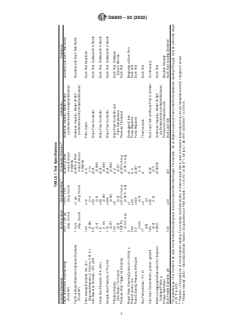
TABLE 1 Test Specifications
A B
Constant Parameter Nominal Value Acceptable Bias Acceptable Precision Instrument Frequency
Test Dust Particle SizePercentag 50 % < 2.5 µm +40 % –10 % ±0.0001 g Filter Andersen Impactor, Model 50-900 Quarterly and Each New Batch
(Pural NF) (Avg. 3 runs) (Avg. 3 runs) mass Gain per (as Determined by Analytical Balance)
weighing
Test Dust Mass Mean Aerodynamic Diameter 1.5 µm ±1 µm ±0.0001 g Filter Andersen Impactor, Model 50-900 Quarterly and Each New Batch
(Pural NF) (Avg. 3 runs) (Avg. 3 runs) mass Gain per (as Determined by Analytical Balance)
weighing
Filter Sample Diameter, mm (in.) 150 ±1.6 ±1.6 Filter Cutter Each Test Specimen
1 1
(Exposed diameter is 140 mm, 5.51 in.) (5.88) ( ⁄16) ( ⁄16)
Inlet Raw Gas Flowrate, m /h (cfm) 5.8 ±0.3 ±0.01 Mass Flow Controller Each Test. Calibrate @ 6 Month
(3.4) (0.2) (0.006)
Clean Gas Flowrate, m /h (cfm) 1.8 ±0.9 ±0.01 Mass Flow Controller Each Test. Calibrate @ 6 Month
(1.10) (0.06) (0.006)
Sample Gas Flowrate, m /h (cfm) 1.13 ±0.06 ±0.01 Mass Flow Controller Each Test. Calibrate @ 6 Month
(0.67) (0.03) (0.006)
Filtration Velocity 120 ±6 ±1.2 Mass Flow Controller and Each Test. Calibrate
C
(G/C Ratio), m/h (fpm) (6.6) (0.3) (0.07) Filter Sample Area Every 6 Months
Pressure Drop Trigger for Cleaning 1000 Pa ±0.127 cm w.g ±0.127 cm w.g Pressure Transducer Each Test
(4.0 in. w.g) (0.05 in. w.g) (0.05 in. w.g)
Rapid Pulse Cleaning Cycles (0–10 000), s 3 ±1 ±1 Datalogger Clock Beginning of Each Test
Pulse Duration, ms 50.0 ±5.0 ±1.0 Pulse Regulator Each Test
Pulse Cleaning Pressure, MPa (psi) 0.5 ±0.03 ±0.007 Pulse Regulator Each Test
(75.0) (5.0) (1.0)
Gas Temperature, °F (°C) 77 ±4 ±1 Thermocouple Each Test
(25) (2)
Inlet Dust Concentration, g/dscm (gr/dscf) 18.4 ±3.6 ±0.22 Dust Load Cell and Mass Flow Controller Continuously
(8.0) (1.6) (0.1)
Minimum Aggregate Mass Gain for Impactor 0.0001 ±0.00005 Andersen Impactor, Model 50-900 Each Test
Substrate Filters, g (as Determined by Analytical Balance)
Charge Neutralizer Polonium-210 Alpha Source Replace Annually
Dust Feeder Operation, g/h 100 ±20 ±20 Dust Load Cell Each Dust Loading Operation
A
Acceptable bias = For the test to be valid, the instrument reading must record a value within listed range. For example, the ±4 degrees accuracy means that the temperature reading of the gas must be within the range
of 73 °F to 81°F.
B
Precision = The precision of the instrument reading. For example, the thermometer or thermocouple that is used to measure temperature must record temperature within 1 degree of actual.
C 2 3 2
Filtration Velocity (G/C) = Clean Gas Stream Volume / Exposed Area of Filter Sample = 1.10 cfm / 0.166 ft = 6.6 fpm. 1.85 m /h/ 0.01539 m = 120 m/h.
D6830 − 02 (2022)
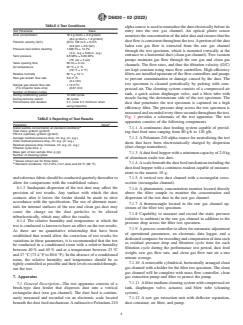
TABLE 2 Test Conditions
alphasourceisusedtoneutralizethedustelectricallybeforeits
Test Parameter Value entry into the raw gas channel. An optical photo sensor
Dust concentration 18.4 g ⁄dscm ± 3.6 g/dscm
monitorstheconcentrationoftheinletdustandensuresthatthe
(8.0 gr ⁄dscf ± 1.6 gr/dscf)
dustflowisconsistentthroughoutthetest.Aportionofthedust
Filtration velocity (G/C) (G/C) 120 m ⁄h±6m/h
(6.6 fpm ± 0.5 fpm) laden raw gas flow is extracted from the raw gas channel
Pressure loss before cleaning 1,000 Pa ± 12 Pa
through the test specimen, which is mounted vertically at the
(4 in. w.g ± 0.05 in. w.g.)
entrance to a horizontal duct (clean gas channel). Two vacuum
Tank pressure 0.5 MPa ± 0.03 MPa
(75 psi ± 5 psi)
pumps maintain gas flow through the raw gas and clean gas
Valve opening time 50 ms±5ms
channels. The flow rates, and thus the filtration velocity (G/C)
Air temperature 25 °C ± 2 °C
are kept constant using mass flow controllers. High efficiency
(78°F±4°F)
Relative humidity 50 % ± 10 %
filters are installed upstream of the flow controllers and pumps
Raw gas stream flow rate 5.8 m /h
to prevent contamination or damage caused by the dust. The
(3.4 cfm)
test specimen is cleaned periodically by pulsing with com-
Sample gas stream flow rate 1.13 m /h
(For impactor tests only) (0.67 cfm)
pressed air. The cleaning system consists of a compressed air
Number of filtration cycles
tank, a quick action diaphragm valve, and a blow tube with
During conditioning period 10 000 cycles
nozzle facing the downstream side of the test specimen. The
During recovery period 30 cycles
Performance test duration 2 h, (note6hminimum when
dust that penetrates the test specimen is captured on a high
using impactor)
efficiency filter. The pressure drop across the test specimen is
measuredandrecordedeverythreesecondsthroughoutthetest.
Fig. 1 provides a schematic of the test apparatus. The test
TABLE 3 Reporting of Test Results
apparatus consists of the following components.
A
Parameter Value
B
7.1.1 A continuous dust feeding system capable of provid-
Outlet particle concentration at standard conditions
Total mass, g/dscm (gr/dscf)
ing dust feed rates ranging from 80 g⁄h to 120 g/h.
PM 2.5 (optional), g/dscm (gr/dscf)
Average residual pressure drop, cm w.g. (in. w.g.)
7.1.2 APolonium-210 alpha source for neutralizing the test
Initial residual pressure drop, cm w.g. (in. w.g.)
dusts that have been electrostatically charged by dispersion
Residual pressure drop increase, cm w.g. (in. w.g.)
(dust charge neutralizer).
Filtration cycle time, s
Mass gain of test sample filter, g (gr)
7.1.3 Adust feed hopper with a minimum capacity of 2.0 kg
Number of cleaning cycles
of aluminum oxide test dust.
A
Values shown are for three tests.
B 7.1.4 Ascalebeneaththedustfeedmechanismincludingthe
Standard conditions: 101.3 kPa (14.7 psia) and 20 °C (68 °F).
dust feed hopper with a continuos readout capable of measure-
ment to the nearest 10 g.
andreferencefabricshouldbeconductedquarterlythereafterto 7.1.5 A vertical raw dust channel with a rectangular cross-
section (rectangular channel).
allow for comparisons with the established values.
6.1.3 Inadequate dispersion of the test dust may affect the
7.1.6 A photometric concentration monitor located directly
precision of test results. Any surface with which the dust
above the filter sample to monitor the concentration and
contacts after it leaves the feeder should be made in strict
dispersion of the test dust in the raw gas channel.
accordance with the specification. The use of alternate mate-
7.1.7 A thermocouple located in the raw gas channel up-
rials for internal surfaces of the raw and clean gas duct may
stream of the filter test specimen.
cause the charge on the dust particles to be altered
7.1.8 Capability to measure and record the static pressure
triboelectrically, which may affect the results.
(relative to ambient) in the raw gas channel in addition to the
6.1.4 The relative humidity and temperature at which the
pressure drop across the filter test specimen.
test is conducted is known to have an effect on the test results.
7.1.9 Aprocess controller to allow for automatic adjustment
As there are no quantitative relationship that have been
of operational parameters, an electronic data logger, and a
established that would allow the correction of test results for
dedicatedcomputerforrecordingandcomputationofdatasuch
variations in these parameters, it is recommended that the test
as residual pressure drop and filtration cycle time for each
be conducted in a conditioned room with a relative humidity
filtration cycle during the performance test period, dust feed
between 40 % and 65 % and at a temperature between 23 °C
weight, raw gas flow rate, and clean gas flow rate on a one
and 27 °C (73.4 °F to 80.6 °F). In the absence of a conditioned
minute average.
room, the relative humidity and temperature should be as
7.1.10 Aremovable cylindrical, horizontally arranged clean
tightlycontrolledaspossibleandtheirlevelsrecordedthrough-
gas channel with a holder for the filter test specimen.The cle
...