

ASTM D5835-20
(Practice)Standard Practice for Sampling Stationary Source Emissions for the Automated Determination of Gas Concentrations
General Information
- Abstract
ABSTRACT
This practice presents the procedures and equipment that will permit, within certain limits, representative sampling of stationary source emissions for the automated determination of gas concentrations of effluent gas streams. This application is limited to the determination of oxygen (O2), carbon dioxide (CO2), carbon monoxide (CO), sulfur dioxide (SO2), nitric oxide (NO), nitrogen dioxide (NO2) and total oxides of nitrogen (NOx). Although velocity measurements are required to determine the mass flow rates of gases, this is, however, not included in this practice. This practice describes representative sampling of gases in a duct, both by extractive and non-extractive methods. In extractive sampling, gases are conditioned to remove aerosols, particulate matter, and other interfering substances before being conveyed to the instruments. In non-extractive sampling, the measurements are made in-situ; therefore, no sample conditioning except filtering is required.
SCOPE
1.1 This practice2 covers procedures and equipment that will permit representative sampling for the automated determination of gas concentrations of effluent gas streams with limitations as described below. The application is limited to the determination of oxygen (O2), carbon dioxide (CO2), carbon monoxide (CO), sulfur dioxide (SO2), nitric oxide (NO), nitrogen dioxide (NO2), and total oxides of nitrogen (NOx).
1.2 Velocity measurements are required to determine the mass flow rates of gases. This is not included in this practice.
1.3 There are some combustion processes and conditions that may limit the applicability of this practice. Where such conditions exist, caution and competent technical judgment are required, especially when dealing with any of the following:
1.3.1 Corrosive or highly reactive components,
1.3.2 High vacuum, high pressure, or high temperature gas streams,
1.3.3 Wet flue gases,
1.3.4 Fluctuations in velocity, temperature, or concentration due to uncontrollable variation in the process,
1.3.5 Gas stratification due to the non-mixing of gas streams,
1.3.6 Measurements made using environmental control devices, and
1.3.7 Low levels of gas concentrations.
1.4 The values stated in SI units are to be regarded as standard. No other units of measurement are included in this standard.
1.5 This standard does not purport to address all of the safety concerns, if any, associated with its use. It is the responsibility of the user of this standard to establish appropriate safety, health, and environmental practices and determine the applicability of regulatory limitations prior to use. For more specific safety precautions, refer to 5.1.4.8, 5.2.1.6, and 6.2.2.1.
1.6 This international standard was developed in accordance with internationally recognized principles on standardization established in the Decision on Principles for the Development of International Standards, Guides and Recommendations issued by the World Trade Organization Technical Barriers to Trade (TBT) Committee.
- Status
- Published
- Publication Date
- 30-Nov-2020
- Technical Committee
- D22 - Air Quality
- Drafting Committee
- D22.03 - Ambient Atmospheres and Source Emissions
Buy Documents
ASTM D5835-20 - Standard Practice for Sampling Stationary Source Emissions for the Automated Determination of Gas Concentrations
REDLINE ASTM D5835-20 - Standard Practice for Sampling Stationary Source Emissions for the Automated Determination of Gas Concentrations
Overview
ASTM D5835-20 is the internationally recognized standard practice developed by ASTM International for sampling stationary source emissions to support automated gas concentration determination. This standard outlines procedures and equipment that enable representative sampling of effluent gas streams, focusing on the determination of specific gases: oxygen (O₂), carbon dioxide (CO₂), carbon monoxide (CO), sulfur dioxide (SO₂), nitric oxide (NO), nitrogen dioxide (NO₂), and total oxides of nitrogen (NOx). The guidance is applicable to both extractive and non-extractive (in-situ) sampling techniques, ensuring sample integrity and accurate automated measurements in compliance with regulatory and operational requirements.
Key Topics
Scope of Application
- Suitable for analyzing O₂, CO₂, CO, SO₂, NO, NO₂, NOx in stationary source emissions
- Excludes measurement of gas velocity required for mass flow calculations
- Emphasizes representative sampling and correct equipment selection
Sampling Methods
- Extractive Sampling: Gases are withdrawn, conditioned (removal of particulate matter, aerosols), and conveyed to analytical instruments
- Non-Extractive (In-Situ) Sampling: Direct measurement within the duct or stack, usually requiring only filtration
Operational Considerations
- Factors affecting representativeness: process stream heterogeneity, site configuration, cross-sectional gas variation, and environmental controls
- Special attention for sampling in challenging conditions (high temperature, wet gases, corrosive components)
- Regular calibration and maintenance protocols to ensure quality and accuracy
Equipment and Materials
- Guidance on suitable construction materials for sampling probes, filters, and lines (e.g., stainless steel, PTFE, glass) with attention to chemical resistance and temperature
- Configuration of sampling lines, filters, pumps, and manifolds tailored to process needs and gas stability
Applications
ASTM D5835-20 is widely used in industrial and environmental settings requiring automated, continuous, or periodic monitoring of stack emissions. Key applications include:
- Regulatory Compliance: Meeting air quality permits and reporting obligations by providing reliable, representative data for regulated gases
- Process Optimization: Enabling operational control and pollution minimization by delivering real-time emission data for process adjustments
- Quality Assurance: Supporting environmental audits and internal QC programs through standardized measurement approaches
- Technology Evaluation: Assisting selection, installation, and validation of continuous emission monitoring systems (CEMS) and automated analyzers
- Environmental Impact Assessment: Generating data for studies on local air quality and industrial environmental impact
Related Standards
To provide comprehensive guidance and facilitate integrated air quality management, several related standards and references are frequently used in conjunction with ASTM D5835-20:
- ASTM D1356: Terminology Relating to Sampling and Analysis of Atmospheres
- ASTM D1608: Test Method for Oxides of Nitrogen in Gaseous Combustion Products
- ASTM D3154: Test Method for Average Velocity in a Duct (Pitot Tube Method)
- ISO 10396: Stationary Source Emissions - Sampling for the Automated Determination of Gas Concentrations
- 40 CFR Part 60 (US EPA): Standards of Performance for Stationary Sources, relevant test methods and QC procedures
Practical Value
ASTM D5835-20 helps ensure that automated stack sampling practices deliver reproducible, accurate, and regulatory-accepted results. This not only enhances environmental protection but also supports industrial operational efficiency and compliance assurance. By following this standard, facilities can select appropriate sampling systems, verify performance under typical and challenging conditions, and maintain high standards of occupational safety and data quality in emission monitoring operations.
Relations
- Effective Date
- 01-Sep-2020
- Effective Date
- 15-Mar-2020
- Effective Date
- 01-Mar-2016
- Effective Date
- 15-Oct-2015
- Effective Date
- 01-Jul-2015
- Effective Date
- 01-Dec-2014
- Effective Date
- 01-May-2014
- Effective Date
- 15-Jan-2014
- Effective Date
- 01-Apr-2010
- Effective Date
- 01-Mar-2009
- Effective Date
- 01-Apr-2006
- Effective Date
- 01-May-2005
- Effective Date
- 10-Apr-2003
- Effective Date
- 10-Nov-2000
- Effective Date
- 10-Sep-2000
Buy Documents
ASTM D5835-20 - Standard Practice for Sampling Stationary Source Emissions for the Automated Determination of Gas Concentrations
REDLINE ASTM D5835-20 - Standard Practice for Sampling Stationary Source Emissions for the Automated Determination of Gas Concentrations
Get Certified
Connect with accredited certification bodies for this standard

CIS Institut d.o.o.
Personal Protective Equipment (PPE) certification body. Notified Body NB-2890 for EU Regulation 2016/425 PPE.

Kiwa BDA Testing
Building and construction product certification.
Kmetijski inštitut Slovenije
Agricultural Institute of Slovenia. Soil testing, plant health, agricultural product analysis.
Sponsored listings
Frequently Asked Questions
ASTM D5835-20 is a standard published by ASTM International. Its full title is "Standard Practice for Sampling Stationary Source Emissions for the Automated Determination of Gas Concentrations". This standard covers: ABSTRACT This practice presents the procedures and equipment that will permit, within certain limits, representative sampling of stationary source emissions for the automated determination of gas concentrations of effluent gas streams. This application is limited to the determination of oxygen (O2), carbon dioxide (CO2), carbon monoxide (CO), sulfur dioxide (SO2), nitric oxide (NO), nitrogen dioxide (NO2) and total oxides of nitrogen (NOx). Although velocity measurements are required to determine the mass flow rates of gases, this is, however, not included in this practice. This practice describes representative sampling of gases in a duct, both by extractive and non-extractive methods. In extractive sampling, gases are conditioned to remove aerosols, particulate matter, and other interfering substances before being conveyed to the instruments. In non-extractive sampling, the measurements are made in-situ; therefore, no sample conditioning except filtering is required. SCOPE 1.1 This practice2 covers procedures and equipment that will permit representative sampling for the automated determination of gas concentrations of effluent gas streams with limitations as described below. The application is limited to the determination of oxygen (O2), carbon dioxide (CO2), carbon monoxide (CO), sulfur dioxide (SO2), nitric oxide (NO), nitrogen dioxide (NO2), and total oxides of nitrogen (NOx). 1.2 Velocity measurements are required to determine the mass flow rates of gases. This is not included in this practice. 1.3 There are some combustion processes and conditions that may limit the applicability of this practice. Where such conditions exist, caution and competent technical judgment are required, especially when dealing with any of the following: 1.3.1 Corrosive or highly reactive components, 1.3.2 High vacuum, high pressure, or high temperature gas streams, 1.3.3 Wet flue gases, 1.3.4 Fluctuations in velocity, temperature, or concentration due to uncontrollable variation in the process, 1.3.5 Gas stratification due to the non-mixing of gas streams, 1.3.6 Measurements made using environmental control devices, and 1.3.7 Low levels of gas concentrations. 1.4 The values stated in SI units are to be regarded as standard. No other units of measurement are included in this standard. 1.5 This standard does not purport to address all of the safety concerns, if any, associated with its use. It is the responsibility of the user of this standard to establish appropriate safety, health, and environmental practices and determine the applicability of regulatory limitations prior to use. For more specific safety precautions, refer to 5.1.4.8, 5.2.1.6, and 6.2.2.1. 1.6 This international standard was developed in accordance with internationally recognized principles on standardization established in the Decision on Principles for the Development of International Standards, Guides and Recommendations issued by the World Trade Organization Technical Barriers to Trade (TBT) Committee.
ABSTRACT This practice presents the procedures and equipment that will permit, within certain limits, representative sampling of stationary source emissions for the automated determination of gas concentrations of effluent gas streams. This application is limited to the determination of oxygen (O2), carbon dioxide (CO2), carbon monoxide (CO), sulfur dioxide (SO2), nitric oxide (NO), nitrogen dioxide (NO2) and total oxides of nitrogen (NOx). Although velocity measurements are required to determine the mass flow rates of gases, this is, however, not included in this practice. This practice describes representative sampling of gases in a duct, both by extractive and non-extractive methods. In extractive sampling, gases are conditioned to remove aerosols, particulate matter, and other interfering substances before being conveyed to the instruments. In non-extractive sampling, the measurements are made in-situ; therefore, no sample conditioning except filtering is required. SCOPE 1.1 This practice2 covers procedures and equipment that will permit representative sampling for the automated determination of gas concentrations of effluent gas streams with limitations as described below. The application is limited to the determination of oxygen (O2), carbon dioxide (CO2), carbon monoxide (CO), sulfur dioxide (SO2), nitric oxide (NO), nitrogen dioxide (NO2), and total oxides of nitrogen (NOx). 1.2 Velocity measurements are required to determine the mass flow rates of gases. This is not included in this practice. 1.3 There are some combustion processes and conditions that may limit the applicability of this practice. Where such conditions exist, caution and competent technical judgment are required, especially when dealing with any of the following: 1.3.1 Corrosive or highly reactive components, 1.3.2 High vacuum, high pressure, or high temperature gas streams, 1.3.3 Wet flue gases, 1.3.4 Fluctuations in velocity, temperature, or concentration due to uncontrollable variation in the process, 1.3.5 Gas stratification due to the non-mixing of gas streams, 1.3.6 Measurements made using environmental control devices, and 1.3.7 Low levels of gas concentrations. 1.4 The values stated in SI units are to be regarded as standard. No other units of measurement are included in this standard. 1.5 This standard does not purport to address all of the safety concerns, if any, associated with its use. It is the responsibility of the user of this standard to establish appropriate safety, health, and environmental practices and determine the applicability of regulatory limitations prior to use. For more specific safety precautions, refer to 5.1.4.8, 5.2.1.6, and 6.2.2.1. 1.6 This international standard was developed in accordance with internationally recognized principles on standardization established in the Decision on Principles for the Development of International Standards, Guides and Recommendations issued by the World Trade Organization Technical Barriers to Trade (TBT) Committee.
ASTM D5835-20 is classified under the following ICS (International Classification for Standards) categories: 13.040.40 - Stationary source emissions. The ICS classification helps identify the subject area and facilitates finding related standards.
ASTM D5835-20 has the following relationships with other standards: It is inter standard links to ASTM D1356-20a, ASTM D1356-20, ASTM D1608-16, ASTM D1356-15a, ASTM D1356-15, ASTM D1356-14b, ASTM D1356-14a, ASTM D1356-14, ASTM D1356-05(2010), ASTM D1608-98(2009), ASTM D3154-00(2006), ASTM D1356-05, ASTM D1608-98(2003), ASTM D1356-00a, ASTM D3154-00. Understanding these relationships helps ensure you are using the most current and applicable version of the standard.
ASTM D5835-20 is available in PDF format for immediate download after purchase. The document can be added to your cart and obtained through the secure checkout process. Digital delivery ensures instant access to the complete standard document.
Standards Content (Sample)
This international standard was developed in accordance with internationally recognized principles on standardization established in the Decision on Principles for the
Development of International Standards, Guides and Recommendations issued by the World Trade Organization Technical Barriers to Trade (TBT) Committee.
Designation: D5835 − 20
Standard Practice for
Sampling Stationary Source Emissions for the Automated
Determination of Gas Concentrations
This standard is issued under the fixed designation D5835; the number immediately following the designation indicates the year of
original adoption or, in the case of revision, the year of last revision. A number in parentheses indicates the year of last reapproval. A
superscript epsilon (´) indicates an editorial change since the last revision or reapproval.
1. Scope mine the applicability of regulatory limitations prior to use.
2 For more specific safety precautions, refer to 5.1.4.8, 5.2.1.6,
1.1 This practice covers procedures and equipment that
and 6.2.2.1.
will permit representative sampling for the automated determi-
1.6 This international standard was developed in accor-
nation of gas concentrations of effluent gas streams with
dance with internationally recognized principles on standard-
limitationsasdescribedbelow.Theapplicationislimitedtothe
ization established in the Decision on Principles for the
determination of oxygen (O ), carbon dioxide (CO ), carbon
2 2
Development of International Standards, Guides and Recom-
monoxide (CO), sulfur dioxide (SO ), nitric oxide (NO),
mendations issued by the World Trade Organization Technical
nitrogen dioxide (NO ), and total oxides of nitrogen (NO ).
2 x
Barriers to Trade (TBT) Committee.
1.2 Velocity measurements are required to determine the
mass flow rates of gases. This is not included in this practice.
2. Referenced Documents
1.3 There are some combustion processes and conditions
2.1 ASTM Standards:
that may limit the applicability of this practice. Where such
D1356 Terminology Relating to Sampling and Analysis of
conditions exist, caution and competent technical judgment are
Atmospheres
required, especially when dealing with any of the following:
D1608 Test Method for Oxides of Nitrogen in Gaseous
1.3.1 Corrosive or highly reactive components,
Combustion Products (Phenol-Disulfonic Acid Proce-
1.3.2 High vacuum, high pressure, or high temperature gas
dures)
streams,
D3154 Test Method for Average Velocity in a Duct (Pitot
1.3.3 Wet flue gases,
Tube Method)
1.3.4 Fluctuations in velocity, temperature, or concentration
2.2 Other Document:
due to uncontrollable variation in the process,
40 CFR Part 60 Standards of Performance for Stationary
1.3.5 Gas stratification due to the non-mixing of gas
Sources, Appendix A, Test Methods 2, 3, 3a, 6, 6c, 7, 7e,
streams,
and 10
1.3.6 Measurements made using environmental control
devices, and 3. Terminology
1.3.7 Low levels of gas concentrations.
3.1 Definitions:
1.4 The values stated in SI units are to be regarded as 3.1.1 For definitions of terms used in this practice, refer to
standard. No other units of measurement are included in this Terminology D1356.
standard.
4. Summary of Practice
1.5 This standard does not purport to address all of the
4.1 This practice describes representative duct or stack gas
safety concerns, if any, associated with its use. It is the
sampling, including both extractive and non-extractive sam-
responsibility of the user of this standard to establish appro-
pling. In extractive sampling, gases are conditioned to remove
priate safety, health, and environmental practices and deter-
aerosols, particulate matter, and other interfering substances
before being conveyed to instruments. In non-extractive
This practice is under the jurisdiction ofASTM Committee D22 on Air Quality
and is the direct responsibility of Subcommittee D22.03 on Ambient Atmospheres
and Source Emissions. For referenced ASTM standards, visit the ASTM website, www.astm.org, or
Current edition approved Dec. 1, 2020. Published January 2021. Originally contact ASTM Customer Service at service@astm.org. For Annual Book of ASTM
approved in 1995. Last previous edition approved in 2012 as D5835 – 95 (2012). Standards volume information, refer to the standard’s Document Summary page on
DOI: 10.1520/D5835-20. the ASTM website.
2 4
This practice is based on ISO 10396, “Stationary source emissions—Sampling Available from U.S. Government Printing Office, Superintendent of
fortheautomateddeterminationofgasconcentrations,”availablefromInternational Documents, 732 N. Capitol St., NW, Washington, DC 20401-0001, http://
Organization for Standardization, Casa Postale 56, CH-1211, Geneva, Switzerland. www.access.gpo.gov.
Copyright ©ASTM International, 100 Barr Harbor Drive, PO Box C700, West Conshohocken, PA19428-2959. United States
D5835 − 20
sampling, the measurements are made in-situ; therefore, 5.1.2 Representativeness may be difficult to achieve for the
sample conditioning is not necessary beyond filtration. following reasons:
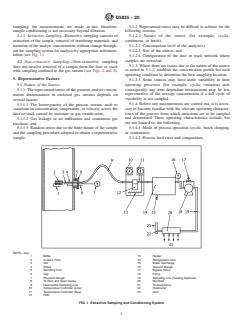
4.1.1 Extractive Sampling—Extractive sampling consists of
5.1.2.1 Nature of the source (for example, cyclic,
extraction of the sample, removal of interfering materials, and continuous, or batch),
retention of the analyte concentration without change through-
5.1.2.2 Concentration level of the analyte(s),
out the sampling system for analysis by appropriate instrumen-
5.1.2.3 Size of the source, and
tation (see Fig. 1).
5.1.2.4 Configuration of the duct or stack network where
samples are extracted.
4.2 Non-extractive Sampling—Non-extractive sampling
5.1.3 Where there are issues due to the nature of the source
does not involve removal of a sample from the duct or stack
as noted in 5.1.2, establish the concentration profile for each
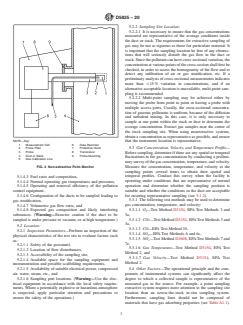
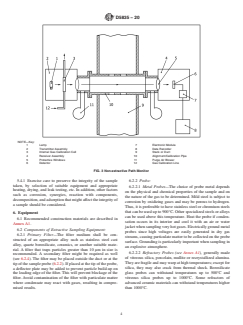
with sampling confined to the gas stream (see Figs. 2 and 3).
operating condition to determine the best sampling location.
5. Representative Factors
5.1.3.1 Some sources may have more variability in their
operating processes (for example, cyclic variation) and,
5.1 Nature of the Source:
consequently, any time dependent measurement may be less
5.1.1 The representativeness of the gaseous analyte concen-
representative of the average concentration if a full cycle of
tration determination in enclosed gas streams depends on
variability is not sampled.
several factors:
5.1.1.1 The heterogeneity of the process stream, such as 5.1.4 Before any measurements are carried out, it is neces-
sary to become familiar with the relevant operating character-
variations in concentration, temperature, or velocity across the
istics of the process from which emissions are to be sampled
duct or stack caused by moisture or gas stratification,
and determined. These operating characteristics include, but
5.1.1.2 Gas leakage or air infiltration and continuous gas
are not limited to, the following:
reactions, and
5.1.4.1 Mode of process operation (cyclic, batch charging,
5.1.1.3 Random errors due to the finite nature of the sample
and the sampling procedure adopted to obtain a representative or continuous),
sample. 5.1.4.2 Process feed rates and composition,
NOTE—Key:
1 Baffle 13 Heater
2 In-stack Filter 14 Refrigeration Unit
3 Tee 15 Water Discharge
4 Probe 16 Vacuum Gauge
5 Sampling Port 17 Bypass Valve
6 Cap 18 Pump
7 Pressure Gauge 19 Sampling Line (Heating Optional)
8 To Zero and Span Gases 20 Manifold
9 Heat-traced Sampling Line 21 ToAnalyzer(s)
10 Temperature Controller (Line) 22 Rotameter
11 Temperature Controller (Box) 23 Vent
12 Filter
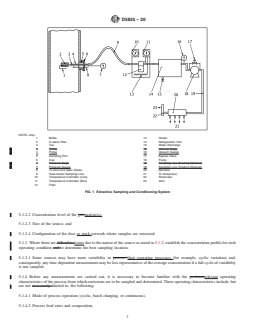
FIG. 1 Extractive Sampling and Conditioning System
D5835 − 20
5.2.2 Sampling Site Location:
5.2.2.1 It is necessary to ensure that the gas concentrations
measured are representative of the average conditions inside
the duct or stack. The requirements for extractive sampling of
gas may be not as rigorous as those for particulate material. It
is important that the sampling location be free of any obstruc-
tions that will seriously disturb the gas flow in the duct or
stack.Sincethepollutantcanhavecrosssectionalvariation,the
concentrationatvariouspointsofthecross-sectionshallfirstbe
checked, in order to assess the homogeneity of the flow and to
detect any infiltration of air or gas stratification, etc. If a
preliminary analysis of cross-sectional measurements indicates
more than 615 % variation in concentrations, and if an
alternative acceptable location is unavailable, multi-point sam-
pling is recommended.
5.2.2.2 Multi-point sampling may be achieved either by
moving the probe from point to point or having a probe with
multiple access ports. Usually, the cross-sectional concentra-
tion of gaseous pollutants is uniform, because of the diffusion
and turbulent mixing. In this case, it is only necessary to
sample at one point within the stack or duct to determine the
average concentration. Extract gas samples near the center of
the stack sampling site. When using nonextractive systems,
obtain a concentration as representative as possible, and ensure
NOTE—Key: that the instrument location is representative.
1 Measurement Cell 6 Data Recorder
5.3 Gas Concentration, Velocity, and Temperature Profile—
2 Probe Filter 7 Protective Hood
3 Probe 8 Transceiver
Before sampling, determine if there are any spatial or temporal
4 Duct or Stack 9 Probe Mounting
fluctuations in the gas concentrations by conducting a prelimi-
5 Gas Calibration Line
narysurveyofthegasconcentration,temperature,andvelocity.
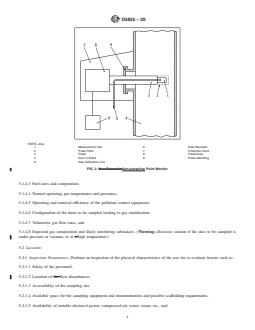
FIG. 2 Non-extractive Point Monitor Measure the concentration, temperature, and velocity at the
sampling points several times to obtain their spatial and
temporal profiles. Conduct this survey when the facility is
5.1.4.3 Fuel rates and composition,
operating under conditions that are representative of normal
5.1.4.4 Normal operating gas temperatures and pressures,
operation and determine whether the sampling position is
5.1.4.5 Operating and removal efficiency of the pollution
suitable and whether the conditions in the duct are acceptable
control equipment,
for ensuring representative sampling (see 5.1.2).
5.1.4.6 Configuration of the ducts to be sampled leading to
5.3.1 The following test methods may be used to determine
gas stratification,
gas concentration, temperature, and velocity:
5.1.4.7 Volumetric gas flow rates, and
5.3.1.1 O —Test Method D3154, EPA Test Methods 3 and
5.1.4.8 Expected gas composition and likely interfering
3a,
substances. (Warning—Exercise caution if the duct to be
5.3.1.2 CO —Test Method D3154, EPATest Methods 3 and
sampled is under pressure or vacuum, or at high temperature.)
3a,
5.2 Location:
5.3.1.3 CO—EPA Test Method 10,
5.2.1 Inspection Parameters—Perform an inspection of the
5.3.1.4 SO —EPA Test Methods 6 and 6c,
physical characteristics of the test site to evaluate factors such
5.3.1.5 NO —Test Method D1608, EPATest Methods 7 and
x
as:
7e,
5.2.1.1 Safety of the personnel,
5.3.1.6 Gas Temperature—Test Method D3154, EPA Test
5.2.1.2 Location of flow disturbances,
Method 2, and
5.2.1.3 Accessibility of the sampling site,
5.3.1.7 Gas Velocity—Test Method D3154, EPA Test
5.2.1.4 Available space for the sampling equipment and
Method 2.
instrumentation and possible scaffolding requirements,
5.2.1.5 Availability of suitable electrical power, compressed
5.4 Other Factors—The operational principle and the com-
air, water, steam, etc., and ponents of instrumental systems can significantly affect the
5.2.1.6 Sampling port locations. (Warning—Use the elec-
degree to which a collected sample is representative of the
trical equipment in accordance with the local safety require- measured gas in the source. For example, a point sampling
ments. Where a potentially explosive or hazardous atmosphere
extractive system requires more attention to the sampling site
is suspected, apply particular attention and precautions to location than an across-the-stack in-situ sampling system.
ensure the safety of the operations.)
Furthermore, sampling lines should not be composed of
materials that have gas adsorbing properties (see Table A1.1).
D5835 − 20
NOTE—Key:
1 Lamp 7 Electronic Module
2 TransmitterAssembly 8 Data Recorder
3 Internal Gas Calibration Cell 9 Stack or Duct
4 ReceiverAssembly 10 Alignment/Calibration Pipe
5 Protective Windows 11 PurgeAir Blower
6 Detector 12 Gas Calibration Line
FIG. 3 Non-extractive Path Monitor
5.4.1 Exercise care to preserve the integrity of the sample 6.2.2 Probe:
taken, by selection of suitable equipment and appropriate
6.2.2.1 Metal Probes—The choice of probe metal depends
heating, drying, and leak testing, etc. In addition, other factors
on the physical and chemical properties of the sample and on
such as corrosion, synergies, reaction with components,
the nature of the gas to be determined. Mild steel is subject to
decomposition,andadsorptionthatmightaffecttheintegrityof
corrosion by oxidizing gases and may be porous to hydrogen.
a sample should be considered.
Thus, it is preferable to have stainless steel or chromium steels
that can be used up to 900°C. Other specialized steels or alloys
6. Equipment
can be used above this temperature. Heat the probe if conden-
6.1 Recommended construction materials are described in
sation occurs in its interior and cool it with an air or water
Annex A1.
jacketwhensamplingveryhotgases.Electricallygroundmetal
6.2 Components of Extractive Sampling Equipment:
probes since high voltages are easily generated in dry gas
6.2.1 Primary Filter—The filter medium shall be con-
streams, causing particulate matter to be collected on the probe
structed of an appropriate alloy such as stainless steel cast
surface. Grounding is particularly important when sampling in
alloy, quartz borosilicate, ceramics, or another suitable mate-
an explosive atmosphere.
rial. A filter that traps particles greater than 10 µm in size is
6.2.2.2 Refractory Probes (see Annex A1), generally made
recommended. A secondary filter might be required as well
of vitreous silica, porcelain, mullite or recrystallized alumina.
(see 6.2.4). The filter may be placed outside the duct or at the
They are fragile and may warp at high temperatures; except for
tip of the sample probe (6.2.2). If placed at the tip of the probe,
silica, they may also crack from thermal shock. Borosilicate
a deflector plate may be added to prevent particle build-up on
glass probes can withstand temperatures up to 500°C and
the leading edge of the filter. This will prevent blockage of the
vitreous silica probes up to 1000°C. Some refractors of
filter. Avoid contamination of the filter with particulate matter
where condensate may react with gases, resulting in compro- advanced ceramic materials can withstand temperatures higher
mised results. than 1000°C.
D5835 − 20
6.2.3 Heated Sampling Line Connected to Moisture Re- 6.2.6.2 Where permeation drying is employed, half of the
moval Assembly: dryer tube (wet end) shall be heated to a temperature of at least
15°C above the gas dewpoint. When acid is present in the
6.2.3.1 Thesamplinglineshallbemadeofstainlesssteel,or
sample, it may be necessary to consider the acid dewpoint.The
Polytetrafluoroethylene (PTFE).
manufacturer’s recommendations on the quantity of purge air
6.2.3.2 The tube diameter shall be adequate to provide a
shall be followed.
flow rate that is sufficient to feed the monitors, bearing in mind
6.2.6.3 Dilution may be used to reduce water content to a
the sampling line length and the pressure characteristics of the
level where water removal may be unnecessary.
sampling pump (6.2.5) used.
6.2.7 Analyzer Sampling Line:
6.2.3.3 Maintain the sampling line at a temperature of at
6.2.7.1 The part of the sampling line associated with the
least 15°C above the water and acid dew-point temperature of
analyzershallbemadeofaninertmaterialandofsufficientsize
the sampled gas. Monitor the temperature.
to accommodate the requirements of the instrumentation.
6.2.3.4 In order to reduce the residence time in the sampling
6.2.7.2 Depending on whether a drying technique or dilu-
line and the risk of physico-chemical transformation of the
tion is used, heat tracing is required where the monitor is
sample, the gas flow can be greater than that required for the
supplied with wet gases; in other cases, it may be necessary to
analytical instruments; only part of the sample is then analyzed
eliminate condensation upstream of the condenser, where the
and the excess flow discarded through a bypass valve (see Fig.
system extracts hot gases. If back flushing is used to clean the
1). It may be necessary to heat the transport line to avoid
in-stack filter, a pressure-regulated valve shall be installed
condensation.
upstream of the conditioner to protect the equipment from high
6.2.4 Secondary Filter:
pressure air damage.
6.2.4.1 Asecondary filter may be needed to remove remain-
6.2.8 Gas Manifold, constructed of an inert material with
ing particulate material and protect both the sampling pump
separate ports for each analyzer. It shall be sized to accommo-
(6.2.5) and analyzer. It shall be placed in the sampling line
date t
...
This document is not an ASTM standard and is intended only to provide the user of an ASTM standard an indication of what changes have been made to the previous version. Because
it may not be technically possible to adequately depict all changes accurately, ASTM recommends that users consult prior editions as appropriate. In all cases only the current version
of the standard as published by ASTM is to be considered the official document.
Designation: D5835 − 95 (Reapproved 2013) D5835 − 20
Standard Practice for
Sampling Stationary Source Emissions for the Automated
Determination of Gas Concentrations
This standard is issued under the fixed designation D5835; the number immediately following the designation indicates the year of
original adoption or, in the case of revision, the year of last revision. A number in parentheses indicates the year of last reapproval. A
superscript epsilon (´) indicates an editorial change since the last revision or reapproval.
1. Scope
1.1 This practice covers procedures and equipment that will permit, within certain limits, permit representative sampling for the
automated determination of gas concentrations of effluent gas streams. streams with limitations as described below. The application
is limited to the determination of oxygen (O ), carbon dioxide (CO ), carbon monoxide (CO), sulfur dioxide (SO ), nitric oxide
2 2 2
(NO), nitrogen dioxide (NO )), and total oxides of nitrogen (NO ).
2 x
1.2 Velocity measurements are required to determine the mass flow rates of gases. This is not included in this practice.
1.3 There are some combustion processes and situationsconditions that may limit the applicability of this practice. Where such
conditions exist, caution and competent technical judgment are required, especially when dealing with any of the following:
1.3.1 Corrosive or highly reactive components,
1.3.2 High vacuum, high pressure, or high temperature gas streams,
1.3.3 Wet flue gases,
1.3.4 Fluctuations in velocity, temperature, or concentration due to uncontrollable variation in the process,
1.3.5 Gas stratification due to the non-mixing of gas streams,
1.3.6 Measurements made using environmental control devices, and
1.3.7 Low levels of gas concentrations.
1.4 The values stated in SI units are to be regarded as standard. No other units of measurement are included in this standard.
1.5 This standard does not purport to address all of the safety concerns, if any, associated with its use. It is the responsibility
of the user of this standard to establish appropriate safety, health, and environmental practices and determine the applicability of
regulatory limitations prior to use. For more specific safety precautions, refer to 5.1.4.8, 5.2.1.6, and 6.2.2.1.
This practice is under the jurisdiction of ASTM Committee D22 on Air Quality and is the direct responsibility of Subcommittee D22.03 on Ambient Atmospheres and
Source Emissions.
Current edition approved April 1, 2013Dec. 1, 2020. Published April 2013January 2021. Originally approved in 1995. Last previous edition approved in 20072012 as
D5835 – 95 (2007).(2012). DOI: 10.1520/D5835-95R13.10.1520/D5835-20.
This practice is based on ISO 10396, “Stationary source emissions—Sampling for the automated determination of gas concentrations,” available from International
Organization for Standardization, Casa Postale 56, CH-1211, Geneva, Switzerland.
Copyright © ASTM International, 100 Barr Harbor Drive, PO Box C700, West Conshohocken, PA 19428-2959. United States
D5835 − 20
1.6 This international standard was developed in accordance with internationally recognized principles on standardization
established in the Decision on Principles for the Development of International Standards, Guides and Recommendations issued
by the World Trade Organization Technical Barriers to Trade (TBT) Committee.
2. Referenced Documents
2.1 ASTM Standards:
D1356 Terminology Relating to Sampling and Analysis of Atmospheres
D1608 Test Method for Oxides of Nitrogen in Gaseous Combustion Products (Phenol-Disulfonic Acid Procedures)
D3154 Test Method for Average Velocity in a Duct (Pitot Tube Method)
2.2 Other Document:
40 CFR Part 60 CFR Part 60, Standards of Performance for Stationary Sources, Appendix A, Test Methods 2, 3, 3a, 6, 6c, 7,
7e, and 10
3. Terminology
3.1 Definitions:
3.1.1 For definitions of terms used in this practice, refer to Terminology D1356.
3.1 Definitions:
3.1.1 For definitions of terms used in this practice, refer to Terminology D1356.
4. Summary of Practice
4.1 This practice describes representative sampling of gases in a duct, duct or stack gas sampling, including both extractive and
non-extractive sampling. In extractive sampling, these gases are conditioned to remove aerosols, particulate matter, and other
interfering substances before being conveyed to the instruments. In non-extractive sampling, the measurements are made in-situ;
therefore, no sample conditioning except filtering is required.is not necessary beyond filtration.
4.1.1 Extractive Sampling—Extractive sampling includes consists of extraction of the sample, removal of interfering materials,
and maintenanceretention of the gasanalyte concentration without change throughout the sampling system for subsequent analysis
by appropriate instrumentation (see Fig. 1).
4.2 Non-extractive Sampling—Non-extractive sampling does not involve removal of a sample, and sampling is sample from the
duct or stack with sampling confined to the gas stream in the stack or duct (see Figs. 2 and 3).
5. Representative Factors
5.1 Nature of the Source:
5.1.1 The representativeness of the determination of gaseous analyte concentration determination in enclosed gas streams depends
on several factors:
5.1.1.1 The heterogeneity of the process stream, such as variations in concentration, temperature, or velocity across the duct or
stack caused by moisture or gas stratification,
5.1.1.2 Gas leakage or air infiltration and continuous gas reactions, and
5.1.1.3 Random errors due to the finite nature of the sample and the sampling procedure adopted to obtain a representative sample.
5.1.2 Representativeness may be difficult to achieve for the following reasons:
5.1.2.1 Nature of the source (for example, cyclic, continuous, or batch),
For referenced ASTM standards, visit the ASTM website, www.astm.org, or contact ASTM Customer Service at service@astm.org. For Annual Book of ASTM Standards
volume information, refer to the standard’sstandard’s Document Summary page on the ASTM website.
Available from U.S. Government Printing Office, Superintendent of Documents, 732 N. Capitol St., NW, Washington, DC 20401-0001, http://www.access.gpo.gov.
D5835 − 20
NOTE—Key:
1 Baffle 13 Heater
2 In-stack Filter 14 Refrigeration Unit
3 Tee 15 Water Discharge
4 Probe 16 Vacuum Gage
4 Probe 16 Vacuum Gauge
5 Sampling Port 17 Bypass Valve
6 Cap 18 Pump
7 Pressure Gage 19 Sampling Line (Heating Optional)
7 Pressure Gauge 19 Sampling Line (Heating Optional)
8 To Zero and Span Gases 20 Manifold
9 Heat-traced Sampling Line 21 To Analyzer(s)
10 Temperature Controller (Line) 22 Rotameter
11 Temperature Controller (Box) 23 Vent
12 Filter
FIG. 1 Extractive Sampling and Conditioning System
5.1.2.2 Concentration level of the gas,analyte(s),
5.1.2.3 Size of the source, and
5.1.2.4 Configuration of the duct or stack network where samples are extracted.
5.1.3 Where there are difficultiesissues due to the nature of the source as noted in 5.1.2, establish the concentration profile for each
operating condition and to determine the best sampling location.
5.1.3.1 Some sources may have more variability in process their operating processes (for example, cyclic variation) and,
consequently, any time dependent measurement may be less representative of the average concentration if a full cycle of variability
is not sampled.
5.1.4 Before any measurements are carried out, it is necessary to become familiar with the pertinentrelevant operating
characteristics of the process from which emissions are to be sampled and determined. These operating characteristics include, but
are not necessarily limited to, the following:
5.1.4.1 Mode of process operation (cyclic, batch charging, or continuous),
5.1.4.2 Process feed rates and composition,
D5835 − 20
NOTE—Key:
1 Measurement Cell 6 Data Recorder
2 Probe Filter 7 Protective Hood
3 Probe 8 Transceiver
4 Duct or Stack 9 Probe Mounting
5 Gas Calibration Line
FIG. 2 Non-ExtractiveNon-extractive Point Monitor
5.1.4.3 Fuel rates and composition,
5.1.4.4 Normal operating gas temperatures and pressures,
5.1.4.5 Operating and removal efficiency of the pollution control equipment,
5.1.4.6 Configuration of the ducts to be sampled leading to gas stratification,
5.1.4.7 Volumetric gas flow rates, and
5.1.4.8 Expected gas composition and likely interfering substances. (Warning—Exercise caution if the duct to be sampled is
under pressure or vacuum, or at a high temperature.)
5.2 Location:
5.2.1 Inspection Parameters—Perform an inspection of the physical characteristics of the test site to evaluate factors such as:
5.2.1.1 Safety of the personnel,
5.2.1.2 Location of the flow disturbances,
5.2.1.3 Accessibility of the sampling site,
5.2.1.4 Available space for the sampling equipment and instrumentation and possible scaffolding requirements,
5.2.1.5 Availability of suitable electrical power, compressed air, water, steam, etc., and
D5835 − 20
NOTE—Key:
1 Lamp 7 Electronic Module
2 Transmitter Assembly 8 Data Recorder
3 Internal Gas Calibration Cell 9 Stack or Duct
4 Receiver Assembly 10 Alignment/Calibration Pipe
5 Protective Windows 11 Purge Air Blower
6 Detector 12 Gas Calibration Line
FIG. 3 Non-ExtractiveNon-extractive Path Monitor
5.2.1.6 Sampling port locations. (Warning—Use the electrical equipment in accordance with the local safety requirements. Where
a potentially explosive or hazardous atmosphere is suspected, apply particular attention and precautions to ensure the safety of the
operations.)
D5835 − 20
5.2.2 Sampling Site Location:
5.2.2.1 It is necessary to ensure that the gas concentrations measured are representative of the average conditions inside the duct
or stack. The requirements for the extractive sampling of gas may be not as stringentrigorous as those for particulate material. It
is important that the sampling location be removed fromfree of any obstructions that will seriously disturb the gas flow in the duct
or stack. The Since the pollutant can have cross sectional variation. Thevariation, the concentration at various points of the
cross-section shall first be checked, in order to assess the homogeneity of the flow and to detect any infiltration of air or gas
stratification, etc. If a preliminary analysis of cross-section at cross-sectional measurements taken indicates more than 6 15 %
615 % variation in concentrations, and if an alternative acceptable location is not available, unavailable, multi-point sampling is
recommended.
5.2.2.2 Multi-point sampling may be achieved either by moving the probe from point to point or having a probe with multiple
access ports. Usually, the cross sectional cross-sectional concentration of gaseous pollutants is uniform, because of the diffusion
and turbulent mixing. If so, In this case, it is only necessary to sample at one point within the stack or duct to determine the average
concentration. Extract gas samples near the center of the stack sampling site. When using nonextractive systems, obtain a
concentration as representative as possible, butand ensure that the instrument location is representative.
5.3 Gas Concentration, Velocity, and Temperature Profile—Before commencing sampling, determine if there are any spatial or
temporal fluctuations in the gas concentrations by conducting a preliminary survey of the gas concentration, temperature, and
velocity. Measure the concentration, temperature, and velocity at the sampling points several times to obtain their spatial and
temporal profiles. Conduct this survey when the plantfacility is operating under conditions that will be are representative of normal
operation and determine whether the sampling position is suitable and whether the conditions in the duct are satisfactory acceptable
for ensuring representative sampling (see 5.1.2).
5.3.1 The following test methods may be used to determine gas concentration, temperature, and velocity:
5.3.1.1 O —Test Method D3154, EPA Test Methods 3 and 3a,
5.3.1.2 CO —Test Method D3154, EPA Test Methods 3 and 3a,
5.3.1.3 CO—EPA Test Method 10,
5.3.1.4 SO —EPA Test Methods 6 and 6c,
5.3.1.5 NO —Test Method D1608, EPA Test Methods 7 and 7e,
x
5.3.1.6 Gas Temperature—Test Method D3154, EPA Test Method 2, and
5.3.1.7 Gas Velocity—Test Method D3154, EPA Test Method 2.
5.4 Other Factors—The operational principle of operation and the components of the instrument instrumental systems can
significantly affect the degree to which a collected sample is representative of the measured gas in the source. For example, a point
sampling extractive system requires more attention to the sampling site location than an across-the-stack in-situ sampling system.
Furthermore, sampling lines should not be composed of materials that have gas adsorbing properties that can affect the response
time of the measurement section (see Table A1.1).
5.4.1 Exercise care to preserve the integrity of the sample taken, by a good selection of equipment, suitable equipment and
appropriate heating, drying, and leak testing, etc. In addition, other factors such as corrosion, synergies, reaction with components,
decomposition, and adsorption that might affect the integrity of a sample.sample should be considered.
6. Equipment
6.1 Recommended construction materials are described in Annex A1.
6.2 Components of Extractive Sampling Equipment:
D5835 − 20
6.2.1 Primary Filter—The filter medium shall be constructed of an appropriate alloy (suchsuch as a specific stainless steel cast
alloy),alloy, quartz borosilicate, ceramics, or another suitable material. A filter that retainstraps particles greater than 10 μm in size
is recommended. A secondary filter might be required as well (see 6.2.4). The filter medium may be locatedplaced outside the duct
or at the tip of the sample probe (6.2.2). If placed at the tip of the probe, a deflector plate may be added to prevent particle build-up
on the leading edge of the filter. This will prevent blockage of the filter. Avoid contamination of the filter with particulate matter
where condensate may react with gases, resulting in erroneous result.compromised results.
D5835 − 20
6.2.2 Probe:
6.2.2.1 Metal Probes—The choice of theprobe metal depends basically on the physical and chemical properties of the sample and
on the nature of the gas to be determined. Mild steel is subject to corrosion by oxidizing gases and may be porous to hydrogen.
Thus, it is preferable to have stainless steel or chromium steels that can be used up to 900°C. Other specialspecialized steels or
alloys can be used above this temperature. Heat the probe if condensation occurs in its interior and cool it with an air or water jacket
when sampling in very hot gases. Electrically ground metal probes since high voltages are easily generated in dry gas streams,
causing particulate matter to be collected on the probe surface. Grounding is particularly important when employedsampling in an
explosive atmosphere.
6.2.2.2 Refractory Probes (see Annex A1), generally made of vitreous silica, porcelain, mullite or recrystallized alumina. They are
fragile and may warp at high temperatures; with the exception of except for silica, they may also crack from thermal shock.
Borosilicate glass probes can withstand temperatures up to 500°C and vitreous silica probes up to 1000°C. Some refractors of
advanced ceramic materials can withstand temperatures higher than 1000°C.
D5835 − 20
6.2.3 Heated Sampling Line Connected to Moisture Removal Assembly:
6.2.3.1 The sampling line shall be made of stainless steel, or Polytetrafluoroethylene (PTFE).
6.2.3.2 The tube diameter shall be adequate to provide a flow rate that is sufficient to feed the monitors, bearing in mind the
sampling line length and the pressure characteristics of the sampling pump (6.2.5) used.
6.2.3.3 Maintain the sampling line at a temperature of at least 15°C above the water and acid dew-point temperature of the sampled
gas. Monitor the temperature.
6.2.3.4 In order to reduce the residence time in the sampling line and the risk of physico-chemical transformation of the sample,
the gas flow can be greater than that required for the analytical units;instruments; only part of the sample is then analyzed and the
excess flow discarded through a bypass valve (see Fig. 1). It may be necessary to heat the transport line to avoid condensation.
6.2.4 Secondary Filter:
6.2.4.1 A secondary filter may be needed to remove the remaining particulate material, in order to protect the material and protect
both the sampling pump (6.2.5) and analyzer. It shall follow be placed in the sampling line (6.2.3) immediately downstream of the
probe. A filter that retains particles greater than 1 μm is recommended. Acceptable materials are PTFE or quartz borosilicate. The
size of the filter shall be determined from the required sample flow and the manufacturer’s data on the flow rate per unit area.
6.2.4.2 Maintain the filter temperature not less than 15°C above the water and acid dew-point of the sampled gas. The secondary
filter may also be an unheated filter. In this case, it shall be placed immediately followafter the water vapor removal (cooler) device.
6.2.5 Sampling Pump:
6.2.5.1 Use a gas-tight pump to withdraw a continuous sample from the duct or stack through the sampling system. This may be
a diaphragm pump, a metal bellows pump, or another type of acceptable suitable pump that is constructed of corrosion-resistant
material.
6.2.5.2 The capacity of the pump shall be such that it can supply all the analyzers with their required flows, pluswith a 10 % excess
flow margin. Place a bypass valve across the pump to control the flow rate. This valve will lengthen the life of the pump if used
it is frequently used at lower flow rates. Note that some commercially available conditioning mod
...