

ASTM D7296-18
(Practice)Standard Practice for Collection of Settled Dust Samples Using Dry Wipe Sampling Methods for Subsequent Determination of Beryllium and Compounds
General Information
- Abstract
SIGNIFICANCE AND USE
5.1 This practice is intended for the collection of settled dust samples for the subsequent measurement of beryllium and compounds. The practice is meant for use in the collection of settled dust samples that are of interest in clearance, hazard evaluation, risk assessment, and other purposes.
5.2 This practice is intended solely for the collection of settled dust samples from hard, relatively smooth nonporous surfaces that may be compromised by water or other wetting agents and that are therefore not suitable for wet wipe sampling using Practice D6966 or micro-vacuum sampling using Practice D7144. Use of this practice for any purpose other than the intended purpose is discouraged due to the limited collection efficiency and high variability of dry wipe sampling as compared to wetted wipe or micro-vacuum sampling.3
5.3 This practice is less effective for collecting settled dust samples from surfaces with substantial texture such as rough concrete, brickwork, textured ceilings, and soft fibrous surfaces such as upholstery and carpeting. Micro-vacuum sampling using Practice D7144 may be more suitable for these surfaces.
SCOPE
1.1 This practice covers the collection of settled dust containing beryllium and beryllium compounds on surfaces using the dry wipe sampling method, or both. These samples are collected in a manner that will permit subsequent extraction and determination of beryllium and compounds in the wipes using laboratory analysis techniques such as atomic spectrometry or fluorescence detection.
1.2 This practice is limited in its scope to applications where wetted wipe sampling (using Practice D6966) or vacuum sampling (using Practice D7144) is not physically feasible (for example, if the surface to be wiped would be compromised by use of wetted wipes).
1.3 This practice does not address the sampling design criteria (that is, sampling plan which includes the number and location of samples) that are used for clearance, hazard evaluation, risk assessment, and other purposes. To provide for valid conclusions, sufficient numbers of samples should be obtained as directed by a sampling plan. Additional guidance is provided in Guide D7659.
1.4 This practice contains notes that are explanatory and are not part of the mandatory requirements of this practice.
1.5 The values stated in SI units are to be regarded as standard. No other units of measurement are included in this standard.
1.6 This standard does not purport to address all of the safety concerns, if any, associated with its use. It is the responsibility of the user of this standard to establish appropriate safety, health, and environmental practices and determine the applicability of regulatory limitations prior to use.
1.7 This international standard was developed in accordance with internationally recognized principles on standardization established in the Decision on Principles for the Development of International Standards, Guides and Recommendations issued by the World Trade Organization Technical Barriers to Trade (TBT) Committee.
- Status
- Published
- Publication Date
- 31-Oct-2018
- Technical Committee
- D22 - Air Quality
- Drafting Committee
- D22.04 - Workplace Air Quality
Buy Documents

ASTM D7296-18 - Standard Practice for Collection of Settled Dust Samples Using Dry Wipe Sampling Methods for Subsequent Determination of Beryllium and Compounds
REDLINE ASTM D7296-18 - Standard Practice for Collection of Settled Dust Samples Using Dry Wipe Sampling Methods for Subsequent Determination of Beryllium and Compounds
Overview
ASTM D7296-18 is an international standard published by ASTM International, titled Standard Practice for Collection of Settled Dust Samples Using Dry Wipe Sampling Methods for Subsequent Determination of Beryllium and Compounds. This practice provides guidance for collecting settled dust samples from hard, nonporous surfaces using dry wipe methods, specifically for the purpose of subsequent laboratory analysis to determine the presence and levels of beryllium and its compounds.
The standard is designed for use in environments where wet wipe or vacuum sampling methods are not suitable, either due to the sensitivity of the surfaces or the nature of contamination. It is widely used for clearance assessment, hazard evaluation, and risk assessment in occupational and environmental settings where beryllium exposure is a concern.
Key keywords: dry wipe sampling, settled dust, beryllium detection, environmental monitoring, contamination assessment, ASTM D7296-18.
Key Topics
Dry Wipe Sampling Technique:
The method specified uses non-wetted wipes to collect settled dust from hard, relatively smooth, nonporous surfaces. The standard provides a detailed procedure, including surface preparation, wipe handling, and sample collection patterns (e.g., overlapping "S" or "Z" wiping).Surface Suitability:
Sampling is limited to hard surfaces that could be compromised by moisture (such as laboratory equipment, sealed flooring, or other nonporous surfaces). The practice is not recommended for rough, textured, or porous surfaces, where other methods (such as micro-vacuum sampling) may provide better results.Sample Collection Protocol:
- Use of standardized templates to define sample areas
- Use of powderless gloves to prevent contamination
- Use of suitable containers for secure sample transport
- Systematic wiping and fold-over methods to maximize sample collection and minimize loss
- Field blank collection for quality control
Laboratory Analysis Readiness:
Dust gathered on wipes is intended for subsequent extraction and quantitative measurement of beryllium and compounds using advanced analytical techniques such as atomic spectrometry or fluorescence detection.Documentation and Quality Assurance:
- Detailed records are maintained, including sample identification, area dimensions, and chain-of-custody.
- The use of field blanks and documentation helps assess contamination and ensure the reliability of analytical results.
Applications
Industrial Hygiene and Workplace Safety:
Used to assess beryllium contamination following cleaning or maintenance, supporting worker protection programs and regulatory compliance.Hazard Evaluation:
Helps establish whether beryllium residues are within acceptable limits in manufacturing or laboratory environments.Regulatory Risk Assessment:
Supports environmental health and safety audits by providing standardized data collection for regulatory reporting and remediation decisions.Clearance Testing:
Essential in confirming successful decontamination following spillage or facility cleaning, especially in sectors where beryllium and its compounds are used.Research and Environmental Monitoring:
Facilitates site studies and research into the distribution of settled beryllium dust in occupational or community environments.
Related Standards
- ASTM D6966: Practice for Collection of Settled Dust Samples Using Wipe Sampling Methods for Subsequent Determination of Metals - covers wet wipe methods.
- ASTM D7144: Practice for Collection of Surface Dust by Micro-Vacuum Sampling for Subsequent Metals Determination - more suitable for textured or porous surfaces.
- ASTM D7659: Guide for Strategies for Surface Sampling of Metals and Metalloids for Worker Protection - offers guidance on designing sampling plans.
- ASTM D7707: Specification for Wipe Sampling Materials for Beryllium in Surface Dust - outlines material requirements for wipes.
- ASTM D4840: Guide for Sample Chain-of-Custody Procedures - ensures integrity and traceability of collected samples.
- ASTM D1356: Terminology Relating to Sampling and Analysis of Atmospheres - provides standardized terminology.
ASTM D7296-18 is a vital tool for professionals involved in environmental monitoring and occupational safety, ensuring reliable sampling and assessment of beryllium contamination using a practical, standardized approach.
Relations
- Effective Date
- 01-Nov-2018
- Effective Date
- 01-Sep-2020
- Effective Date
- 15-Mar-2020
- Effective Date
- 01-Nov-2018
- Effective Date
- 15-Aug-2018
- Effective Date
- 15-Oct-2015
- Effective Date
- 01-Jul-2015
- Effective Date
- 01-Dec-2014
- Effective Date
- 01-May-2014
- Effective Date
- 15-Jan-2014
- Effective Date
- 01-Apr-2013
- Effective Date
- 01-Mar-2011
- Refers
ASTM D7707-11 - Standard Specification for Wipe Sampling Materials for Beryllium in Surface Dust - Effective Date
- 01-Mar-2011
- Effective Date
- 01-Aug-2010
- Effective Date
- 01-Apr-2010
Buy Documents
ASTM D7296-18 - Standard Practice for Collection of Settled Dust Samples Using Dry Wipe Sampling Methods for Subsequent Determination of Beryllium and Compounds
REDLINE ASTM D7296-18 - Standard Practice for Collection of Settled Dust Samples Using Dry Wipe Sampling Methods for Subsequent Determination of Beryllium and Compounds
Get Certified
Connect with accredited certification bodies for this standard

CIS Institut d.o.o.
Personal Protective Equipment (PPE) certification body. Notified Body NB-2890 for EU Regulation 2016/425 PPE.

Kiwa BDA Testing
Building and construction product certification.
Kmetijski inštitut Slovenije
Agricultural Institute of Slovenia. Soil testing, plant health, agricultural product analysis.
Sponsored listings
Frequently Asked Questions
ASTM D7296-18 is a standard published by ASTM International. Its full title is "Standard Practice for Collection of Settled Dust Samples Using Dry Wipe Sampling Methods for Subsequent Determination of Beryllium and Compounds". This standard covers: SIGNIFICANCE AND USE 5.1 This practice is intended for the collection of settled dust samples for the subsequent measurement of beryllium and compounds. The practice is meant for use in the collection of settled dust samples that are of interest in clearance, hazard evaluation, risk assessment, and other purposes. 5.2 This practice is intended solely for the collection of settled dust samples from hard, relatively smooth nonporous surfaces that may be compromised by water or other wetting agents and that are therefore not suitable for wet wipe sampling using Practice D6966 or micro-vacuum sampling using Practice D7144. Use of this practice for any purpose other than the intended purpose is discouraged due to the limited collection efficiency and high variability of dry wipe sampling as compared to wetted wipe or micro-vacuum sampling.3 5.3 This practice is less effective for collecting settled dust samples from surfaces with substantial texture such as rough concrete, brickwork, textured ceilings, and soft fibrous surfaces such as upholstery and carpeting. Micro-vacuum sampling using Practice D7144 may be more suitable for these surfaces. SCOPE 1.1 This practice covers the collection of settled dust containing beryllium and beryllium compounds on surfaces using the dry wipe sampling method, or both. These samples are collected in a manner that will permit subsequent extraction and determination of beryllium and compounds in the wipes using laboratory analysis techniques such as atomic spectrometry or fluorescence detection. 1.2 This practice is limited in its scope to applications where wetted wipe sampling (using Practice D6966) or vacuum sampling (using Practice D7144) is not physically feasible (for example, if the surface to be wiped would be compromised by use of wetted wipes). 1.3 This practice does not address the sampling design criteria (that is, sampling plan which includes the number and location of samples) that are used for clearance, hazard evaluation, risk assessment, and other purposes. To provide for valid conclusions, sufficient numbers of samples should be obtained as directed by a sampling plan. Additional guidance is provided in Guide D7659. 1.4 This practice contains notes that are explanatory and are not part of the mandatory requirements of this practice. 1.5 The values stated in SI units are to be regarded as standard. No other units of measurement are included in this standard. 1.6 This standard does not purport to address all of the safety concerns, if any, associated with its use. It is the responsibility of the user of this standard to establish appropriate safety, health, and environmental practices and determine the applicability of regulatory limitations prior to use. 1.7 This international standard was developed in accordance with internationally recognized principles on standardization established in the Decision on Principles for the Development of International Standards, Guides and Recommendations issued by the World Trade Organization Technical Barriers to Trade (TBT) Committee.
SIGNIFICANCE AND USE 5.1 This practice is intended for the collection of settled dust samples for the subsequent measurement of beryllium and compounds. The practice is meant for use in the collection of settled dust samples that are of interest in clearance, hazard evaluation, risk assessment, and other purposes. 5.2 This practice is intended solely for the collection of settled dust samples from hard, relatively smooth nonporous surfaces that may be compromised by water or other wetting agents and that are therefore not suitable for wet wipe sampling using Practice D6966 or micro-vacuum sampling using Practice D7144. Use of this practice for any purpose other than the intended purpose is discouraged due to the limited collection efficiency and high variability of dry wipe sampling as compared to wetted wipe or micro-vacuum sampling.3 5.3 This practice is less effective for collecting settled dust samples from surfaces with substantial texture such as rough concrete, brickwork, textured ceilings, and soft fibrous surfaces such as upholstery and carpeting. Micro-vacuum sampling using Practice D7144 may be more suitable for these surfaces. SCOPE 1.1 This practice covers the collection of settled dust containing beryllium and beryllium compounds on surfaces using the dry wipe sampling method, or both. These samples are collected in a manner that will permit subsequent extraction and determination of beryllium and compounds in the wipes using laboratory analysis techniques such as atomic spectrometry or fluorescence detection. 1.2 This practice is limited in its scope to applications where wetted wipe sampling (using Practice D6966) or vacuum sampling (using Practice D7144) is not physically feasible (for example, if the surface to be wiped would be compromised by use of wetted wipes). 1.3 This practice does not address the sampling design criteria (that is, sampling plan which includes the number and location of samples) that are used for clearance, hazard evaluation, risk assessment, and other purposes. To provide for valid conclusions, sufficient numbers of samples should be obtained as directed by a sampling plan. Additional guidance is provided in Guide D7659. 1.4 This practice contains notes that are explanatory and are not part of the mandatory requirements of this practice. 1.5 The values stated in SI units are to be regarded as standard. No other units of measurement are included in this standard. 1.6 This standard does not purport to address all of the safety concerns, if any, associated with its use. It is the responsibility of the user of this standard to establish appropriate safety, health, and environmental practices and determine the applicability of regulatory limitations prior to use. 1.7 This international standard was developed in accordance with internationally recognized principles on standardization established in the Decision on Principles for the Development of International Standards, Guides and Recommendations issued by the World Trade Organization Technical Barriers to Trade (TBT) Committee.
ASTM D7296-18 is classified under the following ICS (International Classification for Standards) categories: 13.040.40 - Stationary source emissions. The ICS classification helps identify the subject area and facilitates finding related standards.
ASTM D7296-18 has the following relationships with other standards: It is inter standard links to ASTM D7296-12, ASTM D1356-20a, ASTM D1356-20, ASTM D6966-18, ASTM D4840-99(2018)e1, ASTM D1356-15a, ASTM D1356-15, ASTM D1356-14b, ASTM D1356-14a, ASTM D1356-14, ASTM D6966-13, ASTM D7144-05a(2011), ASTM D7707-11, ASTM D7659-10, ASTM D1356-05(2010). Understanding these relationships helps ensure you are using the most current and applicable version of the standard.
ASTM D7296-18 is available in PDF format for immediate download after purchase. The document can be added to your cart and obtained through the secure checkout process. Digital delivery ensures instant access to the complete standard document.
Standards Content (Sample)
This international standard was developed in accordance with internationally recognized principles on standardization established in the Decision on Principles for the
Development of International Standards, Guides and Recommendations issued by the World Trade Organization Technical Barriers to Trade (TBT) Committee.
Designation: D7296 − 18
Standard Practice for
Collection of Settled Dust Samples Using Dry Wipe
Sampling Methods for Subsequent Determination of
Beryllium and Compounds
This standard is issued under the fixed designation D7296; the number immediately following the designation indicates the year of
original adoption or, in the case of revision, the year of last revision. A number in parentheses indicates the year of last reapproval. A
superscript epsilon (´) indicates an editorial change since the last revision or reapproval.
1. Scope mendations issued by the World Trade Organization Technical
Barriers to Trade (TBT) Committee.
1.1 This practice covers the collection of settled dust con-
taining beryllium and beryllium compounds on surfaces using
2. Referenced Documents
the dry wipe sampling method, or both. These samples are
2.1 ASTM Standards:
collected in a manner that will permit subsequent extraction
D1356 Terminology Relating to Sampling and Analysis of
and determination of beryllium and compounds in the wipes
Atmospheres
using laboratory analysis techniques such as atomic spectrom-
D4840 Guide for Sample Chain-of-Custody Procedures
etry or fluorescence detection.
D6966 Practice for Collection of Settled Dust Samples
1.2 Thispracticeislimitedinitsscopetoapplicationswhere
Using Wipe Sampling Methods for Subsequent Determi-
wetted wipe sampling (using Practice D6966) or vacuum
nation of Metals
sampling (using Practice D7144) is not physically feasible (for
D7144 Practice for Collection of Surface Dust by Micro-
example, if the surface to be wiped would be compromised by
vacuum Sampling for Subsequent Metals Determination
use of wetted wipes).
D7659 Guide for Strategies for Surface Sampling of Metals
1.3 This practice does not address the sampling design
and Metalloids for Worker Protection
criteria (that is, sampling plan which includes the number and
D7707 Specification forWipe Sampling Materials for Beryl-
location of samples) that are used for clearance, hazard
lium in Surface Dust
evaluation, risk assessment, and other purposes.To provide for
valid conclusions, sufficient numbers of samples should be 3. Terminology
obtainedasdirectedbyasamplingplan.Additionalguidanceis
3.1 For definitions of terms not listed here, seeTerminology
provided in Guide D7659.
D1356.
1.4 This practice contains notes that are explanatory and are
3.2 Definitions:
not part of the mandatory requirements of this practice.
3.2.1 batch, n—a group of field or quality control (QC)
1.5 The values stated in SI units are to be regarded as samples that are collected or processed together at the same
standard. No other units of measurement are included in this time using the same reagents and equipment.
standard.
3.2.2 dry wipe, n—a suitable non-wetted wiping medium.
1.6 This standard does not purport to address all of the 3.2.2.1 Discussion—These are to be distinguished from
safety concerns, if any, associated with its use. It is the wipes as defined in Practice D6966 and Specification D7707,
responsibility of the user of this standard to establish appro- which are wet wipes.
priate safety, health, and environmental practices and deter-
3.3 Definitions of Terms Specific to This Standard:
mine the applicability of regulatory limitations prior to use.
3.3.1 field blank, n—adrywipe(see3.2.2)thatisexposedto
1.7 This international standard was developed in accor-
the same handling as field samples except that no sample is
dance with internationally recognized principles on standard-
collected (no surface is actually wiped).
ization established in the Decision on Principles for the
3.3.1.1 Discussion—Analysis results from field blanks pro-
Development of International Standards, Guides and Recom-
vide information on the analyte background level in the dry
This practice is under the jurisdiction ofASTM Committee D22 on Air Quality
and is the direct responsibility of Subcommittee D22.04 on WorkplaceAir Quality. For referenced ASTM standards, visit the ASTM website, www.astm.org, or
Current edition approved Nov. 1, 2018. Published November 2018. Originally contact ASTM Customer Service at service@astm.org. For Annual Book of ASTM
approved in 2006. Last previous edition approved in 2012 as D7296 – 12. Standards volume information, refer to the standard’s Document Summary page on
DOI:10.1520/D7296-18. the ASTM website.
Copyright © ASTM International, 100 Barr Harbor Drive, PO Box C700, West Conshohocken, PA 19428-2959. United States
D7296 − 18
wipe, combined with the potential contamination experienced concentration to be measured. Variability of background levels
bysamplescollectedwithinthebatch(see3.2.1)resultingfrom of beryllium shall not exceed ten times the standard deviation
handling. of the mean background level. Dry wipe materials shall be
compatible with the anticipated sample preparation and analy-
4. Summary of Practice
sis methods.
4.1 Wipe samples of settled dust are collected on surfaces
NOTE 2—Characteristics of dry wipe materials, such as hardness,
from areas of known dimensions with dry wipes satisfying
porosity, and thickness, may affect collection efficiency. Quantitative
certain requirements, using a specified pattern of wiping. laboratory filter paper, or wipe media with demonstrated equivalent or
superior performance, should be used. Consistent use of a single material
4.2 The collected dry wipes are then ready for subsequent
is recommended because use of multiple materials may produce widely
sample preparation and analysis for the measurement of
varying results. For analysis by ICP-AES or ICP-MS, dry wipes should
beryllium and compounds. be either wholly soluble or wholly insoluble when using the selected
sample preparation method. This is because partially dissolved wipes can
make subsequent handling of sample solutions difficult, or they can cause
5. Significance and Use
analytical errors due to matrix mismatches between sample solutions and
5.1 Thispracticeisintendedforthecollectionofsettleddust
calibration solutions, or both. Partially dissolved wipes may be acceptable
as long as the undissolved remnant leaves an intact skeleton (that is, of
samples for the subsequent measurement of beryllium and
woven fabric) that does not adversely affect the sample solution. If the
compounds. The practice is meant for use in the collection of
sample preparation method selected involves quantitative transfer of the
settled dust samples that are of interest in clearance, hazard
sample solution to volumetric glassware prior to analysis, the wipes used
evaluation, risk assessment, and other purposes.
for sampling should be completely soluble when using the chosen sample
preparation method.
5.2 This practice is intended solely for the collection of
settled dust samples from hard, relatively smooth nonporous 6.3 Sample containers, sealable, rigid-walled, 15-mL mini-
mum volume.
surfaces that may be compromised by water or other wetting
agentsandthatarethereforenotsuitableforwetwipesampling
NOTE 3—Screw-top plastic centrifuge tubes are an example of a
using Practice D6966 or micro-vacuum sampling using Prac-
suitable rigid-walled sample container.
tice D7144. Use of this practice for any purpose other than the
NOTE 4—Use of sealable plastic bags for holding and transporting the
settled dust wipe samples is not recommended due to the potential loss of
intended purpose is discouraged due to the limited collection
collected dust within the plastic bags during transportation and laboratory
efficiency and high variability of dry wipe sampling as com-
handling. Quantitative removal and processing of the settled dust wipe
pared to wetted wipe or micro-vacuum sampling.
sample by the laboratory is significantly improved through the use of
sealable rigid-walled containers.
5.3 This practice is less effective for collecting settled dust
samples from surfaces with substantial texture such as rough
6.4 Measuring tool, tape or ruler, capable of measuring to
concrete,brickwork,texturedceilings,andsoftfibroussurfaces
the nearest 60.1 cm.
such as upholstery and carpeting. Micro-vacuum sampling
6.5 Plastic gloves, powderless.
using Practice D7144 may be more suitable for these surfaces.
6.6 Cleaning cloths, for cleaning of templates and other
6. Apparatus equipment.
6.1 Sampling Templates—One or more of the following: 10
NOTE5—WetwipesthatcomplywithSpecificationD7707maybeused
for cleaning templates and other sampling equipment as long as they are
cm by 10 cm (minimum dimensions) reusable or disposable
allowed to dry thoroughly before use. Other cleaning cloths or wipes not
aluminum or plastic template(s), or disposable cardboard
meeting those requirements may also be suitable for this purpose.
templates, (full-square, rectangular, square “U-shaped,” rect-
6.7 Adhesive tape, suitable for securing the template(s) to
angular “U-shaped,” or “L-shaped,” or both); or templates of
the surface(s) to be sampled, and for demarcating sampling
alternative areas having accurately known dimensions (see
areas if templates are not used.
Note 1). Templates shall be capable of lying flat on a surface.
NOTE 6—Masking tape, for example, functions well for these purposes.
NOTE 1—For most surfaces, it is recommended to collect settled dust
from a minimum surface area of 100 cm to provide sufficient material for
6.8 Disposable shoe covers, optional.
subsequentlaboratoryanalysis.However,largerareas(forexample,30cm
by 30 cm) may be appropriate for surfaces having little or no visible
7. Procedure
settled dust, while a smaller sampling area (for example, 10 cm by 10 cm)
may be appropriate for surfaces with high levels of visible settled dust. It
7.1 Use one of the following two procedures for collecting
is recommended to have a suite of templates with various sampling
settled dust samples from each sampling location. For wide,
dimensions.
flat locations, it is recommended to use the template-assisted
6.2 Dry wipes, for collection of settled dust samples from
sampling procedure (see 7.1.1.2 (1)). For small locations (for
surfaces. The background metal(s) content of the dry wipes
example,
...
This document is not an ASTM standard and is intended only to provide the user of an ASTM standard an indication of what changes have been made to the previous version. Because
it may not be technically possible to adequately depict all changes accurately, ASTM recommends that users consult prior editions as appropriate. In all cases only the current version
of the standard as published by ASTM is to be considered the official document.
Designation: D7296 − 12 D7296 − 18
Standard Practice for
Collection of Settled Dust Samples Using Dry Wipe
Sampling Methods for Subsequent Determination of
Beryllium and Compounds
This standard is issued under the fixed designation D7296; the number immediately following the designation indicates the year of
original adoption or, in the case of revision, the year of last revision. A number in parentheses indicates the year of last reapproval. A
superscript epsilon (´) indicates an editorial change since the last revision or reapproval.
1. Scope
1.1 This practice covers the collection of settled dust containing beryllium and/orand beryllium compounds on surfaces using
the dry wipe sampling method. method, or both. These samples are collected in a manner that will permit subsequent extraction
and determination of beryllium and compounds in the wipes using laboratory analysis techniques such as atomic spectrometry or
fluorescence detection.
1.2 This practice is limited in its scope to applications where wetted wipe sampling (using Practice D6966) or vacuum sampling
(using Practice D7144) is not physically feasible (for example, if the surface to be wiped would be compromised by use of wetted
wipes).
1.3 This practice does not address the sampling design criteria (that is, sampling plan which includes the number and location
of samples) that are used for clearance, hazard evaluation, risk assessment, and other purposes. To provide for valid conclusions,
sufficient numbers of samples should be obtained as directed by a sampling plan. Additional guidance is provided in Guide D7659.
1.4 This practice contains notes that are explanatory and are not part of the mandatory requirements of this practice.
1.5 The values stated in SI units are to be regarded as standard. No other units of measurement are included in this standard.
1.6 This standard does not purport to address all of the safety concerns, if any, associated with its use. It is the responsibility
of the user of this standard to establish appropriate safety safety, health, and healthenvironmental practices and determine the
applicability of regulatory limitations prior to use.
1.7 This international standard was developed in accordance with internationally recognized principles on standardization
established in the Decision on Principles for the Development of International Standards, Guides and Recommendations issued
by the World Trade Organization Technical Barriers to Trade (TBT) Committee.
2. Referenced Documents
2.1 ASTM Standards:
D1356 Terminology Relating to Sampling and Analysis of Atmospheres
D4840 Guide for Sample Chain-of-Custody Procedures
D6966 Practice for Collection of Settled Dust Samples Using Wipe Sampling Methods for Subsequent Determination of Metals
D7144 Practice for Collection of Surface Dust by Micro-vacuum Sampling for Subsequent Metals Determination
D7659 Guide for Strategies for Surface Sampling of Metals and Metalloids for Worker Protection
D7707 Specification for Wipe Sampling Materials for Beryllium in Surface Dust
3. Terminology
3.1 For definitions of terms not listed here, see Terminology D1356.
3.2 Definitions:
3.2.1 batch, n—a group of field or quality control (QC) samples that are collected or processed together at the same time using
the same reagents and equipment.
This practice is under the jurisdiction of ASTM Committee D22 on Air Quality and is the direct responsibility of Subcommittee D22.04 on Workplace Air Quality.
Current edition approved April 1, 2012Nov. 1, 2018. Published May 2012November 2018. Originally approved in 2006. Last previous edition approved in 20062012 as
D7296 – 06.D7296 – 12. DOI:10.1520/D7296-12.DOI:10.1520/D7296-18.
For referenced ASTM standards, visit the ASTM website, www.astm.org, or contact ASTM Customer Service at service@astm.org. For Annual Book of ASTM Standards
volume information, refer to the standard’s Document Summary page on the ASTM website.
Copyright © ASTM International, 100 Barr Harbor Drive, PO Box C700, West Conshohocken, PA 19428-2959. United States
D7296 − 18
3.2.2 sampling location, n—a specific area within a sampling site that is subjected to sample collection. D6966
3.2.2.1 Discussion—
Multiple sampling locations are commonly designated for a single sampling site (see 3.2.3).
3.2.3 sampling site, n—a local geographic area that contains the sampling locations (see 3.2.2). D6966
3.2.3.1 Discussion—
A sampling site is generally limited to an area that is easily covered by walking.
3.2.2 dry wipe, n—a suitable non-wetted wiping medium.
3.2.2.1 Discussion—
These are to be distinguished from wipes as defined in Practice D6966 and Specification D7707, which are wet wipes.
3.3 Definitions of Terms Specific to This Standard:
3.3.1 field blank, n—a dry wipe (see 3.2.43.2.2) that is exposed to the same handling as field samples except that no sample is
collected (no surface is actually wiped).
3.3.1.1 Discussion—
Analysis results from field blanks provide information on the analyte background level in the dry wipe, combined with the potential
contamination experienced by samples collected within the batch (see 3.2.1) resulting from handling.
4. Summary of Practice
4.1 Wipe samples of settled dust are collected on surfaces from areas of known dimensions with dry wipes satisfying certain
requirements, using a specified pattern of wiping.
4.2 The collected dry wipes are then ready for subsequent sample preparation and analysis for the measurement of beryllium
and compounds.
5. Significance and Use
5.1 This practice is intended for the collection of settled dust samples for the subsequent measurement of beryllium and
compounds. The practice is meant for use in the collection of settled dust samples that are of interest in clearance, hazard
evaluation, risk assessment, and other purposes.
5.2 This practice is intended solely for the collection of settled dust samples from hard, relatively smooth nonporous surfaces
that may be compromised by water or other wetting agents and that are therefore not suitable for wet wipe sampling using Practice
D6966 or micro-vacuum sampling using Practice D7144. Use of this practice for any purpose other than the intended purpose is
discouraged due to the limited collection efficiency and high variability of dry wipe sampling as compared to wetted wipe or
micro-vacuum sampling.
5.3 This practice is less effective for collecting settled dust samples from surfaces with substantial texture such as rough
concrete, brickwork, textured ceilings, and soft fibrous surfaces such as upholstery and carpeting. Micro-vacuum sampling using
Practice D7144 may be more suitable for these surfaces.
6. Apparatus
6.1 Sampling Templates—One or more of the following: 10 cm by 10 cm (minimum dimensions) reusable or disposable
aluminum or plastic template(s), or disposable cardboard templates, (full-square, rectangular, square “U-shaped,” rectangular
“U-shaped,” or “L-shaped,” or both); or templates of alternative areas having accurately known dimensions (see Note 1).
Templates shall be capable of lying flat on a surface.
NOTE 1—For most surfaces, it is recommended to collect settled dust from a minimum surface area of 100 cm to provide sufficient material for
subsequent laboratory analysis. However, larger areas (for example, 30 cm by 30 cm) may be appropriate for surfaces having little or no visible settled
dust, while a smaller sampling area (for example, 10 cm by 10 cm) may be appropriate for surfaces with high levels of visible settled dust. It is
recommended to have a suite of templates with various sampling dimensions.
Dufay, S. K., and Archuleta, M.,,M., “Comparison of Collection Efficiency of Sampling Methods for Removable Beryllium Surface Contamination,” J. Environ.
Monit.Journal of Environmental Monitoring, Vol 8, No. 6, 2006, pp. 630–633;–633. DOI 10.1039/b601526n.
D7296 − 18
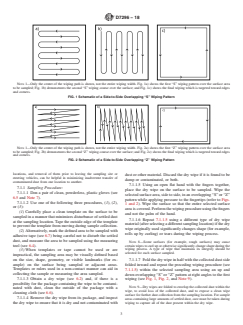
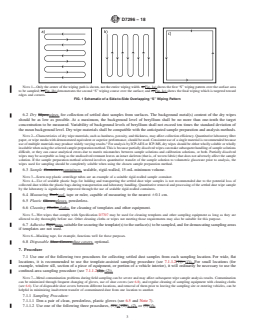
NOTE 1—Only the center of the wiping path is shown, not the entire wiping width. a) Fig. 1a) shows the first “S” wiping pattern over the surface area
to be sampled; b) Fig. 1b) demonstrates the second “S” wiping course over the surface; and c) Fig. 1c) shows the final wiping which is targeted toward
edges and corners.
FIG. 1 Schematic of a Side-to-Side Overlapping “S” Wiping Pattern
6.2 Dry Wipes,wipes, for collection of settled dust samples from surfaces. The background metal(s) content of the dry wipes
should be as low as possible. At a maximum, the background level of beryllium shall be no more than one-tenth the target
concentration to be measured. Variability of background levels of beryllium shall not exceed ten times the standard deviation of
the mean background level. Dry wipe materials shall be compatible with the anticipated sample preparation and analysis methods.
NOTE 2—Characteristics of dry wipe materials, such as hardness, porosity, and thickness, may affect collection efficiency. Quantitative laboratory filter
paper, or wipe media with demonstrated equivalent or superior performance, should be used. Consistent use of a single material is recommended because
use of multiple materials may produce widely varying results. For analysis by ICP-AES or ICP-MS, dry wipes should be either wholly soluble or wholly
insoluble when using the selected sample preparation method. This is because partially dissolved wipes can make subsequent handling of sample solutions
difficult, or they can cause analytical errors due to matrix mismatches between sample solutions and calibration solutions, or both. Partially dissolved
wipes may be acceptable as long as the undissolved remnant leaves an intact skeleton (that is, of woven fabric) that does not adversely affect the sample
solution. If the sample preparation method selected involves quantitative transfer of the sample solution to volumetric glassware prior to analysis, the
wipes used for sampling should be completely soluble when using the chosen sample preparation method.
6.3 Sample Containers,containers, sealable, rigid-walled, 15-mL minimum volume.
NOTE 3—Screw-top plastic centrifuge tubes are an example of a suitable rigid-walled sample container.
NOTE 4—Use of sealable plastic bags for holding and transporting the settled dust wipe samples is not recommended due to the potential loss of
collected dust within the plastic bags during transportation and laboratory handling. Quantitative removal and processing of the settled dust wipe sample
by the la
...