

ASTM D7295-18
(Practice)Standard Practice for Sampling Combustion Effluents and Other Stationary Sources for the Subsequent Determination of Hydrogen Cyanide
General Information
- Abstract
SIGNIFICANCE AND USE
5.1 Hydrogen cyanide is highly toxic. In relatively low quantities, hydrogen cyanide can cause asphyxia and death.
5.2 The National Fire Protection Association has assigned a flammability rating of 4 (severe fire hazard) to hydrogen cyanide.
SCOPE
1.1 This practice is used to collect samples for the determination of gaseous hydrogen cyanide (HCN) from any combustion device or atmosphere where cyanide may be present. While primarily designed for the measurement of gas phase HCN, the sample collection described in this practice also includes cyanide ion (CN-) absorbed particles that may be present in the sampling atmosphere.
1.1.1 Samples can be collected from a closed chamber such as the NBS smoke box described in Test Method E662 provided it is equipped with sampling ports.
1.1.2 Open chambers such as industrial work areas or large scale fires can be monitored for HCN with this practice.
1.1.3 The HCN emissions of a flow through system can be determined by sampling from its discharge stack. Examples of such systems include large scale manufacturing applications and the cone calorimeter described in Test Method E1354.
1.2 This practice can be used to monitor HCN levels in lab scale fire smoke effluents in order to estimate toxicity of gases produced from burning materials. See Guide E800.
1.3 The concentration range of hydrogen cyanide will be dependent on the volume of gas sampled, the volume of sodium hydroxide solution placed in the impinger during sampling, and the analytical method used to measure cyanide. For example, the lower limit of detection would be 0.002-mg/m3 when 0.1-m3 of combustion effluent is collected into 100-mL sodium hydroxide solution based on a detection limit of 0.002 mg/L cyanide in the impinger solution when using the flow injection analysis (FIA) system described in Test Method D6888.
1.4 The values stated in SI units are to be regarded as standard. No other units of measurement are included in this standard.
1.5 This standard does not purport to address all of the safety concerns, if any, associated with its use. It is the responsibility of the user of this standard to establish appropriate safety, health, and environmental practices and determine the applicability of regulatory limitations prior to use.
1.6 This international standard was developed in accordance with internationally recognized principles on standardization established in the Decision on Principles for the Development of International Standards, Guides and Recommendations issued by the World Trade Organization Technical Barriers to Trade (TBT) Committee.
- Status
- Published
- Publication Date
- 30-Apr-2018
- Technical Committee
- D22 - Air Quality
- Drafting Committee
- D22.03 - Ambient Atmospheres and Source Emissions
Buy Documents
ASTM D7295-18 - Standard Practice for Sampling Combustion Effluents and Other Stationary Sources for the Subsequent Determination of Hydrogen Cyanide
REDLINE ASTM D7295-18 - Standard Practice for Sampling Combustion Effluents and Other Stationary Sources for the Subsequent Determination of Hydrogen Cyanide
Overview
ASTM D7295-18 is a widely recognized standard practice developed by ASTM International for sampling combustion effluents and other stationary sources for the subsequent determination of hydrogen cyanide (HCN). Hydrogen cyanide is an extremely toxic and highly flammable gas, frequently produced during combustion processes and industrial operations. Monitoring and accurate detection of HCN in atmospheric emissions is critical for workplace safety, environmental compliance, and fire toxicity studies.
This standard provides detailed guidance on collecting samples from various environments, including closed and open combustion chambers, industrial settings, discharge stacks, and laboratory-scale fire tests. The procedure also enables the detection of cyanide ions (CN-) absorbed on particulates in the sampled atmosphere, allowing comprehensive assessment of both gaseous and particulate-bound cyanide.
Key Topics
- Sampling Methods: Outlines practices for obtaining representative samples from stack emissions, combustion chambers, and workspaces where HCN may be present.
- Sample Collection Equipment: Specifies the use of constant flow pumps, impingers, glass fiber filters, and appropriate tubing to ensure effective sample capture with minimal loss or contamination.
- Interference Mitigation: Advises on handling potential interferences from sulfides, aldehydes, and oxidizing agents to maintain sample integrity.
- Storage and Handling: Guidance on transporting and storing collected samples to prevent degradation, with recommendations for temperature control and preservatives.
- Analytical Techniques: Recommends validated analysis methods such as flow injection analysis (FIA) and ion chromatography, with additional colorimetric and ion-selective electrode screening options.
- Safety Considerations: Emphasizes the need for appropriate safety, health, and environmental practices due to the extreme toxicity and flammability of HCN.
Applications
The ASTM D7295-18 standard is applied across multiple industries and scenarios where the detection and quantification of hydrogen cyanide are crucial:
- Industrial Emissions Monitoring: Sampling effluents from manufacturing operations, especially those involving polymers, textiles, or chemical processing, to measure and control HCN releases.
- Fire Safety and Research: Assessing the toxicity of gases in smoke generated during material combustion in both real-scale fires and laboratory fire science experiments.
- Workplace Air Quality: Monitoring occupational exposure to hydrogen cyanide in industrial and laboratory environments, ensuring compliance with exposure limits and safeguarding worker health.
- Environmental Compliance: Supporting regulatory frameworks by providing validated methods for measuring HCN emissions from combustion sources, essential for environmental impact assessments.
Related Standards
Several ASTM and other recognized standards complement or reference ASTM D7295-18 in the context of cyanide sampling and analysis:
- ASTM D6888 – Test Method for available cyanides with ligand displacement and flow injection analysis.
- ASTM D2036 – Test Methods for cyanides in water (including analytical detection options).
- ASTM D1356 – Terminology relating to sampling and analysis of atmospheres.
- ASTM D3614 – Guide for laboratories involved in sampling and analysis of atmospheres and emissions.
- ASTM E800 – Guide for measurement of gases present or generated during fires.
- ASTM E662 – Test Method for specific optical density of smoke generated by solid materials.
- ASTM E1354 – Test Method for heat and visible smoke release rates using an oxygen consumption calorimeter.
Practical Value
ASTM D7295-18 provides a robust, internationally recognized methodology for sampling and analyzing hydrogen cyanide in a variety of combustion and industrial scenarios. By enabling accurate quantification of both gaseous and particulate cyanides, the standard helps industries comply with safety and environmental requirements, supports critical fire toxicity research, and improves workplace health standards. Its detailed procedural guidance ensures reliable results and effective risk management regarding one of the most hazardous gases encountered during combustion processes.
Relations
- Effective Date
- 01-May-2018
- Effective Date
- 15-Nov-2023
- Effective Date
- 15-Nov-2023
- Effective Date
- 01-Sep-2020
- Effective Date
- 15-Mar-2020
- Effective Date
- 01-May-2019
- Effective Date
- 01-Dec-2018
- Effective Date
- 01-Jul-2017
- Effective Date
- 01-Feb-2017
- Effective Date
- 01-May-2016
- Effective Date
- 01-Apr-2016
- Effective Date
- 01-Feb-2016
- Effective Date
- 01-Nov-2015
- Effective Date
- 15-Oct-2015
- Effective Date
- 01-Aug-2015
Buy Documents
ASTM D7295-18 - Standard Practice for Sampling Combustion Effluents and Other Stationary Sources for the Subsequent Determination of Hydrogen Cyanide
REDLINE ASTM D7295-18 - Standard Practice for Sampling Combustion Effluents and Other Stationary Sources for the Subsequent Determination of Hydrogen Cyanide
Get Certified
Connect with accredited certification bodies for this standard

CIS Institut d.o.o.
Personal Protective Equipment (PPE) certification body. Notified Body NB-2890 for EU Regulation 2016/425 PPE.

Kiwa BDA Testing
Building and construction product certification.
Kmetijski inštitut Slovenije
Agricultural Institute of Slovenia. Soil testing, plant health, agricultural product analysis.
Sponsored listings
Frequently Asked Questions
ASTM D7295-18 is a standard published by ASTM International. Its full title is "Standard Practice for Sampling Combustion Effluents and Other Stationary Sources for the Subsequent Determination of Hydrogen Cyanide". This standard covers: SIGNIFICANCE AND USE 5.1 Hydrogen cyanide is highly toxic. In relatively low quantities, hydrogen cyanide can cause asphyxia and death. 5.2 The National Fire Protection Association has assigned a flammability rating of 4 (severe fire hazard) to hydrogen cyanide. SCOPE 1.1 This practice is used to collect samples for the determination of gaseous hydrogen cyanide (HCN) from any combustion device or atmosphere where cyanide may be present. While primarily designed for the measurement of gas phase HCN, the sample collection described in this practice also includes cyanide ion (CN-) absorbed particles that may be present in the sampling atmosphere. 1.1.1 Samples can be collected from a closed chamber such as the NBS smoke box described in Test Method E662 provided it is equipped with sampling ports. 1.1.2 Open chambers such as industrial work areas or large scale fires can be monitored for HCN with this practice. 1.1.3 The HCN emissions of a flow through system can be determined by sampling from its discharge stack. Examples of such systems include large scale manufacturing applications and the cone calorimeter described in Test Method E1354. 1.2 This practice can be used to monitor HCN levels in lab scale fire smoke effluents in order to estimate toxicity of gases produced from burning materials. See Guide E800. 1.3 The concentration range of hydrogen cyanide will be dependent on the volume of gas sampled, the volume of sodium hydroxide solution placed in the impinger during sampling, and the analytical method used to measure cyanide. For example, the lower limit of detection would be 0.002-mg/m3 when 0.1-m3 of combustion effluent is collected into 100-mL sodium hydroxide solution based on a detection limit of 0.002 mg/L cyanide in the impinger solution when using the flow injection analysis (FIA) system described in Test Method D6888. 1.4 The values stated in SI units are to be regarded as standard. No other units of measurement are included in this standard. 1.5 This standard does not purport to address all of the safety concerns, if any, associated with its use. It is the responsibility of the user of this standard to establish appropriate safety, health, and environmental practices and determine the applicability of regulatory limitations prior to use. 1.6 This international standard was developed in accordance with internationally recognized principles on standardization established in the Decision on Principles for the Development of International Standards, Guides and Recommendations issued by the World Trade Organization Technical Barriers to Trade (TBT) Committee.
SIGNIFICANCE AND USE 5.1 Hydrogen cyanide is highly toxic. In relatively low quantities, hydrogen cyanide can cause asphyxia and death. 5.2 The National Fire Protection Association has assigned a flammability rating of 4 (severe fire hazard) to hydrogen cyanide. SCOPE 1.1 This practice is used to collect samples for the determination of gaseous hydrogen cyanide (HCN) from any combustion device or atmosphere where cyanide may be present. While primarily designed for the measurement of gas phase HCN, the sample collection described in this practice also includes cyanide ion (CN-) absorbed particles that may be present in the sampling atmosphere. 1.1.1 Samples can be collected from a closed chamber such as the NBS smoke box described in Test Method E662 provided it is equipped with sampling ports. 1.1.2 Open chambers such as industrial work areas or large scale fires can be monitored for HCN with this practice. 1.1.3 The HCN emissions of a flow through system can be determined by sampling from its discharge stack. Examples of such systems include large scale manufacturing applications and the cone calorimeter described in Test Method E1354. 1.2 This practice can be used to monitor HCN levels in lab scale fire smoke effluents in order to estimate toxicity of gases produced from burning materials. See Guide E800. 1.3 The concentration range of hydrogen cyanide will be dependent on the volume of gas sampled, the volume of sodium hydroxide solution placed in the impinger during sampling, and the analytical method used to measure cyanide. For example, the lower limit of detection would be 0.002-mg/m3 when 0.1-m3 of combustion effluent is collected into 100-mL sodium hydroxide solution based on a detection limit of 0.002 mg/L cyanide in the impinger solution when using the flow injection analysis (FIA) system described in Test Method D6888. 1.4 The values stated in SI units are to be regarded as standard. No other units of measurement are included in this standard. 1.5 This standard does not purport to address all of the safety concerns, if any, associated with its use. It is the responsibility of the user of this standard to establish appropriate safety, health, and environmental practices and determine the applicability of regulatory limitations prior to use. 1.6 This international standard was developed in accordance with internationally recognized principles on standardization established in the Decision on Principles for the Development of International Standards, Guides and Recommendations issued by the World Trade Organization Technical Barriers to Trade (TBT) Committee.
ASTM D7295-18 is classified under the following ICS (International Classification for Standards) categories: 13.040.40 - Stationary source emissions. The ICS classification helps identify the subject area and facilitates finding related standards.
ASTM D7295-18 has the following relationships with other standards: It is inter standard links to ASTM D7295-11, ASTM D6888-16(2023), ASTM D6696-16(2023), ASTM D1356-20a, ASTM D1356-20, ASTM E2877-12(2019), ASTM E662-18, ASTM E662-17a, ASTM E662-17, ASTM E1354-16a, ASTM D6696-16, ASTM E1354-16, ASTM E662-15a, ASTM D1356-15a, ASTM E1354-15a. Understanding these relationships helps ensure you are using the most current and applicable version of the standard.
ASTM D7295-18 is available in PDF format for immediate download after purchase. The document can be added to your cart and obtained through the secure checkout process. Digital delivery ensures instant access to the complete standard document.
Standards Content (Sample)
This international standard was developed in accordance with internationally recognized principles on standardization established in the Decision on Principles for the
Development of International Standards, Guides and Recommendations issued by the World Trade Organization Technical Barriers to Trade (TBT) Committee.
Designation: D7295 − 18
Standard Practice for
Sampling Combustion Effluents and Other Stationary
Sources for the Subsequent Determination of Hydrogen
Cyanide
This standard is issued under the fixed designation D7295; the number immediately following the designation indicates the year of
original adoption or, in the case of revision, the year of last revision. A number in parentheses indicates the year of last reapproval. A
superscript epsilon (´) indicates an editorial change since the last revision or reapproval.
1. Scope 1.5 This standard does not purport to address all of the
safety concerns, if any, associated with its use. It is the
1.1 This practice is used to collect samples for the determi-
responsibility of the user of this standard to establish appro-
nation of gaseous hydrogen cyanide (HCN) from any combus-
priate safety, health, and environmental practices and deter-
tion device or atmosphere where cyanide may be present.
mine the applicability of regulatory limitations prior to use.
While primarily designed for the measurement of gas phase
1.6 This international standard was developed in accor-
HCN, the sample collection described in this practice also
- dance with internationally recognized principles on standard-
includes cyanide ion (CN ) absorbed particles that may be
ization established in the Decision on Principles for the
present in the sampling atmosphere.
Development of International Standards, Guides and Recom-
1.1.1 Samples can be collected from a closed chamber such
mendations issued by the World Trade Organization Technical
as the NBS smoke box described in Test Method E662
Barriers to Trade (TBT) Committee.
provided it is equipped with sampling ports.
1.1.2 Open chambers such as industrial work areas or large
2. Referenced Documents
scale fires can be monitored for HCN with this practice.
2.1 ASTM Standards:
1.1.3 The HCN emissions of a flow through system can be
D1193 Specification for Reagent Water
determined by sampling from its discharge stack. Examples of
D1356 Terminology Relating to Sampling and Analysis of
such systems include large scale manufacturing applications
Atmospheres
and the cone calorimeter described in Test Method E1354.
D2036 Test Methods for Cyanides in Water
1.2 This practice can be used to monitor HCN levels in lab
D2777 Practice for Determination of Precision and Bias of
scale fire smoke effluents in order to estimate toxicity of gases
Applicable Test Methods of Committee D19 on Water
produced from burning materials. See Guide E800.
D3154 Test Method for Average Velocity in a Duct (Pitot
1.3 The concentration range of hydrogen cyanide will be
Tube Method)
dependent on the volume of gas sampled, the volume of
D3614 Guide for Laboratories Engaged in Sampling and
sodium hydroxide solution placed in the impinger during
Analysis of Atmospheres and Emissions
sampling, and the analytical method used to measure cyanide.
D3685/D3685M Test Methods for Sampling and Determina-
For example, the lower limit of detection would be 0.002-
tion of Particulate Matter in Stack Gases
3 3
mg/m when 0.1-m of combustion effluent is collected into
D4841 Practice for Estimation of Holding Time for Water
100-mL sodium hydroxide solution based on a detection limit
Samples Containing Organic and Inorganic Constituents
of 0.002 mg/Lcyanide in the impinger solution when using the
D5337 Practice for Flow RateAdjustment of Personal Sam-
flow injection analysis (FIA) system described in Test Method
pling Pumps
D6888.
D6696 Guide for Understanding Cyanide Species
D6888 Test Method for Available Cyanides with Ligand
1.4 The values stated in SI units are to be regarded as
Displacement and Flow InjectionAnalysis (FIA) Utilizing
standard. No other units of measurement are included in this
Gas Diffusion Separation and Amperometric Detection
standard.
D7365 Practice for Sampling, Preservation and Mitigating
Interferences in Water Samples for Analysis of Cyanide
This practice is under the jurisdiction ofASTM Committee D22 on Air Quality
and is the direct responsibility of Subcommittee D22.03 on Ambient Atmospheres
and Source Emissions. For referenced ASTM standards, visit the ASTM website, www.astm.org, or
Current edition approved May 1, 2018. Published May 2018. Originally contact ASTM Customer Service at service@astm.org. For Annual Book of ASTM
approved in 2006. Last previous edition approved in 2011 as D7295 – 11. DOI: Standards volume information, refer to the standard’s Document Summary page on
10.1520/D7295-18. the ASTM website.
Copyright © ASTM International, 100 Barr Harbor Drive, PO Box C700, West Conshohocken, PA 19428-2959. United States
D7295 − 18
E337 Test Method for Measuring Humidity with a Psy- to 15-L/min or at the desired flow rate. Personal industrial
chrometer (the Measurement of Wet- and Dry-Bulb Tem- hygiene sampling pumps or high volume sampling pumps may
peratures)
be utilized. More than one sample can be collected with a
E662 Test Method for Specific Optical Density of Smoke
single pump using a manifold with flow control valves. The
Generated by Solid Materials
system should be calibrated as described in Practice D5337 or
E800 Guide for Measurement of Gases Present or Generated
using a suitable commercially available calibrator.
During Fires
6.1.2 Impinger Sample Collection Vessels—Standard mini
E1354 Test Method for Heat and Visible Smoke Release
or midget impingers with standard tip. Greenberg-Smith im-
Rates for Materials and Products Using an Oxygen Con-
pingers equipped with a standard tip with 500-mL capacity
sumption Calorimeter
may be used when larger flow rates are desired. Impinger
E2877 Guide for Digital Contact Thermometers
connections should consist of leak free ground glass joints to
avoid the loss of HCN during sampling and should be free of
3. Terminology
any silicone grease. The use of a single impinger has shown to
3.1 Refer to Terminology D1356 for terminology related to
yield an average of 97 % efficiency in combustion effluents;
sampling and analysis of atmospheres.
however, higher efficiencies are possible using additional
3.2 For definitions of terms related to cyanide testing, refer impingers in series. Without prior knowledge of the
to Guide D6696 and Test Method D6888.
atmosphere, it is recommended to use a backup impinger to
determine if breakthrough occurs. Test each impinger for
3.3 For definitions of terms related to the measurement of
cyanide as a separate sample in order to demonstrate capture
gases present or generated during fires, refer to Guide E800.
efficiency; mathematically combine the results by adding the
3.4 For additional information related to sampling and
observed concentrations.
analysis of atmospheres, see Guide D3614.
6.1.3 Sample Collection Tubing and Probes—Collection
tubing and probes should be constructed of inert material such
4. Summary of Practice
PTFE or PTFE-lined stainless steel. Vinyl tubing can be used
4.1 Aknown volume of gaseous sample is bubbled through
in the sample train where flexible tubing is necessary, but the
an impinger containing 0.1–M sodium hydroxide solution
aforementioned are preferred. The sample lines should be
utilizing a calibrated pumping system. Particulates that may
heated at 120 6 5°C when sampling stack emissions in moist
pass through the impinger are captured on a glass fiber filter
air in order to prevent condensate from forming in the sample
then recombined back into the impinger solution prior to
train.
analysis. Because HCN is soluble in aqueous solutions, it may
6.1.4 Glass Fiber Filters—Type A/E, 1 µm binder free
be present in water droplets formed from either a wet scrubber
borosilicateglassfiberfilterandcassetteassemblycartridgefor
system or condensation in the stack. Because of this, samples
air sampling applications. The filters are used between the
that contain moist air should be sampled near isokinetic
impingers and pumping system to capture fine particulates that
conditions.
may pass through the impingers and to protect the pumping
4.2 During the sampling process, hydrogen cyanide (HCN)
-
system. It is recommended to use 13-mm filters for mini-
is converted to cyanide ion (CN ) in the sodium hydroxide
- impingers and 47-mm filters for Greenberg-Smith impingers.
solution. The CN is analyzed with a flow injection analysis
6.1.5 Duplicate and Matrix Spike Sample Trains—It is
(FIA) system described in Test Method D6888 or with a
recommended to setup duplicate impingers to evaluate preci-
suitable analytical method such as ion chromatography de-
sion.Inaddition,asecondsetofimpingerscanbefortifiedwith
scribed in Test Methods D2036.
a known amount of cyanide (see 8.11) to evaluate recovery.
4.2.1 Colorimetric and ion selective electrode methods, also
Fig. 1 shows an example of such a system.
described in Test Methods D2036 can be used for screening
purposes.
6.1.6 Thermometer—Measure the temperature of the stack
or atmosphere with a thermometer as described in Guide
4.3 The concentration of HCN in the atmosphere or stack is
E2877 capable of accurately reading within 60.1°C.
calculated as described in 9.6.
5. Significance and Use
7. Interferences
5.1 Hydrogen cyanide is highly toxic. In relatively low
7.1 Sulfide, aldehydes, and oxidizing agents in the atmo-
quantities, hydrogen cyanide can cause asphyxia and death.
sphere are possible interferences.
5.2 The National Fire ProtectionAssociation has assigned a
7.2 Prior to conducting sampling and analysis, review 9.4 in
flammability rating of 4 (severe fire hazard) to hydrogen
order to avoid cyanide degradation or inaccurate results.
cyanide.
8. Reagents and Materials
6. Apparatus
6.1 Sample Collection Train 8.1 Purity of Reagents—Reagent grade chemicals shall be
used in all tests. Unless otherwise indicated, it is intended that
6.1.1 Constant Flow Pumping System—Pumps used to col-
lectsamplesshouldbeabletoaccuratelypumpfrom0.1-L/min all reagents shall conform to the specifications of theAmerican
D7295 − 18
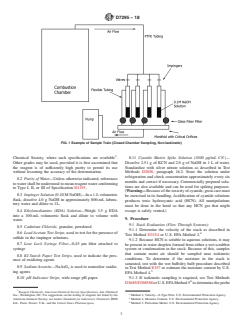
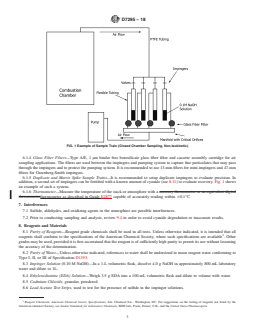
FIG. 1 Example of Sample Train (Closed Chamber Sampling, Non-Isokinetic)
3 -
Chemical Society, where such specifications are available . 8.11 Cyanide Matrix Spike Solution (1000 µg/mL CN )—
Other grades may be used, provided it is first ascertained that Dissolve 2.51 g of KCN and 2.0 g of NaOH in 1 L of water.
the reagent is of sufficiently high purity to permit its use Standardize with silver nitrate solution as described in Test
D2036, paragraph 16.2. Store the solution under
without lessening the accuracy of the determination. Methods
refrigeration and check concentration approximately every six
8.2 Purity of Water—Unless otherwise indicated, references
months and correct if necessary. Commercially prepared solu-
towatershallbeunderstoodtomeanreagentwaterconforming
tions are also available and can be used for spiking purposes.
to Type I, II, or III of Specification D1193.
(Warning—Becauseofthetoxicityofcyanide,greatcaremust
8.3 Impinger Solution(0.10MNaOH)—Ina1-Lvolumetric
be exercised in its handling.Acidification of cyanide solutions
flask, dissolve 4.0 g NaOH in approximately 800-mL labora-
produces toxic hydrocyanic acid (HCN). All manipulations
tory water and dilute to 1L.
must be done in the hood so that any HCN gas that might
escape is safely vented.)
8.4 Ethylenediamine (EDA) Solution—Weigh 3.5 g EDA
into a 100-mL volumetric flask and dilute to volume with
9. Procedure
water.
9.1 Stack Evaluation (Flow Through Systems):
8.5 Cadmium Chloride, granular, powdered.
9.1.1 Determine the velocity of the stack as described in
8.6 Lead Acetate Test Strips, used to test for the presence of 4
Test Method D3154 or U.S. EPA Method 2.
sulfide in the impinger solutions.
9.1.2 Because HCN is soluble in aqueous solutions, it may
8.7 Leur Lock Syringe Filter—0.45 µm filter attached to be present in water droplets formed from either a wet scrubber
syringe
system or condensation in the stack. Because of this, samples
that contain moist air should be sampled near isokinetic
8.8 KI Starch Paper Test Strips, used to indicate the pres-
conditions. To determine if the moisture in the stack is
ence of oxidizing agents
saturated, test with the wet bulb/dry bulb procedure described
8.9 Sodium Arsenite—NaAsO is used to neutralize oxidiz-
in Test Method E337 or estimate the moisture content by U.S.
ing agents 5
EPA
...
This document is not an ASTM standard and is intended only to provide the user of an ASTM standard an indication of what changes have been made to the previous version. Because
it may not be technically possible to adequately depict all changes accurately, ASTM recommends that users consult prior editions as appropriate. In all cases only the current version
of the standard as published by ASTM is to be considered the official document.
Designation: D7295 − 11 D7295 − 18
Standard Practice for
Sampling and Determination of Hydrogen Cyanide (HCN) in
Combustion Effluents and Other Stationary
SourcesCombustion Effluents and Other Stationary Sources
for the Subsequent Determination of Hydrogen Cyanide
This standard is issued under the fixed designation D7295; the number immediately following the designation indicates the year of
original adoption or, in the case of revision, the year of last revision. A number in parentheses indicates the year of last reapproval. A
superscript epsilon (´) indicates an editorial change since the last revision or reapproval.
1. Scope
1.1 This practice is used to determine the concentrationcollect samples for the determination of gaseous hydrogen cyanide
(HCN) from any combustion device or atmosphere where cyanide may be present. While primarily designed for the measurement
-
of gas phase HCN, the sample collection described in this practice also includes cyanide ion (CN ) absorbed particles that may be
present in the sampling atmosphere.
1.1.1 Samples can be collected from a closed chamber such as the NBS smoke box described in Test Method E662 provided
it is equipped with sampling ports.
1.1.2 Open chambers such as industrial work areas or large scale fires can be monitored for HCN with this practice.
1.1.3 The HCN emissions of a flow through system can be determined by sampling from its discharge stack. Examples of such
systems include large scale manufacturing applications and the cone calorimeter described in Test Method E1354.
1.2 This practice can be used to monitor HCN levels in lab scale fire smoke effluents in order to estimate toxicity of gases
produced from burning materials. See Guide E800.
1.3 The concentration range of hydrogen cyanide will be dependent on the volume of gas sampled, the volume of sodium
hydroxide solution placed in the impinger during sampling, and the analytical method used to measure cyanide. For example, the
3 3
lower limit of detection would be 0.002-mg/m when 0.1-m of combustion effluent is collected into 100-mL sodium hydroxide
solution based on a detection limit of 0.002 mg/L cyanide in the impinger solution when using the flow injection analysis (FIA)
system described in Test Method D6888.
1.4 The values stated in SI units are to be regarded as standard. No other units of measurement are included in this standard.
1.5 This standard does not purport to address all of the safety concerns, if any, associated with its use. It is the responsibility
of the user of this standard to establish appropriate safety safety, health, and healthenvironmental practices and determine the
applicability of regulatory limitations prior to use.
1.6 This international standard was developed in accordance with internationally recognized principles on standardization
established in the Decision on Principles for the Development of International Standards, Guides and Recommendations issued
by the World Trade Organization Technical Barriers to Trade (TBT) Committee.
2. Referenced Documents
2.1 ASTM Standards:
D1193 Specification for Reagent Water
D1356 Terminology Relating to Sampling and Analysis of Atmospheres
D2036 Test Methods for Cyanides in Water
D2777 Practice for Determination of Precision and Bias of Applicable Test Methods of Committee D19 on Water
D3154 Test Method for Average Velocity in a Duct (Pitot Tube Method)
D3614 Guide for Laboratories Engaged in Sampling and Analysis of Atmospheres and Emissions
This practice is under the jurisdiction of ASTM Committee D22 on Air Quality and is the direct responsibility of Subcommittee D22.03 on Ambient Atmospheres and
Source Emissions.
Current edition approved March 1, 2011May 1, 2018. Published March 2011May 2018. Originally approved in 2006. Last previous edition approved in 20062011 as
D7295 – 06.D7295 – 11. DOI: 10.1520/D7295-11.10.1520/D7295-18.
For referenced ASTM standards, visit the ASTM website, www.astm.org, or contact ASTM Customer Service at service@astm.org. For Annual Book of ASTM Standards
volume information, refer to the standard’s Document Summary page on the ASTM website.
Copyright © ASTM International, 100 Barr Harbor Drive, PO Box C700, West Conshohocken, PA 19428-2959. United States
D7295 − 18
D3685/D3685M Test Methods for Sampling and Determination of Particulate Matter in Stack Gases
D4841 Practice for Estimation of Holding Time for Water Samples Containing Organic and Inorganic Constituents
D5337 Practice for Flow Rate Adjustment of Personal Sampling Pumps
D6696 Guide for Understanding Cyanide Species
D6888 Test Method for Available Cyanides with Ligand Displacement and Flow Injection Analysis (FIA) Utilizing Gas
Diffusion Separation and Amperometric Detection
D7365 Practice for Sampling, Preservation and Mitigating Interferences in Water Samples for Analysis of Cyanide
E337 Test Method for Measuring Humidity with a Psychrometer (the Measurement of Wet- and Dry-Bulb Temperatures)
E662 Test Method for Specific Optical Density of Smoke Generated by Solid Materials
E800 Guide for Measurement of Gases Present or Generated During Fires
E1354 Test Method for Heat and Visible Smoke Release Rates for Materials and Products Using an Oxygen Consumption
Calorimeter
E2877 Guide for Digital Contact Thermometers
3. Terminology
3.1 Refer to Terminology D1356 for terminology related to sampling and analysis of atmospheres.
3.2 For definitions of terms related to cyanide testing, refer to Guide D6696 and Test Method D6888.
3.3 For definitions of terms related to the measurement of gases present or generated during fires, refer to Guide E800.
3.4 For additional information related to sampling and analysis of atmospheres, see Guide D3614.
4. Summary of Practice
4.1 A known volume of gaseous sample is bubbled through an impinger containing 0.1–M sodium hydroxide solution utilizing
a calibrated pumping system. Particulates that may pass through the impinger are captured on a glass fiber filter then recombined
back into the impinger solution prior to analysis. Because HCN is soluble in aqueous solutions, it may be present in water droplets
formed from either a wet scrubber system or condensation in the stack. Because of this, samples that contain moist air should be
sampled near isokinetic conditions.
-
4.2 During the sampling process, hydrogen cyanide (HCN) is converted to cyanide ion (CN ) in the sodium hydroxide solution.
-
The CN is analyzed with a flow injection analysis (FIA) system described in Test Method D6888 or with a suitable analytical
method such as ion chromatography described in Test Methods D2036.
4.2.1 Colorimetric and ion selective electrode methods, also described in Test Methods D2036 can be used for screening
purposes.
4.3 The concentration of HCN in the atmosphere or stack is calculated as described in 9.6.
5. Significance and Use
5.1 Hydrogen cyanide is highly toxic. In relatively low quantities, hydrogen cyanide can cause asphyxia and death.
5.2 The National Fire Protection Association has assigned a flammability rating of 4 (severe fire hazard) to hydrogen cyanide.
6. Apparatus
6.1 Sample Collection Train
6.1.1 Constant Flow Pumping System—Pumps used to collect samples should be able to accurately pump from 0.1-L/min to
15-L/min or at the desired flow rate. Personal industrial hygiene sampling pumps or high volume sampling pumps may be utilized.
More than one sample can be collected with a single pump using a manifold with flow control valves. The system should be
calibrated as described in Practice D5337 or using a suitable commercially available calibrator.
6.1.2 Impinger Sample Collection Vessels—Standard mini or midget impingers with standard tip. Greenberg-Smith impingers
equipped with a standard tip with 500-mL capacity may be used when larger flow rates are desired. Impinger connections should
consist of leak free ground glass joints to avoid the loss of HCN during sampling and should be free of any silicone grease. The
use of a single impinger has shown to yield an average of 97 % efficiency in combustion effluents; however, higher efficiencies
are possible using additional impingers in series. Without prior knowledge of the atmosphere, it is recommended to use a backup
impinger to determine if breakthrough occurs. Test each impinger for cyanide as a separate sample in order to demonstrate capture
efficiency; mathematically combine the results by adding the observed concentrations.
6.1.3 Sample Collection Tubing and Probes—Collection tubing and probes should be constructed of inert material such PTFE
or PTFE-lined stainless steel. Vinyl tubing can be used in the sample train where flexible tubing is necessary, but the
aforementioned are preferred. The sample lines should be heated at 120 6 5°C when sampling stack emissions in moist air in order
to prevent condensate from forming in the sample train.
D7295 − 18
FIG. 1 Example of Sample Train (Closed Chamber Sampling, Non-Isokinetic)
6.1.4 Glass Fiber Filters—Type A/E, 1 μm binder free borosilicate glass fiber filter and cassette assembly cartridge for air
sampling applications. The filters are used between the impingers and pumping system to capture fine particulates that may pass
through the impingers and to protect the pumping system. It is recommended to use 13-mm filters for mini-impingers and 47-mm
filters for Greenberg-Smith impingers.
6.1.5 Duplicate and Matrix Spike Sample Trains—It is recommended to setup duplicate impingers to evaluate precision. In
addition, a second set of impingers can be fortified with a known amount of cyanide (see 8.11) to evaluate recovery. Fig. 1 shows
an example of such a system.
6.1.6 Thermometer—Measure the temperature of the stack or atmosphere with a mercury thermometer or an equivalent digital
thermometerthermometer as described in Guide E2877 capable of accurately reading within 60.1°C.
7. Interferences
7.1 Sulfide, aldehydes, and oxidizing agents in the atmosphere are possible interferences.
7.2 Prior to conducting sampling and analysis, review 9.4 in order to avoid cyanide degradation or inaccurate results.
8. Reagents and Materials
8.1 Purity of Reagents—Reagent grade chemicals shall be used in all tests. Unless otherwise indicated, it is intended that all
reagents shall conform to the specifications of the American Chemical Society, where such specifications are available . Other
grades may be used, provided it is first ascertained that the reagent is of sufficiently high purity to permit its use without lessening
the accuracy of the determination.
8.2 Purity of Water—Unless otherwise indicated, references to water shall be understood to mean reagent water conforming to
Type I, II, or III of Specification D1193.
8.3 Impinger Solution (0.10 M NaOH)—In a 1-L volumetric flask, dissolve 4.0 g NaOH in approximately 800-mL laboratory
water and dilute to 1L.
8.4 Ethylenediamine (EDA) Solution—Weigh 3.5 g EDA into a 100-mL volumetric flask and dilute to volume with water.
8.5 Cadmium Chloride, granular, powdered.
8.6 Lead Acetate Test Strips, used to test for the presence of sulfide in the impinger solutions.
Reagent Chemicals, American Chemical Society Specifications, Am. Chemical Soc., Washington, DC. For suggestions on the testing of reagents not listed by the
American chemical Society, see Analar Standards for Laboratory Chemicals, BDH Ltd., Poole, Dorset, U.K., and the United States Pharmacopeia.
D7295 − 18
8.7 Leur Lock Syringe Filter—0.45 μm filter attached to syringe
8.8 KI Starch Paper Test Strips, used to indicate the presence of oxidizing agents
8.9 Sodium Arsenite—NaAsO is used to neutralize oxidizing agents
8.10 pH Indicator Strips, wide range pH paper.
-
8.11 Cyanide Matrix Spike Solution (1000 μg/mL CN )—Dissolve 2.51 g of KCN and 2.0 g of NaOH in 1 L of water. Standardize
with silver nitrate solution as described in Test Methods D2036, paragraph 16.2. Store the solution under refrigeration and check
concentration approximately every six months and correct if necessary. Commercially prepared solutions are also available and can
be used for spiking purposes. (Warning—Because of the toxicity of cyanide, great care must be exercised in its handling.
Acidification of cyanide solutions produces toxic hydrocyanic acid (HCN). All manipulations must be done in the hood so that any
HCN gas that might escape is safely vented.)
9. Procedure
9.
...