

ASTM D4922-21
(Test Method)Standard Test Method for Determination of Radioactive Iron in Water
General Information
- Abstract
SIGNIFICANCE AND USE
5.1 Fe-55 is formed in reactor coolant systems of nuclear reactors by activation of stable iron. The 55Fe is not completely removed by waste processing systems and some is released to the environment by means of normal waste liquid discharges. Power plants are required to monitor these discharges for 55Fe as well as other radionuclides.
5.2 This technique effectively removes other activation and fission products such as isotopes of iodine, zinc, manganese, cobalt, and cesium by the addition of hold-back carriers and an anion exchange technique. The fission products (zirconium-95 and niobium-95) are selectively eluted with hydrochloric-hydrofluoric acid washes. The iron is finally separated from Zn+2 by precipitation of FePO4 at a pH of 3.0.
SCOPE
1.1 This test method covers the determination of 55Fe in the presence of 59Fe by liquid scintillation counting. The a-priori minimum detectable concentration for this test method is 7.4 Bq/L.2
1.2 This test method was developed principally for the quantitative determination of 55Fe. However, after proper calibration of the liquid scintillation counter with reference standards of each nuclide, 59Fe may also be quantified.
1.3 This test method was used successfully with Type III reagent water conforming to Specification D1193. It is the responsibility of the user to ensure the validity of this test method for waters of untested matrices.
1.4 This standard does not purport to address all of the safety concerns, if any, associated with its use. It is the responsibility of the user of this standard to establish appropriate safety, health, and environmental practices and determine the applicability of regulatory limitations prior to use. For a specific hazard statement, see Section 9.
1.5 This international standard was developed in accordance with internationally recognized principles on standardization established in the Decision on Principles for the Development of International Standards, Guides and Recommendations issued by the World Trade Organization Technical Barriers to Trade (TBT) Committee.
- Status
- Published
- Publication Date
- 14-Dec-2021
- Technical Committee
- D19 - Water
- Drafting Committee
- D19.04 - Methods of Radiochemical Analysis
Overview
ASTM D4922-21 is the globally recognized standard test method for the determination of radioactive iron, specifically Fe-55, in water samples using liquid scintillation counting. Developed by ASTM International, this method addresses the monitoring of Fe-55 and Fe-59, which arise from nuclear reactor operations, ensuring compliance with environmental and regulatory requirements concerning radioactive discharges. Fe-55, produced by activation of stable iron in reactor coolant systems, is closely monitored in power plants to protect public health and the environment. The standard details the preparation, separation, detection, and quantification steps necessary for accurate testing of Fe-55 in aqueous matrices.
Key Topics
Significance of Fe-55 Monitoring
- Fe-55 is a common activation product found in nuclear reactor coolant systems.
- Not fully removed during waste processing, Fe-55 can be released into the environment through liquid discharges.
- Regulatory bodies mandate regular monitoring of Fe-55 alongside other radionuclides.
Standard Methodology
- Utilizes liquid scintillation counting for sensitive detection of Fe-55, with a minimum detectable concentration of 7.4 Bq/L.
- Effectively separates iron from interfering isotopes, including iodine, zinc, manganese, cobalt, cesium, zirconium-95, and niobium-95.
- Employs anion exchange and selective elution techniques, followed by iron-precipitation at pH 3.0 for high specificity.
- Calibration using reference standards allows for the quantification of both Fe-55 and Fe-59.
Quality Control
- Includes requirements for laboratory quality assurance, blanks, matrix spikes, and independent reference materials.
- Precision and bias are validated through multi-lab collaborative data and ongoing QC procedures.
Safety and Environmental Considerations
- Emphasizes the need for appropriate safety practices when handling hazardous reagents (e.g., hydrofluoric acid).
- Directs users to establish safety, health, and environmental protocols.
Applications
Nuclear Power Plants
- Used for compliance monitoring of effluents and waste streams to detect and quantify radioactive iron (Fe-55, Fe-59).
- Supports regulatory reporting, safety assessments, and environmental stewardship.
Environmental and Regulatory Testing Laboratories
- Applied in water quality analysis to monitor radioactive contaminants in surface water, groundwater, and effluent discharges.
- Supports national and international radiological protection programs.
Research
- Valuable for studies on radionuclide migration, environmental fate, and behavior of activation products in aquatic environments.
- Enables efficient separation and measurement of low-level radioactive iron even in complex matrices.
Related Standards
The following ASTM standards and references are related to or referenced within ASTM D4922-21:
- ASTM D1068 - Test Methods for Iron in Water.
- ASTM D1129 - Terminology Relating to Water.
- ASTM D1193 - Specification for Reagent Water.
- ASTM D2777 - Practice for Determination of Precision and Bias of Test Methods.
- ASTM D3370 - Practices for Sampling Water from Flowing Process Streams.
- ASTM D5847 - Practice for Writing Quality Control Specifications for Water Analysis.
- ASTM D7282 - Practice for Calibration and Quality Control of Instruments Used for Radioactivity Measurements.
- ASTM D7902 - Terminology for Radiochemical Analyses.
These standards ensure comprehensive technical alignment in radiochemical water analysis, covering aspects of terminology, methodology, quality assurance, and instrument calibration.
Keywords: ASTM D4922-21, Fe-55, Fe-59, radioactive iron, liquid scintillation counting, anion exchange, environmental monitoring, nuclear power, water analysis, radiochemical testing, quality assurance, regulatory compliance.
Relations
- Effective Date
- 01-May-2020
- Effective Date
- 01-May-2020
- Effective Date
- 01-Feb-2018
- Effective Date
- 01-Feb-2016
- Effective Date
- 15-Jan-2014
- Effective Date
- 15-Jan-2014
- Effective Date
- 15-Jun-2012
- Effective Date
- 01-Dec-2010
- Effective Date
- 01-Sep-2010
- Effective Date
- 01-Mar-2010
- Effective Date
- 01-Oct-2008
- Effective Date
- 15-Jan-2008
- Effective Date
- 01-Dec-2007
- Effective Date
- 15-Dec-2006
- Effective Date
- 01-Sep-2006
Get Certified
Connect with accredited certification bodies for this standard

CIS Institut d.o.o.
Personal Protective Equipment (PPE) certification body. Notified Body NB-2890 for EU Regulation 2016/425 PPE.

Kiwa BDA Testing
Building and construction product certification.
Kmetijski inštitut Slovenije
Agricultural Institute of Slovenia. Soil testing, plant health, agricultural product analysis.
Sponsored listings
Frequently Asked Questions
ASTM D4922-21 is a standard published by ASTM International. Its full title is "Standard Test Method for Determination of Radioactive Iron in Water". This standard covers: SIGNIFICANCE AND USE 5.1 Fe-55 is formed in reactor coolant systems of nuclear reactors by activation of stable iron. The 55Fe is not completely removed by waste processing systems and some is released to the environment by means of normal waste liquid discharges. Power plants are required to monitor these discharges for 55Fe as well as other radionuclides. 5.2 This technique effectively removes other activation and fission products such as isotopes of iodine, zinc, manganese, cobalt, and cesium by the addition of hold-back carriers and an anion exchange technique. The fission products (zirconium-95 and niobium-95) are selectively eluted with hydrochloric-hydrofluoric acid washes. The iron is finally separated from Zn+2 by precipitation of FePO4 at a pH of 3.0. SCOPE 1.1 This test method covers the determination of 55Fe in the presence of 59Fe by liquid scintillation counting. The a-priori minimum detectable concentration for this test method is 7.4 Bq/L.2 1.2 This test method was developed principally for the quantitative determination of 55Fe. However, after proper calibration of the liquid scintillation counter with reference standards of each nuclide, 59Fe may also be quantified. 1.3 This test method was used successfully with Type III reagent water conforming to Specification D1193. It is the responsibility of the user to ensure the validity of this test method for waters of untested matrices. 1.4 This standard does not purport to address all of the safety concerns, if any, associated with its use. It is the responsibility of the user of this standard to establish appropriate safety, health, and environmental practices and determine the applicability of regulatory limitations prior to use. For a specific hazard statement, see Section 9. 1.5 This international standard was developed in accordance with internationally recognized principles on standardization established in the Decision on Principles for the Development of International Standards, Guides and Recommendations issued by the World Trade Organization Technical Barriers to Trade (TBT) Committee.
SIGNIFICANCE AND USE 5.1 Fe-55 is formed in reactor coolant systems of nuclear reactors by activation of stable iron. The 55Fe is not completely removed by waste processing systems and some is released to the environment by means of normal waste liquid discharges. Power plants are required to monitor these discharges for 55Fe as well as other radionuclides. 5.2 This technique effectively removes other activation and fission products such as isotopes of iodine, zinc, manganese, cobalt, and cesium by the addition of hold-back carriers and an anion exchange technique. The fission products (zirconium-95 and niobium-95) are selectively eluted with hydrochloric-hydrofluoric acid washes. The iron is finally separated from Zn+2 by precipitation of FePO4 at a pH of 3.0. SCOPE 1.1 This test method covers the determination of 55Fe in the presence of 59Fe by liquid scintillation counting. The a-priori minimum detectable concentration for this test method is 7.4 Bq/L.2 1.2 This test method was developed principally for the quantitative determination of 55Fe. However, after proper calibration of the liquid scintillation counter with reference standards of each nuclide, 59Fe may also be quantified. 1.3 This test method was used successfully with Type III reagent water conforming to Specification D1193. It is the responsibility of the user to ensure the validity of this test method for waters of untested matrices. 1.4 This standard does not purport to address all of the safety concerns, if any, associated with its use. It is the responsibility of the user of this standard to establish appropriate safety, health, and environmental practices and determine the applicability of regulatory limitations prior to use. For a specific hazard statement, see Section 9. 1.5 This international standard was developed in accordance with internationally recognized principles on standardization established in the Decision on Principles for the Development of International Standards, Guides and Recommendations issued by the World Trade Organization Technical Barriers to Trade (TBT) Committee.
ASTM D4922-21 is classified under the following ICS (International Classification for Standards) categories: 13.060.50 - Examination of water for chemical substances; 13.060.60 - Examination of physical properties of water. The ICS classification helps identify the subject area and facilitates finding related standards.
ASTM D4922-21 has the following relationships with other standards: It is inter standard links to ASTM D7902-20, ASTM D1129-13(2020)e2, ASTM D7902-18, ASTM D7902-16, ASTM D7902-14, ASTM D7902-14e1, ASTM D2777-12, ASTM D3370-10, ASTM D1068-10, ASTM D1129-10, ASTM D3370-08, ASTM D2777-08, ASTM D3370-07, ASTM D7282-06, ASTM D1129-06ae1. Understanding these relationships helps ensure you are using the most current and applicable version of the standard.
ASTM D4922-21 is available in PDF format for immediate download after purchase. The document can be added to your cart and obtained through the secure checkout process. Digital delivery ensures instant access to the complete standard document.
Standards Content (Sample)
This international standard was developed in accordance with internationally recognized principles on standardization established in the Decision on Principles for the
Development of International Standards, Guides and Recommendations issued by the World Trade Organization Technical Barriers to Trade (TBT) Committee.
Designation: D4922 − 21
Standard Test Method for
Determination of Radioactive Iron in Water
This standard is issued under the fixed designation D4922; the number immediately following the designation indicates the year of
original adoption or, in the case of revision, the year of last revision.Anumber in parentheses indicates the year of last reapproval.A
superscript epsilon (´) indicates an editorial change since the last revision or reapproval.
1. Scope D2777Practice for Determination of Precision and Bias of
Applicable Test Methods of Committee D19 on Water
1.1 This test method covers the determination of Fe in the
59 D3370Practices for Sampling Water from Flowing Process
presence of Fe by liquid scintillation counting. The a-priori
Streams
minimum detectable concentration for this test method is 7.4
2 D5847Practice for Writing Quality Control Specifications
Bq/L.
for Standard Test Methods for Water Analysis
1.2 This test method was developed principally for the
D7282Practice for Setup, Calibration, and Quality Control
quantitative determination of Fe. However, after proper cali-
of Instruments Used for Radioactivity Measurements
bration of the liquid scintillation counter with reference stan-
D7902Terminology for Radiochemical Analyses
dards of each nuclide, Fe may also be quantified.
3. Terminology
1.3 This test method was used successfully with Type III
reagent water conforming to Specification D1193.Itisthe
3.1 Definitions—For definitions of terms used in this test
responsibility of the user to ensure the validity of this test
method, refer to Terminologies D1129 and D7902. For terms
method for waters of untested matrices.
not defined in this test method or in Terminologies D1129 or
D7902, refer to other published glossaries.
1.4 This standard does not purport to address all of the
safety concerns, if any, associated with its use. It is the
4. Summary of Test Method
responsibility of the user of this standard to establish appro-
priate safety, health, and environmental practices and deter-
4.1 This test method describes the effective separation of
mine the applicability of regulatory limitations prior to use.
iron from the interfering cations of manganese, cobalt,
For a specific hazard statement, see Section 9.
zirconium, niobium, and cesium by anion exchange using acid
1.5 This international standard was developed in accor-
washes of various molarities. Subsequent elution of the iron is
dance with internationally recognized principles on standard-
followed by phosphate precipitation to remove any residual
ization established in the Decision on Principles for the
zinc.The iron phosphate precipitate is dissolved in phosphoric
Development of International Standards, Guides and Recom-
acidandwaterandmixedwithliquidscintillationcocktail.The
mendations issued by the World Trade Organization Technical
chemical yield is determined by the recovery of iron carrier
Barriers to Trade (TBT) Committee.
using atomic absorption spectrophotometry.Alternatively, any
procedure described in Test Methods D1068 may be used, but
2. Referenced Documents
this will need to be validated by the user prior to reporting
sample results.
2.1 ASTM Standards:
D1068Test Methods for Iron in Water
5. Significance and Use
D1129Terminology Relating to Water
D1193Specification for Reagent Water 5.1 Fe-55 is formed in reactor coolant systems of nuclear
reactorsbyactivationofstableiron.The Feisnotcompletely
removed by waste processing systems and some is released to
the environment by means of normal waste liquid discharges.
This test method is under the jurisdiction ofASTM Committee D19 on Water
andisthedirectresponsibilityofSubcommitteeD19.04onMethodsofRadiochemi-
Power plants are required to monitor these discharges for Fe
cal Analysis.
as well as other radionuclides.
Current edition approved Dec. 15, 2021. Published May 2022. Originally
ɛ1
approved in 1989. Last previous edition approved in 2016 as D4922–09 (2016) .
5.2 This technique effectively removes other activation and
DOI: 10.1520/D4922-21.
fission products such as isotopes of iodine, zinc, manganese,
Currie, L., “Limits for Qualitative Detection and Quantitative Determination,”
Analytical Chemistry, Vol. 40, 1968, pp. 586–593.
For referenced ASTM standards, visit the ASTM website, www.astm.org, or
contact ASTM Customer Service at service@astm.org. For Annual Book of ASTM “American National Standard Glossary of Terms,” Nuclear Science and
Standards volume information, refer to the standard’s Document Summary page on Technology (ANSI N1.1), American National Standards Institute, 1430 Broadway,
the ASTM website. New York, NY 10018.
Copyright © ASTM International, 100 Barr Harbor Drive, PO Box C700, West Conshohocken, PA 19428-2959. United States
D4922 − 21
6.5 The stable iron content in a sample will interfere in the
determinationofthechemicalyield.Sincetheamountofstable
ironinasamplewilldependonitssources,acorrectionforthe
iron in the sample must be made.
7. Apparatus
7.1 Liquid Scintillation Counter, with an automatic external
standard and multiple energy region of interest (ROI) capabili-
ties.
7.2 Glass Scintillation Vials,20mLvialsexhibitingsuitable
optical reproducibility so as not to cause erratic results among
samples.
7.3 Atomic Absorption Spectrophotometer.
7.4 Variable Speed Peristaltic Pump, with controller. Pump
speed should be between 5 and 8 mL/min.
7.5 Centrifuge, using 100 mL centrifuge tubes.
7.6 Volumetric Flasks.
7.7 Anion Exchange Columns:
FIG. 1 Percent of Total Radionuclide Activity Removed Per Acid
Wash
7.7.1 Columns—Commercially available plastic drying
tubes and ends (40 mLvolume, 1.5 cm diameter, 15 cm long).
7.7.2 Tubing—Pump inlet tubing, approximately 45.7 cm
(18 in.) in length, and pump outlet tubing, approximately 76.2
cobalt,andcesiumbytheadditionofhold-backcarriersandan
cm (30 in.) in length.
anion exchange technique. The fission products (zirconium-95
7.7.3 Polyethylene Porous Disc—35 µm pore size and 3.2
and niobium-95) are selectively eluted with hydrochloric-
hydrofluoric acid washes. The iron is finally separated from mm thick.
+2
Zn by precipitation of FePO at a pH of 3.0.
8. Reagents and Materials
6. Interferences
8.1 Purity of Reagents—Reagent grade chemicals shall be
usedforalltests.Unlessotherwiseindicated,itisintendedthat
6.1 Samples of reactor origin will also contain Fe after
all reagents shall conform to the specifications of the Commit-
other radioactive contaminants have been removed by anion
tee onAnalytical Reagents of theAmerican Chemical Society,
exchange (see Fig. 1). Fe is also an activation product which
where such specifications are available. Other grades may be
decays by β-γ emission and will be a source of interference in
used, provided it is first ascertained that the reagent is of
the quantitative determination of Fe. The large difference in
sufficiently high purity to permit its use without lessening the
the energies of their characteristic decay emissions makes it
accuracy of the determination.
possibletodetermineappropriatefactorstocorrectforthe Fe
spectral cross-talk in the Fe region.
8.2 Purity of Water—Unless otherwise indicated, references
towatershallbeunderstoodtomeanreagentwaterconforming
6.2 Quenching, which may be caused by a number of
to Specification D1193, Type III.
factors, results in a reduction in light output from the sample.
Thesubsequentdecreaseinthespectralpulseheightwillcause
8.3 Resin—AGl-X8,AG1-X10, 200–400 mesh; 25 mL pre-
variations in the counting efficiency with varying degrees of
viously equilibrated with 125 mL concentrated hydrochloric
quench. For this reason, it is necessary to monitor both the
acid.
55 59
changes in the Fe efficiency and the Fe cross-talk in
55 8.4 Scintillation Cocktail—Commercially prepared Insta-
the Fe region as a function of quench. This technique
Gel scintillator or equivalent non-ionic detergent scintillator of
recommends the use of the automatic external standard ratio
the octyl-phenyl polyglycol ether type.
supplied by most liquid scintillation counters to monitor the
amount of quench in a sample.
6.3 Thefinalheatingofthesamplesolutionwilldriveoffall ACS Reagent Chemicals, Specifications and Procedures for Reagents and
Standard-Grade Reference Materials, American Chemical Society, Washington,
excess hydrochloric acid, ammonia, and water. These sub-
DC. For suggestions on the testing of reagents not listed by theAmerican Chemical
stances are, therefore, effectively removed as possible quench-
Society, see Analar Standards for Laboratory Chemicals, BDH Ltd., Poole, Dorset,
ing agents.
U.K., and the United States Pharmacopeia and National Formulary, U.S. Pharma-
copeial Convention, Inc. (USPC), Rockville, MD.
6.4 Scintillation stock or sample solutions which have been
The sole source of supply of the apparatus known to the committee at this time
exposed to light must be dark adapted to avoid erratic results
is Insta-Gel scintillator, available from PerkinElmer Life and Analytical Sciences,
940 Winter Street, Waltham, MA 02451. If you are aware of alternative suppliers,
due to light activation of the scintillator.
please provide this information to ASTM International Headquarters. Your com-
NOTE 1—It is the responsibility of the user to determine the required ments will receive careful consideration at a meeting of the responsible technical
dark adaptation period for the specific cocktail used. committee, which you may attend.
D4922 − 21
+2
NOTE 2—To obtain a clear aqueous final sample, the sample volume
8.22 Zinc Carrier Solution (1 mg/mL)—Zn in dilute
must be kept below 1.8 mLwith the addition of 15 mLInsta-Gel. It is the
hydrochloric acid.
responsibility of the user to determine the optimum sample volume to
+4
8.23 Zirconium Carrier Solution (1 mg/mL)—Zr in dilute
cocktail volume to obtain a clear homogeneous solution for any other
liquid scintillation cocktail used.
hydrochloric acid.
8.5 Ammonium Hydroxide (NH OH)—Concentrated (ap-
4 8.24 Fe Standard Solution—Traceable to the SI through a
proximately 15M) (sp gr 0.90).
national metrology institute such as National Institute of
Standards and Technology (NIST) or UK National Physical
8.6 Ammonium Phosphate (0.5 M)—Dissolve 66 g of am-
Laboratory (NPL).
moniummonohydrogenphosphate[(NH ) HPO ]inwaterand
4 2 4
dilute to 1000 mL with water in a volumetric flask.
8.25 Fe Standard Solution—Traceable to the SI through a
national metrology institute such as NIST or NPL.
8.7 Cesium Carrier Solution (1 mg/1 mL)—Cesium as
cesium chloride (CsCl) in dilute hydrochloric acid.
9. Hazards
8.8 Cobalt Carrier Solution (1 mg/1 mL)—Cobalt as cobalt
7 9.1 HF is extremely hazardous and should be used in a
chloride (CoCl ) in dilute hydrochloric acid.
well-ventilated hood. Wear rubber gloves, safety glasses or
8.9 Hydrochloric Acid (sp gr 1.187)—Concentrated HCl.
goggles, and a laboratory coat.Avoid breathing any HF fumes.
8.10 Hydrochloric Acid 10 M—Dilute 833 mL of concen- Clean all spills and wash thoroughly after using HF. Also, do
not add HF to any glassware for it is a significant hazard and
trated hydrochloric acid in 100 mL water and dilute to 1000
mL with water in a volumetric flask. can affect analytical accuracy.
8.11 Hydrochloric Acid 6 M—Dilute 500 mL of concen-
10. Sampling
tratedhydrochloricacidin400mLofwater,diluteto1000mL
10.1 Collect samples in accordance with procedures pre-
with water in a volumetric flask.
sented in Practices D3370, as applicable.
8.12 Hydrochloric Acid 4 M—Dilute 333 mL of concen-
10.2 If the sample is not acidified at the time of collection,
tratedhydrochloricacidin600mLofwater,diluteto1000mL
20mLofconcentratedHClorHNO shouldbeaddedper1000
with water in a volumetric flask. 3
mL of sample. After acidification of the sample, the sample
8.13 Hydrochloric Acid 0.5 M—Dilute 42 mL of concen-
should be allowed to sit overnight prior to analysis.
tratedhydrochloricacidin900mLofwater,diluteto1000mL
with water in a volumetric flask.
11. Calibration
8.14 Hydrochloric Acid 0.01 M—Dilute 20 mL of 0.5 M
11.1 The reference standard for both iron isotopes will
HCl in 900 mL of water, dilute to 1000 mL with water in a
contain 5 mg iron carrier. Add 6 drops of concentrated
volumetric flask.
phosphoric acid to the carrier solution and heat on a hot plate
until it clears. This will drive off any excess hydrochloric acid
8.15 Hydrochloric (6 M)-Hydrofluoric Acid (0.5 M)—
and water (to less than 0.5 mL but do not allow to bake dry).
Dilute 500 mL of concentrated hydrochloric acid (HCl) (sp gr
Add1mLofwaterandswirlintheglassvial.Thisfinalcarrier
1.187)and20mLof49%concentratedhydrofluoricacid(HF)
solutionshouldbecolorless.Coolthevialtoroomtemperature.
in 400 mL of water, dilute to 1000 mL with water in a plastic
Spike with the appropriate isotope and add 15 mL of scintil-
or TFE-fluorocarbon volumetric flask.
lation cocktail. Cap and shake until the mixture is clear; this
+3 7
8.16 Iron Carrier Solution (Fe as ferric chloride) —
step ensures that the proper sample volume to scintillation
Dissolve 5.00 g of metallic iron in 300 mL of 6 M HCl, filter,
cocktail volume ratio is obtained for a clear, homogeneous
dilute to 1 L, and calibrate using an atomic absorption
solution. The volume of the reference standard should be such
spectrophotometer (Test Methods D1068).
that its addition to the sample does not cause additional
+2
8.17 Manganese Carrier Solution (1 mg/1 mL)—Mn in
quench.
dilute nitric acid (HNO ).
3 55
11.2 Prepare a series of quenched Fe standards and a
+5
8.18 Niobium Carrier Solution (1 mg/1 mL)—Nb in 5%
seriesofquenched Festandardsusingvariousweightsofiron
hydrofluoric acid (1+9 M).
carrier or concentration or volumes, or both, of acid. Use the
least quenched standards in each set to optimize the liquid
8.19 Nitric Acid (sp gr 1.42)—Concentrated (HNO ).
scintillationcounter(LSC)discriminatorsettingsandamplifier
8.20 Phosphoric Acid (sp gr 1.834)—Concentrated
gain. Ensure that the Fe spectrum does not spill over into
(H PO ).
3 4
the Fe ROI. If your instrument does not allow for multiple
8.21 Sodium Hydroxide (6 M)—Dissolve 24 g sodium hy-
nuclides to be optimized follow Practice D7282 for instrument
droxide (NaOH) in 90 mL water, allow to cool, and dilute to
optimization.
100 mLwith water and store in plastic bottles; a commercially
11.3 Count each set of standards with the LSC automatic
prepared solution may also be used.
externalstandardratioselectedontoobtainapproximately1%
counting statistics (approximately 10 000 counts) in the ROI.
11.4 Prepare a curve of the Fe efficiency versus the
Commercially available atomic absorption reference standards in 1 mg=1mL
concentrations may be used as carriers. external standard ratio.
D4922 − 21
11.5 Prepare a crosstalk (XT) curve of the ratio of Fe flask and dilute to 50 mL with water. Weigh the remaining
55 59 59
counts in the Fe ROI to the Fe counts in the Fe ROI solution plus the vial (m ).
versus the external standard ratio.
12.12 Calculate the ratio (Eq 2), the amount remaining
11.6 Additional guidance on the set up, calibration, and versus the amount transferred.
calibration verification of the instrument can be found in
12.13 Determine the iron concentration by using an atomic
Practice D7282.
absorption spectrophotometer (Test Methods D1068)onthe
filtered water sample (EC ) and the diluted aliquant (EC)in
o a
12. Procedure
12.11.
12.1 Measureanacidifiedandfilteredaliquantofthesample
12.14 Determine the chemical yield by Eq 1:
(approximately 0.05 L) into a 100 mL centrifuge tube.
EC ·V ·Ratio
a D
12.1.1 Abackground subtraction sample shall be processed
Y 5 (1)
EC ·V ·m
o s c
in accordance with 12.2 through 12.16 with each set of
samples.
where:
Y = chemical yield of iron,
12.2 Add 5 mg iron carrier and mix well.
EC = concentration of iron in the aliquant transferred and
a
12.3 Add NaOH (6 M), mix, and heat to precipitate iron
diluted in a proper size volumetric flask, (ppm
hydroxide.
(mg/L)),
12.4 Centrifuge and decant the supernatant solution to EC = concentration of iron in the original sample
o
(filtered), ppm (mg/L),
waste.
V = volume of the dilution in 12.11,L,
D
12.5 Wash the precipitate with 50 mL of hot water, centri-
V = volume of the original sample aliquant in 12.1,L,
s
fuge and decant the supernatant solution to waste.
m
...
This document is not an ASTM standard and is intended only to provide the user of an ASTM standard an indication of what changes have been made to the previous version. Because
it may not be technically possible to adequately depict all changes accurately, ASTM recommends that users consult prior editions as appropriate. In all cases only the current version
of the standard as published by ASTM is to be considered the official document.
´1
Designation: D4922 − 09 (Reapproved 2016) D4922 − 21
Standard Test Method for
Determination of Radioactive Iron in Water
This standard is issued under the fixed designation D4922; the number immediately following the designation indicates the year of
original adoption or, in the case of revision, the year of last revision. A number in parentheses indicates the year of last reapproval. A
superscript epsilon (´) indicates an editorial change since the last revision or reapproval.
ε NOTE—Editorial corrections were made to 5.1 in January 2016.
1. Scope
55 59
1.1 This test method covers the determination of Fe in the presence of Fe by liquid scintillation counting. The a-priori
minimum detectable concentration for this test method is 7.4 Bq/L.
1.2 This test method was developed principally for the quantitative determination of Fe. However, after proper calibration of the
liquid scintillation counter with reference standards of each nuclide, Fe may also be quantified.
1.3 This test method was used successfully with Type III reagent water conforming to Specification D1193. It is the responsibility
of the user to ensure the validity of this test method for waters of untested matrices.
1.4 This standard does not purport to address all of the safety concerns, if any, associated with its use. It is the responsibility
of the user of this standard to establish appropriate safety safety, health, and healthenvironmental practices and determine the
applicability of regulatory limitations prior to use. For a specific hazard statement, see Section 9.
1.5 This international standard was developed in accordance with internationally recognized principles on standardization
established in the Decision on Principles for the Development of International Standards, Guides and Recommendations issued
by the World Trade Organization Technical Barriers to Trade (TBT) Committee.
2. Referenced Documents
2.1 ASTM Standards:
D1068 Test Methods for Iron in Water
D1129 Terminology Relating to Water
D1193 Specification for Reagent Water
D2777 Practice for Determination of Precision and Bias of Applicable Test Methods of Committee D19 on Water
D3370 Practices for Sampling Water from Flowing Process Streams
D5847 Practice for Writing Quality Control Specifications for Standard Test Methods for Water Analysis
D7282 Practice for Setup, Calibration, and Quality Control of Instruments Used for Radioactivity Measurements
D7902 Terminology for Radiochemical Analyses
This test method is under the jurisdiction of ASTM Committee D19 on Water and is the direct responsibility of Subcommittee D19.04 on Methods of Radiochemical
Analysis.
Current edition approved Jan. 1, 2016Dec. 15, 2021. Published January 2016May 2022. Originally approved in 1989. Last previous edition approved in 20092016 as
ɛ1
D4922 – 09.D4922 – 09 (2016) . DOI: 10.1520/D4922-09R16E01.10.1520/D4922-21.
Currie, L., “Limits for Qualitative Detection and Quantitative Determination,” Analytical Chemistry, Vol. 40, 1968, pp. 586–593.
For referenced ASTM standards, visit the ASTM website, www.astm.org, or contact ASTM Customer Service at service@astm.org. For Annual Book of ASTM Standards
volume information, refer to the standard’s Document Summary page on the ASTM website.
Copyright © ASTM International, 100 Barr Harbor Drive, PO Box C700, West Conshohocken, PA 19428-2959. United States
D4922 − 21
FIG. 1 Percent of Total Radionuclide Activity Removed Per Acid Wash
3. Terminology
3.1 Definitions—For definitions of terms used in this test method, refer to TerminologyTerminologies D1129 and D7902. For terms
not defined in this test method or in TerminologyTerminologies D1129 or D7902, refer to other published glossaries.
4. Summary of Test Method
4.1 This test method describes the effective separation of iron from the interfering cations of manganese, cobalt, zirconium,
niobium, and cesium by anion exchange using acid washes of various molarities. Subsequent elution of the iron is followed by
phosphate precipitation to remove any residual zinc. The iron phosphate precipitate is dissolved in phosphoric acid and water and
mixed with liquid scintillation cocktail. The chemical yield is determined by the recovery of iron carrier using atomic absorption
spectrophotometry. Alternatively, any procedure described in Test Methods D1068 may be used, but this will need to be validated
by the user prior to reporting sample results.
5. Significance and Use
5.1 Fe-55 is formed in reactor coolant systems of nuclear reactors by activation of stable iron. The Fe is not completely removed
by waste processing systems and some is released to the environment by means of normal waste liquid discharges. Power plants
are required to monitor these discharges for Fe as well as other radionuclides.
5.2 This technique effectively removes other activation and fission products such as isotopes of iodine, zinc, manganese, cobalt,
and cesium by the addition of hold-back carriers and an anion exchange technique. The fission products (zirconium-95 and
+2
niobium-95) are selectively eluted with hydrochloric-hydrofluoric acid washes. The iron is finally separated from Zn by
precipitation of FePO at a pH of 3.0.
6. Interferences
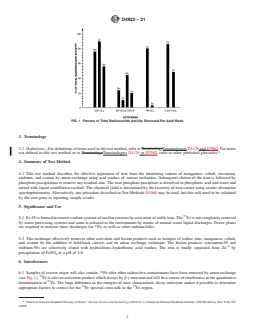
6.1 Samples of reactor origin will also contain Fe after other radioactive contaminants have been removed by anion exchange
(see Fig. 1). Fe is also an activation product which decays by β-γ emission and will be a source of interference in the quantitative
determination of Fe. The large difference in the energies of their characteristic decay emissions makes it possible to determine
59 55
appropriate factors to correct for the Fe spectral cross-talk in the Fe region.
“American National Standard Glossary of Terms,” Nuclear Science and Technology (ANSI N1.1), American National Standards Institute, 1430 Broadway, New York, NY
10018.
D4922 − 21
6.2 Quenching, which may be caused by a number of factors, results in a reduction in light output from the sample. The subsequent
decrease in the spectral pulse height will cause variations in the counting efficiency with varying degrees of quench. For this reason,
55 59 55
it is necessary to monitor both the changes in the Fe efficiency and the Fe cross-talk in the Fe region as a function of quench.
This technique recommends the use of the automatic external standard ratio supplied by most liquid scintillation counters to
monitor the amount of quench in a sample.
6.3 The final heating of the sample solution will drive off all excess hydrochloric acid, ammonia, and water. These substances are,
therefore, effectively removed as possible quenching agents.
6.4 Scintillation stock or sample solutions which have been exposed to light must be dark adapted to avoid erratic results due to
light activation of the scintillator.
NOTE 1—It is the responsibility of the user to determine the required dark adaptation period for the specific cocktail used.
6.5 The stable iron content in a sample will interfere in the determination of the chemical recovery.yield. Since the amount of
stable iron in a sample will depend on its sources, a correction for the iron in the sample must be made.
7. Apparatus
7.1 Liquid Scintillation Counter, with an automatic external standard and multiple energy region of interest (ROI) capabilities.
7.2 Glass Scintillation Vials, 20-mL 20 mL vials exhibiting suitable optical reproducibility so as not to cause erratic results among
samples.
7.3 Atomic Absorption Spectrophotometer.
7.4 Variable Speed Peristaltic Pump, with controller. Pump speed should be between 5 and 8 mL/min.
7.5 Centrifuge, using 100 mL centrifuge tubes.
7.6 Volumetric Flasks.
7.7 Anion Exchange Columns:
7.7.1 Columns—Commercially available plastic drying tubes and ends (40 mL volume, 1.5 cm diameter, 15 cm long).
7.7.2 Tubing—Pump inlet tubing, approximately 45.7 cm (18 in.) in length, and pump outlet tubing, approximately 76.2 cm (30
in.) in length.
7.7.3 Polyethylene Porous Disc—35-μm 35 μm pore size and 3.2 mm thick.
8. Reagents and Materials
8.1 Purity of Reagents—Reagent grade chemicals shall be used for all tests. Unless otherwise indicated, it is intended that all
reagents shall conform to the specifications of the Committee on Analytical Reagents of the American Chemical Society, where
such specifications are available. Other grades may be used, provided it is first ascertained that the reagent is of sufficiently high
purity to permit its use without lessening the accuracy of the determination.
Reagent Chemicals, American Chemical Society Specifications,ACS Reagent Chemicals, Specifications and Procedures for Reagents and Standard-Grade Reference
Materials, American Chemical Society, Washington, DC. For Suggestionssuggestions on the testing of reagents not listed by the American Chemical Society, see
AnnualAnalar Standards for Laboratory Chemicals, BDH Ltd., Poole, Dorset, U.K., and the United States Pharmacopeia and National Formulary, U.S. Pharmacopeial
Convention, Inc. (USPC), Rockville, MD.
D4922 − 21
8.2 Purity of Water—Unless otherwise indicated, references to water shall be understood to mean reagent water conforming to
Specification D1193, Type III.
8.3 Resin—AGl-X8, AG1-X10, 200–400 mesh; 25 mL previously equilibrated with 125 mL concentrated hydrochloric acid.
8.4 Scintillation Cocktail—Commercially prepared Insta-Gel scintillator or equivalent non-ionic detergent scintillator of the
octyl-phenyl polyglycol ether type.
NOTE 2—To obtain a clear aqueous final sample, the sample volume must be kept below 1.8 mL with the addition of 15 mL Insta-Gel. It is the
responsibility of the user to determine the optimum sample volume to cocktail volume to obtain a clear homogeneous solution for any other liquid
scintillation cocktail used.
8.5 Ammonium Hydroxide (NH OH)—Concentrated (approximately 15M) (sp gr 0.90).
8.6 Ammonium Phosphate (0.5 M)—Dissolve 66 g of ammonium monohydrogen phosphate [(NH ) HPO ] in water and dilute to
4 2 4
1000 mL with water in a volumetric flask.
8.7 Cesium Carrier Solution (1 mg/1 mL)—Cesium as cesium chloride (CsCl) in dilute hydrochloric acid.
8.8 Cobalt Carrier Solution (1 mg/1 mL)—Cobalt as cobalt chloride (CoCl ) in dilute hydrochloric acid.
8.9 Hydrochloric Acid (sp gr 1.187)—Concentrated HCl.
8.10 Hydrochloric Acid 10 M—Dilute 833 mL of concentrated hydrochloric acid in 100 mL water and dilute to 1000 mL with
water in a volumetric flask.
8.11 Hydrochloric Acid 6 M—Dilute 500 mL of concentrated hydrochloric acid in 400 mL of water, dilute to 1000 mL with water
in a volumetric flask.
8.12 Hydrochloric Acid 4 M—Dilute 333 mL of concentrated hydrochloric acid in 600 mL of water, dilute to 1000 mL with water
in a volumetric flask.
8.13 Hydrochloric Acid 0.5 M—Dilute 42 mL of concentrated hydrochloric acid in 900 mL of water, dilute to 1000 mL with water
in a volumetric flask.
8.14 Hydrochloric Acid 0.01 M—Dilute 20 mL of 0.5 M HCl in 900 mL of water, dilute to 1000 mL with water in a volumetric
flask.
8.15 Hydrochloric (6 M)-Hydrofluoric Acid (0.5 M)—Dilute 500 mL of concentrated hydrochloric acid (HCl) (sp gr 1.187) and
20 mL of 49 % concentrated hydrofluoric acid (HF) in 400 mL of water, dilute to 1000 mL with water in a plastic or
TFE-fluorocarbon volumetric flask.
+3 7
8.16 Iron Carrier Solution (Fe as ferric chloride) —Dissolve 5.00 g of metallic iron in 300 mL of 6 M HCl, filter, dilute to 1
L, and calibrate using an atomic absorption spectrophotometer (Test Methods D1068).
+2 7
8.17 Manganese Carrier Solution (1 mg/1 mL)—Mn in dilute nitric acid (HNO ).
The sole source of supply of the apparatus known to the committee at this time is Insta-Gel scintillator, available from PerkinElmer Life and Analytical Sciences, 940
Winter Street, Waltham, MA 02451. If you are aware of alternative suppliers, please provide this information to ASTM International Headquarters. Your comments will receive
careful consideration at a meeting of the responsible technical committee, which you may attend.
Commercially available atomic absorption reference standards in 1 mg = 1 mL concentrations may be used as carriers.
D4922 − 21
+5 7
8.18 Niobium Carrier Solution (1 mg/1 mL)—Nb in 5 % hydrofluoric acid (1 + 9 M).
8.19 Nitric Acid (sp gr 1.42)—Concentrated (HNO ).
8.20 Phosphoric Acid (sp gr 1.834)—Concentrated (H PO ).
3 4
8.21 Sodium Hydroxide (6 M)—Dissolve 24 g sodium hydroxide (NaOH) in 90 mL water, allow to cool, and dilute to 100 mL
with water and store in plastic bottles; a commercially prepared solution may also be used.
+2 7
8.22 Zinc Carrier Solution (1 mg/mL)—Zn in dilute hydrochloric acid.
+4 7
8.23 Zirconium Carrier Solution (1 mg/mL)—Zr in dilute hydrochloric acid.
8.24 Fe Standard Solution—Traceable to the SI through a national standards laboratorymetrology institute such as National
Institute of Standards and Technology (NIST) or UK National Physical Laboratory (NPL).
8.25 Fe Standard Solution—Traceable to the SI through a national standards laboratorymetrology institute such as NIST or NPL.
9. Hazards
9.1 HF is extremely hazardous and should be used in a well-ventilated hood. Wear rubber gloves, safety glasses or goggles, and
a laboratory coat. Avoid breathing any HF fumes. Clean all spills and wash thoroughly after using HF. Also, do not add HF to any
glassware for it is a significant hazard and can affect analytical accuracy.
10. Sampling
10.1 Collect samples in accordance with procedures presented in Practices D3370, as applicable.
10.2 If the sample is not acidified at the time of collection, 20 mL of concentrated HCl or HNO should be added per 1000 mL
of sample. After acidification of the sample, the sample should be allowed to sit overnight prior to analysis.
11. Calibration
11.1 The reference standard for both iron isotopes will contain 5 mg iron carrier. Add 6 drops of concentrated phosphoric acid to
the carrier solution and heat on a hot plate until it clears. This will drive off any excess hydrochloric acid and water (to less than
0.5 mL but do not allow to bake dry). Add 1 mL of water and swirl in the glass vial. This final carrier solution should be colorless.
Cool the vial to room temperature. Spike with the appropriate isotope and add 15 mL of scintillation cocktail. Cap and shake until
the mixture is clear; this step ensures that the proper sample volume to scintillation cocktail volume ratio is obtained for a clear,
homogeneous solution. The volume of the reference standard should be such that its addition to the sample does not cause
additional quench.
55 59
11.2 Prepare a series of quenched Fe standards and a series of quenched Fe standards using various weights of iron carrier or
concentration or volumes, or both, of acid. Use the least quenched standards in each set to optimize the liquid scintillation counter
55 59
(LSC) discriminator settings and amplifier gain. Ensure that the Fe spectrum does not spill over into the Fe ROI. If your
instrument does not allow for multiple nuclides to be optimized follow Practice D7282 for instrument optimization.
11.3 Count each set of standards with the LSC automatic external standard ratio selected on to obtain approximately 1 % counting
statistics (approximately 10 000 counts) in the ROI.
11.4 Prepare a curve of the Fe efficiency versus the external standard ratio.
59 55 59 59
11.5 Prepare a crosstalk (XT) curve of the ratio of Fe counts in the Fe ROI to the Fe counts in the Fe ROI versus the
external standard ratio.
D4922 − 21
11.6 Additional guidance on the set-up, calibration set up, calibration, and calibration verification of the instrument can be found
in Practice D7282.
12. Procedure
12.1 Measure an acidified and filtered aliquant of the sample (approximately 0.05 L) into a 100 mL centrifuge tube.
12.1.1 A background subtraction sample shall be processed in accordance with 12.2 through 12.16 with each set of samples.
12.2 Add 5 mg iron carrier and mix well.
12.3 Add NaOH (6 M), mix, and heat to precipitate iron hydroxide.
12.4 Centrifuge and decant the supernatant solution to waste.
12.5 Wash the precipitate with 50 mL of hot water, centrifuge and decant the supernatant solution to waste.
+2 +2
12.6 Dissolve the precipitate in 5 mL of 10 M HCl and add 2 mL (2 mg) each of the appropriate hold-back carriers (Co , Zn ,
+4 +5 +2 +1
Zr , Nb , Mn , and Cs carriers). It is recommended that an aliquant of the sample be prepared for gamma isotopic analysis
to verify the presence of potentially interfering nuclides. Transfer the solution with 10 M HCl washes to a beaker and dilute to
approximately 50 mL with 10 M HCl. Pass the solution through an anion exchange column (AG1-X8 or AG1-X10, 200–400 mesh)
previously equilibrated with 125 mL of concentrated HCl. The column volume is approximately 25 mL. The speed of the sample
and washes through the column should be between 5 and 8 mL/min.
12.7 After the sample has been passed through the column, wash the column with 100 mL of 10 M HCl, then 150 mL of 6 M HCl
95 95
followed by 300 mL of 4 M HCl. If Zr/ Nb activity is suspected, replace the 6 M HCl with the 6 M HCl-0.5 M HF. Discard
the effluents.
NOTE 3—If 6 M HCl-0.5 M HF is used, use only plastic ware. Column plug should not be glass wool.
12.8 Elute the iron with approximately 150 mL of 0.01 M HCl (discard the first 20 mL) and collect the yellow band indicative
+3
of Fe in a beaker. Do not allow the column to run dry.
12.9 Add 10 mL of 0.5 M (NH ) HPO to the beaker and add dropwise concentrated NH OH until the pH is 3.0. The use of pH
4 2 4 4
paper may not be sensitive enough to accurately determine the pH. Gently heat the sample on a hot pl
...