

ASTM E2598/E2598M-21
(Practice)Standard Practice for Acoustic Emission Examination of Cast Iron Yankee and Steam Heated Paper Dryers
General Information
- Abstract
SIGNIFICANCE AND USE
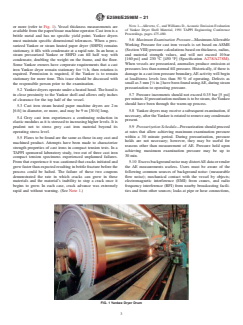
5.1 Cast iron Yankee dryers can be up to 6.7 m [22 ft] in diameter, 7.3 m [24 ft] long, and weigh 91 000 Kg [100 tons], or more (refer to Fig. 1). Vessel thickness measurements are available from the paper/tissue machine operator. Cast iron is a brittle metal and has no specific yield point. Yankee dryers must maintain specific dimensional tolerances. When a pressurized Yankee or steam heated paper dryer (SHPD) remains stationary, it fills with condensate at a rapid rate. In an hour, a steam pressurized Yankee or SHPD can fill half way with condensate, doubling the weight on the frame, and the floor. Some Yankee owners have corporate requirements that a cast iron Yankee dryer remain stationary for 1/2 h, then rotation is required. Permission is required, if the Yankee is to remain stationary for more time. This issue should be discussed with the responsible person prior to the examination.
FIG. 1 Yankee Dryer Drum
5.2 Yankee dryers operate under a heated hood. The hood is in close proximity to the Yankee shell and allows only inches of clearance for the top half of the vessel.
5.3 Cast iron steam heated paper machine dryers are 2 m [6 ft] in diameter, or more, and may be 9 m [30 ft] long.
5.4 Grey cast iron experiences a continuing reduction in elastic modulus as it is stressed to increasing higher levels. It is prudent not to stress grey cast iron material beyond its operating stress level.
5.5 Flaws to be found are the same as those in any cast and machined product. Attempts have been made to characterize strength properties of cast irons in compact tension tests. In a TAPPI sponsored laboratory study, two out of three cast iron compact tension specimens experienced unplanned failures. From that experience it was cautioned that cracks initiated and grew faster than expected resulting in brittle fracture before the process could be halted. The failure of these two coupons demonstrated the rate in which cracks can grow in these materials and the mater...
SCOPE
1.1 This practice is no longer being updated but is being retained for historical value due to the procedures herein that are unique to the AE community.
1.2 This practice provides guidelines for carrying out acoustic emission (AE) examinations of Yankee and Steam Heated Paper Dryers (SHPD) of the type to make tissue, paper, and paperboard products.
1.3 This practice requires pressurization to levels used during normal operation. The pressurization medium may be high temperature steam, air, or gas. The dryer is also subjected to significant stresses during the heating up and cooling down periods of operation. Acoustic Emission data maybe collected during these time periods but this testing is beyond the scope of this document.
1.4 The AE measurements are used to detect, as well as, localize emission sources. Other methods of nondestructive testing (NDT) may be used to further evaluate the significance of acoustic emission sources.
1.5 Units—The values stated in either SI units or inch-pound units are to be regarded separately as standard. The values stated in each system are not necessarily exact equivalents; therefore, to ensure conformance with the standard, each system shall be used independently of the other, and values from the two systems shall not be combined.
1.6 This standard does not purport to address all of the safety concerns, if any, associated with its use. It is the responsibility of the user of this standard to establish appropriate safety, health, and environmental practices and determine the applicability of regulatory limitations prior to use.
1.7 This international standard was developed in accordance with internationally recognized principles on standardization established in the Decision on Principles for the Development of International Standards, Guides and Recommendations issued by the World Trade Organization Technical Barriers to Trade (TBT) Committee.
- Status
- Published
- Publication Date
- 31-Oct-2021
- Technical Committee
- E07 - Nondestructive Testing
- Drafting Committee
- E07.04 - Acoustic Emission Method
Buy Documents
ASTM E2598/E2598M-21 - Standard Practice for Acoustic Emission Examination of Cast Iron Yankee and Steam Heated Paper Dryers
REDLINE ASTM E2598/E2598M-21 - Standard Practice for Acoustic Emission Examination of Cast Iron Yankee and Steam Heated Paper Dryers
Overview
ASTM E2598/E2598M-21 is a standard practice developed by ASTM International for the acoustic emission (AE) examination of cast iron Yankee and steam-heated paper dryers. Although no longer updated, the practice is preserved for its unique value to the acoustic emission testing community, specifically in applications involving large, brittle cast iron vessels used in the tissue, paper, and paperboard industries. This standard outlines methods for detecting and localizing structural flaws through AE testing during pressurization, supporting safer operation and maintenance of these critical process components.
Key Topics
- Acoustic Emission (AE) Testing: AE is a nondestructive testing (NDT) method used to monitor and analyze the stress-induced sounds emitted by materials, providing real-time detection of flaws such as cracks or fatigue in pressure vessels.
- Scope of Application: The standard applies to large cast iron Yankee dryers (up to 6.7 m [22 ft] diameter, 7.3 m [24 ft] length, and 91,000 kg [100 tons]) and steam-heated paper machine dryers used in the production of paper, tissue, and paperboard.
- Operational Considerations: AE examination is performed during normal operating pressurization, using air, steam, or gas as the pressurization medium. Data may also be collected during heating and cooling cycles, but such testing is beyond the main scope.
- Detection and Localization: AE sensors are used to identify emission sources (potential flaws) and their locations. Identified areas may require further evaluation using other NDT methods like magnetic particle, ultrasonic, or radiographic testing.
- Material Behavior: The standard highlights the brittleness of cast iron, which lacks a specific yield point and can experience rapid, brittle fracture once cracks initiate. Operators are cautioned not to exceed the normal operating stress levels.
- Reporting and Safety: AE results, operational history, and NDT findings must be documented. Safety, health, and environmental protocols must be established by the user before conducting examinations.
Applications
- Routine Maintenance and Inspection: AE examination per ASTM E2598/E2598M-21 is primarily applied as part of periodic safety and integrity assessments for paper machine dryers. Early detection of cracks and flaws allows for timely corrective action.
- Quality Control in Manufacturing and Refurbishment: Manufacturers and repair agencies use AE testing to verify the structural integrity of cast iron vessels after fabrication, repair, or refurbishment.
- Condition Monitoring: Plants with critical drying equipment in continuous operation employ AE to monitor vessel health without needing to stop production, thereby minimizing downtime while maintaining high safety standards.
- Failure Investigation: In the event of process anomalies or suspected vessel damage, AE testing provides valuable data to help pinpoint the location and severity of defects.
Related Standards
- ASTM E543: Specification for agencies performing nondestructive testing, covering agency capabilities and performance.
- ASTM E569/E569M: Practice for acoustic emission monitoring of structures during controlled stimulation.
- ASTM E650: Guide for mounting piezoelectric acoustic emission sensors.
- ASTM E976: Guide for determining the reproducibility of acoustic emission sensor response.
- ASTM E1316: Terminology for nondestructive examinations.
- ASTM E2374: Guide for acoustic emission system performance verification.
- ASTM A278/A278M: Specification for gray iron castings for pressure-containing parts up to 650 °F (350 °C).
- ASNT SNT-TC-1A & ANSI/ASNT CP-189: Recommended practices for qualification and certification of NDT personnel.
By adhering to the guidelines and procedures in ASTM E2598/E2598M-21, organizations involved in the production or maintenance of cast iron paper dryers can enhance safety, reliability, and longevity of these vital industrial assets using advanced acoustic emission testing techniques. This standard is especially valuable for industries requiring nondestructive evaluation (NDE) of large pressure vessels where early crack detection and material integrity are paramount.
Relations
- Effective Date
- 01-Feb-2024
- Effective Date
- 01-May-2020
- Effective Date
- 15-Jan-2020
- Effective Date
- 01-Dec-2019
- Effective Date
- 01-Mar-2019
- Effective Date
- 01-Jan-2018
- Effective Date
- 15-Jun-2017
- Effective Date
- 01-Feb-2017
- Effective Date
- 01-Aug-2016
- Effective Date
- 01-Feb-2016
- Effective Date
- 01-Dec-2015
- Effective Date
- 01-Dec-2015
- Effective Date
- 01-Sep-2015
- Effective Date
- 01-Jun-2014
- Effective Date
- 01-Jun-2014
Buy Documents
ASTM E2598/E2598M-21 - Standard Practice for Acoustic Emission Examination of Cast Iron Yankee and Steam Heated Paper Dryers
REDLINE ASTM E2598/E2598M-21 - Standard Practice for Acoustic Emission Examination of Cast Iron Yankee and Steam Heated Paper Dryers
Get Certified
Connect with accredited certification bodies for this standard

Control Union Certifications
Global certification for agriculture and sustainability.

BSMI (Bureau of Standards, Metrology and Inspection)
Taiwan's standards and inspection authority.
Gozdarski inštitut Slovenije
Slovenian Forestry Institute. Forest management certification support, timber testing.
Sponsored listings
Frequently Asked Questions
ASTM E2598/E2598M-21 is a standard published by ASTM International. Its full title is "Standard Practice for Acoustic Emission Examination of Cast Iron Yankee and Steam Heated Paper Dryers". This standard covers: SIGNIFICANCE AND USE 5.1 Cast iron Yankee dryers can be up to 6.7 m [22 ft] in diameter, 7.3 m [24 ft] long, and weigh 91 000 Kg [100 tons], or more (refer to Fig. 1). Vessel thickness measurements are available from the paper/tissue machine operator. Cast iron is a brittle metal and has no specific yield point. Yankee dryers must maintain specific dimensional tolerances. When a pressurized Yankee or steam heated paper dryer (SHPD) remains stationary, it fills with condensate at a rapid rate. In an hour, a steam pressurized Yankee or SHPD can fill half way with condensate, doubling the weight on the frame, and the floor. Some Yankee owners have corporate requirements that a cast iron Yankee dryer remain stationary for 1/2 h, then rotation is required. Permission is required, if the Yankee is to remain stationary for more time. This issue should be discussed with the responsible person prior to the examination. FIG. 1 Yankee Dryer Drum 5.2 Yankee dryers operate under a heated hood. The hood is in close proximity to the Yankee shell and allows only inches of clearance for the top half of the vessel. 5.3 Cast iron steam heated paper machine dryers are 2 m [6 ft] in diameter, or more, and may be 9 m [30 ft] long. 5.4 Grey cast iron experiences a continuing reduction in elastic modulus as it is stressed to increasing higher levels. It is prudent not to stress grey cast iron material beyond its operating stress level. 5.5 Flaws to be found are the same as those in any cast and machined product. Attempts have been made to characterize strength properties of cast irons in compact tension tests. In a TAPPI sponsored laboratory study, two out of three cast iron compact tension specimens experienced unplanned failures. From that experience it was cautioned that cracks initiated and grew faster than expected resulting in brittle fracture before the process could be halted. The failure of these two coupons demonstrated the rate in which cracks can grow in these materials and the mater... SCOPE 1.1 This practice is no longer being updated but is being retained for historical value due to the procedures herein that are unique to the AE community. 1.2 This practice provides guidelines for carrying out acoustic emission (AE) examinations of Yankee and Steam Heated Paper Dryers (SHPD) of the type to make tissue, paper, and paperboard products. 1.3 This practice requires pressurization to levels used during normal operation. The pressurization medium may be high temperature steam, air, or gas. The dryer is also subjected to significant stresses during the heating up and cooling down periods of operation. Acoustic Emission data maybe collected during these time periods but this testing is beyond the scope of this document. 1.4 The AE measurements are used to detect, as well as, localize emission sources. Other methods of nondestructive testing (NDT) may be used to further evaluate the significance of acoustic emission sources. 1.5 Units—The values stated in either SI units or inch-pound units are to be regarded separately as standard. The values stated in each system are not necessarily exact equivalents; therefore, to ensure conformance with the standard, each system shall be used independently of the other, and values from the two systems shall not be combined. 1.6 This standard does not purport to address all of the safety concerns, if any, associated with its use. It is the responsibility of the user of this standard to establish appropriate safety, health, and environmental practices and determine the applicability of regulatory limitations prior to use. 1.7 This international standard was developed in accordance with internationally recognized principles on standardization established in the Decision on Principles for the Development of International Standards, Guides and Recommendations issued by the World Trade Organization Technical Barriers to Trade (TBT) Committee.
SIGNIFICANCE AND USE 5.1 Cast iron Yankee dryers can be up to 6.7 m [22 ft] in diameter, 7.3 m [24 ft] long, and weigh 91 000 Kg [100 tons], or more (refer to Fig. 1). Vessel thickness measurements are available from the paper/tissue machine operator. Cast iron is a brittle metal and has no specific yield point. Yankee dryers must maintain specific dimensional tolerances. When a pressurized Yankee or steam heated paper dryer (SHPD) remains stationary, it fills with condensate at a rapid rate. In an hour, a steam pressurized Yankee or SHPD can fill half way with condensate, doubling the weight on the frame, and the floor. Some Yankee owners have corporate requirements that a cast iron Yankee dryer remain stationary for 1/2 h, then rotation is required. Permission is required, if the Yankee is to remain stationary for more time. This issue should be discussed with the responsible person prior to the examination. FIG. 1 Yankee Dryer Drum 5.2 Yankee dryers operate under a heated hood. The hood is in close proximity to the Yankee shell and allows only inches of clearance for the top half of the vessel. 5.3 Cast iron steam heated paper machine dryers are 2 m [6 ft] in diameter, or more, and may be 9 m [30 ft] long. 5.4 Grey cast iron experiences a continuing reduction in elastic modulus as it is stressed to increasing higher levels. It is prudent not to stress grey cast iron material beyond its operating stress level. 5.5 Flaws to be found are the same as those in any cast and machined product. Attempts have been made to characterize strength properties of cast irons in compact tension tests. In a TAPPI sponsored laboratory study, two out of three cast iron compact tension specimens experienced unplanned failures. From that experience it was cautioned that cracks initiated and grew faster than expected resulting in brittle fracture before the process could be halted. The failure of these two coupons demonstrated the rate in which cracks can grow in these materials and the mater... SCOPE 1.1 This practice is no longer being updated but is being retained for historical value due to the procedures herein that are unique to the AE community. 1.2 This practice provides guidelines for carrying out acoustic emission (AE) examinations of Yankee and Steam Heated Paper Dryers (SHPD) of the type to make tissue, paper, and paperboard products. 1.3 This practice requires pressurization to levels used during normal operation. The pressurization medium may be high temperature steam, air, or gas. The dryer is also subjected to significant stresses during the heating up and cooling down periods of operation. Acoustic Emission data maybe collected during these time periods but this testing is beyond the scope of this document. 1.4 The AE measurements are used to detect, as well as, localize emission sources. Other methods of nondestructive testing (NDT) may be used to further evaluate the significance of acoustic emission sources. 1.5 Units—The values stated in either SI units or inch-pound units are to be regarded separately as standard. The values stated in each system are not necessarily exact equivalents; therefore, to ensure conformance with the standard, each system shall be used independently of the other, and values from the two systems shall not be combined. 1.6 This standard does not purport to address all of the safety concerns, if any, associated with its use. It is the responsibility of the user of this standard to establish appropriate safety, health, and environmental practices and determine the applicability of regulatory limitations prior to use. 1.7 This international standard was developed in accordance with internationally recognized principles on standardization established in the Decision on Principles for the Development of International Standards, Guides and Recommendations issued by the World Trade Organization Technical Barriers to Trade (TBT) Committee.
ASTM E2598/E2598M-21 is classified under the following ICS (International Classification for Standards) categories: 17.140.20 - Noise emitted by machines and equipment; 85.100 - Equipment for the paper industry. The ICS classification helps identify the subject area and facilitates finding related standards.
ASTM E2598/E2598M-21 has the following relationships with other standards: It is inter standard links to ASTM E1316-24, ASTM A278/A278M-01(2020), ASTM E569/E569M-20, ASTM E1316-19b, ASTM E1316-19, ASTM E1316-18, ASTM E1316-17a, ASTM E1316-17, ASTM E1316-16a, ASTM E1316-16, ASTM E1316-15a, ASTM E2374-15, ASTM E1316-15, ASTM E1316-14, ASTM E1316-14e1. Understanding these relationships helps ensure you are using the most current and applicable version of the standard.
ASTM E2598/E2598M-21 is available in PDF format for immediate download after purchase. The document can be added to your cart and obtained through the secure checkout process. Digital delivery ensures instant access to the complete standard document.
Standards Content (Sample)
This international standard was developed in accordance with internationally recognized principles on standardization established in the Decision on Principles for the
Development of International Standards, Guides and Recommendations issued by the World Trade Organization Technical Barriers to Trade (TBT) Committee.
Designation: E2598/E2598M − 21
Standard Practice for
Acoustic Emission Examination of Cast Iron Yankee and
Steam Heated Paper Dryers
ThisstandardisissuedunderthefixeddesignationE2598/E2598M;thenumberimmediatelyfollowingthedesignationindicatestheyear
of original adoption or, in the case of revision, the year of last revision.Anumber in parentheses indicates the year of last reapproval.
A superscript epsilon (´) indicates an editorial change since the last revision or reapproval.
1. Scope* mendations issued by the World Trade Organization Technical
Barriers to Trade (TBT) Committee.
1.1 This practice is no longer being updated but is being
retained for historical value due to the procedures herein that
2. Referenced Documents
are unique to the AE community.
2.1 ASTM Standards:
1.2 Thispracticeprovidesguidelinesforcarryingoutacous-
A278/A278M Specification for Gray Iron Castings for
tic emission (AE) examinations of Yankee and Steam Heated
Pressure-Containing Parts for Temperatures Up to 650°F
Paper Dryers (SHPD) of the type to make tissue, paper, and
(350°C)
paperboard products.
E543Specification forAgencies Performing Nondestructive
1.3 This practice requires pressurization to levels used
Testing
during normal operation. The pressurization medium may be
E569/E569MPractice for Acoustic Emission Monitoring of
high temperature steam, air, or gas.The dryer is also subjected
Structures During Controlled Stimulation
to significant stresses during the heating up and cooling down
E650Guide for Mounting Piezoelectric Acoustic Emission
periods of operation. Acoustic Emission data maybe collected
Sensors
during these time periods but this testing is beyond the scope
E976GuideforDeterminingtheReproducibilityofAcoustic
of this document.
Emission Sensor Response
1.4 The AE measurements are used to detect, as well as, E1316Terminology for Nondestructive Examinations
localize emission sources. Other methods of nondestructive E2374Guide for Acoustic Emission System Performance
testing (NDT) may be used to further evaluate the significance Verification
of acoustic emission sources. 3
2.2 ASNT Standards:
1.5 Units—The values stated in either SI units or inch- SNT-TC-1A Recommended Practice for Nondestructive
pound units are to be regarded separately as standard. The
Testing Personnel
values stated in each system are not necessarily exact equiva- ANSI/ASNT CP-189Standard for Qualification and Certifi-
lents; therefore, to ensure conformance with the standard, each
cation of Nondestructive Testing Personnel
system shall be used independently of the other, and values
from the two systems shall not be combined.
3. Terminology
1.6 This standard does not purport to address all of the
3.1 Definitions—See Terminology E1316 for general termi-
safety concerns, if any, associated with its use. It is the
nology applicable to this practice.
responsibility of the user of this standard to establish appro-
priate safety, health, and environmental practices and deter-
4. Summary of Practice
mine the applicability of regulatory limitations prior to use.
4.1 Each mounted sensor, on the cast iron vessel, monitors
1.7 This international standard was developed in accor-
while the vessel is stationary and pressurized to normal
dance with internationally recognized principles on standard-
operating pressure.The vessel may be at ambient, or operating
ization established in the Decision on Principles for the
120°C–230°C [250°F–450°F] temperature.
Development of International Standards, Guides and Recom-
1 2
This practice is under the jurisdiction of ASTM Committee E07 on Nonde- For referenced ASTM standards, visit the ASTM website, www.astm.org, or
structive Testing and is the direct responsibility of Subcommittee E07.04 on contact ASTM Customer Service at service@astm.org. For Annual Book of ASTM
Acoustic Emission Method. Standards volume information, refer to the standard’s Document Summary page on
Current edition approved Nov. 1, 2021. Published December 2021. Originally the ASTM website.
approved in 2007. Last previous edition approved in 2013 as E2598/E2598M – 13. AvailablefromAmericanSocietyforNondestructiveTesting(ASNT),P.O.Box
DOI: 10.1520/E2598_E2598M-21. 28518, 1711 Arlingate Ln., Columbus, OH 43228-0518, http://www.asnt.org.
*A Summary of Changes section appears at the end of this standard
Copyright © ASTM International, 100 Barr Harbor Drive, PO Box C700, West Conshohocken, PA 19428-2959. United States
E2598/E2598M − 21
4.2 Each mounted AE sensor is connected to an acoustic strength properties of cast irons in compact tension tests. In a
emission signal processor.After a monitoring period (up to 10 TAPPI sponsored laboratory study, two out of three cast iron
min) and pre-examination sensor sensitivity checks, pressur- compact tension specimens experienced unplanned failures.
ization can begin. From that experience, it was cautioned that “cracks initiated
and grew faster than expected resulting in brittle fracture
4.3 Location
before the process could be halted.” The failure of these two
4.3.1 Zone Location—Each channel shall have the same
coupons demonstrated the rate in which cracks can grow in
system examination threshold. A simulated AE source gener-
thesematerialsandthematerial’sinabilitytostopacrackonce
ated anywhere on the vessel shall be detected by at least one
it begins to grow. In each case, crack advance was extremely
sensor.
rapid and without warning.
4.3.2 Source Location—All location data resulting from
analysis shall be presented in a manner consistent with the 4.12 Maximum Examination Pressure—Maximum Allow-
previously established calibration accuracy. The simulatedAE
able Working Pressure for cast iron vessels is set based on
source generated in each structure mounted sensor array shall ASME(SectionVIII)pressurecalculationsbasedonthickness,
be detected by the minimum number of sensors required to
radius,andmaterialstrengthvalues,andwillnotexceed11bar
locate the source within 65% of sensor spacing. [160 psi] and 230°C [450°F] (Specification A278/A278M).
When vessels are pressurized, anomalies produce emission at
4.4 Due to the potential for gasketed interfaces (at the
pressures less than normal fill pressure. Historically, if there is
heads/manway),multiplemetalcombinations(metalspray,cast
damageinacastironpressureboundary,AEactivitywillbegin
steel-cast iron combinations), high vessel temperature, or
at load/stress levels less than 50% of operating. Defects as
randomvariationsinthematerialvelocityofcastiron,accurate
smallas3mm[ ⁄8in.]havebeenfoundusingAE,duringsteam
source location (65% sensor spacing) may not always be
pressurization to operating pressure.
possible.
4.13 Pressure increments should not exceed 350 millibar/
4.5 Once the AE sensor source is localized, further evalua-
minute[5psi/minute].Ifpressurizationmediumistobesteam,
tion is begun by observing a “history” of events involving the
the Yankee should have been through the warm-up process.
area [Head tilt (corrosion induced head strain), leak repair,
objects through the nip (working contact with another roll),
4.14 Yankee dryers may receive a subsequent examination,
etc.]. This may give further direction to the selection of the
if necessary, after the Yankee is rotated to remove any
NDE method to use for follow-up examination of the AE
condensate present.
indication area.
4.15 Pressurization Schedule—Pressurization should pro-
4.6 Secondary examination establishes presence of flaws
ceed at rates that allow achieving maximum examination
and measures flaw dimensions.
pressure within a 30 min period. During pressurization, pres-
sure holds are not necessary; however, they may be useful for
4.7 Cast iron Yankee dryers can be up to 6.7m [22 ft]in
reasons other than measurement of AE. Pressure hold upon
diameter, 7.3 m [24 ft] long, and weigh 90 000 Kg
achieving maximum examination pressure may be up to 30
[200000lb], or more. Vessel thickness measurements are
min.
availablefromthepaper/tissuemachineoperator.Castironisa
brittle metal and has no specific yield point. Yankee dryers
4.16 ExcessbackgroundnoisemaydistortAEdataorrender
must maintain specific dimensional tolerances. When a pres-
the AE measurements useless. Users must be aware of the
surized Yankee or steam heated paper dryer (SHPD) remains
following common sources of background noise: (measurable
stationary, it fills with condensate at a rapid rate. In an hour, a
filling or flow noise); mechanical contact with the vessel by
steam pressurized Yankee or SHPD can fill half way with
objects; electromagnetic interference (EMI) from cranes, and
condensate, doubling the weight on the frame, and the floor.
radio frequency interference (RFI) from nearby broadcasting
Some Yankee owners have corporate requirements that a cast
facilities and from other sources; leaks at pipe or hose
iron Yankee dryer remain stationary for ⁄2 hour, then rotation
connections, or rain drops. This practice should not be used if
is required. Permission is required, if the Yankee is to remain
background noise cannot be eliminated or controlled.
stationary for more time. This issue should be discussed with
4.17 Other nondestructive test methods may be used to
the responsible person prior to the examination.
evaluate the significance of AE sources. Magnetic particle,
4.8 Yankeedryersoperateunderaheatedhood.Thehoodis
ultrasonic, and radiographic examinations have been used to
in close proximity to the Yankee shell and allows only inches
establish circumferential position, depth, and dimensions of
of clearance for the top half of the vessel.
flaws that produce AE. Procedures for using other NDT
methods are beyond the scope of this practice.
4.9 Cast iron steam heated paper machine dryers are 1.8m
[6ft] in diameter, or more, and may be 9m [30ft] long.
5. Significance and Use
4.10 Gray cast iron experiences a continuing reduction in
5.1 Cast iron Yankee dryers can be up to 6.7m [22ft] in
elasticmodulusasitisstressedtoincreasinghigherlevels.Itis
diameter, 7.3m [24ft] long, and weigh 91000Kg [100tons],
prudent not to stress grey cast iron material beyond its
operating stress level.
4.11 Flawstobefoundarethesameasthoseinanycastand
Alleveto, C., and Williams D.,Acoustic Emission Evaluation ofYankee Dryer
machined product. Attempts have been made to characterize Shell Material, 1991 TAPPI Engineering Conference Proceedings, pages 475-480.
E2598/E2598M − 21
NOTE 1—Alleveto, C., and Williams D.,Acoustic Emission Evaluation
or more (refer to Fig. 1). Vessel thickness measurements are
of Yankee Dryer Shell Material, 1991 TAPPI Engineering Conference
availablefromthepaper/tissuemachineoperator.Castironisa
Proceedings, pages 475-480.
brittle metal and has no specific yield point. Yankee dryers
5.6 Maximum Examination Pressure—MaximumAllowable
must maintain specific dimensional tolerances. When a pres-
Working Pressure for cast iron vessels is set based on ASME
surized Yankee or steam heated paper dryer (SHPD) remains
(SectionVIII)pressurecalculationsbasedonthickness,radius,
stationary, it fills with condensate at a rapid rate. In an hour, a
and material strength values, and will not exceed 10bar
steam pressurized Yankee or SHPD can fill half way with
[160psi] and 230°C [450°F] (Specification A278/A278M).
condensate, doubling the weight on the frame, and the floor.
When vessels are pressurized, anomalies produce emission at
Some Yankee owners have corporate requirements that a cast
pressures less than normal fill pressure. Historically, if there is
iron Yankee dryer remain stationary for ⁄2h, then rotation is
damageinacastironpressureboundary,AEactivitywillbegin
required. Permission is required, if the Yankee is to remain
at load/stress levels less than 50 % of operating. Defects as
stationary for more time. This issue should be discussed with
smallas3mm[ ⁄8in.]havebeenfoundusingAE,duringsteam
the responsible person prior to the examination.
pressurization to operating pressure.
5.2 Yankeedryersoperateunderaheatedhood.Thehoodis
5.7 Pressure increments should not exceed 0.35 bar [5 psi]
in close proximity to the Yankee shell and allows only inches
perminute.Ifpressurizationmediumistobesteam,theYankee
of clearance for the top half of the vessel.
should have been through the warm-up process.
5.3 Cast iron steam heated paper machine dryers are 2m
[6ft] in diameter, or more, and may be 9m [30ft] long. 5.8 Yankeedryersmayreceiveasubsequentexamination,if
necessary,aftertheYankeeisrotatedtoremoveanycondensate
5.4 Grey cast iron experiences a continuing reduction in
present.
elasticmodulusasitisstressedtoincreasinghigherlevels.Itis
5.9 Pressurization Schedule—Pressurizationshouldproceed
prudent not to stress grey cast iron material beyond its
operating stress level. at rates that allow achieving maximum examination pressure
within a 30 minute period. During pressurization, pressure
5.5 Flaws to be found are the same as those in any cast and
holds are not necessary; however, they may be useful for
machined product. Attempts have been made to characterize
reasons other than measurement of AE. Pressure hold upon
strength properties of cast irons in compact tension tests. In a
achieving maximum examination pressure may be up to
TAPPI sponsored laboratory study, two out of three cast iron
30min.
compact tension specimens experienced unplanned failures.
From that experience it was cautioned that cracks initiated and 5.10 ExcessbackgroundnoisemaydistortAEdataorrender
grewfasterthanexpectedresultinginbrittlefracturebeforethe the AE measurements useless. Users must be aware of the
process could be halted. The failure of these two coupons following common sources of background noise: (measurable
demonstrated the rate in which cracks can grow in these flow noise); mechanical contact with the vessel by objects;
materials and the material’s inability to stop a crack once it electromagnetic interference (EMI) from cranes, and radio
begins to grow. In each case, crack advance was extremely frequency interference (RFI) from nearby broadcasting facili-
rapid and without warning. (See Note 1.) ties and from other sources; leaks at pipe or hose connections,
FIG. 1 Yankee Dryer Drum
E2598/E2598M − 21
or rain drops. This practice should not be used if background 6.6 Reporting Criteria/AE Evaluation Criteria—
noise cannot be eliminated or controlled. Examination results will be reported and compared with AE
evaluation criteria. Since acceptance criteria (f
...
This document is not an ASTM standard and is intended only to provide the user of an ASTM standard an indication of what changes have been made to the previous version. Because
it may not be technically possible to adequately depict all changes accurately, ASTM recommends that users consult prior editions as appropriate. In all cases only the current version
of the standard as published by ASTM is to be considered the official document.
Designation: E2598/E2598M − 13 E2598/E2598M − 21
Standard Practice for
Acoustic Emission Examination of Cast Iron Yankee and
Steam Heated Paper Dryers
This standard is issued under the fixed designation E2598/E2598M; the number immediately following the designation indicates the year
of original adoption or, in the case of revision, the year of last revision. A number in parentheses indicates the year of last reapproval.
A superscript epsilon (´) indicates an editorial change since the last revision or reapproval.
1. Scope*
1.1 This practice is no longer being updated but is being retained for historical value due to the procedures herein that are unique
to the AE community.
1.2 This practice provides guidelines for carrying out acoustic emission (AE) examinations of Yankee and Steam Heated Paper
Dryers (SHPD) of the type to make tissue, paper, and paperboard products.
1.3 This practice requires pressurization to levels used during normal operation. The pressurization medium may be high
temperature steam, air, or gas. The dryer is also subjected to significant stresses during the heating up and cooling down periods
of operation. Acoustic Emission data maybe collected during these time periods but this testing is beyond the scope of this
document.
1.4 The AE measurements are used to detect, as well as, localize emission sources. Other methods of nondestructive testing (NDT)
may be used to further evaluate the significance of acoustic emission sources.
1.5 Units—The values stated in either SI units or inch-pound units are to be regarded separately as standard. The values stated in
each system mayare not benecessarily exact equivalents; therefore, to ensure conformance with the standard, each system shall be
used independently of the other. Combiningother, and values from the two systems may result in non-conformance with the
standards.shall not be combined.
1.6 This standard does not purport to address all of the safety concerns, if any, associated with its use. It is the responsibility
of the user of this standard to establish appropriate safety safety, health, and healthenvironmental practices and determine the
applicability of regulatory limitations prior to use.
1.7 This international standard was developed in accordance with internationally recognized principles on standardization
established in the Decision on Principles for the Development of International Standards, Guides and Recommendations issued
by the World Trade Organization Technical Barriers to Trade (TBT) Committee.
2. Referenced Documents
2.1 ASTM Standards:
A278/A278M Specification for Gray Iron Castings for Pressure-Containing Parts for Temperatures Up to 650 °F (350 °C)
This practice is under the jurisdiction of ASTM Committee E07 on Nondestructive Testing and is the direct responsibility of Subcommittee E07.04 on Acoustic Emission
Method.
Current edition approved Jan. 1, 2013Nov. 1, 2021. Published January 2013December 2021. Originally approved in 2007. Last previous edition approved in 20072013
as E2598E2598/E2598M - 07.– 13. DOI: 10.1520/E2598_E2598-13.10.1520/E2598_E2598M-21.
For referenced ASTM standards, visit the ASTM website, www.astm.org, or contact ASTM Customer Service at service@astm.org. For Annual Book of ASTM Standards
volume information, refer to the standard’s Document Summary page on the ASTM website.
*A Summary of Changes section appears at the end of this standard
Copyright © ASTM International, 100 Barr Harbor Drive, PO Box C700, West Conshohocken, PA 19428-2959. United States
E2598/E2598M − 21
E543 Specification for Agencies Performing Nondestructive Testing
E569E569/E569M Practice for Acoustic Emission Monitoring of Structures During Controlled Stimulation
E650 Guide for Mounting Piezoelectric Acoustic Emission Sensors
E976 Guide for Determining the Reproducibility of Acoustic Emission Sensor Response
E1316 Terminology for Nondestructive Examinations
E2374 Guide for Acoustic Emission System Performance Verification
2.2 ASNT Standards:
SNT-TC-1A Recommended Practice for Nondestructive Testing Personnel
ANSI/ASNT CP-189 Standard for Qualification and Certification of Nondestructive Testing Personnel
3. Terminology
3.1 Definitions—See Terminology E1316 for general terminology applicable to this practice.
4. Summary of Practice
4.1 Each mounted sensor, on the cast iron vessel, monitors while the vessel is stationary and pressurized to normal operating
pressure. The vessel may be at ambient, or operating 120°C-230°C [250°F-450°F]120 °C–230 °C [250 °F–450 °F] temperature.
4.2 Each mounted AE sensor is connected to an acoustic emission signal processor. After a monitoring period (up to 10
minutes)min) and pre-examination sensor sensitivity checks, pressurization can begin.
4.3 Location
4.3.1 Zone Location—Each channel shall have the same system examination threshold. A simulated AE source generated
anywhere on the vessel shall be detected by at least one sensor.
4.3.2 Source Location—All location data resulting from analysis shall be presented in a manner consistent with the previously
established calibration accuracy. The simulated AE source generated in each structure mounted sensor array shall be detected by
the minimum number of sensors required to locate the source within 65 % of sensor spacing.
4.4 Due to the potential for gasketed interfaces (at the heads/manway), multiple metal combinations (metalspray, cast steel-cast
iron combinations), high vessel temperature, or random variations in the material velocity of cast iron, accurate source location
(65 % sensor spacing) may not always be possible.
4.5 Once the AE sensor source is localized, further evaluation is begun by observing a “history” of events involving the area [Head
tilt (corrosion induced head strain), leak repair, objects through the nip (working contact with another roll), etc.]. This may give
further direction to the selection of the NDE method to use for follow-up examination of the AE indication area.
4.6 Secondary examination establishes presence of flaws and measures flaw dimensions.
4.7 Cast iron Yankee dryers can be up to 6.7 m [22 ft] in diameter, 7.3 m [24 ft] 6.7 m [22 ft] in diameter, 7.3 m [24 ft] long, and
weigh 90,00090 000 Kg [200,000 lb], [200 000 lb], or more. Vessel thickness measurements are available from the paper/tissue
machine operator. Cast iron is a brittle metal and has no specific yield point. Yankee dryers must maintain specific dimensional
tolerances. When a pressurized Yankee or steam heated paper dryer (SHPD) remains stationary, it fills with condensate at a rapid
rate. In an hour, a steam pressurized Yankee or SHPD can fill half way with condensate, doubling the weight on the frame, and
the floor. Some Yankee owners have corporate requirements that a cast iron Yankee dryer remain stationary for ⁄2 hour, then
rotation is required. Permission is required, if the Yankee is to remain stationary for more time. This issue should be discussed with
the responsible person prior to the examination.
4.8 Yankee dryers operate under a heated hood. The hood is in close proximity to the Yankee shell and allows only inches of
clearance for the top half of the vessel.
Available from American Society for Nondestructive Testing (ASNT), P.O. Box 28518, 1711 Arlingate Ln., Columbus, OH 43228-0518, http://www.asnt.org.
E2598/E2598M − 21
4.9 Cast iron steam heated paper machine dryers are 1.8 m [6 ft] 1.8 m [6 ft] in diameter, or more, and may be 9 m [30 ft] 9 m
[30 ft] long.
4.10 Gray cast iron experiences a continuing reduction in elastic modulus as it is stressed to increasing higher levels. It is prudent
not to stress grey cast iron material beyond its operating stress level.
4.11 Flaws to be found are the same as those in any cast and machined product. Attempts have been made to characterize strength
properties of cast irons in compact tension tests. In a TAPPI sponsored laboratory study, two out of three cast iron compact tension
specimens experienced unplanned failures. From that experience, it was cautioned that “cracks initiated and grew faster than
expected resulting in brittle fracture before the process could be halted.halted.” The failure of these two coupons demonstrated the
rate in which cracks can grow in these materials and the material’s inability to stop a crack once it begins to grow. In each case,
crack advance was extremely rapid and without warning.
4.12 Maximum Examination Pressure—Maximum Allowable Working Pressure for cast iron vessels is set based on ASME
(Section VIII) pressure calculations based on thickness, radius, and material strength values, and will not exceed 11 bar [160 psi]
and 230°C [450°F] (230 °C [450 °F] (Specification A278/A278M). When vessels are pressurized, anomalies produce emission at
pressures less than normal fill pressure. Historically, if there is damage in a cast iron pressure boundary, AE activity will begin at
load/stress levels less than 50 % of operating. Defects as small as 3 mm 3 mm [ ⁄8 in.] in.] have been found using AE, during steam
pressurization to operating pressure.
4.13 Pressure increments should not exceed 350 millibar/minute [5 psi/minute]. If pressurization medium is to be steam, the
Yankee should have been through the warm-up process.
4.14 Yankee dryers may receive a subsequent examination, if necessary, after the Yankee is rotated to remove any condensate
present.
4.15 Pressurization Schedule—Pressurization should proceed at rates that allow achieving maximum examination pressure within
a 30 minutemin period. During pressurization, pressure holds are not necessary; however, they may be useful for reasons other than
measurement of AE. Pressure hold upon achieving maximum examination pressure may be up to 30 minutes.min.
4.16 Excess background noise may distort AE data or render the AE measurements useless. Users must be aware of the following
common sources of background noise: (measurable filling or flow noise); mechanical contact with the vessel by objects;
electromagnetic interference (EMI) from cranes, and radio frequency interference (RFI) from nearby broadcasting facilities and
from other sources; leaks at pipe or hose connections, or rain drops. This practice should not be used if background noise cannot
be eliminated or controlled.
4.17 Other nondestructive test methods may be used to evaluate the significance of AE sources. Magnetic particle, ultrasonic, and
radiographic examinations have been used to establish circumferential position, depth, and dimensions of flaws that produce AE.
Procedures for using other NDT methods are beyond the scope of this practice.
5. Significance and Use
5.1 Cast iron Yankee dryers can be up to 6.7 m [22 ft] in diameter, 7.3 m [24 ft] 6.7 m [22 ft] in diameter, 7.3 m [24 ft] long, and
weigh 91,000 Kg [100 tons], 91 000 Kg [100 tons], or more (refer to Fig. 1). Vessel thickness measurements are available from
the paper/tissue machine operator. Cast iron is a brittle metal and has no specific yield point. Yankee dryers must maintain specific
dimensional tolerances. When a pressurized Yankee or steam heated paper dryer (SHPD) remains stationary, it fills with condensate
at a rapid rate. In an hour, a steam pressurized Yankee or SHPD can fill half way with condensate, doubling the weight on the frame,
and the floor. Some Yankee owners have corporate requirements that a cast iron Yankee dryer remain stationary for ⁄2 hour, h,
then rotation is required. Permission is required, if the Yankee is to remain stationary for more time. This issue should be discussed
with the responsible person prior to the examination.
Alleveto, C., and Williams D., Acoustic Emission Evaluation of Yankee Dryer Shell Material, 1991 TAPPI Engineering Conference Proceedings, pages 475-480.
E2598/E2598M − 21
FIG. 1 Yankee Dryer Drum
5.2 Yankee dryers operate under a heated hood. The hood is in close proximity to the Yankee shell and allows only inches of
clearance for the top half of the vessel.
5.3 Cast iron steam heated paper machine dryers are 2 m [6 ft] 2 m [6 ft] in diameter, or more, and may be 9 m [30 ft] 9 m [30 ft]
long.
5.4 Grey cast iron experiences a continuing reduction in elastic modulus as it is stressed to increasing higher levels. It is prudent
not to stress grey cast iron material beyond its operating stress level.
5.5 Flaws to be found are the same as those in any cast and machined product. Attempts have been made to characterize strength
properties of cast irons in compact tension tests. In a TAPPI sponsored laboratory study, two out of three cast iron compact tension
specimens experienced unplanned failures. From that experience it was cautioned that cracks initiated and grew faster than
expected resulting in brittle fracture before the process could be halted. The failure of these two coupons demonstrated the rate
in which cracks can grow in these materials and the material’s inability to stop a crack once it begins to grow. In each case, crack
advance was extremely rapid and without warning. (See Note 1.)
NOTE 1—Alleveto, C., and Williams D., Acoustic Emission Evaluation of Yankee Dryer Shell Material, 1991 TAPPI Engineering Conference Proceedings,
pages 475-480.
5.6 Maximum Examination Pressure—Maximum Allowable Working Pressure for cast iron vessels is set based on ASME (Section
VIII) pressure calculations based on thickness, radius, and material strength values, and will not exceed 10 bar [160 psi] and 230°C
[450°F] (ASTM10 bar [160 psi] and 230 °C [450 °F] (Specification A278/A278MA278).). When vessels are pressurized,
anomalies produce emission at pressures less than normal fill pressure. Historically, if there is damage in a cast iron pressure
boundary, AE activity will begin at load/stress levels less than 50 % of operating. Defects as small as 3 mm [ ⁄8 in.] have been found
using AE, during steam pressurization to operating pressure.
5.7 Pressure increments should not exceed 0.35 bar [5 psi] per minute. If pressurization medium is to be steam, the Yankee should
have been through the warm-up process.
5.8 Yankee dryers may receive a subsequent examination, if necessary, after the Yankee is rotated to remove any condensate
present.
E2598/E2598M − 21
5.9 Pressurization Schedule—Pressurization should proceed at rates that allow achieving maximum examination pressure within
a 30 minute period. During pressurization, pressure holds are not necessary; however, they may be useful for reasons other than
measurement of AE. Pressure hold upon achieving maximum examination pressure may be up to 30 minutes.30 min.
5.10 Excess background noise may distort AE data or render the AE measurements useless. Users must be aware of the following
common sources of background noise: (measurable flow noise); mechanical contact with the vessel by objects; electromagnetic
interference (EMI) from cranes, and radio frequency inter ferenceinterference (RFI) from nearby broadcasting facilities and from
other sources; leaks at pipe or hose connections, or rain drops. This practice should not be used if background noise cannot be
eliminated or controlled.
5.11 Other Non-destructive test methods may be used to evaluate the significance of AE sources. Magnetic particle, ultrasonic,
and radiographic examinations have b
...