

ASTM E1135-19(2024)
(Test Method)Standard Test Method for Comparing the Brightness of Fluorescent Penetrants
General Information
- Abstract
SIGNIFICANCE AND USE
5.1 The principle use of this procedure is for the comparison of the brightness between batches of fluorescent penetrants compared to a specified standard, as a batch quality control test.
5.2 The procedure is also utilized in monitoring the brightness of an in-use penetrant against the brightness of the unused sample of the same material.
5.3 The significance of the results are not absolute values but rather relative comparisons at a point in time, by a particular laboratory or operator on the specified fluorometer.
SCOPE
1.1 This test method describes the techniques for comparing the brightness of the penetrants used in the fluorescent dye penetrant process. This comparison is performed under controlled conditions that eliminate most of the variables present in actual penetrant examination. Thus, the brightness factor is isolated and is measured independently of the other factors which affect the performance of a penetrant system.
1.2 The brightness of a penetrant indication is affected by the developer with which it is used. This test method, however, measures the brightness of a penetrant on a convenient filter paper substrate which serves as a substitute for the developer.
1.3 The brightness measurement obtained is color-corrected to approximate the color response of the average human eye. Since most examinations are done by human eyes, this number has more practical value than a measurement in units of energy emitted. Also, the comparisons are expressed as a percentage of some chosen standard penetrant because no absolute system of measurement exists at this time.
1.4 The measurements made by this standard compare the brightness of a candidate penetrant to that of a standard penetrant when tested according to the technique. There is no known correlation between the results obtained and the brightness of actual flaw indications obtained using the penetrant in inspection.
1.5 This standard does not purport to address all of the safety concerns, if any, associated with its use. It is the responsibility of the user of this standard to establish appropriate safety, health, and environmental practices and determine the applicability of regulatory limitations prior to use.
1.6 This international standard was developed in accordance with internationally recognized principles on standardization established in the Decision on Principles for the Development of International Standards, Guides and Recommendations issued by the World Trade Organization Technical Barriers to Trade (TBT) Committee.
- Status
- Published
- Publication Date
- 31-Jan-2024
- Technical Committee
- E07 - Nondestructive Testing
- Drafting Committee
- E07.03 - Liquid Penetrant and Magnetic Particle Methods


Overview
ASTM E1135-19(2024): Standard Test Method for Comparing the Brightness of Fluorescent Penetrants defines standardized techniques to compare the brightness of fluorescent penetrants. Utilized in the fluorescent dye penetrant inspection process, this method provides a reliable, repeatable way to assess the relative brightness of penetrant batches or to monitor the stability of in-use penetrants under controlled conditions. The procedure isolates the brightness factor, ensuring that the evaluation is independent from other variables that may influence system performance.
This standard, developed by ASTM International, addresses the need for quality control in non-destructive testing (NDT) by establishing a comparative measurement to a reference or standard penetrant. While it does not provide an absolute value, it is a critical part of batch acceptance and ongoing process monitoring in industries that depend on high-integrity inspection methods.
Key Topics
- Comparative Assessment: The test method is designed for comparing brightness between different batches of fluorescent penetrants or between in-use and unused samples of the same batch.
- Controlled Testing Environment: By using filter paper as the substrate instead of actual developers, variables found in real-world inspection are minimized, allowing a true comparison of penetrant brightness.
- Color Correction: Measurements are color-corrected to reflect the response of the average human eye, enhancing the practical relevance for actual inspection scenarios.
- Quality Control: Results are expressed as a percentage relative to a selected standard penetrant, serving as an effective batch quality control and process monitoring tool.
- Instrument Calibration: The procedure utilizes a fluorometer calibrated with a standard sample and includes detailed steps to prepare consistent test specimens.
- Relative Measurements Only: There is currently no absolute scale for penetrant brightness in this context; all values are comparative and specific to the test environment and instrumentation.
Applications
The scope of ASTM E1135-19(2024) makes it essential in the following applications:
- Manufacturing Quality Assurance: Used as a batch acceptance test to ensure consistent brightness quality between batches of fluorescent penetrants, which is critical for reliable non-destructive examination.
- Routine Monitoring of Penetrants: Helps monitor the condition and performance of in-use penetrants by comparison with unused samples, supporting timely replacement or replenishment.
- Process Standardization: Supports laboratories and operators in maintaining standardized methods for evaluating penetrant brightness, leading to more predictable inspection outcomes.
- Training and Verification: The procedure provides a benchmark for training operators and validating new fluorometers or inspection setups, enhancing laboratory competency.
Related Standards
For comprehensive implementation of fluorescent penetrant inspection and related NDT practices, consider the following ASTM standards:
- ASTM E1316 – Terminology for Nondestructive Examinations: Provides definitions for terms applicable to this and related NDT methods.
- ASTM E1417 – Standard Practice for Liquid Penetrant Testing: Offers procedures and requirements for conducting penetrant inspections, often used in conjunction with brightness measurement.
- ASTM E165 – Standard Practice for Liquid Penetrant Examination: Covers the general practice of liquid penetrant examination, with references to test method specifics.
- ASTM E3022 – Standard Practice for Measurement of Emission Characteristics of UV-A Lamps Used in Fluorescent Penetrant and Magnetic Particle Testing: Addresses UV-A light sources, a key component in penetrant fluorescence and brightness assessment.
By following ASTM E1135-19(2024) and related standards, organizations strengthen their nondestructive testing programs, establish effective penetrant brightness comparison procedures, and ensure ongoing compliance with international quality benchmarks for fluorescent penetrant inspection.
Relations
- Effective Date
- 01-Feb-2024
- Effective Date
- 01-Feb-2024
- Effective Date
- 01-Sep-2023
- Effective Date
- 01-Feb-2024
Get Certified
Connect with accredited certification bodies for this standard

BSMI (Bureau of Standards, Metrology and Inspection)
Taiwan's standards and inspection authority.
Sponsored listings
Frequently Asked Questions
ASTM E1135-19(2024) is a standard published by ASTM International. Its full title is "Standard Test Method for Comparing the Brightness of Fluorescent Penetrants". This standard covers: SIGNIFICANCE AND USE 5.1 The principle use of this procedure is for the comparison of the brightness between batches of fluorescent penetrants compared to a specified standard, as a batch quality control test. 5.2 The procedure is also utilized in monitoring the brightness of an in-use penetrant against the brightness of the unused sample of the same material. 5.3 The significance of the results are not absolute values but rather relative comparisons at a point in time, by a particular laboratory or operator on the specified fluorometer. SCOPE 1.1 This test method describes the techniques for comparing the brightness of the penetrants used in the fluorescent dye penetrant process. This comparison is performed under controlled conditions that eliminate most of the variables present in actual penetrant examination. Thus, the brightness factor is isolated and is measured independently of the other factors which affect the performance of a penetrant system. 1.2 The brightness of a penetrant indication is affected by the developer with which it is used. This test method, however, measures the brightness of a penetrant on a convenient filter paper substrate which serves as a substitute for the developer. 1.3 The brightness measurement obtained is color-corrected to approximate the color response of the average human eye. Since most examinations are done by human eyes, this number has more practical value than a measurement in units of energy emitted. Also, the comparisons are expressed as a percentage of some chosen standard penetrant because no absolute system of measurement exists at this time. 1.4 The measurements made by this standard compare the brightness of a candidate penetrant to that of a standard penetrant when tested according to the technique. There is no known correlation between the results obtained and the brightness of actual flaw indications obtained using the penetrant in inspection. 1.5 This standard does not purport to address all of the safety concerns, if any, associated with its use. It is the responsibility of the user of this standard to establish appropriate safety, health, and environmental practices and determine the applicability of regulatory limitations prior to use. 1.6 This international standard was developed in accordance with internationally recognized principles on standardization established in the Decision on Principles for the Development of International Standards, Guides and Recommendations issued by the World Trade Organization Technical Barriers to Trade (TBT) Committee.
SIGNIFICANCE AND USE 5.1 The principle use of this procedure is for the comparison of the brightness between batches of fluorescent penetrants compared to a specified standard, as a batch quality control test. 5.2 The procedure is also utilized in monitoring the brightness of an in-use penetrant against the brightness of the unused sample of the same material. 5.3 The significance of the results are not absolute values but rather relative comparisons at a point in time, by a particular laboratory or operator on the specified fluorometer. SCOPE 1.1 This test method describes the techniques for comparing the brightness of the penetrants used in the fluorescent dye penetrant process. This comparison is performed under controlled conditions that eliminate most of the variables present in actual penetrant examination. Thus, the brightness factor is isolated and is measured independently of the other factors which affect the performance of a penetrant system. 1.2 The brightness of a penetrant indication is affected by the developer with which it is used. This test method, however, measures the brightness of a penetrant on a convenient filter paper substrate which serves as a substitute for the developer. 1.3 The brightness measurement obtained is color-corrected to approximate the color response of the average human eye. Since most examinations are done by human eyes, this number has more practical value than a measurement in units of energy emitted. Also, the comparisons are expressed as a percentage of some chosen standard penetrant because no absolute system of measurement exists at this time. 1.4 The measurements made by this standard compare the brightness of a candidate penetrant to that of a standard penetrant when tested according to the technique. There is no known correlation between the results obtained and the brightness of actual flaw indications obtained using the penetrant in inspection. 1.5 This standard does not purport to address all of the safety concerns, if any, associated with its use. It is the responsibility of the user of this standard to establish appropriate safety, health, and environmental practices and determine the applicability of regulatory limitations prior to use. 1.6 This international standard was developed in accordance with internationally recognized principles on standardization established in the Decision on Principles for the Development of International Standards, Guides and Recommendations issued by the World Trade Organization Technical Barriers to Trade (TBT) Committee.
ASTM E1135-19(2024) is classified under the following ICS (International Classification for Standards) categories: 17.180.20 - Colours and measurement of light; 87.040 - Paints and varnishes. The ICS classification helps identify the subject area and facilitates finding related standards.
ASTM E1135-19(2024) has the following relationships with other standards: It is inter standard links to ASTM E1135-19, ASTM E1316-24, ASTM E1316-23b, ASTM E1417/E1417M-21e1. Understanding these relationships helps ensure you are using the most current and applicable version of the standard.
ASTM E1135-19(2024) is available in PDF format for immediate download after purchase. The document can be added to your cart and obtained through the secure checkout process. Digital delivery ensures instant access to the complete standard document.
Standards Content (Sample)
This international standard was developed in accordance with internationally recognized principles on standardization established in the Decision on Principles for the
Development of International Standards, Guides and Recommendations issued by the World Trade Organization Technical Barriers to Trade (TBT) Committee.
Designation: E1135 − 19 (Reapproved 2024)
Standard Test Method for
Comparing the Brightness of Fluorescent Penetrants
This standard is issued under the fixed designation E1135; the number immediately following the designation indicates the year of
original adoption or, in the case of revision, the year of last revision. A number in parentheses indicates the year of last reapproval. A
superscript epsilon (´) indicates an editorial change since the last revision or reapproval.
1. Scope 2. Referenced Documents
1.1 This test method describes the techniques for comparing 2.1 ASTM Standards:
the brightness of the penetrants used in the fluorescent dye
E1316 Terminology for Nondestructive Examinations
penetrant process. This comparison is performed under con-
trolled conditions that eliminate most of the variables present
3. Terminology
in actual penetrant examination. Thus, the brightness factor is
3.1 Definitions:
isolated and is measured independently of the other factors
3.1.1 Definitions of terms applicable to this test method may
which affect the performance of a penetrant system.
be found in Terminology E1316.
1.2 The brightness of a penetrant indication is affected by
the developer with which it is used. This test method, however,
4. Summary of Test Method
measures the brightness of a penetrant on a convenient filter
4.1 Simulated indications are prepared by impregnating
paper substrate which serves as a substitute for the developer.
filter paper with a specified quantity of the penetrant under test.
1.3 The brightness measurement obtained is color-corrected
The samples and similarly prepared standards are then mea-
to approximate the color response of the average human eye.
sured in a fluorometer equipped to excite the penetrant with
Since most examinations are done by human eyes, this number
near ultraviolet (UV-A) light and respond to color approxi-
has more practical value than a measurement in units of energy
mately as does the human eye under the conditions encoun-
emitted. Also, the comparisons are expressed as a percentage of
tered during a normal examination. The fluorometer must be
some chosen standard penetrant because no absolute system of
equipped with a special sample holder to accept the samples
measurement exists at this time.
employed.
1.4 The measurements made by this standard compare the
4.2 The sample test results are not indicative of the total
brightness of a candidate penetrant to that of a standard
system performance but are convenient as a lot acceptance test,
penetrant when tested according to the technique. There is no
and to monitor the condition of in-use penetrant compared to
known correlation between the results obtained and the bright-
an unused sample. A known amount of penetrant is diluted with
ness of actual flaw indications obtained using the penetrant in
a specified amount of a volatile solvent, pieces of filter paper
inspection.
are soaked in the mixture, the papers are dried under specified
1.5 This standard does not purport to address all of the
conditions at room temperature, placed in the sample holder,
safety concerns, if any, associated with its use. It is the
and measured with the fluorometer.
responsibility of the user of this standard to establish appro-
priate safety, health, and environmental practices and deter-
5. Significance and Use
mine the applicability of regulatory limitations prior to use.
5.1 The principle use of this procedure is for the comparison
1.6 This international standard was developed in accor-
of the brightness between batches of fluorescent penetrants
dance with internationally recognized principles on standard-
compared to a specified standard, as a batch quality control
ization established in the Decision on Principles for the
test.
Development of International Standards, Guides and Recom-
5.2 The procedure is also utilized in monitoring the bright-
mendations issued by the World Trade Organization Technical
ness of an in-use penetrant against the brightness of the unused
Barriers to Trade (TBT) Committee.
sample of the same material.
This test method is under the jurisdiction of ASTM Committee E07 on
Nondestructive Testing and is the direct responsibility of Subcommittee E07.03 on
Liquid Penetrant and Magnetic Particle Methods. For referenced ASTM standards, visit the ASTM website, www.astm.org, or
Current edition approved Feb. 1, 2024. Published February 2024. Originally contact ASTM Customer Service at service@astm.org. For Annual Book of ASTM
approved in 1986. Last previous edition approved in 2019 as E1135 – 19. DOI: Standards volume information, refer to the standard’s Document Summary page on
10.1520/E1135-19R24. the ASTM website.
Copyright © ASTM International, 100 Barr Harbor Drive, PO Box C700, West Conshohocken, PA 19428-2959. United States
E1135 − 19 (2024)
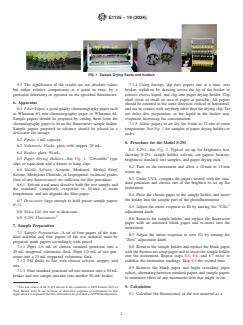
FIG. 1 Sample Drying Racks and Holders
5.3 The significance of the results are not absolute values 7.1.4 Using forceps, dip four papers one at a time, into
but rather relative comparisons at a point in time, by a beaker, withdraw by drawing across the lip of the beaker to
particular laboratory or operator
...