

ASTM D4783-01(2021)
(Test Method)Standard Test Methods for Resistance of Adhesive Preparations in Container to Attack by Bacteria, Yeast, and Fungi
General Information
- Abstract
SIGNIFICANCE AND USE
5.1 These test methods are used to demonstrate whether an adhesive preparation is sufficiently protected with biocide to resist attack by bacteria, yeast, and fungi during its storage life. They are patterned after methods used by biological laboratories serving the adhesive industry.
5.2 These test methods may also be used to determine the efficacy of different biocide systems against specific microorganisms.
5.3 These test methods are especially useful when tested against wild-type microorganisms which have been isolated from contaminated adhesives as an aid in determining the amount and type of biocide necessary to kill or inhibit the growth of the contaminants. If an isolated microorganism not generally used as a challenge organism, is chosen as the inoculum, it is important to identify the organism and determine on which medium and under what conditions it will grow, in order to demonstrate the efficacy of the biocide.
5.4 The results obtained when using the procedures given in these methods apply only to the species which are used for the testing. The test species listed in Section 9 are frequently used by laboratories to test for antimicrobial properties, but they are not the only ones which could be used. Selection of the species to use for these test methods requires informed judgment by the testing laboratory or by the party requesting the tests. It is also important that species which commonly attack adhesives be used. See 9.4.
5.5 The presence of an active biocide carried over from the adhesive specimen to the agar could have an inhibiting effect on the growth of microorganisms, resulting in no growth during the span of a normal incubation period, when in fact, viable microorganisms are present, but their growth has been slowed down or held in stasis. The use of Letheen agar and broth is recommended to neutralize the effect of this carry-over.
Note 4: Letheen agar may be used for the streak plates, or if another agar is chosen for testing, ...
SCOPE
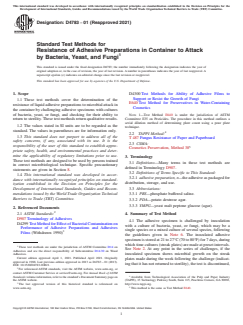
1.1 These test methods cover the determination of the resistance of liquid adhesive preparations to microbial attack in the container by challenging adhesive specimens with cultures of bacteria, yeast, or fungi, and checking for their ability to return to sterility. These test methods return qualitative results.
1.2 The values stated in SI units are to be regarded as the standard. The values in parentheses are for information only.
1.3 This standard does not purport to address all of the safety concerns, if any, associated with its use. It is the responsibility of the user of this standard to establish appropriate safety, health, and environmental practices and determine the applicability of regulatory limitations prior to use. These test methods are designed to be used by persons trained in correct microbiological technique. Specific precautionary statements are given in Section 8.
1.4 This international standard was developed in accordance with internationally recognized principles on standardization established in the Decision on Principles for the Development of International Standards, Guides and Recommendations issued by the World Trade Organization Technical Barriers to Trade (TBT) Committee.
- Status
- Published
- Publication Date
- 31-Mar-2021
- Technical Committee
- D14 - Adhesives
- Drafting Committee
- D14.30 - Wood Adhesives
Overview
ASTM D4783-01(2021) - Standard Test Methods for Resistance of Adhesive Preparations in Container to Attack by Bacteria, Yeast, and Fungi offers a comprehensive, qualitative procedure for evaluating the microbial stability of liquid adhesive products stored in containers. Developed by ASTM International, this standard is invaluable for manufacturers and laboratories seeking to ensure that adhesives remain resistant to spoilage caused by bacteria, yeast, and fungi during storage and application. The test methods are based on established microbiological techniques and are widely recognized in the adhesive industry.
Key Topics
- Microbial Challenge Testing: This standard outlines methods to challenge adhesive specimens with selected cultures of bacteria, yeast, or fungi, then assess their ability to return to a sterile state.
- Evaluation of Biocide Performance: ASTM D4783 assists in determining if an adhesive preparation contains sufficient biocidal protection to prevent microbial contamination.
- Species Selection: The standard provides guidance on using test organisms commonly encountered as contaminants in adhesives, including wild-type microorganisms.
- Qualitative Results: The procedures yield qualitative determinations of resistance but can be adapted for semi-quantitative monitoring if needed.
- Neutralization of Biocidal Carry-over: Recommendations such as the use of Letheen agar and broth help provide accurate readings by neutralizing residual biocide effects.
Applications
ASTM D4783 is utilized in several key scenarios:
- Quality Assurance in Adhesive Manufacturing: Manufacturers rely on these methods to confirm the long-term microbial stability of their adhesive products for safe storage and successful end-use performance.
- R&D of Biocide Systems: Researchers and formulators use the test to compare the efficacy of different preservative systems against targeted species of bacteria, yeast, and fungi.
- Troubleshooting and Compliance: When adhesive contamination issues arise, labs can reproduce field contamination conditions to identify vulnerabilities and recommend improved biocide strategies.
- Supplier-Purchaser Agreements: The standard can be referenced in purchasing contracts to ensure products consistently meet predefined microbial resistance specifications.
Related Standards
To ensure best practices for biological resistance testing, ASTM D4783 references or aligns with several other important standards:
- ASTM D4300: Focuses on testing the resistance of adhesive films-not container-stored adhesives-to fungal growth.
- ASTM E640: Provides methods for determining preservatives' effectiveness in water-containing products, relevant for adhesives with similar preservation needs.
- TAPPI T487: Details fungal resistance assessment for paper and paperboard, which may be substrates for adhesives.
- CSMA Method 38: Addresses preservation of cosmetic products, analogous to preservation challenges in adhesives.
Practical Value
Adhering to ASTM D4783 can help organizations:
- Prevent product spoilage due to microbial growth during storage and transport.
- Improve customer satisfaction and reduce returns linked to degraded adhesives.
- Demonstrate regulatory compliance and due diligence in product stewardship.
- Strengthen product claims regarding antimicrobial protection in technical documentation and marketing materials.
Keywords: ASTM D4783, adhesive microbial resistance, adhesive preservation, biocide efficacy, bacteria, yeast, fungi, container testing, adhesive spoilage prevention, quality assurance, industrial adhesives, laboratory standards.
For laboratories, manufacturers, and users of adhesives seeking reliable methods to ensure product integrity against microbial attack, ASTM D4783 provides clear, actionable guidance supported by industry consensus.
Relations
- Effective Date
- 01-Jan-2019
- Effective Date
- 01-Jul-2012
- Effective Date
- 01-May-2012
- Effective Date
- 01-Apr-2012
- Effective Date
- 01-Dec-2011
- Effective Date
- 01-Jan-2011
- Effective Date
- 01-Oct-2008
- Effective Date
- 15-Aug-2008
- Effective Date
- 01-Apr-2008
- Effective Date
- 01-Mar-2008
- Effective Date
- 01-Dec-2006
- Effective Date
- 15-Nov-2006
- Effective Date
- 01-Apr-2005
- Effective Date
- 01-Apr-2005
- Effective Date
- 01-Dec-2004
Get Certified
Connect with accredited certification bodies for this standard

DIN CERTCO
DIN Group product certification.

Smithers Quality Assessments
US management systems and product certification.
Sponsored listings
Frequently Asked Questions
ASTM D4783-01(2021) is a standard published by ASTM International. Its full title is "Standard Test Methods for Resistance of Adhesive Preparations in Container to Attack by Bacteria, Yeast, and Fungi". This standard covers: SIGNIFICANCE AND USE 5.1 These test methods are used to demonstrate whether an adhesive preparation is sufficiently protected with biocide to resist attack by bacteria, yeast, and fungi during its storage life. They are patterned after methods used by biological laboratories serving the adhesive industry. 5.2 These test methods may also be used to determine the efficacy of different biocide systems against specific microorganisms. 5.3 These test methods are especially useful when tested against wild-type microorganisms which have been isolated from contaminated adhesives as an aid in determining the amount and type of biocide necessary to kill or inhibit the growth of the contaminants. If an isolated microorganism not generally used as a challenge organism, is chosen as the inoculum, it is important to identify the organism and determine on which medium and under what conditions it will grow, in order to demonstrate the efficacy of the biocide. 5.4 The results obtained when using the procedures given in these methods apply only to the species which are used for the testing. The test species listed in Section 9 are frequently used by laboratories to test for antimicrobial properties, but they are not the only ones which could be used. Selection of the species to use for these test methods requires informed judgment by the testing laboratory or by the party requesting the tests. It is also important that species which commonly attack adhesives be used. See 9.4. 5.5 The presence of an active biocide carried over from the adhesive specimen to the agar could have an inhibiting effect on the growth of microorganisms, resulting in no growth during the span of a normal incubation period, when in fact, viable microorganisms are present, but their growth has been slowed down or held in stasis. The use of Letheen agar and broth is recommended to neutralize the effect of this carry-over. Note 4: Letheen agar may be used for the streak plates, or if another agar is chosen for testing, ... SCOPE 1.1 These test methods cover the determination of the resistance of liquid adhesive preparations to microbial attack in the container by challenging adhesive specimens with cultures of bacteria, yeast, or fungi, and checking for their ability to return to sterility. These test methods return qualitative results. 1.2 The values stated in SI units are to be regarded as the standard. The values in parentheses are for information only. 1.3 This standard does not purport to address all of the safety concerns, if any, associated with its use. It is the responsibility of the user of this standard to establish appropriate safety, health, and environmental practices and determine the applicability of regulatory limitations prior to use. These test methods are designed to be used by persons trained in correct microbiological technique. Specific precautionary statements are given in Section 8. 1.4 This international standard was developed in accordance with internationally recognized principles on standardization established in the Decision on Principles for the Development of International Standards, Guides and Recommendations issued by the World Trade Organization Technical Barriers to Trade (TBT) Committee.
SIGNIFICANCE AND USE 5.1 These test methods are used to demonstrate whether an adhesive preparation is sufficiently protected with biocide to resist attack by bacteria, yeast, and fungi during its storage life. They are patterned after methods used by biological laboratories serving the adhesive industry. 5.2 These test methods may also be used to determine the efficacy of different biocide systems against specific microorganisms. 5.3 These test methods are especially useful when tested against wild-type microorganisms which have been isolated from contaminated adhesives as an aid in determining the amount and type of biocide necessary to kill or inhibit the growth of the contaminants. If an isolated microorganism not generally used as a challenge organism, is chosen as the inoculum, it is important to identify the organism and determine on which medium and under what conditions it will grow, in order to demonstrate the efficacy of the biocide. 5.4 The results obtained when using the procedures given in these methods apply only to the species which are used for the testing. The test species listed in Section 9 are frequently used by laboratories to test for antimicrobial properties, but they are not the only ones which could be used. Selection of the species to use for these test methods requires informed judgment by the testing laboratory or by the party requesting the tests. It is also important that species which commonly attack adhesives be used. See 9.4. 5.5 The presence of an active biocide carried over from the adhesive specimen to the agar could have an inhibiting effect on the growth of microorganisms, resulting in no growth during the span of a normal incubation period, when in fact, viable microorganisms are present, but their growth has been slowed down or held in stasis. The use of Letheen agar and broth is recommended to neutralize the effect of this carry-over. Note 4: Letheen agar may be used for the streak plates, or if another agar is chosen for testing, ... SCOPE 1.1 These test methods cover the determination of the resistance of liquid adhesive preparations to microbial attack in the container by challenging adhesive specimens with cultures of bacteria, yeast, or fungi, and checking for their ability to return to sterility. These test methods return qualitative results. 1.2 The values stated in SI units are to be regarded as the standard. The values in parentheses are for information only. 1.3 This standard does not purport to address all of the safety concerns, if any, associated with its use. It is the responsibility of the user of this standard to establish appropriate safety, health, and environmental practices and determine the applicability of regulatory limitations prior to use. These test methods are designed to be used by persons trained in correct microbiological technique. Specific precautionary statements are given in Section 8. 1.4 This international standard was developed in accordance with internationally recognized principles on standardization established in the Decision on Principles for the Development of International Standards, Guides and Recommendations issued by the World Trade Organization Technical Barriers to Trade (TBT) Committee.
ASTM D4783-01(2021) is classified under the following ICS (International Classification for Standards) categories: 83.180 - Adhesives. The ICS classification helps identify the subject area and facilitates finding related standards.
ASTM D4783-01(2021) has the following relationships with other standards: It is inter standard links to ASTM E640-06(2019), ASTM D907-12a, ASTM D907-12, ASTM E640-06(2012), ASTM D907-11a, ASTM D907-11, ASTM D907-08b, ASTM D907-08a, ASTM D4300-01(2008), ASTM D907-08, ASTM D907-06, ASTM E640-06, ASTM D907-05, ASTM D907-05e1, ASTM D907-04a. Understanding these relationships helps ensure you are using the most current and applicable version of the standard.
ASTM D4783-01(2021) is available in PDF format for immediate download after purchase. The document can be added to your cart and obtained through the secure checkout process. Digital delivery ensures instant access to the complete standard document.
Standards Content (Sample)
This international standard was developed in accordance with internationally recognized principles on standardization established in the Decision on Principles for the
Development of International Standards, Guides and Recommendations issued by the World Trade Organization Technical Barriers to Trade (TBT) Committee.
Designation: D4783 − 01 (Reapproved 2021)
Standard Test Methods for
Resistance of Adhesive Preparations in Container to Attack
by Bacteria, Yeast, and Fungi
This standard is issued under the fixed designation D4783; the number immediately following the designation indicates the year of
original adoption or, in the case of revision, the year of last revision.Anumber in parentheses indicates the year of last reapproval.A
superscript epsilon (´) indicates an editorial change since the last revision or reapproval.
This standard has been approved for use by agencies of the U.S. Department of Defense.
1. Scope D4300Test Methods for Ability of Adhesive Films to
Support or Resist the Growth of Fungi
1.1 These test methods cover the determination of the
E640Test Method for Preservatives in Water-Containing
resistanceofliquidadhesivepreparationstomicrobialattackin
Cosmetics
the container by challenging adhesive specimens with cultures
of bacteria, yeast, or fungi, and checking for their ability to
NOTE 1—Test Method E640 is under the jurisdiction of ASTM
Committee E35 on Pesticides. The procedure in this method outlines a
return to sterility.These test methods return qualitative results.
serial dilution method of determining plate count using a pour plate
1.2 The values stated in SI units are to be regarded as the
technique.
standard. The values in parentheses are for information only.
2.2 TAPPI Method:
1.3 This standard does not purport to address all of the
T487Fungus Resistance of Paper and Paperboard
safety concerns, if any, associated with its use. It is the
2.3 CSMA:
responsibility of the user of this standard to establish appro-
Cosmetics Preservation, Method38
priate safety, health, and environmental practices and deter-
mine the applicability of regulatory limitations prior to use.
3. Terminology
These test methods are designed to be used by persons trained
3.1 Definitions—Many terms in these test methods are
in correct microbiological technique. Specific precautionary
defined in Terminology D907.
statements are given in Section 8.
3.2 Definitions of Terms Specific to This Standard:
1.4 This international standard was developed in accor-
3.2.1 adhesive preparation, n—theadhesiveaspackagedfor
dance with internationally recognized principles on standard-
distribution, storage, and use.
ization established in the Decision on Principles for the
3.3 Abbreviations:
Development of International Standards, Guides and Recom-
mendations issued by the World Trade Organization Technical 3.3.1 PBS—phosphate buffered saline.
Barriers to Trade (TBT) Committee.
3.3.2 PDA—potato dextrose agar.
3.3.3 YMPG—yeast malt peptone glucose (agar).
2. Referenced Documents
2.1 ASTM Standards:
4. Summary of Test Method
D907Terminology of Adhesives
4.1 The adhesive specimen is challenged by inoculation
D4299TestMethodforEffectofBacterialContaminationon
with a culture of bacteria, yeast, or fungi, which may be a
Performance of Adhesive Preparations and Adhesives
single species or a mixed culture of several species, following
Films (Withdrawn 1990)
the guidelines given in Note 6. The inoculated adhesive
specimenisstoredat21to27°C(70to80°F)for7days,during
whichtimecultures(streakplates)aremadeatpresetintervals.
These test methods are under the jurisdiction of ASTM Committee D14 on
See Note 2. At any point in the series of challenges, if the
Adhesives and are the direct responsibility of Subcommittee D14.30 on Wood
Adhesives. inoculated specimen shows microbial growth on the streak
Current edition approved April 1, 2021. Published April 2021. Originally
plates made during the week following the challenge (indicat-
approved in 1988. Last previous edition approved in 2013 as D4783–01 (2013).
ing that it has not returned to sterility), the test is discontinued,
DOI: 10.1520/D4783-01R21.
For referenced ASTM standards, visit the ASTM website, www.astm.org, or
contact ASTM Customer Service at service@astm.org. For Annual Book of ASTM
Standards volume information, refer to the standard’s Document Summary page on Available from Technological Association of the Pulp and Paper Industry
the ASTM website. (TAPPI), 15 Technology Parkway South, Suite 115, Peachtree Corners, GA30092,
The last approved version of this historical standard is referenced on http://www.tappi.org.
www.astm.org. This method is the same as Test Method E640.
Copyright © ASTM International, 100 Barr Harbor Drive, PO Box C700, West Conshohocken, PA 19428-2959. United States
D4783 − 01 (2021)
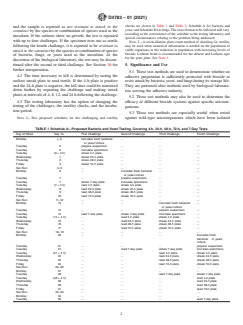
checks are shown in Table 1 and Table 2, Schedule A for bacteria and
and the sample is reported as not resistant to attack in the
yeast,andScheduleBforfungi.Theexactformattobefollowedwillvary,
container by the species or combination of species used as the
according to the convenience of the schedule to the testing laboratory and
inoculum. If the cultures show no growth, the test is repeated
special circumstances relating to the problem being addressed.
with up to four challenges. If the specimen tests out as sterile
NOTE 3—A serial-dilution plate-count method of checking for sterility
following the fourth challenge, it is reported to be resistant to
may be used when numerical information is needed on the population of
viable organisms or the reduction in population with increasing levels of
attackinthecontainerbythespeciesorcombinationofspecies
biocide. Letheen broth is recommended for the diluent and Letheen agar
of bacteria, fungi, or yeast used as the inoculum. At the
for the pour plate. See Note 1.
discretion of the biological laboratory, the test may be discon-
tinued after the second or third challenge. See Section 16 for
5. Significance and Use
further interpretation.
5.1 These test methods are used to demonstrate whether an
4.2 The time necessary to kill is determined by noting the
adhesive preparation is sufficiently protected with biocide to
earliest streak plate to read sterile. If the 4-h plate is positive
resistattackbybacteria,yeast,andfungiduringitsstoragelife.
and the 24-h plate is negative, the kill time could be narrowed
They are patterned after methods used by biological laborato-
down further by repeating the challenge and making streak
ries serving the adhesive industry.
platesatintervalsof4,8,12,and24hfollowingthechallenge.
5.2 These test methods may also be used to determine the
4.3 The testing laboratory has the option of changing the
efficacy of different biocide systems against specific microor-
timing of the challenges, the sterility checks, and the incuba-
ganisms.
tion period.
5.3 These test methods are especially useful when tested
NOTE 2—Two proposed schedules for the challenging and sterility against wild-type microorganisms which have been isolated
TABLE 1 Schedule A—Proposed Bacteria and Yeast Testing, Covering 4-h, 24-h, 48-h, 72-h, and 7-Day Tests
Day of Week Day no. First Challenge Second Challenge Third Challenge Fourth Challenge
Monday (−1) inoculate fresh bacterial . . .
or yeast culture
Tuesday 0 prepare suspension . . .
Tuesday 0 inoculate specimens . . .
Tuesday (0 + 4 h) streak 4-h plate . . .
Wednesday 1 streak 24-h plate . . .
Thursday 2 streak 48-h plate . . .
Friday 3 streak 72-h plate . . .
Sat./Sun. 4–5 . . . .
Monday 6 . inoculate fresh bacterial . .
or yeast culture
Tuesday 7 . prepare suspension . .
Tuesday 7 streak 7-day plate inoculate specimens . .
Tuesday (7 + 4 h) read 4-h plate streak 4-h plate . .
Wednesday 8 read 24-h plate streak 24-h plate . .
Thursday 9 read 48-h plate streak 48-h plate . .
Friday 10 read 72-h plate streak 72-h plate . .
Sat./Sun. 11–12 . . . .
Monday 13 . . inoculate fresh bacterial .
or yeast culture
Tuesday 14 . . prepare suspension .
Tuesday 14 read 7-day plate streak 7-day plate inoculate specimens .
Tuesday (14 + 4 h) . read 4-h plate streak 4-h plate .
Wednesday 15 . read 24-h plate streak 24-h plate .
Thursday 16 . read 48-h plate streak 48-h plate .
Friday 17 . read 72-h plate streak 72-h plate .
Sat./Sun. 18–19 . . . .
Monday 20 . . . inoculate fresh
bacterial or yeast
culture
Tuesday 21 . . . prepare suspension
Tuesday 21 . read 7-day plate streak 7-day plate inoculate specimens
Tuesday (21 + 4 h) . . read 4-h plate streak 4-h plate
Wednesday 22 . . read 24-h plate streak 24-h plate
Thursday 23 . . read 48-h plate streak 48-h plate
Friday 24 . . read 72-h plate streak 72-h plate
Sat./Sun. 25–26 . . . .
Monday 27 . . . .
Tuesday 28 . . read 7-day plate streak 7-day plate
Tuesday (28 + 4 h) . . . read 4-h plate
Wednesday 29 . . . read 24-h plate
Thursday 30 . . . read 48-h plate
Friday 31 . . . read 72-h plate
Sat./Sun. 32–33 . . . .
Monday 34 . . . .
Tuesday 35 . . . read 7-day plate
D4783 − 01 (2021)
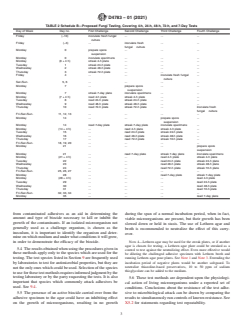
TABLE 2 Schedule B—Proposed Fungi Testing, Covering 4-h, 24-h, 48-h, 72-h, and 7-Day Tests
Day of Week Day no. First Challenge Second Challenge Third Challenge Fourth Challenge
Friday (−10) inoculate fresh fungal . . .
culture
Friday (−3) . inoculate fresh . .
fungal culture
Monday 0 prepare spore . . .
suspension
Monday 0 inoculate specimens . . .
Monday (0 + 4 h) streak 4-h plate . . .
Tuesday 1 streak 24-h plate . . .
Wednesday 2 streak 48-h plate . . .
Thursday 3 streak 72-h plate . . .
Friday 4 . . inoculate fresh fungal .
culture
Sat./Sun. 5, 6 . . . .
Monday 7 . prepare spore . .
suspension
Monday 7 streak 7-day plate inoculate specimens . .
Monday (7 + 4 h) read 4-h plate streak 4-h plate . .
Tuesday 8 read 24-h plate streak 24-h plate . .
Wednesday 9 read 48-h plate streak 48-h plate . .
Thursday 10 read 72-h plate streak 72-h plate . inoculate fresh
fungal culture
Fri./Sat./Sun. 11, 12, 13 . . . .
Monday 14 . . prepare spore .
suspension
Monday 14 read 7-day plate streak 7-day plate inoculate specimens .
Monday (14 + 4 h) . read 4-h plate streak 4-h plate .
Tuesday 15 . read 24-h plate streak 24-h plate .
Wednesday 16 . read 48-h plate streak 48-h plate .
Thursday 17 . read 72-h plate streak 72-h plate .
Fri./Sat./Sun. 18, 19, 20 . . . .
Monday 21 . . . prepare spore
suspension
Monday 21 . read 7-day plate streak 7-day plate inoculate specimens
Monday (21 + 4 h) . . read 4-h plate streak 4-h plate
Tuesday 22 . . read 24-h plate streak 24-h plate
Wednesday 23 . . read 48-h plate streak 48-h plate
Thursday 24 . . read 72-h plate streak 72-h plate
Fri./Sat./Sun. 25, 26, 27 . . . .
Monday 28 . . read 7-day plate streak 7-day plate
Monday (28 + 4 h) . . . read 4-h plate
Tuesday 29 . . . read 24-h plate
Wednesday 30 . . . read 48-h plate
Thursday 31 . . . read 72-h plate
Fri./Sat./Sun. 32, 33, 34 . . . .
Monday 35 . . . read 7-day plate
from contaminated adhesives as an aid in determining the during the span of a normal incubation period, when in fact,
amount and type of biocide necessary to kill or inhibit the
viable microorganisms are present, but their growth has been
growth of the contaminants. If an isolated microorganism not
slowed down or held in stasis. The use of Letheen agar and
generally used as a challenge organism, is chosen as the
broth is recommended to neutralize the effect of this carry-
inoculum, it is important to identify the organism and deter-
over.
mineonwhichmediumandunderwhatconditionsitwillgrow,
NOTE 4—Letheen agar may be used for the streak plates, or if another
in order to demonstrate the efficacy of the biocide.
agar is chosen for testing, a Letheen agar plate could be streaked as a
5.4 Theresultsobtainedwhenusingtheproceduresgivenin
control to test against the neutralizing effect. Even more effective would
these methods apply only to the species which are used for the
be diluting the challenged adhesive specimen with Letheen broth and
testing. The test species listed in Section 9 are frequently used running Letheen agar pour plates. See Note 1 and Note 3. Extending the
incubation period of negative plates would be another safeguard. To
by laboratories to test for antimicrobial properties, but they are
neutralize thiazoline-based preservatives, 10 to 50 ppm of sodium
nottheonlyoneswhichcouldbeused.Selectionofthespecies
thioglycolate can be added to the medium.
touseforthesetestmethodsrequiresinformedjudgmentbythe
testing laboratory or by the party requesting the tests. It is also
5.6 These test methods are dependent upon the physiologi-
important that species which commonly attack adhesives be
cal action of living microorganisms under a reported set of
used. See 9.4.
conditions. Conclusions about the resistance of the test adhe-
sive to microbiological attack can be drawn by comparing the
5.5 The presence of an active biocide carried over from the
resultstosimultaneouslyruncontrolsofknownresistance.See
adhesive specimen to the agar could have an inhibiting effect
on the growth of microorganisms, resulting in no growth X5.2 for statements regarding test repeatability.
D4783 − 01 (2021)
6. Apparatus 7.14 Tryptone Glucose Extract Agar, dehydrated (Difco or
equivalent).
6.1 In addition to the standard equipment found in any fully
equipped microbiological laboratory, the following items are
7.15 Yeast Malt Peptone Glucose Agar (YMPGA), dehy-
sometimes needed: drated (Difco or equivalent).
6.1.1 Autoclave, capable of producing 103 kPa of steam
pressureat121°C(250°F)andmaintainingitforaminimumof
8. Precautions
15 min.
8.1 These test methods employ live cultures of bacteria,
6.1.2 Cell Counting Chamber, Petroff-Hausser, cell depth
fungi,andyeast,someofwhicharecapableofcausingdisease,
0.02 mm (or equivalent).
and others allergic reaction in some humans. In addition to
6.1.3 Bottles, Screwcap, approximately 375 mL, Boston
other precautions, assign laboratory personnel trained in cor-
Rounds of flint glass. Mold-A-7232-D, Finish 28-400, and
rect microbiological techniques to run these tests. Use proper
Black Artmold Caps BM-8041, Size 28-400, with rubber ring
microbiological procedures in order to prevent contamination
liners fastened to caps with steamproof adhesive.
of the cultures or of the work area. Clean and sterilize in an
6.1.4 Constant Temperature Chamber, capable of being
approved manner all spills and all equipment coming into
maintained at 35 6 0.5°C (95 6 1°F) for bacteria, or 30 6
contact with the cultures and the inoculated adhesive speci-
0.5°C (86 6 1°F) for fungi, or two chambers if needed
mens. Also sterilize in an approved manner all cultures and
simultaneously.
contaminateddisposableequipmentbeforediscarding.See1.3.
6.1.5 Glass Rods, 305 mm in length having a diameter of
6.3 mm.
9. Test Organisms
6.1.6 Hemacytometer, Levy Counting Chamber, cell depth
9.1 Cultures of one or more of the following bacterial
0.1 mm, Newbauer rulings.
6.1.7 Hood, laminar flow type. species are suggested for use:
6.1.8 Jar, Screw Cap,round,approximately1L(1-qtmason 9.1.1 Pseudomonas fluorescens (ATCC 9721).
type) for samples.
9.1.2 Pseudomonas aeruginosa (ATCC 10145).
6.1.9 Pasteur Pipets.
9.1.3 Bacillus subtilis (ATCC 6984).
6.1.10 Pipet, 1 mL, disposable, sterile.
9.1.4 Proteus vulgaris (ATCC 9920).
6.1.11 Pipettes,automaticOxfordorEppindorf,sterile,with
9.2 Cultures of one or more of the following yeasts are
sterile tips.
suggested for use:
6.1.12 Refrigerator,capableofmaintainingtemperatureof4
9.2.1 Candida tropicalis (ATCC 750).
6 1°C (39 6 2°F).
9.2.2 Kluyveromyces fragilis (ATCC 8554).
6.1.13 Spectrophotometer, capable of measuring cell count
9.2.3 Candida pseudotropicalis (ATCC 4135).
at a wavelength of 425 nm.
9.3 Cultures of one or more of the following species of
7. Materials
fungi are suggested for use:
7.1 Beef Extract.
9.3.1 Aspergillus niger (ATCC 9642).
9.3.2 Aspergillus flavus (ATCC 9643).
7.2 Deionized or Distilled Water, sterile.
9.3.3 Penicillium pinophilum (ATCC 9644). See X3.1.6.
7.3 Disinfectant Solution, Amphyll, Alcide, or equivalent.
9.4 Since a number of other organisms may be of specific
7.4 Glucose.
interest for certain adhesives or for the environment to which
7.5 Letheen Agar, (Difco or equivalent).
they are to be exposed, such other pure cultures or mixtures of
culturesoforganismsmaybeused,ifagreeduponbetweenthe
7.6 Letheen Broth, (Difco or equivalent).
manufacturer and the purchaser of the adhesive, or upon the
7.7 Mycophil Agar, pH 4.7 (BBL or equivalent).
recommendation of the testing laboratory.
7.8 Nutrient Agar, (BBL or equivalent).
NOTE 5—See Appendix X1, Appendix X2, Appendix X3, and Appen-
7.9 Potato Dextrose Agar (PDA, Dehydrated), (Difco or
dix X4 for guidelines on selection of species of bacteria, yeast, and fungi,
equivalent). and on problems with use of combined species.
NOTE 6—The use of combined species for the challenge inoculum can
7.10 Phosphate buffered saline (PBS), sterile.
result in one species overgrowing the others. When a mixed inoculum is
the choice, the recommended groupings are (a) fungi and yeast, and (b)
7.11 Physiological Saline Solution, 0.85% NaCl, sterile.
Gram-positive and Gram-negative bacteria. Group (a) organisms prefer a
7.12 Sorbitan mono-oleate polyoxyethylene.
pH of 4.5, while Group (b) organisms prefer a pH of 7.Yeast grow faster
than fungi, a fact which should be considered in two steps in the test.The
7.13 Tryptone.
mixed inoculum should be used within2hof preparation, and for yeast,
thestreakplatestodeterminesterilityshouldbereadonScheduleA(same
6 as for bacteria), while for fungi, the plates should be read on Schedule B.
Available from most laboratory supply houses.
Screw cap bottles are available from Owens-Illinois Glass Co., OH Building,
Toledo, OH, or equivalent bottles and caps have been found suitable for this
purpose.
8 10
The Biogard Hood or similar equipment, The Baker Co., Sanford, ME. CulturesmaybepurchasedfromtheAmericanTypeCultureCollection,12301
Available commercially as Tween 80. Parklawn Drive, Rockville, MD 20852.
D4783 − 01 (2021)
10. Sterilization of Equipment and Media the PBS. See Note 8, Note 9, and Note 10 for details of
preparation. Transfer to a sterile container and adjust the
10.1 Follow accepted microbiological practices for steriliz-
7 8
bacterial count to 1×10 to 1×10 , preferably using a
ingequipmentandmediausedforthetests.Also,sterilizeinan
spectrophotometer. Set the spectrophotometer at 425 nm.
approved manner all cultures and contaminated adhesive
Adjusttoanopticaldensityof0.45usinganopticalqualitytest
specimens before discarding.
tubemeasuring12.7mmindiameter.Thisshouldgiveapproxi-
NOTE 7—Two references for sterilization methods areTAPPIT487 and
mately 1.0×10 bacteria/mL. For yeast, these settings should
Ref (1). 7
giveapproximately1.0×10 yeasts/mL.Usetheproductinsert
provided by the manufacturer for the method of determining
11. Preparation of Media
cell count.
11.1 Potato Dextrose Agar and Tryptone Glucose Agar:
12.2.2 For a mixed-species inoculum, first adjust each
11.1.1 Prepare sufficient agar slants and plates for culture
suspensionofanindividualspeciestothegivenlevel,andthen
propagation and for conducting the tests.
combine equal portions. Use the bacterial suspension as the
11.1.2 Follow the instructions given for preparation of the
inoculum for the test in 15.3.1. Prepare a fresh suspension for
commercial product. Dissolve using heat and agitation. Trans-
each subsequent challenge described in 15.3.3.
fer 10 mL of the agar solution to each test tube. Cap tubes
NOTE 8—Prepare the PBS solution by the following formula:
looselywithmetal,plastic,orfoamcaps.Autoclavefor15min
grams
at103kPaandatemperatureof121°C(250°F).Allowtheagar
NaCl 7.2
to cool to 48 to 50°C (118 to 122°F) before pouring the plates.
Na HPO (anhydrous) 1.48
2 4
Tighten the caps on the tubes and place them in a slanted
KH PO (anhydrous) 0.43
2 4
position to solidify, making a slant of about 51 mm. Store in
Dilute to 1 L and sterilize. pH should be 7.2.
refrigerator until needed.
Instead of PBS, some laboratories use sterile deionized water or sterile
physiological saline solution. See 7.2 and 7.11.
11.2 Other Agar Types—Letheen, Nutrient, and Mycophil—
NOTE 9—Follow the same general procedure as given in A1.1 to
Prepare as needed to conduct tests, using commercially avail-
preparetheprimarysuspension,exceptforbacteriaandyeasts,usePBSas
able product.
the diluent, do not use a wetting agent, and rinse the pellet only once.
NOTE 10—The alternate method for measuring and adjusting the
11.3 Tryptone Glucose Extract Broth and Letheen Broth:
bacterial and yeast count is use of the Petroff-Hausser counting chamber,
11.3.1 Prepare sufficient media to conduct the tests.
which has a depth of 0.02 mm and can handle bacteria and yeasts better
11.3.2 For the tryptone glucose broth add 1.5 g of beef
than the hemacytometer chamber. Methyl violet may be used to stain the
extract, 2.5 g of tryptone, and 0.5 g of glucose to 500 mL of bacteria for better visibility. See the instructions which accompany the
counting chamber.
cold distilled water in a 1000-mL beaker. For the Letheen
NOTE11—TomeetScheduleAinTable1,maketheinoculation(12.2.1)
broth, follow directions for the commercial product.
on Monday, and prepare the suspension (12.2.1 and 12.2.2) on Tuesday,
11.3.3 Forbothtypesofbroth,heattoboilingtodissolvethe
the day the adhesive specimens are inoculated.
mediumcompletely,transfer10mLofthedissolvedmediumto
13. Yeast Cultures
eachtesttube,andautoclavetubes(withcapsloose)for15min
at 103 kPa and a temperature of 121°C (
...