

ASTM D7966/D7966M-16(2023)
(Test Method)Standard Test Method for Resistance to Creep of Adhesives in Static Shear by Compression Loading (Wood-to-Wood)
General Information
- Abstract
SIGNIFICANCE AND USE
5.1 This test method evaluates the performance of the adhesive in laminated wood as measured by resistance to creep under static load.
5.2 Test results from the evaluation of adhesive creep resistance, under designated environmental conditions of the test, provide a measure of the adhesive’s ability to withstand constant loading over a relatively long period of time.
5.3 Creep measured with this test method is normally used in conjunction with specifications such as, but not limited to Specification D2559 and CSA O112.9 to confirm suitability of an adhesive to resist creep under designed loads when subjected to specific levels of stress, load duration and environmental conditions.
SCOPE
1.1 This test method covers the determination of creep properties of structural adhesives in wood-to-wood bonds when a standardized specimen is subjected to shearing stresses at various levels of static load, constant temperature, and relative humidity. Apparatus and procedures are provided for shear deformation (creep) of adhesive bonds under static load. This test method is used under the indicated conditions to evaluate resistance to creep properties of a structural wood adhesive.
1.2 The test method is used to evaluate creep performance of adhesives suitable for the bonding of wood, including treated wood, into structural wood products for general construction, marine use, or for other uses where a high-strength general construction, creep-resistant, durable adhesive bond is required. Individual block shear specimens are prepared from adhesively bonded laminations, subjected to a constant load under various combinations of temperature and relative humidity, and the amount of creep measured.
1.3 Creep of structural wood adhesives as measured by this test method may not be comparative to other ASTM methods and is limited to the conditions of the test and procedures contained herein.
1.4 The values stated in either SI units or inch-pound units are to be regarded separately as standard. The values stated in each system are not necessarily exact equivalents; therefore, to ensure conformance with the standard, each system shall be used independently of the other, and values from the two systems shall not be combined.
1.5 This standard does not purport to address all of the safety concerns, if any, associated with its use. It is the responsibility of the user of this standard to establish appropriate safety, health, and environmental practices and determine the applicability of regulatory limitations prior to use.
1.6 This international standard was developed in accordance with internationally recognized principles on standardization established in the Decision on Principles for the Development of International Standards, Guides and Recommendations issued by the World Trade Organization Technical Barriers to Trade (TBT) Committee.
- Status
- Published
- Publication Date
- 30-Apr-2023
- Technical Committee
- D14 - Adhesives
- Drafting Committee
- D14.30 - Wood Adhesives
Overview
ASTM D7966/D7966M-16(2023) is the internationally recognized standard test method for determining the resistance to creep of adhesives in static shear by compression loading in wood-to-wood bonds. Developed by ASTM International, this method is essential for evaluating the long-term performance of structural adhesives used in laminated wood products. By subjecting standardized wood specimens, bonded with an adhesive, to shearing stresses under controlled temperature and relative humidity, this standard provides a reliable means of assessing an adhesive’s capacity to withstand constant loads over extended periods. It is widely applied in the construction and manufacturing of structural wood products, including those used in general construction and marine environments.
Key Topics
- Creep Resistance Evaluation: This standard outlines procedures to determine how well a structural wood adhesive resists deformation (creep) when subjected to static shear stress over time.
- Environmental Conditioning: The method specifies the importance of testing under various combinations of temperature and humidity to simulate real-world application environments.
- Specimen Preparation: Guidelines are provided for preparing block shear test specimens from laminated wood assemblies, ensuring consistent and reproducible results.
- Adhesive Suitability: The results from this test are crucial for confirming an adhesive’s suitability for use in applications requiring durability and resistance to creep, especially when exposed to sustained loads.
- Measurement and Reporting: The standard details the measurement of creep displacement at the adhesive bondline and the necessary reporting of various test and material parameters to evaluate adhesive performance comprehensively.
Applications
The ASTM D7966/D7966M-16(2023) standard is widely applied in sectors where wood adhesive performance is critical, such as:
- Engineered Wood Products: Manufacturers use this standard to qualify adhesives for products like laminated beams, glulam, and cross-laminated timber (CLT), ensuring long-term structural integrity.
- General Construction: Structural wood adhesives assessed against this method are commonly used in buildings, bridges, and load-bearing wood components, confirming their resistance to creep under designed service conditions.
- Marine Applications: This test method helps validate adhesives intended for marine-grade structural wood products exposed to humid or harsh environments.
- Product Certification and Specification: It is often referenced in conjunction with other standards (such as ASTM D2559 and CSA O112.9) to comply with code requirements for strength and durability.
- Quality Control: Manufacturers, quality laboratories, and certifying bodies employ this test to ensure consistent adhesive performance as part of product approval processes.
Related Standards
Several key standards complement and provide context for ASTM D7966/D7966M-16(2023):
- ASTM D2559: Specification for adhesives for bonded structural wood products for use under exterior exposure conditions.
- CSA O112.9: Canadian standard for evaluation of adhesives in structural wood products (exterior exposure).
- ASTM D905: Test method for strength properties of adhesive bonds in shear by compression loading.
- ASTM D907: Terminology of adhesives, which defines crucial terms used in this test method.
- ASTM D1101 and D2395: Related to integrity and density of adhesive wood joints.
- ASTM D4442: Direct moisture content measurement of wood and wood-based materials.
By utilizing the rigorous procedures detailed in ASTM D7966/D7966M-16(2023), organizations ensure that wood adhesives deliver reliable, long-term performance in demanding structural applications, meeting both regulatory and market expectations for durability and creep resistance.
Relations
- Effective Date
- 01-Mar-2020
- Effective Date
- 01-Aug-2018
- Effective Date
- 01-Aug-2018
- Effective Date
- 15-Nov-2016
- Effective Date
- 01-Jun-2015
- Effective Date
- 01-Jun-2014
- Effective Date
- 01-May-2014
- Effective Date
- 01-May-2014
- Effective Date
- 01-May-2013
- Effective Date
- 01-Jul-2012
- Effective Date
- 01-Jun-2012
- Effective Date
- 01-Jun-2012
- Effective Date
- 01-May-2012
- Effective Date
- 01-Dec-2011
- Effective Date
- 01-Jan-2011
Get Certified
Connect with accredited certification bodies for this standard

DIN CERTCO
DIN Group product certification.
Gozdarski inštitut Slovenije
Slovenian Forestry Institute. Forest management certification support, timber testing.

Smithers Quality Assessments
US management systems and product certification.
Sponsored listings
Frequently Asked Questions
ASTM D7966/D7966M-16(2023) is a standard published by ASTM International. Its full title is "Standard Test Method for Resistance to Creep of Adhesives in Static Shear by Compression Loading (Wood-to-Wood)". This standard covers: SIGNIFICANCE AND USE 5.1 This test method evaluates the performance of the adhesive in laminated wood as measured by resistance to creep under static load. 5.2 Test results from the evaluation of adhesive creep resistance, under designated environmental conditions of the test, provide a measure of the adhesive’s ability to withstand constant loading over a relatively long period of time. 5.3 Creep measured with this test method is normally used in conjunction with specifications such as, but not limited to Specification D2559 and CSA O112.9 to confirm suitability of an adhesive to resist creep under designed loads when subjected to specific levels of stress, load duration and environmental conditions. SCOPE 1.1 This test method covers the determination of creep properties of structural adhesives in wood-to-wood bonds when a standardized specimen is subjected to shearing stresses at various levels of static load, constant temperature, and relative humidity. Apparatus and procedures are provided for shear deformation (creep) of adhesive bonds under static load. This test method is used under the indicated conditions to evaluate resistance to creep properties of a structural wood adhesive. 1.2 The test method is used to evaluate creep performance of adhesives suitable for the bonding of wood, including treated wood, into structural wood products for general construction, marine use, or for other uses where a high-strength general construction, creep-resistant, durable adhesive bond is required. Individual block shear specimens are prepared from adhesively bonded laminations, subjected to a constant load under various combinations of temperature and relative humidity, and the amount of creep measured. 1.3 Creep of structural wood adhesives as measured by this test method may not be comparative to other ASTM methods and is limited to the conditions of the test and procedures contained herein. 1.4 The values stated in either SI units or inch-pound units are to be regarded separately as standard. The values stated in each system are not necessarily exact equivalents; therefore, to ensure conformance with the standard, each system shall be used independently of the other, and values from the two systems shall not be combined. 1.5 This standard does not purport to address all of the safety concerns, if any, associated with its use. It is the responsibility of the user of this standard to establish appropriate safety, health, and environmental practices and determine the applicability of regulatory limitations prior to use. 1.6 This international standard was developed in accordance with internationally recognized principles on standardization established in the Decision on Principles for the Development of International Standards, Guides and Recommendations issued by the World Trade Organization Technical Barriers to Trade (TBT) Committee.
SIGNIFICANCE AND USE 5.1 This test method evaluates the performance of the adhesive in laminated wood as measured by resistance to creep under static load. 5.2 Test results from the evaluation of adhesive creep resistance, under designated environmental conditions of the test, provide a measure of the adhesive’s ability to withstand constant loading over a relatively long period of time. 5.3 Creep measured with this test method is normally used in conjunction with specifications such as, but not limited to Specification D2559 and CSA O112.9 to confirm suitability of an adhesive to resist creep under designed loads when subjected to specific levels of stress, load duration and environmental conditions. SCOPE 1.1 This test method covers the determination of creep properties of structural adhesives in wood-to-wood bonds when a standardized specimen is subjected to shearing stresses at various levels of static load, constant temperature, and relative humidity. Apparatus and procedures are provided for shear deformation (creep) of adhesive bonds under static load. This test method is used under the indicated conditions to evaluate resistance to creep properties of a structural wood adhesive. 1.2 The test method is used to evaluate creep performance of adhesives suitable for the bonding of wood, including treated wood, into structural wood products for general construction, marine use, or for other uses where a high-strength general construction, creep-resistant, durable adhesive bond is required. Individual block shear specimens are prepared from adhesively bonded laminations, subjected to a constant load under various combinations of temperature and relative humidity, and the amount of creep measured. 1.3 Creep of structural wood adhesives as measured by this test method may not be comparative to other ASTM methods and is limited to the conditions of the test and procedures contained herein. 1.4 The values stated in either SI units or inch-pound units are to be regarded separately as standard. The values stated in each system are not necessarily exact equivalents; therefore, to ensure conformance with the standard, each system shall be used independently of the other, and values from the two systems shall not be combined. 1.5 This standard does not purport to address all of the safety concerns, if any, associated with its use. It is the responsibility of the user of this standard to establish appropriate safety, health, and environmental practices and determine the applicability of regulatory limitations prior to use. 1.6 This international standard was developed in accordance with internationally recognized principles on standardization established in the Decision on Principles for the Development of International Standards, Guides and Recommendations issued by the World Trade Organization Technical Barriers to Trade (TBT) Committee.
ASTM D7966/D7966M-16(2023) is classified under the following ICS (International Classification for Standards) categories: 79.060.01 - Wood-based panels in general; 83.180 - Adhesives. The ICS classification helps identify the subject area and facilitates finding related standards.
ASTM D7966/D7966M-16(2023) has the following relationships with other standards: It is inter standard links to ASTM D4442-20, ASTM D2559-12a(2018), ASTM D1101-97a(2018), ASTM D4442-16, ASTM D4442-15, ASTM E4-14, ASTM D2395-14, ASTM D2395-14e1, ASTM D1101-97a(2013), ASTM D907-12a, ASTM D2559-12ae1, ASTM D2559-12a, ASTM D907-12, ASTM D907-11a, ASTM D907-11. Understanding these relationships helps ensure you are using the most current and applicable version of the standard.
ASTM D7966/D7966M-16(2023) is available in PDF format for immediate download after purchase. The document can be added to your cart and obtained through the secure checkout process. Digital delivery ensures instant access to the complete standard document.
Standards Content (Sample)
This international standard was developed in accordance with internationally recognized principles on standardization established in the Decision on Principles for the
Development of International Standards, Guides and Recommendations issued by the World Trade Organization Technical Barriers to Trade (TBT) Committee.
Designation: D7966/D7966M − 16 (Reapproved 2023)
Standard Test Method for
Resistance to Creep of Adhesives in Static Shear by
Compression Loading (Wood-to-Wood)
This standard is issued under the fixed designation D7966/D7966M; the number immediately following the designation indicates the
year of original adoption or, in the case of revision, the year of last revision. A number in parentheses indicates the year of last
reapproval. A superscript epsilon (´) indicates an editorial change since the last revision or reapproval.
1. Scope 1.6 This international standard was developed in accor-
dance with internationally recognized principles on standard-
1.1 This test method covers the determination of creep
ization established in the Decision on Principles for the
properties of structural adhesives in wood-to-wood bonds
Development of International Standards, Guides and Recom-
when a standardized specimen is subjected to shearing stresses
mendations issued by the World Trade Organization Technical
at various levels of static load, constant temperature, and
Barriers to Trade (TBT) Committee.
relative humidity. Apparatus and procedures are provided for
shear deformation (creep) of adhesive bonds under static load.
2. Referenced Documents
This test method is used under the indicated conditions to
2.1 ASTM Standards:
evaluate resistance to creep properties of a structural wood
D905 Test Method for Strength Properties of Adhesive
adhesive.
Bonds in Shear by Compression Loading
1.2 The test method is used to evaluate creep performance
D907 Terminology of Adhesives
of adhesives suitable for the bonding of wood, including
D1101 Test Methods for Integrity of Adhesive Joints in
treated wood, into structural wood products for general
Structural Laminated Wood Products for Exterior Use
construction, marine use, or for other uses where a high-
D2395 Test Methods for Density and Specific Gravity (Rela-
strength general construction, creep-resistant, durable adhesive
tive Density) of Wood and Wood-Based Materials
bond is required. Individual block shear specimens are pre-
D2559 Specification for Adhesives for Bonded Structural
pared from adhesively bonded laminations, subjected to a
Wood Products for Use Under Exterior Exposure Condi-
constant load under various combinations of temperature and
tions
relative humidity, and the amount of creep measured.
D4442 Test Methods for Direct Moisture Content Measure-
1.3 Creep of structural wood adhesives as measured by this ment of Wood and Wood-Based Materials
test method may not be comparative to other ASTM methods E4 Practices for Force Calibration and Verification of Test-
and is limited to the conditions of the test and procedures ing Machines
contained herein. 2.2 Other Document:
CSA O112.9 Evaluation of Adhesives for Structural Wood
1.4 The values stated in either SI units or inch-pound units
Products (Exterior Exposure)
are to be regarded separately as standard. The values stated in
2.3 ASTM Adjuncts:
each system are not necessarily exact equivalents; therefore, to
Compression-Shear Creep Test Apparatus
ensure conformance with the standard, each system shall be
used independently of the other, and values from the two
3. Terminology
systems shall not be combined.
3.1 Definitions: Many terms in this test method are defined
1.5 This standard does not purport to address all of the
in Terminology D907.
safety concerns, if any, associated with its use. It is the
3.1.1 laminated wood, n—the fabricated product resulting
responsibility of the user of this standard to establish appro-
from the bonding of two or more laminations, with each
priate safety, health, and environmental practices and deter-
lamination made from one or more pieces bonded either
mine the applicability of regulatory limitations prior to use.
For referenced ASTM standards, visit the ASTM website, www.astm.org, or
contact ASTM Customer Service at service@astm.org. For Annual Book of ASTM
This test method is under the jurisdiction of ASTM Committee D14 on Standards volume information, refer to the standard’s Document Summary page on
Adhesives and is the direct responsibility of Subcommittee D14.30 on Wood the ASTM website.
Adhesives. Available from APA – The Engineered Wood Association, 7011 S.19th St.,
Current edition approved May 1, 2023. Published May 2023. Originally Tacoma, WA 98466-5333, www.apawood.org.
approved in 2014. Last previous edition approved in 2016 as D7966/D7966M – 16. Available from ASTM International Headquarters. Order Adjunct No. ADJ-
DOI: 10.1520/D7966_D7966-16R23. ADJD4680. Original adjunct produced in 1987.
Copyright © ASTM International, 100 Barr Harbor Drive, PO Box C700, West Conshohocken, PA 19428-2959. United States
D7966/D7966M − 16 (2023)
lengthwise, edgewise, or both, and all with the direction of the 4.6 At the completion of the designated exposure time, the
grain essentially parallel, to form a larger piece such as a amount of creep for each specimen is measured and reported
structural member.
along with the average creep for the group of specimens.
3.1.1.1 Discussion—Laminated wood as defined in D1101.
5. Significance and Use
3.1.2 stress, n—the force exerted per unit area at a point
within a plane.
5.1 This test method evaluates the performance of the
3.2 Definitions of Terms Specific to This Standard: adhesive in laminated wood as measured by resistance to creep
3.2.1 average creep of specimen, n—calculated creep dis- under static load.
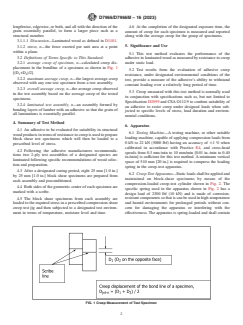
placement in the bondline of a specimen as shown in Fig. 1
5.2 Test results from the evaluation of adhesive creep
[(D +D )/2].
1 2
resistance, under designated environmental conditions of the
3.2.2 maximum average creep, n—the largest average creep
test, provide a measure of the adhesive’s ability to withstand
observed with any one test specimen from a test assembly.
constant loading over a relatively long period of time.
3.2.3 overall average creep, n—the average creep observed
5.3 Creep measured with this test method is normally used
in the test assembly based on the average creep of the tested
in conjunction with specifications such as, but not limited to
specimens.
Specification D2559 and CSA O112.9 to confirm suitability of
3.2.4 laminated test assembly, n—an assembly formed by
an adhesive to resist creep under designed loads when sub-
bonding layers of lumber with an adhesive so that the grain of
jected to specific levels of stress, load duration and environ-
all laminations is essentially parallel.
mental conditions.
4. Summary of Test Method
6. Apparatus
4.1 An adhesive to be evaluated for suitability in structural
6.1 Testing Machine—A testing machine, or other suitable
wood products in terms of resistance to creep is used to prepare
loading machine, capable of applying compression loads from
block shear test specimens which will then be loaded to a
0 kN to 22 kN (5000 lbf) having an accuracy of 61 % when
prescribed level of stress.
calibrated in accordance with Practice E4, and cross-head
4.2 Following the adhesive manufacturers recommenda-
speeds from 0.3 mm ⁄min to 10 mm/min [0.01 in. ⁄min to 0.40
tions two 2-ply test assemblies of a designated species are
in./min] is sufficient for this test method. A minimum vertical
laminated following specific recommendations of wood selec-
space of 510 mm [20 in.] is required to compress the loading
tion and preparation.
spring in the creep-test apparatus.
4.3 After a designated curing period, eight 25 mm [1.0 in.]
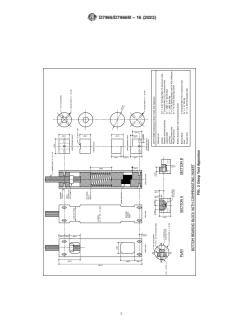
6.2 Creep-Test Apparatus—Static loads shall be applied and
by 25 mm [1.0 in.] block shear specimens are prepared from
maintained on block-shear specimens by means of the
each assembly and preconditioned.
compression-loaded creep-test cylinder shown in Fig. 2. The
4.4 Both sides of the geometric center of each specimen are
specific spring used in the apparatus shown in Fig. 2 has a
marked with a scribe.
design load of 2300 lbf (10 kN) and is made of corrosion-
resistant components so that is can be used in high-temperature
4.5 The block shear specimens from each assembly are
loaded to the required stress in a prescribed compression-shear and humid environments for prolonged periods without con-
creep test jig and then subjected to a designated test environ- cern for damaging the apparatus or interfering with the
ment in terms of temperature, moisture level and time. effectiveness. The apparatus is spring-loaded and shall contain
FIG. 1 Creep Measurement of Test Specimen
D7966/D7966M − 16 (2023)
FIG. 2 Creep Test Apparatus
D7966/D7966M − 16 (2023)
TABLE 1 Standard Environmental Conditions
Relative Humidity
Test Condition Temperature Time (days) Stress Level
(%)
A
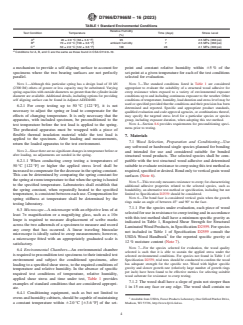
A 20 ± 2.0 °C [68 ± 3.6 °F] 95 7 2.5 MPa (360 psi)
A
B 70 ± 2.0 °C [158 ± 3.6 °F] ambient humidity 7 2.5 MPa (360 psi)
A
C 50 ± 2.0 °C [122 ± 3.6 °F] 100 28 2.1 MPa (300 psi)
A
Conditions for A, B, and C are the same as those found in CSA O112.9–10.
a mechanism to provide a self aligning surface to account for point and constant relative humidity within 65 % of the
specimens where the two bearing surfaces are not perfectly set-point at a given temperature for each of the test conditions
parallel. selected for evaluation.
NOTE 1—Although this particular spring has a design load of 10 kN NOTE 3—The standard conditions listed in Table 1 are considered
(2300 lbf) others of greater or less capacity may be substituted. Varying appropriate to evaluate the suitability of a structural wood adhesive for
spring capacities with outside diameters no greater than the cylinder inside creep resistance when exposed to a variety of environmental exposure
diameter are available. Additional details, including options for providing conditions up to and including continuous exposure to the weather. Other
self aligning surface can be found in Adjunct ADJD4680. conditions of temperature, humidity, load duration and stress level may be
used or specified provided that the conditions and their precision has been
6.2.1 For creep testing up to 50 °C [122 °F], it is not
determined and reported. Specific and appropriate product standards,
necessary to adjust the spring or load to compensate for the
qualified evaluation and code approval agencies, or combinations thereof,
effects of changing temperature. It is only necessary that the
may specify the targeted stress level for a particular species or species
group, including exposure duration, when adopting this test method.
apparatus, with included specimen, be preconditioned to the
NOTE 4—Section 8.6 provides requirements for preconditioning speci-
test temperature before the test load is applied to the spring.
mens prior to testing.
The preheated apparatus must be wrapped with a piece of
flexible thermal insulation material while the test load is
7. Materials
applied to the specimen. After loading and measurements,
7.1 Wood Selection, Preparation and Conditioning—Use
return the loaded apparatus to the test environment.
any softwood or hardwood single species planned for bonding
NOTE 2—Since there are no significant changes in temperature before or
and intended for use and considered suitable for bonded
after loading, no adjustments are needed in the spring.
structural wood products. The selected species shall be com-
6.2.1.1 When conducting creep testing a temperatures of
patible with the test structural wood adhesive and determined
50 °C [122 °F] or higher the applied stress level shall be suitable to evaluate resistance to creep using this test method as
increased to compensate for the decrease in the spring constant.
required, specified or desired. Bond only to vertical grain wood
This can be determined by comparing the spring constant for surfaces (Note 6).
the spring at room temperature to that when the spring is heated
NOTE 5—This test only measures resistance to creep; for characterizing
to the specified temperature. Laboratories shall establish that
additional adhesive properties related to the selected species, such as
the spring constant, when repeatedly heated to the specified
bondability, an alternative test method or specification, including but not
limited to Specification D2559 should be considered.
temperature, is consistent between each use. Compensation for
NOTE 6—The bond face is considered vertical grain when the growth
spring stiffness at temperature shall be determined by the
rings make an angle of between 45° and 90° to the face.
testing laboratory.
7.1.1 For the species under evaluation, each piece of wood
6.3 Microscope—A microscope with an objective lens of at
selected for use in resistance to creep testing and in accordance
least 7× magnification or a magnifying glass, such as a 10×
with this test method shall have a minimum specific gravity as
loupe is required to measure displacement of scribe marks
indicated in Table 1, Required Shear Strength for Structural
across the two adherends of a specimen to measure and record
Laminated Wood Products, in Specification D2559. For species
any creep that has occurred. A linear traveling binocular
not included in Table 1 of Specification D2559 consult the
microscope is ideally suited to creep measurements; however,
USDA Wood Handbook for the reported specific gravity at
a microscope fitted with an appropriately graduated scale is
12 % moisture content (Note 7).
satisfactory.
NOTE 7—For the species selected for evaluation, the wood quality
6.4 Environmental Chambers—An environmental chamber
selected is such that it is able to sustain the applied stress under the
is required to precondition test specimens to their intended test
selected environmental conditions. For species not found in Table 1 of
environment and subject the conditioned specimens, after
Specification D2559, trial tests should be conducted to confirm the wood
has adequate strength for the specific test. Wood with higher specific
loading to a specified shear stress, to the required conditions of
gravity and slower growth rate (relatively large number of growth rings
temperature and relative humidity. In the absence of specific
per inch) have been found to be effective metrics for selecting suitable
require
...