

ASTM G222-21
(Practice)Standard Practice for Estimation of UV Irradiance Received by Field-Exposed Products as a Function of Location
General Information
- Abstract
SIGNIFICANCE AND USE
5.1 Products exposed outdoors degrade due to primarily three stress factors: sunlight, temperature and moisture. The rate of property change is a function of time and stressors’ intensity.
5.2 Whereas the UV irradiance calculated in this practice is independent of material, it is especially relevant to polymeric materials exposed outdoors as the combined action of UV radiation and oxygen is often the dominant factor leading to their degradation. Therefore, estimating UV irradiance is an important parameter to assess the service life of products.
5.3 UV radiant dosage is often more important to determine in the correlation with the amount of degradation than total solar radiant dosage or duration of time. The comparison of UV radiant dosage from one location to another may be used to normalize degradation results.
5.4 Measured UV irradiance data are scarce compared to total solar irradiance data. Many locations that monitor solar resource data only collect data for total solar radiation. This practice allows the user to estimate the amount of UV irradiance from the amount of total solar irradiance for any site.
SCOPE
1.1 This practice describes methods to estimate the total solar ultraviolet irradiance on a horizontal surface as a function of Air Mass and geographic location.
1.2 This practice provides a mathematical model for calculating Global Horizontal Ultraviolet irradiance (GHUV) from Global Horizontal Irradiance (GHI) data for a specific location.
1.3 Units—The values stated in SI units are to be regarded as standard. No other units of measurement are included in this standard.
1.4 This standard does not purport to address all of the safety concerns, if any, associated with its use. It is the responsibility of the user of this standard to establish appropriate safety, health, and environmental practices and determine the applicability of regulatory limitations prior to use.
1.5 This international standard was developed in accordance with internationally recognized principles on standardization established in the Decision on Principles for the Development of International Standards, Guides and Recommendations issued by the World Trade Organization Technical Barriers to Trade (TBT) Committee.
- Status
- Published
- Publication Date
- 31-May-2021
- Technical Committee
- G03 - Weathering and Durability
- Drafting Committee
- G03.09 - Radiometry
Overview
ASTM G222-21: Standard Practice for Estimation of UV Irradiance Received by Field-Exposed Products as a Function of Location provides a scientifically based methodology for estimating ultraviolet (UV) irradiance on products exposed outdoors. The standard offers a reliable approach to derive UV exposure values from widely available solar energy data, addressing the challenge of limited direct UV measurements at global locations. Understanding UV irradiance is essential for predicting the weathering, service life, and degradation of materials-especially polymeric materials that are highly impacted by UV radiation.
This standard is applicable to a broad range of field-exposed products and enables manufacturers, researchers, and quality professionals to assess performance and durability under varying environmental conditions based on location-specific data.
Key Topics
Estimation of Global Horizontal UV Irradiance (GHUV):
Provides a mathematical model to estimate total UV irradiance on a horizontal surface using global horizontal irradiance (GHI) data, air mass, and geographic location.Relevant Wavelength Ranges:
Focuses particularly on common UV ranges such as 280–400 nm (UVA + UVB) and 295–385 nm, which are significant for material weathering studies.Role of Environmental Stressors:
Recognizes sunlight (especially UV), temperature, and moisture as the principal outdoor stressors influencing degradation rates.Mathematical Modeling:
Describes usage of location-specific coefficients and air mass calculations for accurate estimations, supporting both measured and modeled input data.Conversion to Radiant Exposure:
Details procedures for converting average UV irradiance into radiant exposure (dosage), which is directly correlated with material degradation.Practical Data Use:
Supplies guidance for leveraging publicly available solar resource datasets to derive site-specific UV values in the absence of direct measurements.
Applications
ASTM G222-21 is widely applicable in several contexts:
Material Durability Testing:
Helps laboratories and manufacturers assess product longevity and accelerate weathering studies by estimating representative UV exposure levels for specific locations.Outdoor Product Development:
Supports the design and selection of materials for outdoor use-such as coatings, polymers, construction products, photovoltaic modules, and automotive parts-by quantifying expected UV stress based on geographic variables.Normalization of Field Test Results:
Enables accurate comparison of degradation data from multiple sites by normalizing to equivalent UV doses, ensuring meaningful multi-location studies.Quality Assurance and Regulatory Compliance:
Assists in meeting certification and performance standards by providing a scientific basis for reported UV exposure during durability assessments.Research and Environmental Studies:
Facilitates studies that require understanding of the relationship between UV radiation and the aging or performance of both natural and synthetic materials.
Related Standards
ASTM G222-21 references several key standards and resources for UV and solar irradiance measurements, modeling, and terminology:
- ASTM G113: Terminology Relating to Natural and Artificial Weathering Tests of Nonmetallic Materials
- ASTM G173: Tables for Reference Solar Spectral Irradiances
- ASTM G183: Practice for Field Use of Pyranometers, Pyrheliometers, and UV Radiometers
- ASTM D7869: Practice for Xenon Arc Exposure Test with Enhanced Light and Water Exposure for Transportation Coatings
- ISO 9060: Specification and Classification of Instruments for Measuring Hemispherical Solar and Direct Solar Radiation
- ISO/TR 17801: Reference Global Solar Spectral Irradiance at Sea Level
- Best Practices Handbook for the Collection and Use of Solar Resource Data for Solar Energy Applications (NREL): A key guide for sourcing measured and modeled solar irradiance data
By leveraging these standards within the ASTM G222-21 framework, users ensure consistent, accurate, and internationally accepted estimation of UV exposure for diverse outdoor applications.
Keywords: ASTM G222-21, UV irradiance estimation, solar ultraviolet, global horizontal UV irradiance, field-exposed products, weathering, material degradation, outdoor durability, air mass, solar resource data, polymer degradation, radiant exposure, quality assurance, international standards.
Relations
- Effective Date
- 01-Feb-2017
- Effective Date
- 01-Mar-2014
- Effective Date
- 01-Sep-2013
- Effective Date
- 01-Jun-2013
- Effective Date
- 01-Sep-2011
- Effective Date
- 01-Dec-2010
- Effective Date
- 15-Jun-2009
- Effective Date
- 01-Aug-2008
- Effective Date
- 01-Jun-2008
- Effective Date
- 01-Jun-2008
- Effective Date
- 01-Dec-2006
- Effective Date
- 01-Dec-2006
- Effective Date
- 15-Aug-2005
- Effective Date
- 01-Apr-2005
- Refers
ASTM G183-05 - Standard Practice for Field Use of Pyranometers, Pyrheliometers and UV Radiometers - Effective Date
- 01-Feb-2005
Get Certified
Connect with accredited certification bodies for this standard

DNV
DNV is an independent assurance and risk management provider.

Lloyd's Register
Lloyd's Register is a global professional services organisation specialising in engineering and technology.
DNV Energy Systems
Energy and renewable energy certification.
Sponsored listings
Frequently Asked Questions
ASTM G222-21 is a standard published by ASTM International. Its full title is "Standard Practice for Estimation of UV Irradiance Received by Field-Exposed Products as a Function of Location". This standard covers: SIGNIFICANCE AND USE 5.1 Products exposed outdoors degrade due to primarily three stress factors: sunlight, temperature and moisture. The rate of property change is a function of time and stressors’ intensity. 5.2 Whereas the UV irradiance calculated in this practice is independent of material, it is especially relevant to polymeric materials exposed outdoors as the combined action of UV radiation and oxygen is often the dominant factor leading to their degradation. Therefore, estimating UV irradiance is an important parameter to assess the service life of products. 5.3 UV radiant dosage is often more important to determine in the correlation with the amount of degradation than total solar radiant dosage or duration of time. The comparison of UV radiant dosage from one location to another may be used to normalize degradation results. 5.4 Measured UV irradiance data are scarce compared to total solar irradiance data. Many locations that monitor solar resource data only collect data for total solar radiation. This practice allows the user to estimate the amount of UV irradiance from the amount of total solar irradiance for any site. SCOPE 1.1 This practice describes methods to estimate the total solar ultraviolet irradiance on a horizontal surface as a function of Air Mass and geographic location. 1.2 This practice provides a mathematical model for calculating Global Horizontal Ultraviolet irradiance (GHUV) from Global Horizontal Irradiance (GHI) data for a specific location. 1.3 Units—The values stated in SI units are to be regarded as standard. No other units of measurement are included in this standard. 1.4 This standard does not purport to address all of the safety concerns, if any, associated with its use. It is the responsibility of the user of this standard to establish appropriate safety, health, and environmental practices and determine the applicability of regulatory limitations prior to use. 1.5 This international standard was developed in accordance with internationally recognized principles on standardization established in the Decision on Principles for the Development of International Standards, Guides and Recommendations issued by the World Trade Organization Technical Barriers to Trade (TBT) Committee.
SIGNIFICANCE AND USE 5.1 Products exposed outdoors degrade due to primarily three stress factors: sunlight, temperature and moisture. The rate of property change is a function of time and stressors’ intensity. 5.2 Whereas the UV irradiance calculated in this practice is independent of material, it is especially relevant to polymeric materials exposed outdoors as the combined action of UV radiation and oxygen is often the dominant factor leading to their degradation. Therefore, estimating UV irradiance is an important parameter to assess the service life of products. 5.3 UV radiant dosage is often more important to determine in the correlation with the amount of degradation than total solar radiant dosage or duration of time. The comparison of UV radiant dosage from one location to another may be used to normalize degradation results. 5.4 Measured UV irradiance data are scarce compared to total solar irradiance data. Many locations that monitor solar resource data only collect data for total solar radiation. This practice allows the user to estimate the amount of UV irradiance from the amount of total solar irradiance for any site. SCOPE 1.1 This practice describes methods to estimate the total solar ultraviolet irradiance on a horizontal surface as a function of Air Mass and geographic location. 1.2 This practice provides a mathematical model for calculating Global Horizontal Ultraviolet irradiance (GHUV) from Global Horizontal Irradiance (GHI) data for a specific location. 1.3 Units—The values stated in SI units are to be regarded as standard. No other units of measurement are included in this standard. 1.4 This standard does not purport to address all of the safety concerns, if any, associated with its use. It is the responsibility of the user of this standard to establish appropriate safety, health, and environmental practices and determine the applicability of regulatory limitations prior to use. 1.5 This international standard was developed in accordance with internationally recognized principles on standardization established in the Decision on Principles for the Development of International Standards, Guides and Recommendations issued by the World Trade Organization Technical Barriers to Trade (TBT) Committee.
ASTM G222-21 is classified under the following ICS (International Classification for Standards) categories: 17.240 - Radiation measurements; 27.160 - Solar energy engineering. The ICS classification helps identify the subject area and facilitates finding related standards.
ASTM G222-21 has the following relationships with other standards: It is inter standard links to ASTM D7869-17, ASTM G113-14, ASTM E772-13, ASTM D7869-13, ASTM E772-11, ASTM G183-05(2010), ASTM G113-09, ASTM G113-08, ASTM G177-03(2008)e1, ASTM G173-03(2008), ASTM G113-06e1, ASTM G113-06, ASTM G113-05, ASTM E772-05, ASTM G183-05. Understanding these relationships helps ensure you are using the most current and applicable version of the standard.
ASTM G222-21 is available in PDF format for immediate download after purchase. The document can be added to your cart and obtained through the secure checkout process. Digital delivery ensures instant access to the complete standard document.
Standards Content (Sample)
This international standard was developed in accordance with internationally recognized principles on standardization established in the Decision on Principles for the
Development of International Standards, Guides and Recommendations issued by the World Trade Organization Technical Barriers to Trade (TBT) Committee.
Designation: G222 − 21
Standard Practice for
Estimation of UV Irradiance Received by Field-Exposed
Products as a Function of Location
This standard is issued under the fixed designation G222; the number immediately following the designation indicates the year of
original adoption or, in the case of revision, the year of last revision.Anumber in parentheses indicates the year of last reapproval.A
superscript epsilon (´) indicates an editorial change since the last revision or reapproval.
1. Scope butions: Hemispherical on 37° Tilted Surface
G183Practice for Field Use of Pyranometers, Pyrheliom-
1.1 This practice describes methods to estimate the total
eters and UV Radiometers
solarultravioletirradianceonahorizontalsurfaceasafunction
2.2 ISO Standards:
of Air Mass and geographic location.
ISO/TR 17801Standard Table for Reference Global Solar
1.2 This practice provides a mathematical model for calcu-
Spectral Irradiance at Sea Level — Horizontal, Relative
lating Global Horizontal Ultraviolet irradiance (GHUV) from
Air Mass 1
GlobalHorizontalIrradiance(GHI)dataforaspecificlocation.
ISO 9060:2018Solar Energy — Specification and Classifi-
1.3 Units—The values stated in SI units are to be regarded
cation of Instruments for Measuring Hemispherical Solar
asstandard.Nootherunitsofmeasurementareincludedinthis
and Direct Solar Radiation
standard.
3. Terminology
1.4 This standard does not purport to address all of the
safety concerns, if any, associated with its use. It is the
3.1 Definitions:
responsibility of the user of this standard to establish appro-
3.1.1 Definitions applicable to this practice can be found in
priate safety, health, and environmental practices and deter-
Terminologies E772 and G113.
mine the applicability of regulatory limitations prior to use.
3.2 Definitions of Terms Specific to This Standard:
-2
1.5 This international standard was developed in accor-
3.2.1 Diffuse Horizontal Irradiance (DHI), W·m ,n—the
dance with internationally recognized principles on standard-
total solar irradiance received on a horizontal plane that has
ization established in the Decision on Principles for the
been scattered or diffused by the atmosphere.
-2
Development of International Standards, Guides and Recom-
3.2.2 Direct Normal Irradiance (DNI), W·m ,n—the total
mendations issued by the World Trade Organization Technical
solar irradiance received on a plane normal to the sun within a
Barriers to Trade (TBT) Committee.
5° concentric field of view around the sun.
-2
3.2.3 Global Horizontal Irradiance (GHI), W·m ,n—the
2. Referenced Documents
total solar irradiance received on a horizontal plane measured
2.1 ASTM Standards:
directly using a pyranometer with a hemispherical view, or
D7869PracticeforXenonArcExposureTestwithEnhanced
calculated as the sum of Direct Normal Irradiance (DNI) and
Light and Water Exposure for Transportation Coatings
DiffuseHorizontalIrradiance(DHI)eachmeasuredormodeled
E772Terminology of Solar Energy Conversion
independently:
G113Terminology Relating to Natural andArtificial Weath-
GHI = DHI + DNI * cos (θ ) where θ is the solar zenith angle.
z z
ering Tests of Nonmetallic Materials
3.2.3.1 Discussion—The wavelength range reported for
G173TablesforReferenceSolarSpectralIrradiances:Direct
fieldmeasurementsofGHIvarieswiththepyranometerdesign
Normal and Hemispherical on 37° Tilted Surface
and application. Commercial pyranometers generally measure
G177Tables for Reference Solar Ultraviolet Spectral Distri-
over the 300–3000 nm range, from near the solar cut-on and
cut-off (see ISO 9060). This is sufficient for weathering and
1 durability testing applications because 95% of the solar
ThispracticeisunderthejurisdictionofASTMCommitteeG03onWeathering
and Durability and is the direct responsibility of Subcommittee G03.09 on
irradiance on a surface is from wavelengths < 1800 nm.
Radiometry.
Standardreferencespectrafordifferentapplicationsvaryinthe
Current edition approved June 1, 2021. Published July 2021. DOI: 10.1520/
G0222-21.
For referenced ASTM standards, visit the ASTM website, www.astm.org, or
contact ASTM Customer Service at service@astm.org. For Annual Book of ASTM Available from International Organization for Standardization (ISO), ISO
Standards volume information, refer to the standard’s Document Summary page on Central Secretariat, Chemin de Blandonnet 8, CP 401, 1214 Vernier, Geneva,
the ASTM website. Switzerland, https://www.iso.org.
Copyright © ASTM International, 100 Barr Harbor Drive, PO Box C700, West Conshohocken, PA 19428-2959. United States
G222 − 21
wavelength range they report. For example, ISO 17801 reports 5. Significance and Use
values from 285–2400 nm, whereas ASTM G173, which was
5.1 Products exposed outdoors degrade due to primarily
developed primarily for photovoltaic energy applications, re-
three stress factors: sunlight, temperature and moisture. The
ports from 280–4000 nm.
rate of property change is a function of time and stressors’
-2
intensity.
3.2.4 Global Horizontal UV irradiance (GHUV), W·m ,
n—the ultraviolet solar irradiance received on a horizontal
5.2 Whereas the UV irradiance calculated in this practice is
plane for wavelengths shorter than those for visible irradiance
independent of material, it is especially relevant to polymeric
and longer than the solar cut-on where the upper limit varies
materials exposed outdoors as the combined action of UV
withtheultravioletradiometerdesign.GHUVshallbereported
radiation and oxygen is often the dominant factor leading to
using the following format designating the wavelength range
their degradation. Therefore, estimating UV irradiance is an
over which it is valid: GHUV(X–Y) where X is the minimum
important parameter to assess the service life of products.
wavelength and Y is the maximum.
5.3 UVradiant dosage is often more important to determine
3.2.4.1 Discussion—GHUV values for the range 295–385
in the correlation with the amount of degradation than total
nm, denoted as GHUV(295–385), have historically been mea-
solarradiantdosageordurationoftime.ThecomparisonofUV
sured and reported by solar radiation monitoring stations,
radiant dosage from one location to another may be used to
especially from outdoor exposure testing service suppliers.
normalize degradation results.
This range traces back to the early use of spectroradiometers
5.4 Measured UV irradiance data are scarce compared to
with a spectral range of 295–385 nm. Another commonly
total solar irradiance data. Many locations that monitor solar
reportedvalueisGHUV(280–400)thatcombinestheUVAand
resource data only collect data for total solar radiation. This
UVB ranges of solar ultraviolet irradiance (see Terminology
practice allows the user to estimate the amount of UV
G113). Some radiometers measure the total UVA and UVB
irradiancefromtheamountoftotalsolarirradianceforanysite.
irradiance directly while others measure them independently;
GHUV(280–400) is then calculated as the sum of the values
6. Estimating the Contribution of UV Light to the Solar
obtained.
Irradiance on a Horizontal Surface
3.2.5 Solar cut-on, n—the wavelength at which the solar
6.1 Under clear-sky conditions, GHUV and GHI can be
irradiance on a plane is greater than 0.001 W/m /nm. For
simulated using the SMARTS spectral radiation model, as
practical weathering and durability exposure testing purposes,
describedbyGueymard(3-5).Thispracticeisbasedonversion
the lowest wavelength at which this value can occur is 295 nm
2.9.8 of SMARTS (5).
under ideal conditions (for example, ASTM G177); see Ap-
6.2 Eq 1, as described by Habte et al. (6), was created by
pendix X3 (1).
fitting GHUV and GHI data as a function of air mass for
multiple SMARTS simulations and for different locations,
4. Summary of Practice
surface albedo, and atmospheric constituents such as aerosols,
4.1 The mathematical model described in this practice
water vapor or ozone. The SMARTS outputs can be directly
provides a simple way to estimate the representative contribu-
compared to what would be obtained under the conditions
tion of UV to the total solar irradiance on a horizontal surface
pertaining to the ASTM G177 standard spectrum, since the
through the ratio GHUV/GHI.
latter was developed with SMARTS.
4.2 Data for GHI may be obtained from measurements or
GHUV
i
5 m AM (1)
i
(
modeled datasets (2). GHI
i50
4.3 ThemethodrequiresGHIinputofgoodquality.Practice where:
G183providesdetailsaboutstandardpracticeoffieldmeasure-
GHUV = global horizontal UV irradiance, W/m
mentsofsolarradiometricdata.IfGHIisnotreliablymeasured
GHI = global horizontal irradiance, W/m
on site, low-uncertainty modeled estimates should be used m = location-specific numerical coefficients
i
AM = air mass coefficient
instead.
Eq 1 can be directly used with AM values obtained from
4.4 The Simple Model of theAtmospheric Radiative Trans-
climatedatafileswithhourly,ormorefrequent,data.Mostdata
ferofSunshine(SMARTS)atmospherictransmissioncodewas
sources will include a measure of the solar zenith angle (θ );
z
used to generate ratios of ultraviolet to total solar radiation, as
see 3.2.3. The solar zenith angle should be obtained from a
a function of air mass for multiple locations with site specific
solar geometry calculator.The air mass may also be calculated
surface albedo, and atmospheric constituents such as aerosols,
fromthevalueofthesolarzenithangleusingequationforsolar
water vapor or ozone. The mathematical model described in
zenith angles below 80° (7).
this practice generalizes these ratios to any geographical
location with an estimation of accuracy. 1
AM 5 (2)
0.09585 1.754
@cos ~θ !10.48353 3 θ ⁄~96.741 2 θ ! #
z z z
where θ is the solar zenith angle, with θ < 80.
z z
6.3 The m coefficients used in Eq 1 are location specific.A
The boldface numbers in parentheses refer to the list of references at the end of i
this standard. set of m coefficients for 15 locations are proposed by Habte et
i
G222 − 21
al. (6). If location-specific m coefficients are not available, AverageIrradiance ~Watts/m !· 0.0036 · Time ~Hours!
i
mean m values and the upper and lower bounds of the 95%
i 5 RadiantExposure ~MJ/m ! (4)
confidence interval are listed in Table 1 for the
8.3 Where 0.0036 is a factor combining the conversion of
GHUV(280–400)/GHI ratio and the GHUV(295–385)/GHI
seconds to hours and joules to megajoules. Other factors may
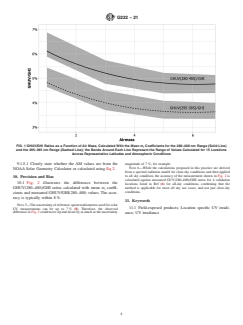
ratio.They are based on descriptive statistics of m coefficients
i
be used if the exposure period is desired to be expressed in
calculated to provide the best fit for 15 locations across
days, months, etc. or if the radiant exposure is expressed in
representative latitudes and atmospheric conditions used by
other units, such as kJ/m .
Habte et al. (6).
8.4 When exposure duration is to be calculated given an
6.4 TheamountofUVradiationattheearth’ssurfacevaries
averageirradianceandradiantexposure,theaboveformulacan
with atmospheric conditions, such as air mass (AM), ozone
be changed using common algebraic functions, as follows:
concentration,aerosolopticaldepth(AOD),amountofprecipi-
table water (PW), atmospheric pressure, surface albedo, or RadiantExposure ~MJ/m !
Time ~hours!5 (5)
cloud fraction. The mean m coefficients estimate the mean AverageIrradiance ~W/m !·0.0036
i
GHUV/GHI ratios. The lower and upper bounds describe the NOTE 1—This is commonly done to equate the radiant dosage in
accelerated aging and in natural exposures. Users are strongly cautioned
expected range of the GHUV/GHI ratios due to site-specific
that matching the radiant exposure in accelerated and natural exposures
atmospheric conditions and are based on the lower and higher
doesnotimplythattheexposedmaterialswillexperiencethesamedegree
ratios measured for the 15 aforementioned locations (see Fig.
of property change, as other factors also influence the degradation of
1).
materials,suchastemperature,moisture,spectralpowerdistributionofthe
UV source, potential secondary weathering effects, and synergistic rela-
tionships between all of these weathering factors.
7. Estimating the UV Irradiance Incident on a
NOTE 2—It is important to remember that the wavelength (or wave-
Horizontal Surface as a Function of Location
length range) for both irradiance and radiant exposure shall be the same.
7.1 The modeled GHUV/GHI ratios obtained from Eq 1
In other words, if the GHUV range of 295–385 nm is used, then the
radiant exposure should also be expressed in that wavelength range.
shall then be multiplied by available, location-specific GHI
NOTE3—AsmentionedinNote1,itissometimesofinteresttocompare
data to obtain the UV irradiance incident on a horizontal
the outdoor radiant exposure to an artificial weathering radiant exposure.
surface for a given location.
To calculate the equivalent radiant exposure in artificial weathering, users
shall input the number of light hours, when the artificial light is on, not
7.2 Alisting of publicly available Solar Resource Data sets
necessarily the total test time, if the test includes periods of exposure in
with GHI values for a wide range of global locations is
the dark.
available in Table 5-1 of the Best Practices Handbook for the
NOTE 4—Because different UV wavelengths can cause both qualitative
Collection and Use of Solar Resource Data for Solar Energy
and quantitative differences in degradation, the calculation is valid only
Applications: Second Edition(2).MostoftheseSolarResource
for artificial UV sources that closely match the UV spectrum of natural
sunlight, such as those specified in Practice D7869.
Data include both the solar zenith angle and GHI. The solar
zenith angle and GHI are the minimum data required to
9. Report
calculate the UV irradiance incident on a horizontal surface,
using the mean m coefficients listed in Table 1 for GHUV
i
9.1 Report the following information:
(280–400) and GHUV (295–385).
9.1.1 The geographic location for which the estimate of
GHUV is calculated.
8. Converting Irradiance to Radiant Exposure
9.1.1.1 The location should be identified in terms of City,
8.1 Whentheaverageirradianceisknownovertheexposure
Country, or nominal GPS coordinates, or a combination
period, the radiant exposure (often referred to as the radiant
thereof.
dosage)shallbedeterminedfollowingthephysicalrelationship
9.1.2 The GHUV estimate calculated in accordance with
between power and energy:
this practice along with the wavelength range over which the
AverageIrradiance ~W/m !·ExpsoureTime ~Seconds! GHUV estimate is obtained.
5 RadiantExposure ~J/m ! (3) 9.1.2.1 Clearly state whether the estimate is for
GHUV(280–400) or GHUV(295–385).
8.2 Given that exposure times are typically long in duration
9.1.3 The time period for which the GHUV estimate is
(often expressed in hours, days or months), and radiant
calculated (that is, annual, by month, by day or for a custom
exposureiscommonlyreportedinmegajoulespersquaremeter
period).
(MJ/m ), conversions from seconds to hours and joules to
9.1.4 The source of the GHI data used in the calculation.
megajoules may be applied. Combining these conversions
resultsinthefollowingformula(notethedifferenceintheunits 9.1.5 The source of the Air Mass coefficient (AM) or
...