

ASTM B602-21
(Guide)Standard Guide for Attribute Sampling of Metallic and Inorganic Coatings
General Information
- Abstract
SIGNIFICANCE AND USE
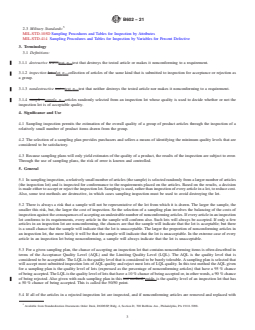
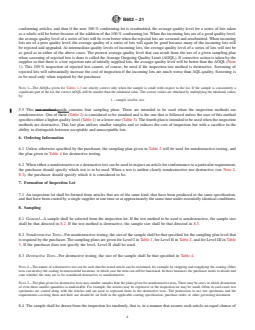
4.1 Sampling inspection permits the estimation of the overall quality of a group of product articles through the inspection of a relatively small number of product items drawn from the group.
4.2 The selection of a sampling plan provides purchasers and sellers a means of identifying the minimum quality levels that are considered to be satisfactory.
4.3 Because sampling plans will only yield estimates of the quality of a product, the results of the inspection are subject to error. Through the use of sampling plans, the risk of error is known and controlled.
SCOPE
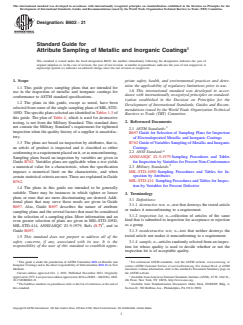
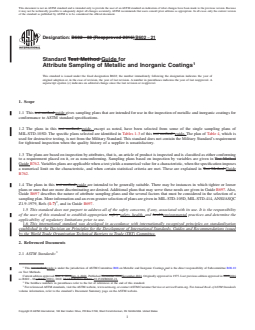
1.1 This guide gives sampling plans that are intended for use in the inspection of metallic and inorganic coatings for conformance to ASTM standard specifications.
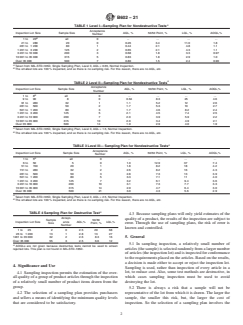
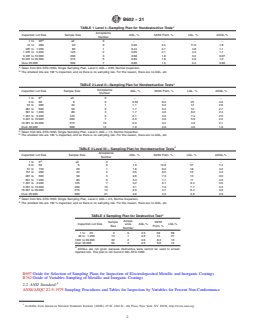
1.2 The plans in this guide, except as noted, have been selected from some of the single sampling plans of MIL-STD-105D. The specific plans selected are identified in Tables 1-3 of this guide. The plan of Table 4, which is used for destructive testing, is not from the Military Standard. This standard does not contain the Military Standard's requirement for tightened inspection when the quality history of a supplier is unsatisfactory.
1.3 The plans are based on inspection by attributes, that is, an article of product is inspected and is classified as either conforming to a requirement placed on it, or as nonconforming. Sampling plans based on inspection by variables are given in Guide B762. Variables plans are applicable when a test yields a numerical value for a characteristic, when the specification imposes a numerical limit on the characteristic, and when certain statistical criteria are met. These are explained in Guide B762.
1.4 The plans in this guide are intended to be generally suitable. There may be instances in which tighter or looser plans or ones that are more discriminating are desired. Additional plans that may serve these needs are given in Guide B697. Also, Guide B697 describes the nature of attribute sampling plans and the several factors that must be considered in the selection of a sampling plan. More information and an even greater selection of plans are given in MIL-STD-105D, MIL-STD-414, ANSI/ASQC Z1.9-1979, Refs (1-7)2, and in Guide B697.
1.5 This standard does not purport to address all of the safety concerns, if any, associated with its use. It is the responsibility of the user of this standard to establish appropriate safety, health, and environmental practices and determine the applicability of regulatory limitations prior to use.
1.6 This international standard was developed in accordance with internationally recognized principles on standardization established in the Decision on Principles for the Development of International Standards, Guides and Recommendations issued by the World Trade Organization Technical Barriers to Trade (TBT) Committee.
- Status
- Published
- Publication Date
- 30-Sep-2021
- Technical Committee
- B08 - Metallic and Inorganic Coatings
- Drafting Committee
- B08.10 - Test Methods
Overview
ASTM B602-21 is the Standard Guide for Attribute Sampling of Metallic and Inorganic Coatings, published by ASTM International. This guide provides comprehensive sampling plans for the inspection of metallic and inorganic coatings to verify conformance with ASTM standard specifications. The purpose of this standard is to enable users to estimate the overall quality of large groups of coated products by inspecting a smaller, representative sample from each batch, optimizing both time and cost.
The guide details the use of sampling inspection-especially critical when destructive testing is involved, making full inspection impractical or cost-prohibitive. The sampling plans in ASTM B602-21 are largely adapted from MIL-STD-105D but tailored for the specifics of coatings inspection, ensuring consistency and reliability in quality assurance.
Key Topics
- Attribute Sampling Plans: The standard outlines single-sample plans for both nondestructive and destructive testing of coated products. Attribute sampling involves classifying each inspected item as conforming or nonconforming to specification requirements.
- Levels of Sampling: Three tables provide plans for different levels (I, II, III) of nondestructive testing, chosen based on desired quality assurance stringency. A separate plan is supplied for destructive tests.
- Acceptance Quality and Risks: Key statistical measures such as the Acceptance Quality Level (AQL), Limiting Quality Level (LQL), and Average Outgoing Quality Limit (AOQL) define acceptable quality thresholds and help manage risk.
- Random and Interval Sampling Methods: Guidance is included for proper randomization and systematic selection to ensure representative sampling, reducing potential bias.
- Inspection Lot Definitions: The standard covers formation of inspection lots-items to be grouped together for inspection must be of the same kind, produced to the same spec, and coated under similar conditions.
Applications
ASTM B602-21 is widely used in industries where quality control of metallic and inorganic coatings is crucial, including:
- Automotive and Aerospace: Ensures protective coatings on critical components meet reliability and safety standards.
- Electronics Manufacturing: Helps verify that coatings on electronic parts, connectors, and enclosures conform to conductance and corrosion resistance specifications.
- Industrial and Architectural Products: Used for products like fasteners, structural elements, and decorative hardware, where coating uniformity and durability are essential.
- Quality Assurance and Procurement: Purchasers and suppliers use this guide to agree on minimum acceptable coating quality, facilitating communication and minimizing disputes.
The standard is valuable for both purchasers and manufacturers as it describes recognized statistical methods to assess quality, helps control inspection costs, and ensures that risks of accepting defective lots are quantifiable and controlled. For destructive testing-where every inspected item is destroyed-ASTM B602-21 provides smaller sample sizes to maintain practicality.
Related Standards
To facilitate comprehensive quality assessment, ASTM B602-21 references several related standards and guides:
- Guide B697: Provides additional and alternative attribute sampling plans as well as factors for selection of the most appropriate plan.
- Guide B762: Offers sampling by variables, suited to tests yielding numerical measurements rather than pass/fail results.
- MIL-STD-105D: Sampling procedures and tables for inspection by attributes, the primary source for sampling plans in B602-21.
- MIL-STD-414: Sampling procedures and tables for inspection by variables for percent defective.
- ANSI/ASQC Z1.9: Sampling procedures and tables for inspection by variables for percent nonconformance.
By adhering to ASTM B602-21 and its related standards, organizations can achieve internationally recognized quality control practices for metallic and inorganic coatings, supporting compliance and regulatory assurance in global markets.
Relations
- Effective Date
- 01-Apr-2010
- Refers
ASTM B762-90(2010) - Standard Test Method of Variables Sampling of Metallic and Inorganic Coatings - Effective Date
- 01-Apr-2010
- Refers
ASTM B762-90(2005) - Standard Test Method of Variables Sampling of Metallic and Inorganic Coatings - Effective Date
- 15-May-2005
- Effective Date
- 15-May-2005
- Effective Date
- 10-Nov-1999
- Refers
ASTM B762-90(1999) - Standard Test Method of Variables Sampling of Metallic and Inorganic Coatings - Effective Date
- 10-Nov-1999
Get Certified
Connect with accredited certification bodies for this standard

DVS-ZERT GmbH
German welding certification society.
CARES (UK Certification Authority for Reinforcing Steels)
UK certification for reinforcing steels and construction.
EWF/IIW (European/International Welding Federation)
International welding personnel certification.
Sponsored listings
Frequently Asked Questions
ASTM B602-21 is a guide published by ASTM International. Its full title is "Standard Guide for Attribute Sampling of Metallic and Inorganic Coatings". This standard covers: SIGNIFICANCE AND USE 4.1 Sampling inspection permits the estimation of the overall quality of a group of product articles through the inspection of a relatively small number of product items drawn from the group. 4.2 The selection of a sampling plan provides purchasers and sellers a means of identifying the minimum quality levels that are considered to be satisfactory. 4.3 Because sampling plans will only yield estimates of the quality of a product, the results of the inspection are subject to error. Through the use of sampling plans, the risk of error is known and controlled. SCOPE 1.1 This guide gives sampling plans that are intended for use in the inspection of metallic and inorganic coatings for conformance to ASTM standard specifications. 1.2 The plans in this guide, except as noted, have been selected from some of the single sampling plans of MIL-STD-105D. The specific plans selected are identified in Tables 1-3 of this guide. The plan of Table 4, which is used for destructive testing, is not from the Military Standard. This standard does not contain the Military Standard's requirement for tightened inspection when the quality history of a supplier is unsatisfactory. 1.3 The plans are based on inspection by attributes, that is, an article of product is inspected and is classified as either conforming to a requirement placed on it, or as nonconforming. Sampling plans based on inspection by variables are given in Guide B762. Variables plans are applicable when a test yields a numerical value for a characteristic, when the specification imposes a numerical limit on the characteristic, and when certain statistical criteria are met. These are explained in Guide B762. 1.4 The plans in this guide are intended to be generally suitable. There may be instances in which tighter or looser plans or ones that are more discriminating are desired. Additional plans that may serve these needs are given in Guide B697. Also, Guide B697 describes the nature of attribute sampling plans and the several factors that must be considered in the selection of a sampling plan. More information and an even greater selection of plans are given in MIL-STD-105D, MIL-STD-414, ANSI/ASQC Z1.9-1979, Refs (1-7)2, and in Guide B697. 1.5 This standard does not purport to address all of the safety concerns, if any, associated with its use. It is the responsibility of the user of this standard to establish appropriate safety, health, and environmental practices and determine the applicability of regulatory limitations prior to use. 1.6 This international standard was developed in accordance with internationally recognized principles on standardization established in the Decision on Principles for the Development of International Standards, Guides and Recommendations issued by the World Trade Organization Technical Barriers to Trade (TBT) Committee.
SIGNIFICANCE AND USE 4.1 Sampling inspection permits the estimation of the overall quality of a group of product articles through the inspection of a relatively small number of product items drawn from the group. 4.2 The selection of a sampling plan provides purchasers and sellers a means of identifying the minimum quality levels that are considered to be satisfactory. 4.3 Because sampling plans will only yield estimates of the quality of a product, the results of the inspection are subject to error. Through the use of sampling plans, the risk of error is known and controlled. SCOPE 1.1 This guide gives sampling plans that are intended for use in the inspection of metallic and inorganic coatings for conformance to ASTM standard specifications. 1.2 The plans in this guide, except as noted, have been selected from some of the single sampling plans of MIL-STD-105D. The specific plans selected are identified in Tables 1-3 of this guide. The plan of Table 4, which is used for destructive testing, is not from the Military Standard. This standard does not contain the Military Standard's requirement for tightened inspection when the quality history of a supplier is unsatisfactory. 1.3 The plans are based on inspection by attributes, that is, an article of product is inspected and is classified as either conforming to a requirement placed on it, or as nonconforming. Sampling plans based on inspection by variables are given in Guide B762. Variables plans are applicable when a test yields a numerical value for a characteristic, when the specification imposes a numerical limit on the characteristic, and when certain statistical criteria are met. These are explained in Guide B762. 1.4 The plans in this guide are intended to be generally suitable. There may be instances in which tighter or looser plans or ones that are more discriminating are desired. Additional plans that may serve these needs are given in Guide B697. Also, Guide B697 describes the nature of attribute sampling plans and the several factors that must be considered in the selection of a sampling plan. More information and an even greater selection of plans are given in MIL-STD-105D, MIL-STD-414, ANSI/ASQC Z1.9-1979, Refs (1-7)2, and in Guide B697. 1.5 This standard does not purport to address all of the safety concerns, if any, associated with its use. It is the responsibility of the user of this standard to establish appropriate safety, health, and environmental practices and determine the applicability of regulatory limitations prior to use. 1.6 This international standard was developed in accordance with internationally recognized principles on standardization established in the Decision on Principles for the Development of International Standards, Guides and Recommendations issued by the World Trade Organization Technical Barriers to Trade (TBT) Committee.
ASTM B602-21 is classified under the following ICS (International Classification for Standards) categories: 25.220.40 - Metallic coatings; 25.220.99 - Other treatments and coatings. The ICS classification helps identify the subject area and facilitates finding related standards.
ASTM B602-21 has the following relationships with other standards: It is inter standard links to ASTM B697-88(2010), ASTM B762-90(2010), ASTM B762-90(2005), ASTM B697-88(2005), ASTM B697-88(1999), ASTM B762-90(1999). Understanding these relationships helps ensure you are using the most current and applicable version of the standard.
ASTM B602-21 is available in PDF format for immediate download after purchase. The document can be added to your cart and obtained through the secure checkout process. Digital delivery ensures instant access to the complete standard document.
Standards Content (Sample)
This international standard was developed in accordance with internationally recognized principles on standardization established in the Decision on Principles for the
Development of International Standards, Guides and Recommendations issued by the World Trade Organization Technical Barriers to Trade (TBT) Committee.
Designation: B602 − 21
Standard Guide for
Attribute Sampling of Metallic and Inorganic Coatings
This standard is issued under the fixed designation B602; the number immediately following the designation indicates the year of
original adoption or, in the case of revision, the year of last revision.Anumber in parentheses indicates the year of last reapproval.A
superscript epsilon (´) indicates an editorial change since the last revision or reapproval.
1. Scope priate safety, health, and environmental practices and deter-
mine the applicability of regulatory limitations prior to use.
1.1 This guide gives sampling plans that are intended for
1.6 This international standard was developed in accor-
use in the inspection of metallic and inorganic coatings for
dance with internationally recognized principles on standard-
conformance to ASTM standard specifications.
ization established in the Decision on Principles for the
1.2 The plans in this guide, except as noted, have been
Development of International Standards, Guides and Recom-
selected from some of the single sampling plans of MIL-STD-
mendations issued by the World Trade Organization Technical
105D.ThespecificplansselectedareidentifiedinTables1-3of
Barriers to Trade (TBT) Committee.
this guide. The plan of Table 4, which is used for destructive
2. Referenced Documents
testing, is not from the Military Standard. This standard does
not contain the Military Standard’s requirement for tightened
2.1 ASTM Standards:
inspection when the quality history of a supplier is unsatisfac-
B697Guide for Selection of Sampling Plans for Inspection
tory.
of Electrodeposited Metallic and Inorganic Coatings
B762GuideofVariablesSamplingofMetallicandInorganic
1.3 The plans are based on inspection by attributes, that is,
Coatings
an article of product is inspected and is classified as either
2.2 ANSI Standard:
conformingtoarequirementplacedonit,orasnonconforming.
ANSI/ASQC Z1.9-1979Sampling Procedures and Tables
Sampling plans based on inspection by variables are given in
for Inspection byVariables for Percent Non-Conformance
Guide B762. Variables plans are applicable when a test yields
2.3 Military Standards:
a numerical value for a characteristic, when the specification
MIL-STD-105DSampling Procedures and Tables for In-
imposes a numerical limit on the characteristic, and when
spection by Attributes
certainstatisticalcriteriaaremet.TheseareexplainedinGuide
MIL-STD-414 Sampling Procedures and Tables for Inspec-
B762.
tion by Variables for Percent Defective
1.4 The plans in this guide are intended to be generally
suitable. There may be instances in which tighter or looser
3. Terminology
plans or ones that are more discriminating are desired. Addi-
3.1 Definitions:
tional plans that may serve these needs are given in Guide
3.1.1 destructive test, n—test that destroys the tested article
B697. Also, Guide B697 describes the nature of attribute
or makes it nonconforming to a requirement.
sampling plans and the several factors that must be considered
3.1.2 inspection lot, n—collection of articles of the same
in the selection of a sampling plan. More information and an
kind that is submitted to inspection for acceptance or rejection
even greater selection of plans are given in MIL-STD-105D,
as a group.
MIL-STD-414, ANSI/ASQC Z1.9-1979, Refs (1-7) , and in
Guide B697.
3.1.3 nondestructive test, n—test that neither destroys the
tested article nor makes it nonconforming to a requirement.
1.5 This standard does not purport to address all of the
safety concerns, if any, associated with its use. It is the
3.1.4 sample, n—articlesrandomlyselectedfromaninspec-
responsibility of the user of this standard to establish appro- tion lot whose quality is used to decide whether or not the
inspection lot is of acceptable quality.
1 3
This guide is under the jurisdiction ofASTM Committee B08 on Metallic and For referenced ASTM standards, visit the ASTM website, www.astm.org, or
Inorganic Coatings and is the direct responsibility of Subcommittee B08.10 on Test contact ASTM Customer Service at service@astm.org. For Annual Book of ASTM
Methods. Standards volume information, refer to the standard’s Document Summary page on
Current edition approved Oct. 1, 2021. Published November 2021. Originally the ASTM website.
approvedin1975.Lastpreviouseditionapprovedin2016asB602–88(2016).DOI: Available fromAmerican National Standards Institute (ANSI), 25 W. 43rd St.,
10.1520/B0602-21. 4th Floor, New York, NY 10036, http://www.ansi.org.
Theboldfacenumbersinparenthesesrefertothelistofreferencesattheendof Available from Standardization Documents Order Desk, DODSSP, Bldg. 4,
this standard. Section D, 700 Robbins Ave., Philadelphia, PA 19111-5098.
Copyright © ASTM International, 100 Barr Harbor Drive, PO Box C700, West Conshohocken, PA 19428-2959. United States
B602 − 21
A
TABLE 1 Level I—Sampling Plan for Nondestructive Tests
Acceptance
Inspection Lot Size Sample Size AQL, % 50/50 Point, % LQL, % AOQL,%
Number
B
1to 20 all 0 . . . .
21 to 280 20 0 0.26 3.4 11.0 1.8
281 to 1 200 80 1 0.44 2.1 4.8 1.1
1 201 to 3 200 125 2 0.65 2.1 4.3 1.1
3 201 to 10 000 200 3 0.68 1.8 3.3 0.97
10 001 to 35 000 315 5 0.83 1.8 2.9 1.0
Over 35 000 500 7 0.80 1.5 2.4 0.90
A
Taken from MIL-STD-105D, Single Sampling Plan, Level II, AQL = 0.65, Normal Inspection.
B
The smallest lots are 100 % inspected, and so there is no sampling risk. For this reason, there are no AQL, etc.
A
TABLE 2 Level II—Sampling Plan for Nondestructive Tests
Acceptance
Inspection Lot Size Sample Size AQL, % 50/50 Point, % LQL, % AOQL,%
Number
B
1to 8 all 0 . . . .
9 to 90 8 0 0.64 8.3 25 4.6
91 to 280 32 1 1.1 5.2 12 2.6
281 to 500 50 2 1.7 5.3 10 2.7
501 to 1 200 80 3 1.7 4.6 8.2 2.4
1 201 to 3 200 125 5 2.1 4.5 7.4 2.5
3 201 to 10 000 200 7 2.0 3.9 5.9 2.2
10 001 to 35 000 315 10 2.0 3.4 4.9 2.1
Over 35 000 500 14 1.9 2.9 4.0 1.9
A
Taken from MIL-STD-105D, Single Sampling Plan, Level II, AQL = 1.5, Normal Inspection.
B
The smallest lots are 100 % inspected, and so there is no sampling risk. For this reason, there are no AQL, etc.
A
TABLE 3 Level III— Sampling Plan for Nondestructive Tests
Acceptance
Inspection Lot Size Sample Size AQL, % 50/50 Point, % LQL, % AOQL,%
Number
B
1to 5 all 0 . . . .
6 to 50 5 0 1.0 12.9 37 7.4
51 to 150 20 1 1.8 8.2 18 4.2
151 to 280 32 2 2.6 8.2 16 4.3
281 to 500 50 3 2.8 7.3 13 3.9
501 to 1 200 80 5 3.3 7.1 11 4.0
1 201 to 3 200 125 7 3.2 6.1 9.4 3.6
3 201 to 16 000 200 10 3.1 7.3 7.7 3.3
16 001 to 35 000 315 14 2.9 4.7 6.4 3.0
Over 35 000 500 21 3.0 4.3 5.6 2.9
A
Taken from MIL-STD-105D, Single Sampling Plan, Level II, AQL = 2.5, Normal Inspection.
B
The smallest lots are 100 % inspected, and so there is no sampling risk. For this reason, there are no AQL, etc.
A
TABLE 4 Sampling Plan for Destructive Test
4.3 Because sampling plans will only yield estimates of the
Accept-
quality of a product, the results of the inspection are subject to
Sample 50/50
Inspection Lot Size ance AQL,% LQL,%
Size Point, % error. Through the use of sampling plans, the risk of error is
Number
known and controlled.
1 to 25 2 0 2.5 29 68
26 to 1 200 13 1 2.8 13 27
1201 to 35 000 32 2 2.6 8.3 16
5. General
Over 35 000 55 3 2.5 6.6 12
5.1 In sampling inspection, a relatively small number of
A
AOQLs are not given because destructive tests cannot be used to screen
articles(thesample)isselectedrandomlyfromalargernumber
rejected lots. This plan is not found in MIL-STD-105D.
ofarticles(theinspectionlot)andisinspectedforconformance
totherequirementsplacedonthearticles.Basedontheresults,
a decision is made either to accept or reject the inspection lot.
4. Significance and Use
Sampling is used, rather than inspection of every article in a
4.1 Sampling inspection permits the estimation of the over- lot, to reduce cost.Also, some test methods are destructive, in
allqualityofagroupofproductarticlesthroughtheinspection which cases sampling inspection must be used to avoid
of a relatively small number of product items drawn from the destroying the lot.
group.
5.2 There is always a risk that a sample will not be
4.2 The selection of a sampling plan provides purchasers representative of the lot from which it is drawn.The larger the
and sellers a means of identifying the minimum quality levels sample, the smaller this risk, but, the larger the cost of
that are considered to be satisfactory. inspection. So the selection of a sampling plan involves the
B602 − 21
the tabulated values by:
balancing of the costs of inspection against the consequences
1−sample size/lot size
ofacceptinganundesirablenumberofnonconformingarticles.
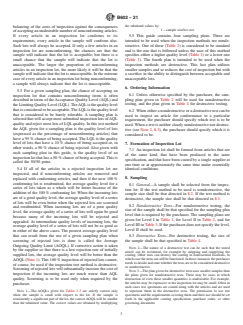
If every article in an inspection lot conforms to its 5.5 This guide contains four sampling plans. Three are
requirements, every article in the sample will conform also. intended to be used when the inspection methods are nonde-
Such lots will always be accepted. If only a few articles in an structive. One of these (Table 2) is considered to be standard
inspection lot are nonconforming, the chances are that the and is the one that is followed unless the user of this method
sample will indicate that the lot is acceptable; but there is a specifies either a higher quality level (Table 1) or a lower one
small chance that the sample will indicate that the lot is (Table 3). The fourth plan is intended to be used when the
unacceptable. The larger the proportion of nonconforming inspection methods are destructive. This last plan utilizes
articles in an inspection lot, the more likely it will be that the smaller samples and so reduces the cost of inspection but with
samplewillindicatethatthelotisunacceptable.Intheextreme a sacrifice in the ability to distinguish between acceptable and
case of every article in an inspection lot being nonconforming, unacceptable lots.
a sample will always indicate that the lot is unacceptable.
6. Ordering Information
5.3 For a given sampling plan, the chance of accepting an
6.1 Unless otherwise specified by the purchaser, the sam-
inspection lot that contains nonconforming items is often
pling plan given in Table 2 will be used for nondestructive
describedintermsoftheAcceptanceQualityLevel(AQL)and
testing, and the plan given in Table 4 for destructive testing.
theLimitingQualityLevel(LQL).TheAQListhequalitylevel
thatisconsideredtobeacceptable.TheLQListhequalitylevel
6.2 Wheneitheranondestructiveoradestructivetestcanbe
that is considered to be barely tolerable. A sampling plan is
used to inspect an article for conformance to a particular
selectedthatwillacceptmostsubmittedinspectionlotsofAQL
requirement, the purchaser should specify which test is to be
quality and reject most lots of LQLquality. In this test method
used.Whenatestisneitherclearlynondestructivenordestruc-
the AQL given for a sampling plan is the quality level of lots
tive (see Note 2, 8.3), the purchaser should specify which it is
(expressed as the percentage of nonconforming articles) that
considered to be.
have a 95% chance of being accepted.The LQLis the quality
level of lots that have a 10% chance of being accepted or, in
7. Formation of Inspection Lot
other words, a 90% chance of being rejected.Also given with
7.1 An inspection lot shall be formed from articles that are
each sampling plan in this guide, is the quality level of an
of the same kind, that have been produced to the same
inspectionlotthathasa50%chanceofbeingaccepted.Thisis
specification, and that have been coated by a single supplier at
called the 50/50 point.
one time or at approximately the same time under essentially
5.4 If all of the articles in a rejected inspection lot are identical conditions.
inspected, and if nonconforming articles are removed and
8. Sampling
replaced with conforming articles, and then if the now 100%
conforming lot is resubmitted, the average quality level for a
8.1 General—A sample shall be selected from the inspec-
series of lots taken as a whole will be better because of the
tion lot. If the test method to be used is nondestructive, the
addition of the 100% conforming lot.When the incoming lots
sample size shall be that directed in 8.2. If the test method is
areofagoodqualitylevel,theaveragequalitylevelofaseries
destructive, the sample size shall be that directed in 8.3.
of lots will be even better when the rejected lots are screened
8.2 Nondestructive Tests—For nondestructive testing, the
and resubmitted. When incoming lots are of a poor quality
size of the sample shall be that specified for the sampling plan
level, the average quality of a series of lots will again be good
level that is required by the purchaser. The sampling plans are
because many of the incoming lots will be rejected and
given for Level I in Table 1, for Level II in Table 2, and for
upgraded. At intermediate quality levels of incoming lots, the
LevelIIIinTable3.Ifthepurchaserdoesnotspecifythelevel,
average quality level of a series of lots will not be as good as
Level II shall be used.
in either of the above cases. The poorest average quality level
8.3 Destructive Tests—For destructive testing, the size of
that can result from the use of a given sampling plan when
screening of rejected lots is done is called the Average the sample shall be that specified in Table 4.
Outgoing Quality Limit (AOQL). If corrective action is taken
NOTE 2—The nature of a destructive test can be such that the tested
by the supplier so that there is a low rejection rate of initially
article can be reclaimed, for example by stripping and reapplying the
supplied lots, the average quality level will be better than the
coating. Other tests can destroy the coating in nonessential locations, in
whichcasetheitemcanstillbefunctional.Intheseinstancesthepurchaser
AOQL(Note1).This100%inspectionofrejectedlotscannot,
needstodecideandstatewhetherthetestsaretobeconsidereddestructive
of course, be used if the inspection test method is destructive.
or nondestructive.
Screeningofrejectedlotswillsubstantiallyincreasethecostof
NOTE3—Theplangivenfordestructivetestsusessmallersamplesthan
inspection if the incoming lots are much worse than AQL
the plans given for nondestructive tests. There may be cases in which
quality. Screening is to be used only when required by the destruction of even these smaller quantities is undesirable. For example,
the articles may be expensive or the inspection lot may be small. Often in
purchaser.
such cases test specimens are coated along with the articles and are used
NOTE 1—The AOQLs given for Tables 1-3 are strictly correct only to represent them in the destructive tests. The permission to use test
when the sample is small with respect to the lot. If the sample is specimensandtherequirementscoveringthemandtheiruseshouldbeset
consistently a significant part of the lot, the correctAOQLwill be smaller forth in the applicable coating specification, purchase order, or other
than the tabulated value. The correct values are obtained by multiplying governing document.
B602 − 21
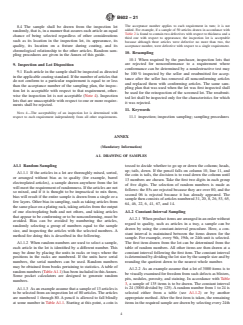
The acceptance number applies to each requirement in turn; it is not
8.4 The sample shall be drawn from the inspection lot
added. For example, if a sample of 50 articles drawn in accordance with
randomly,thatis,inamannerthatassureseacharticleanequal
Table 2 is found to contain two defectives with respect to thickness and a
chance of being selected regardless of other considerations
third one with respect to appearance, the inspection lot is acceptable
such as its location in the inspection lot, its appearance, its
because although three articles were defective no more than two, the
quality, its location on a
...
This document is not an ASTM standard and is intended only to provide the user of an ASTM standard an indication of what changes have been made to the previous version. Because
it may not be technically possible to adequately depict all changes accurately, ASTM recommends that users consult prior editions as appropriate. In all cases only the current version
of the standard as published by ASTM is to be considered the official document.
Designation: B602 − 88 (Reapproved 2016) B602 − 21
Standard Test Method Guide for
Attribute Sampling of Metallic and Inorganic Coatings
This standard is issued under the fixed designation B602; the number immediately following the designation indicates the year of
original adoption or, in the case of revision, the year of last revision. A number in parentheses indicates the year of last reapproval. A
superscript epsilon (´) indicates an editorial change since the last revision or reapproval.
1. Scope
1.1 This test method guide gives sampling plans that are intended for use in the inspection of metallic and inorganic coatings for
conformance to ASTM standard specifications.
1.2 The plans in this test method, guide, except as noted, have been selected from some of the single sampling plans of
MIL-STD-105D. The specific plans selected are identified in Tables 1-3 of this test method. guide. The plan of Table 4, which is
used for destructive testing, is not from the Military Standard. This standard does not contain the Military Standard’s requirement
for tightened inspection when the quality history of a supplier is unsatisfactory.
1.3 The plans are based on inspection by attributes, that is, an article of product is inspected and is classified as either conforming
to a requirement placed on it, or as nonconforming. Sampling plans based on inspection by variables are given in Test Method
Guide B762. Variables plans are applicable when a test yields a numerical value for a characteristic, when the specification imposes
a numerical limit on the characteristic, and when certain statistical criteria are met. These are explained in Test Method Guide
B762.
1.4 The plans in this test method guide are intended to be generally suitable. There may be instances in which tighter or looser
plans or ones that are more discriminating are desired. Additional plans that may serve these needs are given in Guide B697. Also,
Guide B697 describes the nature of attribute sampling plans and the several factors that must be considered in the selection of a
sampling plan. More information and an even greater selection of plans are given in MIL-STD-105D, MIL-STD-414, ANSI/ASQC
Z1.9-1979, Refs (1-7) , and in Guide B697.
1.5 This standard does not purport to address all of the safety concerns, if any, associated with its use. It is the responsibility
of the user of this standard to establish appropriate safety safety, health, and healthenvironmental practices and determine the
applicability of regulatory limitations prior to use.
1.6 This international standard was developed in accordance with internationally recognized principles on standardization
established in the Decision on Principles for the Development of International Standards, Guides and Recommendations issued
by the World Trade Organization Technical Barriers to Trade (TBT) Committee.
2. Referenced Documents
2.1 ASTM Standards:
This test method guide is under the jurisdiction of ASTM Committee B08 on Metallic and Inorganic Coatings and is the direct responsibility of Subcommittee B08.10
on Test Methods.
Current edition approved Nov. 1, 2016Oct. 1, 2021. Published November 2016November 2021. Originally approved in 1975. Last previous edition approved in 20102016
as B602 – 88 (2010).(2016). DOI: 10.1520/B0602-88R16. 10.1520/B0602-21.
The boldface numbers in parentheses refer to the list of references at the end of this standard.
For referenced ASTM standards, visit the ASTM website, www.astm.org, or contact ASTM Customer Service at service@astm.org. For Annual Book of ASTM Standards
volume information, refer to the standard’s Document Summary page on the ASTM website.
Copyright © ASTM International, 100 Barr Harbor Drive, PO Box C700, West Conshohocken, PA 19428-2959. United States
B602 − 21
A
TABLE 1 Level I—Sampling Plan for Nondestructive Tests
Acceptance
Inspection Lot Size Sample Size AQL, % 50/50 Point, % LQL, % AOQL,%
Number
B
1 to 20 all 0 . . . .
21 to 280 20 0 0.26 3.4 11.0 1.8
281 to 1 200 80 1 0.44 2.1 4.8 1.1
1 201 to 3 200 125 2 0.65 2.1 4.3 1.1
3 201 to 10 000 200 3 0.68 1.8 3.3 0.97
10 001 to 35 000 315 5 0.83 1.8 2.9 1.0
Over 35 000 500 7 0.80 1.5 2.4 0.90
A
Taken from MIL-STD-105D, Single Sampling Plan, Level II, AQL = 0.65, Normal Inspection.
B
The smallest lots are 100 % inspected, and so there is no sampling risk. For this reason, there are no AQL, etc.
A
TABLE 2 Level II—Sampling Plan for Nondestructive Tests
Acceptance
Inspection Lot Size Sample Size AQL, % 50/50 Point, % LQL, % AOQL,%
Number
B
1 to 8 all 0 . . . .
9 to 90 8 0 0.64 8.3 25 4.6
91 to 280 32 1 1.1 5.2 12 2.6
281 to 500 50 2 1.7 5.3 10 2.7
501 to 1 200 80 3 1.7 4.6 8.2 2.4
1 201 to 3 200 125 5 2.1 4.5 7.4 2.5
3 201 to 10 000 200 7 2.0 3.9 5.9 2.2
10 001 to 35 000 315 10 2.0 3.4 4.9 2.1
Over 35 000 500 14 1.9 2.9 4.0 1.9
A
Taken from MIL-STD-105D, Single Sampling Plan, Level II, AQL = 1.5, Normal Inspection.
B
The smallest lots are 100 % inspected, and so there is no sampling risk. For this reason, there are no AQL, etc.
A
TABLE 3 Level III— Sampling Plan for Nondestructive Tests
Acceptance
Inspection Lot Size Sample Size AQL, % 50/50 Point, % LQL, % AOQL,%
Number
B
1 to 5 all 0 . . . .
6 to 50 5 0 1.0 12.9 37 7.4
51 to 150 20 1 1.8 8.2 18 4.2
151 to 280 32 2 2.6 8.2 16 4.3
281 to 500 50 3 2.8 7.3 13 3.9
501 to 1 200 80 5 3.3 7.1 11 4.0
1 201 to 3 200 125 7 3.2 6.1 9.4 3.6
3 201 to 16 000 200 10 3.1 7.3 7.7 3.3
16 001 to 35 000 315 14 2.9 4.7 6.4 3.0
Over 35 000 500 21 3.0 4.3 5.6 2.9
A
Taken from MIL-STD-105D, Single Sampling Plan, Level II, AQL = 2.5, Normal Inspection.
B
The smallest lots are 100 % inspected, and so there is no sampling risk. For this reason, there are no AQL, etc.
A
TABLE 4 Sampling Plan for Destructive Test
Accept-
Sample 50/50
Inspection Lot Size ance AQL,% LQL,%
Size Point, %
Number
1 to 25 2 0 2.5 29 68
26 to 1 200 13 1 2.8 13 27
1201 to 35 000 32 2 2.6 8.3 16
Over 35 000 55 3 2.5 6.6 12
A
AOQLs are not given because destructive tests cannot be used to screen
rejected lots. This plan is not found in MIL-STD-105D.
B697 Guide for Selection of Sampling Plans for Inspection of Electrodeposited Metallic and Inorganic Coatings
B762 Guide of Variables Sampling of Metallic and Inorganic Coatings
2.2 ANSI Standard:
ANSI/ASQC Z1.9-1979 Sampling Procedures and Tables for Inspection by Variables for Percent Non-Conformance
Available from American National Standards Institute (ANSI), 25 W. 43rd St., 4th Floor, New York, NY 10036, http://www.ansi.org.
B602 − 21
2.3 Military Standards:
MIL-STD-105D Sampling Procedures and Tables for Inspection by Attributes
MIL-STD-414 Sampling Procedures and Tables for Inspection by Variables for Percent Defective
3. Terminology
3.1 Definitions:
3.1.1 destructive test—test, n—test that destroys the tested article or makes it nonconforming to a requirement.
3.1.2 inspection lot—lot, n—collection of articles of the same kind that is submitted to inspection for acceptance or rejection as
a group.
3.1.3 nondestructive test—test, n—test that neither destroys the tested article nor makes it nonconforming to a requirement.
3.1.4 sample—sample, n—articles randomly selected from an inspection lot whose quality is used to decide whether or not the
inspection lot is of acceptable quality.
4. Significance and Use
4.1 Sampling inspection permits the estimation of the overall quality of a group of product articles through the inspection of a
relatively small number of product items drawn from the group.
4.2 The selection of a sampling plan provides purchasers and sellers a means of identifying the minimum quality levels that are
considered to be satisfactory.
4.3 Because sampling plans will only yield estimates of the quality of a product, the results of the inspection are subject to error.
Through the use of sampling plans, the risk of error is known and controlled.
5. General
5.1 In sampling inspection, a relatively small number of articles (the sample) is selected randomly from a larger number of articles
(the inspection lot) and is inspected for conformance to the requirements placed on the articles. Based on the results, a decision
is made either to accept or reject the inspection lot. Sampling is used, rather than inspection of every article in a lot, to reduce cost.
Also, some test methods are destructive, in which cases sampling inspection must be used to avoid destroying the lot.
5.2 There is always a risk that a sample will not be representative of the lot from which it is drawn. The larger the sample, the
smaller this risk, but, the larger the cost of inspection. So the selection of a sampling plan involves the balancing of the costs of
inspection against the consequences of accepting an undesirable number of nonconforming articles. If every article in an inspection
lot conforms to its requirements, every article in the sample will conform also. Such lots will always be accepted. If only a few
articles in an inspection lot are nonconforming, the chances are that the sample will indicate that the lot is acceptable; but there
is a small chance that the sample will indicate that the lot is unacceptable. The larger the proportion of nonconforming articles in
an inspection lot, the more likely it will be that the sample will indicate that the lot is unacceptable. In the extreme case of every
article in an inspection lot being nonconforming, a sample will always indicate that the lot is unacceptable.
5.3 For a given sampling plan, the chance of accepting an inspection lot that contains nonconforming items is often described in
terms of the Acceptance Quality Level (AQL) and the Limiting Quality Level (LQL). The AQL is the quality level that is
considered to be acceptable. The LQL is the quality level that is considered to be barely tolerable. A sampling plan is selected that
will accept most submitted inspection lots of AQL quality and reject most lots of LQL quality. In this test method the AQL given
for a sampling plan is the quality level of lots (expressed as the percentage of nonconforming articles) that have a 95 % chance
of being accepted. The LQL is the quality level of lots that have a 10 % chance of being accepted or, in other words, a 90 % chance
of being rejected. Also given with each sampling plan in this test method, guide, is the quality level of an inspection lot that has
a 50 % chance of being accepted. This is called the 50/50 point.
5.4 If all of the articles in a rejected inspection lot are inspected, and if nonconforming articles are removed and replaced with
Available from Standardization Documents Order Desk, DODSSP, Bldg. 4, Section D, 700 Robbins Ave., Philadelphia, PA 19111-5098.
B602 − 21
conforming articles, and then if the now 100 % conforming lot is resubmitted, the average quality level for a series of lots taken
as a whole will be better because of the addition of the 100 % conforming lot. When the incoming lots are of a good quality level,
the average quality level of a series of lots will be even better when the rejected lots are screened and resubmitted. When incoming
lots are of a poor quality level, the average quality of a series of lots will again be good because many of the incoming lots will
be rejected and upgraded. At intermediate quality levels of incoming lots, the average quality level of a series of lots will not be
as good as in either of the above cases. The poorest average quality level that can result from the use of a given sampling plan
when screening of rejected lots is done is called the Average Outgoing Quality Limit (AOQL). If corrective action is taken by the
supplier so that there is a low rejection rate of initially supplied lots, the average quality level will be better than the AOQL (Note
1). This 100 % inspection of rejected lots cannot, of course, be used if the inspection test method is destructive. Screening of
rejected lots will substantially increase the cost of inspection if the incoming lots are much worse than AQL quality. Screening is
to be used only when required by the purchaser.
NOTE 1—The AOQLs given for Tables 1-3 are strictly correct only when the sample is small with respect to the lot. If the sample is consistently a
significant part of the lot, the correct AOQL will be smaller than the tabulated value. The correct values are obtained by multiplying the tabulated values
by:
1 − sample size/lot size
5.5 This test method guide contains four sampling plans. Three are intended to be used when the inspection methods are
nondestructive. One of these (Table 2) is considered to be standard and is the one that is followed unless the user of this method
specifies either a higher quality level (Table 1) or a lower one (Table 3). The fourth plan is intended to be used when the inspection
methods are destructive. This last plan utilizes smaller samples and so reduces the cost of inspection but with a sacrifice in the
ability to distinguish between acceptable and unacceptable lots.
6. Ordering Information
6.1 Unless otherwise specified by the purchaser, the sampling plan given in Table 2 will be used for nondestructive testing, and
the plan given in Table 4 for destructive testing.
6.2 When either a nondestructive or a destructive test can be used to inspect an article for conformance to a particular requirement,
the purchaser should specify which test is to be used. When a test is neither clearly nondestructive nor destructive (see Note 2,
8.3), the purchaser should specify which it is considered to be.
7. Formation of Inspection Lot
7.1 An inspection lot shall be formed from articles that are of the same kind, that have been produced to the same specification,
and that have been coated by a single supplier at one time or at approximately the same time under essentially identical conditions.
8. Sampling
8.1 General—A sample shall be selected from the inspection lot. If the test method to be used is nondestructive, the sample size
shall be that directed in 8.2. If the test method is destructive, the sample size shall be that directed in 8.3.
8.2 Nondestructive Tests—For nondestructive testing, the size of the sample shall be that specified for the sampling plan level that
is required by the purchaser. The sampling plans are given for Level I in Table 1, for Level II in Table 2, and for Level III in Table
3. If the purchaser does not specify the level, Level II shall be used.
8.3 Destructive Tests—For destructive testing, the size of the sample shall be that specified in Table 4.
NOTE 2—The nature of a destructive test can be such that the tested article can be reclaimed, for example by stripping and reapplying the coating. Other
tests can destroy the coating in nonessential locations, in which case the item can still be functional. In these instances the purchaser needs to decide and
state whether the tests are to be considered destructive or nondestructive.
NOTE 3—The plan given for destructive tests uses smaller samples than the plans given for nondestructive tests. There may be cases in which destruction
of even these smaller quantities is undesirable. For example, the articles may be expensive or the inspection lot may be small. Often in such cases test
specimens are coated along with the articles and are used to represent them in the destructive tests. The permission to use test specimens and the
requirements covering them and their use should be set forth in the applicable coating specification, purchase order, or other governing document.
8.4 The sample shall be drawn from the inspection lot randomly, that is, in a manner that assures each article an equal chance of
B602 − 21
being selected regardless of other considerations such as its location in the inspection lot, its appearance, its quality, its location
on a fixture during coating, and its chronological relationship to the other a
...