

ASTM D5817-20
(Practice)Standard Practice for Carbon Black, Pelleted-Reduction, Blending, and Drying of Gross Samples for Testing
General Information
- Abstract
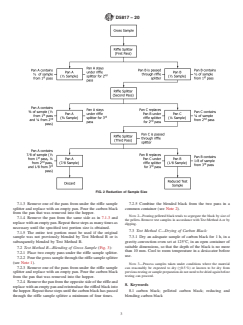
SIGNIFICANCE AND USE
4.1 Several test methods for carbon black require the reduction in sample size or the blending of the test sample to reduce the variation of the measured characteristic. Other factors being equal, larger samples will tend to be more representative of the total supply. This practice provides procedures for reducing the large sample obtained from the bag and bulk sampling practices to a convenient size for conducting a number of tests to describe the material and measure its quality in such a manner that the smaller portion is most likely to be a representation of the bulk sample. Failure to follow the procedures in this practice could result in providing a nonrepresentative sample to be used in subsequent testing. Individual test methods provide for minimum amounts of material to be tested.
4.2 Test Method A, Reduction of Sample Size, is typically used to obtain an aliquot from a large sample, splitting a black into two or more equal portions, or reducing a blended black from Test Method B to a specified sample size. The final sample is always smaller than the original sample and would not be considered to be a “well blended” sample.
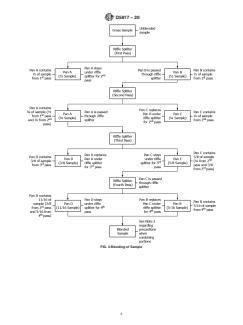
4.3 Test Method B, Blending of Carbon Black, is typically used to prepare a homogeneous sample. The homogeneous sample may be used for several tests (see Note 2) or may be reduced in size by Test Method A. The final sample size is the same as the original.
4.4 When a sample is to be blended and reduced, the sample should be blended (Test Method B) before reduction (Test Method A). The blending and reduction must be done before the sample is dried (Test Method C).
SCOPE
1.1 This practice describes the procedure for blending of pelleted carbon black, the procedure for the reduction of gross samples of pelleted carbon black to the appropriate size for testing and the preparation of the sample for testing. These techniques are intended to minimize variations in measured characteristics between test samples. Standard terminology relating to carbon black samples is found in Terminology D3053. The classification system for carbon blacks used in rubber products can be found in Classification System D1765.
1.2 The values stated in SI units are to be regarded as the standard. The values given in parentheses are for information only.
1.3 This standard does not purport to address all of the safety concerns, if any, associated with its use. It is the responsibility of the user of this standard to establish appropriate safety, health, and environmental practices and determine the applicability of regulatory limitations prior to use.
1.4 This international standard was developed in accordance with internationally recognized principles on standardization established in the Decision on Principles for the Development of International Standards, Guides and Recommendations issued by the World Trade Organization Technical Barriers to Trade (TBT) Committee.
- Status
- Published
- Publication Date
- 31-May-2020
- Technical Committee
- D24 - Carbon Black
- Drafting Committee
- D24.61 - Carbon Black Sampling and Statistical Analysis
Buy Documents
ASTM D5817-20 - Standard Practice for Carbon Black, Pelleted—Reduction, Blending, and Drying of Gross Samples for Testing
REDLINE ASTM D5817-20 - Standard Practice for Carbon Black, Pelleted—Reduction, Blending, and Drying of Gross Samples for Testing
Overview
ASTM D5817-20 is the standard practice established by ASTM International for the reduction, blending, and drying of gross samples of pelleted carbon black intended for testing. This standard ensures that test portions derived from bulk shipments or bag samples are representative and reliable for subsequent analytical procedures. By following this practice, variations in measured characteristics between test samples are minimized, thus supporting quality control, consistency, and reproducibility in carbon black testing.
The document defines procedures for:
- Blending pelleted carbon black to develop homogeneous samples
- Reducing the size of large, gross samples for convenient laboratory testing
- Preparing samples through appropriate drying before analysis
Key Topics
- Sample Reduction: This involves decreasing the size of a bulk or gross sample while aiming to maintain its representativity. The practice prescribes the use of riffle sample splitters and systematic subsampling to ensure each test portion accurately reflects the bulk sample.
- Sample Blending: The standard details systematic techniques for blending gross samples of pelleted carbon black, typically using multiple passes through a riffle splitter, to yield a homogeneous mixture for testing.
- Sample Drying: Drying procedures ensure moisture content is controlled, as required by certain test methods. The standard clarifies when drying is necessary based on the planned analytical techniques.
- Sequence of Operations: Emphasizes that samples needing both blending and reduction must be blended before reduction, and that drying should be performed last where required.
- Minimizing Variation: By standardizing blending and reduction practices, the method reduces the risk of obtaining nonrepresentative test samples and supports more accurate assessments of carbon black material properties.
Applications
ASTM D5817-20 is critical for various industries using carbon black-particularly in the manufacturing of rubber products, plastics, and industrial compounds. Proper sample handling per this standard:
- Improves reliability and consistency of results in quality control laboratories
- Supports accurate classification, characterization, and specification verification for both suppliers and customers
- Ensures compliance with industry and customer requirements for carbon black used in products such as tires, hoses, plastics, and coatings
The practice applies whenever:
- Gross samples of pelleted carbon black are collected from bulk or packaged shipments
- Laboratory subsamples need to be prepared for diverse analytical test methods, such as assessments for ash content, surface area, oil absorption, iodine adsorption number, and more
Related Standards
ASTM D5817-20 references and complements several key ASTM standards related to carbon black, including:
- ASTM D3053: Terminology relating to carbon black
- ASTM D1765: Classification system for carbon blacks used in rubber products
- ASTM D1799 & D1900: Practices for sampling packaged and bulk carbon black shipments
- ASTM D1506, D1508, D1509, D1510, D1511, D1512, D1513, D1514, D1618, D1619, D2414, D3191, D3192, D3265, D3493, D5230, D6556, D7854: Test methods for determining various physical and chemical properties of carbon black
Refer to the latest versions of these referenced standards for detailed test procedures, classification guidelines, and terminology.
Keywords: ASTM D5817, carbon black, sample reduction, sample blending, sample drying, pelleted carbon black, laboratory test sample preparation, ASTM standards, quality control, rubber industry.
Relations
- Effective Date
- 01-Jan-2024
- Effective Date
- 01-Jan-2024
- Effective Date
- 15-Dec-2023
- Effective Date
- 15-Dec-2023
- Effective Date
- 01-Nov-2023
- Effective Date
- 01-Nov-2023
- Refers
ASTM D1618-23 - Standard Test Method for Carbon Black Extractables-Transmittance of Toluene Extract - Effective Date
- 01-Nov-2023
- Effective Date
- 01-Nov-2023
- Effective Date
- 01-Jun-2020
- Refers
ASTM D3192-09(2019) - Standard Test Methods for Carbon Black Evaluation in NR (Natural Rubber) - Effective Date
- 01-May-2019
- Effective Date
- 01-May-2019
- Effective Date
- 01-Jan-2019
- Effective Date
- 01-Dec-2018
- Effective Date
- 01-Dec-2018
- Effective Date
- 01-Dec-2018
Buy Documents
ASTM D5817-20 - Standard Practice for Carbon Black, Pelleted—Reduction, Blending, and Drying of Gross Samples for Testing
REDLINE ASTM D5817-20 - Standard Practice for Carbon Black, Pelleted—Reduction, Blending, and Drying of Gross Samples for Testing
Get Certified
Connect with accredited certification bodies for this standard

ECOCERT
Organic and sustainability certification.

Eurofins Food Testing Global
Global leader in food, environment, and pharmaceutical product testing.

Intertek Bangladesh
Intertek certification and testing services in Bangladesh.
Sponsored listings
Frequently Asked Questions
ASTM D5817-20 is a standard published by ASTM International. Its full title is "Standard Practice for Carbon Black, Pelleted-Reduction, Blending, and Drying of Gross Samples for Testing". This standard covers: SIGNIFICANCE AND USE 4.1 Several test methods for carbon black require the reduction in sample size or the blending of the test sample to reduce the variation of the measured characteristic. Other factors being equal, larger samples will tend to be more representative of the total supply. This practice provides procedures for reducing the large sample obtained from the bag and bulk sampling practices to a convenient size for conducting a number of tests to describe the material and measure its quality in such a manner that the smaller portion is most likely to be a representation of the bulk sample. Failure to follow the procedures in this practice could result in providing a nonrepresentative sample to be used in subsequent testing. Individual test methods provide for minimum amounts of material to be tested. 4.2 Test Method A, Reduction of Sample Size, is typically used to obtain an aliquot from a large sample, splitting a black into two or more equal portions, or reducing a blended black from Test Method B to a specified sample size. The final sample is always smaller than the original sample and would not be considered to be a “well blended” sample. 4.3 Test Method B, Blending of Carbon Black, is typically used to prepare a homogeneous sample. The homogeneous sample may be used for several tests (see Note 2) or may be reduced in size by Test Method A. The final sample size is the same as the original. 4.4 When a sample is to be blended and reduced, the sample should be blended (Test Method B) before reduction (Test Method A). The blending and reduction must be done before the sample is dried (Test Method C). SCOPE 1.1 This practice describes the procedure for blending of pelleted carbon black, the procedure for the reduction of gross samples of pelleted carbon black to the appropriate size for testing and the preparation of the sample for testing. These techniques are intended to minimize variations in measured characteristics between test samples. Standard terminology relating to carbon black samples is found in Terminology D3053. The classification system for carbon blacks used in rubber products can be found in Classification System D1765. 1.2 The values stated in SI units are to be regarded as the standard. The values given in parentheses are for information only. 1.3 This standard does not purport to address all of the safety concerns, if any, associated with its use. It is the responsibility of the user of this standard to establish appropriate safety, health, and environmental practices and determine the applicability of regulatory limitations prior to use. 1.4 This international standard was developed in accordance with internationally recognized principles on standardization established in the Decision on Principles for the Development of International Standards, Guides and Recommendations issued by the World Trade Organization Technical Barriers to Trade (TBT) Committee.
SIGNIFICANCE AND USE 4.1 Several test methods for carbon black require the reduction in sample size or the blending of the test sample to reduce the variation of the measured characteristic. Other factors being equal, larger samples will tend to be more representative of the total supply. This practice provides procedures for reducing the large sample obtained from the bag and bulk sampling practices to a convenient size for conducting a number of tests to describe the material and measure its quality in such a manner that the smaller portion is most likely to be a representation of the bulk sample. Failure to follow the procedures in this practice could result in providing a nonrepresentative sample to be used in subsequent testing. Individual test methods provide for minimum amounts of material to be tested. 4.2 Test Method A, Reduction of Sample Size, is typically used to obtain an aliquot from a large sample, splitting a black into two or more equal portions, or reducing a blended black from Test Method B to a specified sample size. The final sample is always smaller than the original sample and would not be considered to be a “well blended” sample. 4.3 Test Method B, Blending of Carbon Black, is typically used to prepare a homogeneous sample. The homogeneous sample may be used for several tests (see Note 2) or may be reduced in size by Test Method A. The final sample size is the same as the original. 4.4 When a sample is to be blended and reduced, the sample should be blended (Test Method B) before reduction (Test Method A). The blending and reduction must be done before the sample is dried (Test Method C). SCOPE 1.1 This practice describes the procedure for blending of pelleted carbon black, the procedure for the reduction of gross samples of pelleted carbon black to the appropriate size for testing and the preparation of the sample for testing. These techniques are intended to minimize variations in measured characteristics between test samples. Standard terminology relating to carbon black samples is found in Terminology D3053. The classification system for carbon blacks used in rubber products can be found in Classification System D1765. 1.2 The values stated in SI units are to be regarded as the standard. The values given in parentheses are for information only. 1.3 This standard does not purport to address all of the safety concerns, if any, associated with its use. It is the responsibility of the user of this standard to establish appropriate safety, health, and environmental practices and determine the applicability of regulatory limitations prior to use. 1.4 This international standard was developed in accordance with internationally recognized principles on standardization established in the Decision on Principles for the Development of International Standards, Guides and Recommendations issued by the World Trade Organization Technical Barriers to Trade (TBT) Committee.
ASTM D5817-20 is classified under the following ICS (International Classification for Standards) categories: 71.060.10 - Chemical elements. The ICS classification helps identify the subject area and facilitates finding related standards.
ASTM D5817-20 has the following relationships with other standards: It is inter standard links to ASTM D3265-24, ASTM D1510-24, ASTM D3053-23a, ASTM D1765-23b, ASTM D2414-23a, ASTM D1510-23a, ASTM D1618-23, ASTM D3265-23a, ASTM D3191-10(2020), ASTM D3192-09(2019), ASTM D3265-19, ASTM D6556-19, ASTM D3493-18a, ASTM D2414-18a, ASTM D7854-18c. Understanding these relationships helps ensure you are using the most current and applicable version of the standard.
ASTM D5817-20 is available in PDF format for immediate download after purchase. The document can be added to your cart and obtained through the secure checkout process. Digital delivery ensures instant access to the complete standard document.
Standards Content (Sample)
This international standard was developed in accordance with internationally recognized principles on standardization established in the Decision on Principles for the
Development of International Standards, Guides and Recommendations issued by the World Trade Organization Technical Barriers to Trade (TBT) Committee.
Designation: D5817 − 20
Standard Practice for
Carbon Black, Pelleted—Reduction, Blending, and Drying of
Gross Samples for Testing
This standard is issued under the fixed designation D5817; the number immediately following the designation indicates the year of
original adoption or, in the case of revision, the year of last revision. A number in parentheses indicates the year of last reapproval. A
superscript epsilon (´) indicates an editorial change since the last revision or reapproval.
1. Scope D1509 Test Methods for Carbon Black—Heating Loss
D1510 Test Method for Carbon Black—Iodine Adsorption
1.1 This practice describes the procedure for blending of
Number
pelleted carbon black, the procedure for the reduction of gross
D1511 Test Method for Carbon Black—Pellet Size Distri-
samples of pelleted carbon black to the appropriate size for
bution
testing and the preparation of the sample for testing. These
D1512 Test Methods for Carbon Black—pH Value
techniques are intended to minimize variations in measured
D1513 Test Method for Carbon Black, Pelleted—Pour Den-
characteristics between test samples. Standard terminology
sity
relating to carbon black samples is found in Terminology
D1514 Test Method for Carbon Black—Sieve Residue
D3053. The classification system for carbon blacks used in
D1618 Test Method for Carbon Black Extractables—
rubber products can be found in Classification System D1765.
Transmittance of Toluene Extract
1.2 The values stated in SI units are to be regarded as the
D1619 Test Methods for Carbon Black—Sulfur Content
standard. The values given in parentheses are for information
D1765 Classification System for Carbon Blacks Used in
only.
Rubber Products
1.3 This standard does not purport to address all of the
D1799 Practice for Carbon Black—Sampling Packaged
safety concerns, if any, associated with its use. It is the
Shipments
responsibility of the user of this standard to establish appro-
D1900 Practice for Carbon Black—Sampling Bulk Ship-
priate safety, health, and environmental practices and deter-
ments
mine the applicability of regulatory limitations prior to use.
D2414 Test Method for Carbon Black—Oil Absorption
1.4 This international standard was developed in accor-
Number (OAN)
dance with internationally recognized principles on standard-
D3053 Terminology Relating to Carbon Black
ization established in the Decision on Principles for the
D3191 Test Methods for Carbon Black in SBR (Styrene-
Development of International Standards, Guides and Recom-
Butadiene Rubber)—Recipe and Evaluation Procedures
mendations issued by the World Trade Organization Technical
D3192 Test Methods for Carbon Black Evaluation in NR
Barriers to Trade (TBT) Committee.
(Natural Rubber)
D3265 Test Method for Carbon Black—Tint Strength
2. Referenced Documents
D3493 Test Method for Carbon Black—Oil Absorption
2.1 ASTM Standards:
Number of Compressed Sample (COAN)
D412 Test Methods forVulcanized Rubber andThermoplas-
D5230 Test Method for Carbon Black—Automated Indi-
tic Elastomers—Tension
vidual Pellet Hardness
D1506 Test Methods for Carbon Black—Ash Content
D6556 Test Method for Carbon Black—Total and External
D1508 Test Method for Carbon Black, Pelleted Fines and
Surface Area by Nitrogen Adsorption
Attrition D7854 Test Method for Carbon Black-Void Volume at Mean
Pressure
This practice is under the jurisdiction of ASTM Committee D24 on Carbon
3. Summary of Test Methods
Black and is the direct responsibility of Subcommittee D24.61 on Carbon Black
Sampling and Statistical Analysis.
3.1 Test Method A—Reduction of Sample Size:
CurrenteditionapprovedJune1,2020.PublishedJuly2020.Originallyapproved
3.1.1 The gross bulk sample is poured through the riffle
in 1995. Last previous edition approved in 2019 as D5817 – 19. DOI: 10.1520/
D5817-20.
sample splitter.Aportion of the sample is reintroduced into the
For referenced ASTM standards, visit the ASTM website, www.astm.org, or
splitter as many times as necessary to reduce the gross sample
contact ASTM Customer Service at service@astm.org. For Annual Book of ASTM
to the size desired for the intended test portion.The test portion
Standards volume information, refer to the standard’s Document Summary page on
the ASTM website. may not be homogeneous.
Copyright © ASTM International, 100 Barr Harbor Drive, PO Box C700, West Conshohocken, PA 19428-2959. United States
D5817 − 20
3.2 Test Method B—Blending of Carbon Black:
3.2.1 The gross sample is poured through the riffle sample
splitter a minimum of four times in a specific sequence to
prepare a homogeneous test portion. The black must be
cross-blended to accomplish a homogeneous portion for test-
ing.
3.3 Test Method C—Drying of Carbon Black:
3.3.1 The sample must be dried before testing begins for
these test methods: Vulcanized Rubber and Thermoplastic
Elastomers—Tension (Test Methods D412), Ash (Test Meth-
ods D1506), Iodine Adsorption Number (Test Methods
D1510), Carbon Black Extractables—Transmittance of Tolu-
ene Extract (Test Method D1618), Sulfur Content (Test Meth-
ods D1619), Oil Absorption Number (OAN) (Test Method
D2414), Carbon Black in SBR (Styrene-Butadiene Rubber)—
NOTE 1—May be constructed as either closed or open type.
Recipe and Evaluation Procedures (Test Methods D3191),
FIG. 1 Riffle Sample Splitter
Carbon Black Evaluation in NR (Natural Rubber) (Test Meth-
ods D3192), Tint Strength (Test Method D3265), Oil Absorp-
Method A). The blending and reduction must be done before
tion Number of Compressed Sample (COAN) (Test Method
the sample is dried (Test Method C).
D3493), Total and External Surface Area by Nitrogen Adsorp-
tion (Test Method D6556), and Void Volume at Mean Pressure
5. Apparatus
(Test Method D7854).
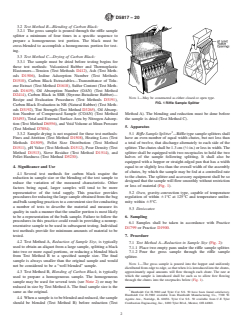
3.3.2 Sample drying is not required for these test methods: 5.1 RiffleSampleSplitter —Riffle type sample splitters shall
Fines and Attrition (Test Method D1508), Heating Loss (Test have an even number of equal width chutes, but not less than
Methods D1509), Pellet Size Distribution (Test Method a total of twelve, that discharge alternately to each side of the
D1511), pH Value (Test Methods D1512), Pour Density (Test
splitter.The chutes shall be 1.3 cm ( ⁄2 in.) or less in width.The
Method D1513), Sieve Residue (Test Method D1514), and splitter shall be equipped with two receptacles to hold the two
Pellet Hardness (T
...
This document is not an ASTM standard and is intended only to provide the user of an ASTM standard an indication of what changes have been made to the previous version. Because
it may not be technically possible to adequately depict all changes accurately, ASTM recommends that users consult prior editions as appropriate. In all cases only the current version
of the standard as published by ASTM is to be considered the official document.
Designation: D5817 − 19 D5817 − 20
Standard Practice for
Carbon Black, Pelleted—Reduction, Blending, and Drying of
Gross Samples for Testing
This standard is issued under the fixed designation D5817; the number immediately following the designation indicates the year of
original adoption or, in the case of revision, the year of last revision. A number in parentheses indicates the year of last reapproval. A
superscript epsilon (´) indicates an editorial change since the last revision or reapproval.
1. Scope
1.1 This practice describes the procedure for blending of pelleted carbon black, the procedure for the reduction of gross samples
of pelleted carbon black to the appropriate size for testing and the preparation of the sample for testing. These techniques are
intended to minimize variations in measured characteristics between test samples. Standard terminology relating to carbon black
samples is found in Terminology D3053. The classification system for carbon blacks used in rubber products can be found in
Classification System D1765.
1.2 The values stated in SI units are to be regarded as the standard. The values given in parentheses are for information only.
1.3 This standard does not purport to address all of the safety concerns, if any, associated with its use. It is the responsibility
of the user of this standard to establish appropriate safety, health, and environmental practices and determine the applicability of
regulatory limitations prior to use.
1.4 This international standard was developed in accordance with internationally recognized principles on standardization
established in the Decision on Principles for the Development of International Standards, Guides and Recommendations issued
by the World Trade Organization Technical Barriers to Trade (TBT) Committee.
2. Referenced Documents
2.1 ASTM Standards:
D412 Test Methods for Vulcanized Rubber and Thermoplastic Elastomers—Tension
D1506 Test Methods for Carbon Black—Ash Content
D1508 Test Method for Carbon Black, Pelleted Fines and Attrition
D1509 Test Methods for Carbon Black—Heating Loss
D1510 Test Method for Carbon Black—Iodine Adsorption Number
D1511 Test Method for Carbon Black—Pellet Size Distribution
D1512 Test Methods for Carbon Black—pH Value
D1513 Test Method for Carbon Black, Pelleted—Pour Density
D1514 Test Method for Carbon Black—Sieve Residue
D1618 Test Method for Carbon Black Extractables—Transmittance of Toluene Extract
D1619 Test Methods for Carbon Black—Sulfur Content
D1765 Classification System for Carbon Blacks Used in Rubber Products
D1799 Practice for Carbon Black—Sampling Packaged Shipments
D1900 Practice for Carbon Black—Sampling Bulk Shipments
D2414 Test Method for Carbon Black—Oil Absorption Number (OAN)
D3053 Terminology Relating to Carbon Black
D3191 Test Methods for Carbon Black in SBR (Styrene-Butadiene Rubber)—Recipe and Evaluation Procedures
D3192 Test Methods for Carbon Black Evaluation in NR (Natural Rubber)
D3265 Test Method for Carbon Black—Tint Strength
D3493 Test Method for Carbon Black—Oil Absorption Number of Compressed Sample (COAN)
This practice is under the jurisdiction of ASTM Committee D24 on Carbon Black and is the direct responsibility of Subcommittee D24.61 on Carbon Black Sampling
and Statistical Analysis.
Current edition approved Nov. 1, 2019June 1, 2020. Published December 2019July 2020. Originally approved in 1995. Last previous edition approved in 20142019 as
D5817 – 03a (2014).D5817 – 19. DOI: 10.1520/D5817-19.10.1520/D5817-20.
For referenced ASTM standards, visit the ASTM website, www.astm.org, or contact ASTM Customer Service at service@astm.org. For Annual Book of ASTM Standards
volume information, refer to the standard’s Document Summary page on the ASTM website.
Copyright © ASTM International, 100 Barr Harbor Drive, PO Box C700, West Conshohocken, PA 19428-2959. United States
D5817 − 20
D5230 Test Method for Carbon Black—Automated Individual Pellet Hardness
D6556 Test Method for Carbon Black—Total and External Surface Area by Nitrogen Adsorption
D7854 Test Method for Carbon Black-Void Volume at Mean Pressure
3. Summary of Test Methods
3.1 Test Method A—Reduction of Sample Size:
3.1.1 The gross bulk sample is poured through the riffle sample splitter. A portion of the sample is reintroduced into the splitter
as many times as necessary to reduce the gross sample to the size desired for the intended test portion. The test portion may not
be homogeneous.
3.2 Test Method B—Blending of Carbon Black:
3.2.1 The gross sample is poured through the riffle sample splitter a minimum of four times in a specific sequence to prepare
a homogeneous test portion. The black must be cross-blended to accomplish a homogeneous portion for testing.
3.3 Test Method C—Drying of Carbon Black:
3.3.1 The sample must be dried before testing begins for these test methods: Vulcanized Rubber and Thermoplastic
Elastomers—Tension (Test Methods D412), Ash (Test Methods D1506), Iodine Adsorption Number (Test Methods D1510),
Carbon Black Extractables—Transmittance of Toluene Extract (Test Method D1618), Sulfur Content (Test Methods D1619), Oil
Absorption Number (OAN) (Test Method D2414), Carbon Black in SBR (Styrene-Butadiene Rubber)— Recipe Rubber)—Recipe
and Evaluation Procedures (Test Methods D3191), Carbon Black Evaluation in NR (Natural Rubber) (Test Methods D3192), Tint
Strength (Test Method D3265), Oil Absorption Number of Compressed Sample (COAN) (Test Method D3493), and Total and
External Surface Area by Nitrogen Adsorption (Test Method D6556), and Void Volume at Mean Pressure (Test Method D7854).
3.3.2 Sample drying is not required for these test methods: Fines and Attrition (Test Method D1508), Heating Loss (Test
Methods D1509), Pellet Size Distribution (Test Method D1511), pH Value (Test Methods D1512), Pour Density (Test Method
D1513), Sieve Residue (Test Method D1514), and Pellet Hardness (Test Method D5230).
4. Significance and Use
4.1 Several test methods for carbon black require the reduction in sample size or the blending of the test sample to reduce the
variation of the measured characteristic. Other factors being equal, larger samples will tend to be more representative of the total
supply. This practice provides procedures for reducing the large sample obtained from the bag and bulk sampling practices to a
convenient size for conducting a number of tests to describe the material and me
...