

ASTM C561-23
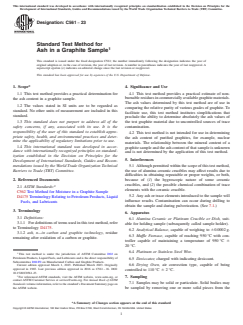
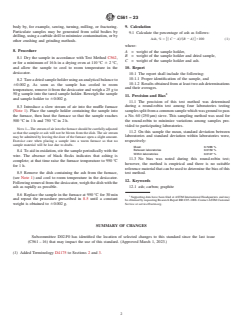
(Test Method)Standard Test Method for Ash in a Graphite Sample
General Information
- Abstract
SIGNIFICANCE AND USE
4.1 This test method provides a practical estimate of nonburnable residues in commercially available graphite materials. The ash values determined by this test method are of use in comparing the relative purity of various grades of graphite. To facilitate use, this test method institutes simplifications that preclude the ability to determine absolutely the ash values of the test graphite material due to uncontrolled sources of trace contamination.
4.2 This test method is not intended for use in determining the ash content of purified graphites, for example, nuclear materials. The relationship between the mineral content of a graphite sample and the ash content of that sample is unknown and is not determined by the application of this test method.
SCOPE
1.1 This test method provides a practical determination for the ash content in a graphite sample.
1.2 The values stated in SI units are to be regarded as standard. No other units of measurement are included in this standard.
1.3 This standard does not purport to address all of the safety concerns, if any, associated with its use. It is the responsibility of the user of this standard to establish appropriate safety, health, and environmental practices and determine the applicability of regulatory limitations prior to use.
1.4 This international standard was developed in accordance with internationally recognized principles on standardization established in the Decision on Principles for the Development of International Standards, Guides and Recommendations issued by the World Trade Organization Technical Barriers to Trade (TBT) Committee.
- Status
- Published
- Publication Date
- 28-Feb-2023
- Technical Committee
- D02 - Petroleum Products, Liquid Fuels, and Lubricants
- Drafting Committee
- D02.F0 - Manufactured Carbon and Graphite Products



Overview
ASTM C561-23, Standard Test Method for Ash in a Graphite Sample, establishes a practical procedure for estimating the ash content in commercially available graphite materials. This ash test method provides valuable information for comparing the relative purity of different graphite grades by measuring the nonburnable residue left after oxidation. Intended for use with commercial graphite, this standard is not suitable for evaluating the ash content in purified graphites, such as those used in nuclear applications.
Accredited by ASTM International, ASTM C561-23 ensures consistency and comparability in graphite quality assessments across industries that rely on graphite's purity and properties.
Key Topics
Scope of Application
- Focuses on determining the ash content in commercially available graphite materials.
- Not intended for measuring ash in highly purified graphite, especially for specialized applications (e.g., nuclear-grade graphite).
- Uses results to provide a practical estimate rather than an absolute value, due to potential trace contaminants introduced during sample preparation and testing.
Test Method Overview
- Utilizes high-temperature oxidation in a controlled environment, typically using a muffle furnace and crucibles.
- Key apparatus include an analytical balance, platinum or ceramic crucibles, desiccator, drying oven, and controlled airflow.
- Samples are dried, weighed, and heated through a programmed temperature schedule up to 950°C, with periodic stirring until ashing is complete.
- The ash residue is weighed to calculate percentage ash content using the prescribed formula.
Precision and Limitations
- Empirical method: accuracy is subject to sample handling and potential contamination during preparation.
- Precision data show low inter- and intra-laboratory variation in results when protocols are closely followed.
- Not designed to establish the relationship between mineral content and ash, nor for tracing all sources of contamination.
Applications
ASTM C561-23 is a crucial standard in industries and quality control laboratories where consistent, reliable assessment of graphite purity is required. Common application areas include:
Quality Assurance in Manufacturing
- Verifies compliance with material specifications for consistency and performance.
- Enables manufacturers to compare graphite sourced from different suppliers.
Material Selection and Grading
- Assists engineers and purchasing professionals in selecting appropriate graphite grades based on purity.
- Facilitates classification of graphite materials for various industrial uses, such as electrodes, lubricants, or seals.
Research and Product Development
- Supports development of new graphite materials or formulations by providing comparative data on non-combustible residue.
Regulatory and Contract Specifications
- Ensures that graphite products meet contractual or regulatory requirements, especially where ash content could affect product performance or safety.
Related Standards
For comprehensive graphite material analysis and terminology, consider these associated ASTM standards:
- ASTM C562 – Test Method for Moisture in a Graphite Sample
- ASTM D4175 – Terminology Relating to Petroleum Products, Liquid Fuels, and Lubricants
These standards complement ASTM C561-23 by addressing other key properties and establishing clear definitions for consistency across the carbon and graphite industry.
Keywords: ASTM C561-23, graphite ash content, graphite purity, test method, industrial graphite analysis, ASTM graphite standard, nonburnable residue in graphite, quality control graphite
Relations
- Refers
ASTM D4175-23a - Standard Terminology Relating to Petroleum Products, Liquid Fuels, and Lubricants - Effective Date
- 15-Dec-2023
- Refers
ASTM D4175-23e1 - Standard Terminology Relating to Petroleum Products, Liquid Fuels, and Lubricants - Effective Date
- 01-Jul-2023
- Effective Date
- 01-May-2010
- Effective Date
- 01-Jun-2005
- Effective Date
- 10-Apr-2000
Get Certified
Connect with accredited certification bodies for this standard

ECOCERT
Organic and sustainability certification.

Eurofins Food Testing Global
Global leader in food, environment, and pharmaceutical product testing.

Intertek Bangladesh
Intertek certification and testing services in Bangladesh.
Sponsored listings
Frequently Asked Questions
ASTM C561-23 is a standard published by ASTM International. Its full title is "Standard Test Method for Ash in a Graphite Sample". This standard covers: SIGNIFICANCE AND USE 4.1 This test method provides a practical estimate of nonburnable residues in commercially available graphite materials. The ash values determined by this test method are of use in comparing the relative purity of various grades of graphite. To facilitate use, this test method institutes simplifications that preclude the ability to determine absolutely the ash values of the test graphite material due to uncontrolled sources of trace contamination. 4.2 This test method is not intended for use in determining the ash content of purified graphites, for example, nuclear materials. The relationship between the mineral content of a graphite sample and the ash content of that sample is unknown and is not determined by the application of this test method. SCOPE 1.1 This test method provides a practical determination for the ash content in a graphite sample. 1.2 The values stated in SI units are to be regarded as standard. No other units of measurement are included in this standard. 1.3 This standard does not purport to address all of the safety concerns, if any, associated with its use. It is the responsibility of the user of this standard to establish appropriate safety, health, and environmental practices and determine the applicability of regulatory limitations prior to use. 1.4 This international standard was developed in accordance with internationally recognized principles on standardization established in the Decision on Principles for the Development of International Standards, Guides and Recommendations issued by the World Trade Organization Technical Barriers to Trade (TBT) Committee.
SIGNIFICANCE AND USE 4.1 This test method provides a practical estimate of nonburnable residues in commercially available graphite materials. The ash values determined by this test method are of use in comparing the relative purity of various grades of graphite. To facilitate use, this test method institutes simplifications that preclude the ability to determine absolutely the ash values of the test graphite material due to uncontrolled sources of trace contamination. 4.2 This test method is not intended for use in determining the ash content of purified graphites, for example, nuclear materials. The relationship between the mineral content of a graphite sample and the ash content of that sample is unknown and is not determined by the application of this test method. SCOPE 1.1 This test method provides a practical determination for the ash content in a graphite sample. 1.2 The values stated in SI units are to be regarded as standard. No other units of measurement are included in this standard. 1.3 This standard does not purport to address all of the safety concerns, if any, associated with its use. It is the responsibility of the user of this standard to establish appropriate safety, health, and environmental practices and determine the applicability of regulatory limitations prior to use. 1.4 This international standard was developed in accordance with internationally recognized principles on standardization established in the Decision on Principles for the Development of International Standards, Guides and Recommendations issued by the World Trade Organization Technical Barriers to Trade (TBT) Committee.
ASTM C561-23 is classified under the following ICS (International Classification for Standards) categories: 71.060.10 - Chemical elements. The ICS classification helps identify the subject area and facilitates finding related standards.
ASTM C561-23 has the following relationships with other standards: It is inter standard links to ASTM D4175-23a, ASTM D4175-23e1, ASTM C562-91(2010)e1, ASTM C562-91(2005), ASTM C562-91(2000). Understanding these relationships helps ensure you are using the most current and applicable version of the standard.
ASTM C561-23 is available in PDF format for immediate download after purchase. The document can be added to your cart and obtained through the secure checkout process. Digital delivery ensures instant access to the complete standard document.
Standards Content (Sample)
This international standard was developed in accordance with internationally recognized principles on standardization established in the Decision on Principles for the
Development of International Standards, Guides and Recommendations issued by the World Trade Organization Technical Barriers to Trade (TBT) Committee.
Designation: C561 − 23
Standard Test Method for
Ash in a Graphite Sample
This standard is issued under the fixed designation C561; the number immediately following the designation indicates the year of
original adoption or, in the case of revision, the year of last revision. A number in parentheses indicates the year of last reapproval. A
superscript epsilon (´) indicates an editorial change since the last revision or reapproval.
This standard has been approved for use by agencies of the U.S. Department of Defense.
1. Scope* 4. Significance and Use
4.1 This test method provides a practical estimate of non-
1.1 This test method provides a practical determination for
burnable residues in commercially available graphite materials.
the ash content in a graphite sample.
The ash values determined by this test method are of use in
1.2 The values stated in SI units are to be regarded as
comparing the relative purity of various grades of graphite. To
standard. No other units of measurement are included in this
facilitate use, this test method institutes simplifications that
standard.
preclude the ability to determine absolutely the ash values of
1.3 This standard does not purport to address all of the the test graphite material due to uncontrolled sources of trace
safety concerns, if any, associated with its use. It is the
contamination.
responsibility of the user of this standard to establish appro-
4.2 This test method is not intended for use in determining
priate safety, health, and environmental practices and deter-
the ash content of purified graphites, for example, nuclear
mine the applicability of regulatory limitations prior to use.
materials. The relationship between the mineral content of a
1.4 This international standard was developed in accor-
graphite sample and the ash content of that sample is unknown
dance with internationally recognized principles on standard-
and is not determined by the application of this test method.
ization established in the Decision on Principles for the
5. Interferences
Development of International Standards, Guides and Recom-
mendations issued by the World Trade Organization Technical 5.1 Although permitted within the scope of this test method,
Barriers to Trade (TBT) Committee. the use of alumina ceramic crucibles may affect results due to
difficulties in obtaining repeatable or proper weights, or both,
because of (1) the hygroscopic nature of some ceramic
2. Referenced Documents
crucibles, and (2) the possible chemical combination of trace
2.1 ASTM Standards:
elements with the ceramic crucible.
C562 Test Method for Moisture in a Graphite Sample
5.2 Any ash or trace elements introduced to the sample will
D4175 Terminology Relating to Petroleum Products, Liquid
influence results. Contamination can occur during drilling to
Fuels, and Lubricants
obtain the sample and during pulverization. (See 7.1.)
3. Terminology
6. Apparatus
3.1 Definitions:
6.1 Alumina Ceramic or Platinum Crucible or Dish, suit-
3.1.1 For definitions of terms used in this test method, refer
able for holding sample (subsequently called sample holder).
to Terminology D4175.
6.2 Analytical Balance, capable of weighing to 60.0002 g.
3.1.2 ash, n—in carbon and graphite technology, residue
6.3 Muffle Furnace, capable of reaching 950 °C with con-
remaining after oxidation of a carbon or graphite.
troller capable of maintaining a temperature of 950 °C 6
20 °C.
6.4 Platinum or Stainless Steel Wire.
This test method is under the jurisdiction of ASTM Committee D02 on
Petroleum Products, Liquid Fuels, and Lubricants and is the direct responsibility of
6.5 Desiccator, charged with indicating desiccant.
Subcommittee D02.F0 on Manufactured Carbon and Graphite Products.
6.6 Drying Oven, air convection type, capable of being
Current edition approved March 1, 2023. Published March 2023. Originally
approved in 1965. Last previous edition approved in 2016 as C561 – 16. DOI:
controlled to 110 °C 6 2 °C.
10.1520/C0561-23.
For referenced ASTM standards, visit the ASTM website, www.astm.org, or
7. Sampling
contact ASTM Customer Service at service@astm.org. For Annual Book of ASTM
7.1 Samples may be solid or particulate. Solid bodies may
Standards volume information, refer to the standard’s Document Summary page on
the ASTM website. be sampled by removing one or more solid pieces from the
*A Summary of Changes section appears at the end of this standard
Copyright © ASTM International, 100 Barr Harbor Drive, PO Box C700, West Conshohocken, PA 19428-2959. United States
C561 − 23
body by, for example, sawing, turning, milling, or fracturing. 9. Calculation
P
...
This document is not an ASTM standard and is intended only to provide the user of an ASTM standard an indication of what changes have been made to the previous version. Because
it may not be technically possible to adequately depict all changes accurately, ASTM recommends that users consult prior editions as appropriate. In all cases only the current version
of the standard as published by ASTM is to be considered the official document.
Designation: C561 − 16 C561 − 23
Standard Test Method for
Ash in a Graphite Sample
This standard is issued under the fixed designation C561; the number immediately following the designation indicates the year of
original adoption or, in the case of revision, the year of last revision. A number in parentheses indicates the year of last reapproval. A
superscript epsilon (´) indicates an editorial change since the last revision or reapproval.
This standard has been approved for use by agencies of the U.S. Department of Defense.
1. Scope*
1.1 This test method provides a practical determination for the ash content in a graphite sample.
1.2 The values stated in SI units are to be regarded as standard. No other units of measurement are included in this standard.
1.3 This standard does not purport to address all of the safety concerns, if any, associated with its use. It is the responsibility
of the user of this standard to establish appropriate safety and healthsafety, health, and environmental practices and determine
the applicability of regulatory limitations prior to use.
1.4 This international standard was developed in accordance with internationally recognized principles on standardization
established in the Decision on Principles for the Development of International Standards, Guides and Recommendations issued
by the World Trade Organization Technical Barriers to Trade (TBT) Committee.
2. Referenced Documents
2.1 ASTM Standards:
C562 Test Method for Moisture in a Graphite Sample
D4175 Terminology Relating to Petroleum Products, Liquid Fuels, and Lubricants
3. Terminology
3.1 Definitions:
3.1.1 For definitions of terms used in this test method, refer to Terminology D4175.
3.1.2 ash, n—in carbon and graphite technology, residue remaining after oxidation of a carbon or graphite.
4. Significance and Use
4.1 This test method provides a practical estimate of nonburnable residues in commercially available graphite materials. The ash
values determined by this test method are of use in comparing the relative purity of various grades of graphite. To facilitate use,
this test method institutes simplifications that preclude the ability to determine absolutely the ash values of the test graphite
material due to uncontrolled sources of trace contamination.
This test method is under the jurisdiction of ASTM Committee D02 on Petroleum Products, Liquid Fuels, and Lubricants and is the direct responsibility of Subcommittee
D02.F0 on Manufactured Carbon and Graphite Products.
Current edition approved Jan. 1, 2016March 1, 2023. Published February 2016March 2023. Originally approved in 1965. Last previous edition approved in 20102016 as
ɛ1
C561 – 91 (2010)C561 – 16. . DOI: 10.1520/C0561-16.10.1520/C0561-23.
For referenced ASTM standards, visit the ASTM website, www.astm.org, or contact ASTM Customer Service at service@astm.org. For Annual Book of ASTM Standards
volume information, refer to the standard’s Document Summary page on the ASTM website.
*A Summary of Changes section appears at the end of this standard
Copyright © ASTM International, 100 Barr Harbor Drive, PO Box C700, West Conshohocken, PA 19428-2959. United States
C561 − 23
4.2 This test method is not intended for use in determining the ash content of purified graphites, for example, nuclear materials.
The relationship between the mineral content of a graphite sample and the ash content of that sample is unknown and is not
determined by the application of this test method.
5. Interferences
5.1 Although permitted within the scope of this test method, the use of alumina ceramic crucibles may affect results due to
difficulties in obtaining repeatable or proper weights, or both, because of (1) the hygroscopic nature of some ceramic crucibles,
and (2) the possible chemical combination of trace elements with the ceramic crucible.
5.2 Any ash or trace elements introduced to the sample will influence results. Contamination can occur during drilling to obtain
the sample and during pulverization. (See 7.1.)
6. Apparatus
6.1 Alumina Ceramic or Platinum Crucible or Dish, suitable for holding sample (subsequently called sample holder).
6.2 Analytical Balance, capable of weighing to 60.0002 g.
6.3 Muffle Furnace, capable of reaching 950 °C with controller capable of maintaining a temperature of 950 °C 6 20 °C.
6.4 Platinum or Stainless Steel Wire.
6.5 Desiccator, charged with indicating desiccant.
6.6 Drying Oven, air convection type, capable of being controlled to 110 °C 6 2 °C.
7. Sampling
7.1 Samples may be solid or particulate. Solid bodies may be sampled by removing one or more solid pieces from the body by,
for example, sawing, turning, mi
...