

ASTM D8091-21
(Guide)Standard Guide for Impregnation of Graphite with Molten Salt
General Information
- Abstract
SIGNIFICANCE AND USE
5.1 The molten salt reactor is a nuclear reactor which uses graphite as reflector and structural material and fluoride molten salt as coolant. The graphite components will be submerged in the molten salt during the lifetime of the reactor. The porous structure of graphite may lead to molten salt permeation, which can affect the thermal and mechanical properties of graphite. Consequently, it is important to assess the effect of impregnation of molten salt on the properties of the as-manufactured graphite material.
5.2 The purpose of this guide is to report considerations that should be included in the preparation of graphite specimens representative of that after exposure to a molten salt environment. The degree to which the molten salt will infiltrate the graphite will depend upon a number of factors, including the type of graphite and the type and extent of porosity, the properties of the molten salt, the impregnation pressure and temperature, and the duration of the exposure of the graphite to the molten salt.
5.3 The user of this guide will need to select impregnation parameters sufficiently representative of those in a molten salt reactor based on parameters provided by the designer. Alternatively, the user may select a standard set of impregnation conditions to allow comparisons across a range of graphites.
5.4 This guide is not intended to be prescriptive. A typical apparatus and associated procedure are described. Some indication of the sensitivity of the procedure to graphite type and impregnation conditions is given in He, et al.5
5.5 There are four major practical issues that must be addressed during the impregnation process:
5.5.1 The density of molten salt is greater than that of graphite. A specially designed tool is required to submerge graphite samples in the molten salt during the impregnation process.
5.5.2 Some molten salts (for example, FLiBe) are poisonous and it is therefore necessary to provide containment by performing proced...
SCOPE
1.1 This guide covers procedures for the impregnation of graphite with molten salt under a consistent pressure and temperature. Such procedures are necessary if the user wishes to prepare graphite specimens for testing that represent material that has been exposed to a molten salt environment in a molten salt nuclear reactor. The user will need to ensure that impregnation temperature and pressure conditions reflect those pertaining to the molten salt environment, noting that the properties of the material will change once it becomes irradiated.
Note 1: The term impregnation is used throughout this guide as this is the correct term for the described process. Other terms such as infiltration and intrusion may be encountered by the user in other texts and the term intrusion is commonly used to describe penetration of open porosity in graphite in a molten salt reactor environment.
1.2 The values stated in SI units are to be regarded as standard. No other units of measurement are included in this guide.
1.3 This standard does not purport to address all of the safety concerns, if any, associated with its use. It is the responsibility of the user of this standard to establish appropriate safety, health, and environmental practices and determine the applicability of regulatory limitations prior to use.
1.4 This international standard was developed in accordance with internationally recognized principles on standardization established in the Decision on Principles for the Development of International Standards, Guides and Recommendations issued by the World Trade Organization Technical Barriers to Trade (TBT) Committee.
- Status
- Published
- Publication Date
- 30-Jun-2021
- Technical Committee
- D02 - Petroleum Products, Liquid Fuels, and Lubricants
- Drafting Committee
- D02.F0 - Manufactured Carbon and Graphite Products
Overview
ASTM D8091-21: Standard Guide for Impregnation of Graphite with Molten Salt provides comprehensive guidelines for preparing graphite specimens intended to replicate graphite components exposed to molten salt environments, such as those found in molten salt nuclear reactors. This standard addresses the procedure for impregnating graphite with molten salt under controlled pressure and temperature. Properly evaluating the interaction between graphite and molten salt is crucial for understanding how molten salt permeates graphite’s porous structure, which can impact thermal and mechanical properties.
The standard is designed for users who need to prepare and test graphite specimens that emulate service conditions in molten salt reactor systems, helping with material selection, performance evaluation, and safety considerations.
Key Topics
- Impregnation Process:
- Describes procedures and conditions for graphite impregnation with molten salt, reflecting reactor environments.
- Stresses the importance of selecting impregnation parameters that represent actual reactor conditions or allow for valid comparative testing.
- Critical Variables:
- Highlights factors such as graphite type, porosity, properties of the molten salt, impregnation temperature and pressure, and exposure duration as key influences on salt penetration.
- Practical Challenges:
- Addresses handling and containment of toxic molten salts (e.g., FLiBe), and need for specialized tools and procedures due to differences in the densities of graphite and molten salt.
- Outlines the necessity of operating within glove boxes to prevent oxidation and exposure to hazardous substances.
- Discusses the requirement for autoclaves designed for controlled pressure and temperature.
- Assessment Parameters:
- Introduces metrics (Dₒ and Dₜ) for quantifying the degree of salt infiltration into open and total pore volume, aiding in the assessment of how impregnation changes graphite’s properties.
- Safety and Compliance:
- Stresses the need for stringent health, safety, and environmental controls, along with adherence to regulatory requirements.
Applications
ASTM D8091-21 is essential in the following areas:
- Nuclear Reactor Design and Maintenance:
- Used in the qualification and evaluation of graphite reflectors and structural components in molten salt reactors, especially regarding their resistance to molten salt intrusion.
- Material Research and Development:
- Assists researchers in developing new grades of graphite or optimizing existing ones for enhanced durability in high-temperature, corrosive reactor environments.
- Quality Assurance and Comparative Testing:
- Enables laboratories and manufacturers to prepare specimens for comparative mechanical, thermal, and porosity testing, supporting consistent benchmarking and lifecycle assessments.
- Safety Assessments:
- Supports safety analysis by enabling the study of material changes post-exposure, ensuring reactor integrity under operational stresses.
Related Standards
- ASTM B923: Test Method for Metal Powder Skeletal Density by Helium or Nitrogen Pycnometry
- ASTM C559: Test Method for Bulk Density by Physical Measurements of Manufactured Carbon and Graphite Articles
- ASTM D7775: Guide for Measurements on Small Graphite Specimens
Practical Value
The guide is invaluable for engineers, researchers, and technicians who deal with graphite materials in molten salt environments. Compliance with ASTM D8091-21 ensures that test specimens and data are relevant to real-world conditions, supporting robust material selection and risk assessment processes. Its robust guidance on safety, process control, and data recording helps organizations reliably simulate and analyze graphite performance, thereby contributing to advances in nuclear reactor technology and operational excellence.
Keywords: graphite impregnation, molten salt, ASTM D8091-21, porous graphite, molten salt reactors, graphite testing, reactor materials, nuclear graphite, high-temperature materials, material standardization
Relations
- Effective Date
- 15-Nov-2023
- Effective Date
- 01-May-2020
- Effective Date
- 01-Oct-2016
- Effective Date
- 01-Jan-2016
- Effective Date
- 01-Jun-2015
- Effective Date
- 01-Dec-2011
- Effective Date
- 01-Dec-2011
- Effective Date
- 01-May-2010
- Effective Date
- 01-May-2010
- Effective Date
- 01-Apr-2008
- Effective Date
- 01-Jun-2005
- Effective Date
- 10-Oct-2002
- Effective Date
- 10-Apr-2000
Get Certified
Connect with accredited certification bodies for this standard

ECOCERT
Organic and sustainability certification.

Eurofins Food Testing Global
Global leader in food, environment, and pharmaceutical product testing.

Intertek Bangladesh
Intertek certification and testing services in Bangladesh.
Sponsored listings
Frequently Asked Questions
ASTM D8091-21 is a guide published by ASTM International. Its full title is "Standard Guide for Impregnation of Graphite with Molten Salt". This standard covers: SIGNIFICANCE AND USE 5.1 The molten salt reactor is a nuclear reactor which uses graphite as reflector and structural material and fluoride molten salt as coolant. The graphite components will be submerged in the molten salt during the lifetime of the reactor. The porous structure of graphite may lead to molten salt permeation, which can affect the thermal and mechanical properties of graphite. Consequently, it is important to assess the effect of impregnation of molten salt on the properties of the as-manufactured graphite material. 5.2 The purpose of this guide is to report considerations that should be included in the preparation of graphite specimens representative of that after exposure to a molten salt environment. The degree to which the molten salt will infiltrate the graphite will depend upon a number of factors, including the type of graphite and the type and extent of porosity, the properties of the molten salt, the impregnation pressure and temperature, and the duration of the exposure of the graphite to the molten salt. 5.3 The user of this guide will need to select impregnation parameters sufficiently representative of those in a molten salt reactor based on parameters provided by the designer. Alternatively, the user may select a standard set of impregnation conditions to allow comparisons across a range of graphites. 5.4 This guide is not intended to be prescriptive. A typical apparatus and associated procedure are described. Some indication of the sensitivity of the procedure to graphite type and impregnation conditions is given in He, et al.5 5.5 There are four major practical issues that must be addressed during the impregnation process: 5.5.1 The density of molten salt is greater than that of graphite. A specially designed tool is required to submerge graphite samples in the molten salt during the impregnation process. 5.5.2 Some molten salts (for example, FLiBe) are poisonous and it is therefore necessary to provide containment by performing proced... SCOPE 1.1 This guide covers procedures for the impregnation of graphite with molten salt under a consistent pressure and temperature. Such procedures are necessary if the user wishes to prepare graphite specimens for testing that represent material that has been exposed to a molten salt environment in a molten salt nuclear reactor. The user will need to ensure that impregnation temperature and pressure conditions reflect those pertaining to the molten salt environment, noting that the properties of the material will change once it becomes irradiated. Note 1: The term impregnation is used throughout this guide as this is the correct term for the described process. Other terms such as infiltration and intrusion may be encountered by the user in other texts and the term intrusion is commonly used to describe penetration of open porosity in graphite in a molten salt reactor environment. 1.2 The values stated in SI units are to be regarded as standard. No other units of measurement are included in this guide. 1.3 This standard does not purport to address all of the safety concerns, if any, associated with its use. It is the responsibility of the user of this standard to establish appropriate safety, health, and environmental practices and determine the applicability of regulatory limitations prior to use. 1.4 This international standard was developed in accordance with internationally recognized principles on standardization established in the Decision on Principles for the Development of International Standards, Guides and Recommendations issued by the World Trade Organization Technical Barriers to Trade (TBT) Committee.
SIGNIFICANCE AND USE 5.1 The molten salt reactor is a nuclear reactor which uses graphite as reflector and structural material and fluoride molten salt as coolant. The graphite components will be submerged in the molten salt during the lifetime of the reactor. The porous structure of graphite may lead to molten salt permeation, which can affect the thermal and mechanical properties of graphite. Consequently, it is important to assess the effect of impregnation of molten salt on the properties of the as-manufactured graphite material. 5.2 The purpose of this guide is to report considerations that should be included in the preparation of graphite specimens representative of that after exposure to a molten salt environment. The degree to which the molten salt will infiltrate the graphite will depend upon a number of factors, including the type of graphite and the type and extent of porosity, the properties of the molten salt, the impregnation pressure and temperature, and the duration of the exposure of the graphite to the molten salt. 5.3 The user of this guide will need to select impregnation parameters sufficiently representative of those in a molten salt reactor based on parameters provided by the designer. Alternatively, the user may select a standard set of impregnation conditions to allow comparisons across a range of graphites. 5.4 This guide is not intended to be prescriptive. A typical apparatus and associated procedure are described. Some indication of the sensitivity of the procedure to graphite type and impregnation conditions is given in He, et al.5 5.5 There are four major practical issues that must be addressed during the impregnation process: 5.5.1 The density of molten salt is greater than that of graphite. A specially designed tool is required to submerge graphite samples in the molten salt during the impregnation process. 5.5.2 Some molten salts (for example, FLiBe) are poisonous and it is therefore necessary to provide containment by performing proced... SCOPE 1.1 This guide covers procedures for the impregnation of graphite with molten salt under a consistent pressure and temperature. Such procedures are necessary if the user wishes to prepare graphite specimens for testing that represent material that has been exposed to a molten salt environment in a molten salt nuclear reactor. The user will need to ensure that impregnation temperature and pressure conditions reflect those pertaining to the molten salt environment, noting that the properties of the material will change once it becomes irradiated. Note 1: The term impregnation is used throughout this guide as this is the correct term for the described process. Other terms such as infiltration and intrusion may be encountered by the user in other texts and the term intrusion is commonly used to describe penetration of open porosity in graphite in a molten salt reactor environment. 1.2 The values stated in SI units are to be regarded as standard. No other units of measurement are included in this guide. 1.3 This standard does not purport to address all of the safety concerns, if any, associated with its use. It is the responsibility of the user of this standard to establish appropriate safety, health, and environmental practices and determine the applicability of regulatory limitations prior to use. 1.4 This international standard was developed in accordance with internationally recognized principles on standardization established in the Decision on Principles for the Development of International Standards, Guides and Recommendations issued by the World Trade Organization Technical Barriers to Trade (TBT) Committee.
ASTM D8091-21 is classified under the following ICS (International Classification for Standards) categories: 71.060.10 - Chemical elements. The ICS classification helps identify the subject area and facilitates finding related standards.
ASTM D8091-21 has the following relationships with other standards: It is inter standard links to ASTM B923-23, ASTM C559-16(2020), ASTM B923-16, ASTM C559-16, ASTM D7775-11(2015), ASTM D7775-11, ASTM D7775-11e1, ASTM C559-90(2010), ASTM B923-10, ASTM B923-02(2008), ASTM C559-90(2005), ASTM B923-02, ASTM C559-90(2000). Understanding these relationships helps ensure you are using the most current and applicable version of the standard.
ASTM D8091-21 is available in PDF format for immediate download after purchase. The document can be added to your cart and obtained through the secure checkout process. Digital delivery ensures instant access to the complete standard document.
Standards Content (Sample)
This international standard was developed in accordance with internationally recognized principles on standardization established in the Decision on Principles for the
Development of International Standards, Guides and Recommendations issued by the World Trade Organization Technical Barriers to Trade (TBT) Committee.
Designation: D8091 − 21
Standard Guide for
Impregnation of Graphite with Molten Salt
This standard is issued under the fixed designation D8091; the number immediately following the designation indicates the year of
original adoption or, in the case of revision, the year of last revision. A number in parentheses indicates the year of last reapproval. A
superscript epsilon (´) indicates an editorial change since the last revision or reapproval.
1. Scope* B923 Test Method for Metal Powder Skeletal Density by
Helium or Nitrogen Pycnometry
1.1 This guide covers procedures for the impregnation of
C559 Test Method for Bulk Density by Physical Measure-
graphite with molten salt under a consistent pressure and
ments of Manufactured Carbon and Graphite Articles
temperature. Such procedures are necessary if the user wishes
D7775 Guide for Measurements on Small Graphite Speci-
to prepare graphite specimens for testing that represent mate-
mens
rial that has been exposed to a molten salt environment in a
molten salt nuclear reactor. The user will need to ensure that
3. Terminology
impregnation temperature and pressure conditions reflect those
3.1 Definitions:
pertaining to the molten salt environment, noting that the
3.1.1 impregnation pressure (P ), n—the differential pres-
properties of the material will change once it becomes irradi-
I
sure between the cover gas pressure and the pore pressure of
ated.
the graphite specimen.
NOTE 1—The term impregnation is used throughout this guide as this is
3.1.1.1 Discussion—If the impregnation starts at a pore
the correct term for the described process. Other terms such as infiltration
pressure of atmospheric pressure, the impregnation pressure is
and intrusion may be encountered by the user in other texts and the term
the gauge pressure of the cover gas; if the impregnation starts
intrusion is commonly used to describe penetration of open porosity in
graphite in a molten salt reactor environment.
at a pore pressure of “0” (vacuum), the impregnation pressure
is the gauge pressure plus atmospheric pressure. For a pore
1.2 The values stated in SI units are to be regarded as
pressurebetween0andatmosphericpressure,theimpregnation
standard. No other units of measurement are included in this
pressure is (gauge pressure + atmospheric pressure – pore
guide.
pressure).
1.3 This standard does not purport to address all of the
3.1.2 impregnation temperature (T ), n—the system tem-
safety concerns, if any, associated with its use. It is the I
perature before the graphite specimen has been immersed in
responsibility of the user of this standard to establish appro-
the molten salt.
priate safety, health, and environmental practices and deter-
mine the applicability of regulatory limitations prior to use.
3.2 Definitions of Terms Specific to This Standard:
1.4 This international standard was developed in accor-
3.2.1 Parameter D ,n—a measure of the extent of penetra-
o
dance with internationally recognized principles on standard-
tion of the graphite porosity by the molten salt expressed in
ization established in the Decision on Principles for the
terms of the open pore volume of the specimen.
Development of International Standards, Guides and Recom-
3.2.1.1 Discussion—If there was no damage to the micro-
mendations issued by the World Trade Organization Technical
structure of the graphite during impregnation, then parameter
Barriers to Trade (TBT) Committee.
D based upon open pore volume would be unity at saturation.
o
This parameter is applicable when damage to the graphite
2. Referenced Documents
microstructure during impregnation is absent or low. Mercury
2.1 ASTM Standards:
porosimetry studies indicate that the threshold pressure for
microstructural damage is 13.8 MPa to 20.0 MPa (2000 psi to
3,4
3000 psi). This threshold should be used as a guide by users
This guide is under the jurisdiction of ASTM Committee D02 on Petroleum
when evaluating D . At high impregnation pressures, closed
o
Products, Liquid Fuels, and Lubricants and is the direct responsibility of Subcom-
porosity may be broken into by the molten salt and parameter
mittee D02.F0 on Manufactured Carbon and Graphite Products.
Current edition approved July 1, 2021. Published July 2021. Originally approved
in 2016. Last previous edition approved in 2016 as D8091 – 16. DOI: 10.1520/
D8091-21. Dickinson, J. M., Shore, J. W., “Observations Concerning the Determination of
For referenced ASTM standards, visit the ASTM website, www.astm.org, or Porosities in Graphites,” Carbon, Vol 6, 1968, pp. 937–941.
contact ASTM Customer Service at service@astm.org. For Annual Book of ASTM Baker, D. J., Morris, J. B., “Structural Damage in Graphite Occurring during
Standards volume information, refer to the standard’s Document Summary page on Pore Size Measurements by High Pressure Mercury,” Carbon, Vol 9, 1971, pp.
the ASTM website. 687–690.
*A Summary of Changes section appears at the end of this standard
Copyright © ASTM International, 100 Barr Harbor Drive, PO Box C700, West Conshohocken, PA 19428-2959. United States
D8091 − 21
D based upon open pore volume could have values greater performing the impregnation process within a glove box with
o
than unity. At such pressures, the user may wish to express a controlled atmosphere.
parameter D in terms of total (open and closed) pore volume, 5.5.4 Pressure control of the molten salt can be difficult to
termed D. Evaluation of this parameter is provided in 9.2. achieve. A specially designed autoclave is needed to hold the
t
specimen and molten salt.
4. Summary of Guide
5.6 In order to assess the quantity of molten salt in the
4.1 This guide provides guidance on the impregnation of
graphite, parameter D is used as a variable in measuring the
graphite with molten salt. The guide gives the various factors
mechanical and thermal material properties. Parameter D is
o
which need to be considered to perform the impregnation
the ratio of salt volume to open pore volume. Parameter D is
t
procedure. These include pretreatment of graphite specimens,
the ratio of salt volume to total pore volume. The saturated
immersion of graphite in the molten salt, safe handling of the
value of D can be greater than 1 when the molten salt
o
molten salt, and selection and control of the impregnation
impregnation takes place at high pressure. It is postulated that
pressures and temperatures.
the internal microstructure of graphite has been damaged by
the high impregnation pressure and some closed pores have
5. Significance and Use
been opened. In this case, the parameter D is more appropriate
t
5.1 The molten salt reactor is a nuclear reactor which uses
to represent the impregnation process.
graphite as reflector and structural material and fluoride molten
salt as coolant. The graphite components will be submerged in
6. Apparatus
the molten salt during the lifetime of the reactor. The porous
6.1 Autoclave:
structureofgraphitemayleadtomoltensaltpermeation,which
6.1.1 Since fluoride molten salts are toxic and a small
can affect the thermal and mechanical properties of graphite.
amountofwatercansignificantlyaffectthewettingbehaviorof
Consequently, it is important to assess the effect of impregna-
graphite, the conditions for the procedure should be strictly
tion of molten salt on the properties of the as-manufactured
controlled during molten salt impregnation. The schematic
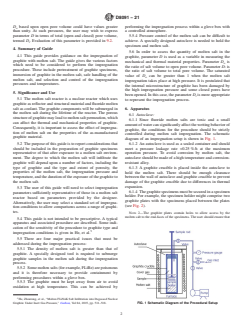
graphite material.
diagram of an impregnation setup is shown in Fig. 1.
5.2 The purpose of this guide is to report considerations that 6.1.2 An autoclave is used as a sealed container and should
should be included in the preparation of graphite specimens
meet a pressure leakage rate <0.25 %⁄h at the maximum
representative of that after exposure to a molten salt environ- operation pressure. To avoid corrosion by molten salt, the
ment. The degree to which the molten salt will infiltrate the
autoclave should be made of a high temperature and corrosion-
graphite will depend upon a number of factors, including the resistant alloy.
type of graphite and the type and extent of porosity, the 6.1.3 A graphite crucible is placed inside the autoclave to
properties of the molten salt, the impregnation pressure and hold the molten salt. There should be enough clearance
temperature, and the duration of the exposure of the graphite to between the wall of autoclave and graphite crucible to prevent
the molten salt. damage of the graphite crucible due to differences in thermal
expansion.
5.3 The user of this guide will need to select impregnation
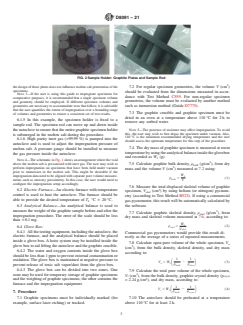
6.1.4 Thegraphitespecimensmustbesecuredinaspecimen
parameters sufficiently representative of those in a molten salt
holder. For example, the specimen holder might comprise two
reactor based on parameters provided by the designer.
graphite plates with the specimens placed between the plates
Alternatively, the user may select a standard set of impregna-
(see Fig. 2).
tion conditions to allow comparisons across a range of graphi-
tes.
NOTE 2—The graphite plates contain holes to allow access by the
molten salt to the end-faces of the specimens. The user should ensure that
5.4 This guide is not intended to be prescriptive. A typical
apparatus and associated procedure are described. Some indi-
cation of the sensitivity of the procedure to graphite type and
impregnation conditions is given in He, et al.
5.5 There are four major practical issues that must be
addressed during the impregnation process:
5.5.1 The density of molten salt is greater than that of
graphite. A specially designed tool is required to submerge
graphite samples in the molten salt during the impregnation
process.
5.5.2 Somemoltensalts(forexample,FLiBe)arepoisonous
and it is therefore necessary to provide containment by
performing procedures within a glove box.
5.5.3 The graphite must be kept away from air to avoid
oxidation at high temperature. This can be achieved by
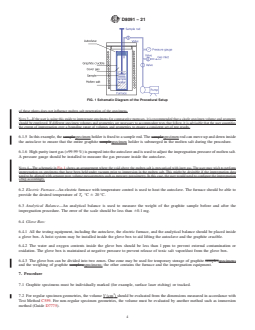
He, Zhoutong, et al., “Molten FLiNaK Salt Infiltration into Degassed Nuclear
Graphite Under Inert Gas Pressure,” Carbon, Vol 84, 2015, pp. 511–518. FIG. 1 Schematic Diagram of the Procedural Setup
D8091 − 21
FIG. 2 Sample Holder: Graphite Plates and Sample Rod
the design of these plates does not influence
...
This document is not an ASTM standard and is intended only to provide the user of an ASTM standard an indication of what changes have been made to the previous version. Because
it may not be technically possible to adequately depict all changes accurately, ASTM recommends that users consult prior editions as appropriate. In all cases only the current version
of the standard as published by ASTM is to be considered the official document.
Designation: D8091 − 16 D8091 − 21
Standard Guide for
Impregnation of Graphite with Molten Salt
This standard is issued under the fixed designation D8091; the number immediately following the designation indicates the year of
original adoption or, in the case of revision, the year of last revision. A number in parentheses indicates the year of last reapproval. A
superscript epsilon (´) indicates an editorial change since the last revision or reapproval.
1. Scope Scope*
1.1 This guide covers procedures for the impregnation of graphite with molten salt under a consistent pressure and temperature.
Such procedures are necessary if the user wishes to prepare graphite specimens for testing that have represent material that has
been exposed to a molten salt environment that may not necessarily represent material exposed to an operating reactor
environment.in a molten salt nuclear reactor. The user will need to ensure that impregnation temperature and pressure conditions
reflect those pertaining to the molten salt environment, noting that the properties of the material will change once it becomes
irradiated.
NOTE 1—The term impregnation is used throughout this guide as this is the correct term for the described process. Other terms such as infiltration and
intrusion may be encountered by the user in other texts and the term intrusion is commonly used to describe penetration of open porosity in graphite in
a molten salt reactor environment.
1.2 The values stated in SI units are to be regarded as standard. No other units of measurement are included in this guide.
1.3 This standard does not purport to address all of the safety concerns, if any, associated with its use. It is the responsibility
of the user of this standard to establish appropriate safety safety, health, and healthenvironmental practices and determine the
applicability of regulatory limitations prior to use.
1.4 This international standard was developed in accordance with internationally recognized principles on standardization
established in the Decision on Principles for the Development of International Standards, Guides and Recommendations issued
by the World Trade Organization Technical Barriers to Trade (TBT) Committee.
2. Referenced Documents
2.1 ASTM Standards:
B923 Test Method for Metal Powder Skeletal Density by Helium or Nitrogen Pycnometry
C559 Test Method for Bulk Density by Physical Measurements of Manufactured Carbon and Graphite Articles
D7775 Guide for Measurements on Small Graphite Specimens
3. Terminology
3.1 Definitions:
3.1.1 impregnation pressure (P ), n—the differential pressure of between the cover gas used in the impregnation.pressure and the
I
pore pressure of the graphite specimen.
This guide is under the jurisdiction of ASTM Committee D02 on Petroleum Products, Liquid Fuels, and Lubricants and is the direct responsibility of Subcommittee
D02.F0 on Manufactured Carbon and Graphite Products.
Current edition approved Dec. 1, 2016July 1, 2021. Published January 2017July 2021. Originally approved in 2016. Last previous edition approved in 2016 as D8091 – 16.
DOI: 10.1520/D8091-16.10.1520/D8091-21.
For referenced ASTM standards, visit the ASTM website, www.astm.org, or contact ASTM Customer Service at service@astm.org. For Annual Book of ASTM Standards
volume information, refer to the standard’s Document Summary page on the ASTM website.
*A Summary of Changes section appears at the end of this standard
Copyright © ASTM International, 100 Barr Harbor Drive, PO Box C700, West Conshohocken, PA 19428-2959. United States
D8091 − 21
3.1.1.1 Discussion—
If the impregnation starts at a pore pressure of atmospheric pressure, the impregnation pressure is the gauge pressure of the cover
gas; if the impregnation starts at a pore pressure of “0” (vacuum), the impregnation pressure is the gauge pressure plus atmospheric
pressure. For a pore pressure between 0 and atmospheric pressure, the impregnation pressure is (gauge pressure + atmospheric
pressure – pore pressure).
3.1.2 impregnation temperature (T ), n—the system temperature before the graphite samplespecimen has been immersed in the
I
molten salt.
3.2 Definitions of Terms Specific to This Standard:
3.2.1 Parameter D—D , n—provides a measure of the extent of penetration of the graphite porosity by the molten salt. If there
o
was no damage to the microstructure of the graphite during impregnation, then parameter D based upon open pore volume would
be unity at saturation. At high impregnation pressures, closed porosity may be broken into by the molten salt and parameter salt
expressed D based upon open pore volume could have values greater than unity. It is therefore useful to express parameter Din
terms of boththe open pore volume and total (open and closed) pore volume.of the specimen.
3.2.1.1 Discussion—
Parameter If there was no damage to the microstructure of the graphite during impregnation, then parameter D is based upon open
o
pore volume (typically applicable at low impregnation pressures) would be unity at saturation. This parameter is applicable when
damage to the graphite microstructure during impregnation is absent or low. Mercury porosimetry studies indicate that the
3,4
threshold pressure for microstructural damage is 13.8 MPa to 20.0 MPa (2000 psi to 3000 psi). This threshold should be used
as a guide by users when evaluating D .and At high impregnation pressures, closed porosity may be broken into by the molten salt
o
and parameter D based upon open pore volume could have values greater than unity. At such pressures, the user may wish to
o
express parameter D in terms of total (open and closed) pore volume, termed D .is calculated as Evaluation of this parameter is
t
provided in 9.2follows:.
W 2 W
2 1
D 5 (1)
o
ρV
o
where:
W = the weight of the graphite sample before impregnation,
W = the weight of the graphite sample after impregnation,
ρ = the density of molten salt, and
V = the open pore volume in the sample.
o
3.2.1.2 Discussion—
Parameter D based upon total pore volume (typically at high impregnation pressures) is calculated as follows:
W 2 W
2 1
D 5 (2)
t
ρV
t
where:
V = the total pore volume in the sample.
t
4. Summary of Guide
4.1 This guide provides guidance on the impregnation of graphite with molten salt. The guide gives the various factors which need
to be considered to perform the impregnation procedure. These include pretreatment of graphite samples,specimens, immersion of
graphite in the molten salt, safe handling of the molten salt, and selection and control of the impregnation pressures and
temperatures.
5. Significance and Use
5.1 The molten salt reactor is a nuclear reactor which uses graphite as reflector and structural material and fluoride molten salt
as coolant. The graphite components will be submerged in the molten salt during the lifetime of the reactor. The porous structure
Dickinson, J. M., Shore, J. W., “Observations Concerning the Determination of Porosities in Graphites,” Carbon, Vol 6, 1968, pp. 937–941.
Baker, D. J., Morris, J. B., “Structural Damage in Graphite Occurring during Pore Size Measurements by High Pressure Mercury,” Carbon, Vol 9, 1971, pp. 687–690.
D8091 − 21
of graphite may lead to molten salt permeation, which can affect the thermal and mechanical properties of graphite. Consequently,
it is important to assess the effect of impregnation of molten salt on the properties of the as-manufactured graphite material.
5.2 The purpose of this guide is to report considerations that should be included in the preparation of graphite samplesspecimens
representative of that after exposure to a molten salt environment. The degree to which the molten salt will infiltrate the graphite
will depend upon a number of factors, including the type of graphite and the type and extent of porosity, the properties of the
molten salt, the impregnation pressure and temperature, and the duration of the exposure of the graphite to the molten salt.
5.3 The user of this guide will need to select impregnation parameters sufficiently representative of those in a molten salt reactor
based on parameters provided by the designer. Alternatively, the user may select a standard set of impregnation conditions to allow
comparisons across a range of graphites.
5.4 This guide is not intended to be prescriptive. A typical apparatus and associated procedure isare described. Some indication
of the sensitivity of the procedure to graphite type and impregnation conditions is given in He, et al.
5.5 There are four major practical issues that must be addressed during the impregnation process:
5.5.1 The density of molten salt is greater than that of graphite. A specially designed tool is required to submerge graphite samples
in the molten salt during the impregnation process.
5.5.2 Some molten salts (for example, FLiBe) are poisonous and it is therefore necessary to provide containment by performing
procedures within a glove box.
5.5.3 The graphite must be kept away from air to avoid oxidation at high temperature. This can be achieved by performing the
impregnation process within a glove box with a controlled atmosphere.
5.5.4 Pressure control of the molten salt can be difficult to achieve. A specially designed autoclave is needed to hold the
samplespecimen and molten salt.
5.6 In order to assess the quantity of molten salt in the graphite, parameter D is used as a variable in measuring the mechanical
and thermal material properties. For a low impregnation pressure, the parameter Parameter D is the ratio of salt volume to open
o
pore volume. For a high impregnation pressure, the parameter Parameter D is the ratio of salt volume to total pore volume. The
t
saturated value of D can be greater than 1 when the molten salt impregnation takes place at high pressure. It is postulated that
o
the internal microstructure of graphite has been damaged by the high impregnation pressure and some closed pores have been
opened. In this case, the parameter D is more appropriate to represent the impregnation process.
t
6. Apparatus
6.1 Autoclave:
6.1.1 Since fluoride molten salts are toxic and a small amount of water can significantly affect the wetting behavior of graphite,
the conditions for the procedure should be strictly controlled during molten salt impregnation. The schematic diagram of an
impregnation setup is shown in Fig. 1.
6.1.2 An autoclave is used as a sealed container and should meet a pressure leakage rate <0.25 % ⁄h. ⁄h at the maximum operation
pressure. To avoid corrosion by molten salt, the autoclave should be made of a high temperature and corrosion-resistant alloy.
6.1.3 A graphite crucible is placed inside the autoclave to hold the molten salt. There should be enough clearance between the wall
of autoclave and graphite crucible to prevent damage of the graphite crucible due to differences in thermal expansion.
6.1.4 The graphite samplesspecimens must be secured in a samplespecimen holder. For example, the samplespecimen holder
might comprise two graphite plates with the samplesspe
...