

ASTM C1179-21
(Test Method)Standard Test Method for Oxidation Mass Loss of Manufactured Carbon and Graphite Materials in Air
General Information
- Abstract
SIGNIFICANCE AND USE
3.1 This test method is primarily concerned with the oxidation mass loss of manufactured carbon and graphite materials in air at temperatures from 371 °C to 677 °C.
3.2 The test method will provide acceptable results at preselected test temperatures that yield less than 10 % mass loss in 100 h. These results can be used to determine relative service temperatures.
SCOPE
1.1 This test method provides a comparative oxidation mass loss of manufactured carbon and graphite materials in air.
1.2 The values stated in SI units are to be regarded as standard. No other units of measurement are included in this standard.
1.3 This standard does not purport to address all of the safety concerns, if any, associated with its use. It is the responsibility of the user of this standard to establish appropriate safety, health, and environmental practices and determine the applicability of regulatory limitations prior to use.
1.4 This international standard was developed in accordance with internationally recognized principles on standardization established in the Decision on Principles for the Development of International Standards, Guides and Recommendations issued by the World Trade Organization Technical Barriers to Trade (TBT) Committee.
- Status
- Published
- Publication Date
- 31-Oct-2021
- Technical Committee
- D02 - Petroleum Products, Liquid Fuels, and Lubricants
- Drafting Committee
- D02.F0 - Manufactured Carbon and Graphite Products
Buy Documents

ASTM C1179-21 - Standard Test Method for Oxidation Mass Loss of Manufactured Carbon and Graphite Materials in Air
REDLINE ASTM C1179-21 - Standard Test Method for Oxidation Mass Loss of Manufactured Carbon and Graphite Materials in Air
Overview
ASTM C1179-21 specifies a standard test method for determining the oxidation mass loss of manufactured carbon and graphite materials when exposed to air at elevated temperatures. This standard provides a comparative framework for evaluating how carbon and graphite products lose mass due to oxidation, particularly within a critical temperature range of 371 °C to 677 °C. The testing helps users assess the relative oxidation rates of these materials under specified conditions, supporting informed decisions about material selection and service temperature limits for various industrial applications.
Key Topics
- Oxidation Mass Loss Measurement: The primary objective is to measure the reduction in mass of carbon and graphite specimens after controlled exposure to air in high-temperature environments.
- Temperature Range: Testing focuses on performance between 371 °C and 677 °C, conditions where oxidation effects become significant for most manufactured carbon and graphite products.
- Comparative Testing: The method is suited for comparing different material grades, manufacturing processes, or protective treatments based on their relative susceptibility to oxidation.
- Sample Preparation and Handling: Emphasizes the use of standard-sized cylindrical specimens, precision weighing, and handling practices to prevent contamination or mechanical damage.
- Instrumentation and Procedures: Utilizes a muffle furnace with precise temperature regulation, analytical balance, and standardized intervals for exposure and weighing.
- Reporting Guidelines: Specifies the reporting of specimen identification and percent mass loss at defined intervals (25, 50, 75, and 100 hours) to support clear material comparisons.
Applications
ASTM C1179-21 plays a critical role in industries where carbon and graphite materials are used in high-heat and oxidative environments. Practical applications include:
- Material Performance Evaluation: Facilitates screening and quality control of carbon and graphite components for oxidation resistance before deployment in industrial applications such as furnaces, reactors, and electrical devices.
- Determining Relative Service Temperatures: The method allows for the establishment of maximum recommended operating temperatures for carbon and graphite parts by correlating oxidation rates with material performance.
- Research and Development: Supports manufacturers and researchers in developing new formulations or treatments aiming to enhance oxidation resistance of carbon and graphite products.
- Supplier and Lot Comparisons: Assists end-users and procurement teams in comparing different suppliers, manufacturing lots, or product grades under standardized test conditions.
Related Standards
Understanding oxidation and thermal behavior of nonmetallic materials often requires reference to additional standards and test methods. Other relevant ASTM standards include:
- ASTM C561: Test Method for Ash in a Graphite Sample.
- ASTM C1170: Test Method for Flexural Properties of Structural Panels.
- ASTM D2414: Test Method for Carbon Black - Oil Absorption Number.
- ASTM D7542: Guide for Interlaboratory Studies for Nonmetallic Materials.
These related documents complement ASTM C1179-21 by providing broader material characterization, test protocols, and quality control benchmarks within the carbon and graphite industry.
Summary
The ASTM C1179-21 standard test method is essential for evaluating oxidation mass loss in manufactured carbon and graphite materials exposed to air, offering reliable data on material stability and oxidation resistance at elevated temperatures. The test results drive materials selection, application safety, and process optimization, making it a vital resource for manufacturers, engineers, and quality assurance professionals working with carbon and graphite products. For comprehensive guidance and up-to-date methodologies, always consult the full text of the standard as published by ASTM International.
Buy Documents
ASTM C1179-21 - Standard Test Method for Oxidation Mass Loss of Manufactured Carbon and Graphite Materials in Air
REDLINE ASTM C1179-21 - Standard Test Method for Oxidation Mass Loss of Manufactured Carbon and Graphite Materials in Air
Get Certified
Connect with accredited certification bodies for this standard

ECOCERT
Organic and sustainability certification.

Eurofins Food Testing Global
Global leader in food, environment, and pharmaceutical product testing.

Intertek Bangladesh
Intertek certification and testing services in Bangladesh.
Sponsored listings
Frequently Asked Questions
ASTM C1179-21 is a standard published by ASTM International. Its full title is "Standard Test Method for Oxidation Mass Loss of Manufactured Carbon and Graphite Materials in Air". This standard covers: SIGNIFICANCE AND USE 3.1 This test method is primarily concerned with the oxidation mass loss of manufactured carbon and graphite materials in air at temperatures from 371 °C to 677 °C. 3.2 The test method will provide acceptable results at preselected test temperatures that yield less than 10 % mass loss in 100 h. These results can be used to determine relative service temperatures. SCOPE 1.1 This test method provides a comparative oxidation mass loss of manufactured carbon and graphite materials in air. 1.2 The values stated in SI units are to be regarded as standard. No other units of measurement are included in this standard. 1.3 This standard does not purport to address all of the safety concerns, if any, associated with its use. It is the responsibility of the user of this standard to establish appropriate safety, health, and environmental practices and determine the applicability of regulatory limitations prior to use. 1.4 This international standard was developed in accordance with internationally recognized principles on standardization established in the Decision on Principles for the Development of International Standards, Guides and Recommendations issued by the World Trade Organization Technical Barriers to Trade (TBT) Committee.
SIGNIFICANCE AND USE 3.1 This test method is primarily concerned with the oxidation mass loss of manufactured carbon and graphite materials in air at temperatures from 371 °C to 677 °C. 3.2 The test method will provide acceptable results at preselected test temperatures that yield less than 10 % mass loss in 100 h. These results can be used to determine relative service temperatures. SCOPE 1.1 This test method provides a comparative oxidation mass loss of manufactured carbon and graphite materials in air. 1.2 The values stated in SI units are to be regarded as standard. No other units of measurement are included in this standard. 1.3 This standard does not purport to address all of the safety concerns, if any, associated with its use. It is the responsibility of the user of this standard to establish appropriate safety, health, and environmental practices and determine the applicability of regulatory limitations prior to use. 1.4 This international standard was developed in accordance with internationally recognized principles on standardization established in the Decision on Principles for the Development of International Standards, Guides and Recommendations issued by the World Trade Organization Technical Barriers to Trade (TBT) Committee.
ASTM C1179-21 is classified under the following ICS (International Classification for Standards) categories: 71.060.10 - Chemical elements. The ICS classification helps identify the subject area and facilitates finding related standards.
ASTM C1179-21 is available in PDF format for immediate download after purchase. The document can be added to your cart and obtained through the secure checkout process. Digital delivery ensures instant access to the complete standard document.
Standards Content (Sample)
This international standard was developed in accordance with internationally recognized principles on standardization established in the Decision on Principles for the
Development of International Standards, Guides and Recommendations issued by the World Trade Organization Technical Barriers to Trade (TBT) Committee.
Designation: C1179 − 21
Standard Test Method for
Oxidation Mass Loss of Manufactured Carbon and Graphite
Materials in Air
This standard is issued under the fixed designation C1179; the number immediately following the designation indicates the year of
original adoption or, in the case of revision, the year of last revision. A number in parentheses indicates the year of last reapproval. A
superscript epsilon (´) indicates an editorial change since the last revision or reapproval.
1. Scope* 4. Interferences
1.1 This test method provides a comparative oxidation mass 4.1 Results can be affected by materials released by the
furnacewallsorfurniture.Thesematerialsmaybepresentfrom
loss of manufactured carbon and graphite materials in air.
previous oxidation test samples or other furnace use. It is
1.2 The values stated in SI units are to be regarded as
recommended that the furnace be operated at 1093 °C for 1 h
standard. No other units of measurement are included in this
prior to use for oxidation mass loss testing.
standard.
4.2 The validity of this test method depends upon the
1.3 This standard does not purport to address all of the
availability of oxygen to the test specimen. The door of the
safety concerns, if any, associated with its use. It is the
furnace shall be kept closed to maintain temperature control;
responsibility of the user of this standard to establish appro-
however, the furnace door shall not be sealed, rendering the
priate safety, health, and environmental practices and deter-
door airtight.
mine the applicability of regulatory limitations prior to use.
4.3 Due to factors beyond the scope of the test method that
1.4 This international standard was developed in accor-
might cause significant differences, this test method is only
dance with internationally recognized principles on standard-
useful for comparative results.
ization established in the Decision on Principles for the
Development of International Standards, Guides and Recom-
5. Apparatus
mendations issued by the World Trade Organization Technical
Barriers to Trade (TBT) Committee.
5.1 Muffle Furnace, with automatic temperature regulation
with 64 °C precision. Furnace chamber volume 983 cm to
2. Summary of Test Method
2458 cm .
2.1 The test method determines mass loss characteristics of
NOTE 1—Commercially available muffle furnaces advertised to achieve
carbon and graphite articles in air as a function of temperature
611 °C can be set up to achieve the necessary precision.
and time by subjecting standard size specimens to muffle
5.2 Thermocouple, K-type (chromel/alumel with Type 304
furnace exposure and then comparing pre-test and post-test
stainless steel sheath).
mass differentials.
5.3 Digital Thermometer, for temperature readout.
3. Significance and Use
5.4 Crucible Tongs.
3.1 This test method is primarily concerned with the oxida-
5.5 Glazed Crucibles, flat bottom.
tion mass loss of manufactured carbon and graphite materials
5.6 Quart Glass Tray, or equivalent.
in air at temperatures from 371 °C to 677 °C.
5.7 Nylon Gloves, lint-free.
3.2 The test method will provide acceptable results at
5.8 Paper, lint-free.
preselected test temperatures that yield less than 10 % mass
loss in 100 h. These results can be used to determine relative
5.9 Analytical Balance, with 0.001 g resolution.
service temperatures.
5.10 Desiccator, charged with indicating desiccant.
This test method is under the jurisdiction of ASTM Committee D02 on
Petroleum Products, Liquid Fuels, and Lubricants and is the direct responsibility of The sole source of supply of the crucible (Coors crucible 60048) known to the
Subcommittee D02.F0 on Manufactured Carbon and Graphite Products. committee at this time is Coors Ceramics Co., 17750 W. 32nd Ave., Golden, CO
Current edition approved Nov. 1, 2021. Published November 2021. Originally 80401. If you are aware of alternative suppliers, please provide this information to
approved in 1991. Last previous edition approved in 2015 as C1179 – 15. DOI: ASTM International Headquarters. Your comments will receive careful consider-
10.1520/C1179-21. ation at a meeting of the responsible technical committee, which you may attend.
*A Summary of Changes section appears at the end of this standard
Copyright © ASTM International, 100 Barr Harbor Drive, PO Box C700, West Conshohocken, PA 19428-2959. United States
C1179 − 21
6. Sample Preparation from furnace to desiccator. The specimen/crucible set should
be transferred so that the specimen is exposed to the atmo-
6.1 All specimens are to be handled with lint-free nylon
sphere for no longer than 30 s. The desiccator should be in the
gloves or equivalent during all machining, handling,
immediate vicinity of the furnace.
impregnation, and testing. Specimens should be kept free of
contamination by placing them on clean nonmetallic surfaces
7.2 Preheat and stabilize the furnace to the designated test
during all operations. Once the specimens have been oxidized,
temperature as verified by a monitoring thermocouple extend-
direct handling is not recommended.
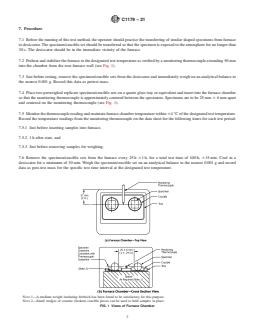
ing 50 mm into the chamber from the rear furnace wall (see
Fig. 1).
6.2 Test specimens are to consist of right cylinders 25.4 mm
diameter by 25.4 mm long 60.3 mm. Specimens are to be
7.3 Just before testing, remove the specimen/crucible sets
machined all over with carbide-tipped tools to achieve a
from the desiccator and immediately weigh on an analytical
surface roughness visually comparable to 0.8 µm arithmetic
balancetothenearest0.001 g.Recordthisdataaspretestmass.
average (AA).
7.4 Place two preweighed replicate specimen/crucible sets
6.3 Wipe specimens with lint-free paper to remove carbon
on a quartz glass tray or equivalent and insert into the furnace
machining dust.
chamber so that the monitoring thermocouple is approximately
6.4 Specimens and crucibles are to be clearly identified. To
centered between the specimens. Specimens are to be 25 mm
avoid sample contamination, use a carbide-tipped scribe to
6 6 mm apart and centered on the monitoring thermocouple
mark the specime
...
This document is not an ASTM standard and is intended only to provide the user of an ASTM standard an indication of what changes have been made to the previous version. Because
it may not be technically possible to adequately depict all changes accurately, ASTM recommends that users consult prior editions as appropriate. In all cases only the current version
of the standard as published by ASTM is to be considered the official document.
Designation: C1179 − 15 C1179 − 21
Standard Test Method for
Oxidation Mass Loss of Manufactured Carbon and Graphite
Materials in Air
This standard is issued under the fixed designation C1179; the number immediately following the designation indicates the year of
original adoption or, in the case of revision, the year of last revision. A number in parentheses indicates the year of last reapproval. A
superscript epsilon (´) indicates an editorial change since the last revision or reapproval.
1. Scope*
1.1 This test method provides a comparative oxidation mass loss of manufactured carbon and graphite materials in air.
1.2 The values stated in SI units are to be regarded as standard. No other units of measurement are included in this standard.
1.3 This standard does not purport to address all of the safety concerns, if any, associated with its use. It is the responsibility
of the user of this standard to establish appropriate safety safety, health, and healthenvironmental practices and determine the
applicability of regulatory limitations prior to use.
1.4 This international standard was developed in accordance with internationally recognized principles on standardization
established in the Decision on Principles for the Development of International Standards, Guides and Recommendations issued
by the World Trade Organization Technical Barriers to Trade (TBT) Committee.
2. Summary of Test Method
2.1 The test method determines mass loss characteristics of carbon and graphite articles in air as a function of temperature and
time by subjecting standard size specimens to muffle furnace exposure and then comparing pre-test and post-test mass differentials.
3. Significance and Use
3.1 This test method is primarily concerned with the oxidation mass loss of manufactured carbon and graphite materials in air at
temperatures from 371 °C to 677 °C.
3.2 The test method will provide acceptable results at preselected test temperatures that yield less than 10 % mass loss in 100 h.
These results can be used to determine relative service temperatures.
4. Interferences
4.1 Results can be affected by materials released by the furnace walls or furniture. These materials may be present from previous
oxidation test samples or other furnace use. It is recommended that the furnace be operated at 1093 °C for 1 h prior to use for
oxidation mass loss testing.
4.2 The validity of this test method depends upon the availability of oxygen to the test specimen. The door of the furnace shall
be kept closed to maintain temperature control; however, the furnace door shall not be sealed, rendering the door airtight.
This test method is under the jurisdiction of ASTM Committee D02 on Petroleum Products, Liquid Fuels, and Lubricants and is the direct responsibility of Subcommittee
D02.F0 on Manufactured Carbon and Graphite Products.
Current edition approved Dec. 1, 2015Nov. 1, 2021. Published January 2016November 2021. Originally approved in 1991. Last previous edition approved in 20052015
ɛ1
as C1179 – 91 (2010)15. . DOI: 10.1520/C1179-15.10.1520/C1179-21.
*A Summary of Changes section appears at the end of this standard
Copyright © ASTM International, 100 Barr Harbor Drive, PO Box C700, West Conshohocken, PA 19428-2959. United States
C1179 − 21
4.3 Due to factors beyond the scope of the test method that might cause significant differences, this test method is only useful for
comparative results.
5. Apparatus
5.1 Muffle Furnace, with automatic temperature regulation with 64°C64 °C precision. Furnace chamber volume 983 cm to
2458 cm .
NOTE 1—Commercially available muffle furnaces advertised to achieve 611 °C can be set up to achieve the necessary precision.
5.2 Thermocouple, K-type (chromel/alumel with Type 304 stainless steel sheath).
5.3 Digital Thermometer, for temperature readout.
5.4 Crucible Tongs.
5.5 Glazed Crucibles, flat bottom.
5.6 Quart Glass Tray, or equivalent.
5.7 Nylon Gloves, lint-free.
5.8 Paper, lint-free.
5.9 Analytical Balance, with 0.001 g resolution.
5.10 Desiccator, charged with indicating desiccant.
6. Sample Preparation
6.1 All specimens are to be handled with lint-free nylon gloves or equivalent during all machining, handling, impregnation, and
testing. Specimens should be kept free of contamination by placing them on clean nonmetallic surfaces during all operations. Once
the specimens have been oxidized, direct handling is not recommended.
6.2 Test specimens are to consist of right cylinders 25.4 mm diameter by 25.4 mm long 60.3 mm. Specimens are to be machined
all over with carbide-tipped tools to achieve a surface roughness visually comparable to 0.8 μm.0.8 μm arithmetic average (AA).
6.3 Wipe specimens with lint-free paper to remove carbon machining dust.
6.4 Specimens and crucibles are to be clearly identified. To avoid sample contamination, use a carbide-tipped scribe to mark the
specimens. Crucibles can be marked with ceramic ink.
6.5 Place each specimen to be tested on its side (cylindrical surface) in a dried, tared crucible. Specimens are to be kept in the
same crucible for the test duration. Record the individual identification numbers for each specimen/crucible set.
6.6 Dry the specimen/crucible sets in a vented oven at 120 °C to 150 °C for a minimum of 2 h. Remove the specimen/crucible
sets and cool in a desiccator for a minimum of 30 min to achieve room temperature.
The sole source of supply of the crucible (Coors crucible 60048) known to the committee at this time is Coors Ceramics Co., 17750 W. 32nd Ave., Golden, CO 80401.
If you are aware of alternative suppliers, please provide this information to ASTM International Headquarters. Your comments will receive careful consideration at a meeting
of the responsible technical committee, which you may attend.
C1179 − 21
7. Procedure
7.1 Before the running of this test method, the operator should practice the transferring of similar shaped specimens from furnace
to desiccator. The specimen/crucible set should be transferred so that the specimen is exposed to the atmosphere for no longer than
30 s. The desiccator sh
...