

ASTM D1618-23
(Test Method)Standard Test Method for Carbon Black Extractables-Transmittance of Toluene Extract
General Information
- Abstract
SIGNIFICANCE AND USE
4.1 The toluene discoloration value provides an estimate of toluene-soluble discoloring residues present on the carbon black.
SCOPE
1.1 This test method covers the measurement of the degree of toluene discoloration by carbon black extractables and is useful in controlling the reaction processes for production of carbon black. This test method may not be applicable to carbon blacks with high extractables.
1.2 The values stated in SI units are to be regarded as standard. No other units of measurement are included in this standard.
1.3 This standard does not purport to address all of the safety concerns, if any, associated with its use. It is the responsibility of the user of this standard to establish appropriate safety, health, and environmental practices and determine the applicability of regulatory limitations prior to use.
1.4 This international standard was developed in accordance with internationally recognized principles on standardization established in the Decision on Principles for the Development of International Standards, Guides and Recommendations issued by the World Trade Organization Technical Barriers to Trade (TBT) Committee.
- Status
- Published
- Publication Date
- 31-Oct-2023
- Technical Committee
- D24 - Carbon Black
- Drafting Committee
- D24.31 - Non-Carbon Black Components of Carbon Black
Buy Documents
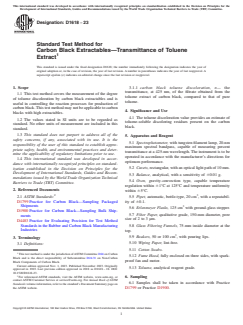
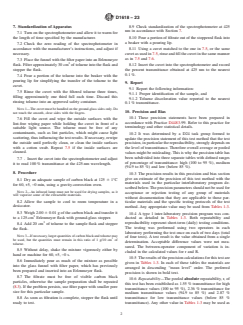
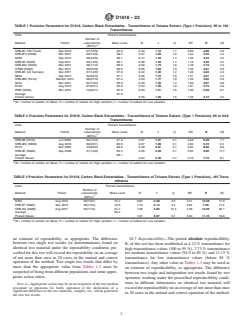

ASTM D1618-23 - Standard Test Method for Carbon Black Extractables—Transmittance of Toluene Extract
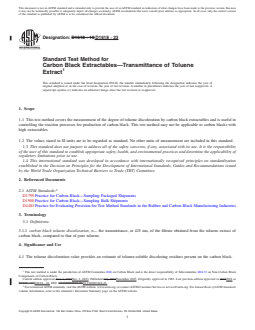
REDLINE ASTM D1618-23 - Standard Test Method for Carbon Black Extractables—Transmittance of Toluene Extract
Overview
ASTM D1618-23 is the Standard Test Method for Carbon Black Extractables - Transmittance of Toluene Extract, developed by ASTM International. This standard specifies a method to measure the degree of toluene discoloration caused by extractable residues in carbon black. The test evaluates the transmittance at 425 nm of the filtrate obtained from the toluene extract, compared to pure toluene. This measurement provides an estimate of toluene-soluble discoloring residues present on the surface of carbon black.
This method plays a critical role in controlling and optimizing the reaction processes during the production of carbon black. Ensuring proper extractable levels helps manufacturers maintain the quality and consistency of carbon black products for use in various industries, particularly those where surface cleanliness and purity are essential.
Key Topics
Toluene Discoloration Value
- This value provides an estimate of toluene-soluble residues, which are mainly organic impurities that can affect the color and performance of carbon black.
- The toluene extract is measured using a spectrophotometer at 425 nm to determine the percent transmittance.
Test Procedure Summary
- Carbon black samples are dried, weighed, and mixed with a specified amount of toluene.
- The mixture is shaken and filtered, and the resulting filtrate is analyzed for transmittance.
- The outcome is reported as the percent transmittance to the nearest 0.1%.
Precision and Repeatability
- The standard provides detailed tables covering test repeatability and reproducibility for high, medium, and low transmittance ranges.
- Repeatability and reproducibility are critical for inter-laboratory comparisons and consistent quality control.
Safety and Compliance
- The method calls for adherence to appropriate safety, health, and environmental practices due to the use of toluene and analytical apparatus.
- Only SI units are standard for this test.
Applications
Quality Control in Carbon Black Manufacturing
- Manufacturers use the ASTM D1618-23 method to monitor and control levels of toluene-soluble extractables, ensuring product consistency.
- The method enables prompt adjustment of production processes to minimize discoloration residues that may impact end-use performance.
Evaluation of Raw Materials
- The test helps assess the suitability of carbon black for sensitive applications, such as in rubber, plastics, coatings, inks, and electronics, where purity is critical.
Inter-laboratory Testing
- The detailed precision data included in the standard supports reliable inter-laboratory comparison, enabling global standardization in carbon black analysis.
Research and Development
- R&D teams employ this method to characterize new grades of carbon black or to evaluate the impact of process modifications on extractable residue levels.
Related Standards
- ASTM D1799 – Practice for Carbon Black-Sampling Packaged Shipments
- ASTM D1900 – Practice for Carbon Black-Sampling Bulk Shipments
- ASTM D4483 – Practice for Evaluating Precision for Test Method Standards in the Rubber and Carbon Black Manufacturing Industries
Other internationally recognized standards on carbon black or extractable content analysis in materials may provide complementary guidance. Using ASTM D1618-23 along with sampling and precision standards ensures robust quality management in carbon black manufacturing.
Keywords: ASTM D1618-23, carbon black extractables, toluene discoloration, transmittance test, quality control, carbon black analysis, ASTM standards, manufacturing, surface residues, precision and repeatability.
Relations
- Effective Date
- 01-Nov-2023
- Effective Date
- 01-Nov-2023
- Referred By
ASTM D4122-17(2023) - Standard Practice for Carbon Black-Evaluation of an Industry Reference Black - Effective Date
- 01-Nov-2023
- Effective Date
- 01-Nov-2023
- Referred By
ASTM D8466-22 - Standard Guide for Recovered Carbon Black-Carbon Black Test Methods for Testing rCB - Effective Date
- 01-Nov-2023
Buy Documents
ASTM D1618-23 - Standard Test Method for Carbon Black Extractables—Transmittance of Toluene Extract
REDLINE ASTM D1618-23 - Standard Test Method for Carbon Black Extractables—Transmittance of Toluene Extract
Get Certified
Connect with accredited certification bodies for this standard

DIN CERTCO
DIN Group product certification.

Smithers Quality Assessments
US management systems and product certification.
Sponsored listings
Frequently Asked Questions
ASTM D1618-23 is a standard published by ASTM International. Its full title is "Standard Test Method for Carbon Black Extractables-Transmittance of Toluene Extract". This standard covers: SIGNIFICANCE AND USE 4.1 The toluene discoloration value provides an estimate of toluene-soluble discoloring residues present on the carbon black. SCOPE 1.1 This test method covers the measurement of the degree of toluene discoloration by carbon black extractables and is useful in controlling the reaction processes for production of carbon black. This test method may not be applicable to carbon blacks with high extractables. 1.2 The values stated in SI units are to be regarded as standard. No other units of measurement are included in this standard. 1.3 This standard does not purport to address all of the safety concerns, if any, associated with its use. It is the responsibility of the user of this standard to establish appropriate safety, health, and environmental practices and determine the applicability of regulatory limitations prior to use. 1.4 This international standard was developed in accordance with internationally recognized principles on standardization established in the Decision on Principles for the Development of International Standards, Guides and Recommendations issued by the World Trade Organization Technical Barriers to Trade (TBT) Committee.
SIGNIFICANCE AND USE 4.1 The toluene discoloration value provides an estimate of toluene-soluble discoloring residues present on the carbon black. SCOPE 1.1 This test method covers the measurement of the degree of toluene discoloration by carbon black extractables and is useful in controlling the reaction processes for production of carbon black. This test method may not be applicable to carbon blacks with high extractables. 1.2 The values stated in SI units are to be regarded as standard. No other units of measurement are included in this standard. 1.3 This standard does not purport to address all of the safety concerns, if any, associated with its use. It is the responsibility of the user of this standard to establish appropriate safety, health, and environmental practices and determine the applicability of regulatory limitations prior to use. 1.4 This international standard was developed in accordance with internationally recognized principles on standardization established in the Decision on Principles for the Development of International Standards, Guides and Recommendations issued by the World Trade Organization Technical Barriers to Trade (TBT) Committee.
ASTM D1618-23 is classified under the following ICS (International Classification for Standards) categories: 83.040.20 - Rubber compounding ingredients. The ICS classification helps identify the subject area and facilitates finding related standards.
ASTM D1618-23 has the following relationships with other standards: It is inter standard links to ASTM D1618-18, ASTM D3053-23, ASTM D4122-17(2023), ASTM D5817-20, ASTM D8466-22. Understanding these relationships helps ensure you are using the most current and applicable version of the standard.
ASTM D1618-23 is available in PDF format for immediate download after purchase. The document can be added to your cart and obtained through the secure checkout process. Digital delivery ensures instant access to the complete standard document.
Standards Content (Sample)
This international standard was developed in accordance with internationally recognized principles on standardization established in the Decision on Principles for the
Development of International Standards, Guides and Recommendations issued by the World Trade Organization Technical Barriers to Trade (TBT) Committee.
Designation: D1618 − 23
Standard Test Method for
Carbon Black Extractables—Transmittance of Toluene
Extract
This standard is issued under the fixed designation D1618; the number immediately following the designation indicates the year of
original adoption or, in the case of revision, the year of last revision. A number in parentheses indicates the year of last reapproval. A
superscript epsilon (´) indicates an editorial change since the last revision or reapproval.
1. Scope 3.1.1 carbon black toluene discoloration, n— the
transmittance, at 425 nm, of the filtrate obtained from the
1.1 This test method covers the measurement of the degree
toluene extract of carbon black, compared to that of pure
of toluene discoloration by carbon black extractables and is
toluene.
useful in controlling the reaction processes for production of
carbon black. This test method may not be applicable to carbon
4. Significance and Use
blacks with high extractables.
4.1 The toluene discoloration value provides an estimate of
1.2 The values stated in SI units are to be regarded as
toluene-soluble discoloring residues present on the carbon
standard. No other units of measurement are included in this
black.
standard.
1.3 This standard does not purport to address all of the
5. Apparatus and Reagent
safety concerns, if any, associated with its use. It is the
5.1 Spectrophotometer, with tungsten filament lamp, 20-nm
responsibility of the user of this standard to establish appro-
maximum spectral bandpass, capable of measuring percent
priate safety, health, and environmental practices and deter-
transmittance at a 425-nm wavelength. The instrument is to be
mine the applicability of regulatory limitations prior to use.
operated in accordance with the manufacturer’s directions for
1.4 This international standard was developed in accor-
optimum performance.
dance with internationally recognized principles on standard-
5.2 Cuvets, rectangular, with an optical light path of 10 mm.
ization established in the Decision on Principles for the
Development of International Standards, Guides and Recom-
5.3 Balance, analytical, with a sensitivity of 60.01 g.
mendations issued by the World Trade Organization Technical
5.4 Oven, gravity-convection type, capable temperature
Barriers to Trade (TBT) Committee.
regulation within 61°C at 125°C and temperature uniformity
2. Referenced Documents within 65°C.
2 3
2.1 ASTM Standards: 5.5 Pipet, automatic, bottle-type, 20 cm , with a repeatabil-
D1799 Practice for Carbon Black—Sampling Packaged ity of 60.1.
Shipments 3
5.6 Erlenmeyer Flasks, 125 cm with ground-glass stopper.
D1900 Practice for Carbon Black—Sampling Bulk Ship-
5.7 Filter Paper, qualitative grade, 150-mm diameter, pore
ments
size of 2 to 3 μm.
D4483 Practice for Evaluating Precision for Test Method
Standards in the Rubber and Carbon Black Manufacturing
5.8 Glass Filtering Funnels, 75-mm inside diameter at the
Industries
top.
5.9 Beakers, 50 or 100 cm , with pouring lips.
3. Terminology
5.10 Wiping Paper, lint-free.
3.1 Definitions:
5.11 Cotton Swabs.
This test method is under the jurisdiction of ASTM Committee D24 on Carbon
5.12 Fume Hood, fully enclosed on three sides, with spark-
Black and is the direct responsibility of Subcommittee D24.31 on Non-Carbon
proof fan and motor.
Black Components of Carbon Black.
Current edition approved Nov. 1, 2023. Published November 2023. Originally
5.13 Toluene, analytical reagent grade.
approved in 1965. Last previous edition approved in 2018 as D1618 – 18. DOI:
10.1520/D1618-23.
For referenced ASTM standards, visit the ASTM website, www.astm.org, or 6. Sampling
contact ASTM Customer Service at service@astm.org. For Annual Book of ASTM
6.1 Samples shall be taken in accordance with Practice
Standards volume information, refer to the standard’s Document Summary page on
the ASTM website. D1799 or Practice D1900.
Copyright © ASTM International, 100 Barr Harbor Drive, PO Box C700, West Conshohocken, PA 19428-2959. United States
D1618 − 23
7. Standardization of Apparatus 8.9 Check standardization of the spectrophotometer at 425
nm in accordance with Section 7.
7.1 Turn on the spectrophotometer and allow it to warm for
the length of time specified by the manufacturer. 8.10 Pour a portion of filtrate out of the stoppered flask into
a beaker with a pouring lip.
7.2 Check the zero reading of the spectrophotometer in
accordance with the manufacturer’s instructions, and adjust if 8.11 Using a cuvet matched to the one in 7.5, or the same
necessary. cuvet as used in 7.5, rinse and fill the cuvet in the same manner
as in 7.5 and 7.6.
7.3 Place the funnel with the filter paper into an Erlenmeyer
flask. Filter approximately 30 cm of toluene into the flask and 8.12 Insert the cuvet into the spectrophotometer and record
stopper the flask. the percent transmittance obtained at 425 nm to the nearest
0.1 %.
7.4 Pour a portion of the toluene into the beaker with the
pouring lip for simplifying the transfer of the toluene to the
9. Report
cuvet.
9.1 Report the following information:
7.5 Rinse the cuvet with the filtered toluene three times,
9.1.1 Proper identification of the sample, and
filling approximately one third full each time. Discard this
9.1.2 Toluene discoloration value reported to the nearest
rinsing toluene into an approved safety container.
0.1 % transmittance.
NOTE 1—The cuvet must be handled on the ground-glass sides only. Do
10. Precision and Bias
not touch the smooth, clear sides with the fingers.
10.1 These precision statements have been prepared in
7.6 Fill the cuvet and wipe the outside surfaces with the
accordance with Practice D4483-99. Refer to this practice for
lint-free wiping paper while holding the cuvet in front of a
terminology and other statistical details.
suitable light source. The toluene must be free of any
contaminants, such as lint particles, which might cause light
10.2 It was determined by a D24 task group formed to
scattering, thus influencing the test results. If necessary, rewipe
update the precision statement of this test method that the test
the outside until perfectly clean, or clean the inside surfaces
precision, in particular the reproducibility, strongly depends on
with a cotton swab. Repeat 7.5 if the inside surfaces are
the level of transmittance. Therefore overall average or pooled
cleaned.
values might be misleading. This is why the precision table has
been subdivided into three separate tables with defined ranges
7.7 . Insert the cuvet into the spectrophotometer and adjust
of percentage of transmittance: high (100 to 95 %), medium
it to read 100 % transmittance at the 425-nm wavelength.
(94.9 to 85 %) and low (below 85 %).
8. Procedure
10.3 The precision results in this precision and bias section
give an estimate of the precision of this test method with the
8.1 Dry an adequate sample of carbon black at 125 6 1°C
materials used in the particular interlaboratory program de-
for 60, +5, −0 min, using a gravity-convection oven.
scribed below. The precision parameters should not be used for
NOTE 2—An infrared lamp must not be used for drying samples, as it
acceptance or rejection testing of any group of materials
will vaporize some of the extractable materials.
without documentation that they are applicable to those par-
8.2 Allow the sample to cool to room temperature in a
ticular materials and the specific testing protocols of the test
desiccator.
method. Any appropriate value may be used from Tables 1-3.
8.3 Weigh 2.00 6 0.01 g of the carbon black and transfer it
10.4 A type 1 inter-laboratory precision program was con-
to a 125-cm Erlenmeyer flask with gr
...
This document is not an ASTM standard and is intended only to provide the user of an ASTM standard an indication of what changes have been made to the previous version. Because
it may not be technically possible to adequately depict all changes accurately, ASTM recommends that users consult prior editions as appropriate. In all cases only the current version
of the standard as published by ASTM is to be considered the official document.
Designation: D1618 − 18 D1618 − 23
Standard Test Method for
Carbon Black Extractables—Transmittance of Toluene
Extract
This standard is issued under the fixed designation D1618; the number immediately following the designation indicates the year of
original adoption or, in the case of revision, the year of last revision. A number in parentheses indicates the year of last reapproval. A
superscript epsilon (´) indicates an editorial change since the last revision or reapproval.
1. Scope
1.1 This test method covers the measurement of the degree of toluene discoloration by carbon black extractables and is useful in
controlling the reaction processes for production of carbon black. This test method may not be applicable to carbon blacks with
high extractables.
1.2 The values stated in SI units are to be regarded as standard. No other units of measurement are included in this standard.
1.3 This standard does not purport to address all of the safety concerns, if any, associated with its use. It is the responsibility
of the user of this standard to establish appropriate safety, health, and environmental practices and determine the applicability of
regulatory limitations prior to use.
1.4 This international standard was developed in accordance with internationally recognized principles on standardization
established in the Decision on Principles for the Development of International Standards, Guides and Recommendations issued
by the World Trade Organization Technical Barriers to Trade (TBT) Committee.
2. Referenced Documents
2.1 ASTM Standards:
D1799 Practice for Carbon Black—Sampling Packaged Shipments
D1900 Practice for Carbon Black—Sampling Bulk Shipments
D4483 Practice for Evaluating Precision for Test Method Standards in the Rubber and Carbon Black Manufacturing Industries
3. Terminology
3.1 Definitions:
3.1.1 carbon black toluene discoloration, n— the transmittance, at 425 nm, of the filtrate obtained from the toluene extract of
carbon black, compared to that of pure toluene.
4. Significance and Use
4.1 The toluene discoloration value provides an estimate of toluene-soluble discoloring residues present on the carbon black.
This test method is under the jurisdiction of ASTM Committee D24 on Carbon Black and is the direct responsibility of Subcommittee D24.31 on Non-Carbon Black
Components of Carbon Black.
Current edition approved June 1, 2018Nov. 1, 2023. Published July 2018November 2023. Originally approved in 1965. Last previous edition approved in 20172018 as
D1618 – 17.D1618 – 18. DOI: 10.1520/D1618-18.10.1520/D1618-23.
For referenced ASTM standards, visit the ASTM website, www.astm.org, or contact ASTM Customer Service at service@astm.org. For Annual Book of ASTM Standards
volume information, refer to the standard’s Document Summary page on the ASTM website.
Copyright © ASTM International, 100 Barr Harbor Drive, PO Box C700, West Conshohocken, PA 19428-2959. United States
D1618 − 23
5. Apparatus and Reagent
5.1 Spectrophotometer, with tungsten filament lamp, 20-nm maximum spectral bandpass, capable of measuring percent
transmittance at a 425-nm wavelength. The instrument is to be operated in accordance with the manufacturer’s directions for
optimum performance.
5.2 Cuvets, rectangular, with an optical light path of 10 mm.
5.3 Balance, analytical, with a sensitivity of 60.01 g.
5.4 Oven, gravity-convection type, capable temperature regulation within 61°C at 125°C and temperature uniformity within
65°C.
5.5 Pipet, automatic, bottle-type, 20 cm , with a repeatability of 60.1.
5.6 Erlenmeyer Flasks, 125 cm with ground-glass stopper.
5.7 Filter Paper, qualitative grade, medium retention, medium-fast filter speed, 150-mm diameter. 150-mm diameter, pore size of
2 to 3 μm.
5.8 Glass Filtering Funnels, 75-mm inside diameter at the top.
5.9 Beakers, 50 or 100 cm , with pouring lips.
5.10 Wiping Paper, lint-free.
5.11 Cotton Swabs.
5.12 Fume Hood, fully enclosed on three sides, with spark-proof fan and motor.
5.13 Toluene, analytical reagent grade.
6. Sampling
6.1 Samples shall be taken in accordance with Practice D1799 or Practice D1900.
7. Standardization of Apparatus
7.1 Turn on the spectrophotometer and allow it to warm for the length of time specified by the manufacturer.
7.2 Check the zero reading of the spectrophotometer in accordance with the manufacturer’s instructions, and adjust if necessary.
7.3 Place the funnel with the filter paper into an Erlenmeyer flask. Filter approximately 30 cm of toluene into the flask and stopper
the flask.
7.4 Pour a portion of the toluene into the beaker with the pouring lip for simplifying the transfer of the toluene to the cuvet.
7.5 Rinse the cuvet with the filtered toluene three times, filling approximately one third full each time. Discard this rinsing toluene
into an approved safety container.
NOTE 1—The cuvet must be handled on the ground-glass sides only. Do not touch the smooth, clear sides with the fingers.
D1618 − 23
7.6 Fill the cuvet and wipe the outside surfaces with the lint-free wiping paper while holding the cuvet in front of a suitable light
source. The toluene must be free of any contaminants, such as lint particles, which might cause light scattering, thus influencing
the test results. If necessary, rewipe the outside until perfectly clean, or clean the inside surfaces with a cotton swab. Repeat 7.5
if the inside surfaces are cleaned.
7.7 . Insert the cuvet into the spectrophotometer and adjust it to read 100 % transmittance at the 425-nm wavelength.
8. Procedure
8.1 Dry an adequate sample of carbon black at 125 6 1°C for 60, +5, −0 min, using a gravity-convection oven.
NOTE 2—An infrared lamp must not be used for drying samples, as it will vaporize some of the extractable materials.
8.2 Allow the sample to cool to room temperature in a desiccator.
8.3 Weigh 2.00 6 0.01 g of the carbon black and transfer it to a 125-cm Erlenmeyer flask with ground-glass stopper.
8.4 Add 20 cm of toluene to the sample flask and stopper the flask.
NOTE 3—If necessary, larger quantities of carbon black and toluene may be used, but the quantities must remain in this ratio of 1 g/10 cm of toluene.
8.5 Without delay, shake the mixture vigorously either by hand or machine for 60, +5, −0 s.
8.6 Immediately pour as much of the mixture as possible into the glass funnel with filter paper, which has previously been prepared
and inserted into an Erlenmeyer flask.
8.7 The filtrate must be free of visible carbon black particles, otherwise the sample preparation shall be repeated (8.3). If the
problem persists, use filter paper with smaller pore size for this particular sample.
8.8 As soon as filtration is complete, stopper the flask until ready to test.
8.9 Check standardization of the spectrophotometer at 425 nm in accordance with Section 7.
8.10 Pour a portion of filtrate out of the stoppered flask into a beaker with a pouring lip.
8.11 Using a cuvet matched to the one in 7.5, or the same cuvet as used in 7.5, rinse and fill the cuvet in the same manner as in
7.5 and 7.6.
8.12 Insert the cuvet into the spectrophotometer and record the percent transmittance obtained at 425 nm to the nearest 0.1 %.
9. Report
9.1 Report the following information:
9.1.1 Proper identification of the sample, and
9.1.2 Toluene discoloration value reported to the nearest 0.1 % transmittance.
10. Precision and Bias
10.1 These precision statements have been prepared in accordance with Practice D4483-99. Refer to this practice for terminology
and other statistical details.
D1618 − 2
...